



Working Capital For Merchants
Table of Contents
Working Capital for Merchants: Understanding Your Financing Options
Working capital for merchants encompasses the short-term funds needed to cover day-to-day expenses like inventory and payroll. According to the CFA Institute, working capital is critical for maintaining liquidity and operational health. For merchants seeking flexibility, revenue-based financing provides capital repaid as a percentage of future sales, ideal for businesses with recurring revenue. Alternatively, asset-based lending uses collateral such as receivables or inventory to secure larger funding amounts. Both options are faster and more flexible than traditional bank loans. For merchants exploring these options, understanding what is an investment bank can clarify how such financing arrangements are structured. At Zaidwood Capital, we specialize in connecting merchants with working capital for merchants that aligns with their growth objectives, drawing on our deep capital markets experience.
1. Distinguish Working Capital Financing from Bank Loans
For merchants evaluating working capital for merchants, the choice between traditional bank loans and working capital financing represents a fundamental shift in how funding aligns with actual business performance. According to the CFA Institute, traditional bank loans rely on rigid underwriting models that prioritize historical credit scores and tangible collateral.
In contrast, bank loans impose fixed monthly payments that remain unchanged regardless of seasonal revenue fluctuations. This structure often requires extensive documentation — including tax returns, audited financial statements, and personal guarantees — leading to approval timelines that stretch over weeks. While commercial banks focus on such term lending, investment banks serve a different role (see what is an investment bank).
Unlike bank loans, working capital financing — including revenue-based financing and asset-based lending variations — underwrites against future revenue streams such as daily credit card sales. Repayment is typically structured as a percentage of daily or weekly sales, meaning the business pays more when revenue is strong and less during slower periods. Funding can arrive within days, and many providers do not require personal guarantees or multi-year financial histories.
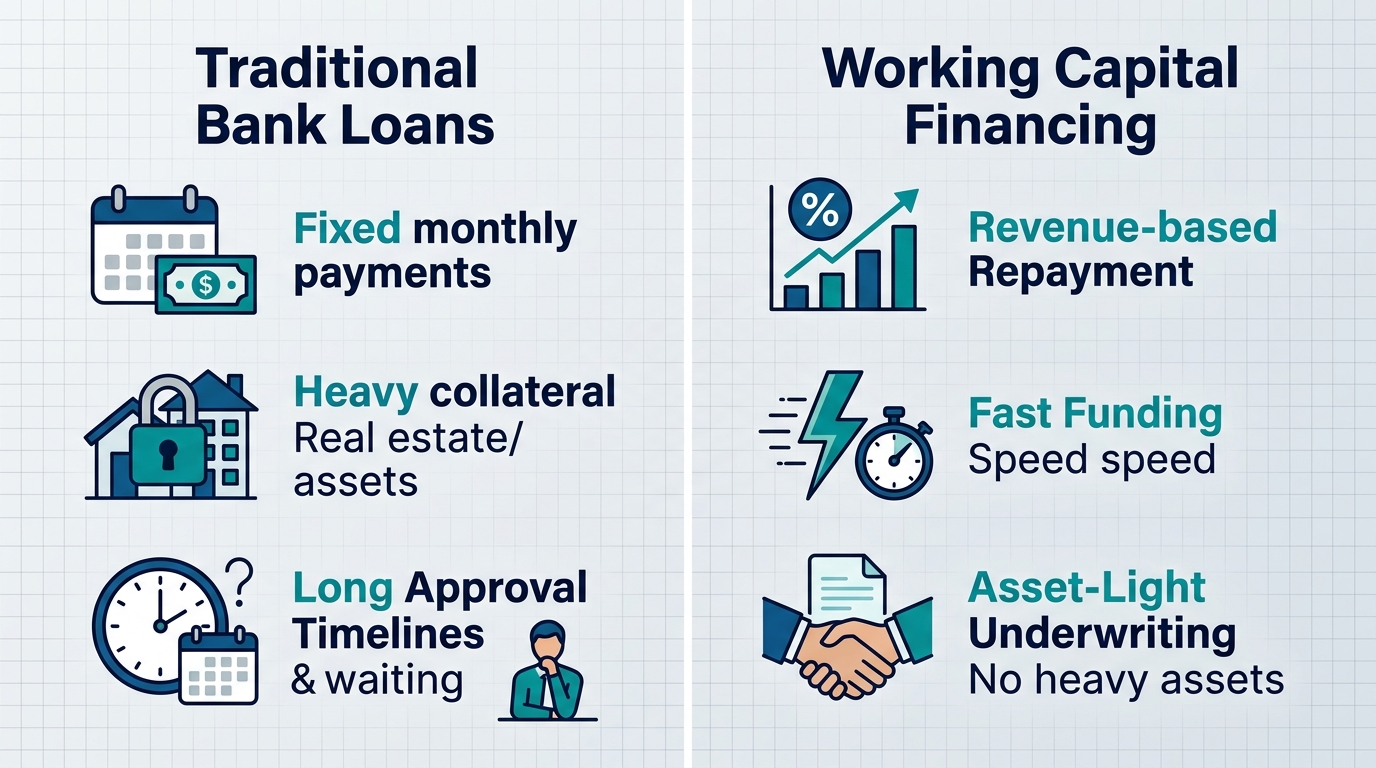
A clean professional infographic comparing bank loans to working capital financing
We see this cash-flow-aligned approach as a flexible alternative for growing businesses. In the next sections, we examine how revenue-based financing and asset-based lending each work in practice.
2. Master Lender Evaluation Criteria
Now that we understand the working capital landscape, let’s examine how to evaluate a master lender effectively. In working capital for merchants, a master lender is the financial institution that provides wholesale funding or originates capital through a network of channels and intermediaries.
When evaluating a master lender, track record and longevity indicate operational stability, while transparency on fees, interest rates, and repayment structures protects against hidden costs. Speed and reliability of funding can determine whether a business captures a time-sensitive opportunity. For those seeking working capital for merchants, underwriting flexibility matters when exploring revenue-based financing or asset-based lending, where lenders assess recurring revenue or collateral value rather than traditional credit scores. Customer service quality and regulatory compliance complete the picture.
According to the Financial Industry Regulatory Authority (FINRA), merchants should verify credentials through BrokerCheck when securities are involved. This guidance is informational and is not a solicitation. Zaidwood Capital is not a registered broker-dealer; securities are offered through Finalis Securities LLC.
With these criteria in mind, we can now explore how different lenders stack up.
3. Calculate Your Growth Capital Needs
Now that you have a clear picture of your business’s value, the next step is calculating the precise amount of growth capital you need to fund your expansion. Determining adequate working capital for merchants in New York and beyond starts with a thorough review of historical financials.
- Historical financials: Review at least 12 months of revenue and cash flow data to identify trends.
- Expense projections: Outline the costs required to execute your growth plan.
- Investment ratio: Determine the capital needed per dollar of projected new revenue.
Once you have these inputs, subtract your existing cash reserves using the formula: Capital Gap = (Projected Revenue Growth × Required Investment Ratio) – Existing Cash Reserves. This calculation yields a starting estimate; as the CFA Institute highlights, sound financial modeling should also incorporate scenario analysis.
Revenue-based financing, where repayments scale with monthly revenue, can reduce fixed-cost pressure, while asset-based lending unlocks capital for merchants holding inventory or equipment. Keep in mind this figure is an estimate; we always recommend consulting a financial advisor to refine your plan.
With your capital needs defined, you can now evaluate which financing options best match your requirements.
4. Navigate Repayment Structures
Once you choose a working capital for merchants product, repayment structure becomes the next critical decision. We at Zaidwood Capital recommend evaluating three primary models to match your cash flow patterns.
- Fixed daily or weekly ACH debits deduct a set dollar amount each period. This creates predictable payments and a clear payoff date. However, the rigidity can strain cash flow during slower revenue cycles when the same debit hits regardless of sales volume.
- Revenue-based financing remits a fixed percentage of daily credit card or total sales. Payments rise with strong revenue and fall during slower periods, adding flexibility. The tradeoff is a potentially higher total cost if revenues remain robust throughout the term.
- Asset-based lending structures repayment as a fixed monthly installment backed by collateral such as equipment or receivables. The cost is typically lower, but qualification is more demanding and the repayment term extends longer.
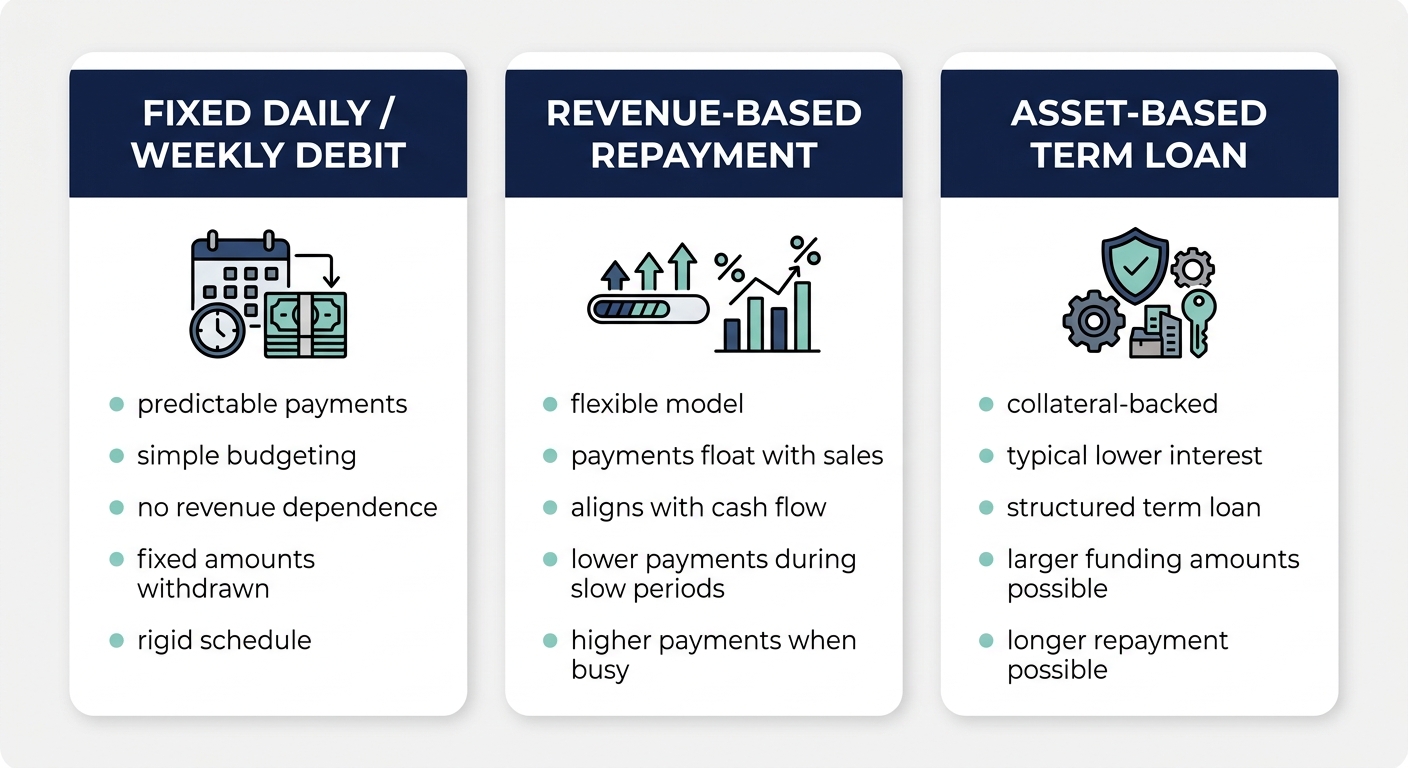
Comparison of merchant working capital repayment structures for advisory use
Revenue-based financing offers the greatest flexibility, while asset-based lending provides the lowest total cost. Industry-standard guidelines from the Financial Industry Regulatory Authority emphasize that lenders must disclose the total payback as a factor of the advance, allowing business owners to compare annualized percentage rates where available. Prepayment penalties vary by structure, so always request a payoff amount schedule before signing.
For businesses navigating more complex transaction financing, our M&A due diligence services provide additional clarity on repayment terms within acquisition structures. Understanding these mechanics sets the stage for comparing lender offers.
This content is for informational purposes only and is not an offer, solicitation, or commitment to buy or sell any security.
5. Explore Revenue-Based Financing
When exploring revenue based financing as a working capital option, merchants gain access to a flexible funding model distinct from traditional loans. Revenue-based financing is a structure where a business receives an upfront cash advance in exchange for a fixed percentage of future monthly revenue, repaid until a predetermined cap is reached.
According to the CFA Institute, typical terms include a repayment cap of 1.5x to 2.5x the advance and a revenue share of 3% to 10% over a term of 6 to 18 months. Unlike traditional debt, RBF requires no collateral or personal guarantee, and repayments adjust with revenue fluctuations. Compared to equity, it preserves ownership since investors receive only a revenue share. This model aligns incentives–both parties benefit from growth–though it can carry a higher cost of capital if revenue surges quickly. It suits merchants with predictable, recurring revenue, such as e-commerce or subscription businesses, and funding can close in days.
We can facilitate introductions to RBF providers or structure deals for qualified clients, leveraging our capital formation expertise. For merchants seeking complementary solutions, asset-based lending also offers working capital secured by receivables or inventory.
6. Leverage Asset-Based Lending
Asset-based lending (ABL) provides working capital for merchants by leveraging tangible assets such as accounts receivable, inventory, and equipment as collateral. Unlike revenue-based financing, which depends on projected earnings, ABL bases borrowing capacity on current asset values, offering a flexible solution for businesses.
Asset-based lending offers greater flexibility than conventional bank loans because borrowing limits adjust with collateral values. It suits seasonal businesses and growth-stage companies that need capital without diluting equity. While more adaptable, ABL often involves higher costs and more intensive monitoring, including regular reporting and field examinations. Maintaining accurate asset valuations and adhering to borrowing-base covenants is essential to avoid default.
Zaidwood Capital advises on structuring these facilities–from negotiating terms and selecting lenders to managing the borrowing base. Our energy mergers and acquisitions advisory frequently integrates ABL solutions to support complex transactions. As a Boutique M&A and Capital Advisory Firm, we align ABL with Full-Cycle M&A strategies while emphasizing risk management. We encourage clients to consult with legal and financial advisors before pursuing secured lending.
Unlock Your Business Potential with Strategic Working Capital
For growing merchants, working capital for merchants is not a last-resort emergency fix. Strategic Working Capital is a proactive tool for expansion, inventory purchase, or bridging receivables. Unlike short-term credit that reacts to distress, this approach empowers businesses to invest in growth on their own timeline. Revenue-based financing ties repayment to future sales, while asset-based lending uses collateral like inventory or receivables. At Zaidwood Capital, we structure these Strategic Working Capital solutions as a high-value advisor, not a lender. Through our energy mergers and acquisitions advisory, we help companies align working capital with transaction strategies. Our capital advisory expertise spans M&A, debt, and equity, ensuring every working capital plan supports long-term value creation. In the sections ahead, we explore the specific structures that turn working capital into a growth engine.
Resources


