



Payment Processing Solutions
Table of Contents
Evaluating Payment Processing Solutions in M&A Due Diligence
Beyond financial statements, a target’s payment processing infrastructure often holds hidden value or risk. The CFA Institute’s due diligence standards emphasize rigorous evaluation of operational assets, and our m&a due diligence services apply this discipline to payment processing solutions.
Our evaluation of payment processing solutions covers regulatory compliance–including PCI DSS and AML/KYC requirements–system uptime and transaction success rates, integration compatibility with the acquirer’s payment stack, and cost structure encompassing per-transaction fees, monthly minimums, and hidden chargeback or foreign exchange costs. We also scrutinize scalability to handle future transaction volumes and the robustness of disaster recovery plans. The reliability of institutional payment rails (ACH, wire, card networks) and cross-border payment infrastructure (SWIFT, local schemes) is assessed separately, especially for targets with global customer bases or in regulated industries like financial services and healthcare.
At Zaidwood Capital, we integrate this operational analysis directly into valuation models, as shortcomings in payment infrastructure can erode deal value. Our due diligence framework treats payment processing solutions as a core operational asset, not an afterthought. Once these systems are thoroughly evaluated, sellers must prepare the corresponding documentation for the data room, ensuring a seamless transition into integration planning.
Stripe
Effective payment processing solutions form the backbone of modern digital commerce, and Stripe stands as one of the most widely adopted platforms for businesses seeking a unified way to accept payments online. Rather than functioning as a traditional bank, Stripe acts as a merchant account provider while also delivering gateway and processing services — enabling companies to handle credit and debit cards, digital wallets like Apple Pay and Google Pay, ACH transfers, and recurring subscriptions without establishing a separate merchant account.
Stripe’s global infrastructure is built on robust institutional payment rails that power transactions in over 135 currencies. It operates a sophisticated cross-border payment infrastructure that allows merchants to settle funds in multiple currencies, reducing the complexity of international expansion. These capabilities are delivered through a developer-focused suite of APIs that integrate natively with platforms like Shopify, WooCommerce, and Magento, as well as through Stripe Connect, which facilitates payments for marketplaces and platforms.
Security and compliance are central to the platform’s architecture. Stripe maintains PCI DSS Level 1 certification and uses its Radar fraud detection system, backed by machine learning, to identify and block suspicious transactions. Data is encrypted both in transit and at rest, providing a secure environment for sensitive financial information.
From startups launching their first product to large enterprises scaling globally, Stripe’s payment processing solutions offer transparency and scalability. For businesses evaluating their payment infrastructure, we at Zaidwood Capital see Stripe as a critical enabler of efficient transaction flow — though the optimal choice always depends on the unique needs of each business.
PayPal
PayPal stands as a dominant force among payment processing solutions, facilitating transactions for more than 400 million active accounts worldwide. From our perspective as a full-cycle M&A advisory firm, we recognize PayPal’s platform as a critical component of modern digital commerce, serving both consumers and businesses across virtually every market segment.
For larger merchants and enterprise clients, PayPal Braintree functions as one of the most widely adopted institutional payment rails available today. It provides a customizable payment gateway that supports one-touch checkout, recurring billing, and seamless integration with major e-commerce platforms. This infrastructure enables businesses to accept diverse payment methods while maintaining a unified transaction flow — a capability that has become essential as digital storefronts continue to scale operations globally.
PayPal’s cross-border payment infrastructure further distinguishes it within the payment technology landscape. The platform supports transactions in more than 25 currencies and extends across over 200 markets, allowing merchants to conduct international sales without the complexity of establishing local banking relationships in every jurisdiction. Its money transfer services, including Xoom, provide additional conduits for international payment flows that reach regions underserved by traditional banking networks.
PayPal’s growth trajectory has been significantly shaped by strategic tech mergers and acquisitions, with high-profile integrations such as Braintree in 2013 and Venmo through Braintree’s earlier acquisition. These moves illustrate the broader consolidation pattern we observe throughout the fintech sector, where established platforms acquire specialized capabilities to expand their service portfolios and strengthen competitive positioning. Collectively, these capabilities establish PayPal as a foundational element of the contemporary payment ecosystem, connecting businesses, consumers, and global financial infrastructure through a unified network.
Square
As a versatile provider of payment processing solutions, Square, now known as Block, delivers a comprehensive suite of tools that integrate seamlessly into modern commerce. As a Boutique M&A and Capital Advisory Firm, we recognize the importance of robust financial infrastructure, and Square’s ecosystem exemplifies how technology can streamline transactions with business development and financial expertise.
At the heart of Square’s offering is its integrated hardware and software ecosystem. The product line includes the Square Reader for mobile payments, the all-in-one Square Terminal for countertop and portable use, and the Square Stand and Register for full point-of-sale setups. These devices function as complete point-of-sale and payment processing solutions, connecting directly to the Square POS software. This software ecosystem extends to Square Online for e-commerce, Square Dashboard for analytics, and the Square API, which allows developers to integrate payment processing capabilities into existing platforms. Collectively, these tools provide an enterprise-grade payment backbone for businesses of varying sizes.
Square’s platform supports a wide range of payment methods, from traditional credit and debit cards to EMV chip and NFC contactless payments like Apple Pay and Google Pay. The system includes digital invoicing and supports institutional payment rails by integrating with Fast and Same-Day ACH networks, granting merchants access to faster settlements typically associated with larger enterprises. Furthermore, Square facilitates cross-border payment infrastructure by enabling international payment acceptance, multi-currency processing, and support for local payment methods in select markets, making it a robust tool for global commerce.
For organizations evaluating financial infrastructure and considering growth through corporate development, we understand how these global transaction networks can underpin a successful scaling strategy. For a deeper discussion on related strategic growth topics, consider our energy mergers and acquisitions advisory services.
Adyen
Another major force in payment processing solutions is Adyen, a global payment processor that provides a single platform for online, mobile, and in-store payments. This unified commerce approach allows businesses to consolidate acquiring, gateway, and risk management into one integrated system, forming the backbone of many enterprise payment platform deployments.
Adyen’s architecture is built on institutional payment rails that offer direct connections to card networks and local payment methods, bypassing the fragmented legacy chains typical of older processors. The platform processes payments in over 150 currencies and supports local payment methods across 200+ countries, making it a critical piece of in cross-border payment infrastructure for merchants operating globally. In-house acquiring in multiple markets reduces dependency on third-party banks and gives merchants greater control over transaction routing and settlement, improving authorization rates and providing real-time reconciliation across channels. Additionally, Adyen’s centralized data and reconciliation features provide merchants with granular settlement visibility, faster dispute resolution workflows, and richer analytics for routing optimization — capabilities that materially reduce operational overhead and support scalable post-close integration efforts.
Major clients include Netflix, Uber, Spotify, and Microsoft, reinforcing the platform’s credibility for high-volume, institutional-grade transaction flows. For acquirers and investors, the technical architecture is only one part of the equation. A platform’s integration complexity, multi-jurisdictional licensing, and operational scalability directly affect deal risk and post-close operating models, which is why our m&a due diligence services evaluate platforms like Adyen for integration complexity and regulatory readiness.
Braintree
Among the most prominent players in the payment processing solutions landscape is Braintree, a Chicago-founded fintech that transformed how digital businesses handle transactions. Since its launch in 2007, the company has grown into an API-driven gateway trusted by some of the world’s fastest-growing platforms. Its full-stack offering–combining a merchant account, payment gateway, and recurring billing engine–enables merchants to accept credit cards, debit cards, and digital wallets, all from a single integration.
Braintree’s developer-first architecture simplifies the orchestration of institutional payment rails and cross-border payment infrastructure, supporting over 130 currencies and popular e-commerce platforms like Shopify, Magento, and WooCommerce. This technical breadth, proven by clients such as Uber, Airbnb, and Dropbox, illustrates the scalability that has made the platform a cornerstone of modern digital commerce. The company’s trajectory took a decisive turn in 2013 when PayPal acquired it for $800 million–a landmark in tech mergers and acquisitions that signaled the strategic value of owning a nimble, API-centric payment processing solutions gateway. From our perspective as M&A advisors, that deal exemplifies how incumbents use targeted acquisitions to capture technological innovation and new merchant segments, a pattern we continue to observe across the fintech ecosystem.
While Braintree excels in seamless checkout and native PayPal integration, the payments space remains dynamic, with different providers emphasizing specialized regional rails, fraud management toolkits, or alternative payment methods. Its story, however, confirms that well-engineered transaction processing platforms can reshape competitive dynamics–and command premium valuations in the process.
Fiserv
Among the prominent providers of payment processing solutions is Fiserv, a global financial services technology company formed through the merger of Fiserv and First Data. Today, the combined entity serves as one of the leading technology partners to banks, credit unions, merchants, and corporations worldwide.
At the core of Fiserv’s value proposition lies its institutional payment rails — the underlying infrastructure that enables secure money movement between financial institutions. These rails support a comprehensive range of transaction types, including real-time payments, ACH transfers, wire transfers, and card processing. For community banks and credit unions in particular, accessing these institutional-grade capabilities through a single technology provider simplifies operations and reduces integration complexity. The platform processes billions of transactions annually, connecting thousands of financial institutions to domestic and international payment networks.
Fiserv distinguishes itself through its cross-border payment infrastructure, which enables businesses to send and receive payments across multiple currencies while maintaining compliance with international regulatory frameworks. This infrastructure supports foreign exchange conversion, sanctions screening, and local clearing connectivity, helping enterprises manage the operational friction of global commerce. Merchants leveraging Fiserv’s acquiring solutions gain access to this international settlement network, while the company’s issuing platforms empower financial institutions to offer card programs that work seamlessly across borders.
Beyond transaction processing, Fiserv provides digital banking platforms, fraud management tools, and data analytics that strengthen the broader payments ecosystem. The company maintains a documented commitment to financial inclusion, working to expand access to digital financial services in underserved markets. These capabilities position Fiserv as an essential infrastructure partner for organizations navigating the increasing complexity of global payment processing solutions and financial technology integration.
Worldpay
Worldpay is a leading global provider of payment processing solutions, enabling merchants and financial institutions to accept payments across multiple channels. As a versatile partner, its platform supports in-person, online, mobile, and cross-border transactions, providing the sophisticated omnichannel capabilities that modern businesses demand.
The core product suite includes payment gateways, acquiring services, and treasury management tools, which empower businesses to process transactions securely and manage settlement and funding, including tailored fraud detection, settlement reconciliation, and reporting for enterprises worldwide. Worldpay’s infrastructure handles high volumes and complex payment types, serving enterprise clients that need reliable authorization and settlement pathways for both card-based and alternative payment methods, such as digital wallets and local bank transfers.
Worldpay also supports institutional payment rails for large-scale B2B and government payment flows. Its connections to card networks like Visa and Mastercard, along with bank transfer systems such as ACH in the U.S. and SEPA in Europe, form the backbone of its cross-border payment infrastructure. This infrastructure enables merchants to reach customers in global markets while navigating currency conversion, local scheme requirements, and regulatory compliance.
As part of FIS (Fidelity National Information Services) following its acquisition in 2019, Worldpay benefits from the combined expertise of a technology-forward financial services company. Its platform processes significant transaction volumes annually, reflecting the scale and trust that the payments industry places in its infrastructure. For businesses seeking payment partners, Worldpay remains a key enabler of global commerce.
Global Payments
Our full-cycle M&A expertise extends across high-growth sectors, including the rapidly evolving global payments industry. As a Boutique M&A and Capital Advisory Firm, Zaidwood Capital brings deep specialization in payment processing solutions. We advise companies throughout the payment ecosystem–from processors and acquirers to payment technology providers–on M&A, capital formation, and strategic growth initiatives.
Many payment businesses depend on institutional payment rails–such as ACH, wire, and real-time settlement systems–that influence transaction scalability, cost structure, and valuation multiples. Our advisory team understands the operational nuances within institutional payment rails and helps clients position their platforms for maximum enterprise value. We guide clients on capital formation and M&A strategies that account for the underlying infrastructure, ensuring that transaction structures align with market dynamics and regulatory requirements.
The growth of cross-border payment infrastructure has introduced new complexities in remittance flows, FX management, and compliance with BSA/AML regulations. Our deep expertise in payment processing solutions across borders enables us to help clients navigate these challenges, and our global investor network provides access to capital. By integrating our proprietary Sovereign Data Nexus, Precision Catalyst, and Velocity Matrix tools, we deliver data-driven insights that accelerate deal execution for cross-border payment infrastructure transactions.
Our data-driven approach–fueled by Sovereign Data Nexus, Precision Catalyst, and Velocity Matrix–provides a competitive edge in payment-sector transactions. Contact us to discuss how we can support your payment-related growth initiatives. Note: Securities are offered through Finalis Securities LLC; Zaidwood Capital is not a registered broker-dealer.
Chase Paymentech
Chase Paymentech stands as a prominent provider of payment processing solutions, formed in 2005 as a joint venture between JPMorgan Chase and First Data (now Fiserv). This collaboration combines the banking strength of JPMorgan with Fiserv’s technology and merchant acquiring expertise, enabling the platform to support a wide range of merchants from small businesses to global enterprises.
At the enterprise level, Chase Paymentech is known for its institutional payment rails, which facilitate large-volume, high-value transactions for major corporations. These rails integrate with complex treasury systems, providing secure, reliable settlement of payments across multiple channels–including point-of-sale, e-commerce, and mobile commerce. This capacity makes it a critical backbone of the digital economy.
For international commerce, Chase Paymentech deploys a robust cross-border payment infrastructure that allows merchants to accept payments in numerous currencies and settle in their local markets. This global reach supports international e-commerce by handling currency conversion, compliance, and settlement logistics, reducing friction for merchants expanding overseas.
We at Zaidwood Capital recognize the strategic importance of such payment engines within the financial ecosystem. Processing billions of transactions annually, Chase Paymentech exemplifies how modern payment processing solutions enable seamless commerce at scale and inform the deal dynamics we analyze in fintech M&A. Its scale, regulatory compliance experience, and tight integration with banking partners often shape due diligence priorities, valuation considerations, and post-close integration planning for acquirers, investors, and payment platform partners across regions and payment channels globally.
Elavon
Elavon is a global merchant acquirer and payment processor owned by U.S. Bancorp, providing end to end payment processing solutions that enable businesses to accept and manage transactions across multiple channels. As one of the largest payment processors worldwide, Elavon supports merchants ranging from small businesses to large enterprises and government entities with a comprehensive suite of financial technology services.
The company’s core offerings include gateway services, omnichannel payment acceptance, and integrated fraud management designed to secure transaction flows. These payment processing capabilities span in store, online, and mobile environments, giving businesses flexibility in how they capture revenue. Elavon processes transactions through direct connections to major card networks and alternative payment methods, making it a reliable infrastructure partner for organizations that require consistent uptime and settlement reliability.
A defining strength of Elavon lies in its platform for institutional payment rails, which supports high volume transaction routing for government agencies, universities, and healthcare systems. These institutions demand settlement precision, audit trails, and compliance with procurement protocols that consumer grade processors rarely accommodate. Elavon’s architecture also supports cross border payment infrastructure, facilitating multicurrency processing and international settlement for enterprises that operate across jurisdictions. This capability reduces the friction of managing disparate regional processors and consolidates reporting under a single operational view.
Elavon maintains a presence across North America, Europe, and Latin America, serving clients in hospitality, retail, education, and public sector verticals. For firms evaluating strategic partnerships with payment processors, Elavon represents a scaled, institutionally oriented option with demonstrated cross border functionality. We recognize that robust payment processing solutions form a critical component of the operational backbone that growth companies and institutional investors assess when evaluating transaction readiness and enterprise value.
Payment Processing Solutions Comparison
To further evaluate potential targets, we compare the top payment processing solutions across critical due diligence dimensions at Zaidwood Capital, a Boutique M&A and Capital Advisory Firm. The following table summarizes key features, pricing models, and integration requirements relevant to Full-Cycle M&A.
| Feature | Stripe | PayPal | Square | Adyen | Braintree | Fiserv | Worldpay | Global Payments | Chase Paymentech | Elavon |
|---|---|---|---|---|---|---|---|---|---|---|
| API Flexibility | High / Extensive | Moderate | Moderate | High / Platform-first | High / Checkout customization | Medium / On-premise | Medium / Legacy | Medium / Integrated | Medium / Terminal-focused | Medium / Multi-channel |
| Pricing Model | Pay-as-you-go, no monthly fee | Transaction + micro-fees | Flat-rate per transaction | Interchange++ or flat | Interchange++ or flat | Custom / Invoice-based | Custom / Invoice-based | Custom / Invoice-based | Custom / Volume-based | Custom / Volume-based |
| Global Reach | 135+ currencies | 25+ currencies | US, UK, AU, JP, CA | 150+ currencies | 130+ currencies | 100+ countries | 146+ currencies | 100+ countries | US, CA, EU | 35+ countries |
Platforms with high API flexibility may be more attractive to acquirers seeking easy integration, while providers with custom pricing models offer depth in specific verticals. Global scale, such as Adyen’s support for 150+ currencies, directly informs the addressable market.
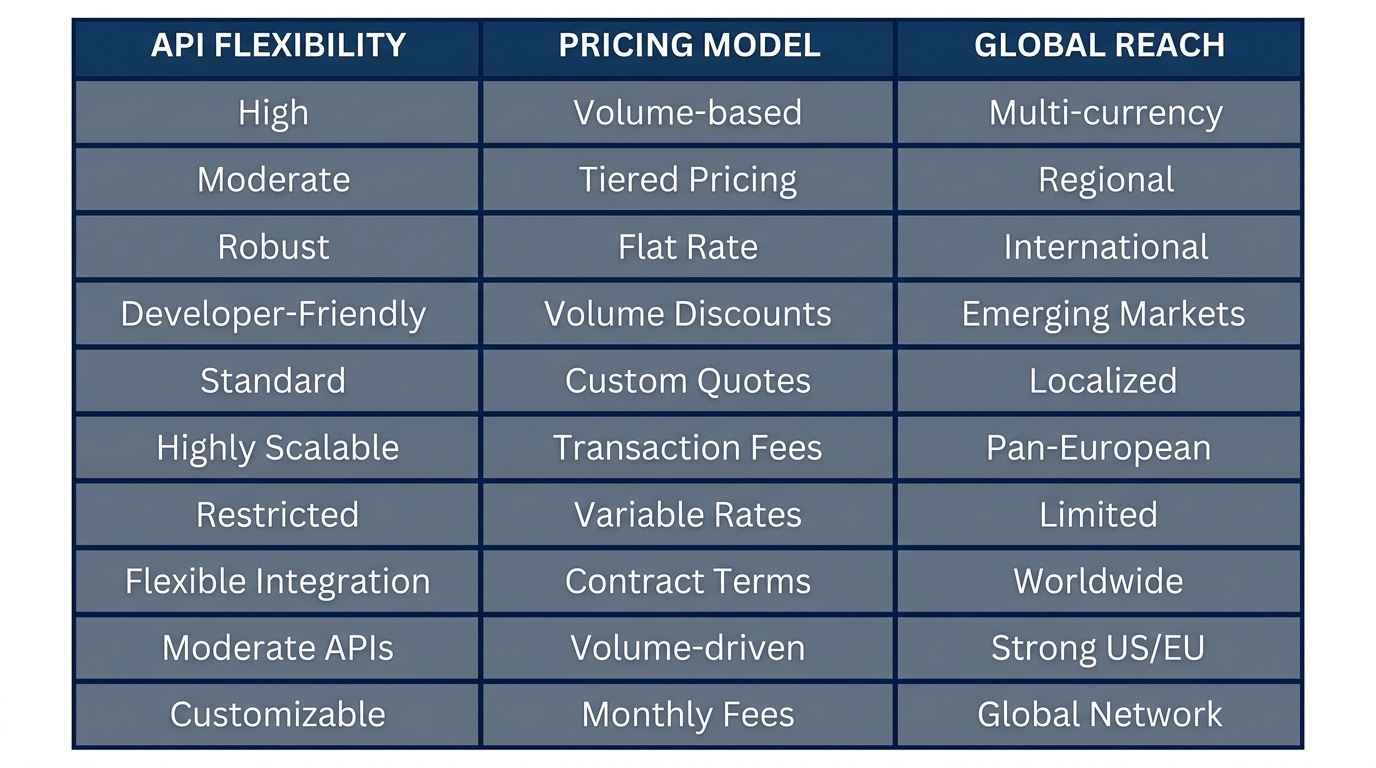
Payment processing solutions comparison grid
These transaction processing systems reveal a clear split between modern, platform-first payment platforms and established solutions operating in cross-border payment infrastructure. Acquirers weighing institutional payment rails must consider whether a target’s API-first architecture or its volume-based commercial relationships better align with their strategy.
Strengthening M&A Due Diligence with Payment Processing Insights
In M&A due diligence, payment processing solutions offer a rich data layer for evaluating target health. At Zaidwood Capital, a Boutique M&A and Capital Advisory Firm, we integrate transaction analytics into our evaluation of target companies, revealing revenue quality and operational stability that conventional financial statements may obscure.
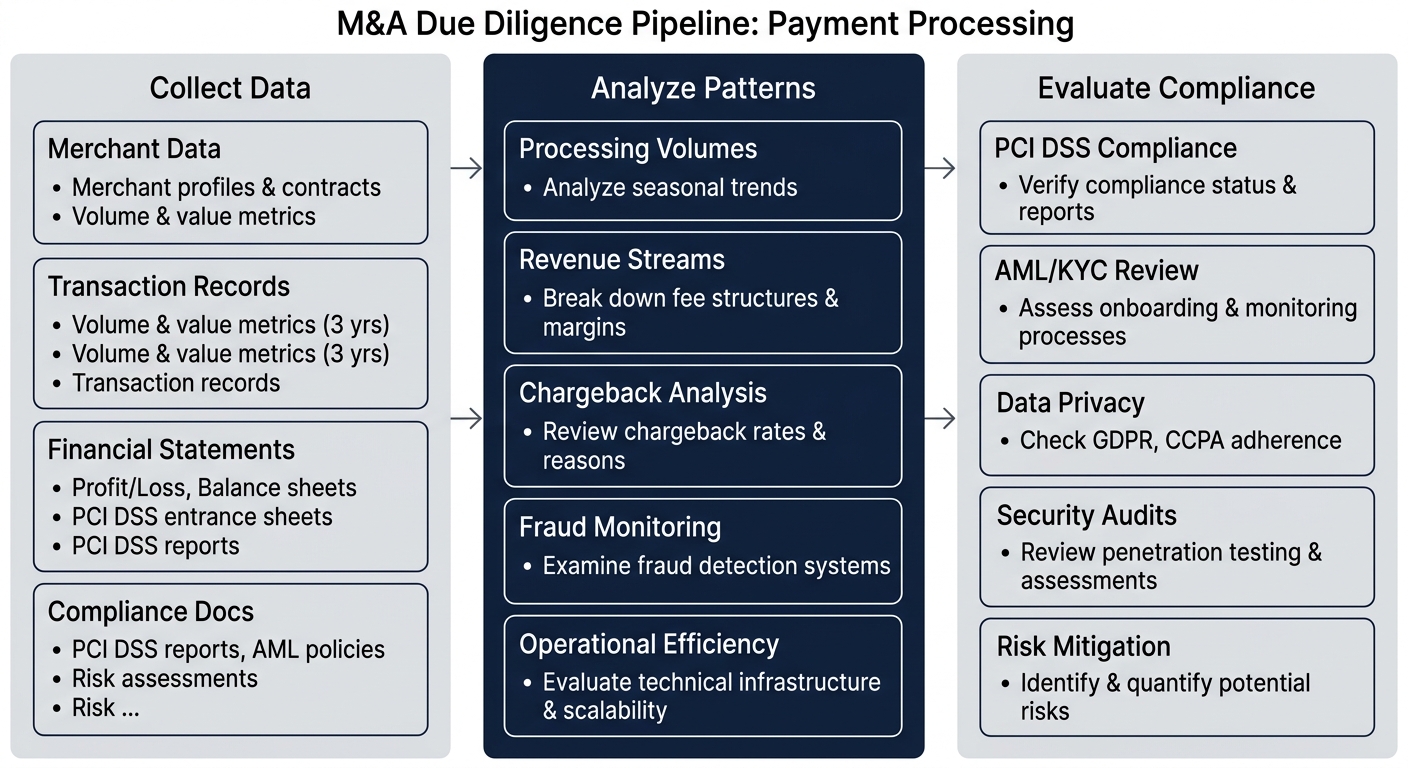
Streamlined M&A due diligence process for payment processing analysis
By examining metrics such as transaction volumes, chargeback rates, and settlement times, we gain insight into a company’s cash flow consistency and fraud exposure. Access to institutional payment rails–like Automated Clearing House (ACH) or real-time gross settlement (RTGS)–signals a target’s financial infrastructure sophistication and liquidity management capabilities. For cross-border targets, cross-border payment infrastructure analysis uncovers currency risk, compliance costs, and settlement efficiency, which are critical in international M&A.
These payment processing insights feed directly into risk assessment and revenue validation, aligning with CFA Institute standards that recommend examining transaction patterns as part of thorough financial analysis. Additionally, FINRA guidelines reinforce due diligence on payment processing partners for anti-money laundering compliance, helping us evaluate operational integrity and regulatory exposure. By incorporating such data-driven payment analytics, we strengthen our due diligence framework–supporting not only initial deal evaluation but also post-merger integration and value creation.
Resources


