



Revenue Based Financing
Table of Contents
Revenue-Based Financing: A Strategic Non-Dilutive Capital Option
Beyond traditional equity and debt, revenue-based financing in the alternative capital landscape emerges as a strategic option. According to the CFA Institute, revenue-based financing in growth-stage capital structures is a repayment model where repayments are calculated as a percentage of a business’s future revenues, typically with a cap and a predetermined multiple. This RBF structure provides flexible working capital for merchants without diluting ownership. Unlike venture debt arrangements that often require warrants or collateral, this financing model aligns lender-borrower incentives solely through revenue performance. Companies with recurring revenue models, such as SaaS platforms or subscription services, benefit from this non-dilutive capital to fuel growth without equity dilution. At Zaidwood Capital, we leverage our proprietary Velocity Matrix and global investor network to structure such solutions, streamlining the transaction while preserving founder control. As a Boutique M&A and Capital Advisory Firm, we tailor each engagement to the client’s revenue profile.
How Revenue Based Financing Differs from Traditional Equity Investment
Having established the basics of revenue based financing, we now examine how it fundamentally differs from traditional equity investment. For growth-oriented business owners, choosing between selling ownership and securing future-revenue-linked capital shapes everything from control to long-term returns.
Revenue based financing provides capital in exchange for a fixed percentage of ongoing revenues until a predetermined total is repaid, typically capped at a multiple of the original funding amount. Traditional equity investment instead grants investors an ownership stake with voting rights, where returns are tied to the company’s valuation at exit and are theoretically unlimited. The CFA Institute defines equity investment standards that include ownership rights, dividend participation, and fiduciary responsibilities, framing equity as a permanent capital infusion rather than a structured repayment obligation.
We see clear practical differences across several dimensions:
- Ownership and dilution: RBF preserves founder equity entirely. The investor receives no shares, no board seat, and no voting power. Equity investors purchase a percentage of the company, diluting existing shareholders and often securing governance rights that influence strategic direction.
- Repayment structure: RBF payments adjust to the company’s actual revenue performance — higher revenue months accelerate repayment, slower periods reduce the payment burden, but the total obligation remains capped. Equity has no repayment schedule; investors realize returns when the company is sold, goes public, or distributes dividends.
- Investor involvement: Equity investors frequently seek board representation and active strategic input. RBF investors focus on cash flow monitoring and revenue verification, remaining passive. As a Boutique M&A and Capital Advisory Firm, we structure capital solutions that align with the level of operational independence our clients want to maintain.
- Risk and suitability: Equity is suited for high-risk, high-reward ventures where exponential growth potential justifies dilution. RBF fits businesses with predictable, recurring revenue streams that can service periodic payments without sacrificing upside. RBF is often classified as a form of non-dilutive capital within the broader venture debt landscape, though its revenue-linked repayment mechanics distinguish it from fixed-schedule debt instruments.
The strategic choice hinges on what founders are optimizing for. Revenue based financing appeals to growth-stage companies that prioritize equity preservation and operational autonomy. Equity investment rewards those pursuing maximum scale and willing to share both control and upside. Our Full-Cycle M&A perspective acknowledges that the right capital structure must reflect each company’s revenue predictability, growth trajectory, and the founder’s long-term vision.
Understanding these differences is especially critical in sectors like healthcare mergers and acquisitions, where capital structure decisions directly affect deal outcomes and post-transaction flexibility. These distinctions become even more pronounced when evaluating real-world applications and term structures, which we explore next.
This website is for informational purposes only and is not an offer, solicitation, recommendation, or commitment to buy or sell any security.
Leveraging Non-Dilutive Capital for Growth and Acquisitions
While equity raises can dilute existing owners, alternative non-dilutive capital structures offer a different path–one that funds growth and acquisitions while preserving ownership. Non-dilutive capital, such as revenue based financing (RBF), enables companies to raise capital without selling equity. With RBF, a business receives upfront funding and repays it as a fixed percentage of future top-line revenue, providing greater flexibility during slow periods compared to traditional bank loans.
Venture debt is another common non-dilutive instrument–a fixed-term loan typically used alongside equity rounds to extend financial runway or finance strategic acquisitions. According to the CFA Institute’s global investment standards, debt-like financing structures like RBF and venture debt have become accepted tools for growth-stage companies seeking to align capital needs with strategic objectives. For example, a SaaS company could use revenue based financing to acquire a smaller competitor, funding the purchase from its predictable subscription revenue rather than issuing new shares. These instruments carry obligations–regular revenue-sharing payments or fixed interest and principal–but they avoid dilution, a crucial advantage for founders focused on long-term control. Non-dilutive capital is not risk-free: venture debt requires fixed repayments regardless of revenue performance, and RBF shares a percentage of top-line revenue even during downturns. However, for companies with predictable cash flows, the trade-off often justifies preserving equity.
Non-dilutive capital is particularly compelling for funding acquisitions. Businesses can deploy future revenue or debt capacity to pursue add-on acquisitions without diluting shareholders. Consider a mid-market healthcare company that leverages revenue based financing to acquire a smaller clinic chain, with repayment linked to the combined entity’s increased cash flow. Such structures fuel healthcare mergers and acquisitions while preserving equity value. This flexibility makes non-dilutive capital highly relevant in sectors like healthcare, where regulatory changes often create timely consolidation opportunities.
At Zaidwood Capital, a boutique M&A and capital advisory firm, we help clients evaluate and structure non-dilutive debt facilities as part of our full-cycle M&A and capital formation services. We streamline transactions with business development and financial expertise, tailoring solutions to each client’s growth strategy. Securities are offered through Finalis Securities LLC; Zaidwood Capital is not a registered broker-dealer.
Venture Debt Structures and Market Trends in 2026
Having explored the fundamentals of revenue based financing, we now turn to venture debt — another important non-dilutive option with distinct structures and growing relevance in 2026. Venture debt, also known as venture lending or debt financing for startups, provides growth-stage companies with the working capital needed to scale without diluting founder equity. We see venture debt as a critical tool for growth-stage companies in the energy and technology sectors.
Venture debt structures typically include fixed-rate term loans and floating-rate lines of credit. Fixed-rate term loans carry interest rates from prime plus 2% to prime plus 6%, with maturities between 24 and 48 months. Lenders often require covenants such as minimum cash runway, revenue milestones, and negative pledges to protect their interests. Early-stage ventures commonly face warrant coverage of 5% to 15%, giving the lender an equity upside. According to the CFA Institute, default rates in venture debt portfolios have remained low, attributable to stringent underwriting and close monitoring. Both venture debt and revenue-based financing are forms of non-dilutive capital, but their repayment mechanics diverge significantly: venture debt follows a fixed amortization schedule, whereas revenue-based financing ties payments to monthly revenue streams.
The CFA Institute projects a robust 18% compound annual growth rate for venture debt in 2026, reflecting its increasing role in startup ecosystems. A notable trend is the entry of traditional banks into the space, intensifying competition with specialist venture debt funds. This competition is compressing spreads and expanding access for middle-market companies in the energy and technology sectors. Lenders are also offering more flexible covenant packages, including covenant-lite structures for top-tier borrowers. As a result, venture debt is no longer reserved for late-stage companies; it is now deployed across earlier growth rounds alongside equity and revenue-based financing. We help clients navigate this evolving landscape by sourcing competitive terms and structuring debt facilities that complement equity raises.
Our role as a Boutique M&A and Capital Advisory Firm is to help clients evaluate these options within their broader capital structure. Our energy mergers and acquisitions advisory further supports companies in structuring these financing arrangements.
Comparing Revenue Based Financing, Non-Dilutive Capital, and Venture Debt
While revenue based financing, non-dilutive capital, and venture debt each offer unique benefits, understanding how they compare against each other is critical for growth-stage companies evaluating alternative capital sources. Per CFA Institute guidelines, classifying these instruments accurately ensures that founders and investors align expectations around repayment, dilution, and eligibility.
Revenue Based Financing (RBF) provides capital in exchange for a fixed percentage of monthly revenue until a predetermined multiple of the principal is repaid. Because repayment aligns with top-line performance, RBF avoids equity dilution and imposes no fixed maturity. Per CFA Institute classification, this structure is akin to contingent debt. Qualification demands consistent revenue, often annualized recurring revenue above $500,000, and the cost is a multiple of the advance, typically 1.2x to 2.5x. RBF suits high-margin, recurring-revenue companies seeking growth capital without dilution.
Non-Dilutive Capital (NDC) encompasses grants, R&D loans, and tax-credit financing that do not require the company to surrender equity. Unlike revenue based financing, NDC often originates from government agencies, industry consortia, or research programs rather than private lenders. The cost is generally lower, though application fees, reporting obligations, or modest interest charges may apply. Qualification hinges on research intensity, asset ownership, or eligibility for specific government incentives, making NDC especially attractive for early-stage ventures or asset-backed projects. Because it avoids equity dilution altogether, non-dilutive capital preserves founder control while funding innovation.
Venture Debt is a term loan provided to venture capital-backed companies, typically with interest-only periods and a three- to four-year amortization schedule. Lenders often receive warrants in addition to interest, creating modest dilution, though the principal remains debt. Per CFA Institute classification, this hybrid sits in the debt category with equity-like features. Qualification generally requires institutional VC backing and evidence of a credible path to profitability. Venture debt acts as bridge capital or a cushion near breakeven, making it a common choice for later-stage ventures.
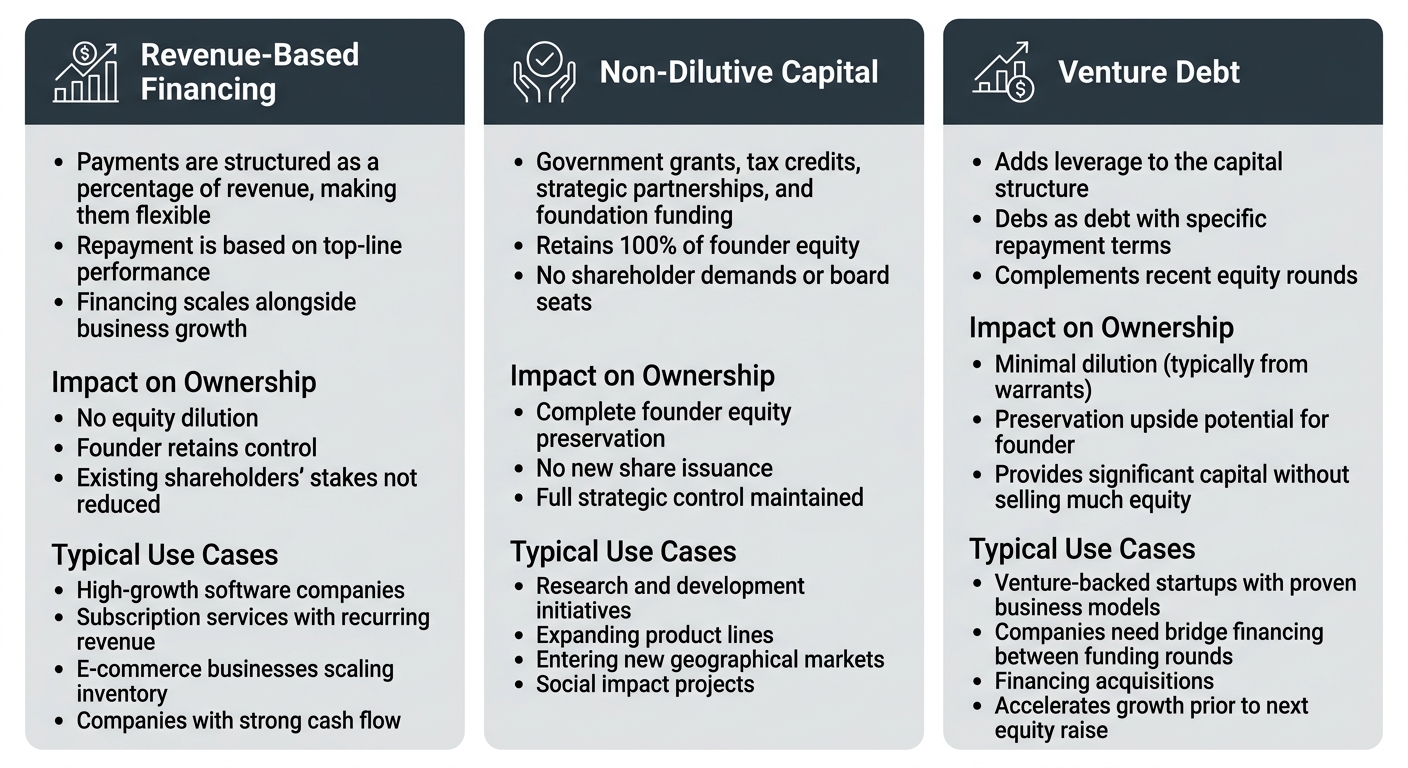
Comparison of alternative financing options for growth companies.
No single structure is universally superior; the right choice depends on stage, revenue profile, and growth trajectory. For companies integrating these instruments into a corporate development strategy, our energy mergers and acquisitions advisory services can align capital with transaction goals. The decision often requires a framework weighing cost, dilution, and strategic fit, a topic explored next.
Strategic Structuring of Alternative Capital Deals
Choosing the right type of capital is only half the equation; strategic structuring determines whether a deal truly aligns with a company’s growth trajectory and investor expectations. At Zaidwood Capital, a Boutique M&A and Capital Advisory Firm, we focus on designing alternative capital solutions where terms are calibrated to preserve founder equity while delivering appropriate risk-adjusted returns. Understanding how structures in revenue based financing and venture debt differ is essential for informed decision-making.
Revenue based financing is typically structured as a flexible repayment tied directly to business performance. Common terms include a fixed percentage of monthly revenues — often between 2% and 8% — directed toward repayment until a predetermined cap, which may range from 1.5x to 3x of the original principal, is reached. There is no fixed maturity date, making the instrument inherently adaptable to revenue cycles. We model these scenarios using our proprietary engine, Sovereign Data Nexus, to stress-test cash flow projections and ensure that the repayment schedule remains sustainable as the company scales. This approach exemplifies Financial Services 3.0, where data-driven insights replace rigid legacy underwriting.
In contrast, venture debt operates as a fixed-term loan, commonly spanning one to four years, and includes regular interest payments alongside an equity “kicker” in the form of warrants. This structure is frequently secured against company assets or future equity rounds, which introduces a different risk calculus compared to the performance-linked repayment in revenue based financing. Our Velocity Matrix accelerates the modeling of these debt instruments, allowing us to compare multiple structuring scenarios and optimize for speed and cost-efficiency. A thorough evaluation of existing debt covenants, revenue predictability, and the company’s growth stage — post-revenue versus pre-revenue — guides our recommendations.
Non-dilutive capital structures, including revenue based financing and carefully negotiated venture debt, are designed so that founders can fund growth without surrendering ownership. Trust is built on predictable revenue streams or collateral, forming the basis for terms that respect both investor risk appetite and the company’s strategic objectives. During the structuring phase, we ensure that any warrants or profit-sharing features are modeled transparently, with cap table impacts assessed in accordance with the ethical standards set by the CFA Institute, which emphasize fair representation and investor suitability.
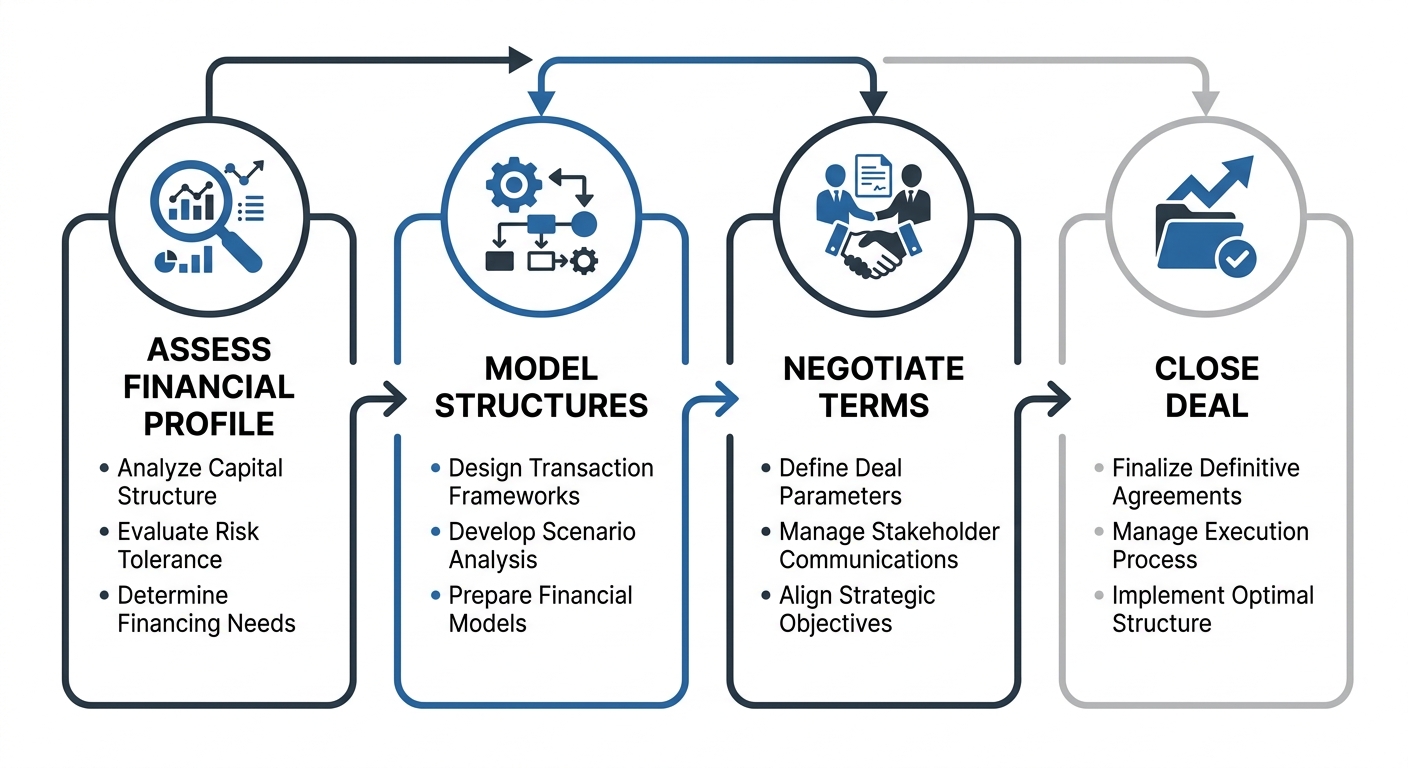
Strategic structuring of alternative capital deals
Our process extends beyond term sheet negotiation. As part of our Full-Cycle M&A offering, we integrate comprehensive m&a due diligence services that rigorously evaluate cash flow predictability and legal compliance before finalizing any revenue based financing terms. This diligence phase, enhanced by our Precision Catalyst methodology, ensures the chosen structure aligns with planned exit pathways and investor return thresholds. Once the structure is set and vetted, we transition seamlessly into execution, streamlining transactions with business development and financial expertise to bring the deal to a timely, compliant close.
This website is for informational purposes only and is not an offer, solicitation, recommendation, or commitment to buy or sell any security. Securities are offered through Finalis Securities LLC; Zaidwood Capital is not a registered broker-dealer. Investments involve risk and are not guaranteed to appreciate; investors may lose all or part of their investment. Past performance does not guarantee future results. Consult with legal, tax, and financial advisors or a registered representative before making investment decisions.
Alternative Capital Strategies for Growth Companies
Beyond conventional options, growth companies are increasingly turning to alternative capital strategies like revenue based financing to fund expansion without diluting equity. In this model, a lender provides upfront capital that is repaid through a fixed percentage of monthly revenue, giving founders flexibility during variable business cycles.
Venture debt serves as a complementary tool, offering fixed-term loans alongside equity rounds to extend a company’s runway. Non-dilutive capital strategies, including venture debt and revenue-linked financing, allow founders to retain ownership–a critical advantage for scaling companies. These instruments provide growth capital without equity dilution, aligning with the goals of management teams focused on long-term value creation.
At Zaidwood Capital, we structure alternative debt solutions and advise on capital-raising strategies tailored to growth-stage companies. As recognized by the CFA Institute, such non-dilutive approaches can strengthen a company’s balance sheet without compromising control. Whether through revenue-based financing or venture debt, our team helps founders navigate these options to accelerate their growth plans.
Resources


