


What Is An Investment Bank
Table of Contents
The Role of Investment Banking in Modern Corporate Growth
Investment banking serves as a strategic engine for corporate growth, enabling companies to pursue transformative opportunities that would be difficult to navigate independently. For those wondering what is an investment bank, these specialized advisory institutions operate at the intersection of corporate strategy and global capital markets in the US, bridging the gap between ambitious companies and the resources they need to scale.
Corporations engage investment banks to execute [mergers and acquisitions] within domestic markets, raise debt or equity capital for expansion, and navigate complex financial transactions that require deep expertise in valuation, due diligence, and investor access. Unlike traditional commercial banks that focus on deposit accounts and lending, investment banks in the US provide specialized strategic advisory throughout the full transaction lifecycle–from initial positioning through buyer outreach and closing.
We provide these advisory services through a boutique model that leverages a proprietary data platform and an extensive investor network, offering companies a tailored approach to [capital raising] and M&A execution within the middle market. At Zaidwood Capital, we apply this role through our full-cycle M&A and capital advisory framework, guiding clients from strategy through successful deal completion.
Core Functions of an Investment Bank: Services and Market Role
What is an investment bank? At its core, an investment bank provides strategic advisory and capital-raising services to corporations, institutional investors, and government entities. Unlike retail-focused commercial banks that accept deposits and extend consumer loans, Investment Banking operates on an advisory fee model and serves a sophisticated client base navigating complex corporate finance transactions.
Investment Banks vs. Commercial Banks: Core Distinctions
The business models of investment and commercial banks diverge at every level. Commercial banks generate revenue primarily through net interest income–earning the spread between what they pay on deposits and what they collect on loans–while investment banks earn advisory fees, placement fees, and success fees tied to transaction milestones. Their regulatory oversight follows separate paths: commercial banks are supervised by both the SEC and the FDIC, whereas investment banks fall principally under SEC jurisdiction and FINRA rules. Client profiles differ equally–commercial banks serve retail consumers and small businesses with deposit accounts, credit cards, and mortgage products; investment banks work exclusively with corporations, institutional investors, and public-sector entities on M&A advisory, capital formation, and strategic alternatives.
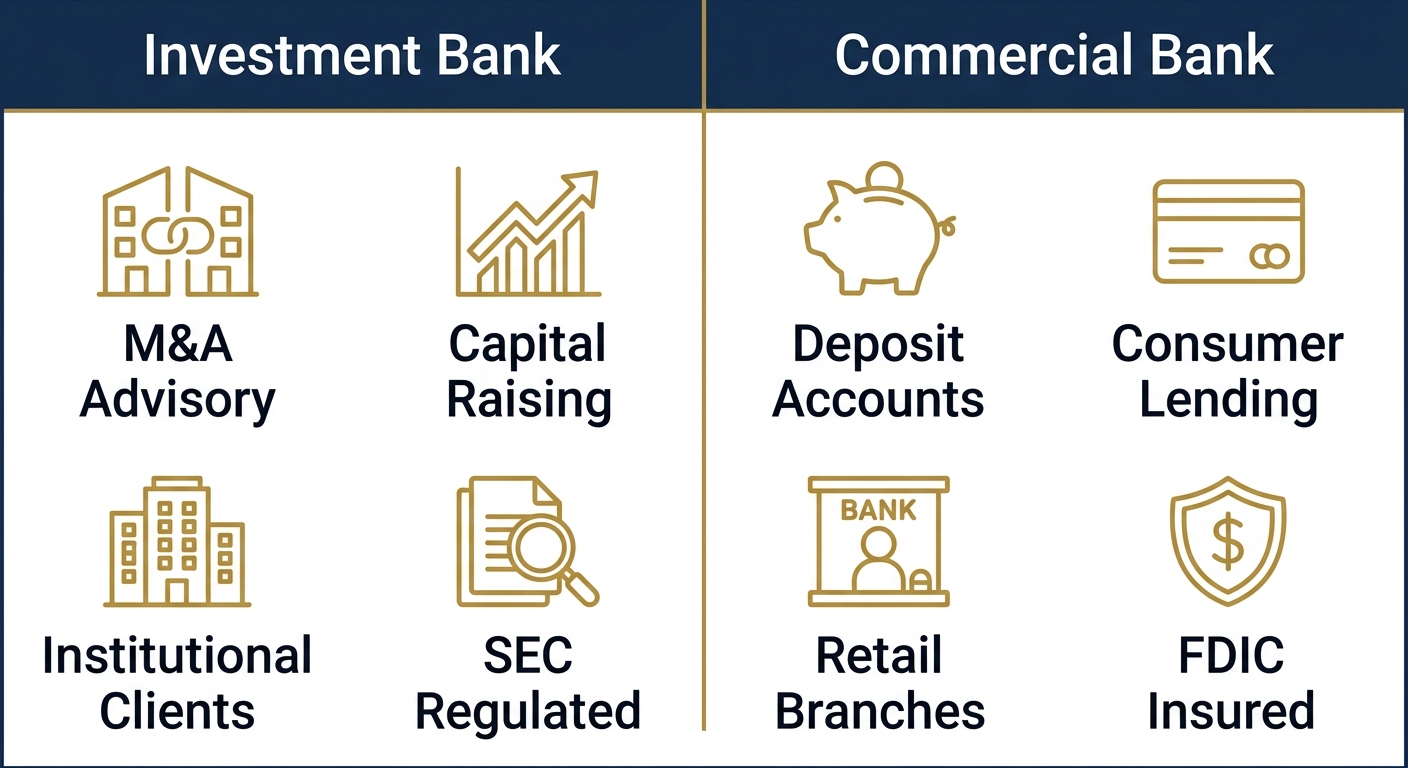
Investment bank vs. commercial bank service comparison infographic.
These structural distinctions shape everything from deal execution timelines to risk management frameworks. The advisory-centered model allows investment banks to focus entirely on transaction outcomes without the balance-sheet constraints deposit-taking institutions face.
Mergers and Acquisitions Advisory Services
Mergers and acquisitions advisory remains a cornerstone of investment banking. On the buy side, we guide acquiring companies through target identification, valuation analysis, due diligence coordination, and negotiation strategy. On the sell side, we prepare target companies for market, position their financial narrative, run competitive auction processes, structure deal terms, and manage closing mechanics. According to Wall Street Prep, valuation in M&A transactions draws on multiple methodologies–discounted cash flow analysis projects future earnings to intrinsic present value, while comparable transaction analysis benchmarks against precedent deals in the same sector. The negotiation phase spans indicative offers, letters of intent, definitive agreement drafting, and final closing conditions. Each stage demands rigorous financial modeling and deep sector expertise to align price expectations with market realities.
Capital Raising: Equity, Debt, and Strategic Alternatives
Capital raising–through equity, debt, or alternative instruments–is another fundamental function of investment banks. For equity, banks lead initial public offerings and follow-on offerings that introduce companies to public markets or allow existing shareholders to monetize positions. Private placements offer a contrasting path, placing securities directly with accredited institutional investors without public registration. On the debt side, banks arrange bond issuances across credit ratings, term loan facilities, and revolving credit structures tailored to working-capital cycles. Mergers & Inquisitions notes that strategic alternatives also include growth equity rounds, where later-stage companies raise minority capital from specialized funds to fuel expansion without pursuing full exits. Each capital-raising path carries distinct regulatory requirements, dilution implications, and investor-relations considerations that shape how companies choose between alternatives.
These functions form the bedrock of modern investment banking and are integral to the advisory model we employ at our firm.
Strategic Advantages of Partnering with an Investment Bank
Beyond these foundational services, three strategic advantages make our boutique approach particularly effective. Understanding what is an investment bank begins with recognizing the differentiators that our Investment Banking Services deliver: a curated institutional network, comprehensive deal execution, and a proprietary data-driven infrastructure.
Access to Deep Institutional Investor Networks
The scale of today’s private capital market demands a curated network. According to Dealroom, a leading industry data platform, efficient capital raising hinges on targeted introductions rather than scattered outreach. Zaidwood Capital maintains a vetted network of over 4,000 institutional investors with more than $15 billion in committed capital, spanning venture capital, growth equity, and family offices. This depth provides clients with direct access to decision-makers actively seeking new opportunities. Instead of time-consuming cold outreach, we leverage ongoing engagement with this ecosystem to surface the investors most likely to engage, ensuring that each meeting advances the fundraising process. The result is a disciplined capital raising effort that converts a vast addressable market into a manageable pipeline of qualified leads, accelerating the path to term sheets and commitment letters.
Full-Cycle Deal Execution and Strategic Guidance
In mergers and acquisitions, maintaining momentum and negotiating leverage is critical. Unlike larger institutions where junior bankers often manage execution, Zaidwood’s boutique structure ensures every engagement receives senior-level attention from start to finish. We take full accountability for the entire transaction lifecycle: from initial positioning and valuation, through preparation of investor-ready materials, to managing due diligence and closing. This comprehensive coverage allows leadership to remain focused on core operations while we navigate negotiations, address buyer concerns, and keep the process on schedule. We also integrate real-time market intelligence to adapt strategy as the landscape evolves, maintaining deal momentum and leverage. The outcome is a structured, high-touch approach that preserves the founder’s strategic leverage and maximizes transaction value.
Proprietary Technology and Data-Driven Advantage
The capital raising landscape is increasingly driven by data. Technology-driven deal sourcing platforms like Grata demonstrate the value of AI-powered investor matching and comprehensive market intelligence. Zaidwood Capital builds on this foundation with our proprietary systems, Sovereign Data Nexus and Precision Catalyst. Sovereign Data Nexus aggregates and analyzes institutional investment patterns, enabling us to identify the most aligned investors for a specific transaction based on real-time criteria. Precision Catalyst streamlines data management and due diligence, accelerating the preparation and dissemination of critical materials. Together, these tools–combined with our rapid-execution Velocity Matrix framework–reduce time-to-close and create a competitive edge unattainable through manual spreadsheet-driven processes. In practice, this means dynamically matching opportunities to funds with demonstrated interest in the relevant sector and stage, improving the quality of investor interactions and leading to faster commitments.
These advantages form the bedrock of our full-cycle M&A and capital formation process, detailed in the following sections.
The Investment Banking Lifecycle from Engagement to Execution
Understanding what an investment bank does during a transaction is essential for business owners considering a sale, recapitalization, or growth equity raise. The full-cycle investment banking process is a structured journey that transforms a company’s strategic objectives into a completed transaction. At our firm, we guide clients through each phase with a disciplined approach that combines rigorous analytics, tailored investor targeting, and coordinated execution. The lifecycle unfolds across three distinct but interconnected stages, each designed to build momentum and maximize value while protecting the client’s interests.
Engagement, Valuation, and Strategy Development
The first phase establishes the foundation for a successful transaction. A boutique investment bank begins with a comprehensive readiness assessment that evaluates the company’s financial health, operational maturity, and market positioning. This diagnostic work identifies strengths to highlight and areas requiring attention before approaching the market. Our team then develops a strategic narrative that articulates the client’s unique value drivers, growth trajectory, and competitive advantages in a compelling investment thesis.
Valuation analysis forms the analytical core of this phase, employing established methodologies that include discounted cash flow modeling, comparable company analysis, and precedent transaction benchmarking. These frameworks establish a defensible value range that anchors subsequent negotiations. A Boutique M&A and Capital Advisory Firm in West Palm Beach leverages this analysis to create essential pitch materials–specifically, a one-page teaser that generates buyer curiosity and a detailed confidential information memorandum (CIM) that provides prospective investors with the financial and operational context needed to submit meaningful indications of interest. This phase culminates in a well-prepared client ready to enter the market with conviction.
Investor Targeting, Outreach, and Structured Negotiations
With the strategic narrative and marketing materials finalized, the process moves into active deal execution. Effective mergers and acquisitions outcomes depend on identifying the right counterparties. Our approach maps the universe of potential investors into two primary categories: strategic buyers, including competitors and industry consolidators who recognize synergistic value, and financial buyers such as private equity funds and family offices seeking platform investments or growth partnerships. This dual-track targeting maximizes competitive tension.
We manage the entire outreach sequence, distributing teasers under confidentiality agreements and granting qualified parties access to a secure data room containing thousands of pages of operational, financial, and legal documentation. Coordinating management presentations allows leadership teams to articulate their vision directly to serious suitors. The capital raising and M&A process at this stage benefits from structured competitive bidding, where simultaneous discussions with multiple parties create the conditions for superior terms. Our Full-Cycle M&A methodology ensures that every indication of interest is evaluated against both financial and qualitative criteria before advancing a select group into final negotiations.
Due Diligence, Documentation, and Closing
The final phase converts negotiated terms into a definitive transaction. Due diligence represents the most intensive period of the engagement, during which buyer-side advisors conduct exhaustive reviews of the company’s financial statements, tax filings, material contracts, intellectual property, regulatory compliance, and operational history. Our role involves coordinating responses to hundreds of information requests, organizing subject-matter expert calls, and proactively addressing potential deal risks before they become obstacles.
This phase also encompasses the negotiation and finalization of legal documentation. The letter of intent (LOI) memorializes the agreed-upon value and structural terms, while the definitive purchase agreement codifies representations, warranties, indemnities, and closing conditions in precise legal language. In transactions meeting certain size thresholds, regulatory filings under the Hart-Scott-Rodino Act in the United States may be required before closing can proceed. The final steps involve funding mechanics, share transfer or asset conveyance, and post-closing adjustments that reconcile working capital estimates with actual figures. For every mergers and acquisitions engagement and capital raising mandate we lead, this disciplined closing process transforms months of preparation into a successfully completed transaction.
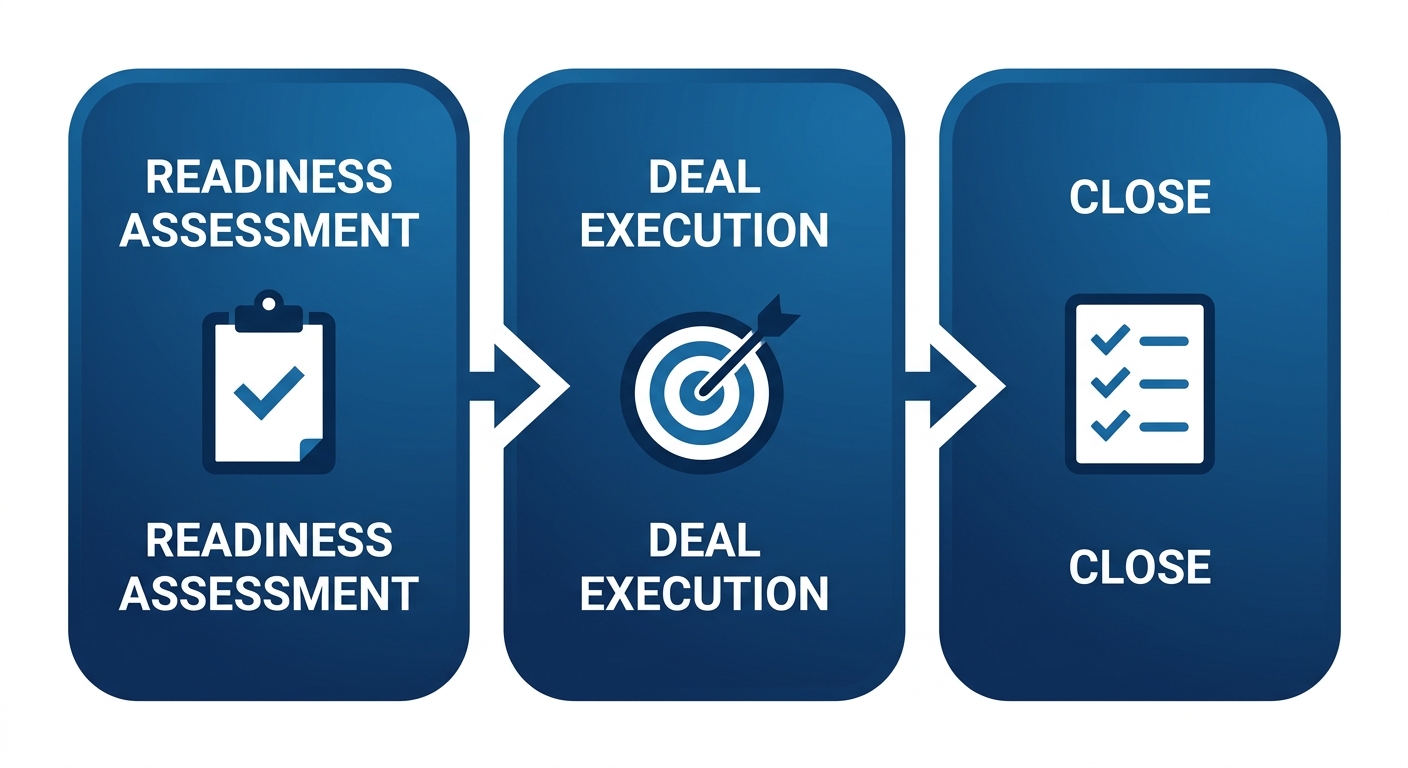
Ciclo de vida de banca de inversión desde evaluación hasta cierre
The structured lifecycle described here represents the core execution framework of an advisory mandate. Each phase builds upon the previous one, creating a logical progression from internal preparation through external engagement to final closing. This disciplined approach distinguishes a professionally managed transaction from an ad hoc process, and it underscores why experienced guidance matters at every stage of the journey.
Selecting and Maximizing Your Investment Banking Partnership
Evaluating Boutique vs. Bulge-Bracket Investment Banks
Understanding what an investment bank offers is the first step in selecting the right partner. For companies navigating a lower middle market investment bank engagement, boutique firms often provide the specialized attention needed. Boutique advisory practices concentrate on a few sectors, dedicating senior partners to each client and delivering deep industry relationships that bulge-bracket institutions, with their vast global platforms, may struggle to replicate. Boutique banks, for instance, often maintain dedicated M&A teams in niche verticals, ensuring that deal sourcing and execution are guided by practitioners who truly understand the market dynamics. This specialization not only sharpens positioning but also enhances credibility with targeted buyers and investors. While large banks offer expansive balance sheets and international reach, growth-stage and middle-market companies frequently benefit from the agility, sector focus, and continuity of a boutique team. The choice between boutique and bulge-bracket should ultimately reflect your company’s stage, goals, and need for hands-on guidance. At Zaidwood Capital, we see that personalized strategic guidance, combined with robust networks, accelerates transaction outcomes and builds lasting partnerships.
Key Criteria for Selecting an Investment Banking Partner
Once you’ve determined the type of bank that fits your needs, evaluating potential partners against specific criteria becomes essential. A firm’s industry specialization is critical, as dedicated M&A teams with deep sector knowledge can navigate a mergers and acquisitions process effectively. Their track record in capital raising, including completed deals in your market, signals the ability to access institutional investors and strategic buyers. Network breadth, cultural alignment, and advisory team composition are equally important. At Zaidwood Capital, we ensure the senior partner leading your engagement has relevant transaction experience and remains accessible. Cultural fit–shared values and communication style–helps manage challenging moments collaboratively. A well-connected bank opens doors to acquirers and capital sources that might otherwise stay out of reach. Our network includes over 4,000 investors and access to $15 billion in capital, enabling us to match clients with ideal counterparties. While no single factor guarantees success, thorough evaluation mitigates risks and sets the stage for a productive partnership.
Maximizing the Value of Your Investment Banking Relationship
Building on these criteria, maximizing the value of the relationship requires proactive preparation and transparency. We encourage companies to come to the table with a clear narrative and a well-structured financial model, which accelerates initial assessments and demonstrates organizational readiness. Organize a virtual data room containing historical financials, cap table, customer contracts, and other diligence materials before engagement. This readiness streamlines due diligence and signals professionalism. According to Grata, 43% of investable companies remain undiscovered through standard research, highlighting the value of a structured approach. Our proprietary platforms, the Sovereign Data Nexus for real-time market data, the Precision Catalyst for AI-driven investor matchmaking, and the Velocity Matrix for streamlined execution, give clients a data-backed advantage. While no tool replaces human judgment, these insights sharpen decision-making. We also recommend establishing a regular communication cadence to maintain alignment throughout the process. By combining organized due diligence, digital tools, and open dialogue, you position your company to navigate the transaction journey with confidence.
Finding the Right Capital Advisory Partner for Your Growth Journey
According to Axos Bank, commercial banking covers loans and deposits, while investment banking services encompass M&A advisory and capital markets. However, boutique firms like Zaidwood Capital provide a more personalized, full-cycle approach for middle-market companies.
At Zaidwood Capital, we differentiate through technology and network depth. Our proprietary Sovereign Data Nexus platform aggregates institutional investor data, while Precision Catalyst uses AI-driven digital engagement to accelerate fundraising. The Velocity Matrix execution framework streamlines deal timelines. This integrated system supports our full-cycle mergers and acquisitions advisory, from valuation to closing, drawing on over 4,000 institutional investors with access to $15B+ in committed capital. Our team coordinates due diligence, investor outreach, and transaction logistics with disciplined, transparent processes across domestic and international markets.
Headquartered in West Palm Beach, we guide growth-stage companies through tailored capital raising strategies. Our advisory team brings more than 80 years of combined experience and $24.4B in transaction volume across 350+ deals. Whether you are seeking equity or debt, our full-cycle service prepares you for every stage. Contact us today for a confidential consultation about your capital raising goals.
Resources


