


Raising Venture Capital For Startups
Table of Contents
The Venture Capital Fundraising Landscape for Startups
The Venture Capital Fundraising landscape for startups has become more disciplined. Founders raising venture capital for startups today must demonstrate strong unit economics and sustainable growth paths to attract institutional interest.
Investor due diligence checklists now probe deeply into customer concentration, churn rates, and a clear roadmap to profitability. Meanwhile, Series A valuation multiples have compressed in sectors like SaaS while remaining elevated in AI and defense. We track these shifts through our Precision Catalyst platform, mapping investor behavior in real time.
These market currents underscore the necessity of rigorous preparation and a data-rich narrative when engaging investors. Understanding the venture capital fundraising landscape helps founders align expectations and position their companies for the diligence process ahead, improving timing, narrative clarity, and investor engagement across priority targets and follow-up diligence deliverables throughout the process.
Building Your Fundraising Foundation Before Approaching Investors
Before raising venture capital for startups, founders must recognize that investor meetings succeed or fail based on the groundwork laid long before the first pitch. At Zaidwood Capital, we guide entrepreneurs through a systematic preparation process that transforms an idea into an investment-ready enterprise, ensuring every element of the business withstands scrutiny.
Crafting a Cohesive Business Narrative and Financial Model
The first step is distilling your vision into a concise narrative that clearly articulates the problem, your solution, the market opportunity, and early traction. This story must be compelling yet data-backed, as it forms the core of all investor communications. Parallel to the narrative, build robust financial projections covering at least three scenarios–base, best, and worst. We advise tracking essential metrics such as revenue growth, burn rate, gross margin, and customer acquisition cost, because investors will immediately probe these numbers. A well-structured model not only validates the viability of your business but also demonstrates disciplined financial thinking, a key factor in winning institutional confidence.
Assembling the Data Room and Conducting Pre-Due Diligence
Once the narrative and financials are solid, focus shifts to the data room. This repository must mirror a thorough investor due diligence checklist, housing your executive summary, pitch deck, cap table, audited financial statements, legal documents such as IP filings and incorporation records, key customer contracts, and independent market research. Before sharing with outsiders, perform an internal pre-due-diligence audit using a typical venture capital due diligence checklist. Identify gaps in your documentation, team inconsistencies, or legal vulnerabilities and address them proactively. Simultaneously, understand your target investors: study their stage preferences, sector focus, typical ticket size, and geographic appetite. Not every venture fund will align with your profile, so tailoring your outreach to investors whose thesis matches your company dramatically increases the probability of a successful raise.
At Zaidwood Capital, we help startups build these foundations with precision, leveraging our 80+ years of collective experience and $24.4B+ in aggregated transaction volume. Once your foundation is in place, the next phase is confidently engaging the right investors. For a comprehensive step-by-step walkthrough, see our guide on How To Raise Venture Capital.
Crafting a Compelling Investor Pitch That Avoids Common Pitfalls
Once you have targeted the right investors, your next challenge is to craft a pitch that captures their attention. When raising venture capital for startups, founders often overlook critical pitch elements that can make or break their fundraising success. A well-structured pitch demonstrates not only your vision but also your command of the metrics and milestones that matter most.
We have observed four common pitfalls that consistently derail otherwise promising pitches:
- Vague Value Propositions — Leading with generic statements like “we connect people” immediately signals a lack of clarity. Investors need a quantified problem and a unique solution they can evaluate. Define the specific pain point in measurable terms and explain exactly how your approach differs from existing alternatives.
- Weak Market Sizing — Overinflating the total addressable market without credible data undermines your credibility. Use the TAM/SAM/SOM framework to present realistic, defensible numbers that show you understand your market’s true scope and your path to capturing it.
- Unrealistic Financial Projections — Hockey-stick revenue curves are a top red flag for experienced investors. During the venture capital raising process, we advise founders to present conservative, evidence-based projections that reflect thoughtful assumptions rather than wishful thinking.
- Ignoring the Due Diligence Checklist — Investors will scrutinize your traction metrics, unit economics, intellectual property position, and team backgrounds. Prepare a comprehensive due diligence folder before you begin pitching so you can respond to information requests promptly and completely.
For founders pursuing a series a funding round, investors will focus specifically on product-market fit and scalability rather than the founding story alone. We recommend rehearsing your pitch with outside advisors who can identify blind spots and pressure-test your responses to tough questions.
As a Boutique M&A and Capital Advisory Firm, we have guided numerous founders through this process. With a refined pitch in hand, you are ready to move into term-sheet negotiations–where preparation and strategic positioning become equally critical.
Traction Metrics That Venture Capitalists Evaluate Before Investing
When raising venture capital for startups, venture capitalists scrutinize specific traction metrics to gauge the health and scalability of a business. At Zaidwood Capital, we evaluate these indicators–beyond the pitch deck–to assess product-market fit, efficient unit economics, and sustainable growth. A solid grasp of these measures helps founders articulate a credible fundraising narrative.
We focus on the following metrics:
- Monthly Recurring Revenue (MRR) and Annual Recurring Revenue (ARR): These subscription-based revenue measures signal predictable income streams. For Series A, many VC firms look for ARR of $1 million or more as a benchmark of product-market fit, and these top-line numbers directly influence Series A valuation multiples. They are the starting point for any financial model.
- Customer Acquisition Cost (CAC): This measures the expense to acquire a new customer. A CAC payback period under 12 months is commonly viewed as a strong indicator of capital-efficient growth, especially when paired with LTV. In early-stage deals, payback within 6-12 months is an attractive target.
- Lifetime Value (LTV) and LTV/CAC Ratio: LTV captures total customer revenue over the relationship, while the LTV/CAC ratio tests unit economics. Venture investors typically target a ratio above 3x to ensure customer economics can fund scalable growth. Ratios exceeding 5x may support premium valuation multiples.
- Gross Margin: Gross margin reveals the profitability of core products after direct costs. For SaaS businesses, VCs frequently seek margins of 70% or higher; margins above 80% are especially favored because they enable rapid reinvestment and accelerate the path to breakeven.
- Net Revenue Retention (NRR): This metric tracks expansion revenue from existing customers, accounting for upsells and churn. An NRR above 120% indicates strong stickiness and upsell potential, a key driver of long-term value. A high NRR mirrors true product-market fit and organic growth within the customer base.
- Month-over-Month Revenue Growth Rate: Sustained MoM growth of 15-20% demonstrates rapid market adoption and execution capability. Consistent growth over six consecutive months is a particularly compelling signal for investors.
Collectively, these metrics form the core of any investor due diligence checklist, giving VCs a standardized lens to compare opportunities. While these metrics are vital for equity fundraising, the capital structure itself matters. For companies seeking capital without equity dilution, revenue based financing is a compelling alternative. In our advisory work, we help founders weigh both equity and non-dilutive funding paths to select the right strategy for their stage and growth profile.
Decoding Series A Valuation Multiples and Equity Dilution
Moving beyond seed dynamics, Series A rounds introduce more complex valuation structures. For founders raising venture capital for startups, understanding how investors price their company is essential to protect equity and maintain control. Series A valuation multiples and equity dilution are the two interconnected forces that shape the round – mastering them can mean the difference between a founder-friendly term sheet and a costly over-dilution.
Understanding Series A Valuation Multiples
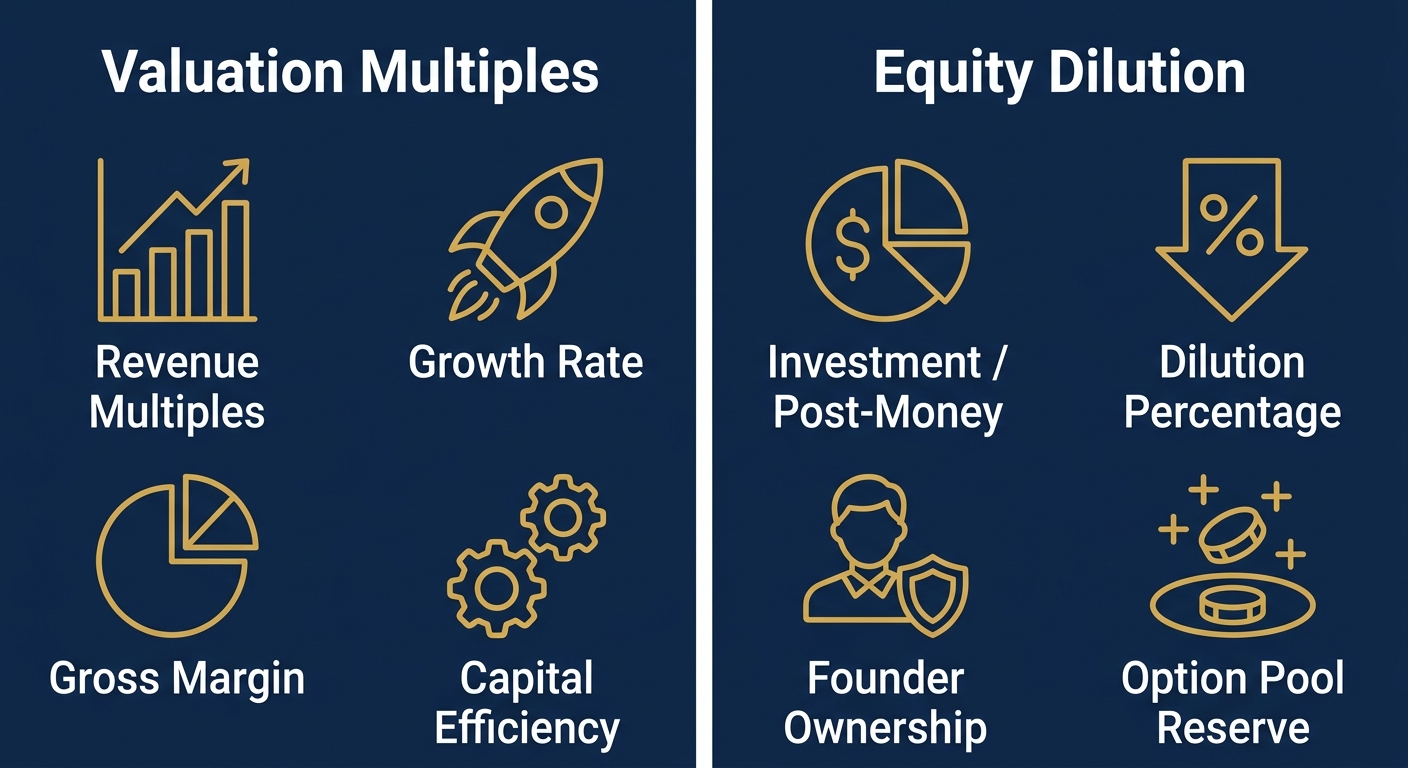
Venture investors typically apply revenue multiples to normalize a startup’s value, especially in fintech where recurring revenue models predominate. Series A valuation multiples for early-stage fintech firms typically range from 2× to 10× trailing or annualized revenue. The three key drivers are total addressable market (TAM), trailing twelve-month revenue growth rate, and gross margin profile. TAM signals scalability, growth validates product-market fit, and margin profile indicates profitability potential. Fintech companies often command premium multiples due to strong unit economics and network effects – see how we approach fintech capital raising in our dedicated resource.
Five-stage venture capital due diligence process from data room to closing
Decoding Series A valuation multiples and equity dilution dynamics for founders
With the valuation framework established, the next critical piece is understanding how that valuation translates into ownership changes. The image above illustrates the interplay between valuation drivers and dilution, but let’s break down the math.
Equity Dilution Dynamics
At its core, dilution is calculated as new investor ownership percentage = investment amount / post-money valuation. For example, an $8 million investment at a $40 million post-money valuation gives the new investors 20% of the company. This simple formula underpins every Series A negotiation. Typical dilution for founders and seed-stage shareholders in a Series A round lands between 15% and 30%, with 20% to 25% viewed as the sweet spot that balances growth capital with founder control. To justify the chosen multiple and minimize dilution, founders must present a well-constructed financial model and an Investor due diligence checklist that validates assumptions around revenue projections, capital efficiency, and market penetration. Without rigorous financial documentation, investors may apply a discount that needlessly erodes founder ownership.
Understanding Series A multiples sets the stage for scaling through follow-on rounds. As a Boutique M&A and Capital Advisory Firm, Zaidwood Capital helps founders navigate these mechanics with data-driven precision – our Precision Catalyst approach equips them to negotiate from strength and preserve the equity they’ve worked to build.
Navigating the Venture Capital Due Diligence Process Successfully
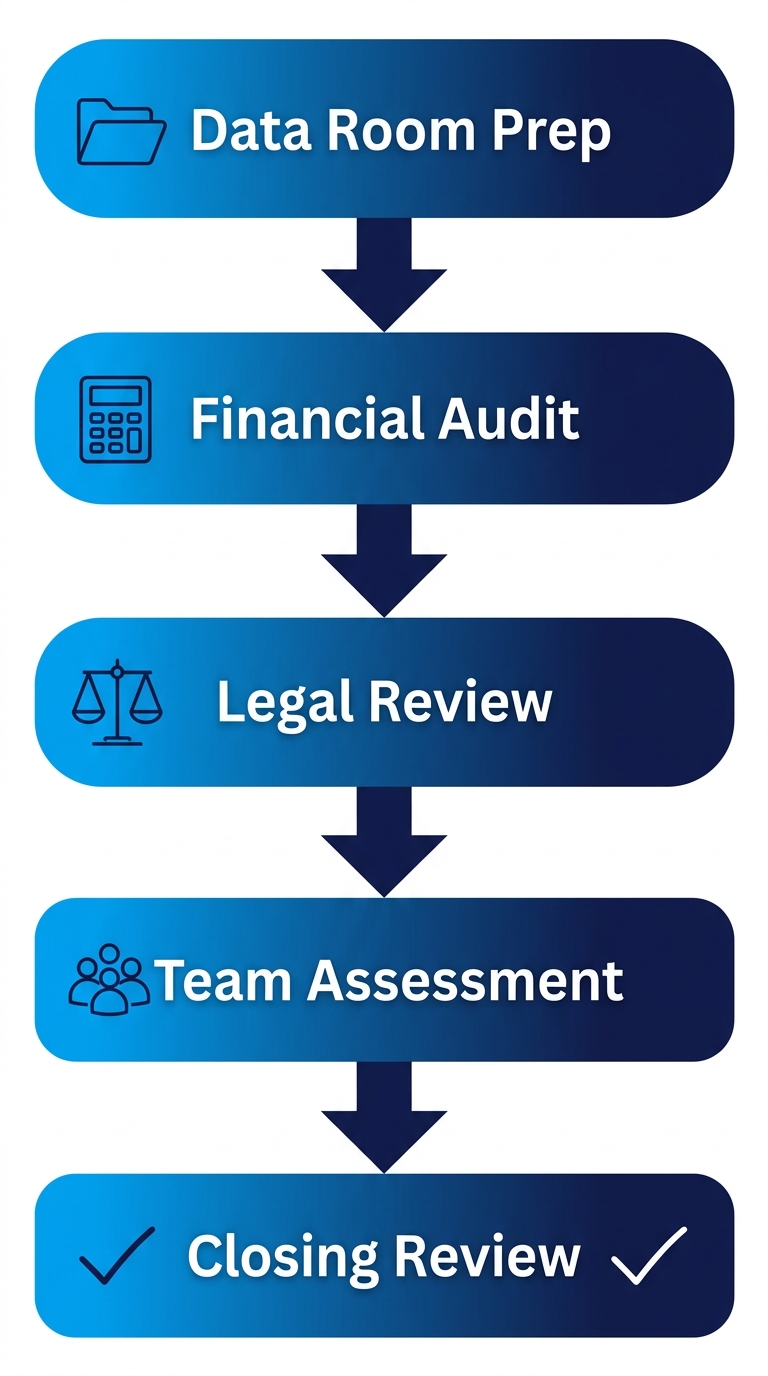
Once you have attracted investor interest, the next critical step in raising venture capital for startups is navigating the due diligence process successfully. This phase is where potential investors rigorously examine every aspect of the business, and the thoroughness of your preparation often determines whether a round closes smoothly or collapses under the weight of unanswered questions.
Start by having audited financial statements, robust financial projections, and a fully updated capitalization table ready. Investors will scrutinize your numbers in detail, comparing your assumptions against industry benchmarks such as Series A valuation multiples to gauge the credibility of your forecasts. Having these documents organized and verified by a qualified accountant signals operational maturity.
Legal readiness is equally critical. Founders must assemble certificates of incorporation, bylaws, intellectual property assignments, and all material contracts, ensuring that employment agreements clearly define roles and that every equity grant is properly documented. For startups that operate in regulated sectors, due diligence extends to a careful review of compliance with rules set by the U.S. Securities and Exchange Commission (SEC) and the Financial Industry Regulatory Authority (FINRA). Offerings that rely on Regulation D exemptions, for instance, require meticulous attention to filing requirements, accredited investor verification, and anti-fraud provisions–all of which investors will examine closely during their legal review.
A well-structured virtual data room substantially accelerates the process. We advise founders to organize the data room into clearly labeled categories: financials, legal, team, market, and intellectual property. This structure maps directly onto the investor due diligence checklist and demonstrably reduces the back-and-forth that can delay closing. Within the market folder, be sure to include third-party market sizing data, competitive analyses, and evidence of customer traction.
For founders in specialized fields like medical device capital raising, regulatory due diligence from the FDA adds an extra layer of complexity, making early preparation essential. Across all industries, the same pitfalls recur: incomplete files, inconsistent data between the pitch deck and the data room, and a reluctance to disclose known gaps proactively. Ignoring regulatory requirements altogether is a sure way to terminate a promising process.
Decoding Series A valuation multiples and equity dilution dynamics for founders
Five-stage venture capital due diligence process from data room to closing
A well-executed due diligence journey not only validates the company’s fundamentals but also builds the confidence investors need to move forward. When founders treat preparation as a continuous discipline throughout the venture capital fundraising journey, they set the stage for productive term sheet discussions and a faster path to close.
Positioning Your Startup for Capital Formation Success
Successfully raising venture capital for startups demands deliberate positioning to attract institutional investors and differentiate in a crowded market. We help founders structure their approach to maximize funding odds.
A compelling narrative that ties your value proposition to clear market opportunity and competitive advantage is fundamental to raising venture capital for startups. A data-backed story strengthens investor confidence.
Realistic financial projections and awareness of benchmarks like Series A valuation multiples set realistic expectations. We advise on metrics that matter to institutional investors.
Our Investor due diligence checklist covers legal, financial, operational, and market risks, enabling you to address gaps before investor scrutiny. Proactive readiness accelerates trust.
Leverage platforms like Sovereign Data Nexus to validate market assumptions. Precision Catalyst’s AI-driven matchmaking and our Velocity Matrix rapid-execution framework accelerate positioning and deal execution.
Once positioned, the next step is choosing the right capital structure–our advisory team guides every phase.
Resources


