


Growth Equity Investment
Table of Contents
Growth Equity Investment: A Strategic Path for Growth-Stage Companies
Growth equity investment provides a strategic path for growth-stage companies seeking expansion capital while retaining control. Representing a minority stake–typically 10-40%–Growth Equity allows revenue-generating firms to scale operations, enter new markets, or fund acquisitions without a majority change of control. According to SIFMA data, the shift toward later-stage private capital has accelerated, reflecting growing demand for flexible growth financing.
For companies evaluating growth equity investment, the key benefit is access to capital plus strategic guidance, industry networks, and operational support–all while maintaining management control. In the US, middle market valuation multiples for such transactions typically range between 2 and 5 times EBITDA, and common growth equity deal terms include convertible notes or redeemable preferred shares that preserve financial flexibility. This minority-growth structure allows founders to accelerate expansion without dilution of decision-making authority. FINRA advises investors to conduct thorough due diligence on private placements, examining the business model, use of proceeds, and exit strategy. Moreover, the current market momentum–fueled by a robust fundraising environment–has made growth equity a compelling option for mid-sized companies seeking expansion without diluting ownership control.
Our Growth Equity Advisory service leverages our proprietary Sovereign Data Nexus platform and Precision Catalyst AI to identify matching institutional investors and streamline engagement. We provide curated introductions, strategic positioning, and transaction support while ensuring that securities are offered through Finalis Securities LLC–Zaidwood Capital is not a registered broker-dealer. In the next section we explore how growth equity advisory aligns with middle-market valuation trends and deal structures.
Understanding Growth Equity and Its Distinction from Venture Capital
To fully grasp the opportunity, one must first understand What Is Growth Equity and how it differs from venture capital. A growth equity investment targets mature, revenue-generating companies with proven product-market fit and consistent cash flow. Unlike venture capital, which backs early-stage ideas with uncertain outcomes, growth equity focuses on scaling enterprises that are past the survival phase.
Typical growth equity targets generate $10 million to $100 million in revenue and maintain positive EBITDA. A growth equity investment often finances geographic expansion, product extensions, acquisitions, or recapitalizations that let founders diversify holdings while retaining control. SIFMA data indicates growth equity has become a significant component of private capital portfolios, reflecting institutional demand for mid-stage companies with proven fundamentals. These companies have established management teams, defensible market positions, and recurring cash flow, making them attractive for investors seeking lower volatility than early-stage ventures.
Venture capital, by contrast, targets startups at the seed or Series A stage, often before revenue or product launch. The failure rate is high, but successful exits can yield exponential returns. Growth equity investors accept moderate risk, relying on existing cash flows to service capital and fund expansion. Unlike VC’s emphasis on rapid growth at any cost, growth equity prioritizes sustainable scaling and profitability. Deals usually involve minority equity stakes with robust governance rights rather than majority control.
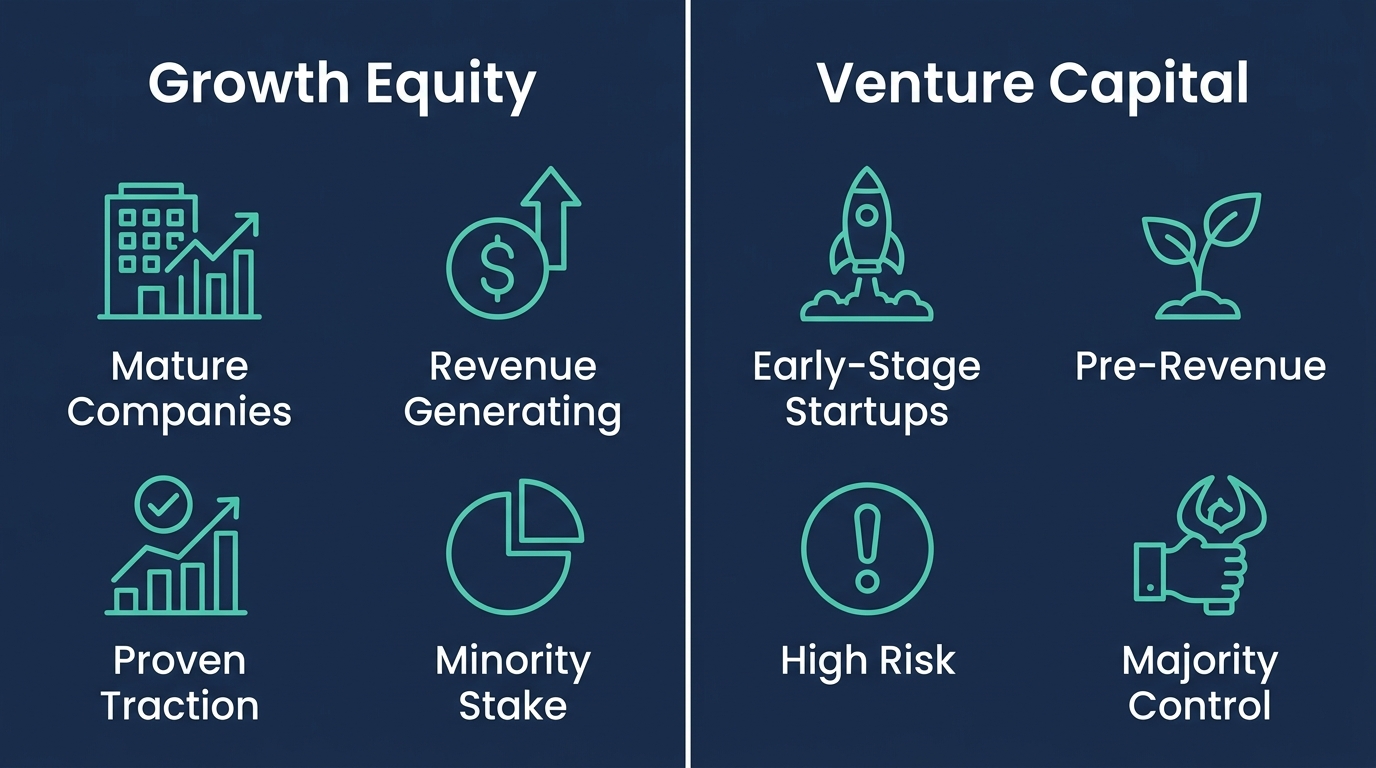
Comparison infographic of Growth Equity and Venture Capital characteristics
With these structural differences clear, valuation becomes a key consideration. Middle market valuation multiples for growth equity deals typically range from 4× to 8× EBITDA, influenced by sector, growth trajectory, and market conditions. Companies with recurring revenue streams and strong margins command premiums, while those facing cyclical headwinds settle toward the lower end. This framework allows investors to align entry pricing with a company’s earnings capacity.
Common growth equity deal terms include convertible preferred equity with participation rights, board seats, anti-dilution clauses, and tag-along and drag-along provisions. As a Boutique M&A and Capital Advisory Firm, we structure these terms to balance investor protection with operational freedom, enabling management to pursue ambitious growth plans. The next section examines how these terms are applied in real-world transactions.
This content is for informational purposes only and does not constitute an offer or solicitation.
Key Criteria and Evaluation Framework for Growth Equity Investors
Understanding growth equity is essential, but the real challenge lies in evaluating opportunities. At Zaidwood Capital, our framework for growth equity investment combines rigorous financial metrics with qualitative analysis to identify companies with long-term potential.
Quantitative Metrics Used by Growth Equity Investors
We focus on three core financial metrics that growth equity investors typically scrutinize:
- Revenue Growth: Consistent year-over-year revenue expansion of at least 20% signals strong market demand and product-market fit. Companies achieving this threshold often exhibit robust market traction and are well-positioned to capture industry share. We benchmark top-line growth against sector peers to confirm the trajectory is sustainable.
- EBITDA Margin: A margin of 15% or higher demonstrates scalability and operational efficiency. This level of profitability indicates that the business can generate ample internal capital to fund expansion while maintaining healthy margins. It also suggests a lean cost structure and effective pricing power.
- Free Cash Flow Yield: We target a free cash flow yield of 5% or above, as sustainable cash generation allows the company to reinvest in growth without over-reliance on external funding. This metric provides a critical buffer against market cycles and underscores the company’s ability to create long-term value.
By applying these thresholds, we at Zaidwood Capital can distinguish businesses that are merely expanding top-line revenue from those that can sustain profitable growth. This distinction is fundamental in growth equity investment, where the objective is to back companies with durable cash flow profiles and scalable operations.
Qualitative Factors in the Evaluation Process
Beyond the numbers, qualitative strengths often determine long-term success. We thoroughly evaluate the management team’s experience, including their ability to scale operations, navigate competitive landscapes, and execute strategic pivots. A leadership group with a proven track record of successful exits inspires confidence in the execution pathway.
Market size is equally critical. We prefer opportunities where the total addressable market surpasses $1 billion, providing ample runway for multi-year expansion. Geographic diversification is also important; we explore opportunities to extend growth into new regions, including expansion through emerging markets M&A, which can unlock high-growth demand in developing economies.
Competitive moats protect long-term shareholder value. Our evaluation focuses on durable advantages such as proprietary technology, network effects, or regulatory barriers that prevent easy replication. These moats support pricing power and customer retention, directly enhancing cash flow stability. Additionally, we scrutinize customer concentration risk. If the top three clients represent more than 50% of revenue, we view it as a significant red flag, as the loss of a key account could severely disrupt financial performance. Collectively, these qualitative factors directly shape the growth equity deal terms we negotiate, balancing risk and alignment with the company’s growth stage.
Industry Benchmarks and Valuation Multiples in Middle Market
The table below summarizes typical EBITDA multiple ranges across key middle-market industries, sourced from SIFMA market data and Zaidwood Capital’s transaction experience.
| Industry | EBITDA Multiple Range (2025-2026) | Key Drivers |
|---|---|---|
| Technology | 10x – 15x | Recurring revenue, high growth rates |
| Healthcare | 8x – 12x | Regulatory tailwinds, demographic demand |
| Business Services | 6x – 10x | Contract stickiness, scalable delivery |
| Consumer Goods | 5x – 8x | Brand loyalty, e-commerce penetration |
| Industrial | 5x – 7x | Capital intensity, cyclical exposure |
According to SIFMA’s Capital Markets Fact Book, these middle market valuation multiples are influenced by revenue growth and interest rates. Companies that consistently outperform on top-line growth command premium multiples, as investors anticipate higher future cash flows. In contrast, rising interest rates typically compress enterprise value multiples, since higher discount rates reduce the present value of those future cash flows. We use these benchmarks to anchor valuation discussions, helping buyers and sellers set realistic expectations. These evaluation criteria inform the negotiation of deal terms and valuation, which we explore in the next section.
This information is for illustrative purposes only and does not constitute investment advice. See full disclaimers.
Navigating Growth Equity Deal Terms and Structuring Your Investment
Once a target is identified, negotiating the right deal terms in a growth equity investment is critical to protect capital and governance rights. Understanding the standard protective provisions, liquidation preferences, anti-dilution mechanisms, and board rights helps minority investors structure a partnership-oriented investment that aligns interests.
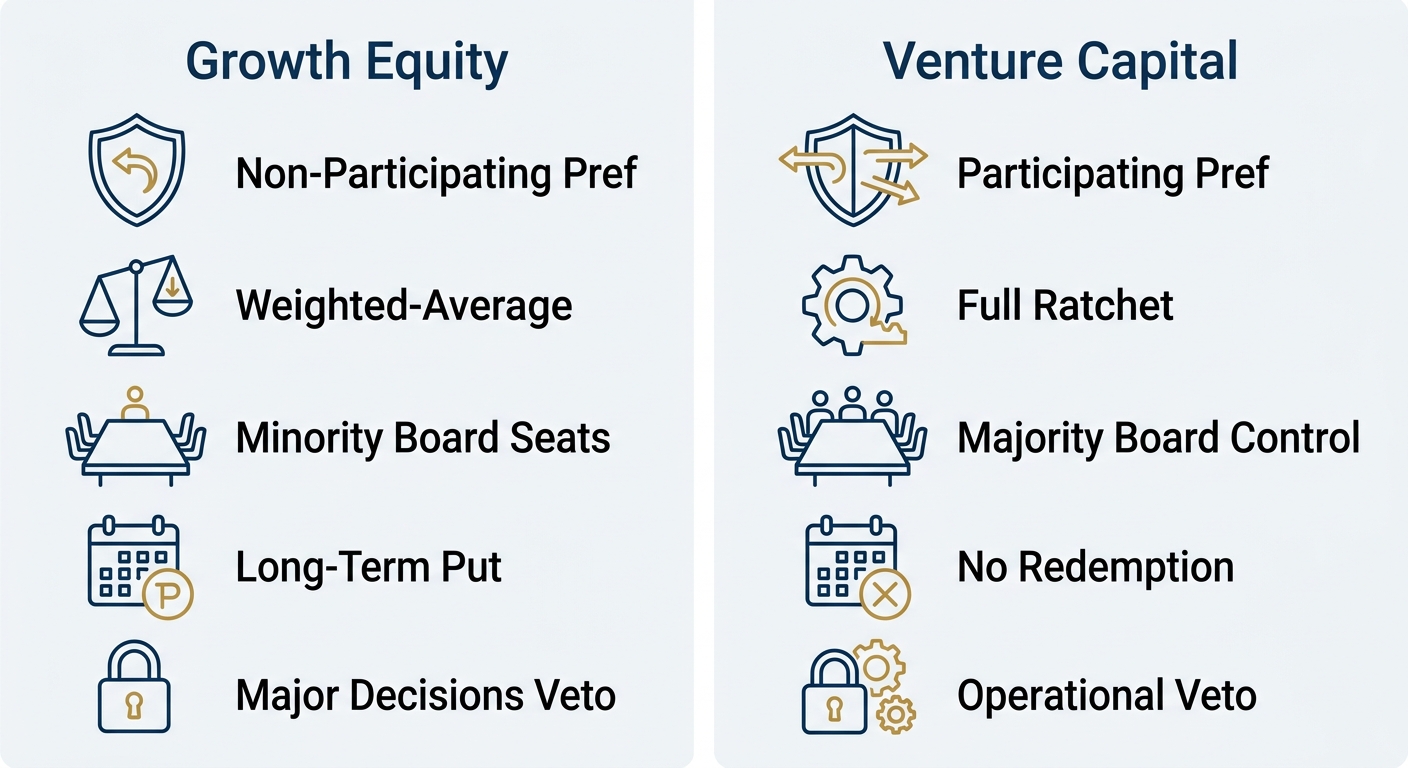
Side-by-side comparison of growth equity and venture capital deal terms.
Standard Protective Rights and Governance Structures
Growth equity protective provisions are limited to major corporate events rather than day-to-day operations. According to FINRA, minority investors commonly obtain veto power over mergers, acquisitions, sale of the company, amendments to the charter, and changes in control–the very events that could materially alter investment value. A boutique merger and acquisition advisory firm can guide minority investors in negotiating these protective provisions and ensuring they are precisely captured in the shareholders’ agreement. In addition, investors receive robust information rights: they are entitled to receive monthly or quarterly financial statements, annual budgets, and the right to inspect books and records, all subject to strict confidentiality. Tag-along (co-sale) rights further protect minority shareholders: if founders decide to sell their shares, investors may join the transaction pro rata, thereby avoiding dilution and securing a proportional exit. These co-sale provisions are a cornerstone of minority protection in growth-stage deals.
To illustrate how growth equity terms diverge from venture capital norms, the table below summarizes key term sheet provisions. The comparison highlights typical differences observed across middle-market transactions.
| Term | Growth Equity | Venture Capital |
|---|---|---|
| Liquidation Preference | 1x non-participating (common) | 1x participating preferred (common) |
| Anti-Dilution | Weighted-average (broad-based) | Weighted-average or full ratchet |
| Board Seats | 1-2 seats (minority) | Majority board control |
| Redemption Rights | Typically 5-7 year put | Rarely used (liquidation via IPO) |
| Protective Provisions | Limited to major decisions (M&A, sale) | Extensive veto rights over operations |
These differences reflect a partnership approach in growth equity, where investors gain meaningful protections without exerting broad operational control, unlike venture capital’s often more expansive safeguards. Consequently, growth equity term sheets tend to be more concise and oriented toward partnership, while VC sheets reflect a more intense oversight role.
Liquidation Preferences and Anti-Dilution Provisions
In growth equity transactions, the standard liquidation preference is a 1x non-participating preferred. This means investors recoup their original investment before common shareholders, but they do not participate in remaining proceeds beyond that threshold. This structure provides a floor when middle market valuation multiples compress during a down round–ensuring capital return even if the company exits at a lower overall value. The 1x, non-participating structure aligns founder and investor incentives by limiting dilution and keeping management engaged. By contrast, venture capital often employs 1x participating preferred, which allows investors to double-dip by both receiving their initial investment and then sharing in remaining proceeds.
For anti-dilution, growth equity deal terms typically rely on weighted-average broad-based provisions. As SIFMA data illustrates, if a subsequent financing prices shares at $5 after a $10 initial round, the conversion price adjusts using a formula that accounts for the lower price and the total number of outstanding shares. This adjustment dilutes founders less severely than a full ratchet, which would simply reduce the conversion price to the new, lower share price. Broad-based formulas include all potentially dilutive securities, which spreads the impact and keeps founder dilution manageable. The weighted-average approach balances founder and investor interests, making it a middle-market standard.
Board Representation and Redemption Rights
Board representation in growth equity investments is typically limited to 1-2 seats as minority directors or observers. This contrasts with venture capital, where investors frequently demand majority board control to direct company strategy. Often the rights are structured as board observer positions rather than full voting directors, enabling the investor to monitor financials and strategic direction while preserving management’s operational autonomy. The presence of an investor director helps align governance without tilting the balance toward control.
Redemption rights in growth equity deal structures commonly take the form of a put option exercisable after 5-7 years. Under such provisions, the company is obligated to repurchase the investor’s shares at an agreed-upon price upon occurrence of specified triggers, such as failure to achieve a liquidity event. Redemption is only available if the company has sufficient legally available funds, and it often includes a minimum return (e.g., a premium over the original investment) to compensate the investor for illiquidity. These rights provide a path to liquidity if an IPO or strategic sale does not materialize within the expected timeframe. In venture capital, redemption rights are rarely included because the preferred exit route is an IPO. These terms collectively ensure minority investors have visibility, protection, and a path to liquidity.
Middle Market Valuation Multiples and Exit Strategies
Understanding current valuation multiples is the first step in crafting a successful exit strategy, especially for owners considering a growth equity investment as part of their long-term plan. For middle-market companies–typically with revenues between $10 million and $1 billion–EBITDA multiples commonly range from 5× to 8×, according to the Securities Industry and Financial Markets Association (SIFMA)’s Capital Markets Fact Book. Industry growth rates, margin profiles, and market position all influence where a business falls within this range. Middle market valuation multiples serve as a critical benchmark, helping us frame a realistic price for any transaction.
Middle-market business owners have three primary exit pathways. A strategic sale to a larger company often yields the highest valuation, as acquirers can extract cost synergies. A growth equity investment allows founders to take partial liquidity while bringing in capital for expansion–typical growth equity deal terms include preferred returns, board seats, and anti-dilution provisions. Management buyouts or recapitalizations, meanwhile, offer a path for existing leadership to own more equity. Each strategy requires distinct valuation considerations, stressing the importance of robust financial modeling and market intelligence. We coordinate timing, stakeholders, governance, and documentation to optimize outcomes.
Many business owners rely on boutique capital advisory services to assess valuation multiples and structure optimal exits. At Zaidwood Capital, our Business Valuation Services and Sell-Side Advisory draw on the proprietary Sovereign Data Nexus to benchmark multiples, uncover hidden value drivers, and refine exit strategies for middle-market firms. By combining real-time industry data with our full-cycle M&A expertise, we help clients decide between a strategic sale and a growth equity path that aligns with their long-term vision and transaction objectives. Once a company understands its valuation range, a structured sell-side process can maximize transaction value.
Frequently Asked Questions About Growth Equity Investment
Here are common questions about growth equity investment.
What is growth equity investment?
Growth equity investment provides mature, revenue-generating companies with private capital to scale without a control stake.
How does growth equity differ from venture capital and private equity?
Unlike VC (startups) and PE (majority buyouts), growth equity targets established, revenue-generating companies.
What are typical valuation multiples for growth equity deals in the middle market?
Middle market valuation multiples for growth equity deals rely on revenue or EBITDA multiples.
What growth equity deal terms should companies expect?
Growth equity deal terms often include minority stakes, board seats, anti-dilution, and liquidation preferences.
How does Zaidwood Capital assist in raising growth equity?
We provide mid-market investment banking services to guide companies through the growth equity process.
What are the risks associated with growth equity investments?
Investments involve risk and are not guaranteed. Zaidwood Capital is not a registered broker-dealer; securities offered through Finalis Securities LLC.
Partnering with Zaidwood Capital for Growth Equity Readiness
Growth equity investment readiness demands a strategic partner, not just capital. As a Boutique M&A and Capital Advisory Firm, we combine Sovereign Data Nexus (real-time middle market valuation multiples and growth equity deal terms), Precision Catalyst (AI-driven investor targeting), and the Velocity Matrix framework to accelerate growth equity investment readiness. Our tools create a comprehensive readiness process so management teams can confidently approach institutional equity. We then connect prepared firms to our network of 4,000+ investors and over $15 billion in capital. Outcomes vary. This partnership builds the foundation for successful institutional engagement.
Resources


