


What Is Growth Equity
Table of Contents
Understanding Growth Equity: A Strategic Financing Option for Scaling Companies
Growth Equity is a strategic financing option designed for mature startups and mid-market companies that need capital to scale without ceding operational control. When entrepreneurs ask what is growth equity, they’re referring to a minority-stake investment that bridges the gap between early-stage venture capital and full buyout private equity.
Unlike debt, growth equity does not require regular interest payments and typically comes with a longer exit horizon, aligning investor returns with company performance. This growth capital is deployed through a minority stake investment, giving founders the resources to expand into new markets, fund acquisitions, or accelerate product development while retaining strategic direction.
Whereas venture capital targets early-stage, high-risk startups and buyout/private equity firms seek majority control, growth equity occupies the middle ground. It’s ideal for companies with a proven business model, positive cash flow, or recurring revenue–businesses that have moved past startup risk but still need capital to reach the next level of growth.
At Zaidwood Capital, our Growth Equity Advisory service leverages our proprietary Sovereign Data Nexus platform and AI-driven Precision Catalyst to connect scaling companies with the right minority-stake investors. This allows founders to secure expansion capital without sacrificing strategic independence. In the following sections, we explore how growth equity can drive scalable growth.
Growth Equity, Venture Capital, and Traditional Private Equity: Key Differences
To fully understand growth equity, it helps to place it alongside venture capital and traditional private equity. Growth equity–often referred to as a Growth Equity Investment–represents a minority stake investment in growth-stage companies with proven business models and revenues typically between $5 million and $100 million. This form of growth capital bridges the gap between early-stage venture capital and mature private equity, allowing investors to partner with management to scale operations without ceding control. Understanding these distinctions is critical for founders and investors operating in the U.S. growth capital market.
The table below, drawing on benchmarks from the Securities Industry and Financial Markets Association (SIFMA), highlights the key differences across four dimensions: company stage, typical ownership stake, control and governance, and return expectations.
| Criteria | Growth Equity | Venture Capital | Traditional Private Equity |
|---|---|---|---|
| Company Stage | Growth stage: proven business model, revenue of $5M-$100M, scaling | Early stage: pre-revenue to early revenue, high uncertainty | Mature stage: stable cash flows, may need turnaround or LBO financing |
| Typical Ownership Stake | Minority (20%-40%) | Minority (10%-30%) | Majority (50%+) |
| Control & Governance | Investor takes board seat(s), limited operational control | Investor may take board seat, high involvement in strategy | Investor controls board and management, operational restructuring |
| Return Expectation | 2-5x multiple, 3-7 year horizon | 10x+ potential, longer hold period | 3-5x, financial engineering & cost optimization |
The fundamental distinction lies in the stage of company and the level of control sought. Growth equity occupies a unique middle ground, offering minority stakes in established but still scaling companies, while venture capital fuels unproven startups and traditional private equity takes majority control of mature businesses for operational improvement. According to SIFMA data, growth equity investments typically have a 3- to 7-year horizon with 2-5x return targets, while venture capital targets 10x+ over longer periods and traditional private equity aims for 3-5x by optimizing cash flows. This pattern guides investors in aligning risk and return objectives with the appropriate strategy.

Key differences between Growth Equity, Venture Capital, and Traditional Private Equity.
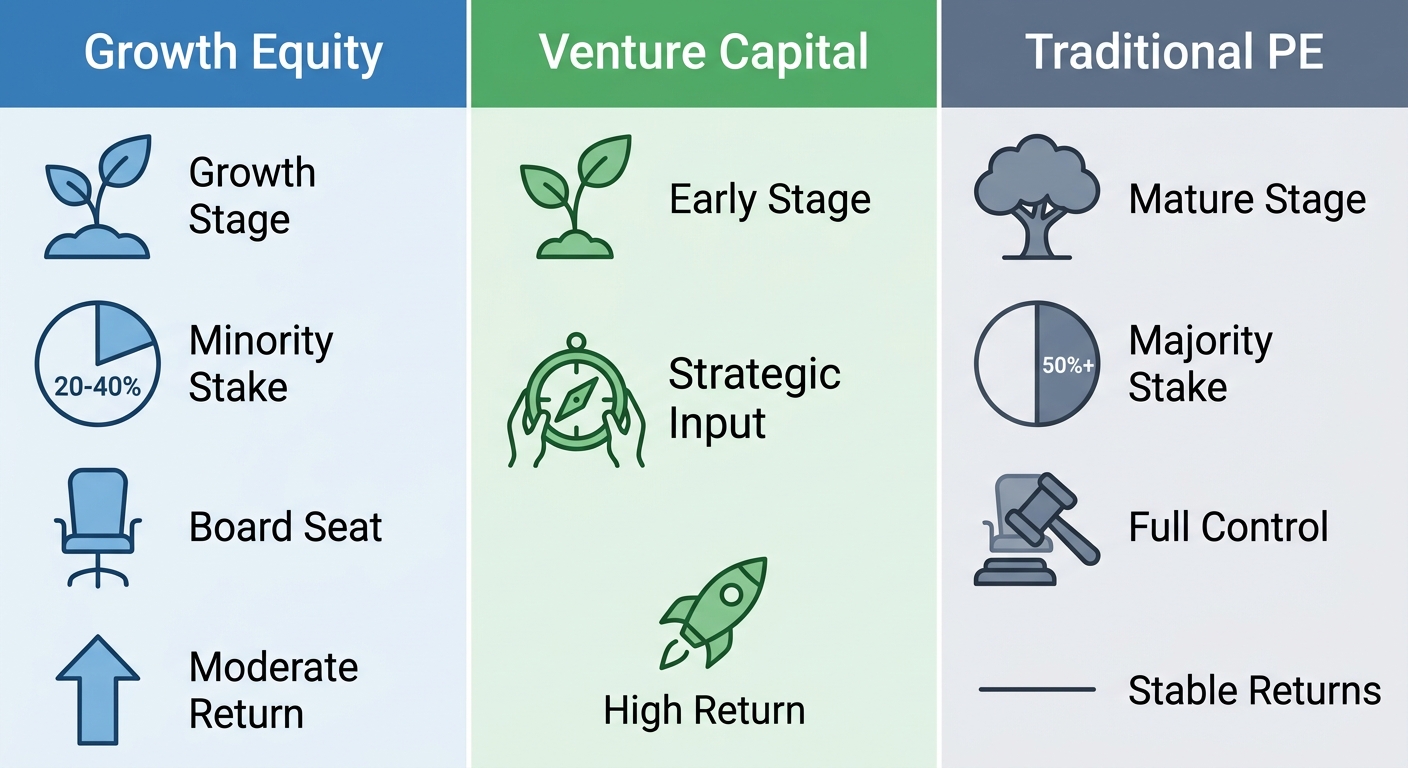
Key differences between Growth Equity, Venture Capital, and Traditional Private Equity.
This visual reinforces how growth equity occupies a distinct middle ground, with minority ownership and moderate return expectations compared to the extremes of venture capital and traditional private equity. In the U.S. market, these categories reflect the capital structure preferences of entrepreneurs and the risk appetite of institutional investors.
With this clarity, we can explore how Zaidwood Capital’s Growth Equity Advisory helps companies navigate this middle path. As a Boutique M&A and Capital Advisory Firm, we leverage our 80+ years of collective experience and a network of 4,000+ investors to secure minority stake investments for growth-stage companies. Our expertise in growth equity capital formation enables founders to access the right partnership while retaining control. By understanding these nuanced strategies, businesses can better position themselves for the right type of investor. (Note: references to SIFMA or other organizations do not constitute endorsements.)
How Growth Equity Investors Evaluate, Structure, and Execute Deals
To understand what is growth equity, one must first examine how investors evaluate, structure, and execute deals in this asset class. With that foundation, we now turn to the practical mechanics: the criteria investors use, the deal structures they negotiate, and the governance rights they secure.
Investment Criteria for Growth Equity
Growth equity investors seek companies that have moved beyond bootstrapping and are ready for first-institutional capital. They apply a rigorous filter centered on four attributes:
- Proven product-market fit – demonstrated by growing revenue, repeat customers, and strong unit economics.
- Strong management team – seasoned leaders who have scaled operations and can execute a growth strategy.
- Large addressable market ($1B+) – a market large enough to absorb rapid expansion and generate outsized returns.
- Clear growth plan with measurable milestones – a detailed roadmap for deploying capital into sales, marketing, or product development.
These criteria separate growth equity from earlier-stage financing. Companies that meet them typically seek growth capital to accelerate market penetration, expand geographically, or launch new products. At Zaidwood Capital, we work with such companies to present a compelling case to institutional investors, aligning strategy with the metrics that matter.
Deal Structures and Ownership Terms
Growth equity typically takes a minority stake of 20%-40%, using preferred equity with liquidation preferences and anti-dilution protection. This allows founders to retain control while accessing growth capital. A minority stake investment aligns incentives without the loss of operational autonomy that comes with a majority sale.
The distinction between minority and majority stakes shapes valuation, exit timing, and governance. SIFMA industry data highlights the trade-offs:
| Attribute | Minority Stake | Majority Stake |
|---|---|---|
| Ownership Stake | 20%-40% | 50%+ |
| Control & Governance | Board seat(s), veto rights; founders retain control | Full board control, management replacement |
| Valuation Method | Revenue multiple, founder-negotiated | EBITDA multiple, detailed due diligence |
| Exit Timeline | 3-7 years, IPO/secondary sale | 3-5 years, strategic sale/recap |
A minority investment preserves founder agility, while a majority position can force a complete exit on a shorter timeline. The choice depends on the company’s stage and investor objectives. Our capital advisory services help growth-stage companies navigate these structures, leveraging our platform Sovereign Data Nexus and Precision Catalyst to connect with aligned capital partners.
Governance Rights and Protective Provisions
Even with a minority stake, growth equity investors negotiate governance rights to safeguard their investment. These provisions create a balanced partnership without displacing the founding team. Typical rights include:
- Board representation – investors gain one or more non-controlling board seats, allowing them to participate in strategic discussions and major budget approvals.
- Veto or protective provisions – rights to block significant corporate actions such as a change in control, large asset sales, or amendments to the capital structure that could dilute their stake.
- Information rights – access to monthly or quarterly financial reports and operational metrics, ensuring timely insight into performance and the ability to intervene if milestones are missed.
Together, these governance tools align the interests of founders and investors, maintaining the entrepreneurial momentum that attracted the capital while providing the oversight needed for a minority stake investment. They underscore growth equity’s function as a bridge between bootstrapping and institutional financing.
Having covered the investor perspective, we next explore how growth equity fits into a company’s overall capital strategy.
Practical Applications of Growth Capital for Scaling Middle-Market Companies
To understand what is growth equity in practice, middle-market companies deploy it across a focused set of high-impact initiatives that accelerate expansion without the burden of fixed monthly repayments. As a Boutique M&A and Capital Advisory Firm, we see growth capital deployed in three primary ways: fueling market expansion and product development, bridging gaps where traditional bank debt falls short, and financing acquisitions that position companies for eventual exit. Each application leverages patient equity to unlock value that would otherwise remain trapped behind cash-flow constraints.
Using Growth Capital for Market Expansion and Product Development
Consider a specialty manufacturer with a proven product line and strong regional demand but limited resources to enter a new geographic market or launch a complementary product. Growth capital provides the funding to scale a sales team, build out distribution channels, and invest in brand marketing without diverting cash from operations. Because growth capital often involves a minority stake investment, founders retain control while gaining the strategic support and board-level guidance that an institutional investor brings.
Product development presents a similar dynamic. A middle-market software company might identify a clear gap in its product suite that existing customers are requesting, yet lack the on-hand capital to fund the R&D cycle. Growth equity finances the build-out, allowing the company to capture additional wallet share and deepen competitive moats before competitors respond. The absence of fixed repayment schedules means management can focus on execution rather than servicing debt during the critical launch window.
Growth Capital vs. Traditional Bank Debt: Making the Right Choice
A common trigger for exploring growth capital is a company with clear scaling opportunities but insufficient cash flow to comfortably cover loan repayments. Traditional bank loans require predictable, timely payments of principal and interest, which can suffocate a growing company that needs to reinvest earnings into people and infrastructure. Growth capital, by contrast, carries no fixed repayment obligation and instead aligns the investor’s return with the company’s long-term value creation.
The table below helps middle-market leaders assess which financing method fits their situation across key dimensions such as use case, repayment structure, dilution, and timeline. Actual terms vary by deal, but the comparison provides a directional framework grounded in market norms.
| Attribute | Growth Capital | Bank Loan | Early-Stage Venture Capital |
|---|---|---|---|
| Use Case | Scaling proven business: market expansion, product development, acquisitions | Working capital, equipment, real estate | R&D, customer acquisition in early stage |
| Repayment | No fixed repayment; investment carries equity / convertible structure | Fixed monthly payments with interest | Equity only; no repayment pressure |
| Dilution | Moderate (20%-40% stake given up) | None (debt financing) | Higher (often 30%-50% in early rounds) |
| Timeline to Secure | 3-6 months with proper advisory support | Weeks to months (depending on credit) | 3-9 months (longer due to early-stage uncertainty) |
Growth capital offers flexibility without fixed repayment, making it ideal for scaling companies that lack the cash flow to service debt. Bank loans provide non-dilutive capital but demand steady cash flow, while early-stage venture capital involves higher dilution and longer timelines but suits pre-revenue traction. For middle-market firms already demonstrating product-market fit, growth capital occupies a strategic middle ground that protects the balance sheet while funding ambition.
Financing Strategic Acquisitions and Preparing for Exit
A manufacturing company looking to acquire a smaller competitor that owns critical distribution relationships often finds that cash reserves and senior debt alone cannot bridge the valuation gap. Growth capital fills this void, enabling the acquisition without over-leveraging the combined entity. The acquired revenue and operational synergies then compound the return on invested expansion capital, creating value that benefits both the sponsor and the original shareholders.
Beyond acquisitions, growth capital strengthens a company’s infrastructure ahead of a planned exit. Companies approaching exit can use growth capital to fund comprehensive sell-side m&a preparation, including financial audits, legal structuring, and buyer outreach. Investments in a new manufacturing facility or upgraded ERP systems simultaneously boost near-term capacity and signal to acquirers that the business operates on a scalable, institutional-grade foundation.
These real-world applications illustrate growth capital’s versatility. According to SIFMA, growth capital has become a prominent tool for scaling middle-market firms, reflecting a broader shift toward flexible equity solutions in capital formation. Next, we examine the process of securing such financing and building a compelling case for investors.
Advanced Considerations in Growth Equity Transactions: Valuation and Dilution
Having established what growth equity is, advanced considerations such as valuation and dilution become critical in structuring successful transactions. For companies seeking growth capital, understanding how pre-money and post-money valuation impact ownership is essential. A minority stake investment, for example, will dilute existing shareholders, but the right structure brings strategic value beyond just the capital infusion.
Valuation in Growth Equity
Growth-stage companies are often valued using revenue multiples rather than EBITDA multiples, as many prioritize top-line expansion over profitability. Industry benchmarks–such as those tracked by authoritative bodies like the Securities Industry and Financial Markets Association–provide context for these multiples, but every business is unique. We emphasize aligning valuation assumptions with realistic growth projections, as overvaluation can create future fundraising hurdles. Our proprietary Sovereign Data Nexus platform aggregates market data to give clients a clearer picture of where their business stands among peers, always without guaranteeing specific outcomes.
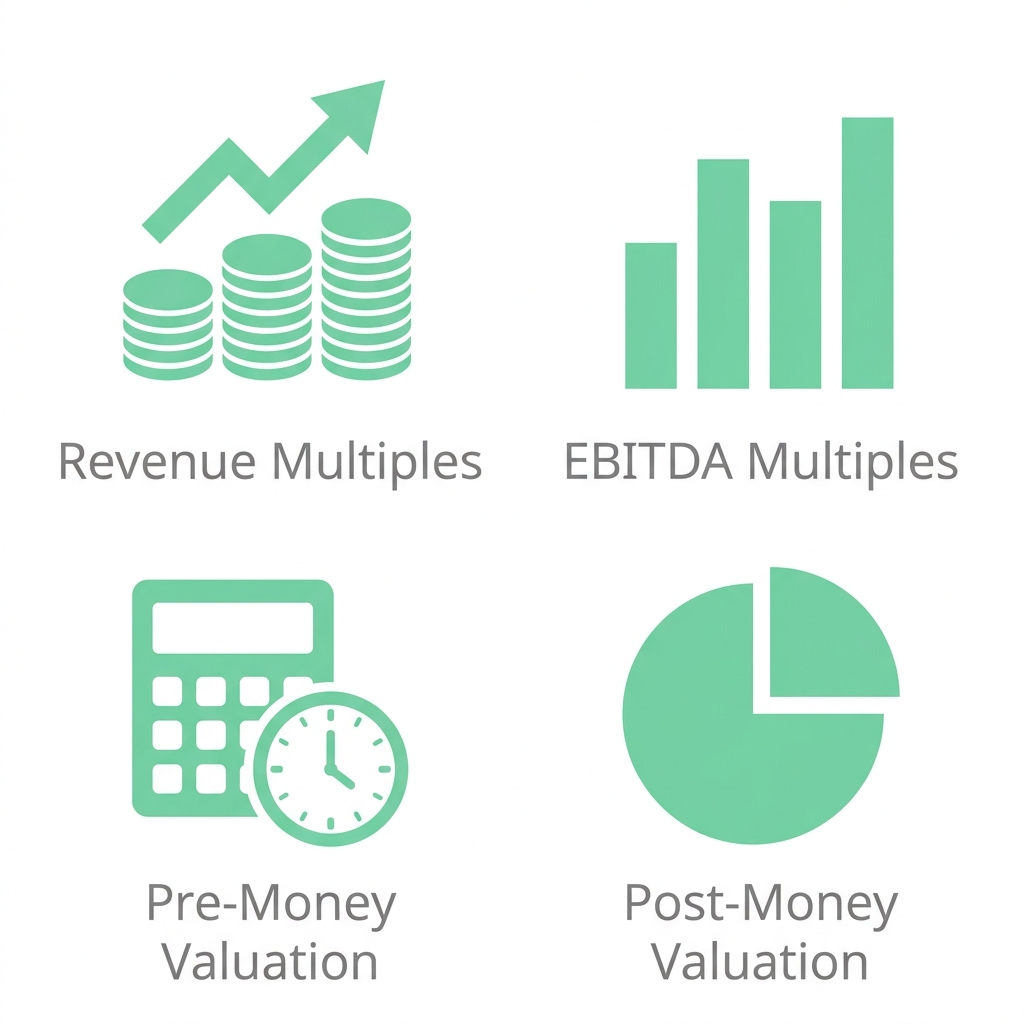
Icon set illustrating key valuation and dilution concepts for growth equity.
When using revenue multiples, the pre-money valuation directly determines the founder’s post-money dilution. For instance, if a company raises $5 million at a $20 million pre-money valuation, the post-money valuation becomes $25 million and the new investor receives a 20% stake. Understanding this math is foundational. EBITDA multiples may apply to more mature growth-stage companies with consistent earnings, but the methodology chosen should reflect the business’s life stage and industry norms.
Understanding Dilution
Dilution is not inherently negative. A minority stake investment brings capital that can accelerate expansion, product development, or market entry. We often advise founders that a smaller piece of a much larger pie can be more valuable than full ownership of a stagnant venture. That said, smart deal structuring is key. Anti-dilution provisions, such as weighted-average ratchets, can protect investors and founders from excessive dilution in future down rounds, aligning incentives and preserving value.
When navigating these complexities, engaging boutique investment banking services can help founders and investors optimize minority stakes and manage dilution with clarity. Our team brings data-driven insights to every negotiation, always mindful that each transaction is unique and that past performance does not indicate future results.
From initial valuation to final capitalization, we work alongside clients to structure growth equity deals that balance capital needs with long-term ownership strategy.
Frequently Asked Questions About Growth Equity
Here are answers to the most frequently asked questions about growth equity.
What is growth equity?
Growth equity is private capital for profitable, mature companies seeking expansion, not early-stage startups. It provides growth capital for scaling operations, entering new markets, or strategic acquisitions without relinquishing control.
How does growth equity differ from venture capital and private equity?
Venture capital funds early-stage, high-risk startups; private equity acquires controlling stakes. Growth equity uses minority stake investment structures (10-40%) with no operational control, often including board participation.
When is a company an ideal candidate for growth equity?
An ideal candidate has proven revenue, positive unit economics, and a clear growth plan but lacks capital to accelerate.
How can Zaidwood Capital help companies access growth equity?
We combine our no-nonsense financial services 3.0 advisory with deep institutional investor access to help you secure growth capital efficiently.
Ready to explore? Schedule a confidential consultation.
Partnering with a Capital Advisor for Your Growth Journey
When exploring what is growth equity for your business, partnering with a strategic capital advisor becomes the critical next step. As a Boutique M&A and Capital Advisory Firm, we combine a deep institutional network of 4,000+ investors and $15B+ capital access with our Sovereign Data Nexus platform to match you with the right growth equity partners. Our full-cycle advisory helps secure growth capital while structuring a minority stake investment that preserves founder control. We help you close the right growth equity deal faster.
Resources


