

Table of Contents
- The Essentials of Supply Chain Financing for Business Leaders
- How Supply Chain Financing Benefits Buyers and Suppliers
- Supply Chain Financing vs. Traditional Factoring: A Detailed Comparison
- Managing Risks and Best Practices in Supply Chain Finance Implementation
- Evaluating Supply Chain Financing as a Strategic Capital Solution
- Frequently Asked Questions About Supply Chain Financing
- Leveraging Supply Chain Financing for Sustainable Growth
The Essentials of Supply Chain Financing for Business Leaders
Supply chain financing (SCF) encompasses solutions such as reverse factoring and dynamic discounting that allow buyers to extend payment terms while suppliers receive early payment from a financial institution. This working capital optimization tool has become essential for business leaders seeking to strengthen liquidity and supplier relationships.
Effective SCF arrangements involve three key stakeholders: the buyer, the supplier, and the financing provider. As a Boutique M&A and Capital Advisory Firm, we understand that buyers can improve Days Payable Outstanding (DPO) and suppliers can reduce Days Sales Outstanding (DSO) while lowering supply chain disruption risk. Unlike traditional factoring or invoice discounting, which are supplier-centric, SCF is a buyer-led approach that does not add debt to the buyer’s balance sheet and often enhances overall liquidity. By accelerating cash conversion cycles, SCF can free up internal funds for growth investments without increasing leverage.
Our asset-based lending and working capital solutions can support SCF programs by providing the capital that flows between trading partners. Drawing on a network of over 4,000 investors and access to $15B+ in capital, Zaidwood Capital can structure bespoke working capital facilities that complement SCF arrangements. However, it is critical to recognize that supply chain financing does not guarantee improved financial outcomes. Each arrangement involves risk and requires thorough due diligence; companies should consult their own legal and financial advisors before proceeding.
Understanding these fundamentals sets the stage for exploring the specific structures available for implementing an SCF strategy.
How Supply Chain Financing Benefits Buyers and Suppliers
Supply chain financing benefits both buyers and suppliers by optimizing payment cycles and strengthening trade relationships. Unlike traditional trade credit, which often pits buyer and supplier interests against each other, this strategic working capital tool enables companies to manage cash flow more effectively without incurring additional debt. We at Zaidwood Capital help clients implement these programs, creating value on both sides of the transaction.
Benefits for Buyers
For buyers, supply chain financing extends days payable outstanding (DPO) without damaging supplier trust. By allowing a company to defer payments to a later date—often up to 60 or even 90 days—while the supplier receives early payment through the financing platform, the buyer preserves cash that can be reinvested in growth or used to reduce existing debt. This arrangement mirrors the working capital preservation achieved through equipment financing: just as equipment loans allow a business to acquire assets without depleting cash reserves, supply chain financing frees up liquidity that would otherwise be tied up in short-term payables. Moreover, offloading early-payment pressure to a third-party funder strengthens supplier relationships, giving suppliers reliable capital access that fosters collaboration and reduces disruption risk. We advise structuring programs so extended terms don’t strain partnerships.
Benefits for Suppliers
For suppliers, supply chain financing provides early payment at a far lower cost than factoring or merchant cash advances. By leveraging the buyer’s credit profile, suppliers can convert approved invoices into cash within days rather than waiting 30, 60, or 90 days. This rapid liquidity reduces reliance on expensive debt consolidation, which merely restructures old obligations without improving ongoing cash flow. Supply chain financing acts as a form of working capital for merchants, offering early payment without traditional debt. Suppliers can use the accelerated payments to fund raw material purchases, meet payroll, or invest in efficiency improvements without taking on high-cost debt. Unlike reactive restructuring, SCF aligns payment timing with actual cash conversion cycles, helping suppliers maintain a healthy debt-service coverage ratio and avoid the downward spiral that often triggers the need for consolidation. This flexibility is especially valuable for middle-market companies operating with thin margins.
These mutual benefits make supply chain financing a cornerstone of modern working capital management, transforming payment cycles into strategic assets for both parties. We at Zaidwood Capital help businesses design programs that unlock these advantages. Next, we will discuss how to implement a program effectively.
Supply Chain Financing vs. Traditional Factoring: A Detailed Comparison
Having explored the fundamentals of supply chain financing, we now compare this buyer-centric approach with traditional factoring. The differences in structure, risk, and relationship dynamics can substantially impact a company’s working capital strategy.
The Working Capital Optimization Framework
Supply chain financing is a cornerstone of modern working capital optimization, enabling companies to accelerate cash flow while preserving strong buyer–supplier relationships. By converting approved invoices into early payments for suppliers, this buyer-led approach shortens the cash conversion cycle and reduces days payable outstanding without straining the buyer’s own liquidity. In a typical SCF structure, the buyer approves an invoice and a third-party funder pays the supplier at a discount, with the buyer settling the full amount on the original due date—effectively extending the buyer’s DPO while injecting early cash into the supplier’s business. We integrate supply chain finance into a broader liquidity strategy that considers asset-based lending, dynamic discounting, and—where appropriate—global lending services to optimize cash flow across the supply chain.
A well-designed supply chain financing program not only frees up cash tied in receivables but also provides suppliers with access to lower-cost credit, which in turn strengthens supply chain resilience. The framework evaluates invoice volumes, supplier segmentation, and payment terms to identify which invoices are best suited for early discounting, as opposed to traditional factoring or outright payment term extensions. As a boutique M&A and capital advisory firm with deep expertise in payables advisory and asset-based lending, we help mid-market businesses structure these programs to complement existing bank lines and support growth objectives. This disciplined approach ensures that SCF delivers measurable improvements to the weighted average cost of capital and working capital ratios.
Key Differences from Traditional Factoring
While both supply chain financing and factoring accelerate supplier payments, they differ sharply in initiation, relationship impact, and cost. The table below outlines six critical dimensions that corporate treasurers should weigh when selecting a working capital tool.
| Feature | Supply Chain Financing | Traditional Factoring |
|---|---|---|
| Initiation | Buyer-initiated, based on approved invoices | Supplier-initiated, often requires sale of receivables |
| Buyer/Supplier Relationship | Strengthens partnership; buyer facilitates early payment | Can strain relationship; supplier bears cost and gives up control |
| Cost Structure | Lower cost, often tied to buyer’s credit rating | Higher discount rates; fees based on receivable quality |
| Risk | Credit risk primarily on buyer; lower overall systemic risk | Supplier risk (non-payment by buyer) can be transferred to factor |
| Flexibility | Scalable; can be selectively applied to approved invoices | Often requires selling entire receivable portfolio; less granular |
| Credit Dependence | Primarily buyer’s credit profile | Supplier’s credit and the creditworthiness of its customers |
Because supply chain financing is buyer-initiated, it fosters a collaborative process: the buyer approves an invoice and invites the supplier to discount it, reinforcing commercial trust. Traditional factoring, by contrast, is supplier-driven and can strain relationships when a supplier sells receivables without the buyer’s knowledge, often signaling cash-flow pressure. Cost structures illustrate another clear divide—supply chain financing leverages the buyer’s stronger credit rating to secure lower financing rates, a dynamic confirmed by Securities Industry and Financial Markets Association (SIFMA) credit risk benchmarks that associate buyer-led programs with reduced default probabilities and cheaper terms. Factoring, however, prices risk based on each receivable’s quality, resulting in higher overall costs for the supplier.
Risk allocation also separates the two approaches. Supply chain financing concentrates credit exposure on the buyer, who is typically a lower credit risk, thereby limiting systemic consequences for the funder. Factoring transfers non-payment risk to the factor, but that protection is embedded in the discount rate and ultimately borne by the supplier. On the flexibility front, a supply chain financing program can be tailored to specific approved invoices, giving treasurers precise control over cash outflows. Factoring frequently requires the sale of the entire accounts receivable portfolio, which sacrifices granularity and strategic liquidity management. Finally, credit dependence underscores a key accessibility advantage: SCF programs tie to the buyer’s credit profile, enabling even smaller or lower-rated suppliers to obtain affordable early payment, whereas factoring examines both the supplier’s credit and the creditworthiness of its customers, potentially excluding weaker participants from cost-effective options.
These comparisons illustrate why many growth-focused companies prefer supply chain financing as a cornerstone of their working capital strategy. By selecting the right tool, companies can avoid the pitfalls of one-size-fits-all financing and strategically manage liquidity. The infographic below distills the core contrasts visually.
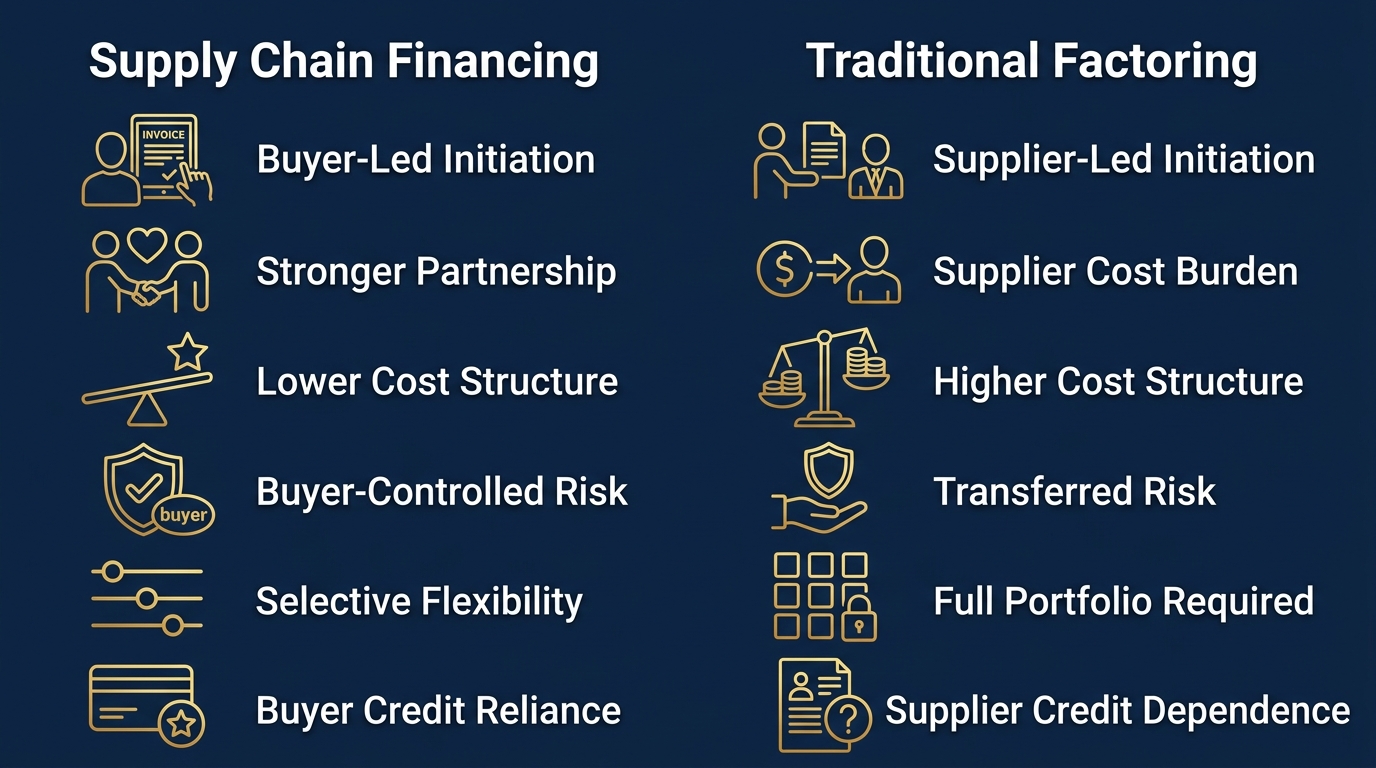
In practice, adopting supply chain financing can reduce total financing costs, deepen supplier loyalty, and build a more resilient supply chain. For mid-market firms, the buyer-led model often aligns incentives across the supply base more effectively than traditional factoring. As the next section explores, implementing such a program demands careful alignment of invoice processes, funding partners, and payables strategy to match your company’s risk appetite and growth objectives.
Managing Risks and Best Practices in Supply Chain Finance Implementation
Identifying and Mitigating Implementation Risks
While supply chain financing delivers significant liquidity benefits, companies must navigate a range of operational, credit, and regulatory risks. A disciplined risk assessment and a mitigation plan tailored to each category protect both the buyer and its supplier community.
| Risk Category | Description | Mitigation Strategy |
|---|---|---|
| Buyer Credit Risk | Risk of buyer defaulting on approved invoices | Thorough credit assessment; use credit insurance or guarantees |
| Supplier Onboarding Complexity | Difficulty in educating and onboarding numerous suppliers | Phased rollout; dedicated supplier support team; clear communication |
| Legal/Regulatory Compliance | Non-compliance with securities or lending regulations | Engage legal counsel; comply with FINRA and state regulations (e.g., through Finalis for securities) |
| Technology Integration | Integration with existing ERP/accounting systems | Use API-first platforms; pilot with a subset of transactions |
| Program Scalability | Unable to scale to larger supplier base or transaction volumes | Design flexible program parameters; partner with experienced finance provider |
Among these, buyer credit risk and legal/regulatory compliance demand the highest attention. Buyer credit risk can undermine the entire program if an anchor buyer cannot meet its obligations, making robust credit analysis and, where appropriate, credit insurance or guarantees essential. On the regulatory side, any supply chain finance structure that touches securities must align with industry rules. The guidelines published by the Securities Industry Trade Association and FINRA emphasize rigorous compliance frameworks. We reinforce that Zaidwood Capital is not a registered broker-dealer; all securities transactions are conducted through Finalis Securities LLC, ensuring that programs adhere to applicable regulations without exposing the sponsoring company to unauthorized activities. Proactive legal counsel and early engagement with compliance resources help contain these risks.
Best Practices for Program Success
A well-designed supply chain financing program incorporates best practices that accelerate adoption, maintain operational integrity, and adapt to evolving business needs. Drawing on our experience with middle-market working capital solutions, we recommend the following:
- Structured supplier education and dedicated support. Phased rollouts, clear communication of the program’s value, and a dedicated onboarding team reduce friction and drive higher supplier participation. Suppliers that understand how early payment improves their cash flow are far more likely to enroll and remain active. Buyers can further incentivize early adoption by offering favorable early payment terms during the initial phase.
- Technology-first platform selection. Choose API-first platforms that integrate seamlessly with existing ERP and accounting systems. A pilot phase with a subset of transactions validates system performance before full-scale deployment. Our own Precision Catalyst platform illustrates how data-driven matchmaking and digital engagement can streamline supplier onboarding and transaction processing—without adding unnecessary complexity. The Velocity Matrix framework ensures technology deployment stays aligned with execution timelines.
- Ongoing performance monitoring. Establish KPIs such as days payable outstanding (DPO), supplier adoption rates, and early-payment discount capture. Regular reviews of these metrics, combined with feedback loops from suppliers, allow for continuous refinement. As we discuss in our debt consolidation and cash-flow resources, improving working capital efficiency often depends on visibility into real-time financial data and disciplined performance tracking. Internal dashboards and structured supplier surveys reinforce the feedback loop and provide early warnings.
- Scalable program architecture. Design flexible program parameters from the start, including tiered financing limits and the ability to add new suppliers without major reconfiguration. Partnering with an experienced finance provider that understands middle-market dynamics ensures the program can grow alongside the buyer’s transaction volumes. Regular scalability reviews help the program keep pace with corporate growth.
With these best practices in place, companies can confidently explore more advanced SCF structures and unlock the full strategic potential of their working capital.
Evaluating Supply Chain Financing as a Strategic Capital Solution
Beyond traditional debt and equity, supply chain financing (SCF) provides a strategic way to optimize working capital without diluting ownership or incurring high-interest debt. SCF is a suite of solutions that improve cash flow by allowing buyers to extend payment terms while suppliers receive early payment on approved invoices, enhancing supply chain resilience.
SCF typically involves a third-party financier—often a bank or fintech—that advances funds to suppliers based on the buyer’s approved payables. For example, a manufacturer in West Palm Beach could approve a $100,000 supplier invoice, have the financier pay the supplier immediately, and then repay the financier 90 days later, preserving its own working capital. The supplier gains faster access to cash, often at a lower cost than factoring, while the buyer strengthens the relationship and reduces supply chain risk.
When evaluating SCF as a strategic capital solution, we consider several criteria: the cost of capital relative to other short-term financing, whether the arrangement is treated as on- or off-balance-sheet debt, how seamlessly it integrates with existing ERP and invoicing systems, and its scalability as transaction volumes grow. Unlike business acquisition financing—where Zaidwood Capital structures layered debt and equity for transformative transactions—and the capital raises we advise for food and beverage brands, SCF focuses on recurring working-capital needs rather than one-time events. It is not a one-size-fits-all solution; companies must assess their cash conversion cycle, supplier concentration, and financial covenants. Like all financial solutions, supply chain financing carries costs and risks that must be evaluated carefully. Additionally, businesses should verify that any SCF platform or financier complies with applicable regulations, including oversight by the Financial Industry Regulatory Authority.
SCF is most valuable for companies with stable buyer-supplier relationships and predictable payment cycles, helping them unlock trapped cash to fund growth without sacrificing equity. However, it is only one part of a comprehensive capital strategy, and advisory guidance can help firms choose the right mix.
Frequently Asked Questions About Supply Chain Financing
Now that we’ve covered the fundamentals of supply chain financing, let’s address common questions.
What is supply chain financing? Supply chain financing is a collaborative, technology-enabled set of solutions that optimize payment terms between buyers and suppliers, improving working capital without traditional borrowing.
Who can benefit from supply chain financing? Mid-market and growth-stage companies seeking to strengthen supplier relationships, reduce supply chain risk, and free up cash for strategic initiatives are ideal candidates for supply chain finance.
Does Zaidwood Capital offer supply chain financing advisory? Yes. As a Boutique M&A and Capital Advisory Firm, we advise on supply chain financing within our Asset-Based Lending / Working Capital advisory. Results vary; we recommend independent due diligence and consultation.
Leveraging Supply Chain Financing for Sustainable Growth
Beyond traditional capital formation, supply chain financing optimizes working capital between buyers and suppliers. According to Zaidwood Capital’s global lending guide, types like invoice financing, reverse factoring, and dynamic discounting unlock liquidity, while specific solutions such as equipment financing address asset needs without draining cash reserves. This approach underpins our full-cycle advisory, leveraging over $15 billion in accessible capital to match businesses with the right financing mix. Through our advisory in asset-based lending, we integrate these instruments to fuel sustainable growth, always within a risk-managed framework.