

Healthcare Mergers And Acquisitions
Table of Contents
The Evolving Landscape of Healthcare Mergers and Acquisitions
Within the healthcare sector, the M&A landscape is undergoing significant transformation. The landscape of healthcare mergers and acquisitions continues to evolve as regulatory shifts, technology disruption, and evolving investor strategies reshape dealmaking. Key healthcare M&A trends include consolidation among large health systems, growing private equity healthcare acquisitions targeting outpatient and specialty services, and a surge in technology-driven deals–particularly in digital health and HCIT. PwC data show a surge in mid-market deals, driven by ongoing value-based reimbursement models and clearer telehealth regulation. Navigating this complexity requires deep sector expertise and data-driven execution–capabilities we deliver through our Sovereign Data Nexus and Precision Catalyst platforms. Our Sovereign Data Nexus consolidates real-time market intelligence, while Precision Catalyst accelerates investor targeting.
1. Key Trends in Healthcare M&A
The landscape of healthcare mergers and acquisitions is evolving rapidly in 2026, driven by shifting capital flows, regulatory pressures, and a push for operational scale amid economic uncertainty. Our analysis, supported by BDO’s healthcare M&A research, shows that M&A activity in healthcare continues to accelerate, with private equity at the forefront of healthcare m&a trends that are now drawing intense regulatory focus.
We see three interconnected trends. First, private equity healthcare acquisitions are expanding into physician practice management, home health, and outpatient services to create integrated platforms. Second, heightened FTC scrutiny is forcing longer deal reviews and more defensive structures. Third, digital health and AI-enabled services are attracting both strategic and financial buyers, speeding up technology-oriented deals.
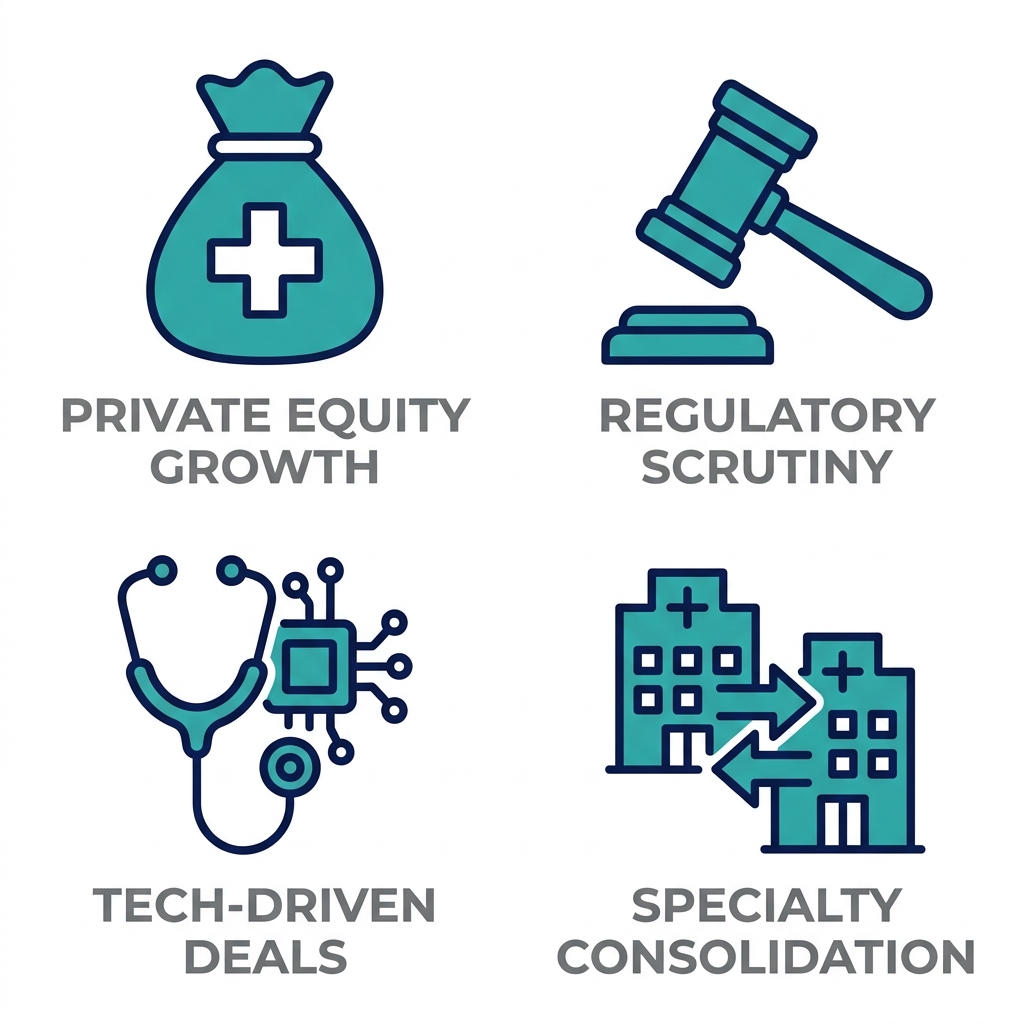
Four key trends driving healthcare M&A
Beyond the numbers, these acquisitions in the health sector are closely tied to value-based care models that reward coordination and scale. As dealmaking adapts to policy and competitive pressures, private equity’s role remains pivotal. The pace of healthcare dealmaking shows no sign of slowing, though transaction structures are becoming more complex. Among these trends, private equity’s growing influence deserves a closer look.
2. Private Equity’s Growing Influence
Private equity firms are increasingly targeting healthcare assets, driving a significant wave of healthcare mergers and acquisitions. According to Pestakeholder, an industry stakeholder project tracking ownership changes, transaction volumes in private equity healthcare acquisitions have expanded sharply, reflecting sustained investor confidence.
This expansion is propelled by stable demand, recurring revenue models, and technological disruption–not short-term speculation. As healthcare M&A trends shift toward value-based care and digital health solutions, PE firms seek platforms with scalable operations and resilient cash flows. The convergence of an aging population and innovation in care delivery further amplifies interest.
Navigating these complex deals requires more than financial capital; it demands specialized advisory. We, as a Boutique M&A and Capital Advisory Firm, function as a dedicated Healthcare Investment Bank, providing full-cycle M&A and capital advisory to guide PE sponsors through regulatory, operational, and valuation challenges. Our deal execution framework ensures that transactions align with long-term strategic goals and stakeholder expectations.
Looking ahead, private equity’s growing influence will continue to reshape healthcare delivery and investor opportunities, consolidating fragmented sectors and accelerating the adoption of clinical and administrative improvements.
3. Regulatory Changes in Healthcare M&A
Compounding existing healthcare M&A trends, recent regulatory changes are reshaping how healthcare mergers and acquisitions are structured and executed in the United States. Evolving federal antitrust enforcement and state-level policy shifts are altering deal strategy, timing, and valuation.
According to Hall Render’s analysis, key regulatory developments include the 2023 FTC/DOJ merger guidelines, which heighten antitrust scrutiny of hospital and physician practice transactions; state-level certificate-of-need reforms altering entry barriers; and value-based reimbursement models now influencing deal valuations. The FTC is also intensifying focus on private equity healthcare acquisitions, while recent Stark Law and Anti-Kickback Statute safe harbor revisions affect physician practice acquisitions.
As these regulations continue to evolve, partnering with an experienced boutique advisory firm becomes increasingly critical. Zaidwood Capital provides Healthcare Investment Banking Services that help middle-market companies structure compliant transactions. Securities offered through Finalis Securities LLC; Zaidwood Capital is not a registered broker-dealer. This overview is not legal advice; consult qualified counsel for specific guidance.
4. Preparing for a Healthcare Merger
Once a healthcare organization decides to pursue a merger, thorough preparation is critical for a successful outcome. In the complex landscape of healthcare mergers and acquisitions, current healthcare M&A trends and private equity healthcare acquisitions demand proactive, multi-faceted planning.
We begin with a strategic self-assessment examining organizational goals, financial health, and market positioning to confirm readiness and alignment.
We then assemble an experienced advisory team–legal counsel, financial advisors, and industry consultants. Engaging boutique M&A advisory services can coordinate the process, from due diligence to negotiation.
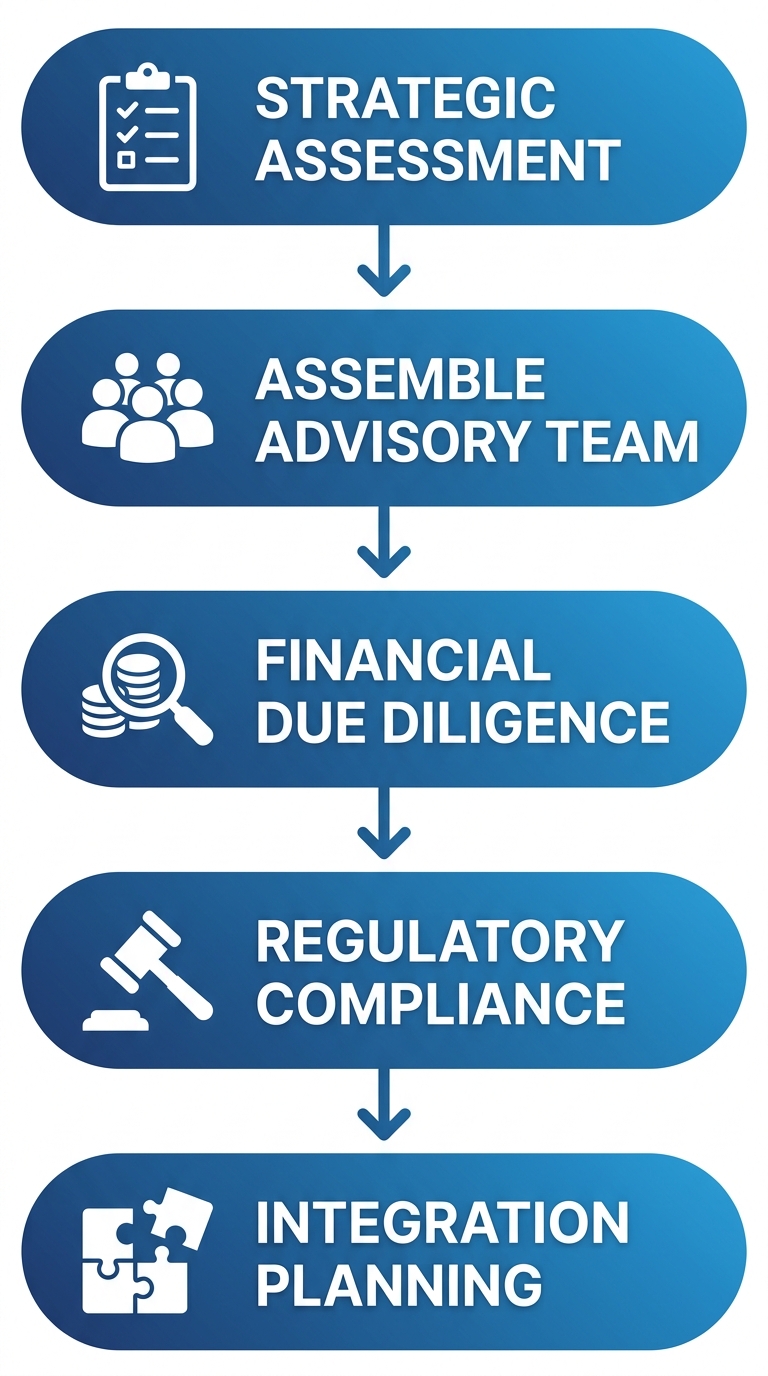
Five-stage healthcare merger preparation process flow
Financial due diligence analyzes revenue sources, payer contracts, and compliance with HIPAA and Stark Law. Regulatory preparations include antitrust review, state approvals, and healthcare-specific licensing. Industry experts caution that cultural misalignment and neglecting daily operations can derail a deal, making early integration planning essential.
With careful preparation, we can ensure the execution phase proceeds more smoothly, confident that the foundation for a successful transaction is in place.
5. M&A Advisory’s Role in Healthcare Deals
In the healthcare vertical, the role of an M&A advisor extends beyond transaction management to encompass deep sector knowledge, regulatory navigation, and strategic buyer matching. For healthcare mergers and acquisitions, we deliver end-to-end support from market positioning to buyer targeting, including financial modeling, data room preparation, and identification of strategic and financial buyers.
PwC’s healthcare deals reports confirm that healthcare M&A trends demand rigorous regulatory due diligence–including antitrust review, state certificate-of-need requirements, and HIPAA compliance. We coordinate with legal experts to ensure these requirements are met without derailing timelines.
Our proprietary platforms–Sovereign Data Nexus, Precision Catalyst, and Velocity Matrix–use buyer data, AI-driven investor matching, and rapid execution to differentiate our boutique approach. Private equity healthcare acquisitions benefit from our 4,000+ investor network and data-driven processes; we never guarantee outcomes, but we maximize efficiency.
Securities are offered through Finalis Securities LLC; Zaidwood Capital’s advisory role is separate from broker-dealer services. This specialized approach is particularly evident in how we structure deals for outpatient services and digital health platforms–the focus of the next section.
6. AI’s Impact on Healthcare M&A
We see artificial intelligence reshaping healthcare mergers and acquisitions within the broader sector, bringing new speed and analytical depth to every phase of the deal lifecycle.
Within target identification, AI-driven tools analyze vast clinical and market data to surface compelling acquisition opportunities faster than traditional methods, a dynamic we observe across contemporary healthcare m&a trends. Private equity firms, in particular, are increasingly deploying AI to screen targets and accelerate execution in private equity healthcare acquisitions.
During due diligence, machine learning models can assess regulatory compliance and clinical outcomes with greater precision, while predictive algorithms enhance financial modeling. According to BDO USA, LLP, these capabilities may significantly reduce the time required for transaction reviews, a factor that is reshaping valuation processes and giving dealmakers deeper insight into risk and opportunity.
As we look ahead, the continued integration of AI promises to become a differentiating factor for boutique advisory firms, enabling them to deliver more data-driven guidance and compete effectively in the evolving healthcare M&A arena.
Navigating the Future of Healthcare Mergers and Acquisitions
Looking ahead, the landscape of healthcare mergers and acquisitions is being reshaped by regulatory evolution, rapid technology adoption, and demographic pressures that are altering care delivery models and opening new avenues for value creation. These shifts are accelerating dealmaking and drawing a wider spectrum of investors.
Within this dynamic environment, healthcare M&A trends reflect deeper structural changes. Private equity healthcare acquisitions are expanding, bringing operational expertise and growth capital to an industry ripe for transformation. Increasingly, alternative investment M&A strategies are being deployed by sophisticated buyers seeking differentiated returns. These strategies enable tailored approaches that traditional transactions often miss. Our data-driven approach, powered by the Precision Catalyst, provides clarity in these complex transactions.
Resources


