


Healthcare Investment Bank
Table of Contents
Healthcare Investment Banking for Middle-Market Companies
A healthcare investment bank provides specialized advisory services that help middle-market healthcare companies, those generating between $10 million and $500 million in revenue, navigate complex financial events. Drawing on core investment banking principles, which explain what is an investment bank, these firms deliver healthcare M&A advisory, capital raising, valuation, and due diligence tailored to founder-led and growth-stage healthcare organizations.
According to the Securities Industry and Financial Markets Association, middle market healthcare M&A activity has been robust, underscoring the need for hands-on transaction support. Healthcare M&A advisory for middle-market firms typically encompasses sell-side and buy-side representation, capital formation through equity or debt, and rigorous valuation work, supported by comprehensive due diligence that addresses regulatory, reimbursement, and competitive concerns. When a company considers a strategic exit, recapitalization, or scaling, a healthcare investment bank structures and negotiates deals, provides in-depth valuation analyses, and manages due diligence, all while aligning with the unique dynamics of the healthcare sector.
Zaidwood Capital, a Boutique M&A and Capital Advisory Firm, brings a Full-Cycle M&A approach to these engagements, enhanced by proprietary tools such as Sovereign Data Nexus and Precision Catalyst that sharpen deal sourcing, execution, and investor matching.

Zaidwood Capital’s three proprietary platforms: data, AI, and velocity engines
These capabilities are designed for the distinct needs of middle-market healthcare firms, a topic we explore in depth next.
Core Services of a Healthcare Investment Bank
A healthcare investment bank delivers a range of tailored services to middle-market healthcare companies navigating complex M&A and capital formation transactions. For growth-stage and privately held firms, specialized advisory is critical when deal sizes range from $10 million to $500 million in enterprise value. Our focus on middle market healthcare M&A ensures that owners and operators receive the sector-specific expertise required to achieve optimal outcomes without the one-size-fits-all approach of larger, full-service institutions.
Healthcare M&A Advisory
M&A advisory is the foundation of our transaction practice. We provide comprehensive sell-side and buy-side representation, from initial valuation and positioning through negotiation and close. Our Healthcare Mergers And Acquisitions advisory supports middle-market companies through every stage of the transaction lifecycle. In-depth healthcare M&A advisory includes rigorous financial modeling, market analysis, and deal structuring that accounts for regulatory and reimbursement dynamics unique to the sector. Whether representing a founder seeking an exit or a strategic buyer pursuing growth, we deploy full-cycle execution to protect value and accelerate deal certainty.
Capital Formation
Capital formation services bridge the gap between ambitious healthcare enterprises and the funding they need to scale. We structure and source both debt and equity capital, arranging asset-based lending, working capital solutions, and growth equity or venture capital fundraises. By matching each company with the appropriate institutional investors–from family offices to dedicated healthcare funds–we help management teams raise committed capital that aligns with their long-term strategic plans. Every engagement includes investor-ready pitch decks, pro forma financial projections, and a disciplined due diligence process designed to shorten the fundraising cycle.
Boutique, Full-Cycle Execution
Our boutique model integrates proprietary platforms–Sovereign Data Nexus, Precision Catalyst, and the Velocity Matrix–to identify, attract, and convert the right counterparties far more efficiently than a traditional advisory firm. Sovereign Data Nexus aggregates intelligence across 4,000+ global investors, Precision Catalyst uses AI-driven matching to surface the most relevant capital sources, and the Velocity Matrix streamlines execution so that transactions progress from term sheet to close without unnecessary delays. This full-cycle approach means we remain hands-on from strategy through integration, not just during the initial outreach.
As defined by the Financial Industry Regulatory Authority (FINRA), investment banking advisory services are distinct from broker-dealer activities. Zaidwood Capital operates solely as a boutique advisory firm and is not a registered broker-dealer. Any securities transactions are facilitated through third-party broker-dealers, ensuring that our clients receive conflict-free strategic counsel while maintaining full regulatory compliance. Understanding these core services sets the stage for exploring the firm’s proprietary execution framework in greater detail.
Valuation Methodologies and Deal Execution in Healthcare M&A
Accurate valuation is the cornerstone of any successful healthcare transaction. A healthcare investment bank must apply specialized frameworks that account for regulatory risks, reimbursement models, and intellectual property. As a boutique M&A and capital advisory firm, we deploy these methodologies to deliver data-driven insights for our clients.
Valuation Frameworks for Healthcare Companies
Several valuation methodologies are used in healthcare M&A. The discounted cash flow (DCF) method projects future cash flows and discounts them by the weighted average cost of capital (WACC), adjusted for regulatory and reimbursement risk. Comparable company analysis benchmarks a target against public peers–selected from medtech, healthcare services, or biopharma–using multiples like EV/EBITDA. Precedent transaction analysis draws on actual deal multiples and size premiums, often referencing market data such as that from the Securities Industry and Financial Markets Association (SIFMA). For pre-revenue or high-growth firms, a revenue multiple based on annual recurring revenue (ARR) is more apt, while profitable service-based practices are typically valued on an EBITDA multiple.
Through our comprehensive business valuation services, we integrate these frameworks to triangulate a defensible range rather than a single figure.
No single valuation approach fits every healthcare company. Practitioners blend multiple methods to triangulate fair value, considering the company’s maturity, revenue profile, and strategic objectives. The table below summarizes the most common methodologies and their ideal applications.
| Method | Best Application | Key Inputs |
|---|---|---|
| Discounted Cash Flow (DCF) | Established firms with predictable cash flows | Revenue projections, terminal value, WACC |
| Comparable Company Analysis | Relative valuation benchmarking against public peers | EV/EBITDA, P/E, revenue multiples |
| Precedent Transaction Analysis | Deal value benchmarking using closed transactions | Historical deal multiples, size premiums, market conditions |
| Revenue Multiple | High-growth or pre-profit firms (biotech, health-tech) | ARR, revenue growth rate, total addressable market |
| EBITDA Multiple | Profitable, scalable practices or service businesses | Adjusted EBITDA, industry norm multiple range |
A boutique advisor selects and weights these methods based on the company’s stage, revenue characteristics, and exit strategy. For example, a profitable medical practice may lean on EBITDA multiples and DCF, while a pre-commercial biotech startup receives greater emphasis on revenue multiples and comparable peer analysis. This customized selection helps stakeholders arrive at a valuation that reflects both intrinsic value and market context.
The Role of Private Equity in Middle-Market Healthcare M&A
Private equity firms are major participants in middle market healthcare M&A. They target fragmented sectors such as physician practice management, outpatient services, and specialty pharma, where consolidation can unlock value. A typical strategy involves acquiring a platform practice, then executing add-on acquisitions to build scale and operational efficiencies. By aggregating independent practices, sponsors can improve operational performance and achieve purchasing economies of scale.
Boutique M&A and capital advisory firms source proprietary deals and advise on transaction structures. Through our healthcare M&A advisory, we help sponsors screen opportunities, coordinate due diligence, and negotiate terms that align with their consolidation thesis. A healthcare investment bank extends beyond valuation to orchestrate the entire deal process, ensuring all strategic and regulatory considerations are addressed.
Transaction Timelines and Deal Lifecycle
A typical healthcare M&A transaction follows a structured lifecycle spanning four to twelve months. The six phases are: (1) strategy and positioning, where we articulate the company’s value proposition and prepare marketing materials; (2) buyer or investor outreach, leveraging our Sovereign Data Nexus to target the right capital partners; (3) the teaser and confidential information memorandum process, which generates initial interest; (4) due diligence management, coordinating document review and specialist evaluations; (5) negotiation of term sheets and definitive agreements; and (6) closing and post-close integration planning.
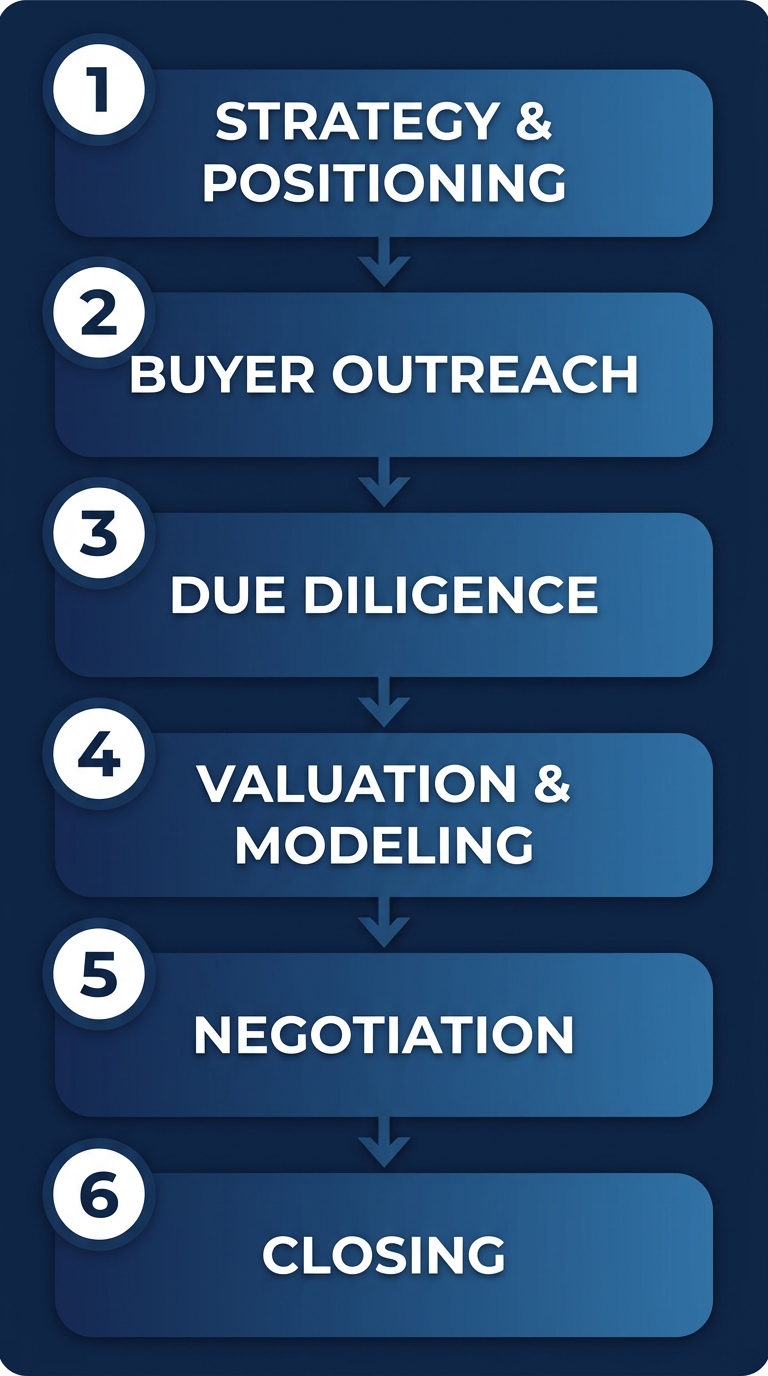
Healthcare M&A lifecycle: six phases from strategy to closing
Boutique firms streamline each phase by dedicating senior-level attention and reducing bureaucratic delays. We prepare investor-ready pitch decks, financial projections, and a secure data room that accelerates diligence. Clear communication keeps the timeline on track, reducing the risk of value erosion from stalled deals.
Selecting the Right Healthcare M&A Advisory Partner
Given the complexity of today’s healthcare M&A landscape, choosing the right healthcare investment bank is the critical first step toward a successful transaction. For middle-market healthcare companies, selecting a Healthcare Investment Banking Services partner demands more than a cursory glance at credentials. We outline a structured framework to identify advisors who bring deep industry specialization, full-cycle execution capability, and cultural alignment.
Criteria for Evaluating Healthcare Investment Banks
When evaluating a healthcare investment bank, middle-market leaders should look beyond fee structures. Five core criteria — industry specialization, execution capability, investor network access, track record, and cultural fit — consistently separate effective advisory partners from those that fall short during high-stakes processes. The following table provides a concise evaluation matrix that underscores why each criterion matters.
Key Criteria for Selecting a Healthcare M&A Advisory Firm
| Criterion | What to Evaluate | Why It Matters |
|---|---|---|
| Industry Specialization | Healthcare subsector deal history and domain expertise | Ensures relevant buyer/investor network and accurate positioning |
| Execution Capability | Full-cycle advisory vs. limited-scope engagement | Avoids gaps between mandate and close |
| Investor Network Access | Number and quality of strategic and financial relationships | Broadens competitive tension and improves terms |
| Track Record & References | Transaction volume, success rate, and client testimonials | Predictive of future outcomes and deal quality |
| Cultural & Communication Fit | Responsiveness, transparency, deal team stability | Critical for high-stakes, months-long processes |
Boutique firms like Zaidwood Capital differentiate by anchoring engagements in deep healthcare specialization, ensuring deal narratives resonate with the right buyers. Our technology-driven framework, Precision Catalyst, accelerates investor matchmaking, while full-cycle accountability keeps the same senior team engaged from mandate to close, avoiding handoff gaps common at larger institutions. This focused approach to healthcare M&A advisory translates into more accurate positioning and stronger deal outcomes. When assessing track records, clients should consider adherence to standards like those set by FINRA; however, Zaidwood Capital is not a FINRA member — securities are offered through Finalis Securities LLC, a FINRA member.
Understanding Engagement Structures and Timelines
Advisory engagements in middle market healthcare M&A typically follow a retainer-and-success-fee structure. The monthly retainer — while not disclosed in dollar terms — covers initial work such as crafting the positioning thesis, preparing marketing materials, and building a curated list of prospective buyers. The success fee, a negotiated percentage of the final transaction value, ensures the firm is fully incentivized to secure optimal terms. This alignment of interests is a fundamental pillar of effective healthcare M&A advisory.
Exclusivity agreements are standard and give the advisor sole mandate for a period of six to twelve months, allowing a controlled, confidential process. Without exclusivity, multiple bankers contacting the same buyers can undermine competitive tension and create confusion. We recommend that founders scrutinize engagement letters for scope, fee triggers, and off-ramp provisions, but reject any partner offering guaranteed outcomes — M&A results are never certain. Instead, prioritize transparency and a proven capacity to manage the nuances of healthcare transactions.
Preparing for a Successful Capital Raise or Exit
Systematic preparation significantly improves deal outcomes. Before engaging a healthcare investment bank, middle-market healthcare companies should assemble the following:
- Clean, audited financials: At least three years of audited statements and a five-year projection provide the quantitative foundation for valuation and minimize diligence surprises.
- Compelling growth narrative: A management presentation that clearly outlines market opportunity, competitive advantages, and scale path builds buyer confidence and supports premium valuation.
- Organized data room: A well-structured virtual data room with financial, legal, and operational documents accelerates due diligence and signals operational maturity.
- Strong management team: Investors underwrite the team as much as the business; a stable, capable leadership group with clear succession can be a decisive factor.
- Aligned shareholder expectations: Ensuring stakeholders understand likely valuation ranges, deal structures, and timelines prevents last-minute re-trades and keeps the process on track.
By investing in these readiness steps, healthcare companies position themselves for faster closes and stronger negotiating leverage.
By applying these criteria, leaders can confidently identify partners that match their unique needs and strategic goals. The next section illustrates how our boutique advisory model delivers on each criterion.
Market Trends, Regulation, and Economic Factors in Healthcare M&A
Navigating the intersection of market trends, regulation, and economics is essential for successful healthcare mergers and acquisitions advisory. As a healthcare investment bank focused on middle-market companies, we analyze how external forces shape dealmaking, from fluctuating deal volumes to evolving regulatory scrutiny. Understanding these dynamics enables us to guide clients through complex transactions.
Drawing on SIFMA’s Capital Markets Fact Book, we note that aggregate healthcare M&A deal volume has remained robust over the past year, with technology-enabled services and outpatient care accounting for a substantial share of activity. Sectors such as telehealth and digital health, which have seen accelerated adoption, now command premium multiples. For healthcare M&A advisory, valuation multiples remain elevated, reflecting strong investor demand and the strategic premium placed on scalable platforms. Middle-market healthcare companies are particularly active as both buyers and sellers, pursuing consolidation to achieve operational synergies.
Regulatory complexity adds another critical layer. FINRA’s Rule 5110 (Corporate Financing Rule) and Rule 5123 (Private Placement Filings) impose rigorous disclosure obligations on M&A transactions, directly affecting the structuring of private placements in healthcare deals. Meanwhile, the FTC’s heightened scrutiny of hospital-physician group mergers has extended deal timelines and prompted parties to adopt more creative transaction structures. State-level oversight of healthcare license transfers further delays certain deals. As a healthcare investment bank, we monitor these regulatory shifts to help clients anticipate compliance hurdles and adapt their strategies accordingly.
For middle market healthcare M&A, interest rate sensitivity is particularly pronounced. Industry analyses indicate that rising borrowing costs are compressing deal returns, while persistent inflation and clinical labor shortages drive consolidation as organizations seek economies of scale. Staffing costs, often the largest expense for provider groups, have spiked, intensifying consolidation pressure. These factors make deal structuring more complex yet also create compelling opportunities for well-advised acquirers.
These market, regulatory, and economic conditions underscore the value of expert healthcare M&A advisory. Our Full-Cycle M&A approach, powered by Sovereign Data Nexus and Velocity Matrix, delivers data-driven guidance to navigate uncertainty and capitalize on opportunities. We remain committed to helping clients thrive in this dynamic environment.
Frequently Asked Questions About Healthcare Investment Banking
We answer the most common questions from healthcare leaders exploring M&A and capital advisory.
What is healthcare investment banking?
Healthcare investment banking provides specialized M&A and capital advisory to healthcare companies. As a healthcare investment bank, we use proprietary platforms like Sovereign Data Nexus and AI-driven Precision Catalyst to match sellers with buyers. Our investment banking services are designed for mid-market execution. Securities offered through Finalis; we are not a broker-dealer.
How can a boutique firm help my mid-market healthcare company with M&A or capital raising?
For middle market healthcare M&A, we offer sell-side/buy-side advisory, debt/equity capital formation, and rapid execution through our Velocity Matrix. Access to 4,000+ investors helps secure competitive outcomes. Securities offered via Finalis; we are not a broker-dealer.
What differentiates Zaidwood Capital from larger investment banks?
We combine boutique personal service with institutional resources–$15B+ in capital and 4,000+ investors–focused on healthcare M&A advisory. This yields responsive, sector-specific guidance without the bureaucracy of a large bank. Securities offered through Finalis; we are not a broker-dealer.
Partnering with a Specialist Healthcare Investment Bank
Partnering with a specialist healthcare investment bank offers distinct advantages over working with a generalist firm, especially for growth-stage companies navigating complex regulatory landscapes. Our healthcare M&A advisory services blend deep sector expertise with rigorous regulatory knowledge of FDA and HIPAA, and access to a curated network of healthcare-focused investors. Zaidwood Capital’s Sovereign Data Nexus platform precisely maps buyers and capital sources, while Precision Catalyst applies AI-driven matching to accelerate middle-market healthcare M&A. As a Boutique M&A and Capital Advisory Firm, we deliver Full-Cycle M&A support–from valuation through closing–with senior banker involvement at every stage, ensuring a personalized, data-driven process that sets the foundation for successful healthcare transactions.
Resources


