


Raise Capital
Table of Contents
Raising Capital for Growth-Stage Companies
For growth-stage companies seeking to scale aggressively, the ability to raise capital efficiently is essential. Unlike early-stage (Seed and Series A) rounds that often fund product development, growth-stage funding (Series B and beyond) focuses on market expansion, acquisitions, and operational scaling.
Growth-stage companies typically pursue equity financing via priced rounds, convertible notes, or SAFEs. In Series A funding, a company raises initial institutional capital, but as it matures, Series B and C rounds become transformative — and many founders choose to work with an Investment Bank To Raise Capital to structure the transaction, underwrite diligence, and source qualified investors. Zaidwood Capital, a Boutique M&A and Capital Advisory Firm, complements this process with specialized Capital Formation advisory, leveraging our Sovereign Data Nexus platform for market intelligence and Precision Catalyst for AI-driven investor matchmaking. Every engagement respects SEC regulations and FINRA investor protection rules, ensuring a compliant, data-informed path to growth. Beyond equity financing, growth companies may also explore debt advisory strategies, which we detail in the next section.
Understanding Your Funding Readiness
Before you raise capital, it is critical to understand your company’s funding readiness. Key indicators include steady revenue traction, a clear growth stage, and organized financial documentation. SIFMA’s Capital Markets Fact Book provides valuable context on current capital market conditions, showing that successful fundraisers often align with sector-level equity issuance trends. By comparing your revenue growth rate over the past 12-24 months with these benchmarks, you can gauge whether your company meets the thresholds investors expect. This self-assessment helps identify gaps before approaching potential investors. Proper preparation increases your credibility and reduces the risk of delays. Aligning with current market dynamics, as reflected in SIFMA data, positions your company more favorably.
Assembling audited financials, detailed projections, and a current capitalization table demonstrates organizational maturity. Equally important is a management team with relevant industry experience. Aligning your growth stage with the right funding source–whether through equity financing for expansion or Series A funding for early-stage ventures–ensures a more efficient capital raise. Engaging a lower middle market investment bank can help refine your pitch deck, target the right investors, and accelerate the process. We recommend consulting a qualified advisor before initiating any fundraising effort to ensure all critical elements are in place.
Assess Your Capital Requirements
We help clients navigate the critical process to raise capital for their growth plans. A disciplined assessment will form the foundation of your investor pitch.
Instructions
We recommend following a structured framework to quantify your needs:
- Compute runway by multiplying monthly burn rate by the months to break-even, accounting for projected revenues.
- Map the ask amount directly to value-creation milestones (e.g., product launch, revenue inflection).
- Categorize spending into product development, marketing, talent, and working capital.
- Add a 15-20% contingency buffer to absorb delays or market surprises.
An imprecise ask indicates weak planning and undermines investor confidence.
Why It Matters
An accurate ask amount proves you can raise capital for your business with a clear roadmap, which boosts investor confidence and accelerates closure. In equity financing rounds, clarity on capital use reduces perceived risk.
Tips
Align capital needs with concrete milestones that lift valuation, especially when targeting Series A funding. Always set aside a 15-20% buffer for unforeseen delays. Break down use of funds into transparent categories to demonstrate operational discipline.
With your capital requirements clearly defined, the next step is to translate them into a compelling pitch deck.
Prepare Key Financial Documents and Metrics
Instructions
- Compile three years of financial statements (income statement, balance sheet, cash flow) and current YTD.
- Prepare a fully diluted cap table showing all share classes, options, warrants, and ownership percentages.
- For Series A funding, craft a pitch deck with traction, revenue growth, market size, and use of funds, prioritizing unit economics and growth trajectory over profitability.
- Include a TAM/SAM/SOM market analysis and competitive landscape slide to demonstrate strategic thinking.
- Consolidate all materials into a secure virtual data room (e.g., DealRoom) with access controls.
Why It Matters
When you prepare to raise capital, having these documents ready demonstrates discipline and shortens due diligence. Investors in an equity financing round will scrutinize your metrics and financials to assess risk–being prepared earns immediate trust and signals professionalism.
Tips
Use a secure virtual data room (e.g., DealRoom) to protect sensitive documents. If you need a defensible valuation, explore our business valuation services to support your data room. Include a one-page executive summary highlighting traction and use of funds for initial outreach.
Determine Your Company Valuation
Before approaching investors, you must determine a defensible valuation.
Instructions
When you raise capital, your valuation is the foundation of negotiations. Our five-step process: 1. Gather recent comparable transactions in your industry and stage. 2. Project realistic 3-5 year financials from current traction. 3. Apply DCF, comparable company analysis, and precedent transactions per SIFMA standards. 4. Cross-check against sector-specific multiples from industry benchmarks. 5. Synthesize findings into a valuation range, not a single figure.
Why It Matters
In equity financing, a realistic valuation reduces friction with investors, while an inflated figure wastes time and signals inexperience. Applying SIFMA’s frameworks alongside our Sovereign Data Nexus and Precision Catalyst provides the credibility investors expect.
Tips
Common pitfalls include relying solely on expected Series A funding without current traction and ignoring market conditions like sector down rounds. Anchor to tangible revenue or user growth metrics, and use recent public comps to gauge sentiment. With a solid valuation in hand, you can now tailor your pitch to match investor expectations.
Evaluate Debt vs. Equity Financing Options
Instructions
Evaluating the debt-versus-equity trade-off is critical. To raise capital efficiently, model these steps: First, calculate cost of capital–compare debt interest against implied equity cost. Second, quantify ownership dilution from new equity. Third, contrast repayment obligations: fixed debt service versus contingent equity returns. Finally, match investor expectations: creditors focus on repayment, equity partners on growth. FINRA’s comparison emphasizes informed choices.
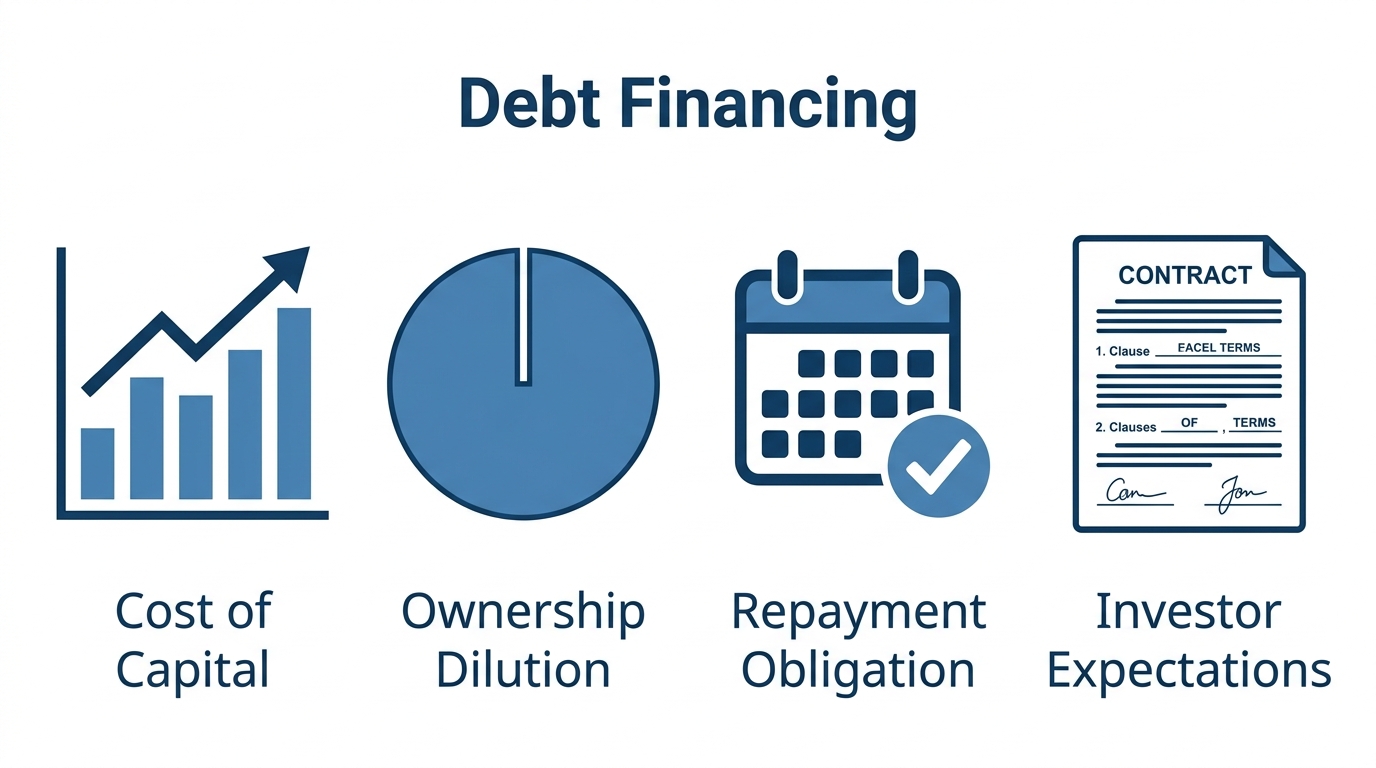
Debt financing key attributes: cost of capital, dilution, repayment, and investor expectations.
Why It Matters
The wrong fit can stunt growth. Excessive debt service may crowd out reinvestment, while too much equity dilution erodes founder control. Misaligned financing can hinder future flexibility and slow growth. We help clients balance cost and control for long-term success.
Tips
In today’s rising-rate environment, equity financing or revenue-based financing may be less burdensome. For recurring-revenue AI companies, enterprise AI capital raising may offer a more flexible path than traditional debt or equity. We help clients find the right fit.
Identify and Approach Potential Investors
Instructions
To raise capital successfully, you need a targeted, curated approach. Start by building a list of at least 50 firms that have invested in your sector and stage. Research each firm’s focus areas, portfolio companies, and typical check sizes–whether pursuing equity financing or a Series A round–then secure warm introductions through advisors or existing portfolio founders. We can accelerate this by providing curated lists from our 4,000+ investor database.
Why It Matters
A focused approach dramatically boosts conversion rates. Cold outreach yields less than 1% success, while warm introductions generate 10-15% meeting rates. Approaching 500 investors without curation yields 5 meetings; targeting 50 aligned investors yields 15. This precision can cut months off your fundraising timeline, setting the stage for successful negotiations.
Tips
Use a CRM to track outreach every 5-7 days and personalize each email by referencing a firm’s recent investment. As a Boutique M&A and Capital Advisory Firm, we leverage Sovereign Data Nexus and our 4,000+ investor network to deliver warm introductions within days. Engage a boutique technology investment bank like Zaidwood Capital. Include a clear ask–for example, a 30-minute meeting to explore alignment with your fund’s thesis.
Build an Investor-Ready Pitch Deck
Instructions
We structure decks to raise capital with the following slides:
- Cover slide: company name, tagline (“Boutique M&A and Capital Advisory Firm”), contact.
- Problem/solution: data-backed market gaps.
- Market size: TAM/SAM/SOM with credible third-party sources.
- Product: proprietary tools (Sovereign Data Nexus, Precision Catalyst).
- Traction: quantitative milestones.
- Team: M&A expertise.
- Competitive landscape: positioning matrix.
- Financials: capital structure, equity financing, projected revenue (pricing not disclosed).
- Use of funds: directly linked to raising capital.
We embed required disclaimers on forward-looking projections.
Why It Matters
Investors spend an average of 3-4 minutes on a deck; clarity and visual impact are decisive. Given the short window, each slide must deliver a clear message without clutter. A well-crafted deck captures attention and communicates your opportunity quickly.
Tips
Customize the deck for each investor type to raise capital effectively. For venture capitalists pursuing Series A funding, emphasize growth scalability; for strategic investors, highlight synergies; for family offices, stress long-term value. With your deck structured, practice your pitch and prepare for Q&A.
Navigate the Due Diligence Process
Instructions
Once your investor materials are ready, due diligence begins. To navigate it effectively:
- Create a secure VDR and provide a diligence checklist early to show transparency.
- Assign an internal champion per diligence stream (legal, financial, operational, commercial) to ensure timely, consistent responses.
- Schedule weekly or bi-weekly check-ins with lead investors to discuss findings and clear bottlenecks.
- Audit all key financial and legal documents (projections, cap table, contracts, IP assignments) before opening the data room, and for an equity financing round, match the rigor of any institutional investor.
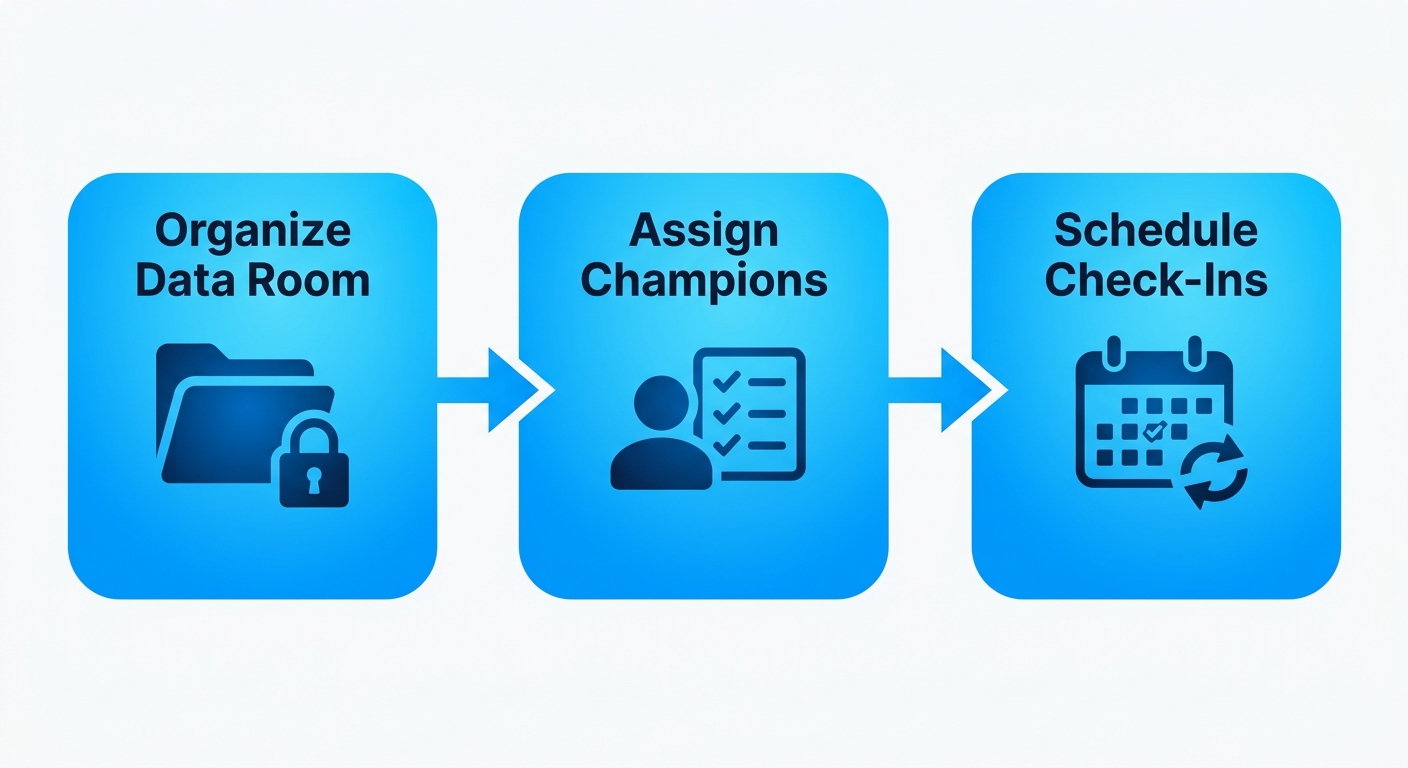
Navigate the due diligence process in three clear steps.
Why It Matters
When you raise capital, the due diligence process is where deals are won or lost. A smooth, transparent effort builds investor confidence and prevents deal-killing surprises. We emphasize that preparation is the single most important factor in maintaining momentum toward closing.
Tips
- Use a dedicated VDR and provide a diligence checklist early to show transparency.
- For a Series A funding round, institutional investors expect rigorous diligence — meet that standard before they ask.
- A well-prepared data room accelerates your raise capital timeline.
Overcoming Common Capital Raising Challenges
When companies seek to raise capital, they often encounter predictable obstacles–from identifying the right investors to preparing compelling materials and navigating compliance. Whether pursuing equity financing or Series A funding, founders must tackle these hurdles efficiently to maintain momentum.
First, many entrepreneurs struggle to connect with aligned institutional investors. Our proprietary Sovereign Data Nexus analyzes thousands of institutional investors to pinpoint the best-fit partners for each mandate, replacing broad outreach with precise targeting.
Second, weak pitch materials consistently slow fundraising. Precision Catalyst uses AI-driven engagement analytics to refine storytelling and data presentation, helping founders craft investor narratives that resonate. The result is a stronger first impression and higher response rates throughout the capital formation process.
Extended timelines represent another critical pain point. Velocity Matrix, our structured framework, accelerates the capital-raising lifecycle without sacrificing quality–keeping diligence on track and preventing rounds from stalling.
Limited network access also caps many promising raises. Zaidwood Capital provides direct introductions to a network of 4,000+ accredited investors and access to over $15B in committed capital, solving the single biggest distribution problem for growth-stage companies.
Fraud and misrepresentation are ever-present risks. According to FINRA, a leading securities industry regulator, common red flags include pressure to invest quickly, unregistered sellers, and promises of high returns with little risk. While no process can eliminate fraud, our institutional-grade due diligence and transparent advisory approach help clients recognize and sidestep these pitfalls.
Our framework is designed to address these challenges head-on–improving access, increasing efficiency, and strengthening investor confidence while always respecting that past performance does not guarantee future results.
Achieving a Successful Capital Raise
To raise capital successfully, businesses must go beyond ambition and adopt a disciplined, data-driven strategy. We start by establishing realistic valuation expectations and a clear capital-use plan, ensuring alignment with investor expectations.
We leverage our Sovereign Data Nexus and Precision Catalyst platforms to match companies with the right institutional investors, which can improve the probability of meeting fundraising goals. Comprehensive financial projections, a compelling equity narrative, and realistic valuation analysis form the backbone of any capital raise. For early-stage ventures, equity financing structures–particularly Series A funding–demand rigorous due diligence on traction, unit economics, and market scalability. As a Full-Cycle M&A firm, we integrate these elements into a cohesive strategy that accelerates execution.
Our full-cycle process, from initial positioning through to a successful close, is the foundation of every client engagement. For a deeper dive into our methodology, read our guide on How To Raise Capital For A Business.
Resources


