
Table of Contents
- Smart Manufacturing Defined for 2026
- Core Principles of Smart Manufacturing
- Key Technologies Driving Smart Manufacturing
- Implementing Smart Manufacturing Practices
- Advanced Smart Manufacturing Strategies
- Smart Manufacturing FAQs
- Future of Smart Manufacturing
Smart Manufacturing Defined for 2026
Building on manufacturing’s evolution toward digital integration, smart manufacturing in 2026 represents interconnected systems leveraging IoT, AI, and data analytics for real-time optimization. These smart manufacturing ecosystems enable factories to adapt dynamically, minimizing waste and maximizing output through advanced automation.
NIST’s smart manufacturing systems provide the foundation via three pillars: cyber-physical systems integration for seamless machine-human collaboration; real-time data analytics for predictive insights; and autonomous decision-making for self-optimizing operations. Authoritative U.S. government standards from the National Institute of Standards and Technology (NIST) emphasize model-based practices, digital threads, and industrial AI metrology. NIST research emphasizes model-based practices, digital threads, and industrial AI metrology, and promotes tools for systems modeling, heterogeneous data fusion, and trusted lifecycle data to support interoperable, measurable, and repeatable smart manufacturing deployments across complex supply chains with clear metrics and standards globally.
2026 Key Tech: Digital Twins & AI
Digital twins in manufacturing simulate production lines virtually, while ai predictive maintenance forecasts failures to slash downtime.
By 2026, these yield 20-30% efficiency gains and cost reductions, per NIST benchmarks and industry data.
At Zaidwood Capital, we view smart manufacturing as a high-growth sector ripe for investment. While defined by these principles, deploying smart manufacturing requires addressing implementation challenges ahead.
Core Principles of Smart Manufacturing
Building on these foundations, the core principles of smart manufacturing revolve around integrating Internet of Things (IoT), artificial intelligence (AI), big data, and cyber-physical systems to create adaptive production environments. This approach transforms static factories into dynamic, responsive operations known as smart factories or Industry 4.0 manufacturing. According to the National Institute of Standards and Technology (NIST), these principles drive innovation and competitiveness in modern industry.
Full Automation. Traditional manual and semi-automated processes give way to AI and IoT-driven full automation. We see ai predictive maintenance playing a pivotal role, where AI algorithms anticipate equipment failures, minimizing downtime and optimizing workflows. NIST guidelines on manufacturing systems design analysis highlight how this shift enhances reliability and efficiency.
Real-Time Data Utilization. Siloed, reactive data is replaced by real-time analytics powered by big data. Digital twins in manufacturing enable simulation-based optimization, allowing virtual replicas of physical assets for testing scenarios without real-world risks. NIST research, cited as authoritative U.S. government frameworks, underscores data analytics for smart manufacturing to support informed decision-making.
Seamless Connectivity. Isolated machines evolve into interconnected cyber-physical systems integration in manufacturing systems design, fostering machine interoperability. National Institute of Standards and Technology (NIST) systems integration frameworks provide standards for this connectivity, enabling resilient production networks as per government research on manufacturing systems integration.
The following table illustrates key differences:
Traditional vs. Smart Manufacturing
Key Differences in Core Principles and Technologies (Data sourced from NIST manufacturing systems research and industry benchmarks for 2026 projections)
| Aspect | Traditional Manufacturing | Smart Manufacturing |
|---|---|---|
| Manual and semi-automated processes | Limited robotics | AI and IoT-driven full automation |
| Reactive, siloed data | Paper-based or basic ERP | Real-time analytics and big data |
| Connectivity | No interoperability | Cyber-physical systems integration |
This comparison, drawn from NIST manufacturing systems design analysis, reveals how smart manufacturing principles outperform traditional methods in adaptability and efficiency. For instance, full automation reduces human error, while real-time data empowers proactive strategies. These shifts position Industry 4.0 manufacturing for scalable growth, aligning with NIST’s emphasis on cyber-physical advancements.
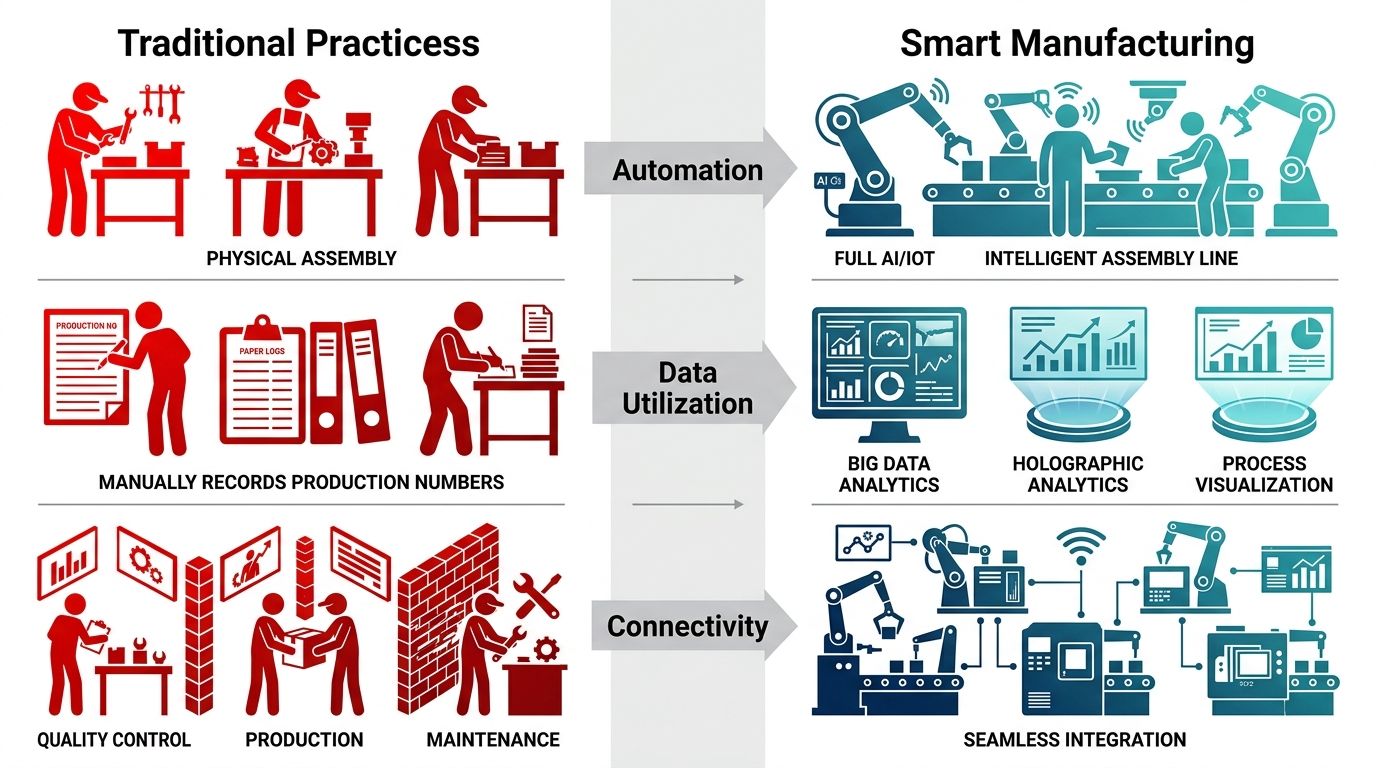
Traditional vs Smart Manufacturing comparison visualization
Key Technologies Driving Smart Manufacturing
Delving deeper into smart manufacturing, interconnected technologies like IoT, AI, and digital twins enable real-time data flow, predictive insights, and optimized operations for intelligent factories.
IoT and Sensor Integration
IoT and sensor integration form the foundation of smart manufacturing by enabling continuous real-time data collection across production lines.
Sensors embedded in machinery capture vital metrics such as temperature, pressure, and vibration, transmitting data via IoT networks for immediate analysis. This connectivity allows factories to monitor equipment health proactively. For instance, vibration sensors on assembly lines detect imbalances early, preventing breakdowns.
- Pressure sensors in hydraulic systems alerting to leaks.
- Temperature monitors on motors to avoid overheating.
AI and Machine Learning Applications
AI and machine learning revolutionize smart manufacturing with predictive analytics and automation, transforming raw data into strategic advantages.
These technologies excel in anomaly detection and process optimization, forecasting issues before they escalate. In ai predictive maintenance, machine learning identifies patterns to schedule upkeep efficiently, minimizing disruptions.
| Technology | Capabilities | Use Case |
|---|---|---|
| Machine Learning | Pattern recognition in data | Anomaly detection |
| Deep Learning | Image and sensor analysis | Advanced forecasting |
Digital Twins in Operations
Digital twins in manufacturing create virtual replicas of physical assets, enabling simulation and real-time optimization per smart manufacturing technologies.
The National Institute of Standards and Technology (NIST), through its authoritative U.S. government standards and research on digital twin technologies, supports SMEs via the Digital Twin Laboratory—a testbed for development and interoperability.
Implementing Smart Manufacturing Practices
Transition Roadmaps
- Assess current infrastructure: Evaluate legacy equipment compatibility and data silos.
- Pilot IoT sensors: Deploy on one production line to monitor real-time performance.
- Implement digital twins in manufacturing: Use simulation tools like NIST-inspired models to test scenarios without risk.
- Scale with AI analytics: Integrate data fusion for predictive insights.
- Establish digital thread: Ensure lifecycle data interoperability per NIST guidelines.
- Monitor and iterate: Use tools like SimPROCESD for discrete-event simulation.
Overcoming Adoption Barriers
| Barrier | Impact | Mitigation |
|---|---|---|
| High Initial Costs | Capital expenditure strain | Phased investment, financing |
| Skills Gap | Lack of expertise | Training programs |
Change Management Essentials
- Leadership commitment: Align C-suite on smart factory implementation vision.
- Comprehensive training: Hands-on sessions for IoT and AI systems.
- Communication strategies: Regular updates to build trust.
- Continuous monitoring: Track KPIs like uptime and efficiency.
Advanced Smart Manufacturing Strategies
Edge Computing
Cloud Computing
Digital Twins in Manufacturing
AI Predictive Maintenance
| Strategy | Edge Computing | Cloud Computing |
|---|---|---|
| Latency | Low | High |
| Scalability | Limited | High |
Smart Manufacturing FAQs
- What is smart manufacturing?
Smart manufacturing integrates IoT, AI, and data analytics for real-time production optimization and efficiency gains. - How do digital twins enhance manufacturing?
Digital twins in manufacturing create virtual replicas to simulate processes, predict issues, and reduce downtime. - What role does AI predictive maintenance play?
ai predictive maintenance uses machine learning to forecast equipment failures, minimizing disruptions.
Future of Smart Manufacturing
Building on today’s foundations, smart manufacturing will evolve through advanced integration by 2030, guided by National Institute of Standards and Technology (NIST) frameworks as authoritative U.S. government technical standards.
This article was researched and written with the assistance of AI tools.
Resources
- Discover PEO Co-Employment for Small Business HR Relief
- Explore Generative AI Fundamentals for M&A Advisory
- Get PEO Services to Slash HR Costs 30%
- Compare Bookkeepers vs Accountants for Business Scaling
- Streamline Compliance with Advanced HR Software Solutions
- Advance Smart Manufacturing with NIST Data Systems
- Integrate Digital Twins and AI via NIST Standards
- Enhance Manufacturing Design Using NIST Analytics Tools
- Accelerate Digital Twins for SMEs with NIST Lab