



Business Valuation For Sale
Table of Contents
Understanding Business Valuation for a Successful Sale
A sound business valuation for sale provides a realistic market price grounded in financial performance, industry dynamics, and growth potential. At Zaidwood Capital, we recognize that valuation is a data-driven strategic tool–not a guarantee of the final sale price–and it sets the foundation for every step that follows.
Two primary approaches shape the analysis: asset-based valuation measures net asset value, while earnings-based valuation applies EBITDA multiples by industry to reflect operating profitability. In the US, typical EBITDA multiples span from 3× to 8×, influenced by factors such as industry growth rate, margin stability, and customer concentration. Equally important is a rigorous Quality of Earnings analysis, which adjusts reported EBITDA for non-recurring items to reveal sustainable earnings. As guidance from the Financial Industry Regulatory Authority (FINRA) underscores, objective, well-documented valuation practices are critical in transactions involving securities and private company sales.
Our Business Valuation Services combine this analytical discipline with the perspective of a Boutique M&A and Capital Advisory Firm. We help sellers identify and strengthen value drivers–from recurring revenue streams to proprietary technology–while flagging weaknesses that merit attention before listing. By aligning the valuation with market realities and regulatory expectations, we equip business owners to enter negotiations with clarity and confidence.
With this foundation established, the next step is to understand how the valuation process unfolds and what you can do to prepare your business for an accurate, defensible assessment.
Core Valuation Methods for Selling a Business
When preparing a business valuation for sale, understanding the core methods is essential. At Zaidwood Capital, we rely on three primary approaches: the Market Approach, the Income Approach, and the Asset Approach. Each method offers a distinct lens through which to view a company’s worth, and the appropriate choice depends on the nature of the business as well as the available financial data.
The following table summarizes these three valuation frameworks, highlighting their key inputs and typical limitations:
| Method | Description | Best Used For | Key Inputs | Limitations |
|---|---|---|---|---|
| Market Approach | Compares the subject business to recently sold comparable companies | Established businesses with good industry comparables | Transaction multiples, EBITDA, revenue of peers | Limited by availability of truly comparable data |
| Income Approach | Discounted cash flow (DCF) or capitalization of earnings | Businesses with predictable, stable cash flows | Historical financials, growth projections, discount rate | Highly sensitive to assumptions; less reliable for early-stage firms |
| Asset Approach | Calculates net asset value based on fair market value of assets minus liabilities | Asset-heavy businesses or those with significant tangible holdings | Balance sheet, asset appraisals, depreciation schedules | May undervalue intangible assets and goodwill |
According to industry data from the Securities Industry and Financial Markets Association (SIFMA), transaction multiples such as EBITDA multiples by industry serve as authoritative benchmarks for the Market Approach. SIFMA, which represents over 500 member firms and 90% of U.S. broker-dealer market share, compiles transaction data that helps normalize valuations across sectors. This allows advisors to derive fair value estimates based on recent M&A activity.
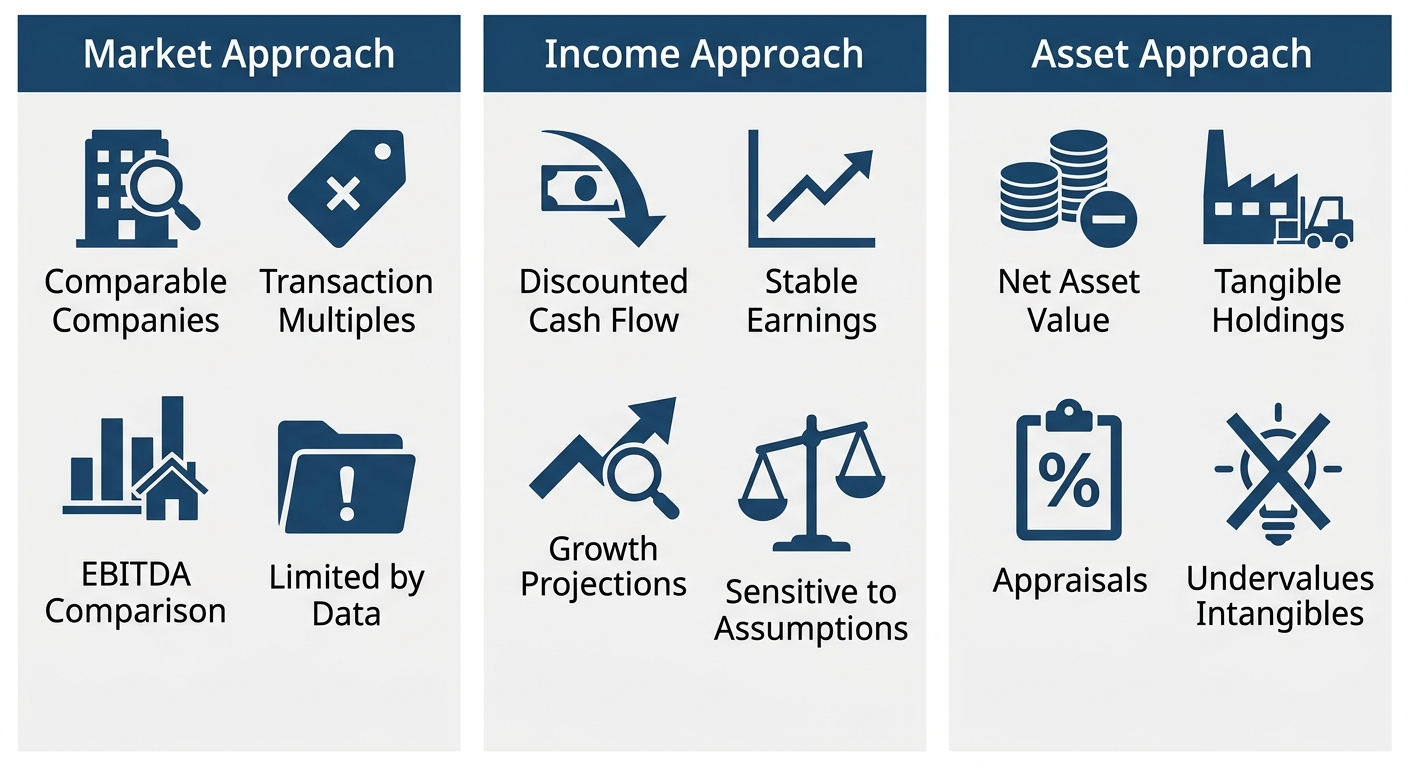
Core valuation methods for selling a business: Market, Income, and Asset approaches.
The Market Approach compares the subject business to recently sold comparable companies using transaction multiples. At Zaidwood Capital, we draw on EBITDA multiples by industry–sourced from leading databases–to benchmark value against recently transacted peers. This method is most applicable to established businesses with a track record of consistent performance and ample peer comparables, though its accuracy depends on the availability of truly comparable data.
The Income Approach projects future cash flows and discounts them to present value, typically through a discounted cash flow (DCF) model or capitalization of earnings. We often recommend a Quality of Earnings analysis to validate the reliability of the underlying financials before applying this method. In any business valuation for sale, this diligence is critical to ensuring that the projected cash flows reflect true economic earning power. The model works best for companies with stable, predictable cash flows, but its output is highly sensitive to assumptions about growth rates and discount rates, making it less suitable for early-stage or highly volatile businesses.
The Asset Approach calculates net asset value by subtracting total liabilities from the fair market value of a company’s tangible assets. This method suits asset-heavy businesses, such as manufacturing or real estate firms, where the balance sheet carries substantial physical holdings. However, it may undervalue intangible assets and goodwill–items that can be significant in service-oriented or technology-based companies. Key inputs include recent appraisals, depreciation schedules, and a thorough liability review.
For business owners in Florida and beyond, understanding these core valuation methods is the first step toward a successful transaction. As a boutique M&A and capital advisory firm, Zaidwood Capital applies these approaches with proprietary data analytics and deep market insight. For a step-by-step guide tailored to your situation, explore our How To Value My Business resource to start the conversation.
EBITDA Multiples and Quality of Earnings: Drivers of Sale Value
EBITDA Multiples Across Industries
Understanding business valuation for sale begins with EBITDA multiples–for technology-focused ventures exploring enterprise ai capital raising, these benchmarks are especially critical. EBITDA, or earnings before interest, taxes, depreciation, and amortization, serves as a proxy for operating cash flow, central to middle-market M&A valuation. Industry-specific EBITDA multiples by industry reflect differing capital structures and risk profiles. Key drivers include recurring revenue, asset intensity, growth rate, customer churn, cyclicality, labor dependence, and regulatory conditions.
We find that manufacturing companies, with high asset intensity and sensitivity to economic cycles, typically trade in a 4.0x-7.0x range. In contrast, SaaS and technology firms benefit from recurring revenue and high gross margins, commanding multiples of 5.0x to 12.0x. Traditional services businesses, often limited by labor dependence and client concentration, land in a 3.0x-5.5x bracket. Healthcare entities benefit from demographic tailwinds and regulatory stability, yielding 6.0x-10.0x multiples.
The following table provides a summary of these industry benchmarks:
| Industry | Typical EBITDA Multiple Range | Key Drivers of Multiple |
|---|---|---|
| Manufacturing | 4.0x – 7.0x | Asset intensity, cyclicality, proprietary technology |
| SaaS / Technology | 5.0x – 12.0x | Recurring revenue, growth rate, gross margin, churn |
| Traditional Services | 3.0x – 5.5x | Client concentration, scalability, labor dependence |
| Healthcare | 6.0x – 10.0x | Regulatory environment, demographics, reimbursement stability |
Source: FINRA and SIFMA market data. The ranges, derived from FINRA and SIFMA industry data, offer owners a clear benchmark.
The Role of Quality of Earnings Reports
A Quality of Earnings analysis is a cornerstone of M&A diligence that goes far beyond a standard financial audit. While an audit verifies that historical statements are fairly presented, a QofE report independently evaluates the sustainability and normalcy of earnings–adjusting for items that may not recur under new ownership. We guide clients through these adjustments to ensure they receive full credit for the cash flow a buyer can realistically expect.
Common QofE adjustments include:
- Owner discretionary expenses: removing personal, non-business costs such as excess compensation or personal travel that new owners would not incur.
- Non-recurring items: stripping out one-time litigation settlements, gains on asset sales, or pandemic-related grants to reveal ongoing earning power.
- Normalized working capital: adjusting for seasonality, inventory anomalies, or receivables patterns to show a buyer the steady-state cash required.
We also scrutinize revenue quality, customer concentration, and backlog to bolster the credibility of projected earnings. Ultimately, a well-prepared QofE instills buyer trust and can narrow the valuation gap. Each adjustment directly impacts normalized EBITDA–the figure multiplied by the valuation multiple. For example, if an owner’s personal expenses total $200,000 and the agreed multiple is 5.0x, the purchase price can increase by $1 million. Conversely, if a business historically under-invested in working capital, a negative adjustment may reduce the sale price. By anticipating these adjustments early, owners can remediate issues and present a cleaner earnings profile, thereby maximizing proceeds.
Interpreting Buyer Perspectives on Value
It is common for business owners to perceive their company’s worth to be higher than what buyers offer. This gap stems from several factors. Buyers incorporate a risk premium for unknown post-acquisition integration challenges, market uncertainties, and the potential loss of key customers. Additionally, strategic buyers often value a business based on the synergies they can realize–such as cross-selling opportunities or cost savings–while an owner typically values the standalone operation. As a boutique M&A and capital advisory firm, we help bridge this gap by framing the narrative around adjusted earnings and growth potential, aligning seller expectations with market realities. Buyers often discount for the effort needed to capture synergies; we structure due diligence to narrow that gap. Understanding these drivers positions you to take actionable steps to enhance your company’s value before entering the market.
Disclaimer: Investments involve risk and are not guaranteed to appreciate. This content is for informational purposes only and does not constitute an offer or solicitation. Past performance does not guarantee future results.
Preparing Your Business for Valuation: Timeline, Documents, and Process
Understanding the value of your business is the first step; preparation is the critical next phase. For owners considering a business valuation for sale, a structured approach ensures you present your company in its best possible light, addressing potential concerns well before a buyer ever sees them.
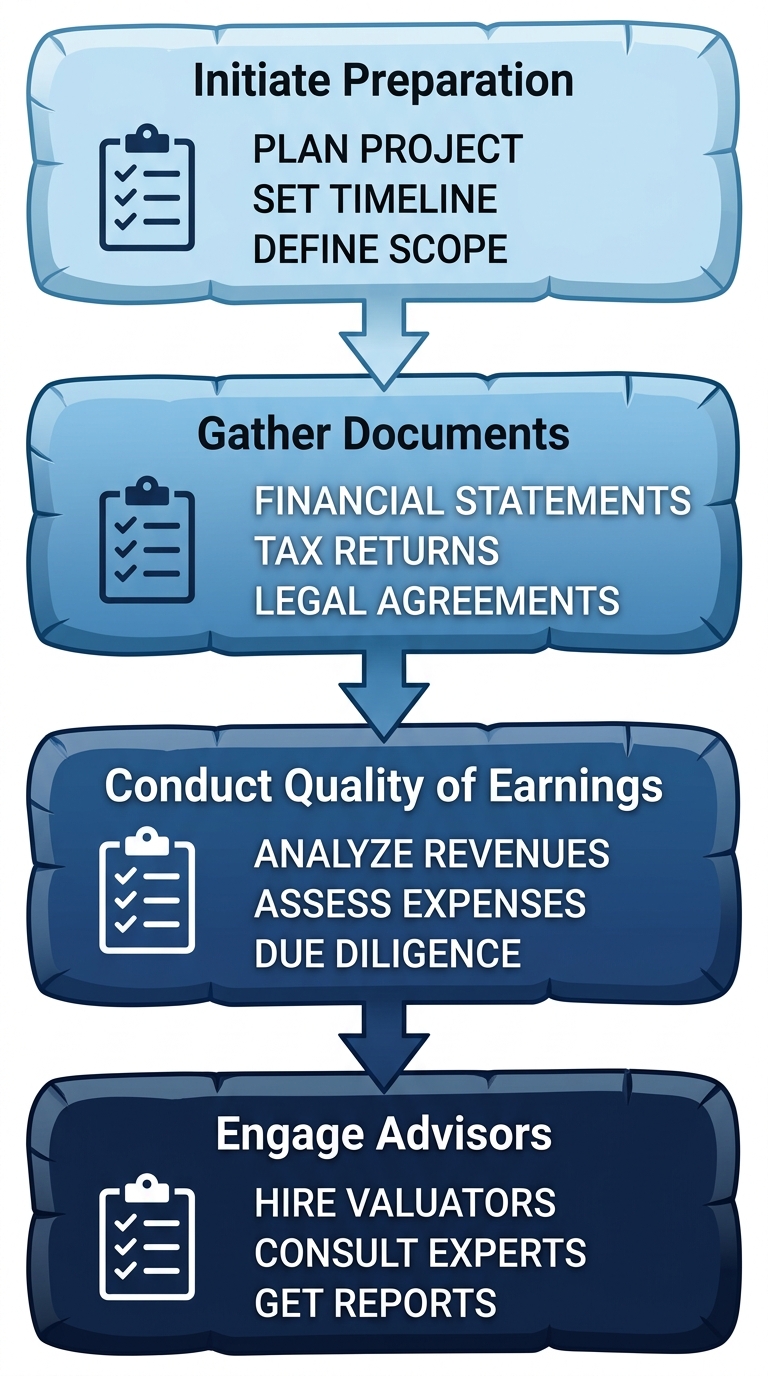
Four-stage preparation process for business valuation
Optimal Timing for a Formal Valuation
We recommend initiating the valuation preparation process 12 to 18 months before you plan to go to market. This extended runway allows time to identify and correct value detractors such as customer concentration, unresolved legal issues, or normalized earnings adjustments that could otherwise depress the multiple you ultimately receive. Early preparation also lets you track EBITDA multiples by industry trends, ensuring your financial performance aligns with sector benchmarks that buyers rely on. By starting early, you can implement strategic improvements–diversifying your client base, renewing key contracts, or cleaning up financials–that materially enhance your valuation outcome.
Essential Documents for Valuation
A well-organized document set accelerates the valuation process and signals operational maturity to potential buyers. We recommend assembling the following records early: historical financial statements covering three to five years, including income statements, balance sheets, and cash flow statements; matching tax returns for the same period to verify reported income; a detailed revenue breakdown by customer and product to highlight growth trajectories and concentration risk; and all key operating agreements, leases, and material contracts. When these records are maintained in good order, preparation time can be compressed to as little as one to four weeks, according to guidance from the Financial Industry Regulatory Authority (FINRA).
The following table summarizes the essential documents and their roles:
| Document Type | Purpose in Valuation | Estimated Preparation Time |
|---|---|---|
| Historical Financial Statements (3-5 years) | Provides a baseline for normalizing earnings and projecting cash flows | 2-4 weeks (if well-kept) |
| Tax Returns (3-5 years) | Verifies reported income and highlights potential adjustments | 1-2 weeks |
| Revenue Breakdown by Customer/Product | Identifies concentration risk and growth trends | 1-2 weeks |
| Operating Agreements, Leases, Contracts | Confirms legal structure and key operational commitments | Variable (2-6 weeks if retrieval needed) |
Source: Financial Industry Regulatory Authority (FINRA) guidance on documentation readiness.
Preparing for Quality of Earnings
For business owners pursuing a business valuation for sale, a sell-side Quality of Earnings analysis is a critical deliverable that confirms the sustainability of your earnings to a buyer. This engagement is performed by an independent third-party CPA or advisory firm–not your internal accounting team–and typically takes six to eight weeks to complete. Preparation involves providing detailed transaction-level data, reconciling non-recurring expenses, and substantiating EBITDA add-backs. A thorough Quality of Earnings analysis uncovers adjustments that a buyer’s diligence team would find, allowing you to address them proactively and defend your asking price with confidence.
Engaging Advisors and Next Steps
Our firm, a Boutique M&A and Capital Advisory Firm, provides comprehensive business valuation services that guide you through every step of the preparation process. We recommend interviewing multiple advisory firms, evaluating their deal track record, industry expertise, and cultural fit before signing an engagement letter. Once engaged, our team leverages the Sovereign Data Nexus platform and Precision Catalyst analytics to pinpoint the right buyer matches and position your business for maximum valuation. Once your documents are in order and your earnings profile is clear, you are ready to proceed to the formal valuation engagement.
Why Buyer and Owner Valuations Differ — and How to Bridge the Gap
The gap between what a business owner thinks their company is worth and what a buyer will pay often surprises first-time sellers. Understanding a business valuation for sale requires examining both perspectives — the emotional owner and the analytical buyer — to align expectations and close deals efficiently.
| Perspective | Key Factors | Typical Value Bias | How to Align |
|---|---|---|---|
| Owner | Sweat equity, future potential, emotional attachment | Higher (overestimates value) | Obtain independent valuation; adjust projections for risk |
| Buyer / Private Equity | Risk assessment, required return, synergies, tax structure | Lower (conservative estimates) | Share quality QofE and detailed growth plan; use market comparables |
This divergence reflects the fundamental gap that our advisory services help clients navigate.
From the owner’s perspective, we regularly encounter overvaluation driven by sweat equity–the countless hours invested over years–optimism about future growth trajectories, and deep emotional attachment to a company that represents a personal legacy. These subjective inputs inflate internal value estimates, often creating a baseline that diverges sharply from market-based calculations.
Buyers, especially private equity firms, approach valuation with a conservative, risk-adjusted lens. As documented by the Securities Industry and Financial Markets Association (SIFMA), private equity investors evaluate deals based on rigorous return thresholds (typically targeting 20-30% IRRs), potential synergies from integration, and tax-efficient deal structures. This framework produces a lower valuation, as buyers discount for execution risk and market volatility, creating a natural tension with sellers’ expectations.
When preparing a business valuation for sale, owners can bridge the gap by presenting objective, data-driven evidence. A thorough Quality of Earnings analysis reframes the financial narrative, verifying adjusted EBITDA and normalizing non-recurring items. Our full-cycle investment banking services include independent valuations, Quality of Earnings analyses, and presentation of market comparables to help sellers present a credible value case. Additionally, aligning growth projections with EBITDA multiples by industry and benchmarking against recent transactions reduces perceived risk and helps both parties converge on a fair price.
Frequently Asked Questions About Business Valuation for Sale
Business valuation for sale is a critical first step when selling your company, setting a baseline for negotiations.
What is a Quality of Earnings analysis?
Our Quality of Earnings analysis verifies the reliability of your financial statements by normalizing earnings to reflect true cash flow. This process ensures that the valuation basis is accurate and defensible.
How do you determine a realistic valuation range?
We analyze EBITDA multiples by industry, using Securities Industry and Financial Markets Association (SIFMA) data, to set a valuation range that reflects market conditions.
What role does a boutique M&A firm play?
As a Boutique M&A and Capital Advisory Firm, we provide hands-on guidance through valuation, buyer identification, and negotiation. Our team leverages deep industry relationships to position your company for a successful sale.
For more detailed answers, visit our M&A advisory FAQ.
Partnering with Zaidwood Capital for Your Business Valuation Journey
On your business valuation for sale journey, partnering with Zaidwood Capital means working with a dedicated team focused on your company’s story. We use our proprietary Sovereign Data Nexus platform to benchmark industry-specific EBITDA multiples and conduct rigorous Quality of Earnings analysis, ensuring your valuation reflects real market dynamics. This valuation is a cornerstone of our Full-Cycle M&A approach, seamlessly connecting to our broader sell-side and capital advisory services. Contact us to start your valuation journey today.
Per FINRA regulations, securities are offered through Finalis Securities LLC; Zaidwood Capital is not a registered broker-dealer and is unaffiliated with Finalis.
Resources


