



Due Diligence Checklist
Table of Contents
Due Diligence Checklist Fundamentals for M&A Transactions
A due diligence checklist is a structured inventory of items reviewed during an M&A transaction, designed to surface risks and validate key assumptions. This framework serves as a critical risk-mitigation tool, ensuring that buyers and investors make informed decisions. At Zaidwood Capital, we treat the comprehensive checklist as the backbone of every transaction we advise.
Drawing on FINRA’s regulatory standards and SIFMA’s industry best practices, we organize the due diligence checklist around five essential categories. Financial due diligence reviews the Quality of Earnings report, tax liabilities, and debt structure. Legal assessment covers contracts, litigation, and intellectual property. Operational scrutiny evaluates management, processes, and technology. Commercial analysis examines market position, customer base, and competition. Regulatory verification confirms licenses and compliance status. These documents are typically organized and reviewed in a Virtual data room, a common platform that centralizes access for all parties.
While a due diligence checklist cannot guarantee a deal’s outcome, it is indispensable for surfacing risks and informing negotiations. Zaidwood Capital, a Boutique M&A and Capital Advisory Firm, guides clients through each category via our M&a Due Diligence Services, a disciplined approach that underpins every transaction we advise.
Preparing for the Due Diligence Process
With a clear understanding of the due diligence framework, the next critical phase is systematic preparation. A thorough due diligence checklist is the foundation of every successful sell-side m&a engagement, enabling sellers to present their business in the strongest possible light while minimizing last-minute disruptions.
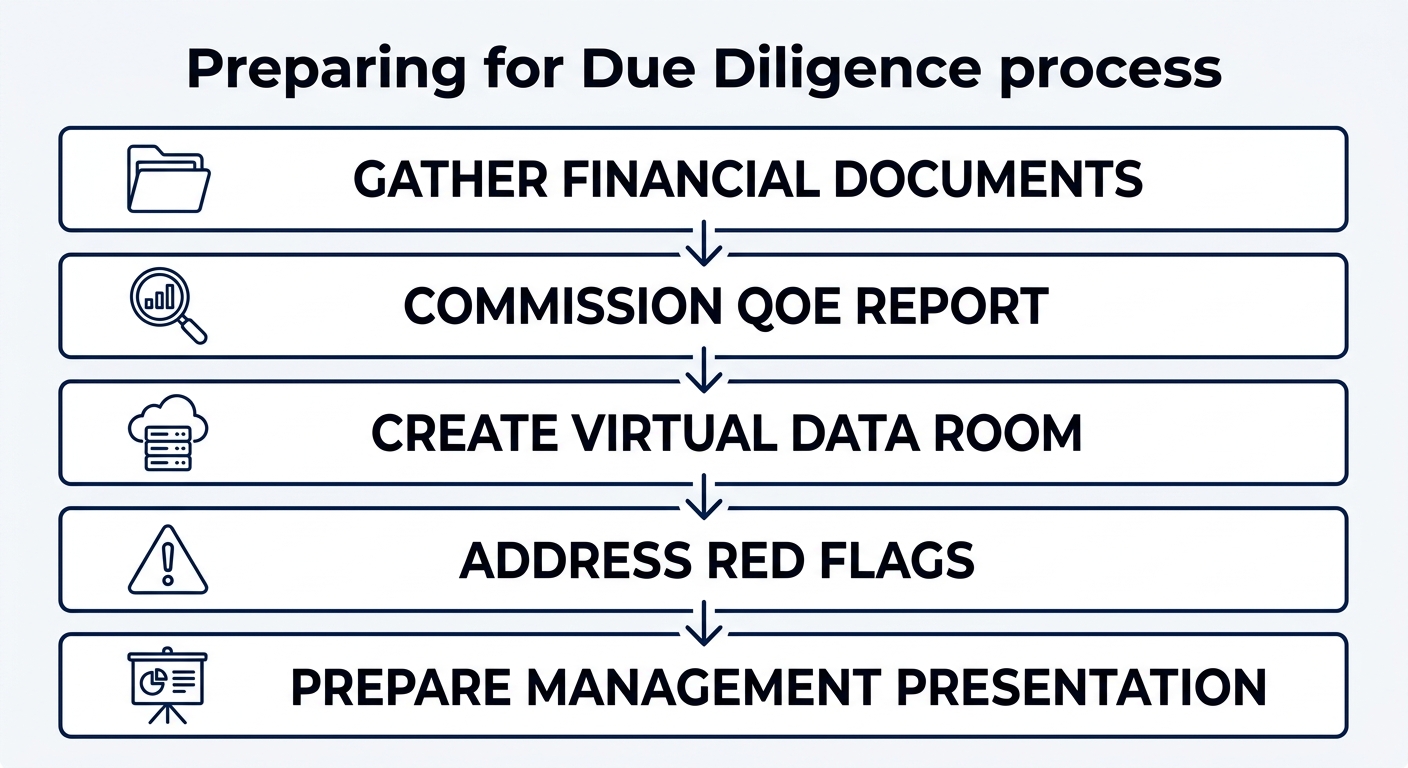
Five-step due diligence preparation process flow
Aligned with SIFMA’s authoritative industry standards, our recommended preparation sequence includes the following action items. Executing each step thoroughly builds a defensible transaction foundation.
- Gather core financial documents–begin by compiling audited financial statements, tax returns, and current management accounts to establish a transparent baseline.
- Commission an independent Quality of Earnings report to validate EBITDA, normalize earnings, and demonstrate financial integrity to buyers.
- Set up a secure virtual data room segmented by category (financial, legal, commercial, operational) and populate it with contracts, IP records, and customer lists.
- Proactively address red flags such as customer concentration or litigation risks, and prepare a succinct management presentation that articulates the business narrative, key metrics, and growth drivers, helping buyers understand the strategic value.
As a Boutique M&A and Capital Advisory Firm, Zaidwood Capital guides sellers through each stage to ensure a seamless diligence process, leveraging deep industry relationships and expert preparation frameworks.
Defining the Transaction Scope and Objectives
Effective due diligence begins with a well-defined scope. In our due diligence checklist, we prioritize clarifying deal parameters — including size, industry, and timeline — during an initial consultation. Our m&a due diligence services incorporate a structured scoping framework designed to capture all critical objectives, ensuring both buyer and seller are aligned from the start.
We work closely with clients to define the financial scope, which commonly includes a thorough review of the Quality of Earnings report, operational analysis, and regulatory compliance checks. Market positioning is also assessed to identify potential risks and opportunities.
Document collection through a Virtual data room streamlines the process while maintaining confidentiality. The scope remains flexible, refined as new information emerges to address identified risks rather than promising exhaustive discovery. This adaptive approach keeps the due diligence focused on the client’s strategic goals.
Once the scope and objectives are agreed upon, the due diligence team moves to document collection and analysis.
Assembling the Documentation Framework
With the scope defined, the next critical step is assembling the documentation framework that underpins thorough Investment Bank Due Diligence. Our standard due diligence checklist includes the following core documents:
- Audited financial statements for the past three years and current interim period
- Federal and state tax returns for the same periods
- Material contracts with customers, suppliers, and key employees
- Corporate governance documents including articles, bylaws, and board minutes
- Intellectual property registrations and supporting records
- A Quality of Earnings report prepared by an independent accountant
Once compiled, these documents must be organized efficiently.
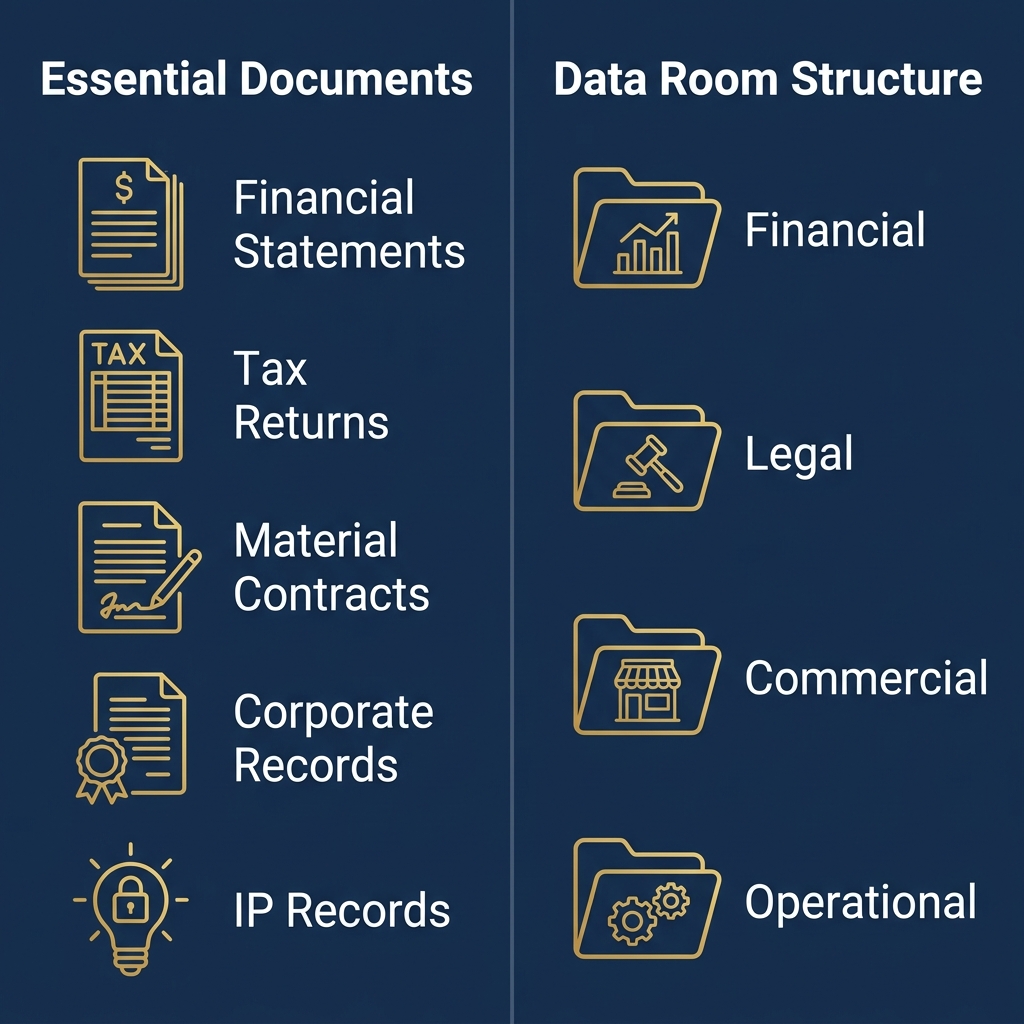
Documentation framework infographic: essential documents and data room structure.
We organize documents in a virtual data room with standardized folder naming (e.g., Financials → Year → Statements) to streamline access and reduce diligence friction. A well-indexed due diligence checklist ensures nothing is overlooked and signals operational maturity. As a Boutique M&A and Capital Advisory Firm, we believe that an airtight documentation framework accelerates Full-Cycle M&A execution and avoids the pitfalls of subjective, unverifiable statements. Once the framework is complete, the review phase can begin.
Conducting Financial Analysis and Identifying Red Flags
A comprehensive due diligence checklist begins with our firm’s M&A due diligence services, which we tailor to identify critical financial red flags before they derail a transaction. We look for the following warning signs:
- Review trends in revenue, gross margin, and operating expenses over at least three fiscal years to detect unusual fluctuations.
- Check for frequent changes in accounting policies or estimates that may manipulate earnings, a red flag highlighted by FINRA guidance.
- Identify related-party transactions that may not be at arm’s length, scrutinizing contracts and pricing structures.
- Analyze the Quality of Earnings report to highlight discrepancies between cash flow from operations and reported net income, a key indicator of earnings quality.
- Examine off-balance-sheet liabilities and contingent obligations; a well-organized Virtual data room helps surface documents such as leases, guarantees, and commitments.
- Look for unusually high debt levels or rapid changes in debt structure, which may signal financial distress or liquidity concerns.
For more detail, see our m&a due diligence services.
As a Boutique M&A and Capital Advisory Firm, we emphasize that this checklist is not exhaustive and recommend engaging professional advisors for comprehensive due diligence.
Reviewing Legal and Regulatory Compliance
Beyond financial and operational due diligence, legal and regulatory compliance must be addressed. When conducting a sell-side m&a transaction, reviewing legal and regulatory compliance is critical. Adhering to FINRA guidelines helps ensure proper disclosure, securities law compliance, and anti-money laundering controls.
We guide our clients through a comprehensive due diligence checklist that confirms securities law compliance, verifies proper disclosure of all material information, and satisfies anti-money laundering requirements. A secure Virtual data room facilitates the organized storage and controlled sharing of these compliance documents, enabling efficient regulatory review by FINRA and other relevant authorities. Meanwhile, a rigorous Quality of Earnings report ensures the accuracy of financial representations and strengthens the foundation for transparent negotiations.
As a Boutique M&A and Capital Advisory Firm, Zaidwood Capital is not a registered broker-dealer. Securities are offered through Finalis Securities LLC; Zaidwood Capital is unaffiliated with Finalis, ensuring full compliance.
Evaluating Operations and Management Infrastructure
Beyond financial statements, a thorough due diligence checklist examines the operational and management infrastructure that underpins a company’s ability to execute its strategy. We assess internal systems, leadership depth, key processes, and technology platforms to identify strengths and risks.
Our operational due diligence checklist includes a review of Quality of Earnings reports, management team biographies, and key performance metrics. A well-organized Virtual data room indicates strong data governance, while factors such as over-reliance on a single executive, outdated technology, or inefficient supply chains reveal potential vulnerabilities. These findings directly influence valuation adjustments and post-acquisition integration plans. As a Boutique M&A and Capital Advisory Firm, we leverage our Full-Cycle M&A expertise and proprietary frameworks like the Velocity Matrix to expedite this operational review without sacrificing depth, ensuring that each insight informs our capital advisory decisions. By systematically evaluating these factors, we help clients strengthen their deal thesis and position for sustainable growth.
Preparing a Quality of Earnings Report
A key component that demands rigorous analysis within the due diligence checklist is the Quality of Earnings report. This independent financial analysis normalizes EBITDA, adjusts revenue for recurring versus one-time items, and assesses working capital trends. We prepare and review these reports as part of our sell-side advisory, ensuring that owners present a clear, defensible financial narrative.
The report’s core components include:
- Normalized earnings and EBITDA add-backs
- Revenue quality analysis
- Working capital assessment and evaluation of discretionary owner expenses
Each element reveals distinct risks and opportunities. EBITDA add-backs remove one-time expenses to show sustainable earnings, while revenue quality analysis distinguishes recurring from non-recurring revenue streams. Working capital review identifies liquidity needs and seasonal patterns.
Once prepared, we securely share the report with potential buyers through a virtual data room, maintaining confidentiality while enabling fast, transparent due diligence. This process allows buyers to validate earnings claims and reduces the likelihood of post-closing disputes. Ultimately, a thorough Quality of Earnings report is essential for informed decision-making and a successful transaction.
Setting Up a Virtual Data Room
Once the due diligence checklist is defined, the next step is to set up the virtual data room (VDR) where all documents will be housed. Here’s how to do it effectively.
We recommend creating a folder structure that mirrors a typical due diligence checklist: Financial (including a Quality of Earnings report), Legal, Commercial, Operational, Tax, and Management. A dedicated “Due Diligence Checklist” folder allows buyers to track completed items within the data room. Append date stamps to file names (e.g., QoE_Report_v1_2025-03-01.pdf) for version control.
For security, require a signed NDA and two-factor authentication before granting any access. Configure permission tiers: full access for the buyer’s advisors, read-only for junior analysts, and restricted access for sensitive items such as management projections. Activate the Q&A module to centralize buyer inquiries and maintain auditable response records.
With these protocols, your virtual data room becomes a secure, organized hub that eliminates friction and keeps due diligence moving efficiently.
Overcoming Common Due Diligence Obstacles
Even a comprehensive due diligence checklist cannot eliminate every obstacle during an M&A transaction. Common hurdles include incomplete financial data, time pressure, regulatory complexity, and communication breakdowns. Here is how to navigate them.
Incomplete or inconsistent financial data is the most frequent challenge in due diligence. According to industry standards from the Securities Industry and Financial Markets Association (SIFMA), validating revenue and EBITDA adjustments is critical to a fair deal. We recommend a Quality of Earnings (QoE) report to provide an independent assessment, helping buyers confirm the accuracy of financial statements and uncover hidden liabilities. A thorough QoE report reduces the risk of post-close surprises.
Time pressure–such as tight 30-day data room deadlines–can force rushed analysis. A structured due diligence checklist helps prioritize the most critical discovery items, ensuring no major red flag is overlooked. When facing regulatory complexity, especially in cross-border deals or specialized industries, we advise engaging legal and sector experts early. Their guidance can prevent costly compliance missteps down the line.
Data organization and security are also common obstacles. Relying on scattered email attachments creates version-control chaos and raises confidentiality risks. A secure virtual data room provides controlled, auditable access for all stakeholders, centralizing documents and streamlining review. Additionally, communication breakdowns between buyer and seller teams can stall progress. We establish weekly sync meetings and designate a single point of contact for all data requests, reducing friction and keeping the process on schedule.
For non-financial challenges like cultural fit, management interviews and site visits offer additional insight. Once these common hurdles are managed, the path to a successful transaction becomes clearer.
Final Checklist and Next Steps
At Zaidwood Capital, a Boutique M&A and Capital Advisory Firm, our Full-Cycle M&A process includes a final due diligence checklist to ensure no detail is missed.
- Financial: Confirm the accuracy of audited financial statements and review the detailed Quality of Earnings report.
- Legal: Verify corporate structure, material contracts, litigation exposure, and regulatory compliance.
- Operational: Assess supply chain stability, technology infrastructure, and secure document exchange in a Virtual data room.
- Commercial: Evaluate customer concentration risks, market positioning, and key contract terms.
- Tax: Review historical tax returns, outstanding liabilities, and compliance with applicable tax laws.
- IT/IP: Audit intellectual property registrations, data security protocols, and software licensing.
- Advisor collaboration: Engage legal, accounting, and industry advisors to provide specialized review throughout the process.
Once the checklist is cleared, the next step is negotiation and drafting of the definitive purchase agreement. This checklist is representative, not exhaustive–professional advisors should be consulted for a deal-specific review.
Resources


