



Investment Bank Due Diligence
Table of Contents
The Role of Due Diligence in Investment Banking
Investment bank due diligence is a systematic evaluation of a target company’s financial, legal, and operational dimensions. This risk-assessment process is critical for identifying hidden liabilities, validating management projections, and confirming the strategic logic of a transaction. In mergers and acquisitions, as well as capital raising, a thorough investigation helps our clients make informed decisions and negotiate from a position of strength. Its objective is not to eliminate all risk but to ensure that every material fact is understood and priced into the deal, thereby reducing the potential for costly surprises.
The process typically encompasses financial due diligence, which scrutinizes historical financial statements, cash flows, and forward-looking projections, and legal due diligence, which examines regulatory compliance, material contracts, and intellectual property rights. The Securities Industry and Financial Markets Association (SIFMA), the leading trade association for the U.S. securities industry, establishes standards and best practices that guide these reviews, promoting consistency and integrity across capital markets. We apply this rigor across all our investment banking services to ensure every recommendation is grounded in thorough analysis. Understanding the types of due diligence is the first step toward executing a thorough review.
Understanding Investment Bank Due Diligence: Purpose and Process
The Role of Due Diligence in the Deal Lifecycle
Investment bank due diligence is a systematic investigation phase that occurs between deal initiation and transaction closure. Its purpose is to verify the accuracy of seller representations, assess financial, operational, and legal risks, and validate key valuation assumptions. At our boutique M&A and capital advisory firm, we view this process as the backbone of informed decision-making, enabling both buyers and sellers to proceed with confidence. By rigorously examining target company data, we help clients avoid surprises and build a solid foundation for negotiations. This transaction due diligence process ultimately shapes the deal structure and post-closing plans, ensuring that no hidden liabilities undermine the outcome. The due diligence review is not a one-size-fits-all exercise; we tailor the scope to the deal’s size, industry, and specific objectives, whether supporting a growth-stage company seeking capital or a middle-market firm considering an acquisition.
Key Areas of Focus: Financial, Legal, and Operational
Financial due diligence digs into the target’s historical financials, quality of earnings, working capital patterns, debt obligations, and forward-looking projections. Legal due diligence scrutinizes material contracts, litigation history, intellectual property assets, regulatory compliance, and corporate organizational structure. Operational due diligence evaluates management strength, business processes, customer and supplier relationships, technology systems, and key dependencies. Commercial due diligence assesses market position, competitive dynamics, customer concentration risk, and sustainable growth drivers. Our M&A due diligence services are tailored to cover these areas comprehensively, adapting the scope to the unique risks and opportunities of each transaction. We also offer m&a due diligence services and m&a due diligence services. This multidimensional review provides the evidence needed to justify deal terms and avoid post-closing pitfalls.
Typical Timeline and Depth of Review
The typical timeline for a full investment bank due diligence process ranges from 30 to 60 days, though a high-level review may be completed in one to two weeks. The depth of review depends on transaction complexity, size, and whether the engagement is buy-side or sell-side. At Zaidwood Capital, we customize the scope to match the deal’s demands–a lean assessment for straightforward transactions or a deep dive for complex, cross-border situations. Our boutique structure allows us to move efficiently without sacrificing rigor, producing a due diligence report, risk matrix, and integration considerations that equip clients to act decisively. While due diligence significantly mitigates risk, it does not eliminate it; we surface critical issues early to give clients leverage in negotiations. Industry guidance from SIFMA supports these typical timeframes and review practices, reinforcing our commitment to a disciplined, thorough approach.
Key Benefits of Thorough Due Diligence in M&A
With a clear understanding of what investment bank due diligence entails, we now explore the specific benefits it delivers to buyers and sellers in M&A.
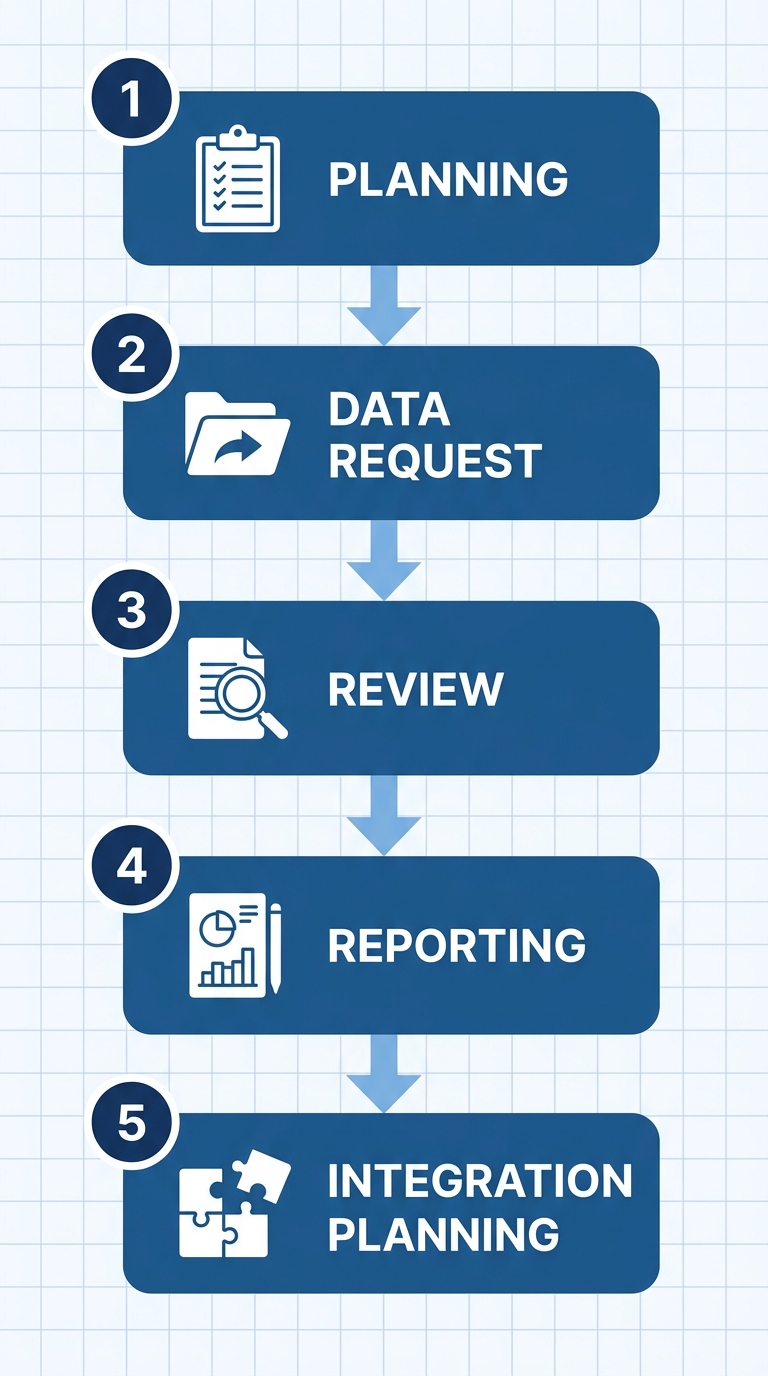
Vertical process flow for investment bank due diligence phases.
Key benefits of thorough due diligence in M&A: confidence, value, and negotiation leverage.
The following three benefits underscore why comprehensive investigation is a non-negotiable step in any transaction.
Enhancing Buyer Confidence and Deal Certainty
Thorough due diligence directly enhances buyer confidence by eliminating information asymmetry. Without a comprehensive review, buyers risk overpaying for assets with inflated earnings or hidden liabilities, leading to costly post-closing surprises. When buyers gain full visibility into a target’s financial, legal, and operational details, they can proceed with certainty. This process uncovers risks such as undisclosed debt, pending litigation, compliance gaps, and customer concentration issues. Addressing these proactively prevents value erosion. As the Financial Industry Regulatory Authority (FINRA) emphasizes, due diligence is essential for fiduciaries to verify material claims and avoid regulatory repercussions. While no review can eliminate all risk, rigorous investigation transforms uncertainty into calculated decision-making, dramatically increasing deal certainty. Financial due diligence validates revenue quality, while legal reviews flag regulatory exposures that could derail the transaction. This granular insight builds trust, reduces renegotiations, and accelerates closing. Moreover, it assures lenders and stakeholders that the deal rests on verified facts rather than optimistic projections, reinforcing overall deal certainty.
Uncovering Value Drivers and Mitigating Risks
Financial due diligence delves into working capital trends, revenue quality, and normalized EBITDA, while legal due diligence identifies contractual pitfalls and regulatory exposure. This dual lens reveals hidden liabilities such as undisclosed debt, pending litigation, environmental liabilities, and customer concentration risks. Environmental liabilities from historical operations or pending lawsuits can carry substantial costs, making early identification critical for valuation. Simultaneously, it highlights value drivers like cross-selling opportunities, market expansion potential, and cost synergies from operational efficiencies and scale. For instance, identifying overlapping distribution channels can unlock cost savings, while complementary product lines create cross-selling revenue. Technology, talent, and intellectual property often represent significant growth levers that a surface-level review would miss. By quantifying both value and risk, due diligence allows parties to negotiate adjustments–such as earn-outs or purchase price reductions–based on factual findings rather than assumptions. This data-driven approach mitigates downside while maximizing upside. To gain deeper insights into this process, explore our M&A Due Diligence Services for comprehensive support. For more information, see M&a Due Diligence Services.
Strengthening Negotiation Position with Comprehensive Data
Comprehensive due diligence arms buyers with objective data that strengthens their negotiating position significantly. The detailed findings from investment bank due diligence provide the empirical basis for negotiating favorable terms. For instance, if financial due diligence reveals inconsistent revenue recognition or aggressive working capital management, buyers can push for a lower purchase price or structure an earn-out to tie future payments to performance. Legal due diligence may expose potential litigation or regulatory non-compliance, allowing parties to negotiate specific indemnification clauses and refine representations and warranties. Post-closing purchase price adjustments, escrow holdbacks, and tailored representations all derive from the factual record built during diligence. When both parties rely on a shared set of verified data, negotiations become more efficient and equitable. This transforms the discussion from subjective opinions to fact-based analysis, enabling creative structures that satisfy both buyer and seller. Armed with these benefits, let us turn to the practical steps for executing thorough due diligence.
How Investment Banks Conduct Due Diligence for Buy-Side and Sell-Side Mandates
In investment bank due diligence, we apply a rigorous, structured approach to uncover risks and validate opportunities for both buy-side and sell-side mandates. Whether representing a buyer or seller, the goal remains the same: provide clear, fact-based insights that drive informed transaction decisions.
The Due Diligence Process: From Strategy to Closing
We phase each engagement into five distinct stages. The planning phase defines scope and assembles the team, grounded in a comprehensive Due Diligence Checklist that ensures no critical area is overlooked. Next, the data request stage delivers detailed information requests to the target. During the review phase, our team analyzes financial, operational, and legal data against the mandate’s objectives. The reporting phase synthesizes findings into a diligence report that highlights key risks, value drivers, and recommended actions. Finally, integration planning maps how the acquirer will absorb the target post-close, bridging diligence findings with real-world execution.
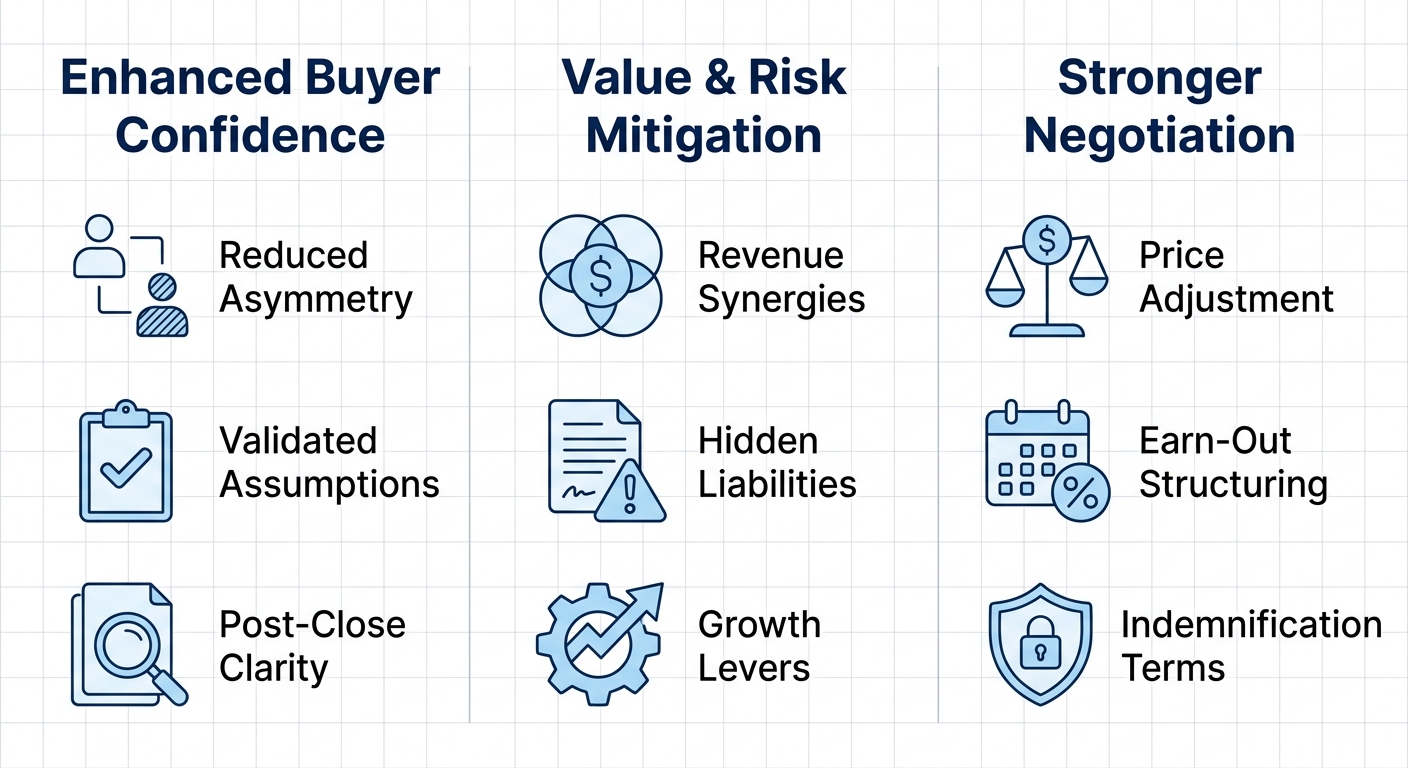
Key benefits of thorough due diligence in M&A: confidence, value, and negotiation leverage.
Vertical process flow for investment bank due diligence phases.
This phased framework adapts to whether we are working on a buy-side or sell-side mandate. On the buy-side, we focus on verifying projections and identifying hidden liabilities; on the sell-side, we prepare the target for buyer examination, addressing potential concerns proactively. Industry nuances likewise shape the checklist–technology deals, for example, demand deeper intellectual property and cybersecurity reviews.
Financial Due Diligence in Detail
Financial due diligence moves beyond surface-level numbers to reveal the true economic performance of a business. We begin with historical financial statement analysis, tracing revenue quality, expense patterns, and EBITDA trends across multiple periods. A central component is the quality of earnings assessment: adjustments to reported EBITDA that remove non-recurring, non-operational items–such as one-time legal settlements or owner-specific expenses–to reflect sustainable profitability. We then analyze normalized working capital levels to determine the cash required to run operations, distinguishing seasonal peaks from structural deficits. Finally, we identify debt-like items, such as underfunded pension obligations, earn-out liabilities, or off-balance-sheet financing, that can significantly alter enterprise value. For sell-side engagements, we often preempt these adjustments to present a clean, defensible financial picture to potential buyers.
Legal Due Diligence and Compliance Checks
Legal due diligence examines the contractual and regulatory fabric of the target. We coordinate with external legal counsel to review material contracts, including customer and supplier agreements, change-of-control provisions, and key-man clauses. Pending or threatened litigation receives special focus, as unresolved disputes can transfer substantial risk to the buyer. Intellectual property rights–patents, trademarks, and trade secrets–are verified to ensure the target holds enforceable ownership. On the compliance front, matters depend on the industry; for regulated entities, FINRA rules establish standards that guide our review, though Zaidwood Capital is not a registered broker-dealer and this analysis is strictly informational. We also assess regulatory exposure to evolving laws and flag any gaps that could require remediation post-close. Throughout, we maintain a clear separation: we coordinate the due diligence effort, but legal conclusions rest with qualified counsel.
Once due diligence is complete, the focus shifts to integration planning and finalizing the transaction. The insights gathered form the foundation for negotiating final terms and ensuring a smooth transition to the next phase of the deal lifecycle.
Best Practices for Effective Due Diligence in Investment Banking
Having explored the core principles of due diligence, we now turn to the best practices that make investment bank due diligence effective in practice. As a boutique M&A advisory firm, we tailor our approach to the lower middle market, where customized checklists and technology-enabled review are essential.
Building a Structured Due Diligence Checklist
A lower middle market investment bank should begin every engagement by customizing a core checklist to the specific industry and risk profile. While we are not a broker-dealer, we adhere to FINRA’s due-diligence standards to ensure regulatory-grade thoroughness. Every checklist should cover five domains: financial, legal, commercial, operational, and management.
- Financial due diligence must verify at least three years of audited or reviewed financials, normalize EBITDA for non-recurring items, and cross-reference against industry benchmarks from SIFMA data.
- Legal due diligence should review material contracts, flag any pending or threatened litigation, and confirm ownership of key intellectual property.
- Commercial diligence examines market positioning, customer concentration, and growth drivers to validate revenue quality.
- Operational and management reviews assess supply chain resilience, IT systems, and leadership depth to uncover hidden risks.
We supplement this framework with our Sovereign Data Nexus platform, providing real-time industry comparables to stress-test financial assumptions.
Leveraging Technology and Data Rooms for Efficiency
Technology has become a force multiplier in investment bank due diligence, allowing deal teams to review thousands of documents quickly and accurately. Virtual data rooms like Datasite and Intralinks now embed AI-driven OCR and keyword search that can cut document review time by up to 40%. We also deploy our Precision Catalyst engine to automate pattern recognition in contracts, flagging unusual terms that warrant closer scrutiny. These tools integrate with due diligence checklists to auto-populate findings and generate exception reports, reducing manual effort. Additionally, natural language processing can scan thousands of emails for compliance red flags, while version-control features ensure every team member works off the latest document. By combining vetted industry data from SIFMA’s due diligence framework with automated analysis, we compress the diligence timeline without sacrificing thoroughness.
Common Pitfalls to Avoid
Even with a rigorous checklist and technology, diligence can go wrong if teams fall into common traps.
- Over�reliance on management forecasts without independent validation. We often see sellers projecting annual growth rates far above industry averages, which must be tested against external market data.
- Failing to red�flag related-party transactions early. Undisclosed loans, preferential pricing, or shared-services arrangements can distort the true economic picture of the business.
- Conducting siloed diligence without weekly cross�functional check�ins. When legal, financial, and commercial work streams don’t speak, inconsistencies slip through and erode deal momentum.
We mitigate these risks by holding daily stand�ups and maintaining a central issues log, ensuring nothing falls through the cracks. After avoiding these pitfalls, the final phase of a successful diligence process is integrating findings into the negotiation strategy.
Maximizing Deal Success Through Robust Due Diligence
Once the deal framework is established, robust due diligence becomes the critical lens through which every opportunity and risk is assessed. As a Boutique M&A and Capital Advisory Firm, Zaidwood Capital approaches due diligence as the cornerstone of successful transactions. In investment bank due diligence, this tailored, data-driven investigation spans financial, legal, operational, and cultural dimensions–not a one-size-fits-all checklist.
At Zaidwood Capital, our financial due diligence covers historical performance, revenue quality, EBITDA normalization, working capital trends, and debt-structure review. Legal due diligence verifies corporate compliance, material contracts, intellectual property ownership, regulatory filings, and litigation exposure–a critical lens for enterprise AI capital raising where rapid innovation demands rigorous analysis. Beyond financials, our operational due diligence examines supply chain resilience, technology infrastructure, and cultural alignment to ensure post-merger integration success. Our proprietary Sovereign Data Nexus platform aggregates real-time market and company data to surface anomalies hidden in manual reviews, while Precision Catalyst applies AI to pattern-match findings against thousands of past transactions, yielding predictive insights on deal viability. This rigorous, data-driven process reflects the due diligence standards that leading investment banks employ. The Securities Industry and Financial Markets Association (SIFMA) confirms that comprehensive financial, legal, operational, and strategic reviews align with industry best practices.
With a complete due diligence picture, our team is equipped to negotiate from a position of strength and drive transactions to a successful close at Zaidwood Capital.
Resources


