

How To Finance Buying A Business
Table of Contents
Understanding How to Finance Buying a Business
How to finance buying a business is a top concern for entrepreneurs; once you identify a target business, the immediate priority is securing the capital. Below we outline the most common routes, drawing on our work as a Boutique M&A and Capital Advisory Firm. For many buyers, specialized Business Acquisition Financing solutions are a practical gateway to evaluating lender and investor options. Our team connects you with SBA lenders, banks, and private capital sources to structure a deal that fits.
The SBA 7(a) loan program is the most widely used government-backed financing option for acquisitions, according to the U.S. Small Business Administration. Understanding SBA 7(a) loan requirements is essential for buyers: the business must be for-profit, and applicants need a satisfactory credit score, acceptable debt-to-income ratio, and sufficient collateral. These loans can cover purchase price, working capital, and equipment, typically requiring a 10-30% down payment from the borrower. SBA 7(a) eligibility criteria also consider the buyer’s management experience and business plan. Because the SBA guarantees a portion of the loan, lenders can offer more favorable terms to qualified buyers.
A leveraged buyout financing structure, or LBO, uses debt secured by the target’s assets and cash flow to fund the acquisition. LBO financing mechanics suit established businesses with stable cash flows and low debt levels; buyers typically form a special purpose vehicle and may bring in equity partners. Seller financing is another alternative, where the seller defers part of the price through a promissory note, cutting the buyer’s upfront capital requirement. With financing in place, thorough due diligence becomes the priority. As a Full-Cycle M&A and capital advisory firm, we guide clients through these financing pathways, from SBA loans to private capital sources.
Key Financing Options for Business Acquisitions
Understanding how to finance buying a business is the first critical step for any acquisition-minded entrepreneur. We typically see three primary financing pathways: seller financing, the SBA 7(a) loan, and self-funding paired with debt. If you are ready to move forward, you can Get A Loan To Buy A Business through our platform.
Before diving deeper, the table below provides a concise comparison of the three methods and their key requirements. Understanding these differences helps buyers select the most appropriate path.
| Financing Method | Down Payment Required | Collateral Needed | Best For |
|---|---|---|---|
| Seller Financing | Typically 10-20% (negotiable) | Business assets (often seller retains security interest) | Smaller deals, relationship-based acquisitions |
| SBA 7(a) Loan | At least 10% (up to 20% for some deals) | Personal guarantee, business assets, 20%+ of loan value | Mainstream acquisitions up to $5M |
| Self-Funding + Debt | 100% of equity (cash from savings/investments) | Personal assets may be pledged for debt portion | Small, opportunistic deals, flexible terms |
As the table highlights, seller financing offers more flexible, relationship-driven terms, whereas SBA loans bring government-backed structure and standardized requirements. Self-funding provides full control but demands the greatest personal equity commitment. Each option suits different buyer profiles and transaction sizes; weighing the trade-offs is essential before committing capital. The infographic below illustrates these distinctions at a glance.
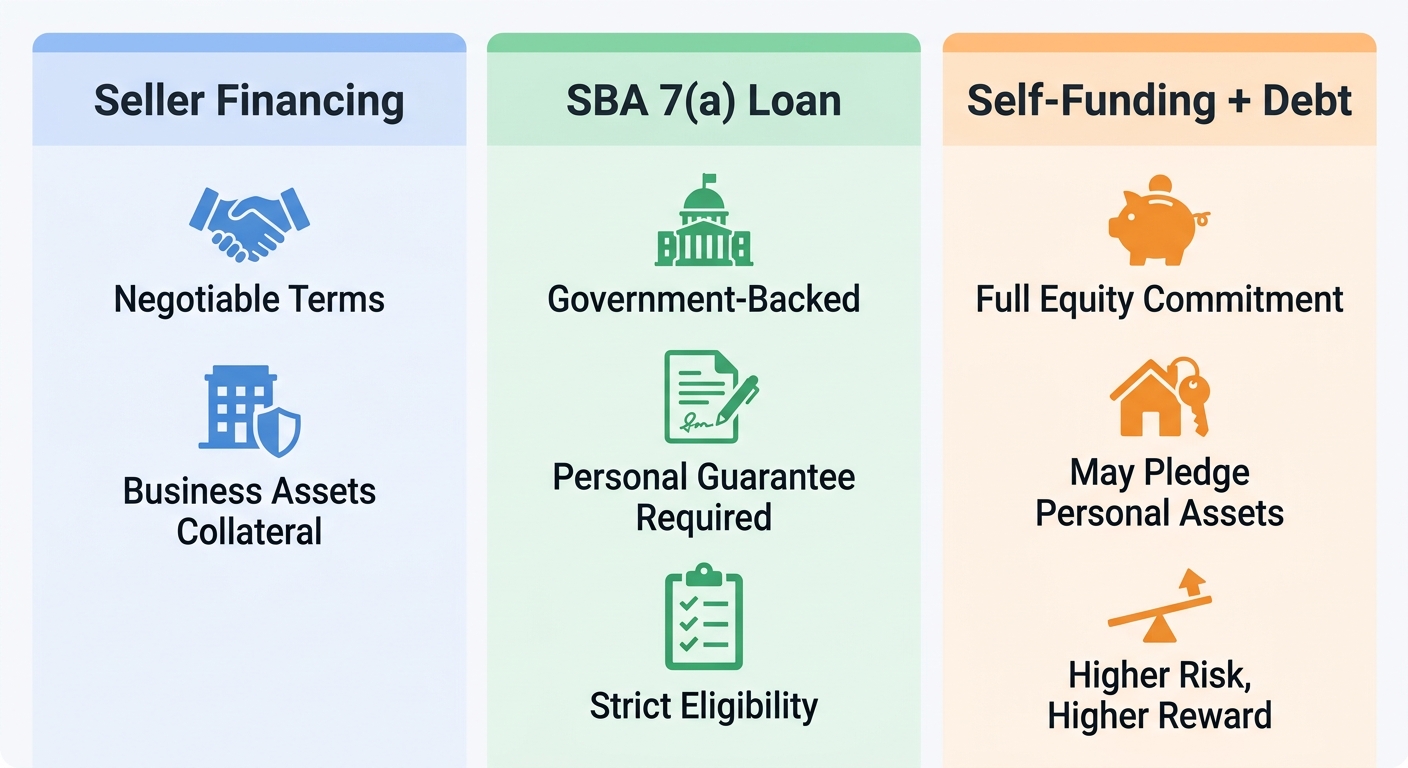
Key financing options for business acquisitions: seller financing, SBA loans, self-funding with debt
Seller financing is a relationship-driven arrangement in which the seller extends credit to the buyer. We find that this method works well for smaller, relationship-based acquisitions. A down payment of 10-20% is typical, though terms are negotiable. The seller retains a security interest in the business assets, reducing third-party lender involvement and often accelerating closings.
According to the U.S. Small Business Administration, SBA 7(a) loan requirements include a minimum down payment of 10% (or up to 20% for higher-risk deals) and a personal guarantee. Collateral must cover at least 20% of the loan value, typically comprising business assets. These government-backed loans are a common choice for acquisitions in the US up to $5M.
When using a leveraged buyout financing structure, the buyer contributes 100% of the equity from personal savings or investments. SIFMA data show that small-business acquisitions often complement this equity with asset-based debt. Personal assets may be pledged to secure the borrowed portion, though this adds personal risk. This path suits opportunistic, flexible-term deals where control is paramount.
Now that you know the three main financing methods, our next section walks you through the application process for each.
This website is for informational purposes only and is not an offer, solicitation, recommendation, or commitment to buy or sell any security or financial product. Securities are offered through Finalis Securities LLC; Zaidwood Capital is not a registered broker-dealer and is unaffiliated with Finalis.
Comparing SBA Loans and Leveraged Buyout Structures
When evaluating how to finance buying a business, two primary acquisition financing pathways stand out: the SBA 7(a) loan and the leveraged buyout (LBO). The SBA 7(a) program, backed by the U.S. Small Business Administration, offers government-guaranteed loans to eligible small businesses, while an LBO relies on a blend of private debt and equity from institutional sources. The following table compares their key attributes, providing a clear framework for first-time buyers and experienced sponsors alike.
| Feature / Requirement | SBA 7(a) Loan | Leveraged Buyout (LBO) |
|---|---|---|
| Typical Loan-to-Value | Up to 90% (80% for acquisitions over $500K) | 50-80% senior debt + 10-20% mezzanine + 10-40% equity |
| Down Payment / Equity Injection | 10-20% from buyer (cash, seller note, or rollover) | Management rollover equity (10-20%) + sponsor equity (10-30%) |
| Debt Service Coverage Ratio (DSCR) | Minimum 1.25x (SBA requirement) | Typically 1.50-2.00x (senior debt); varies for mezzanine |
| Collateral Requirements | Personal guarantee, business assets; up to 100% collateral for loans >$500K | Senior debt secured by business assets; mezzanine may be unsecured or subordinated |
| Loan Size Range | Up to $5 million (max SBA exposure $3.75M for 7(a)) | $10M – $500M+ (middle-market) |
| Best For | First-time buyers, smaller acquisitions, owner-operators | Experienced sponsors, larger deals, growth capital, complex capital structures |
SBA 7(a) Loan Requirements and Application Process
The SBA 7(a) route is particularly attractive for first-time acquirers because of its lower upfront equity requirement and government-backed guarantee, though it carries strict eligibility criteria. According to the U.S. Small Business Administration, the SBA 7(a) loan requirements include an equity injection of 10-20% of the total purchase price; seller notes can count toward that injection if properly structured. A personal guarantee is required from all owners holding 20% or more of the business. For loans above $500,000, the SBA mandates collateral covering up to 100% of the loan amount. The program also requires a minimum debt service coverage ratio of 1.25x, demonstrating that the acquiring entity can comfortably service its debt. Documentation typically includes audited financial statements, tax returns, a detailed business plan, and a purchase agreement. Additionally, the 7(a) program supports partner buyouts, broadening its applicability for ownership transitions.
Leveraged Buyout Capital Stack Mechanics
For larger acquisitions, many buyers turn to a leveraged buyout financing structure. According to the Securities Industry and Financial Markets Association (SIFMA), a typical LBO capital stack comprises senior debt (50-60% of the purchase price), mezzanine debt (10-20%), and equity (30-40%, including management rollover and sponsor equity). Senior debt holds a first-priority lien on the company’s assets and typically requires a debt service coverage ratio between 1.50x and 2.00x–more conservative than the SBA’s 1.25x floor. Mezzanine lenders accept a subordinated position, often receiving payment-in-kind interest and warrants, which raises their return but also the overall cost of capital. Equity layers sit at the bottom of the repayment waterfall, absorbing first losses but capturing most of the upside. Finance principles from the Wharton School reinforce that this tiered structure amplifies returns when the deal performs but elevates risk if cash flows falter. The LBO model therefore suits experienced sponsors who can navigate complex covenants and capital-raising.
While the SBA offers predictability and lower risk for smaller transactions, the LBO framework delivers the capital depth needed for middle-market deals. Buyers often ask whether they must choose exclusively between these two paths.
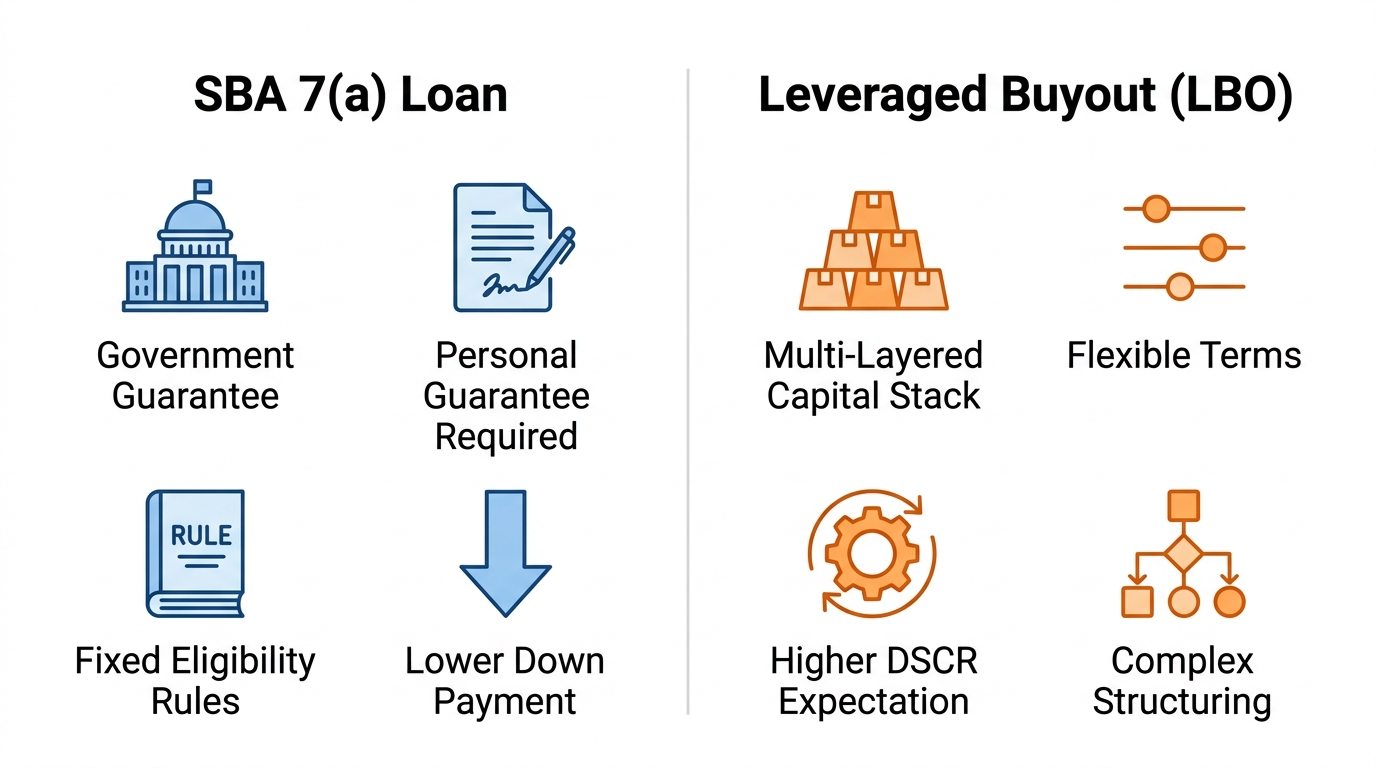
Side-by-side comparison of SBA loans and leveraged buyout structures
Recognizing the strengths of both methods, many acquirers now use hybrid structures that blend elements of traditional SBA lending and private capital instruments.
Hybrid Structures: Combining SBA and Private Capital
In a hybrid approach, a buyer can deploy an SBA 7(a) loan as the senior debt tranche alongside a seller note that acts as mezzanine financing. This combination can reduce the required buyer equity to as little as 5-10% of the purchase price, though the SBA may cap the seller note terms to preserve affordability. Another option is to layer private mezzanine debt on top of an SBA loan, further compressing the equity check and creating a stack that merges government-guaranteed credit with institutional capital. Engaging a boutique investment bank can clarify what is an investment bank‘s role in hybrid financing: they structure, negotiate, and syndicate these blended deals, balancing risk and optimizing the weighted-average cost of capital. By reducing the average interest rate and spreading risk across multiple tranches, hybrids unlock flexibility for transactions that are too large for a pure SBA loan but not suited for a full LBO. At Zaidwood Capital, we advise on both conventional and blended acquisition financing, leveraging our network to tailor capital stacks that meet the specific needs of a deal.
Securities are offered through Finalis Securities LLC; Zaidwood Capital is not a registered broker-dealer and is unaffiliated with Finalis.
Building Your Acquisition Financing Strategy
When building your acquisition financing strategy, understanding how to finance buying a business is the first critical step. A well-structured approach turns a complex acquisition into a clear, achievable transaction.
Preparing Financial Documentation for Lenders
Lenders require a comprehensive package to assess your creditworthiness and the target’s viability. According to the U.S. Small Business Administration, the core documents that align with SBA 7(a) loan requirements include:
- Business plan outlining the acquisition rationale
- Three years of historical financial statements
- Personal and business tax returns
- Personal financial statement
- Projected cash flow statements and a pro-forma P&L
- Any available due-diligence reports
A professional business valuation services engagement establishes a justifiable purchase price and builds lender confidence in the deal. With these materials ready, you can confidently present a complete financing request.
Evaluating and Selecting the Right Financing Mix
With your documents prepared, you can now evaluate financing sources. The capital stack concept layers senior debt, mezzanine, seller notes, and equity to minimize cost while balancing risk. How to finance buying a business typically involves blending these instruments, and when structured optimally the stack can resemble a leveraged buyout financing structure that aligns debt and equity contributions.
| Financing Source | Typical Cost (Interest/Return) | Risk Level (to Issuer) | Best Used For |
|---|---|---|---|
| Senior Debt (Bank/SBA) | Prime + 2-4% (SBA loans have rate caps) | Low (secured, first priority) | Base layer of financing; lower cost, lower LTV |
| Mezzanine Debt | 12-20% (cash + PIK) | Medium (subordinated, second lien) | Filling gap between senior debt and equity; flexible terms |
| Seller Note | 5-10% (negotiated, often below market) | Medium-High (seller has security interest in business) | Reduce cash equity; align seller and buyer incentives |
| Equity (Buyer/Sponsor) | Target IRR 20-30% (opportunity cost) | Highest (residual claim) | Core equity injection; risk capital for growth |
Senior debt provides the lowest cost and is anchored by SBA rate caps, while mezzanine debt–often priced between 12% and 20% according to the Securities Industry and Financial Markets Association (SIFMA)–carries medium risk and fills the equity gap. Seller notes and equity round out the stack, each serving a distinct purpose based on the buyer’s cash flow, risk tolerance, and growth goals.
Navigating the Due Diligence Process
Once you select your financing mix, the due diligence process begins. Lenders and investors will examine every aspect of the target business. Typical review areas include:
- Financial audits: verification of historical revenues, margins, and working capital
- Legal contracts: review of customer agreements, supplier terms, and any pending litigation
- Customer concentration: analysis of reliance on a small number of clients
- Management background: assessment of key personnel and retention plans
- Operational risks: evaluation of systems, compliance, and continuity plans
An experienced M&A advisor–such as Zaidwood Capital–manages this complex process, coordinating with lenders and proactively addressing red flags to ensure a smooth diligence phase. By staying ahead of potential issues, we keep the financing timeline on track and help you move confidently toward closing.
Advanced Capital Stack Strategies for Middle-Market Deals
Moving beyond single-source financing, advanced capital stack strategies combine multiple layers to fund larger, more complex deals. Understanding how to finance buying a business requires a deep grasp of the capital stack — the combination of debt and equity layers ordered by seniority of claims. Our investment banking services help middle-market businesses design optimal capital stacks that balance risk with return, leveraging our experience as a boutique M&A and capital advisory firm.
A common leveraged buyout financing structure in the middle market relies on multiple layers, as illustrated by SIFMA data in the table below.
| Layer | Priority | Typical Percentage of Total Capital | Typical Cost/Risk Profile | Typical Provider |
|---|---|---|---|---|
| Senior Debt | 1st (first lien) | 40-60% | Lowest cost; lowest risk; secured | Banks, SBA, credit funds |
| Mezzanine Debt | 2nd (subordinated) | 15-25% | Higher cost (12-18%); higher risk; unsecured or second lien | Mezzanine funds, BDCs, private credit |
| Seller Note | 2nd or 3rd (negotiated) | 10-20% | Moderate cost (6-10%); aligns seller and buyer | Seller (former owner) |
| Equity (Management + Sponsor) | Residual (last) | 20-30% | Highest cost (target IRR 20-30%); highest risk | Management team, PE sponsor, family office |
Senior debt forms the foundation, typically 40�60% of total capital. It carries the lowest cost and is secured by assets, providing first claim on cash flows. Banks, SBA loans (which have specific SBA 7(a) loan requirements for acquisitions), and credit funds are common providers.
Mezzanine debt occupies a 15�25% layer with higher cost (12�18%, often cash plus PIK) and is subordinated or unsecured. This layer absorbs losses after senior debt but before equity, reflecting the capital structure hierarchy described by Wharton School theory. Mezzanine funds, BDCs, and private credit firms typically supply this layer.
A seller note, representing 10�20% of capital, allows the former owner to defer part of the purchase price. Priced moderately at 6�10%, it aligns incentives and can be structured as a 2nd or 3rd lien, bridging valuation gaps without diluting equity.
Equity (management plus sponsor) makes up 20�30% of the stack and bears the highest risk, targeting a 20�30% IRR. It absorbs losses first and captures upside; providers include management teams, PE sponsors, and family offices.
With this layering framework in mind, our full-cycle M&A approach assists in executing a typical middle-market LBO. Let’s examine how these structures come together in practice.
Frequently Asked Questions About Acquisition Financing
To address common questions about acquisition financing, we’ve compiled a concise FAQ.
How to finance buying a business? Acquisition financing is capital used to purchase a business, typically a mix of debt and equity. We help buyers evaluate structures that align with their strategic growth goals.
What are SBA 7(a) loan requirements? SBA 7(a) loan requirements include strong personal credit, a detailed business plan, and sufficient collateral. The U.S. Small Business Administration provides government-guaranteed funding for eligible acquisitions.
What is a leveraged buyout? A leveraged buyout financing structure uses the target’s assets as collateral, with debt funding the majority of the purchase price. We structure LBOs to align debt service with cash flow projections. For tech mergers and acquisitions, acquisition financing often involves unique structures tailored to high-growth environments.
As a Boutique M&A and Capital Advisory Firm, we guide clients through SBA and LBO financing pathways. Successful acquisition financing demands rigorous preparation and expert guidance.
Next Steps in Your Business Acquisition Journey
If you’re learning how to finance buying a business, the next step is to turn knowledge into action. As SIFMA data shows, capital markets are favorable for prepared buyers — we guide you through SBA 7(a) loan requirements or a leveraged buyout financing structure. Our full-cycle M&A advisory covers valuation, due diligence, and deal closing. Start by scheduling a consultation, preparing your financial statements and target profile, then leveraging our Sovereign Data Nexus for investor matchmaking. Reach out to our team today to schedule a no-obligation discovery call and start mapping your acquisition financing strategy.
Resources


