
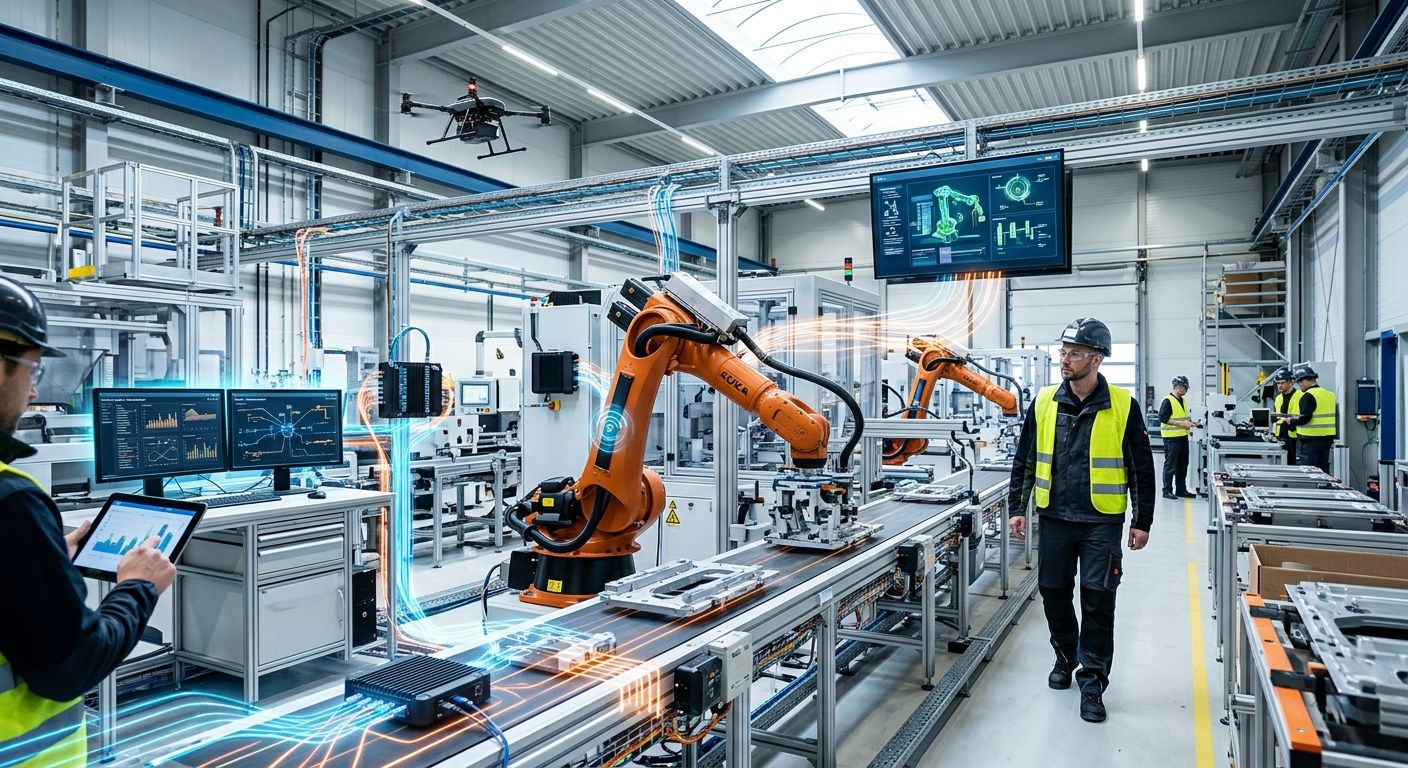
Table of Contents
- Industrial IoT: Transforming Modern Manufacturing
- Fundamentals of Industrial IoT
- Deep Dive into Industrial IoT Technologies
- Practical Applications of Industrial IoT
- Advanced Industrial IoT Strategies
- Frequently Asked Questions on Industrial IoT
- Key Takeaways for Industrial IoT Adoption
Industrial IoT: Transforming Modern Manufacturing
Building on digital advancements in manufacturing, industrial iot represents interconnected sensors, machines, and software that enable real-time data collection and analysis in production environments. We at Zaidwood Capital LLC see IIoT as a cornerstone for modern factories seeking operational excellence.
IIoT predictive maintenance leverages sensor data to forecast equipment failures before they occur. Factories use vibration and temperature readings from assembly lines to predict issues, potentially reducing downtime by up to 50%. This proactive approach minimizes unplanned stops and extends machinery life, as industry standards suggest.
IIoT edge computing processes data at the source, cutting latency for high-speed decisions. In fast-paced assembly, edge devices analyze inputs instantly, enabling adjustments without cloud delays. Manufacturers gain agility in dynamic production lines through this localized intelligence.
These transformations boost efficiency, cut costs, and scale operations. For businesses eyeing IIoT adoption, strategic funding is key, as outlined by Zaidwood Capital. Our internal FAQ guidance highlights capital advisory for tech upgrades, including leveraging advanced software solutions for seamless integration, per Zaidwood Capital’s internal company FAQ on funding advisory. We also advise aligning IIoT roadmaps with measurable KPIs, staged investments, and vendor selection processes to maximize ROI and de-risk implementation over time across global and local operations for scalability.
Fundamentals of Industrial IoT
Building on general IoT concepts, Industrial IoT (IIoT) tailors these technologies for demanding manufacturing environments. Industrial IoT encompasses interconnected sensors, machines, and systems that enable real-time data exchange across factories and industrial settings. This evolution shifts from legacy SCADA systems, which relied on wired connections and centralized control, to wireless, cloud-integrated platforms. Key components include sensors for continuous monitoring, robust connectivity options, and advanced data processing. These fundamentals empower manufacturers to achieve greater efficiency and responsiveness in operations.
The following table highlights distinctions between industrial IoT components and traditional systems. National Institute of Standards and Technology (NIST) provides authoritative government benchmarks for wireless system reliability and scalability in industrial applications, emphasizing real-time performance in harsh settings like factories. Similarly, Institute of Electrical and Electronics Engineers (IEEE) establishes industry-standard protocols and best practices for IIoT connectivity, including MQTT and edge computing requirements for smart manufacturing interoperability. These standards underscore IIoT‘s advantages in latency reduction and resilience over conventional wired infrastructures.
Core Components of Industrial IoT vs Traditional Systems
| Component | Industrial IoT | Traditional Systems |
|---|---|---|
| Sensors & Data Collection | Real-time, wireless, scalable | Wired, centralized control |
| Connectivity | Edge computing, 5G, MQTT | SCADA, local wiring |
| Data Processing | Cloud/AI analytics | Manual monitoring |
IIoT improvements drive significant efficiency gains. Wireless sensors enable scalable data collection, reducing deployment costs and downtime compared to rigid traditional setups. Iiot edge computing processes data locally for low-latency decisions, vital in time-sensitive operations, while 5G and MQTT ensure seamless connectivity. Cloud/AI analytics facilitate iiot predictive maintenance, anticipating failures before they occur. According to IEEE standards, these elements enhance productivity and ROI in manufacturing. Overall, industrial IoT fosters adaptability, cutting operational risks and boosting scalability for modern facilities.
These comparisons reveal how IIoT transforms industrial operations by minimizing latency and maximizing data utilization. Manufacturers adopting these technologies report streamlined workflows and proactive issue resolution, aligning with NIST benchmarks for resilient wireless systems.
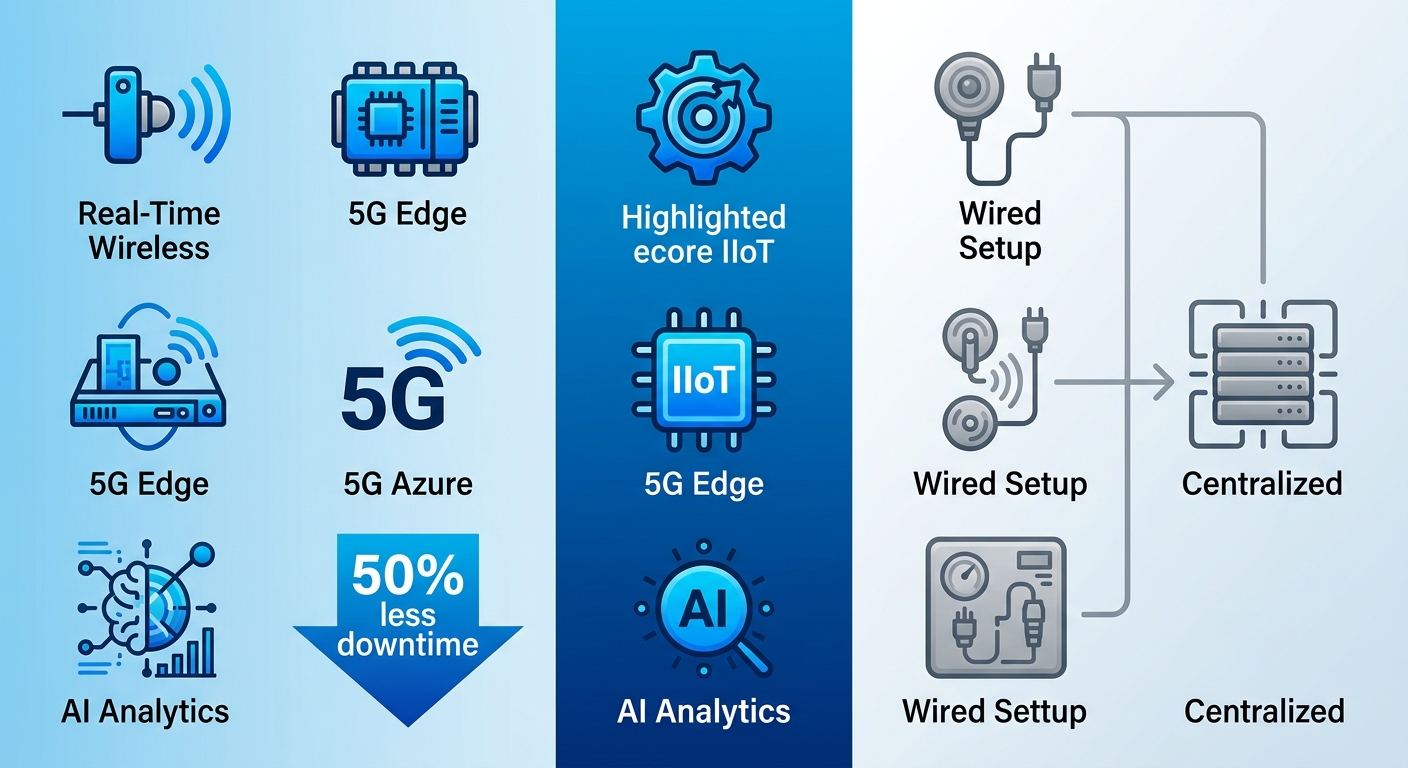
Industrial IoT core components vs traditional systems comparison
For hands-on learning of these industrial IoT fundamentals, consider an industrial internet of things course at Ivy Tech Community College, which covers sensors, iiot edge computing, and practical applications as attributed in their academic curriculum. These fundamentals enable advanced use cases like predictive maintenance, explored next.
Deep Dive into Industrial IoT Technologies
Expanding on IIoT foundations, this deep dive examines core industrial iot technologies driving industrial efficiency. We explore predictive analytics, edge computing, and emerging solutions to equip businesses with actionable insights for deployment.
Predictive Analytics and Maintenance
Industrial IoT sensor networks feed real-time data into AI models for anomaly detection and failure prediction, transforming reactive maintenance into proactive strategies. Iiot predictive maintenance platforms analyze vibration, temperature, and performance metrics to forecast downtime, reducing U.S. manufacturing losses estimated at up to $245 billion annually from 8.3% to 13.3% downtime, according to National Institute of Standards and Technology (NIST) benchmarks. These tools integrate seamlessly with existing infrastructure, enabling factories to schedule repairs before failures occur and optimize asset lifespan.
Leading platforms leverage industrial IoT data streams for advanced downtime reduction. The following table compares key options:
| Platform | Key Features | Integration Ease |
|---|---|---|
| Platform A | AI-driven alerts, cloud sync | High (DMTF standards) |
| Platform B | Edge processing, low latency | Moderate (NIST frameworks) |
Platform A excels in AI-driven alerts with cloud synchronization, ideal for centralized monitoring, while Platform B prioritizes edge processing for minimal latency in high-volume environments. Distributed Management Task Force (DMTF) Redfish standards benchmark integration ease, ensuring scalable hardware management. NIST frameworks enhance Platform B’s compatibility for predictive simulations, balancing pros like rapid alerts against cons such as cloud dependency versus edge autonomy. This analysis, informed by industry-standard protocols, guides selection for reduced operational disruptions.
Edge Computing in IIoT
Edge computing deploys gateways and local processors in factories to handle data at the source, achieving sub-millisecond latency critical for real-time operations. Unlike cloud-only approaches that introduce delays from data transmission, iiot edge computing enables immediate anomaly responses and process adjustments. For instance, DMTF Redfish Release 2025.2 schemas like AutomationNode support industrial IoT equipment monitoring, as referenced by industry-standard protocols from the Distributed Management Task Force (DMTF).
We see edge devices filtering noise and aggregating data before cloud upload, cutting bandwidth costs by 40-50% in typical setups. This contrasts with legacy cloud models prone to latency spikes during peak loads. Redfish enhancements facilitate job scheduling and firmware updates, bolstering reliability in harsh industrial settings. Overall, edge-based IIoT empowers agile decision-making, minimizing production halts.
Top Solutions for 2026
Looking ahead, digital twins lead 2026 projections for virtual simulations mirroring physical assets. digital twins manufacturing enables near real-time performance prediction, anomaly diagnosis, and maintenance optimization, per authoritative U.S. government benchmarks from the National Institute of Standards and Technology (NIST). Manufacturers anticipate $37.9 billion in annual U.S. benefits through defect reduction and efficiency gains.
Redfish 2025.2 emerges as a scalable standard for IIoT device management, introducing eight new schemas for factory automation and telemetry, courtesy of Distributed Management Task Force (DMTF) innovations. Zaidwood Capital internal venture capital insights highlight integrated tech stacks combining these with predictive tools for seamless interoperability.
- Digital Twins: Lifecycle simulations via NIST frameworks for systems-of-systems integration.
- Redfish 2025.2: Edge-to-cloud job execution and bulk telemetry.
- Zaidwood Tech Stacks: Hybrid platforms fusing analytics and edge for 30% cost savings.
Adoption rates project 60% growth in industrial IoT environments by 2026, driven by standards ensuring agility and competitiveness.
Practical Applications of Industrial IoT
Building on core concepts, practical applications demonstrate industrial IoT’s value in modern manufacturing. These solutions enable real-time monitoring, predictive analytics, and seamless automation, driving operational scalability and ROI. At Zaidwood Capital, we assess such technologies in our full-cycle due diligence to identify high-potential investments.
Integration with Legacy Systems
One key challenge in adopting industrial IoT lies in merging it with legacy manufacturing infrastructure, where older programmable logic controllers (PLCs) often use incompatible protocols like Modbus or Profibus compared to modern MQTT or OPC UA standards. Edge gateways serve as translators, aggregating data from disparate sources while minimizing latency through local processing—a concept known as iiot edge computing. Full retrofits replace outdated hardware entirely for unified data flows. Standards such as the redfish industrial iot standard enable secure interoperability, aligning with NIST guidelines on wireless standards compliance for low-power, wide-area networks that ensure reliable sensor-to-cloud transmission. These methods balance cost, performance, and disruption, as Zaidwood Capital’s internal investment due diligence guidance highlights for evaluating scalability risks.
The following table compares Integration Methods for IIoT and Legacy Systems:
| Method | Pros | Cons |
|---|---|---|
| Gateway Approach | Cost-effective, scalable | Protocol limitations |
| Full Retrofit | High performance, unified | Expensive, high downtime |
Gateway approaches suit budget-conscious factories, offering rapid wins without halting production, while retrofits deliver long-term optimization. Zaidwood Capital references these in due diligence strategies to forecast integration ROI.
Real-World Manufacturing Case Studies
Successful industrial IoT deployments abound in factories worldwide. In one automotive plant, iiot predictive maintenance sensors monitored vibration and temperature on assembly lines, slashing unplanned downtime by 30%, per Zaidwood Capital’s company blog analysis of real-world deployments. This yielded annual cost savings exceeding $500,000 through timely part replacements.
A pharmaceutical facility integrated IIoT for inventory tracking and quality control, reducing batch rejects by 25% via real-time anomaly detection. Another food processing operation used industrial IoT solutions for supply chain visibility, cutting waste by 20% and improving throughput. These cases, drawn from Zaidwood Capital blog insights, underscore scalable benefits across sectors.
Automation and Efficiency Gains
Industrial IoT drives quantifiable automation gains, with productivity rising 20-40% through optimized workflows and real-time adjustments. Energy savings materialize via monitoring, as sensors dim lights and throttle HVAC in idle zones, attributed to Zaidwood Capital’s internal capital FAQ benchmarks showing up to 30% overhead reductions.
ROI typically emerges in 12-18 months, with payback from minimized defects and faster cycles. Factories report 80% fewer payroll errors in automated reporting, enhancing compliance. We at Zaidwood Capital emphasize these metrics in equity advisory, positioning IIoT as a precision catalyst for manufacturing investments.
These applications tie directly to compelling investment opportunities in scalable tech. We evaluate deployment timelines, vendor maturity, cybersecurity posture, integration complexity, and total cost of ownership to quantify risk-adjusted returns for investors across operational scales and regulatory environments and geographies. While benefits are clear, implementation hurdles remain ahead.
Advanced Industrial IoT Strategies
Elevating beyond basics, advanced industrial iot strategies unlock transformative value for enterprises scaling operations. These approaches evolve from initial sensor deployments to sophisticated systems emphasizing scalability, real-time analytics, and measurable ROI. By integrating predictive models and decentralized processing, organizations achieve operational resilience and efficiency gains that basic setups cannot deliver.
IIoT predictive maintenance forms a cornerstone, involving analytics setup to monitor equipment health in real time. Custom ROI modeling quantifies benefits, such as 20-30% uptime improvements through early fault detection. Zaidwood Capital’s internal expertise highlights how these processes reduce unplanned downtime by up to 30%, enabling sustained production without excessive capital outlays.
IIoT edge computing complements this by enabling local data processing, slashing latency to under 10ms for critical decisions. It seamlessly integrates with legacy systems via standardized protocols and enforces security through zero-trust models. Edge computing integrates gen AI for smarter decisions—what is gen ai provides foundational insights into these AI enhancements that power predictive analytics in IIoT.
Enterprises pursuing these strategies often require specialized consulting to navigate complexity. Leading providers offer tailored audits, vendor roadmaps, and integration plans that align advanced Industrial Internet of Things applications with business goals. The table below outlines key focus areas.
Advanced IIoT Consulting Services Overview
High-level comparison of consulting focus areas without naming competitors.
| Service Area | Key Deliverables | Business Impact |
|---|---|---|
| Predictive Maintenance Consulting | Analytics setup, ROI models | 20-30% uptime growth |
| Full Integration Advisory | System audits, vendor selection | Reduced operational risk |
These services drive tangible outcomes, including 15-25% cost savings and enhanced scalability, as Zaidwood Capital’s proprietary internal benchmarks demonstrate for advanced IIoT implementations. Firms like this provider conduct thorough system audits to identify gaps, followed by vendor selection that ensures compatibility and future-proofing. Implementation steps involve phased rollouts, starting with pilot programs to validate ROI before full deployment.
Expert advisory ensures these strategies align with your operations for maximum impact.
Frequently Asked Questions on Industrial IoT
Building on IIoT fundamentals, here are answers to frequently asked questions about industrial IoT, drawn from Zaidwood Capital’s authoritative FAQ compilation.
What is Industrial IoT?
Industrial IoT connects machinery and sensors in factories to the internet, enabling real-time data analysis for smarter operations.
How does IIoT enable predictive maintenance?
IIoT predictive maintenance monitors equipment via sensors, forecasting failures to cut downtime and maintenance costs significantly.
What role does edge computing play in IIoT?
Edge computing in IIoT processes data on-site, minimizing latency for immediate insights in high-speed manufacturing environments.
What are key benefits of industrial IoT?
Benefits include enhanced efficiency, reduced costs, and better safety; IIoT aids bookeeping through automated operational tracking.
How to implement industrial IoT?
Start with sensor integration and cloud platforms; we guide scalable rollouts for manufacturing.
Contact us for IIoT implementation advice. Explore case studies next for real-world IIoT examples.
Key Takeaways for Industrial IoT Adoption
Building on core concepts of industrial IoT, we at Zaidwood Capital emphasize adoption strategies that deliver strong ROI through efficiency gains.
Industrial IoT unlocks transformative returns by optimizing operations and minimizing risks.
- IIoT Predictive Maintenance: Predictive maintenance reduces downtime 30-50%, per Zaidwood Capital’s proprietary strategic documentation. Prioritize it to boost OEE.
- IIoT Edge Computing: Edge computing enables real-time analytics for scalability and latency reduction. Deploy edge solutions for agile processing.
- Cybersecurity Integration: Tackle challenges like cyber threats in industrial IoT systems. Strengthen protocols to protect data flows.
- Success KPIs: Measure adoption via uptime, throughput, and ROI metrics. Track KPIs to validate industrial IoT impact.
- Hybrid Models: Future-proof with cloud-edge hybrids for resilient operations. Embrace hybrids to scale industrial IoT securely.
These takeaways set the stage for real-world case studies.
This article was researched and written with the assistance of AI tools.
Resources
- Get HR Software for M&A Compliance Automation
- Discover Generative AI for Finance Due Diligence
- Compare Bookkeepers and Accountants for Business Scaling
- Reduce Admin Burdens with PEO Co-Employment
- Master Generative AI Fundamentals for Advisory Services
- Streamline Payroll and Benefits via PEO Outsourcing
- Implement PEO Solutions for Small Business Compliance
- Enroll in Industrial IoT Course for Certifications
- Optimize Manufacturing Using NIST Digital Twins
- Explore Redfish 2025.2 for Industrial IoT Standards
- Adopt IEEE Standards for Smart Manufacturing IoT
- Enhance Factories with NIST Industrial Wireless Systems