


Who Can Help Me Sell My Company
Table of Contents
Choosing the Right Advisor to Sell Your Business
Once you decide to sell, selecting the right advisor can be the single most impactful decision you make. Many business owners ask, “who can help me sell my company?” The answer lies in carefully evaluating a few key criteria.
Look for advisors with deep sell-side experience in the lower middle market, specifically lower middle market M&A firms that understand the unique dynamics of deals in the $5M-$100M range. Generalist investment banks often lack the targeted buyer networks your company needs.
A proprietary buyer network is critical. Ask how many relevant institutional and strategic buyers the advisor has direct relationships with, and how they source capital. The best sell-side M&A advisory services maintain curated lists of qualified acquirers rather than relying solely on broad auctions.
Evaluate the advisor’s transaction process: due diligence framework, timeline management, and how they handle confidentiality and competitive tension. A transparent, structured approach is a sign of professionalism. Beware of any advisor who promises a guaranteed valuation or sale–that’s a red flag.
Industry-specific expertise enables the advisor to identify the right buyers and position your business effectively. Also, compare communication styles: successful sell-side engagements require regular updates and transparency.
After evaluating these criteria, visit our Sell My Business page to see how our boutique M&A and capital advisory firm guides lower middle market companies through a structured sale.
Business Brokers vs. M&A Advisors: Understanding the Differences
To determine the right partner for your exit, it helps to understand the landscape of transaction advisors. Many founders ask, who can help me sell my company? The answer depends on your company’s size, complexity, and growth aspirations. Transaction advisors range from local business brokers serving Main Street businesses to global boutique investment banks handling complex middle-market transactions. Below, we compare the three primary categories to help you identify where your business fits. Selecting the right advisor can dramatically impact your exit outcome.
The following comparison clarifies how each advisor type serves different company profiles.
| Aspect | Business Broker | M&A Advisor | Boutique Investment Bank |
|---|---|---|---|
| Typical Deal Size | < $5 million | $5 million – $50 million | $10 million – $250+ million |
| Services Provided | Listing, basic valuation, introduction to buyers | Sell-side advisory, buyer identification, valuation, negotiation support | Full-cycle M&A, capital raising, deep diligence, strategic advisory |
| Fee Structure | Percentage of sale price (usually higher) | Retainer + success fee | Retainer + success fee (often lower percentage but larger absolute) |
| Buyer Network | Local / regional buyer pool | National network of strategic buyers and private equity groups | Global institutional investors, PE firms, family offices |
| Confidentiality Approach | Less structured; risk of leaks | Structured with NDAs, controlled process | Rigorous confidentiality, data room protocols |
| Ideal For | Small Main Street businesses | Lower middle market founder-led companies | Growth-stage and middle-market firms seeking strategic exit |
The table underscores deal size and service scope as the key differentiators. Business brokers serve Main Street companies, often with percentage-based fees and a local buyer network, while lower middle market M&A firms provide structured sell-side M&A advisory services–including buyer identification, valuation, and negotiation–on a retainer-plus-success-fee basis. Boutique investment banks add capital raising, deep diligence, and global institutional access. FINRA distinguishes brokers from advisors, particularly in confidentiality: brokers may lack formal NDAs, while investment banks enforce rigorous data room protocols.
If your company generates $5 million to $50 million in revenue, an M&A advisor or boutique investment bank is likely the right fit. These professionals bring disciplined processes and a broader pool of qualified buyers, matching the needs of growth-stage and middle-market founders. M&A advisors and boutique investment banks also bring structured confidentiality and negotiation expertise that can maximize value and protect sensitive information.
This insight empowers you to match your company with the advisory model that fits its unique profile.
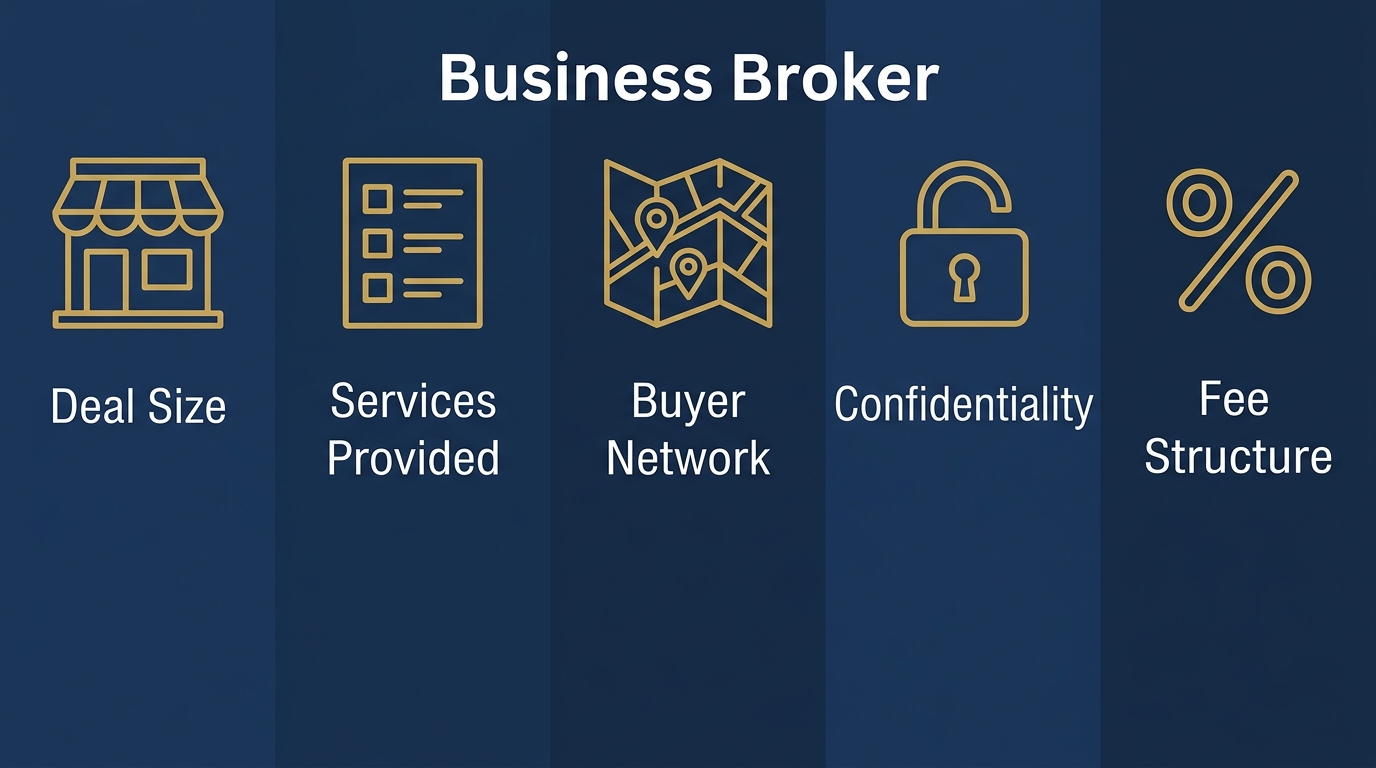
Business Broker services overview: five key aspects comparison.
If you’re exploring your options and need expert guidance, visit our Help Selling My Business page. As a Boutique M&A and Capital Advisory Firm, we provide full-cycle M&A advisory tailored to growth-stage and middle-market companies.
How a Boutique M&A Firm Maximizes Your Company’s Sale Value
If you’re asking who can help me sell my company, the answer extends far beyond a basic broker introduction. As a leading Zaidwood Capital boutique advisory, we combine proprietary data and AI to maximize your company’s value through a disciplined process that expands the buyer pool, preserves deal economics, and accelerates diligence. This Boutique M&A and Capital Advisory Firm approach ensures that every aspect of the transaction is engineered to capture the full worth of your business.
The Power of Proprietary Data and AI in Buyer Matching
Through our sell-side M&A advisory services, we deploy Sovereign Data Nexus, a proprietary database of over 4,000 pre-screened institutional investors, and Precision Catalyst, our AI-driven matchmaking engine, to identify the most suitable strategic and financial buyers. This curated buyer pool creates genuine competitive tension–exposing your company to far more qualified acquirers than a founder’s personal network ever could. For companies in the lower middle market, this AI-powered targeting often surfaces buyers whose investment theses align perfectly with the business’s growth trajectory, directly supporting premium multiples without forcing the founder to accept the first reasonable offer.
The table below contrasts the typical DIY approach with the results achieved through professional sell-side advisory.
| Value Driver | DIY Approach | With Sell-Side Advisory | Impact on Sale Price |
|---|---|---|---|
| Buyer Pool Size | Limited to personal network, 5-10 buyers | Access to 100+ curated institutional buyers | Increased competition leads to higher multiples |
| Quality of Investors | Unvetted leads, potential lowball offers | Pre-qualified strategic and financial buyers | Lowers risk of deal fall-through, supports premium pricing |
| Preparation of Materials | Basic financials, informal summary | Professional CIM, data room, pro forma projections | Builds buyer confidence, reduces diligence delays |
| Negotiation Leverage | Founder as sole negotiator, emotional attachment | Experienced M&A team manages competitive process | Higher final price, better terms, earn‑outs structured |
| Due Diligence Efficiency | Ad hoc responses, risk of discovery gaps | Pre‑organized virtual data room, proactive issue management | Faster close, fewer post‑closing adjustments |
SIFMA industry benchmarks consistently confirm that a larger, curated buyer pool and institutional-quality preparation translate into higher multiples and dramatically lower fall-through risk. For owners of companies in the lower middle market, this difference often separates a sale that fully reflects strategic value from one that merely captures a founder’s networking limitations.
Structuring the Deal for Value Preservation
Value is not just found in the offer price–it must be preserved through the deal structure. Full-Cycle M&A advisors craft the capital structure and negotiation framework to protect the seller’s economics. Earn-outs can bridge valuation gaps while de-risking the transaction; favorable working-capital adjustments and well-drafted representations avoid post-closing value erosion. By running a competitive process rather than a one-on-one negotiation, we keep leverage squarely with the seller. Small technical details–such as defining EBITDA add-backs or setting escrow release dates–often account for material differences in realized proceeds. Our sell-side M&A advisory services ensure no levers are left untouched, turning a good headline number into actual cash at close.
Managing Diligence to Accelerate Closing
Lengthy diligence erodes buyer confidence and can chip away at the negotiated price. We deploy our Velocity Matrix rapid-execution framework to compress the diligence timeline without sacrificing thoroughness. A pre-built virtual data room organizes every contract, financial, and compliance document before the first buyer request arrives. Anticipating the most common diligence areas–quality of earnings, customer concentration, intellectual property–allows us to proactively address issues and reframe them as managed risks. This Financial Services 3.0 approach turns diligence from a defensive scramble into a demonstration of operational discipline, keeping the deal on track and the valuation intact. With careful preparation and expert guidance, the sales process can deliver exceptional results–as outlined in the next section.
The illustration below captures how our proprietary process–from AI-enabled buyer matching through deal structuring to accelerated diligence–works in concert to maximize sale value.
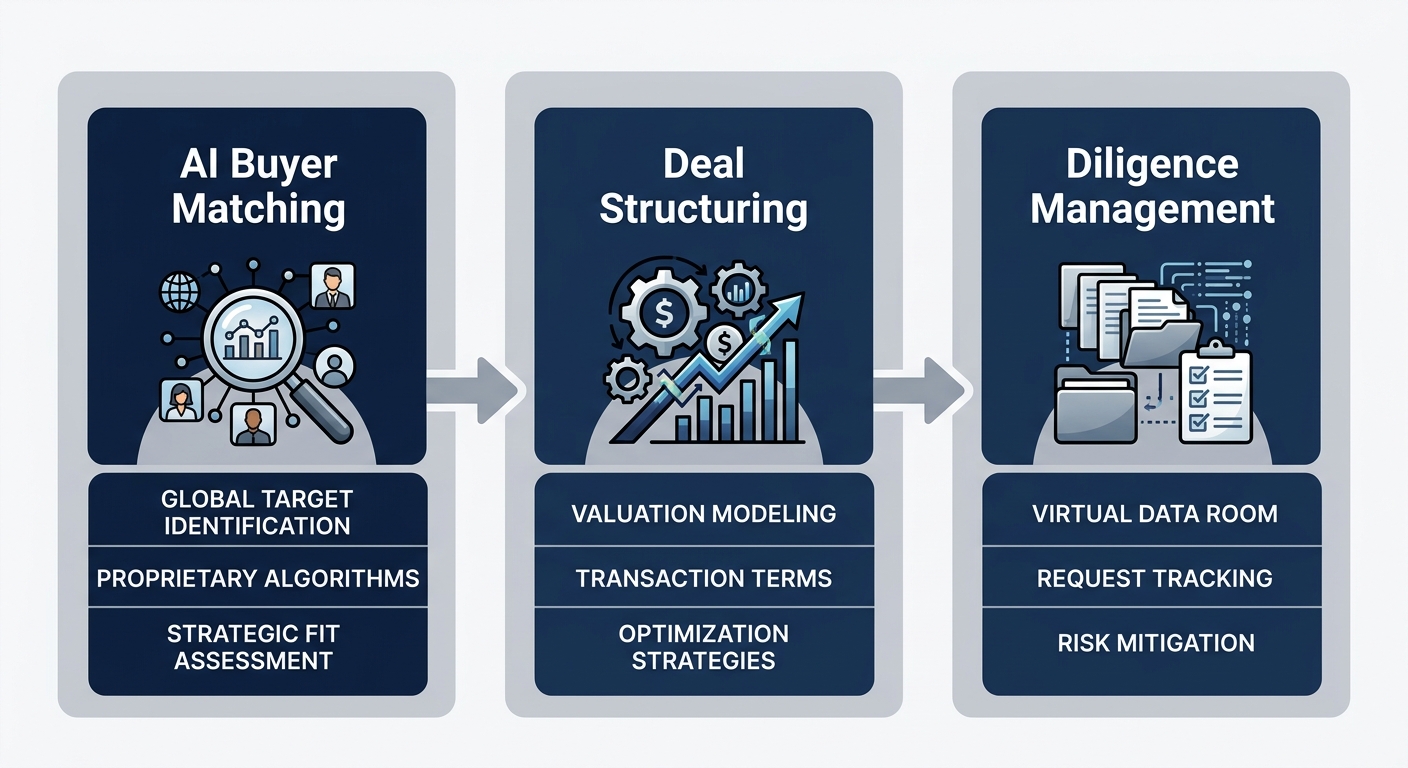
Boutique M&A process maximizing sale value through three steps
A Practical Guide to Engaging the Right M&A Advisor
Now that you understand why a sell-side advisor is critical, here is a practical guide. If you are wondering who can help me sell my company, a structured vetting process is essential. The following checklist highlights five key evaluation criteria.
The following table provides a quick-scan reference for evaluating prospects:
| Evaluation Criteria | Red Flags | Green Flags |
|---|---|---|
| Track Record | Few or no closed deals in your industry; vague case studies | Verifiable deal list with relevant sector experience; client references |
| Fee Transparency | Unclear fee structure; refuses to provide retainer details in writing | Clear retainer plus success fee model with contractual terms |
| Cultural Fit | Does not take time to understand your company’s mission or founder goals | Engages deeply with management team; values alignment and communication |
| Buyer Network | Claims a large network but cannot specify quality or relationships | Demonstrates curated list of institutional investors and strategic buyers relevant to your deal size |
| Process Management | No clear timeline or process; disorganized data room approach | Detailed project plan, dedicated deal team, and robust data room infrastructure |
These criteria align with FINRA transparency guidelines. A trustworthy advisor will document retainer and success fee arrangements in writing.
Building Your Advisor Interview Checklist
Your advisor interview checklist should probe five critical dimensions. First, track record: ask for recent closed deals in your sector and client references. A green-flag response is a list of verifiable transactions; vague answers are a red flag. Second, fee transparency: per FINRA guidelines, insist on a written engagement letter detailing retainer and success fees. Avoid advisors who resist documented terms. Third, cultural fit: a sincere advisor listens deeply and aligns with your mission. The best advisors invest time in understanding your goals and values. Fourth, buyer network: a credible lower-middle-market advisor will share a curated list of relevant investors, not a generic database. Fifth, process management: the advisor should provide a detailed project plan, dedicated deal team, and robust data room. When vetting advisors, consider whether a boutique investment bank zaidwood offers the sector depth and execution speed that large institutions lack. Frameworks like Zaidwood’s Velocity Matrix signal disciplined execution. A secure virtual data room with tiered access is essential.
Timing Your Engagement for Maximum Leverage
We recommend engaging an advisor six to twelve months before a planned sale. This lead time enables thorough preparation–valuation, confidential information memorandum, and targeted buyer list–without urgency. Starting early also lets you resolve operational issues that could lower your price. If an unsolicited offer arrives, bring in the advisor immediately to assess fairness and possibly initiate a competitive process. Many lower middle market m&a firms offer flexible engagement models. If a buyer approaches you, having an advisor already retained accelerates the process and ensures you don’t accept an undervalued offer. Engaging early signals seriousness to buyers and strengthens your negotiating position. Our experience shows that proactive sellers consistently secure better outcomes than those who wait. Avoid a rushed sale that leaves value on the table.
Navigating Confidentiality and Pre-Marketing
The pre-marketing phase maintains strict confidentiality while building momentum. The advisor creates a blind teaser–a company description without identity–to attract interest. Only after a buyer signs an NDA and passes screening does it receive the confidential information memorandum. A virtual data room with tiered access controls sensitive information release, protecting relationships with employees and customers. Sell-side m&a advisory services for the lower middle market emphasize controlled disclosure. The advisor also builds a curated buyer list before outreach, making initial contact strategic. This structured approach creates competitive tension that can improve deal terms. We’ve found that disciplined pre-marketing leads to smoother negotiations and higher valuations. By controlling information flow, you retain maximum leverage throughout the process.
When to Choose a Lower Middle Market M&A Firm Over an Investment Bank
When deciding who can help you sell your company, the choice between a lower middle market M&A firm and a large investment bank depends on your specific business situation. At Zaidwood Capital, we help owners assess whether a boutique full-cycle advisory or a larger platform is the better fit.
The following table matches common scenarios with the most suitable advisor type.
| Scenario | Recommended Advisor | Rationale |
|---|---|---|
| Deal size under $50 million | Lower middle market M&A firm | Boutique firms offer dedicated attention and deeper expertise in lower middle market dynamics, often achieving higher multiples than brokers. |
| Complex capital structure (e.g., multiple investor classes) | Boutique investment bank with full-cycle M&A capability | Full-cycle firms handle structuring, stakeholder alignment, and complex negotiations with institutional rigour. |
| Need for global buyer reach / cross-border sale | Boutique investment bank with international network | Global networks contact private equity and strategic buyers across geographies, maximising competitive tension. |
| Founder-led business with no time pressure | Lower middle market M&A firm or boutique investment bank | Founders can afford longer process to build buyer competition; full-cycle advisory protects value throughout. |
According to SIFMA standards, deals under $50 million fall within the lower middle market. For these sizes, lower middle market M&A firms deliver partner-level attention and nuanced market knowledge that can drive higher valuations than a large bank’s junior-led team. When a company has a complex capital structure, a boutique M&A and capital advisory firm with full-cycle M&A capability is the right choice. These engagements demand institutional-grade investment banking services for cap-table restructuring and stakeholder alignment, without the conflicts of a larger bank. Sellers seeking cross-border deals need a firm with a global reach. Our boutique advisory leverages a network of 4,000+ investors and $15 billion in capital access, using Sovereign Data Nexus and Precision Catalyst to match with international buyers. For founder-led companies with no time pressure, either a lower middle market M&A firm or a full-cycle boutique advisory works well. Our sell-side M&A advisory services protect the founder’s legacy and build buyer competition through a methodical process. Once you’ve identified the right advisor type, the next step is evaluating their capabilities–something we guide our clients through at Zaidwood Capital. Our Boutique M&A and Capital Advisory Firm model blends lower-middle-market focus with full-cycle M&A rigor.
Frequently Asked Questions About Selling Your Business
Who can help me sell my company?
Many owners turn to a boutique investment bank for personalized, full-cycle sell-side M&A advisory services. As a Boutique M&A and Capital Advisory Firm, we tailor solutions for lower middle market firms with revenues between $5 million and $100 million. We are not a registered broker-dealer; securities are offered through Finalis Securities LLC. Zaidwood Capital is unaffiliated with Finalis.
How long does it take to sell a middle-market company?
Timelines typically range 6-12 months, depending on market conditions and buyer readiness. We leverage data from the Sovereign Data Nexus to help set realistic expectations without guaranteeing an outcome.
How do I choose between a large bank and a boutique investment bank?
For lower middle market M&A firms, a boutique advisor offers dedicated attention and deep sector expertise, unlike large banks where your engagement may be deprioritized.
What is the typical process for selling a business?
Our sell-side M&A advisory services include valuation, due diligence, buyer outreach, and negotiation. We utilize the Precision Catalyst and Velocity Matrix to accelerate the entire transaction lifecycle.
Your Next Steps Toward a Successful Company Sale
If you’re asking who can help me sell my company, contact Zaidwood Capital. Our sell-side advisory in the lower middle market uses the Sovereign Data Nexus platform to evaluate your business and build a client-driven roadmap.
This website is for informational purposes only and is not an offer, solicitation, recommendation, or commitment to buy or sell any security or financial product. Securities are offered through Finalis Securities LLC; Zaidwood Capital is not a registered broker-dealer and is unaffiliated with Finalis. Investments involve risk and are not guaranteed to appreciate; investors may lose all or part of their investment.
Resources


