


What is Series B Funding
Table of Contents
Understanding Series B Funding for Growth-Stage Companies
For entrepreneurs asking ‘what is series b funding,’ Series B funding is the third major institutional investment round, aimed at growth-stage companies that have proven product-market fit and are ready to scale operations, expand teams, and increase market share.
While Series A confirms product-market fit, Series B shifts focus to scaling operations and capturing market share. Series B rounds typically raise between $7 million and $30 million, based on industry benchmarks. Investors in this stage include growth equity firms, later-stage venture capital funds, strategic corporate investors, and occasionally crossover funds. These backers bring not only capital but also strategic guidance to help companies accelerate growth.
As a boutique M&A and capital advisory firm, we at Zaidwood Capital know that Series B investors scrutinize series b valuation metrics–including revenue multiples and growth acceleration–and expect companies to demonstrate clear series b revenue milestones such as expanding recurring revenue and improving unit economics. They look for strong LTV-to-CAC ratios, high retention rates, and a defensible competitive moat to ensure the business can scale profitably.
Understanding these core elements of a Series B round sets the foundation for evaluating the financial metrics that growth-stage companies are expected to demonstrate. As with any investment, these rounds involve risk; investors may lose part or all of their capital, and this information is for educational purposes only and does not constitute an offer or solicitation.
Series B Funding Fundamentals
What is Series B funding? It is the growth-stage venture capital round that startups pursue after demonstrating product-market fit and generating meaningful revenue. Typically, Series B raises from $7 million to $50 million, with most rounds landing between $10 million and $30 million. This round fuels aggressive scaling–expanding teams, penetrating new markets, and refining the business model before a potential Series C or later-stage event.
Industry benchmark data from Value Add VC highlights the key contrasts between Series A and Series B funding. Unlike series a funding, which centers on validating product-market fit, Series B demands proven revenue traction and a clear path to scale.
| Aspect | Series A | Series B |
|---|---|---|
| Typical Capital Raised | $2M – $15M | $7M – $50M |
| Primary Investors | Angel, Seed, early‑stage VC | Growth‑stage VC, crossover funds, corporate VC |
| Key Metric Focus | Product‑market fit, user engagement | Revenue growth, ARR, unit economics, NRR |
| Valuation Drivers | Team, product, market size | Revenue velocity, gross margins, retention, market share |
| Difficulty to Raise | Moderate – requires proof of concept | High – requires strong revenue traction, proven metrics, clear scaling plan |
The comparison shows that Series B not only requires larger commitments but also sets much higher performance thresholds. Investors in this stage are typically growth-stage VC firms, crossover funds (including mutual funds and hedge funds), and corporate venture capital arms. They look for companies that have moved beyond the early-stage promise and now demonstrate repeatable revenue streams, robust unit economics, and a defensible market position.
Moving from definition to practice, what is Series B funding? It is a meticulous financial vetting where investors scrutinize annual recurring revenue (ARR) growth, net revenue retention (NRR) above 100%, gross margins surpassing 60%, and a healthy LTV/CAC ratio. Key series b valuation metrics include revenue velocity–year-over-year growth rate–and gross margin trends. Startups typically need to hit series b revenue milestones such as $2 million to $10 million in ARR to attract serious investor interest. Valuation drivers also encompass customer retention, total addressable market share, and the strength of the competitive moat. Because the bar is significantly higher than at Series A, raising a Series B is considerably harder; it requires convincing data that the business can scale efficiently and sustainably.
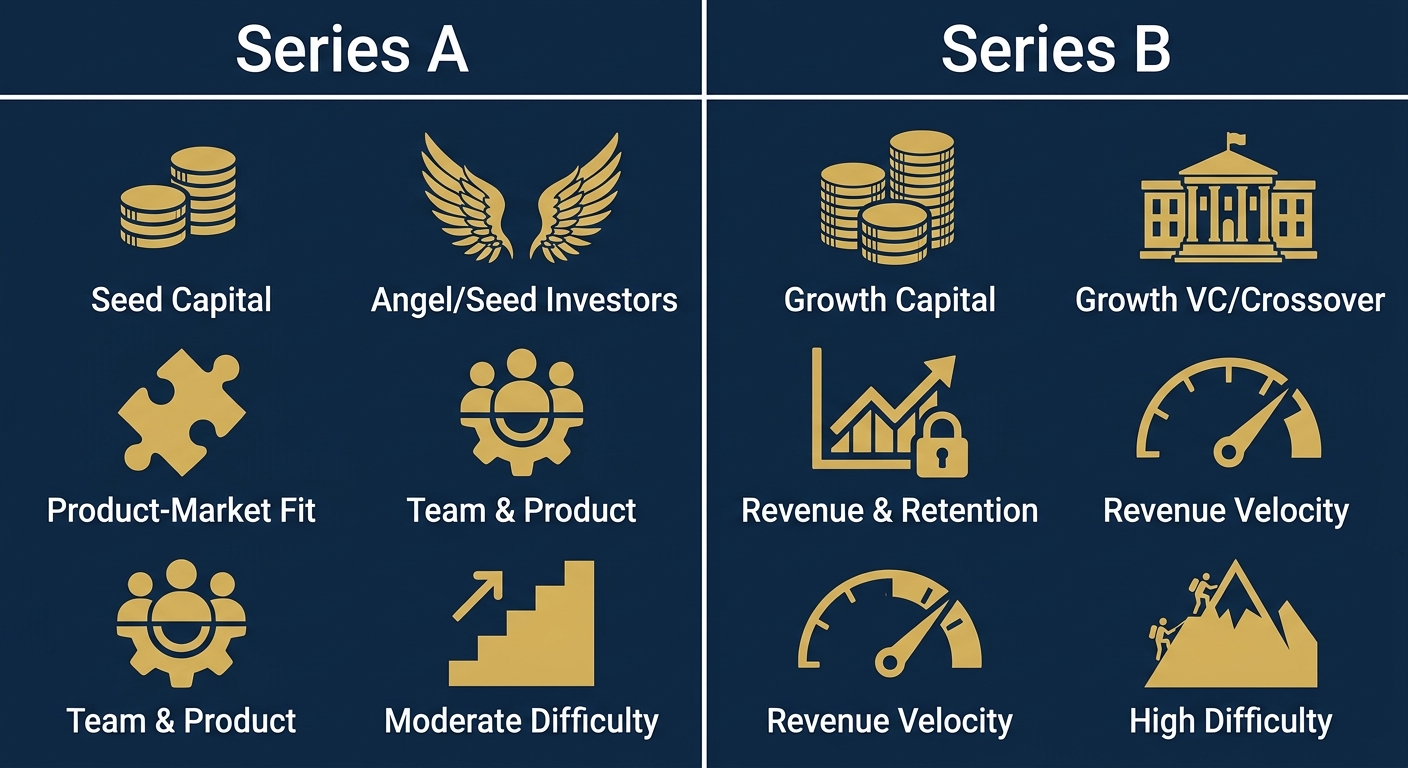
Series A vs. Series B funding comparison: capital, investors, metrics, valuation drivers, and difficulty.
Understanding these fundamentals is the first step. At Zaidwood Capital, our growth equity advisory team helps founders align the key metrics and build the investor-ready materials needed for a successful Series B round. In the next section, we outline the essential checklist to prepare for this critical stage.
Key Metrics and Evaluation Criteria for Series B Investors
Now that you understand what Series B funding entails, let’s examine the key metrics investors use to evaluate companies at this stage. To understand what is Series B funding and the metrics investors prioritize, founders must first grasp the key evaluation criteria. When evaluating a company for Series B Funding, investors look at a specific set of quantitative benchmarks to gauge growth and scalability. These benchmarks, though not rigid, help identify whether a company is on the right trajectory to attract significant institutional capital.
The table below summarizes the key metrics and typical Series B benchmarks.
| Metric | Described | Typical Series B Benchmark |
|---|---|---|
| ARR (Annual Recurring Revenue) | Starting point for revenue traction | $5M – $30M+ depending on sector |
| YoY Revenue Growth | Growth trajectory indicator | 70%+ for high‑growth, 40‑60% for steady‑growth |
| Net Revenue Retention (NRR) | Expansion revenue retention | >120% preferred, >100% acceptable |
| Gross Margin | Profitability potential | 70%+ for SaaS, lower for other models |
| CAC Payback Period | Efficiency of customer acquisition | <12 months |
| Valuation (Pre‑/Post‑Money) | Multiples applied to ARR or revenue | 10‑20x ARR for high‑growth, lower for slower growth |
These benchmarks are general guideposts, not rigid thresholds; each sector carries its own nuances. For example, enterprise SaaS companies often command higher valuations, while capital-intensive models may see lower multiples but higher growth potential. At Zaidwood Capital, we help founders benchmark their performance against industry standards using Precision Catalyst, which provides real-time visibility into ARR, churn, and unit economics.
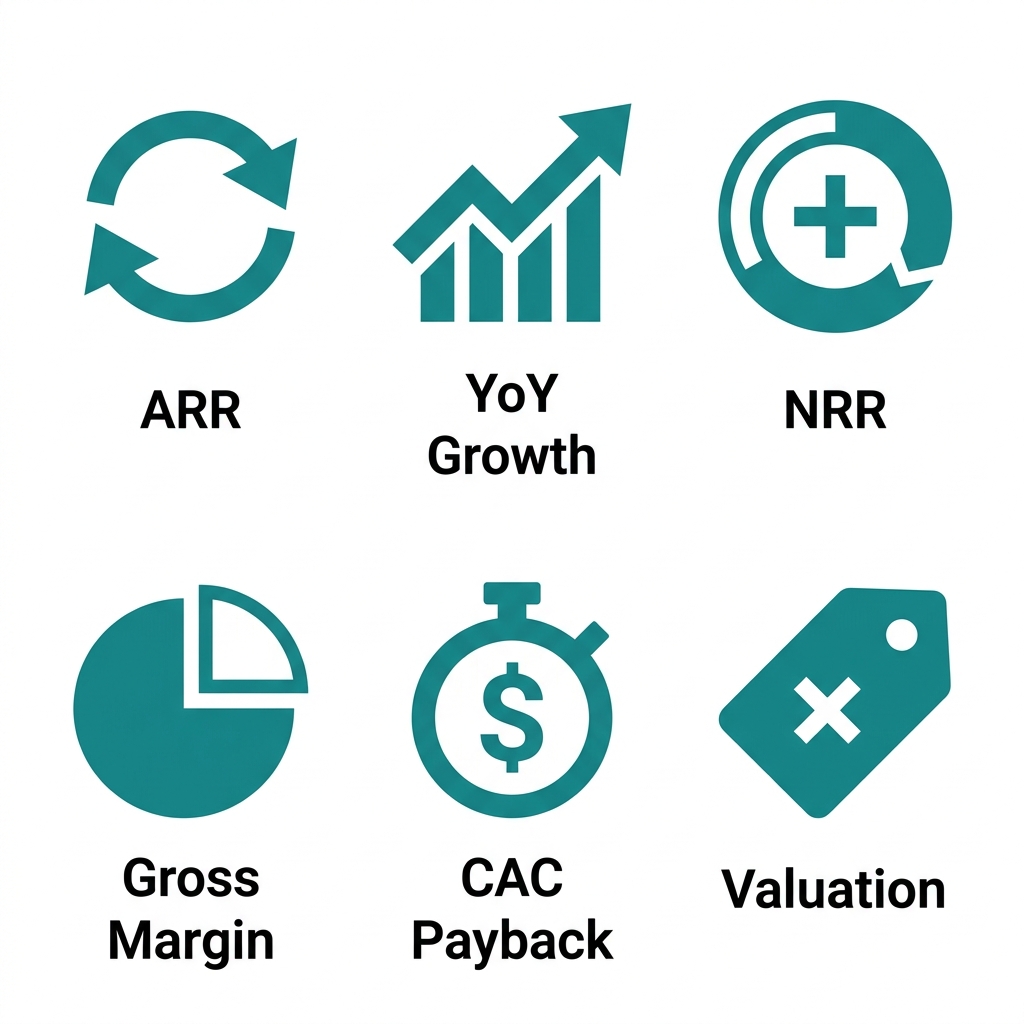
Six core metrics for Series B investor evaluation represented as clean icons.
Revenue Milestones and Investor Expectations
Investors at the Series B stage look for a clear revenue trajectory, starting with annual recurring revenue (ARR). Most institutional investors target companies in the $5M-$30M range, with enterprise SaaS firms often at the higher end to demonstrate market fit. Year-over-year revenue growth is also critical: high-growth startups typically exceed 70%, while 40-60% signals steady growth. Net revenue retention (NRR) measures expansion revenue from existing customers through upgrades, cross-sells, and renewals; an NRR above 120% is preferred, while above 100% indicates that expansion offsets churn. Consistently high NRR demonstrates that the customer base is not only sticky but also growing.
Founders should track series b revenue milestones such as ARR and YoY growth to gauge progress. Our Precision Catalyst platform helps clients monitor these metrics in real time, enabling them to identify gaps and refine their narrative before approaching our network of institutional investors. Such metrics, when tracked over time, reveal the underlying health of the business model and its ability to scale profitably.
Valuation Multiples and Calculation Methods
Pre-money and post-money valuation are foundational to any Series B negotiation. Pre-money valuation values the company before the investment, while post-money adds the capital raised. Investors typically apply revenue multiples to ARR to derive a valuation range. Among the critical series b valuation metrics, revenue multiples remain the most common starting point. High-growth companies in the 70%+ bracket often command multiples of 10-20x ARR, whereas slower-growth firms may see 5-10x. Gross margin strongly influences these multiples: SaaS businesses with gross margins above 70% are rewarded with higher multiples because each incremental dollar contributes more to the bottom line. Businesses with lower gross margins must demonstrate exceptional unit economics.
Our Sovereign Data Nexus platform provides real-time market comparables, enabling founders to build a valuation thesis grounded in market evidence. This data-backed approach helps founders negotiate from a position of strength, supported by industry benchmarks rather than assumptions.
The Investor Diligence Process
Beyond headline metrics, Series B investors conduct a comprehensive diligence review. Financial due diligence examines audited (or reviewed) statements, revenue recognition policies, and cash-flow projections. Legal diligence scrutinizes IP ownership, cap table structure, and material contracts. Operational diligence assesses management team depth, customer concentration, churn, and scalability. Together, these reviews determine whether the business can withstand growth and institutional scrutiny.
At Zaidwood Capital, we help founders prepare for diligence by organizing secure data rooms and producing investor-ready documentation through our Velocity Matrix process. This reduces time to term sheet and demonstrates operational rigor. Please note that Zaidwood Capital is not a registered broker-dealer; securities are offered through a third-party broker-dealer. This content is for educational purposes and does not constitute an offer or solicitation. Understanding these metrics is the first step; the next section will show you how to build a data-backed story that resonates with those investors.
How to Prepare and Execute a Successful Series B Round
After understanding what series b funding is, the next step is preparing to execute a successful round. We help founders build a compelling narrative, size the raise appropriately, and navigate the process from outreach to close.
Building Your Financial Narrative and Pitch Deck
A strong Series B narrative begins with a rigorous 3-year financial model that isolates unit economics (CAC, LTV, gross margin) and a compelling pitch deck. As a Boutique M&A and Capital Advisory Firm, we ensure the narrative aligns with institutional expectations. The deck must clearly present traction (revenue growth, cohort retention), a bottom-up TAM/SAM/SOM analysis, a competitive landscape map, and a detailed use-of-funds plan. Key steps include:
- Financial model: Build a model that breaks out CAC, LTV, and gross margin to validate unit economics and cash burn projections.
- Pitch deck: Assemble slides covering traction, market opportunity, competitive positioning, and a milestone-aligned use of funds.
- Data room: Set up a diligence-ready data room using our Sovereign Data Nexus platform.
- Investor matching: Use Precision Catalyst to identify the most relevant growth-stage investors from our network of 4,000+.
For a refresher on earlier rounds, see our series a funding guide. A well-crafted narrative accelerates investor interest and shortens time to term sheet.
Determining Capital Amount and Valuation Range
We recommend raising enough to fund 12-18 months of execution, directly tied to achieving series b revenue milestones such as doubling ARR or entering a new market. For SaaS companies, series b valuation metrics typically fall in the 8-12x trailing ARR range; B2B models may trade lower. Key considerations:
- Capital sizing: Link every dollar to specific hires (VP Sales, CMO), product launches, or geographic entry; this discipline signals a clear roadmap and efficient resource allocation.
- Valuation benchmarking: Compare recent Series B transactions in your sector and use our Velocity Matrix framework to stress-test scenarios; this yields a defensible pre-money range that protects founder equity.
- Lead investor engagement: Initiate conversations early on board seats, liquidation preferences, and pro-rata rights; mutual understanding reduces friction during term sheet negotiation.
- Dilution impact: Model dilution scenarios to understand the impact on founder ownership and option pool; we help founders balance financing needs with long-term alignment.
A well-calibrated ask projects confidence and attracts the right institutional partners.
Navigating the Fundraising Process from Outreach to Close
We orchestrate a 6-8 week sprint from targeted outreach to signed term sheet, using our Velocity Matrix to maintain momentum and competitive tension. Weekly investor updates and a fully prepared data room are non-negotiable. Key stages include:
- Investor targeting: Curate a list of 30-50 growth-stage funds via Precision Catalyst and our 4,000+ network, focusing on mandates that align with your sector. This precision increases lead investor interest.
- Outreach: Launch a concise email and teaser deck; systematic follow-up, managed by our advisors, maximizes first-meeting conversion.
- Updates: Share weekly performance snapshots and progress reports to sustain engagement; consistent communications often accelerate term sheet delivery.
- Data room: Maintain a comprehensive, always-current data room using Sovereign Data Nexus, giving investors 24/7 secure access and reducing diligence time.
- Term sheet: Evaluate competing offers on economics, control, and alignment; our senior advisors guide founders to a close that preserves long-term flexibility.
Once the round is underway, the focus shifts to managing term sheets and closing (covered in the next section).
The following table, based on industry data from valueaddvc.com, summarizes how raised capital is typically deployed across strategic milestones.
| Strategy / Milestone | Primary Objective | Typical Allocation of Funds |
|---|---|---|
| Scale sales & marketing | Accelerate revenue growth, expand customer base | 40‑60% of raised capital |
| Expand product & engineering | Build new features, enhance platform, enter new markets | 20‑30% of raised capital |
| Strengthen operations & talent | Hire senior leadership, build corporate infrastructure | 10‑20% of raised capital |
| International expansion | Enter new geographies, build local teams | 5‑15% of raised capital |
| Reserve for working capital / M&A | Maintain liquidity, prepare for strategic acquisitions | 5‑10% of raised capital |
Disclaimer: This content is for informational purposes only and does not constitute an offer, solicitation, or recommendation to buy or sell any security. Securities are offered through Finalis Securities LLC; Zaidwood Capital is not a registered broker-dealer and is unaffiliated with Finalis. Investments involve risk and are not guaranteed to appreciate; investors may lose all or part of their investment. Past performance does not guarantee future results. Prospective investors should conduct their own due diligence and consult legal, tax, and financial advisors.
Advanced Series B Valuation Strategies and Post-Money Considerations
For many growth-stage companies, understanding what is series B funding is critical to scaling operations and market penetration. Series B represents a company’s third institutional funding round, where venture capital firms invest in proven business models with strong product-market fit. Building on these fundamentals, we explore the advanced valuation strategies that shape successful Series B transactions.
Series B valuation relies on revenue multiples, typically 5x to 10x annual recurring revenue, but series B valuation metrics are far more nuanced. Growth rate, gross margin, and market size adjust where within that range a company lands. For example, a SaaS company growing 50% year over year with strong margins might command a higher multiple. Achieving series b revenue milestones such as $10M ARR indicates scalability and product-market fit. This industry benchmark signals readiness for institutional capital, though it does not guarantee a specific valuation outcome.
Post-money valuation directly affects founder dilution. In a hypothetical scenario, raising $10 million at a $40 million post-money valuation dilutes the founders by 25%. Understanding this relationship is essential for preserving long-term value. To negotiate higher multiples, we advise focusing on unit economics: a LTV/CAC ratio exceeding 3.0 and net revenue retention over 100% serve as powerful valuation levers.
At Zaidwood Capital, our proprietary analytics strengthen valuation narratives. Our Sovereign Data Nexus platform aggregates real-time market comparables, while the Precision Catalyst leverages AI-driven investor matching to identify capital partners that validate the business model and growth potential.
Once valuation parameters are defined, execution begins. Engaging a boutique firm like ours involves clear communication around tech M&A advisory fees; see our FAQ for a breakdown of typical costs. With our analytical capabilities and investor network, we help founders navigate the fundraising journey. In the next section, we outline the step-by-step Series B process.
To help clarify Series B funding, here are answers to common questions our team often addresses with founders pursuing this stage of growth.
What is Series B funding?
Series B funding is a growth-stage equity round for companies that have proven product-market fit and are scaling revenue, typically following an initial venture raise.
What revenue milestones do Series B investors expect?
Series B revenue milestones usually include at least $10 million in annual recurring revenue and strong unit economics, though thresholds vary by industry.
How are Series B valuations determined?
Series B valuation metrics are driven by revenue multiples, growth rate, market size, and competitive positioning, with common ranges of 5-10× forward revenue.
How does Series B differ from a later round like Series E?
Series B rounds focus on scaling, while series e funding is later-stage capital often targeted at companies advancing toward an IPO. We help founders navigate each phase with our capital advisory expertise.
Preparing for Growth: The Series B Journey Ahead
Understanding what is series b funding is just the start; preparation defines what’s ahead. To secure funding, companies must reach series b revenue milestones around $10M-$30M ARR and present series b valuation metrics like 6-10x ARR multiples and 50%+ YoY growth. Beyond numbers, investors assess unit economics, a clear path to profitability, and a scalable go-to-market model. A comprehensive data room with financial projections and customer metrics is essential. Boutique advisory firms like Zaidwood Capital help founders prepare for this rigorous due diligence. This groundwork enables a successful raise, which we detail in the following section.
Resources


