


How To Value My Business
Table of Contents
Why Business Valuation Matters for M&A
When exploring how to value my business, a rigorous business valuation is essential. It establishes fair market value and safeguards both buyers and sellers from mispricing.
According to Morgan & Westfield, a precise valuation provides the objective data needed for effective negotiation–justifying price adjustments, earnouts, or other deal-structure modifications. During due diligence, it uncovers financial risks, intangible assets, and growth assumptions, often through methods like EBITDA valuation multiples and discounted cash flow analysis. A robust valuation also strengthens credibility with lenders, investors, and regulators, and it supports post-merger integration by pinning down realistic synergy targets. By establishing a defensible price, valuation aligns the expectations of both seller and buyer from the outset, reducing the risk of deal-killing disputes. For our boutique firm, these insights serve as the bedrock of a disciplined, value-creating M&A strategy.
Our boutique M&A and Capital Advisory Firm in West Palm Beach offers Business Valuation Services — the next section details the methods we use.
Preparing Your Business for Valuation
Before diving into valuation methods, proper preparation ensures accuracy. As a Boutique M&A and Capital Advisory Firm in West Palm Beach, Florida, we know that understanding how to value my business begins with organizing financial and operational records, setting the stage for a credible appraisal.
- Assemble core financial statements.
Collect your profit and loss statements for the past three years, the current and prior-year balance sheets, and a detailed cash flow statement. These documents form the factual foundation for any business appraisal. - Normalize EBITDA.
Adjust for one-time expenses, owner perks, and non-operating income to reveal true earning power. This normalization ensures accurate EBITDA valuation multiples and a fair reflection of operational performance. - Organize operational records.
Gather client contracts, supplier agreements, lease terms, and employee headcount data. A clear picture of your business’s contractual obligations and workforce structure strengthens the credibility of the valuation. - Map out valuation drivers.
Consider factors beyond earnings: industry revenue multiples, growth trajectory, customer concentration risk, and intangible assets such as patents and brand equity. Future-focused methods like discounted cash flow analysis depend on reliable growth projections and risk assessments.
Following this process flow builds a solid foundation for your appraisal.
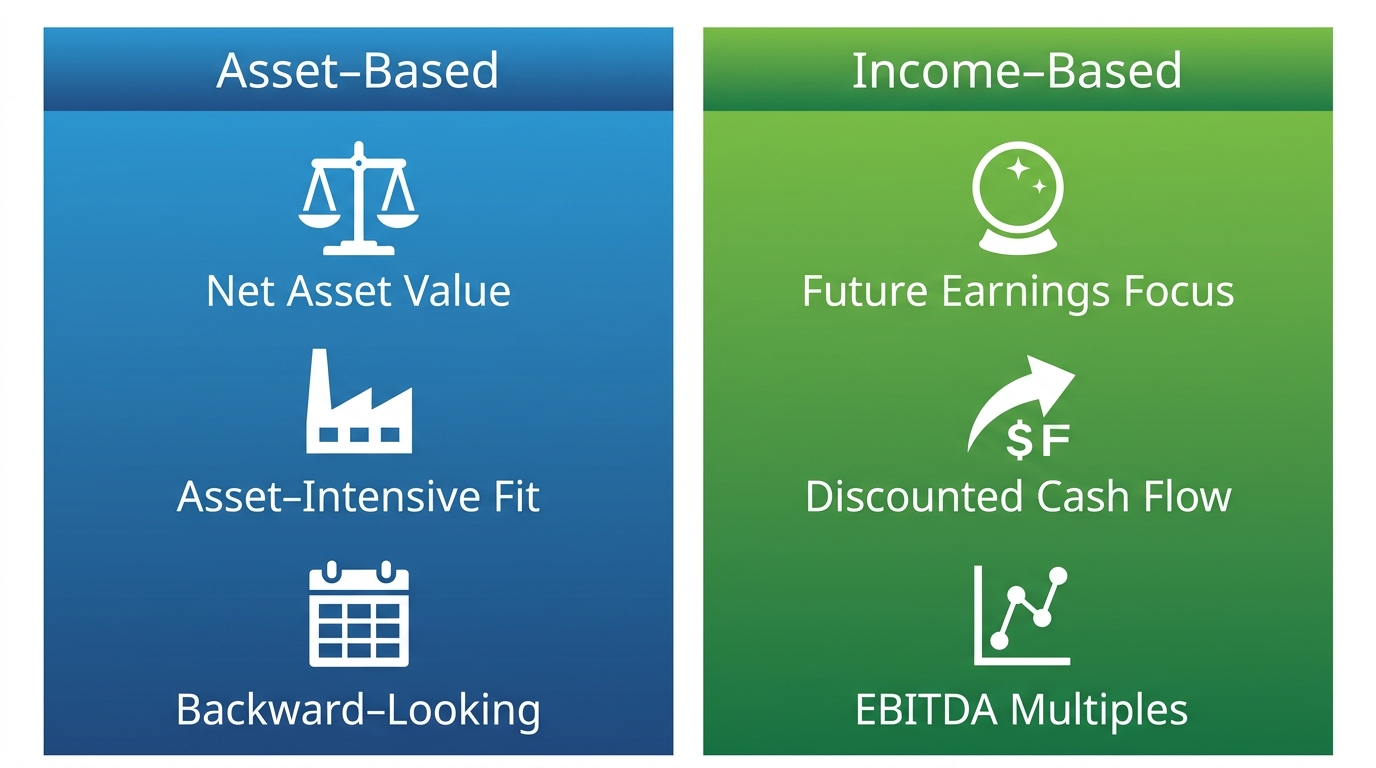
Comparison of asset-based and income-based valuation methods.
Vertical process flow for preparing your business for valuation with four key steps.
With your financials organized and normalized, you are ready to explore valuation methodologies. When a successful exit is the goal, our dedicated Business Valuation For Sale service, backed by our Full-Cycle M&A expertise, provides tailored guidance for owners in West Palm Beach and beyond.
Valuation Methods: Asset-Based vs. Income-Based
When an entrepreneur first asks how to value my business, the discussion typically narrows to two fundamental approaches. The asset-based method calculates net asset value by subtracting total liabilities from total assets, making it a natural fit for capital-intensive sectors like manufacturing or real estate. By contrast, the income-based approach estimates what a business is worth by projecting its future earnings power–most commonly in a discounted cash flow analysis or using EBITDA valuation multiples–and is considered best suited for service-driven or fast-growing companies where tomorrow’s cash flows are the primary value driver.
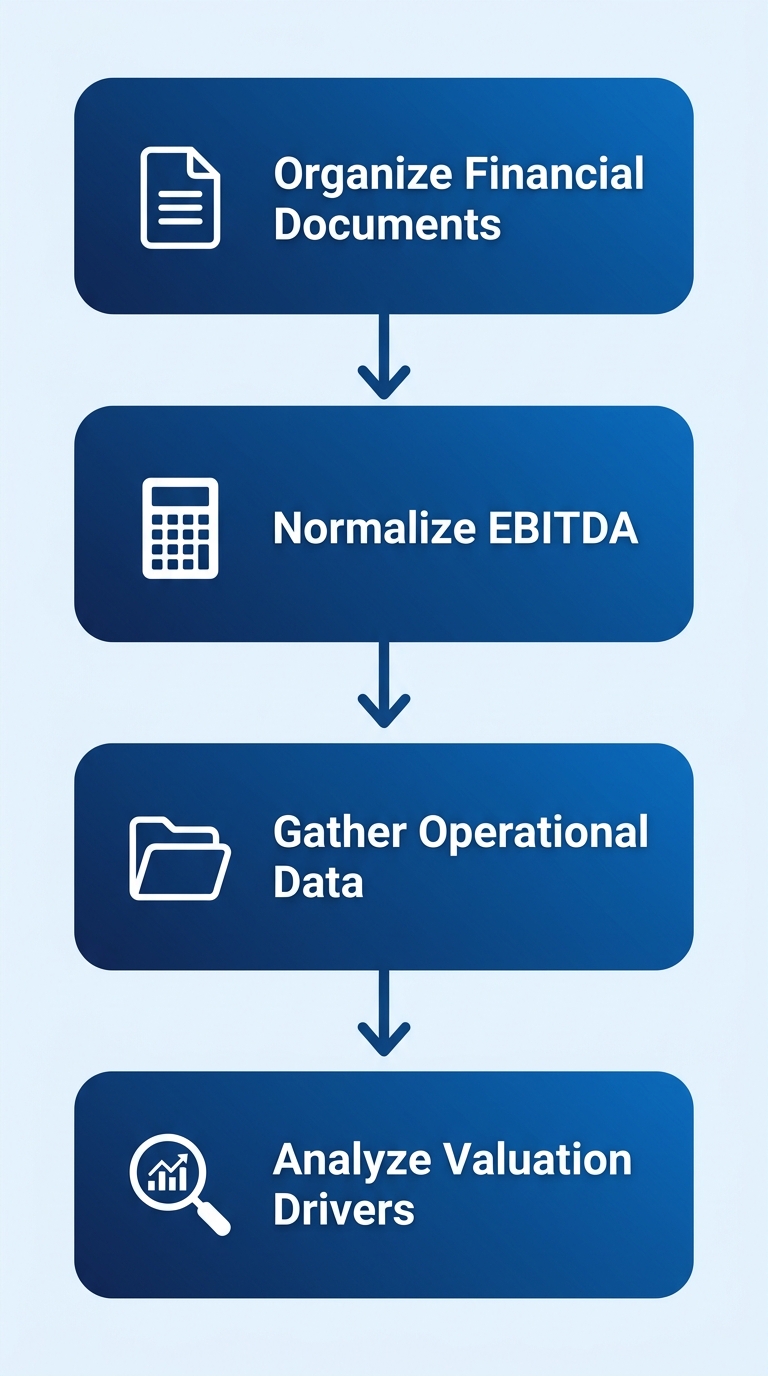
Vertical process flow for preparing your business for valuation with four key steps.
Comparison of asset-based and income-based valuation methods.
Where asset-based analysis relies on historical balance-sheet figures, income-based modeling focuses on anticipated performance, making the former backward-looking and the latter forward-looking. Because each method answers a different question, a thorough business valuation often leans on both, and expert guidance can help interpret the outcomes. For a tailored review, explore our business valuation services.
EBITDA Valuation Multiples Explained
If you are wondering how to value my business, the EBITDA valuation multiple is one of the first metrics you will encounter. EBITDA–Earnings Before Interest, Taxes, Depreciation, and Amortization–measures operating profitability by stripping out non-cash and financing items. The multiple, typically ranging from 3x to 7x, is derived from comparable company transactions and industry norms, not a fixed formula. Applying it to EBITDA yields an enterprise value, which must be adjusted for debt, cash, and working capital to arrive at a final price. Multiples vary with industry sector, growth rates, profit margins, customer concentration, market conditions, and the business’s overall risk profile. While EBITDA multiples offer a quick benchmark, a thorough valuation requires professional judgment and often multiple methods like discounted cash flow analysis. Arriving at a market-ready valuation is just one critical step in a successful sell-side m&a process, and at Zaidwood Capital we guide owners through the full valuation process to ensure the multiple is part of a broader strategic framework.
Discounted Cash Flow Analysis for Middle-Market Companies
For middle-market owners asking how to value my business, discounted cash flow analysis provides a cash-flow-based intrinsic valuation that goes beyond common market multiples. In a discounted cash flow analysis, a company’s future free cash flows are projected, discounted to present value using a rate that captures its cost of capital and risk, and a terminal value added for long-term worth. This intrinsic measure reveals the business’s true earning power aligned with its unique risk profile and growth trajectory.
Unlike EBITDA valuation multiples that benchmark against peers, DCF derives intrinsic value from a company’s own free cash flows. Middle-market firms with stable, predictable cash flows therefore obtain a valuation that truly reflects their unique risk and growth.
As a Boutique M&A and Capital Advisory Firm based in West Palm Beach, we leverage DCF in sell-side and capital-raising engagements. Our proprietary platforms–Sovereign Data Nexus and Precision Catalyst–then deploy our Enterprise AI Capital Raising framework to connect clients with institutional investors. In contrast, traditional EBITDA valuation multiples offer a complementary market perspective.
Industry and Growth-Stage Adjustments
Understanding how to value my business requires more than a generic formula–it demands adjustments for industry sector and growth stage. To arrive at a truly accurate valuation, standard methods must be refined by these variables.
Industry risk profiles–whether cyclical or defensive–alongside regulatory intensity and capital intensity directly shape appropriate valuation multiples. For mature companies with predictable cash flows, EBITDA valuation multiples serve as a primary benchmark, especially in capital-intensive manufacturing sectors.
Early-stage companies with high growth but no positive earnings demand a different lens. A discounted cash flow analysis with elevated discount rates or revenue-based multiples better captures future potential. For SaaS ventures, EV/Revenue predominates; for financial services, P/E multiples are more standard.
Our proprietary Sovereign Data Nexus platform and Precision Catalyst draw on real-time transactional data from over 4,000 investors to calibrate these adjustments precisely.
Our investment banking advisory services incorporate these industry and growth-stage adjustments to produce valuations that stand up to investor scrutiny.
Enhancing Business Value Before Seeking Investment
Before engaging investors, we recommend maximizing your business’s value. If you’re asking how to value my business, the answer starts with proactive enhancements that attract acquirers and equity partners. Additionally, we prioritize measurable operational improvements, robust documentation, and clear audit trails to substantiate valuation assumptions for prospective investors.
- Drive consistent revenue growth above 15% year-over-year to signal scalability.
- Boost EBITDA margins to industry-leading levels, directly improving EBITDA valuation multiples.
- Adopt auditable financial reporting to underpin a reliable discounted cash flow analysis.
- Diversify your customer base if concentration exceeds 30%.
- Document recurring revenue and contract lengths to show revenue stickiness.
- Enhance management depth and protect intellectual property to build a defensible moat.
Once your business is optimally positioned, the next step is navigating the investment landscape with a seasoned advisor.
The Professional Valuation Process
When a business owner asks “how to value my business,” we begin a structured valuation engagement built on analytic rigor and market intelligence. The process starts with a comprehensive data request that gathers historical financial statements, tax returns, and operational metrics. Our analysts then review historical performance, normalizing earnings to isolate recurring profitability and remove one-time items.
To determine value, we apply two primary methodologies. First, we derive EBITDA valuation multiples from comparable public companies and precedent transactions–a market-based approach that captures how similar businesses are priced. Second, we construct a discounted cash flow analysis, projecting future free cash flows and discounting them at an appropriate rate (such as WACC) to reflect time and risk. Throughout, we calibrate inputs using our proprietary Sovereign Data Nexus platform, which provides real-time market transaction data.
The engagement concludes with a detailed valuation report that synthesizes both approaches into a defensible value range, complete with assumptions and limitations. The result is a clear, data-driven perspective that empowers owners to make informed strategic decisions about exit, growth, or capital raises–without promising a specific transaction price or guaranteed outcome.
Factors That Increase Your EBITDA Multiple
If you’re asking how to value my business, understanding the factors that drive a higher EBITDA multiple is essential. At Zaidwood Capital, we focus on several key drivers that often lead to an elevated valuation.
- Revenue Growth Trajectory: Consistent, accelerating revenue growth signals future potential. We find that upward top-line momentum often leads to higher EBITDA multiples, as investors pay a premium for scalability.
- Profit Margins: Strong gross and operating margins indicate operational efficiency. Companies with above-average margins tend to attract higher EBITDA valuation multiples, reflecting their ability to convert revenue into cash flow.
- Recurring Revenue Models: Predictable income streams, such as SaaS subscriptions, typically command a higher multiple than transactional revenue. Data from our Sovereign Data Nexus indicates that recurring models often drive more favorable valuations.
- Industry Tailwinds: Businesses in sectors with positive macro trends, like technology or healthcare, benefit from tailwinds. While discounted cash flow analysis offers intrinsic value insights, favorable industry dynamics can amplify the multiple a buyer is willing to pay.
Understanding what drives a higher multiple is crucial; next, we explore how to calculate and benchmark your own EBITDA multiple.
Common Valuation Mistakes and How to Avoid Them
When you ask how to value my business, certain missteps are easy to make, even for experienced owners. According to Adams Brown CPA, several common pitfalls can distort a company’s true worth if not carefully avoided.
- Over-reliance on EBITDA valuation multiples: Many owners fixate on a single multiple, but multiples vary by industry, company size, and growth stage; using just one can paint a misleading picture. A better approach is to combine multiple methods–such as market, income, and asset approaches–to triangulate a robust value range.
- Ignoring normalization adjustments: One-time expenses or discretionary owner perks frequently inflate or deflate earnings. Recasting financials to remove these one-offs reveals the true economic earnings that buyers and investors will focus on.
- Using stale financial data: Valuations must reflect the most recent 12-24 months. Outdated numbers skew a discounted cash flow analysis and comparable company analysis, leading to inaccurate value conclusions.
- Neglecting the valuation’s purpose: A sale, fundraising round, or estate plan each demand different weightings on growth, risk, and market comparables. Without clarifying the goal, the resulting value may not match the intended use.
- Skipping professional guidance: Online calculators and personal assumptions miss nuances like market conditions and buyer synergies. We recommend engaging a full-cycle M&A advisory firm like Zaidwood Capital to capture all value drivers and avoid missteps.
Avoiding these pitfalls is easier with an experienced advisor at your side. When you ask how to value my business, a purpose-driven methodology transforms complexity into a clear plan.
Disclaimer: This content is for informational purposes only; securities are offered through Finalis Securities LLC, and Zaidwood Capital is not a registered broker-dealer.
Final Steps for a Successful Business Valuation
Once you have a preliminary value from learning how to value my business, these final steps will turn your calculation into a negotiation-ready figure.
Cross-check your result. Compare your DCF or multiples outcome against industry norms using S&P Capital IQ or recent industry reports.
Update your financials. Refresh your forecast with the latest 12 months of actual revenue, margins, and debt; material shifts can move a valuation significantly.
Build a one-page summary. Capture key assumptions, the EBITDA valuation multiples range, and your final value range — a negotiation-ready reference.
Validate with an advisor. Engage a professional valuation advisor or a boutique firm like ours for an opinion letter; critical for buyer or lender confidence.
Confirm methodology alignment. If you used a discounted cash flow analysis, document the WACC calculation to satisfy bankers and auditors.
By completing this checklist, you transform a theoretical number into a negotiation-ready asset. Our team at Zaidwood Capital, based in West Palm Beach, stands ready to support you through every phase.
Resources


