


Series B
Table of Contents
Understanding Series B Funding for Growth-Stage Companies
After establishing product-market fit in earlier rounds, companies often turn to Series B funding to fuel rapid scaling. Understanding Series B Funding is critical for growth-stage companies aiming to accelerate market penetration. This round, typically raised by companies with proven traction–revenue, user base, and market fit–enables scaling operations, expanding into new markets, and building operational infrastructure.
According to Silicon Valley Bank (SVB) industry benchmarks, Series B rounds generally range from $10 million to $50 million, often reflecting higher valuations and the operational demands of scaling companies. Investors in these rounds include venture capital firms–particularly late-stage VCs–growth equity funds, corporate venture arms, and private equity. They evaluate series b funding requirements including strong unit economics, a clear path to profitability, an experienced management team, and a defensible market position that ensures scalability and long-term viability.
At Zaidwood Capital, our Growth Equity Advisory service helps founders prepare for Series B capital formation. By leveraging our institutional investor network and proprietary data platform, Sovereign Data Nexus, we assist with refining the narrative and optimizing series b valuation metrics for stronger investor interest. Proceeds from a Series B are typically deployed across sales and marketing expansion, product development, senior talent acquisition, and international growth. We are not a broker-dealer; securities are offered through Finalis Securities LLC.
Key Requirements and Milestones for Series B Funding
Now that you have a foundational understanding of What is Series B Funding, it is critical to understand the specific requirements investors demand at this stage. Series B funding marks a pivotal inflection point where startups must demonstrate not only strong product-market fit but also scalable unit economics and operational maturity.
The table below contrasts the key series b funding requirements against typical Series A benchmarks, revealing the heightened bar for later-stage companies.
| Criteria | Series A | Series B |
|---|---|---|
| ARR | $1M-$3M | $10M-$20M+ |
| Year-over-year growth rate | 100%+ | 50%-100% |
| Gross margin | 50%-70% | 70%+ |
| Unit economics efficiency | Improving LTV/CAC | LTV/CAC > 3x, payback < 12 months |
| Team and governance | Founder-heavy | VP-level hires, board with independent members |
Delving deeper into these metrics reveals the rationale behind investor scrutiny.
- ARR: According to Silicon Valley Bank (SVB), a leading bank serving the innovation economy, typical annual recurring revenue for a Series B candidate falls between $10 million and $20 million–a steep climb from the $1-3 million expected at Series A.
- Year-over-year growth rate: Examining series b valuation metrics, investors look for sustained growth of 50% to 100%. This range is lower than the triple-digit pace sought in early stages because larger revenue bases make hypergrowth harder to maintain.
- Gross margin: Gross margins should exceed 70%, signaling efficient cost structures and a defensible business model. SVB benchmarks indicate that Series A companies often operate at 50-70%; reaching 70%+ demonstrates substantial operational maturation.
- Unit economics efficiency: Intelligent Business data emphasizes that investors now demand an LTV/CAC ratio greater than 3x and a payback period shorter than 12 months. These metrics prove that each customer acquisition generates a healthy return and that capital is recycled quickly for further growth.
- Team and governance: The organizational structure must mature beyond a founder-led model. Series B investors expect to see VP-level hires across key functions such as sales and marketing, as well as a board that includes independent members bringing external oversight and governance rigor.
Each of these areas collectively signals to investors that the business is no longer an experiment but a predictable growth engine.
Meeting these benchmarks positions your company to enter the preparation phase. Hitting these milestones demonstrates that a startup has moved beyond early-stage uncertainty and can command the confidence of institutional growth investors. With validated unit economics and a seasoned leadership team, founders are ready to transition from proving the model to scaling it–the focus of the subsequent preparation phase.
Valuation Metrics Driving Series B Round Success
To succeed in a Series B round, founders must intimately understand the valuation metrics that growth-stage investors prioritize. We examine the core series b valuation metrics–from revenue multiples to net revenue retention and the Rule of 40–and highlight how these drivers vary across SaaS and AI/Deep Tech sectors, enabling founders to position their companies for optimal outcomes.
Pre-Money Valuation and Revenue Multiples
Pre-money valuation for a Series B round is primarily derived by applying a revenue multiple to your annual recurring revenue (ARR) or recent run rate. For SaaS companies, the typical multiple ranges from 10x to 20x ARR, while AI and deep tech ventures may command 15x to 30x+ ARR, reflecting higher growth expectations. These benchmarks are informed by market comparables and academic research from the University of Munich, which highlights how sector dynamics and counterparty transactions shape valuation. As one of the central series b valuation metrics, revenue multiples reward faster growth rates–a company growing 100% year-over-year earns a premium over one at 50%. Investors then refine this multiple based on qualitative factors such as competitive moat and management depth. We recommend that founders rigorously track ARR trajectory and present clear market comps in their data rooms to substantiate their valuation target. Ultimately, pre-money valuation must balance ambition with investor comparables to avoid pricing the round too aggressively.
The Role of Net Revenue Retention and the Rule of 40
Net revenue retention (NRR) measures existing customer revenue growth net of churn, and an NRR above 110% signals robust expansion and retention–directly boosting valuation. For SaaS companies, investors seek NRR in the 110%-130% range, whereas AI/Deep Tech ventures may be viewed favorably with 100%-120%. The Rule of 40, calculated as revenue growth percentage plus profit margin percentage, serves as a quick health check: a combined score of 40 or above indicates sound growth efficiency. Academic research from the University of Munich reinforces that these metrics are critical for Series B stage assessment. While SaaS firms typically target a Rule of 40 above 30%, AI companies may fall below that benchmark due to heavy R&D spend, but must demonstrate a clear path to efficiency. Beyond these core metrics, broader series b funding requirements–such as product-market fit and team experience–also weigh on investor decisions. Founders who consistently track NRR and articulate a plan to reach or exceed the Rule of 40 will materially strengthen their fundraising narrative.
Sector-Specific Valuation Trends: SaaS vs. AI
Investor expectations diverge sharply between traditional SaaS and AI/Deep Tech ventures. To illustrate these distinctions, we present the following comparison based on industry benchmarks.
| Metric | SaaS | AI / Deep Tech |
|---|---|---|
| Revenue multiple (ARR-based) | 10x-20x | 15x-30x+ |
| Rule of 40 threshold | 30%+ | May be lower due to R&D spend |
| Net Revenue Retention (NRR) | 110%-130% | 100%-120% |
| Gross margin requirement | 70%-80% | 60%-75% |
As the table shows, AI companies command higher revenue multiples due to perceived scalability and technology premiums, yet often operate with lower gross margins and NRR. Founders in the AI space should articulate a clear glide path to SaaS-like unit economics to align with typical Series B expectations. Transparently addressing these differences in pitch decks can build credibility with sophisticated investors. We advise all founders to use these sector-specific benchmarks when setting valuation targets and preparing investor materials.
Once founders understand these critical metrics, they can focus on optimizing each area before approaching investors. For deeper M&A context and fundraising strategies, explore our Zaidwood Capital M&A FAQ.
Preparing for a Successful Series B Fundraising Process
Once you’ve decided a series B round is the right move, thorough preparation is key. The shift from early-stage fundraising to a growth-stage institutional round demands a more rigorous approach across due diligence, pitch materials, and governance. At Zaidwood Capital, we work side-by-side with founders to navigate this evolution, turning preparation into a competitive advantage.
Navigating the Series B Due Diligence Process
Series B investors conduct a far deeper diligence review than what you faced at seed or Series A. The five primary areas–financial, legal, operational, team, and market–each expand significantly. To prepare, founders should gather audited financials for at least two fiscal years, compile all legal documents including IP assignments, material contracts, and regulatory filings, arrange customer reference calls in advance, and, if possible, commission an independent market analysis. Meeting series B funding requirements means going beyond burn-rate tracking to auditable statements that prove your unit economics and market defensibility. On the regulatory front, founders must be aware that the SEC and self-regulatory organizations such as FINRA enforce rules governing private placements and investor accreditation. While we do not provide legal advice, we recommend consulting securities counsel to ensure full compliance with FINRA’s private placement advertising, suitability, and record-keeping requirements.
| Due Diligence Area | Early Stage (Seed/Series A) | Growth Stage (Series B) |
|---|---|---|
| Financial diligence | Basic financials, burn rate | Audited financials, detailed unit economics, full P&L by product line |
| Legal diligence | Cap table, IP assignment | Full IP portfolio review, regulatory compliance, material contracts |
| Operational diligence | Founder interviews, product roadmap | Third-party assessments, infrastructure review, customer reference calls |
| Team diligence | Key hires, founder background | Management team depth, board composition, succession planning |
| Market diligence | TAM/SAM/SOM, competitive landscape | Independent market analysis, customer concentration, competitive moat |
As the table shows, financial diligence moves from basic burn-rate analysis to audited financials and full P&L by product line, while legal and operational reviews become far more comprehensive. These heightened expectations are why a systematic approach to due diligence–covering all five categories–is essential before you begin outreach.
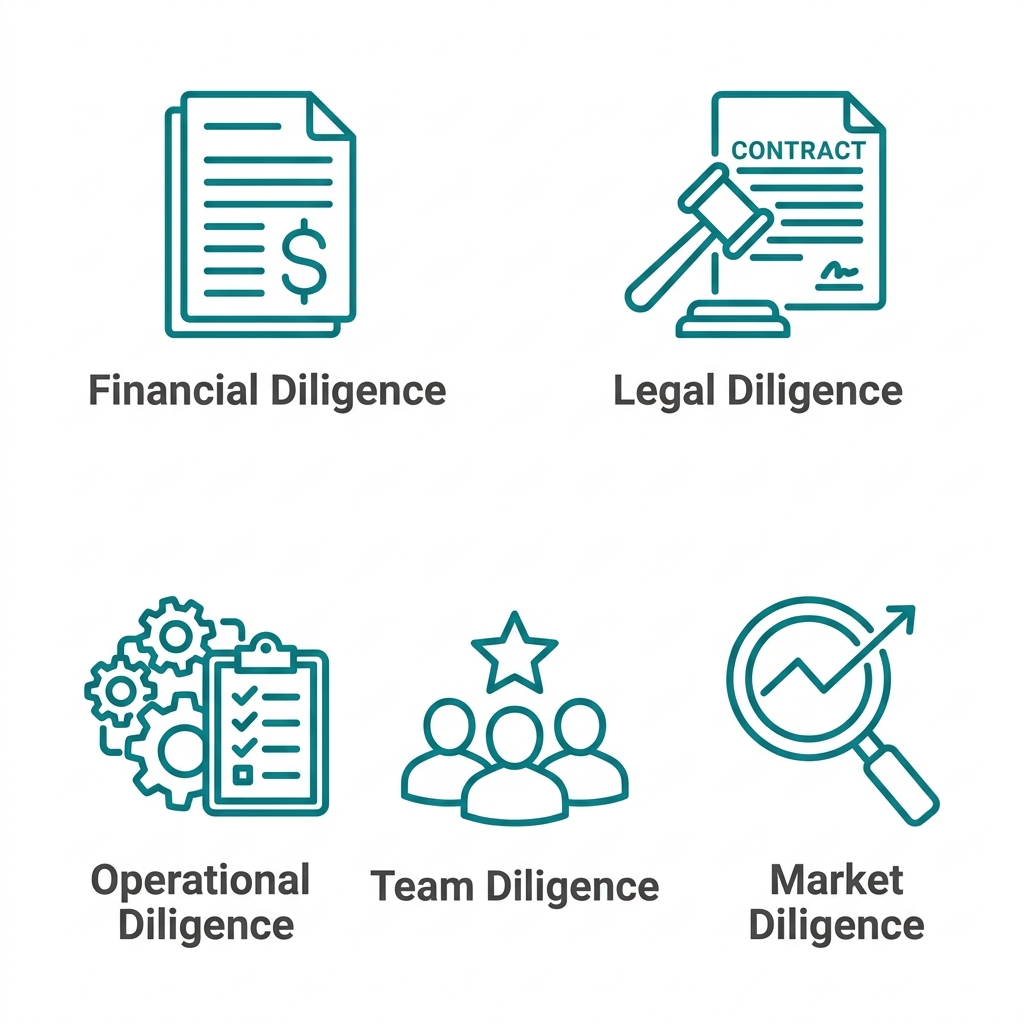
Five key areas of Series B due diligence
With the diligence foundation laid, the next step is crafting a pitch deck that proves your company’s scalability.
Building a Compelling Pitch Deck and Proving Scalability
Series B investors need a narrative that goes beyond product-market fit and proves repeatability. Your deck should be 10-12 slides and include problem/solution, product traction (monthly revenue growth, gross retention above 80%), scalable unit economics (LTV/CAC >3), competitive moat, team expansion plan, and use of funds. Emphasize that your growth is not a one-time spike but a consistent, scalable engine. Incorporate series B valuation metrics–such as revenue multiples, growth rates, and margin profiles–to anchor your ask. Avoid over-optimistic projections; ground your forecast in historical data and plausible market-share assumptions. At Zaidwood Capital, our boutique M&A and capital advisory firm helps founders refine these metrics and craft investor-ready presentations that highlight their scaling story.
Governance, Team Structure, and Board Readiness
Institutional investors at the Series B stage expect boards of at least five directors, including one independent seat, a formal board charter, and quarterly board meetings with audited financials. We recommend recruiting a VP of Finance and a Head of Revenue Operations before the round closes to signal operational maturity. As you strengthen your board and management team, consider how a future exit aligns with your growth plan: our sell-side m&a advisory can help you navigate that path. With these preparations in place, you are ready to approach the right institutional investors. Let our team guide you through the Series B process from term sheet to close.
Advanced Strategies for Closing Your Series B Round
Once your data room is institutional-grade and your target list is refined, it is time to deploy advanced tactics to convert conversations into committed capital for your growth-stage capital raise. At Zaidwood Capital, we guide founders through this critical last mile with proprietary tools and a structured advisory approach that accelerates timelines without sacrificing deal integrity.
Leverage Data-Driven Investor Targeting. We deploy our Sovereign Data Nexus to identify the exact subset of growth-equity investors who have recently deployed capital at the $20-$50M valuation range typical for a later-stage financing. This intelligence eliminates spray-and-pray outreach and focuses your Series B fundraise on funds with verified, recent conviction in your stage and sector.
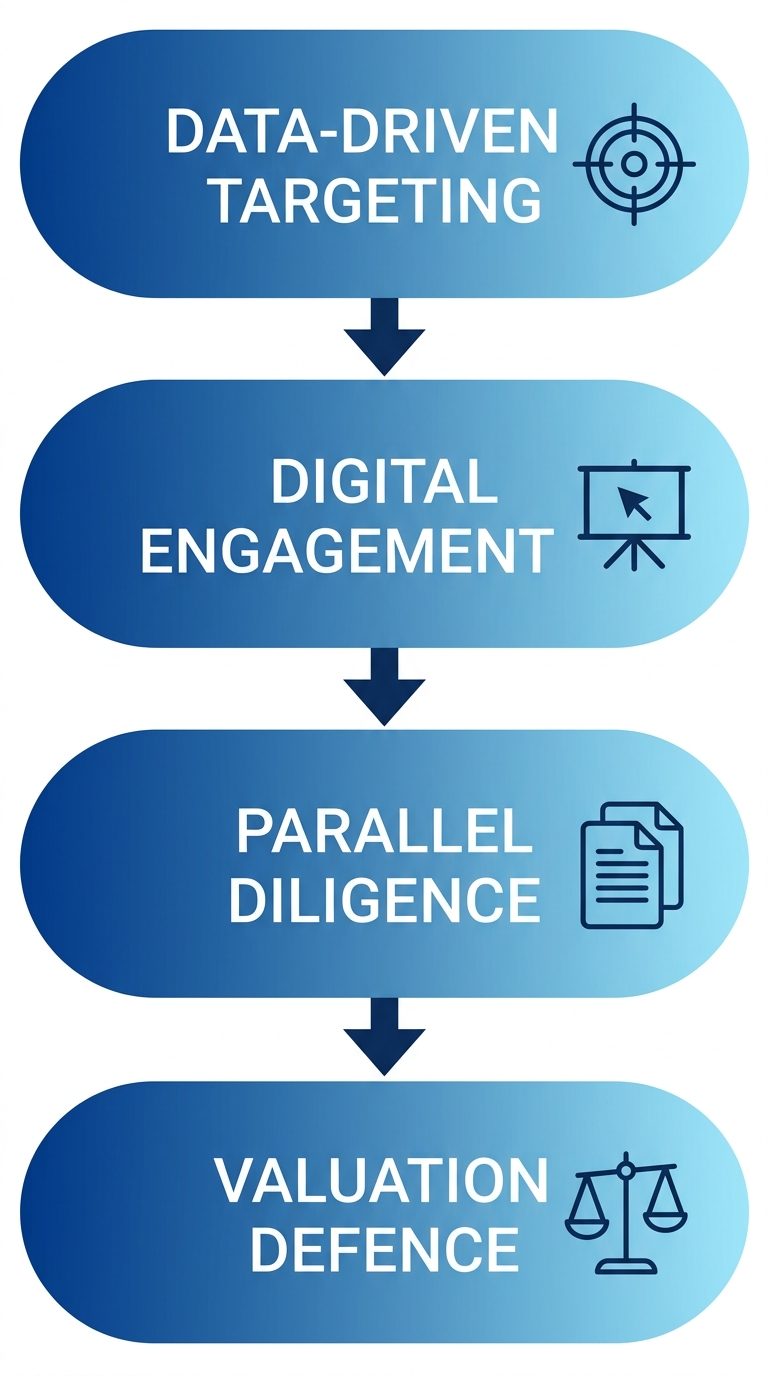
Advanced series B closing strategies visualized as a four-stage flow
Activate the Velocity Matrix for Parallel Diligence. Academic research from the University of Munich confirms that deal timelines compress and success rates improve when founders run three to four investor data rooms concurrently. Our Velocity Matrix sets a five-business-day deadline for first term sheets and populates a real-time comparison matrix covering valuation, liquidation preferences, board governance, and redemption provisions. Running parallel tracks creates competitive tension that rewards preparation and penalizes investor delay.
Anchor Valuation Ranges, Never a Single Number. During negotiation, presenting a defensible range backed by Series B valuation metrics–rather than a fixed number–preserves flexibility and reduces friction. We incorporate University of Munich research on later-stage determinants and comparable transaction data to build an evidence-based valuation corridor that withstands investor scrutiny and supports your negotiating position.
Precision Catalyst Digital Engagement. We schedule pre-recorded management presentations and follow up with customized data summaries that address each investor’s specific investment memo parameters. Automated reminders maintain momentum, while understanding typical tech m&a advisory fees helps you budget for the external financial advisors who provide term-sheet comparisons and capital structure modeling. This orchestration ensures no Series B funding requirements fall through the cracks during the diligence sprint.
Secure Written Commitment Within 48 Hours. After a verbal term sheet arrives, our advisors help you request a signed commitment letter within two business days. This micro-step hardens soft interest into binding momentum and materially reduces the risk of last-minute re-trades or drop-offs as the round approaches its final close.
As a Boutique M&A and Capital Advisory Firm, Zaidwood Capital acts in an advisory capacity and does not guarantee specific deal outcomes or absolute returns. After closing, the focus shifts to deploying the capital efficiently–the topic of our next section.
Frequently Asked Questions About Series B Funding
As a Boutique M&A and Capital Advisory Firm, we often field questions about raising growth-stage capital. To address common questions, we’ve compiled this FAQ.
What is Series B funding?
Series B funding is a growth-stage equity round that follows early-stage financing, typically pursued by startups with proven product-market fit and accelerating revenue.
What are typical series b valuation metrics?
Key series b valuation metrics include annual recurring revenue (ARR) growth rate, revenue multiples, and total addressable market size. Investors also assess unit economics and path to profitability.
What are the common series b funding requirements?
Common series b funding requirements include demonstrated revenue momentum, strong unit economics, a clear path to profitability, and a scalable business model. A well-prepared data room and realistic projections are essential.
How does our firm assist with Series B fundraising?
We leverage Sovereign Data Nexus to benchmark valuation drivers and Precision Catalyst AI to identify aligned investors. While outcomes are never guaranteed, we support pitch deck refinement, financial projections, and investor introductions. Contact us for personalized guidance.
Partner with Zaidwood Capital for Your Series B Journey
The Series B round is a critical inflection point for growth-stage companies. To navigate its complexities, partner with Zaidwood Capital, a full-cycle Boutique M&A and Capital Advisory Firm. Sovereign Data Nexus delivers Series B valuation metrics, Precision Catalyst enables AI-powered investor matchmaking, and Velocity Matrix ensures rapid execution. We offer access to 4,000+ investors and $15B+ to fulfill Series B funding requirements. With Zaidwood Capital’s full-cycle support, you can execute your Series B with speed and strategic insight. For more details on our advisory process, visit our FAQ on tech m&a advisory cost.
Resources


