
Table of Contents
Quality of Earnings and EBITDA Adjustments Explained
An explanation of quality of earnings and EBITDA adjustments reveals that adjusted EBITDA, called normalized or sustainable EBITDA, is the primary metric determining a company’s final acquisition price in M&A transactions. Quality of earnings assesses the sustainability and reliability of reported earnings, which informs whether EBITDA add backs are justified; these adjustments remove non-recurring, non-operational, or timing items to reflect the ongoing earning power a buyer can expect. According to KPMG, there is no universal standard for normalizing EBITDA, making each adjustment a subject of negotiation between buyer and seller. Pro forma adjustments are frequently applied to normalize EBITDA across different reporting periods, aligning past results with expected sustainable performance. These normalization steps produce a normalized ebitda figure. Even small normalization adjustments can have a disproportionately large impact on the final purchase price because they are multiplied by the transaction multiple. These adjustments fuel valuation multiples, and we guide clients through the cost framework that shapes the deal.
Cost Questions
The result of due diligence transforms EBITDA into a more effective basis for assessing values in the context of an acquisition. Our goal is to educate on the basic economics of deal-making. We have seen how normalization adjustments refine reported earnings into a sustainable profit measure, and these refinements translate into the price a buyer is willing to pay. In assessing earnings, an acquirer has to refine the reported number. The adjusted EBITDA figure that emerges from due diligence serves as the primary foundation upon which acquisition offers are built.
According to KPMG, adjusted EBITDA is the central variable for determining the final purchase price of a company because it represents the sustainable level of profitability a new owner can reasonably expect to inherit. In such cases, a great deal of time and effort is spent justifying and agreeing to each normalization adjustment. Because the transaction multiple method multiplies adjusted EBITDA by a market-standard factor, a dollar added to or subtracted from EBITDA does not move the price by a single dollar.
A middle-market company reporting $2,000,000 in unadjusted EBITDA with an agreed transaction multiple of 6x generates a valuation of $12,000,000. During the due diligence process, the buyer discovers $150,000 in non-recurring owner expenses that the seller considers normalizing. the buyer, however, identifies the expense as a potential adjustment to EBITDA. The buyer also discovers $50,000 in below-market rent that the seller considers normalization, while the buyer sees the rent as an expense that should be subtracted from EBITDA. The total of the normalized adjustment is $100,000. When the 6x multiple is applied to the $100,000 net positive adjustment, the price increases by $600,000. Because of the effect that normalization adjustments have on price, minor adjustment disagreements become major negotiation points in a transaction.
EBITDA adjustment amplification bar chart

What makes these discussions complex is the absence of any universally recognized standard on how adjusted EBITDA should be computed. The firm’s financial due diligence practice notes that there is no definitive literature that prescribes which items qualify for normalization, turning each adjustment into a matter of persuasive argument rather than a mechanical exercise. Buyers prefer to adjust down the earnings base, while sellers take the view that many adjustments should be made to reflect the true earning power of the business going forward.
Our experience in the middle market deals confirms that negotiation on pro forma adjustments is where the true deal value is won or lost. We inform our clients to be prepared to substantiate every claimed normalization adjustment with supporting evidence as a general norm, and operating rationale in particular, as a stand-alone adjustment rarely holds up to the test of the buyer’s due diligence. The art and science of leveraging these financial proposals in negotiation determines whether the deal price reflects the full worth of the enterprise or value is left unrealized.
Process Questions
We have examined costs associated with transactions, now we will cover EBITDA normalization, the last step in determining a price. The firm’s 2024 insight on corporate transactions states Adjusted EBITDA is the metric that dictates a company’s acquisition price in M&A transactions. EBITDA (as reported) is a measure of current earnings. Adjusted EBITDA attempts to answer the question, “what is the level of sustainable profitability a buyer will see after closing?” Negotiating the price of a business is the end result of this process. This is the core of a due diligence exercise. The reported EBITDA of a business is the starting point, and through the due diligence exercise, the EBITDA that accurately reflects a businesses’ true sustainable profitability level is determined, thereby influencing the business valuation.
There are many reasons why a company’s EBITDA (as reported) may deviate from a business’s true sustainable profitability level. Some examples include, one time legal settlements, restructuring charges, owner related expenses that will not continue after a change in ownership, pro-forma adjustments to represent what a business may earn under more normalized conditions (i.e. the cost of a full year’s lease). These are just a few examples and the report notes there is no standard for what is considered an adjustment. As M&A advisors, we work closely with our clients to identify defensible adjustments and provide the supporting arguments that withstand the scrutiny of a buyer’s due diligence team.
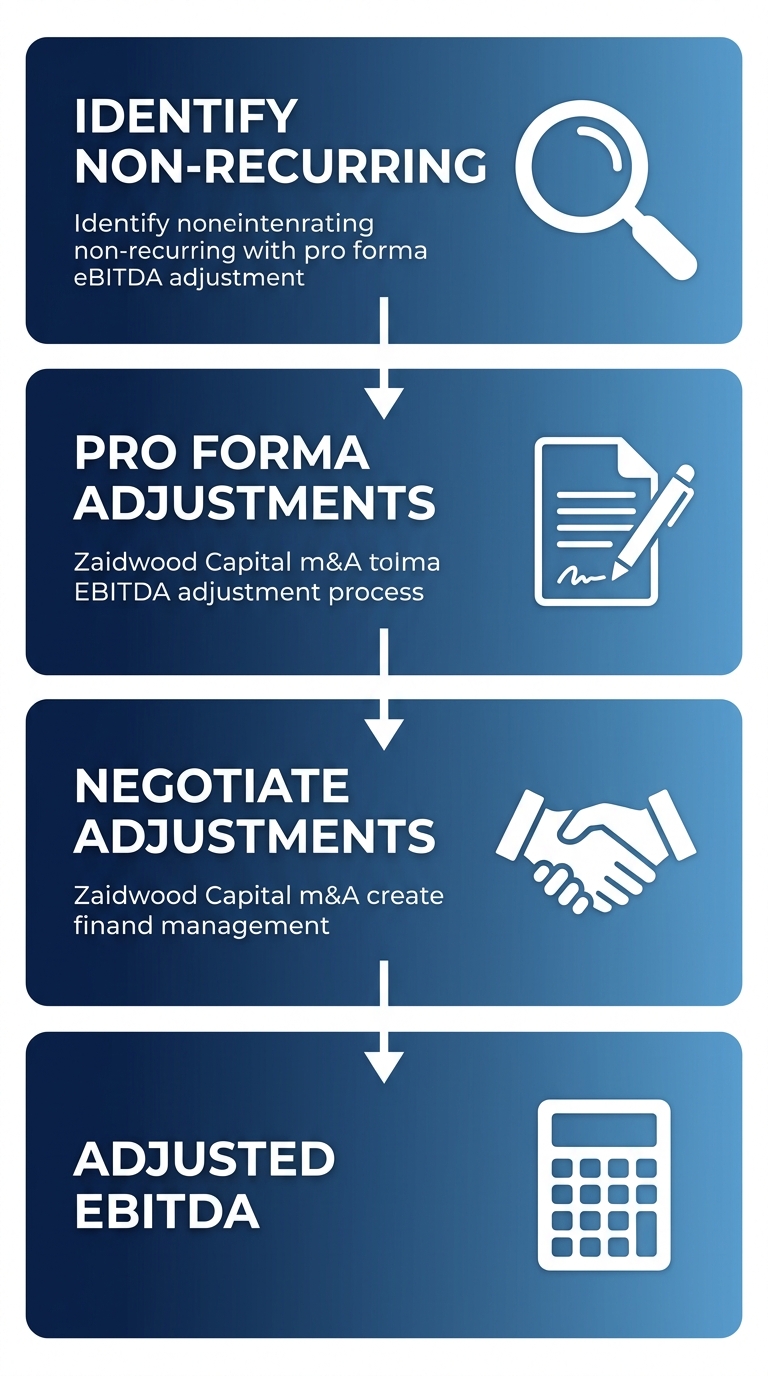
Each change however small has a big impact on the final result. Adjusted EBITDA is multiplied by a market multiple, generally in the range of 6x to 7x, based on deal and industry specific factors. As a result, a small adjustment in EBITDA can result in a big change in purchase price. KPMG gives the example of a $100,000 adjustment to EBITDA. At a multiple of 7, that would result in a change of $700,000 to the final purchase price. That is why both parties on the transaction need to thoroughly support each and every adjustment. In addition, at Zaidwood Capital, we not only identify opportunities to normalize earnings but also stress-test the logic behind each adjustment so the final figure stands up to cross-examination.
Now that we have clarified the financial process, we can move on to review the legal side of the transaction. Understanding the steps behind adjusted EBITDA helps business owners comfortably participate in due diligence, as they know the valuation discussion is not based on arbitrary figures, but on a systematic, supported approach. The process can get somewhat technical, but the goal is to bring the parties involved to an understanding of the value of the business being sold, and close the deal.
Code & Permit Questions
In any M&A transaction, adjusted EBITDA, the sustainable level of profitability a buyer expects–is the primary metric driving the purchase price. Normalizing reported EBITDA for one-time items, including compliance costs, becomes a central negotiation between buyers and sellers.
During a due diligence process, Buyers’ teams usually limit their focus on permitting and code issues to:
- Are all business licenses and operating permits current and in good standing?
- Have there been any recent code violations, citations, or unresolved enforcement actions?
- Is the facility properly zoned for its current use, and does that zoning transfer with the sale?
- Are building permits, occupancy certificates, and renovation approvals complete and documented?
- Are pending inspections or compliance deadlines scheduled that could create near-term costs?
- Can critical permits be transferred to a new owner without re-application or delay?
- Have environmental, health, or safety permits been obtained and renewed as required?
These questions reflect a concern that goes beyond a simple compliance check. The discovery of an expired permit, a pending re-inspection, or a non-conforming zoning status makes the remediation cost a one-time adjustment that must be normalized in the adjusted EBITDA calculation. According to the firm, normalization adjustments lack a universal standard, which makes them a frequent topic of negotiation; each adjustment is then multiplied by the transaction multiple–often in the 6x to 7x range. For example, the normalization of a $100,000 compliance expense from EBITDA would adjust the enterprise value by $600,000 to $700,000. Resolving findings from codes and permits usually determines the overall closing date of the transaction and awareness of the overall schedule is critical.
Timeline Questions
What matters most during EBITDA normalisation is how long it takes. The firm notes that, due to a lack of uniformity, negotiation between the buyer and seller occurs for adjusted EBITDA calculations. Disagreements around EBITDA adjustments are multiplied by the valuation multiple, and the final purchase price can differ by hundreds of thousands of dollars. Minor adjustments become large disparities when compounded by deal value, leading to lengthy negotiations and a protracted process. Because the final price can vary substantially based on minor adjustments, EBITDA normalisation is often the most schedule-sensitive part of an M&A transaction.
Clients often want to know how long EBITDA normalisation takes; we caution there is no standard timeframe because every deal is unique, common causes of delay include disputes over one-time costs, classification of non-operating items and the need to reconcile several years of financial data, and the final adjusted EBITDA figure often becomes the pivotal hurdle to closing. We always advise reserving ample time at the outset for detailed data gathering and for pro forma adjustments negotiations–rushing normalisation can leave value on the table, whereas a methodical yet focused approach helps keep the deal moving, and sellers and buyers who prepare clean historical statements and document potential adjustments typically face fewer last-minute surprises.
While this overview captures the primary timeline influences, we continue to explore other scheduling variables as the discussion progresses.
Still Have Questions?
After reviewing the timeline, you have questions about quality of earnings and EBITDA adjustments. Call 800-962-0418 or email contact@zaidwoodcapital.com. Zaidwood Capital is not a registered broker-dealer; securities are offered through Finalis Securities LLC (Member FINRA/SIPC), unaffiliated with Finalis. This website is informational, not an offer or solicitation. Investments involve risk; you may lose your investment. Conduct due diligence and consult advisors. Past performance does not guarantee future results. Logos do not represent endorsements.