
Table of Contents
Financing an Acquisition with the Right Debt Structure
Financing an acquisition with the right debt structure is about matching acquisition financing with a company’s cash flow stability and growth prospects and integrating the right debt structure with the existing capital structure.
When considering structures, one has to weigh different loans against each other because they impact control and covenant flexibility, as well as the seniority of the lender. Our advice to buyers is to strategically align the capital structure to meet their priorities.
Differences in structures, like those between unitranche and senior debt, have to be taken into account.
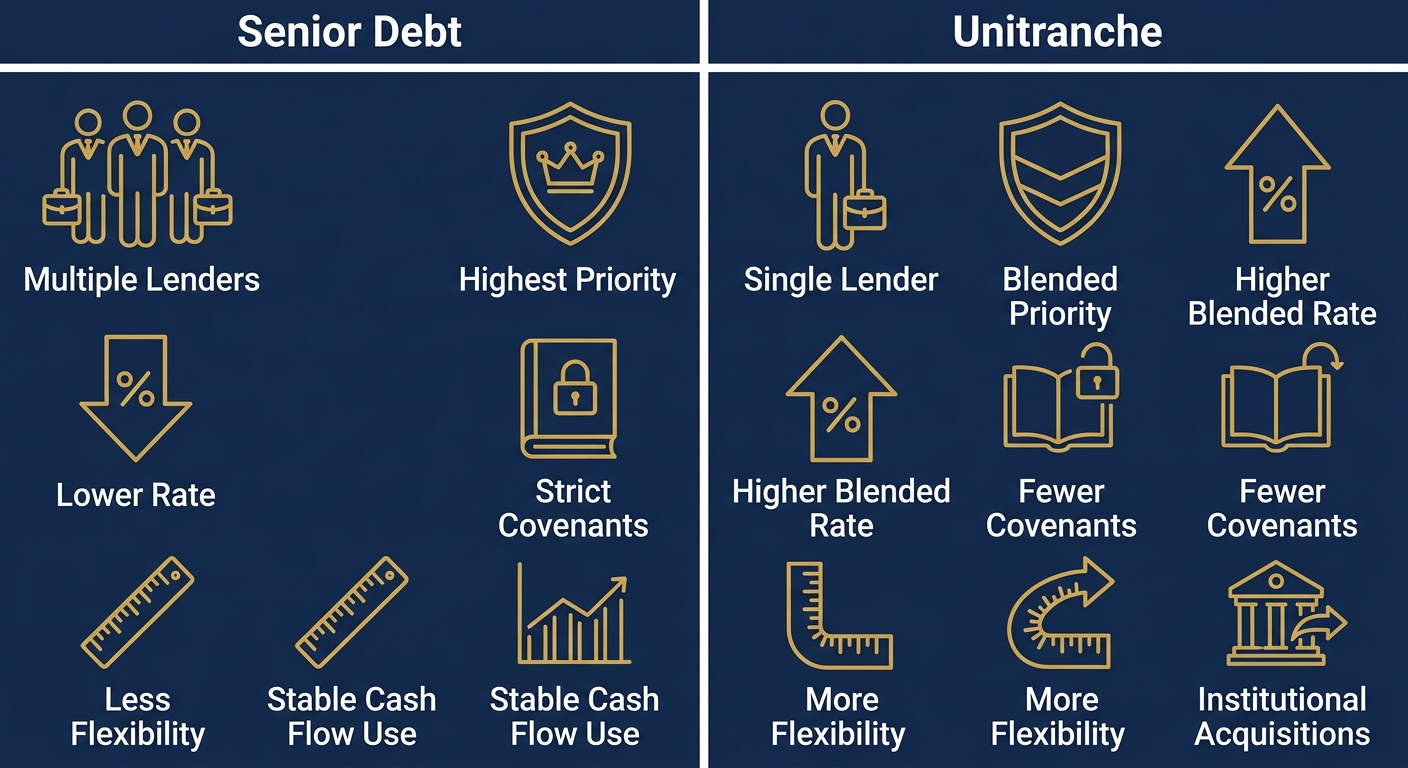
Senior Debt vs Unitranche: Key Structural Differences
The choice between unitranche and senior debt often hinges on borrower needs for speed versus lower cost.
| Dimension | Senior Debt | Unitranche |
|---|---|---|
| Number of Lenders | Bank or syndicate | Single lender |
| Repayment Priority | Highest priority | Senior/junior blend; first-loss |
| Interest Rate Structure | Lower rate | Higher rate (senior + mezzanine) |
| Covenants & Flexibility | Stricter covenants; less flexibility | Fewer covenants; more flexibility |
| Typical Use Case | Stable cash-flow businesses | Rapid closings; complex acquisitions |
Understanding Senior Debt Financing for Acquisitions
Acquisition financing structures typically rely on senior debt because it provides lenders the highest priority claim on a borrower’s assets and cash flows. As a result, it is the most secure debt issued by a borrower and provides the lowest cost of capital.
Senior secured debt often constitutes the main component of traditional acquisition financing, funding the majority of the purchase price. Lenders generally analyze the cash flows of the target, and are willing to lend a multiple of EBITDA. The senior loans typically amortize over a five- to seven-year period. As the debt is at the top of the capital structure, the interest is lower than other subordinated debts or equity. Senior debt also includes financial maintenance covenants that protect lenders. At Zaidwood Capital, we guide clients in structuring senior debt that aligns with acquisition goals while preserving financial flexibility.
From an acquisition financing perspective, senior debt remains the most common foundation for acquisition capital, but blended structures such as unitranche can consolidate multiple layers into one facility, and our advisory process helps business owners evaluate which approach best meets their acquisition objectives.
Unitranche Financing: The Hybrid Debt Structure
A unitranche loan simplifies the borrowing process by combining senior and subordinated debt into a single facility. A unitranche definition describes it as a single, unified agreement that combines the features of a senior loan with the flexibility of subordinated debt, thus serving as a simplified alternative to a financing package.
The interest rate on a unitranche loan is typically calculated as a blended average of the individual rates of senior and subordinated debt. Each tranche within the structure is defined by a unique class designation, seniority level, duration, and interest rate, with underwriters responsible for documenting these specific terms. This customization can include call rights or a mix of fixed and variable interest rates, allowing issuers to tailor the debt to their needs.
When performing advisory work, we have observed that institutional acquisitions rely on unitranche debt to accelerate deal closures and reduce fundraising costs by consolidating capital into a single issuance. Unlike syndicated loans with standardized terms, unitranche arrangements allow for issuer-friendly provisions. Senior debt remains the preferred financing source for many acquisition structures. Understanding how unitranche differs from senior debt helps us determine when each instrument is appropriate.
When Senior Debt is the Right Choice for Your Acquisition
While unitranche structures accommodate transactions, in acquiring-entity financing senior debt is the better fit when a lower cost of capital and more favorable terms are valued. Use of senior debt depends on borrower credit quality, collateral availability, and the need for the lowest cost of capital. In leveraged acquisition financing, senior lenders prioritize stable cash flows and tangible asset coverage, offering a priority lien, a fixed repayment schedule, and maintenance covenants. The debt qualification process examines coverage ratios and asset quality. When a borrower’s credit risk and asset coverage thresholds are determined, senior debt is generally faster and more efficient to secure than a blended unitranche facility. For borrowers that do not meet these stringent criteria, unitranche may remain the accessible path.
When Unitranche Financing Outperforms Senior Debt
While senior debt aligns well with stable, lower-cost situations, unitranche financing becomes the more fitting choice when speed and simplicity drive the acquisition strategy. Among the clearest unitranche advantages in institutional deals is the ability to merge senior and subordinated debt into a single facility, eliminating the need to coordinate multiple lenders. According to Investopedia, the blended interest rate on this hybrid structure typically falls between stand-alone senior and subordinated rates, offering a pragmatic middle ground on cost without layering separate tranches. The resulting speed to close is a decisive factor for large-scale transactions where a streamlined, single-lender process accelerates execution and reduces fundraising friction. When unitranche is not the optimal fit, a more tailored, blended capital structure may offer the flexibility the deal requires.
When a Blended Approach or Alternative Financing Makes Sense
Although unitranche can help lower borrowing costs, there are cases in which neither pure senior nor unitranche debt structures work for the transaction, requiring a blended approach or alternative financing.
Determining whether an equity investment or shareholder loan is made is very important, because reclassifying the debt as equity can increase the weighted average cost of capital. The six factors the IRS looks at to evaluate bona fide debt status are, among others, repayment history and the size of the loan. Debt treatment will be more easily supported if documentation is done properly and interest is charged. Knowing where these alternatives apply allows a potential user to compare them to traditional financing structures based on cost.
The Cost Breakdown: Senior vs Unitranche
According to Investopedia, unitranche interest rates typically reflect a weighted blend of senior and subordinated debt rates, producing a cost of capital that sits between the two. By merging both tiers into a single facility, the structure simplifies debt pricing and avoids the duplication of fees inherent in multiple tranches. For acquirers, this consolidated approach can lower total fundraising costs compared to sourcing separate senior and subordinated loans. We observe that these cost dynamics are a frequent subject of inquiry when structuring acquisition financing, where the blended rate can materially influence the overall capital stack.
Frequently Asked Questions About Acquisition Financing
The cost comparison between senior and unitranche facilities often raises follow-up questions about tailoring a debt structure; below we answer common questions.
How can I minimize risk when structuring acquisition debt?
We prioritize risk minimization by stress-testing cash flows under downside scenarios, building covenant flexibility, modeling covenant cures, and preserving liquidity to support operations during early post-close adjustments.
Who are the typical acquisition financing lenders I should approach?
We target traditional banks, debt funds, private credit managers, and institutional limited partners, ensuring we match capital sources to deal size, collateral profile, sector dynamics, and tenor so timing and covenants align with transaction needs.
How do I structure a management buyout so it closes smoothly?
We achieve management buyout structuring by aligning the sponsor equity, seller notes and third party debt early and creating an investor ready business plan with projections that demonstrate a clear path to sustainable debt service.
What should I expect next after debt structure education?
We translate capital needs into a targeted debt structure and negotiate terms on your behalf; to explore financing your acquisition, contact our team to schedule a consultation.
The FAQs and answers are for informational purposes only and do not constitute a commitment to provide financing. Any securities transactions discussed will be offered through Finalis Securities LLC, Member FINRA/SIPC.
Take the Next Step in Structuring Your Acquisition Debt
Contact us to discuss financing an acquisition with the right debt structure through our M&A advisory and Capital formation; this website is informational only; securities offered through Finalis Securities LLC; Zaidwood Capital is not a registered broker-dealer. Investments involve risk.