
Table of Contents
Partial Liquidity Through a Recapitalization: Key Questions Answered
Partial liquidity through recapitalization allows business owners to convert a portion of their company equity into cash while retaining majority ownership and control. This can be an effective way for owners to protect and grow personal wealth, or bring in a partner without effecting a full exit. As a boutique M&A and capital advisory firm, we provide owners insight on recapitalization, showing them how much liquidity is available, the structures associated with minority recapitalizations, whether a second bite of the apple private equity structure can be employed to preserve upside, and other items. Each recapitalization is unique, and the structures directly impact the control and upside an owner retains. We also help owners think through tax impact, governance and the impact of a partnership, among other things. By understanding the structures available, owners can better understand how the mechanics of a partial liquidity transaction will ultimately turn out.
Understanding the Financial Mechanics of Recapitalization
When a company pursues partial liquidity through a recapitalization, the underlying financial mechanics transform its capital structure in ways that have lasting implications for leverage, risk, and ownership control. At Zaidwood Capital, we help owners navigate these shifts to make informed decisions.
How does a dividend recapitalization work?
In a dividend recapitalization, a company borrows new debt and uses the proceeds to pay a special dividend to its existing shareholders. This allows owners to extract partial liquidity without selling any equity stake. The company’s overall leverage rises, and the interest payments on the new debt may be tax-efficient. Our debt advisory team structures these transactions so new obligations align with cash flow and shareholders receive near-term liquidity.
How does a recapitalization change a company’s debt-to-equity ratio?
A recapitalization directly alters the company’s debt-to-equity ratio by introducing new debt, which reduces equity’s proportional share. Consider a $10 million capital structure that is 60% equity and 40% debt: adding $2 million in new debt shifts the ratio to roughly 50% equity and 50% debt. This higher leverage can constrain financial flexibility and borrowing capacity, but it also concentrates remaining equity for existing holders. Our capital advisors model these scenarios to show owners how the reshaped ratio affects risk and long-term access to capital.
What is the difference between recapitalization and refinancing?
Recapitalization and refinancing serve distinct purposes. A recapitalization reshapes the entire capital stack–altering the mix of debt and equity and potentially bringing in a new equity partner or changing ownership–whereas refinancing simply replaces existing debt with new debt, on better terms, without affecting the equity base. The key differentiator is whether the transaction changes ownership or the equity structure. We at Zaidwood Capital help clients evaluate whether a full capital restructuring or a debt-only refinancing better serves their strategic goals. Understanding these financial shifts lays the groundwork for looking at how a recapitalization is actually executed and what control the owner retains through the process.
The Recapitalization Process and Owner Control
Why would a business owner choose a recapitalization over other financing options?
A business owner may pursue a recapitalization to achieve partial liquidity through a recapitalization, obtaining cash for a portion of their equity while keeping a significant stake. Unlike a company sale, which represents a complete departure, or a traditional bank loan that adds debt but no strategic guidance, a recapitalization combines immediate liquidity with ongoing involvement. We also see owners use a recapitalization to de-risk personal balance sheets by converting paper wealth into cash, preserving the option to participate in future value creation.
Does a recapitalization allow business owners to retain operational control?
In our experience, a minority recapitalization is structured precisely to preserve the founder’s day-to-day control. The negotiating leverage and the specific transaction terms determine board composition, voting rights, and protective provisions. Typically, the owner maintains a majority of board seats, and the new investor receives consent rights only over major decisions–such as selling the company or taking on significant debt–rather than routine operations. These governance mechanisms ensure that the owner continues to drive vision and strategy while benefiting from the investor’s capital and expertise. The safeguards are not automatic; they emerge from careful negotiation, and we guide clients in crafting a balance that protects their operational authority while welcoming a financial partner.
How does a recapitalization differ from a full company sale?
A full company sale, or total exit, means that the owner has sold the entire company equity stake and typically leaves the business. In a recapitalization, the owner sells a partial stake, allowing them to keep a meaningful equity stake and potentially leadership position in the business. As part of a recapitalization, we frequently structure rollover equity, in which the selling owner reinvests a portion of the sale proceeds into the restructured company, to align incentives with the new capital partner. A recapitalization provides the owner the opportunity to continue to grow the business beyond the sale, and the extent of control retained by the owner is determined by the type of recapitalization (i.e. whether it is a minority or majority transaction), a distinction that directly shapes shareholder rights and requires careful planning.
Minority Recapitalization Benefits and Shareholder Rights
A minority recapitalization allows founders to achieve partial liquidity, retain strategic control, and maximize upside potential. According to Financial Advisors for Business Exit, the standard rollover equity in mid-market deals is between 10% and 30%, providing founders with some flexibility. A strategic minority investor allows the founding team to gain expertise and relationships without giving up control of the board.
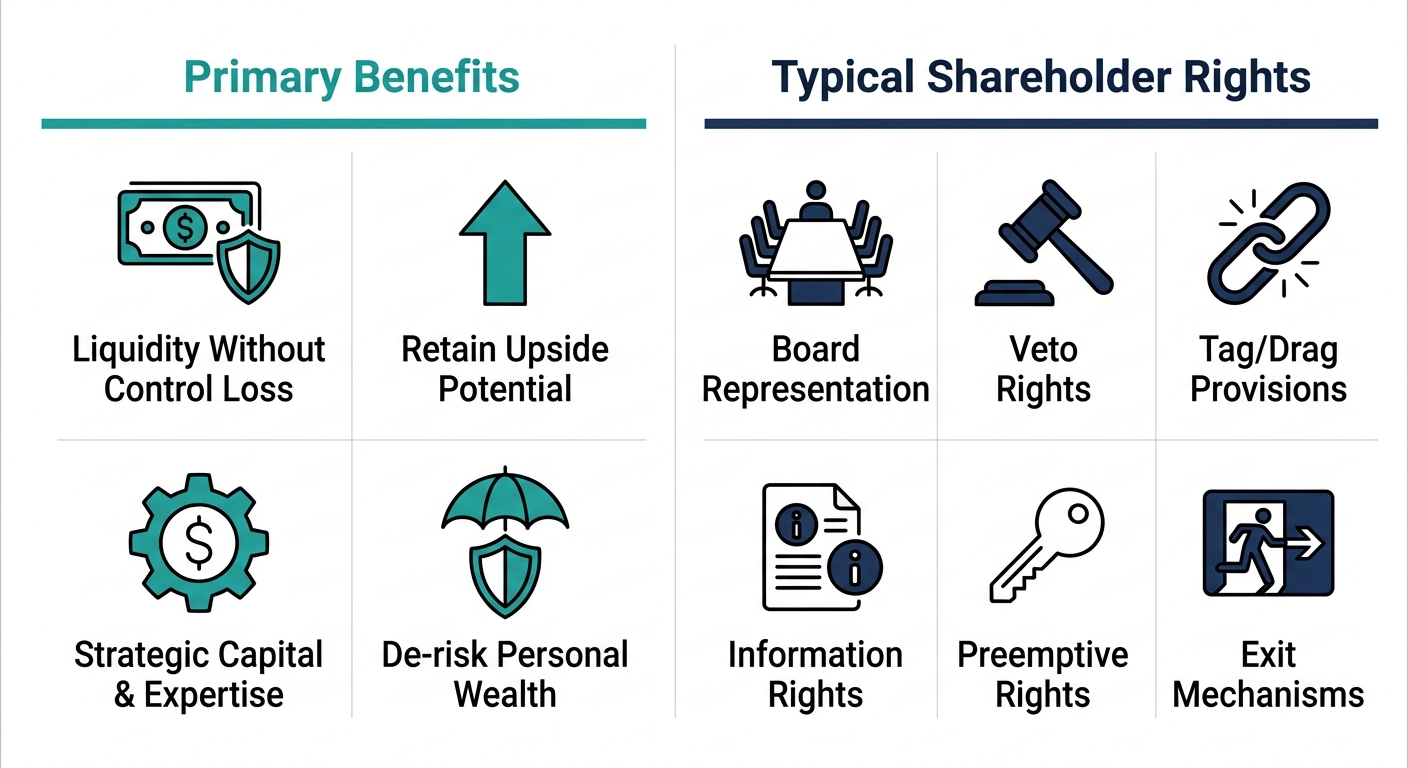
It’s important for founders to understand the types of rights minority shareholders negotiate to align incentives and avoid disputes.
What typical rights do minority shareholders expect in a recapitalization?
From our experience, the types of rights minority shareholders negotiate typically include board representation or an observer seat, the right to veto major decisions, and tag-along provisions that allow them to exit alongside the controlling owner. Drag-along rights ensure minority consent for a majority sale. Information rights, pre-emptive rights, and liquidity-based exit mechanisms are also commonly negotiated. These rights are negotiable and, when carefully structured, align the interests of the founders and investors.
A minority recapitalization transaction executed to balance these rights allows for greater future opportunities to maximize value.
Maximizing Value with the ‘Second Bite’ Strategy
What is the ‘second bite of the apple’ in a private equity transaction?
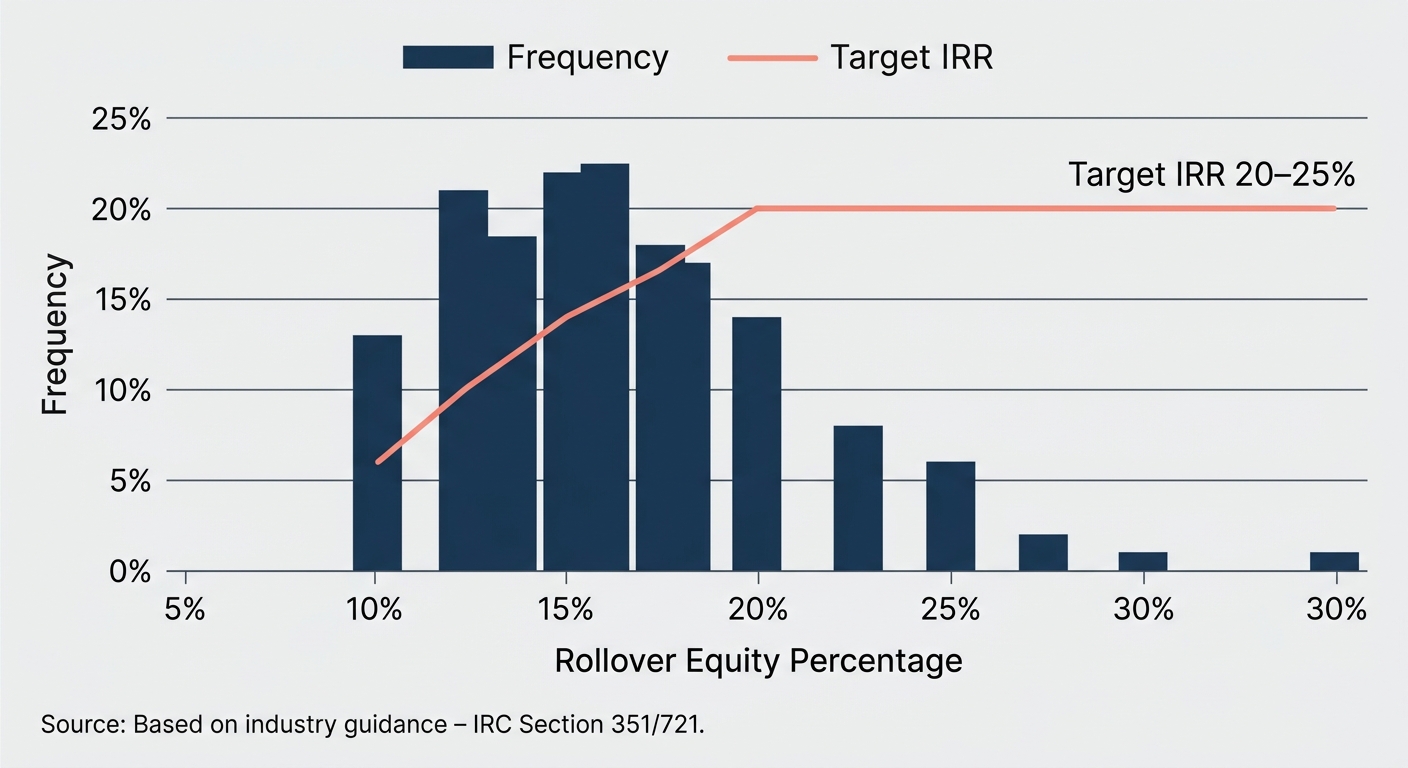
The “second bite of the apple” is the opportunity for founders to generate a second wealth event when equity is sold and appreciated over time. In private equity, this is often referred to as “the second bite of the apple” private equity. In mid-market transactions, sellers typically roll over 10-30% of the total equity. The rolled equity stake is typically structured as a tax-deferred exchange under IRC Section 351, thereby defers the capital gain until the sponsor liquidates its position. Sophisticated sellers often target a 20-25% internal rate of return on their rolled equity.
How can founders maximize the value of their second bite of the apple?
We encourage founders to retain a meaningful portion of 20-30% of the total equity. Governance rights such as board observer seats, tag-along provisions, and protective covenants should be negotiated to safeguard the minority stake. The rollover equity should be structured to qualify for a tax deferral under IRC Section 351 or 721. We encourage founders to take a separate investment approach to the rollover equity.
Transaction Documentation and Risk Considerations
After assessing the viability of a partial liquidity event, the focus then turns to the practicalities of performing the transaction.
What documents do investors typically require for a recapitalization transaction?
- Confidential information memorandum (CIM): provides investors with a comprehensive overview of the business opportunity.
- Quality of Earnings report: verifies the sustainability of historical earnings and identifies non-recurring items that can skew results.
- Legal agreements (purchase, shareholders, subscription): define rights, obligations, and the deal structure.
- Due diligence reports: document legal, financial, and operational risks uncovered during review.
Zaidwood Capital assists in preparing these documents and securely stores them in a virtual data room.
What are the main risks associated with bringing in a minority equity partner?
In a minority recapitalization, the owners may lose some control over the business, e.g., investors may ask for board seats or veto rights. We try to avoid this situation by assessing the track record and cultural fit of the investors.
Conflicts of interest between the majority and minority holders can also arise. The strategic intent of the business should be aligned in the shareholders’ agreement.
Ownership dilution reduces the founder’s stake. Protective provisions and anti-dilution clauses help preserve decision authority.
Negotiating the terms of restraint of trade (non-compete, tag-along, drag-along) covenants may constrain the freedom of the business. Negotiate the covenants to strike the balance.
Having investors with compatible time horizons may reduce the pressure to make short-term decisions.
Knowing the risks and understanding the documents helps business owners make an informed decision to approach professionals for assistance.
Get Expert Guidance on Your Recapitalization Strategy
We structure deals helping owners achieve partial liquidity through a recapitalization, preserving growth, aligning rollover equity, business owners get in touch 800-962-0418 or contact@zaidwoodcapital.com.
This website is informational only and not an offer, solicitation, recommendation, or commitment to buy or sell securities. Securities are offered through Finalis Securities LLC; Zaidwood Capital is not a registered broker-dealer and is unaffiliated with Finalis. Investments involve risk; investors may lose all or part of their investment. Past performance is not indicative of future results.