
Table of Contents
Key Questions About Selling and Valuing SaaS and IT Services Companies
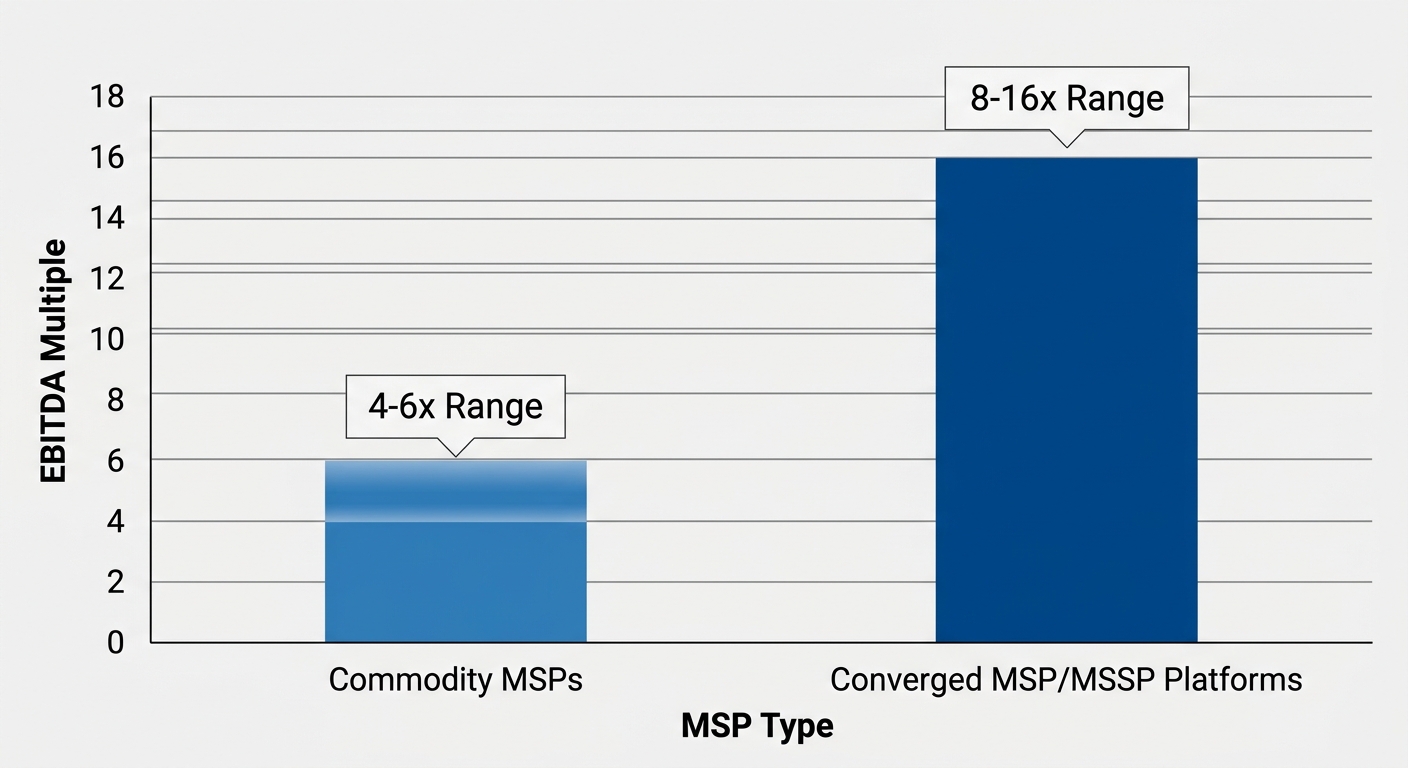
Selling and valuing SaaS and IT services companies reveals a market where a business’s worth hinges on recurring revenue quality, cybersecurity posture, and customer concentration. According to Guicarlos, commodity MSPs typically trade at 4-6x EBITDA, while converged MSP/MSSP platforms command 8-16x, and we counsel our clients to allow a 12-18 month cleanup period before approaching the market.
SaaS valuation multiples prompt the question “What multiple can my SaaS company command?” Similarly, understanding how to sell a SaaS company involves asking whether recurring revenue exceeds 70% of income and whether cybersecurity maturity elevates the business into a premium tier.
For IT services businesses, MSP valuation multiples and how to sell an IT services business center on questions like “How does customer concentration affect my sale price?” and “When should I begin preparation?” With these key valuation factors in mind, owners then face the practical cost and valuation questions that shape a successful transaction.
Cost and Valuation Questions for SaaS and IT Services Sales
A technology company’s valuation depends as much on operational factors as on headline revenue or earnings.
What Drives SaaS Valuation Multiples in the Current Market?
SaaS companies are typically valued on a multiple of annual recurring revenue (ARR). Two factors–growth rate and net revenue retention–push that multiple higher. A business growing ARR above 30% with net retention over 100% will command a premium, while decelerating growth and elevated churn compress the multiple. Private company multiples generally sit a few turns below those of public peers due to liquidity and risk. We caution against relying on any single multiple figure; market benchmarks shift.
How Are MSP Valuations Determined and What Commands a Premium?
MSP valuations are primarily expressed as a multiple of adjusted EBITDA. According to GuiCarlos’s 2026 guide, commodity MSPs trade at 4-6x adjusted EBITDA, while converged MSP/MSSP platforms command 8-16x. Recurring revenue quality is paramount–businesses where subscriptions and managed services exceed 70% of revenue earn higher multiples. Buyers also assess operational margins, client diversification, and cybersecurity capabilities, all of which widen the valuation gap. In our Full-Cycle M&A advisory work, we help owners strengthen these metrics to maximize buyer interest. The chart below illustrates the split.
Even with similar EBITDA, structural risks can cause offers to diverge sharply.
Why Can Two Identical-Revenue Companies Receive Different Valuation Offers?
Even when revenue or EBITDA looks identical, other structural factors create wide valuation gaps. Client concentration is the most significant: Market guidance notes that when the top three customers account for more than 25% of revenue, buyers apply a 10-30% discount. The durability of recurring contracts, the recent growth trajectory, and the overall M&A market climate also influence the price. A diversified, subscription-heavy business with accelerating growth will nearly always command a premium over a project-dependent firm with a narrow customer base.
How Much Should a SaaS Company Spend on Marketing? The 3-3-2-2-2 Rule Explained
A commonly cited framework for SaaS marketing spend is the 3-3-2-2-2 rule. It prescribes spending 3% of revenue for established startups and growth-stage companies, then 2% each for the scale, mature, and decline phases. The rule offers a rough budgeting guide, not a rigid benchmark; actual spend should adjust for competitive intensity, customer acquisition costs, and profitability targets. We encourage owners to model different scenarios and ground their budgets in unit economics rather than follow any single formula absolutely.
With these valuation drivers clarified, owners can prioritize the operational improvements that make their companies more attractive when the time to sell arrives.
Steps to Prepare Your SaaS or IT Business for Sale
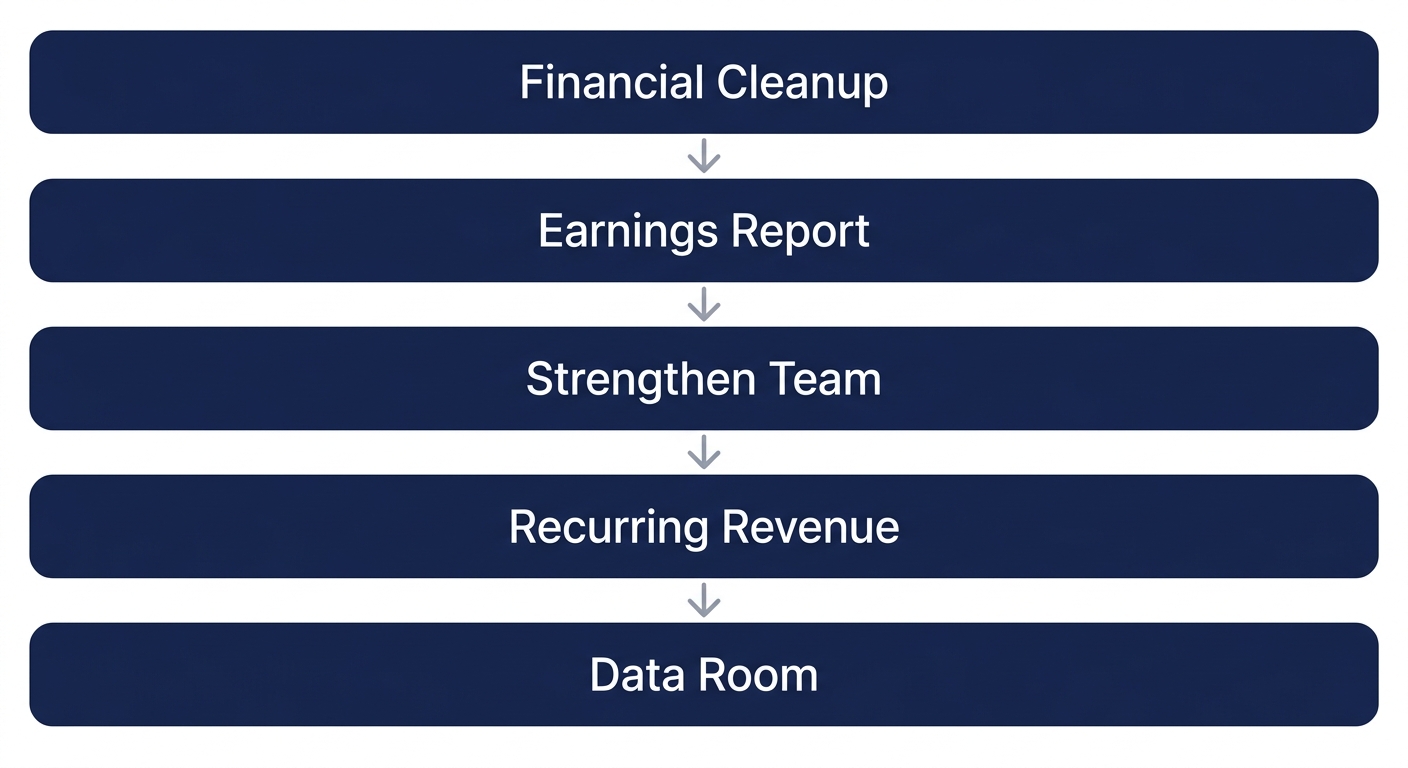
Preparing a SaaS or IT services company for a successful sale demands early financial optimization, ideally starting 12-18 months before the intended exit.
What Are the Essential Steps to Prepare a SaaS Company for an M&A Exit?
Begin with financial cleanup and commission a sell-side Quality of Earnings (QoE) report to demonstrate recurring revenue predictability. Strengthen the management team so operations do not depend on one person. Optimize recurring revenue, targeting over 70% from subscription sources. Reduce customer concentration to below 25% of total revenue;excessive reliance on a few clients can trigger 10-30% valuation discounts. Assemble a data room with audited financials, customer contracts, and IP records. Starting 12-18 months ahead provides the runway to fix gaps and present a polished asset to buyers.
Do I Need an M&A Advisor to Sell My SaaS Company?
Our firm provides full-cycle support–from valuation and positioning through buyer outreach, due diligence, and closing. Access to a network of 4,000+ institutional investors, including private equity, venture capital, and family offices. A boutique advisor ensures discreet marketing and a structured process, letting you focus on operations while we create competitive tension and negotiate optimal terms.
What Common Due Diligence Gaps Kill SaaS Deals and How to Avoid Them
Common deal-killers include inconsistent financials, missing customer contracts, weak IP documentation, and excessive customer concentration.when the top three clients exceed 25% of revenue, acquirers typically apply a 10-30% valuation haircut. An absent Quality of Earnings report can trigger post-diligence re-trading or termination. We advise owners to preempt these gaps: validate financials with an audit firm, organize all client agreements with clear service-level and auto-renewal terms, and document IP ownership thoroughly. Commission a sell-side QoE provider 12-18 months before going to market to create a defensible financial picture.
How Should I Prepare IT Services Business Financials and What Documents Go in a Data Room?
We recommend assembling audited financials for three years plus interim periods, customer contracts with SLAs and renewal terms, an IP portfolio with proprietary code documentation, compliance certifications (SOC 2 or ISO 27001), and organizational charts reflecting management depth. Include a sell-side Quality of Earnings report and key metrics (MRR, churn, LTV). With these materials ready, leadership can confidently address the legal and regulatory considerations that accompany any tech M&A transaction.
After completing these preparation steps, you will be ready to address the legal and regulatory requirements that accompany a tech M&A transaction.
Legal and Regulatory Considerations for Tech M&A
Regulatory and deal-structuring considerations shape every sale of an IT services business.
What Regulatory and Code Compliance Factors Impact the Sale of an IT Services Business?
Buyers closely examine data privacy practices under the CCPA and GDPR. We advise sellers to complete a pre-sale audit of data inventories, consent records, and third-party data-processor contracts. Software licensing compliance is equally critical; undocumented open-source obligations or non-transferable enterprise license terms can derail a deal. It is also essential to clarify that any securities transactions offered in connection with the deal are placed through Finalis Securities LLC (Member FINRA/SIPC). Zaidwood Capital is not a broker-dealer.
How Do I Structure Earnouts and Management Retention in a Deal?
An earnout is a contingent payment tied to post-close performance targets such as revenue, EBITDA, or user growth. Common structures include single-tranche payouts after a performance period, multi-tranche milestones, and hybrid models combining time- and metric-based thresholds. Negotiation friction points often center around the measurement period length, the accounting methodology for calculating targets, and dispute resolution mechanisms. To retain key management, we see stay bonuses, equity rollovers, and employment agreements with acceleration clauses. These tools must comply with tax and securities laws, especially when equity is involved. We recommend that any earnout or retention plan be reviewed by counsel for tax and securities compliance.
Timeline and Strategic Considerations When Selling Your Business
How Long Does a Typical SaaS Sale Take and What Are Key Milestones?
A SaaS sale begins with thorough preparation: compiling audited financials, key metrics, and a growth narrative into a confidential memorandum. A targeted marketing phase then presents the opportunity to a select group of qualified strategic and financial buyers under nondisclosure. Diligence verifies financials, technology, customer contracts, and legal posture–its duration increases with deal complexity and response time. Negotiation of definitive agreements and final terms runs parallel, culminating in a closing that transfers ownership.
How Does Buyer Type (Strategic vs Private Equity) Impact the Sale Process?
Strategic acquirers, such as larger SaaS companies, buy to capture synergies–integrating technology, talent, or market share. Their deal process can close faster once the strategic fit is validated, but integration complexities often require detailed negotiation on employment, IP, and customer transition terms. Private equity firms focus on financial returns, targeting recurring revenue stability and growth to support a leveraged recapitalization. Their diligence is typically more intensive, scrutinizing historical cash flows, customer concentration, and management depth, which can extend timelines. In our work, we see that strategic valuations may include a synergy premium, while private equity brings structured offers with seller rollover equity, earnouts, or management incentives.
How to Reduce Energy Costs as a Homeowner
- Increase home insulation.
- Use energy-efficient lighting and appliances.
While your primary focus may be on selling and valuing SaaS and IT services companies, reducing personal energy costs can also support your financial well-being.
This website is for informational purposes only and is not an offer, solicitation, recommendation, or commitment to buy or sell any security. Securities are offered through Finalis Securities LLC, member FINRA/SIPC; Zaidwood Capital is not a registered broker-dealer. Investments involve risk and are not guaranteed to appreciate; investors may lose all or part of their investment. Prospective investors should conduct their own due diligence and consult legal, tax, and financial advisors.