
Table of Contents
Investment Banking Options for Smaller Companies: Finding the Right Advisory Partner
When evaluating investment banking options for smaller companies, the most practical path is to work with a boutique advisory firm, because bulge-bracket banks typically prioritize transactions above $100 million and leave mid-market enterprises underserved. Smaller companies struggle to get attention from these institutions, which require deal sizes that growth-stage businesses cannot meet.
Many founders ask, do investment banks work with small companies? The answer is yes. But the type of firm matters. For a boutique firm vs. bulge bracket bank comparison, large banks provide a global resource model, but impose strict thresholds and inflexibility with respect to deal size. Boutique firms provide a more flexible advisory and engagement model. When considering a partner investment bank for small business, it is important that the partner firm has industry expertise and a transaction history that align with the business’s scale.
Identifying the right partner is only one piece of the puzzle. Understanding how advisory fees are charged is equally important when considering a partner firm. Fee models vary widely, and knowing what to expect helps you budget effectively and align incentives.
Understanding Investment Banking Costs for Small Business Transactions
Selecting the right advisory partner for a business sale or capital raise naturally raises questions about how the partnership is structured financially. Boutique investment banks typically use a hybrid model with a retainer and a success fee that balances commitment and outcome alignment. The retainer is an engagement fee that covers preparatory work including valuation, due diligence readiness, marketing materials, and strategic positioning. It allows the advisory team to begin work immediately and provides the working capital to launch a professional marketing effort.
In parallel, the success fee is the contingent portion of the advisor’s compensation, payable only upon a successful closing. This structure tightly aligns the advisor’s interests with the client’s ultimate objective–achieving the best possible outcome. Because the fee is earned through a completed transaction, our team is incentivized to execute with precision, negotiate rigorously, and maximize value rather than simply moving a deal forward. For small business owners who have poured years into building their company, this incentive alignment is critical because the transaction often represents the capstone of their work. The success fee transforms the relationship into a true partnership where both sides win together.
The amount and form of the hybrid fee package depend on the engagement. Some key factors include the deal complexity, the anticipated size of the deal, the range of advisory services needed and the time frame for providing such services. A seller M&A mandate with extensive buyer coverage and negotiation with multiple parties will differ from a targeted equity raise or a recapitalization. We calibrate fees to the engagement’s demands so that the retainer and success components accurately reflect the effort and risk involved. Every engagement is designed so that the fee structure matches the level of service required, from initial valuation through closing.
For business owners interested in understanding more on how this structure applies to them, we invite you to contact Zaidwood Capital for an initial consultation. There you will learn more about the components of a full cycle M&A transaction and how each fee component aligns to the work to be performed in that phase.
Navigating the M&A and Capital Raising Process
The financial aspects of the M&A and capital raising processes are only one part of the equation. The structure of the process is equally as important and can have a significant impact on the outcome. Smaller companies benefit from our advisory-led approach as it provides them with focused execution and access to our extensive institutional network. The M&A and capital raising process is broken down into four key phases as illustrated below.
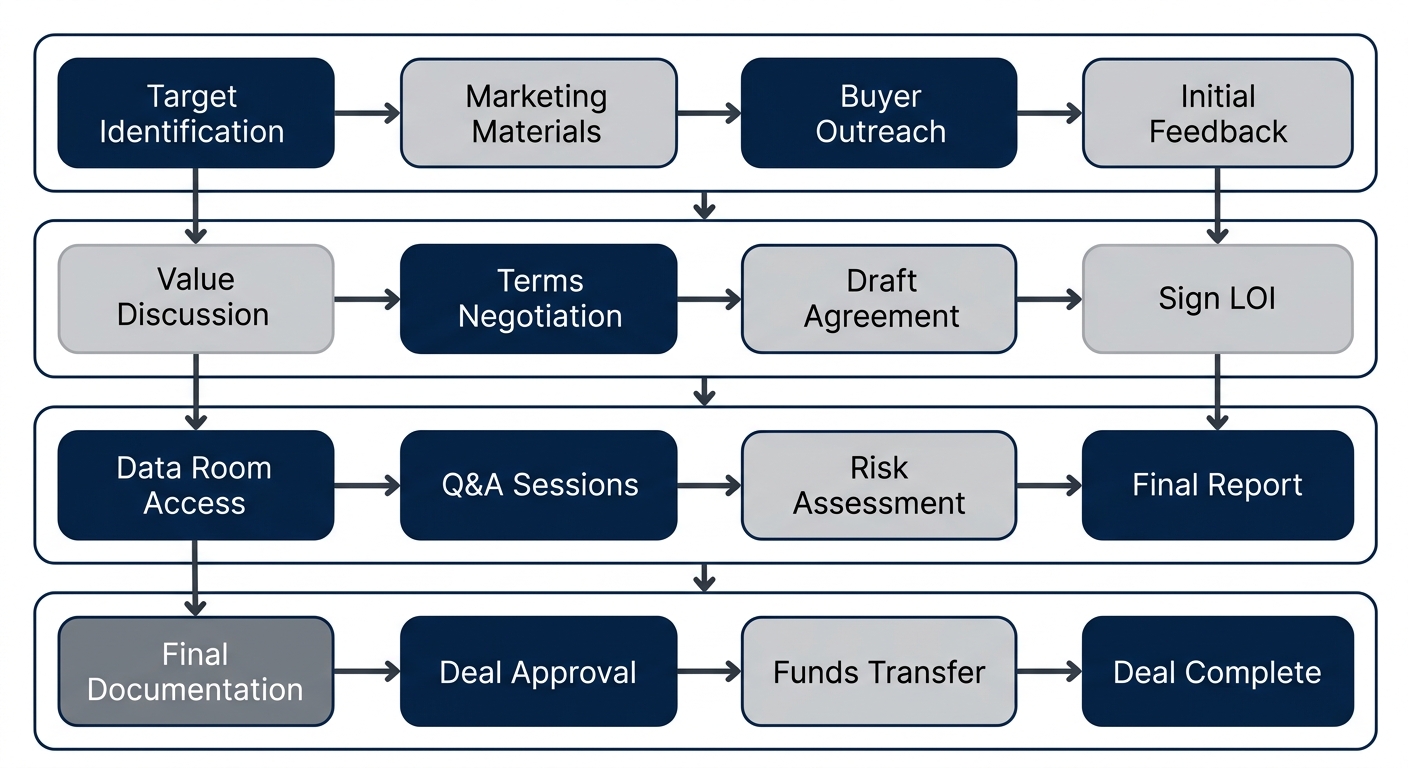
Each of these phases requires specialized expertise and coordinated execution, which our boutique team delivers through proprietary systems and a worldwide network of relationships.
We start by preparing a confidential information memorandum (CIM) and pitch deck. Using our Precision Catalyst platform and Velocity Matrix framework, we target strategic buyers, private equity, venture capital, and family offices from a network of over 4,000 investors, sparking competitive interest while protecting confidentiality.
As offers materialize, we evaluate each against our client’s strategic and financial objectives. We lead the negotiation of term sheets and letters of intent, addressing valuation, deal structure, earnout provisions, and exclusivity, all while preserving competitive tension to secure the most favorable terms.
After the letter of intent (LOI) is signed, we manage the due diligence process. That includes opening a secure data room to manage and respond to document requests and field third-party requests. Throughout, we represent the client’s interests, allowing the client to focus on managing the business while we address and resolve due diligence-related issues promptly and ensure accuracy.
Negotiating definitive purchase or investment agreements, satisfying any regulatory filings, and orchestrating the funds transfer complete this process. We organize and manage the logistics of last-minute legal and financial closing activities. We work closely with legal and financial services advisors to remove last-minute obstacles and facilitate the closing.
Throughout every stage of this process, we embed rigorous adherence to applicable securities regulations, ensuring each outreach, negotiation, and disclosure is conducted in full compliance. This discipline lays the groundwork for the legal and regulatory considerations that safeguard the entire transaction.
Compliance and Regulatory Considerations in Investment Banking
Smaller companies executing a capital raise or M&A transaction in the United States face a compliance framework that extends well beyond the business deal itself. For instance, the U.S. securities laws require the registration of virtually every offer and sale of securities. If a valid exemption applies, using that exemption properly triggers parallel requirements under state blue-sky rules and FINRA oversight.
Most private placements rely on Regulation D, which permits sales to accredited investors under Rule 506(b) or 506(c) with a Form D filing. Even with a federal exemption, issuers must meet blue-sky notice filings and fees in each state and satisfy FINRA document review requirements. The JOBS Act further expanded options through Regulation A+ (streamlined mini-IPO up to $75 million) and crowdfunding under Regulation CF, though both demand rigorous compliance.
We at Zaidwood Capital guide company owners through these regulatory requirements so they can remain focused on their business. Our firm is not a registered broker-dealer; all securities transactions are conducted exclusively through Finalis Securities LLC, a registered broker-dealer and member of FINRA and SIPC. This structure ensures that every offering meets all applicable rules, and our advisory team handles disclosure preparation, filing coordination, and state-level compliance. With a solid compliance foundation, owners can then concentrate on timeline management and operational readiness for a successful close.
Timeline and Readiness Factors for Small Business Deals
A small business M&A transaction typically follows a multi-step timeline that can extend from several months to over a year, depending on the company’s preparedness and external conditions. Focusing on readiness for smaller deals early in the process helps owners avoid delays and maximize value.
The standard phases include:
- Preparation: Gathering and organizing financial statements, legal documents, and operational data, and developing a clear valuation story.
- Marketing: Identifying qualified buyers and approaching them discreetly while preserving confidentiality.
- Negotiation: Drafting and finalizing a letter of intent, including price, structure, and key conditions.
- Due Diligence: Allowing the buyer to verify financials, contracts, customer relationships, and compliance.
- Closing: Completing the legal transfer, signing final documents, and funding the transaction.
Preparedness for an M&A transaction by a seller tends to secure higher valuations and smoother due diligence. External factors like market conditions, industry cycles, and regulatory approvals can introduce delays.
We evaluate a company’s readiness for smaller deals and identify gaps before marketing begins. This preparation helps compress the timeline and strengthens negotiating positions.
After developing a clear picture of timeline expectations and the importance of readiness, we believe that choosing an investment banking partner that aligns with your goals is the next logical step for a company.
Boutique vs. Bulge Bracket: Choosing the Right Investment Banking Partner
A boutique investment bank focuses on mid-market and smaller companies and provides a more personalized advisory service with direct access to their senior partners. Bulge bracket banks are large, global banks that work with multi-national corporations to execute billions of dollars worth of deals. Here, junior bankers do most of the work in executing a deal.
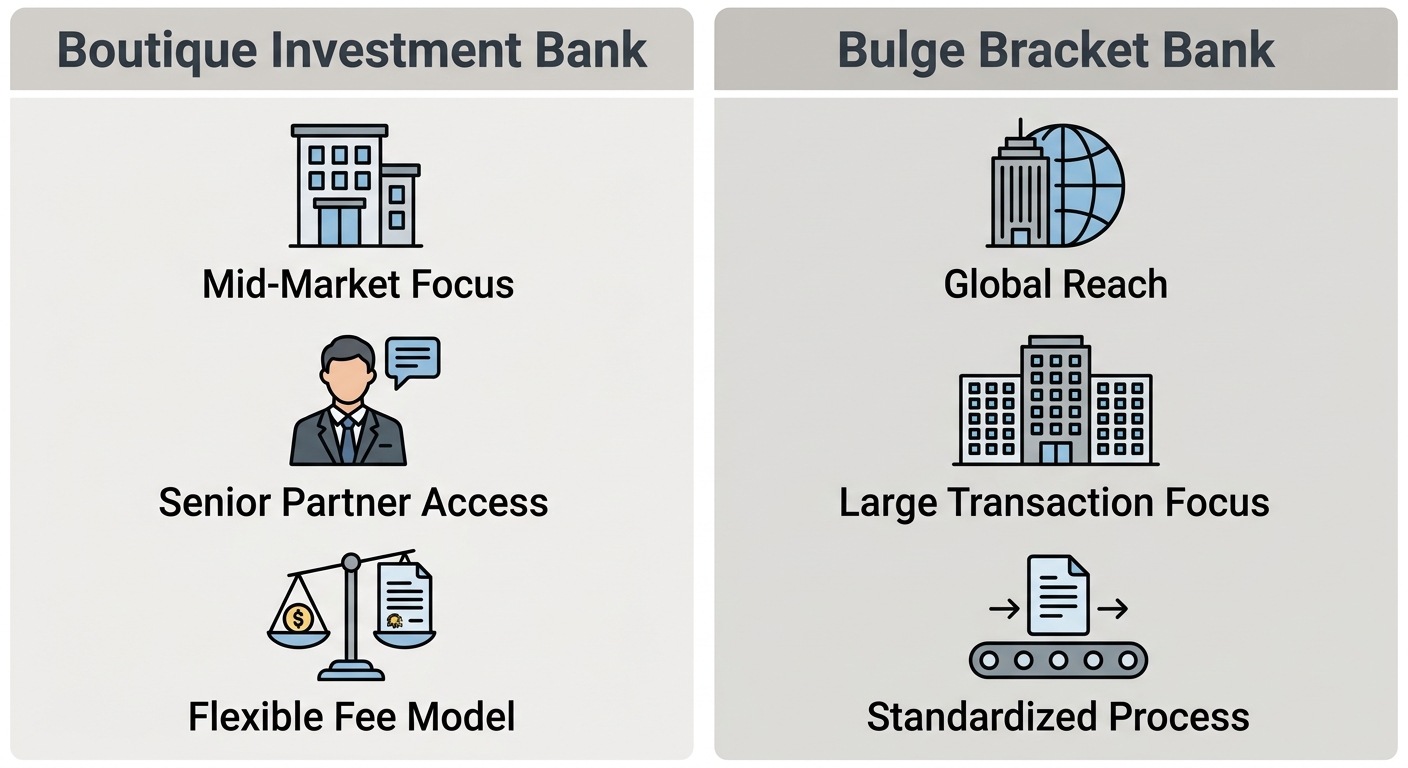
Boutique banks work with business owners seeking hands-on guidance throughout the M&A process, while bulge bracket firms prioritize top-tier corporate clients. Similarly, boutique firms are more accustomed to smaller transactions and offer fee structures that can accommodate those deal sizes, whereas bulge bracket banks often require minimum deal thresholds that exclude small companies. Choosing a boutique partner typically means faster decision-making, greater flexibility in fee arrangements, and a team dedicated to your specific transaction size.
From our perspective, mid-market business owners benefit from the boutique approach, which provides the attention and agility essential for successful outcomes. When mid-market businesses look at alternatives to Houlihan Lokey, they often find that boutique firms are more aligned with their deal size and need for senior-level involvement. With this information, you can be more comfortable with the advisory firm that is aligned to your deal size and goals.
Start Your Advisory Journey with Zaidwood Capital
For those evaluating investment banking options for smaller companies, Our firm provides full-cycle advisory, from strategic positioning to investor outreach and closing. Headquartered in West Palm Beach, Florida, we work with founders, CEOs nationwide and internationally, with M&A and capital markets expertise, a network of 4,000+ investors and $15B+ committed capital; securities via Finalis (not a registered broker-dealer); investments carry risk; performance not guaranteed; consult legal, tax, financial advisors. Call 800-962-0418 or email contact@ourfirm.com to start a conversation.