
Table of Contents
Find Out What Your Business Is Really Worth
Finding out what your business is really worth is the critical first step for any owner considering a sale, capital raise, or strategic exit. Business valuation is not a single number but a multi-method process that answers the question every founder asks: what is my business worth?
Investopedia, a comprehensive financial education resource, outlines methods ranging from market capitalization to discounted cash flow, while Anders CPA emphasizes that credible valuations go beyond superficial rules of thumb, incorporating income, market, and asset-based approaches. as a Boutique M&A and Capital Advisory Firm, we help founders peel back these layers to understand how to value a business and to explain how debt affects business valuation. And for most businesses, revenue is the first metric buyers scrutinize when estimating worth.
How Much Is My Business Worth Based on Annual Sales?
Annual sales provide a concrete starting point for valuation, but the result is only an approximation. A revenue multiple–a common business valuation method–multiplies gross revenue by an industry factor to yield an indicative value. Alternatively, an EBITDA multiple applies a factor to earnings before interest, taxes, depreciation, and amortization, shifting focus to profitability. Both shortcuts skip the normalization of financial statements for discretionary expenses and one-time items–a step professional valuations incorporate, as Anders CPA notes. We recommend engaging a qualified advisor to build a defensible valuation that accounts for factors beyond simple sales multiples. From growth trajectory to customer concentration, qualitative and quantitative elements shape true market value.
What Factors Beyond Profit Influence My Business’s Worth?
Annual revenue and profit figures provide a partial picture of a business’s worth. To find true value, EBITDA normalization is used to account for discretionary expenses (owner perks, for example) to identify consistent earnings. For a dependable valuation, three or more years of financial records are necessary, according to the U.S. Chamber of Commerce. We compare an asset-based approach (net assets minus liabilities) with the market approach (sales of comparable firms), as noted by that source. Revenue stability, margin profile and the growth trajectory of the business help shape the final valuation. From a buyer’s valuation perspective, risk and scalability determine the premium paid. Conversely, the potential for a business to grow and be financially scalable influences the valuation. A firm’s value exceeds its tangible assets alone, prompting a more comprehensive assessment.
Can My Business Be Worth More Than the Sum of Its Assets?
Yes, we believe that companies can be worth more than their physical assets when valued through the income or market approaches.
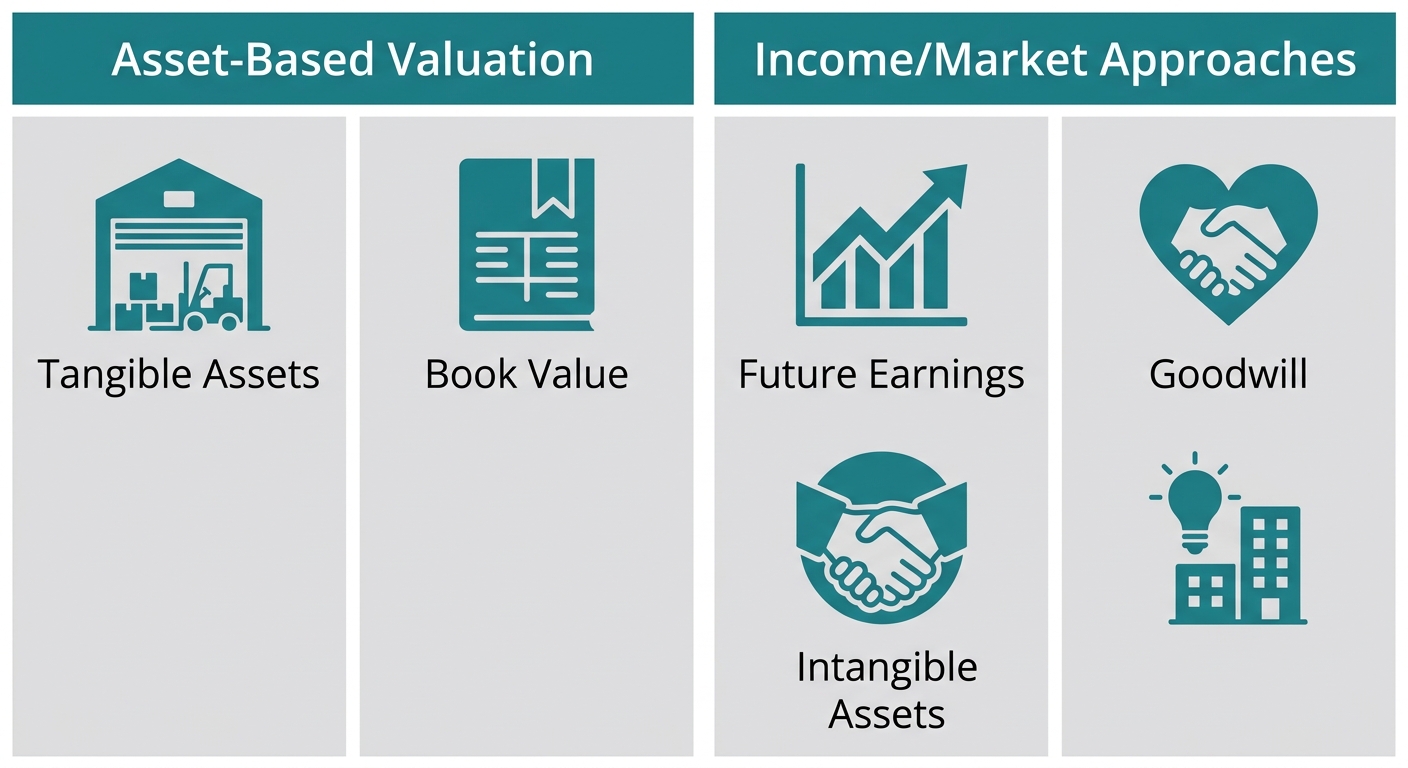
Tangible net assets are what is counted in asset-based valuation; intangible assets like brand and proprietary technology are often disregarded.
Future earnings are captured in income approaches and market comparables, and the premium over net tangible assets is goodwill.
What Is the Difference Between a Business Valuation and a Business Appraisal?
A professional business valuation rigorously employs multiple methodologies to support their conclusions. Each of these methodologies can be defined as an approach: income approach, market approach, or asset approach. A business appraisal tends to rely on rules-of-thumb or revenue multiples to derive a conclusion. Such appraisals ignore a company’s unique characteristics. This valuation vs appraisal distinction underpins every high-stakes M&A and capital transaction, where only a comprehensive valuation provides the accuracy required.
Both the U.S. Chamber of Commerce and Anders CPAs report that professional valuations normalize financials and are performed by credentialed experts such as a Certified Valuation Analyst (CVA) or a member of the ABV division. The outcome is a formal valuation report that withstands scrutiny from buyers, lenders, and tax authorities.
What Are the Most Common Standards of Value Used in M&A Transactions?
We can define the specific standard of value for M&A transactions once we distinguish appraisals from valuations, and that standard dictates the methodology. In M&A, the two most prevalent standards are fair market value and investment value. Fair market value is the price a willing buyer and seller would agree upon. Investment value reflects the worth of the business to the specific potential buyer. One firm groups defensible valuation approaches into three categories: income, market, and asset-based, while warning that rules of thumb are not dependable. We, at Zaidwood Capital, determine the most defensible approach based on the standard of value and deliver a valuation based on that approach. The focus then shifts to choosing the most suitable valuation methodology for high-growth companies.
What Is the Most Accurate Method to Value a High-Growth Company?
DCF valuation is the most accurate method for high-growth company valuation because it projects future cash flows and accounts for the time value of money.
The correct application of this method relies on the professional normalization of financial statements to eliminate discretionary and non-recurring items.
Valuation rules of thumb based on revenue or EBITDA multiples frequently ignore margin profile and other unique factors of high-growth businesses and hence, are less reliable. However, for very early-stage companies, a tailored variation of venture capital method can be applied to estimate terminal value based on the expected company exit. Knowing the right methodology aids a business owner to make an informed decision on when to commission a formal valuation.
When Should a Business Owner Undergo a Formal Business Valuation?
Major ownership changes, or valuation triggers, prompt our team to advise that a formal business valuation is essential. As that source highlights, unlike informal rules of thumb, a professional appraisal yields objective, defensible numbers for high-stakes decisions. As that source notes, informal rules of thumb lack objectivity and may offer little to no defense for high-stakes decisions.
A formal valuation prior to a liquidity event provides a basis for negotiations, along with investor confidence. For a partnership buyout, it ensures fair terms for exiting partners. As noted by the U.S. Chamber of Commerce, valuations help define tax and estate planning.
Awareness of valuation triggers illuminates the importance of a formal valuation beyond the confines of a one-time transaction.
Why Is Business Valuation Important for Long-Term Strategic Planning?
The analysis of business valuation uses financial information to build a defensible baseline for growth, exit and capital decisions.
The U.S. Chamber of Commerce states that preparation for an official valuation requires a minimum of three years of financial records. This drive for disciplined long-term financial planning helps to uncover value gaps.
The defensible number provided by our valuation professionals is grounded in the ABV credential recognized by the U.S. Chamber of Commerce as the industry standard. This number serves as a basis for strategic exit planning.
In addition, a defensible valuation serves the entrepreneur in anchoring their wealth management strategies to the value of their business.
How Do Market Conditions Impact What My Business Is Worth Today?
Numerous factors beyond a business’s fundamental worth contribute to valuation. Multiples are a function of market appetite and the cost of capital and are therefore fluid. In an active M&A environment, and as long as deal multiples rise, valuations increase. The reverse is true in a declining M&A environment. There are additional, longer-term trending market factors that shift valuation multiples and the overall attractiveness of an industry. Macroeconomic factors in valuation, including interest rates, inflation, and GDP growth, influence the discount rates and earnings projections that underpin every appraisal. Beyond these broad signals, shifting industry trends can alter a sector’s attractiveness and the premium buyers assign to it. At Zaidwood Capital, we help business owners interpret these dynamics so they approach a transaction with a current, defensible understanding of their company’s worth.
Should I Get a Professional Valuation Before Receiving an Unsolicited Offer?
A professional valuation is critical when an unsolicited offer arrives. That source warns that rules-of-thumb or EBITDA multiples ignore key business drivers. A proper unsolicited offer evaluation combines income, market, and asset-based methods to provide a defensible price anchor and negotiation leverage.
The U.S. Chamber of Commerce emphasizes that proper seller due diligence should involve a certified valuator, such as one with the Accredited in Business Valuation (ABV) credential, and at least three years of financial records. This protects against undervaluing your business. A comprehensive valuation also accounts for debt and capital structure, which we’ll address when discussing how leverage impacts deal terms.
How Does Having Significant Debt Affect My Business Valuation in an M&A Deal?
We at Zaidwood Capital consider capital structure to be a key determinant of risk. Debt and equity jointly affect the weighted average cost of capital, which is used as the discount rate in a cash flow analysis. Moderate debt can increase equity return potential because interest is deemed a business expense and is therefore tax-deductible. Evaluating the effect of debt on valuation, we are looking at the debt-to-equity ratio.
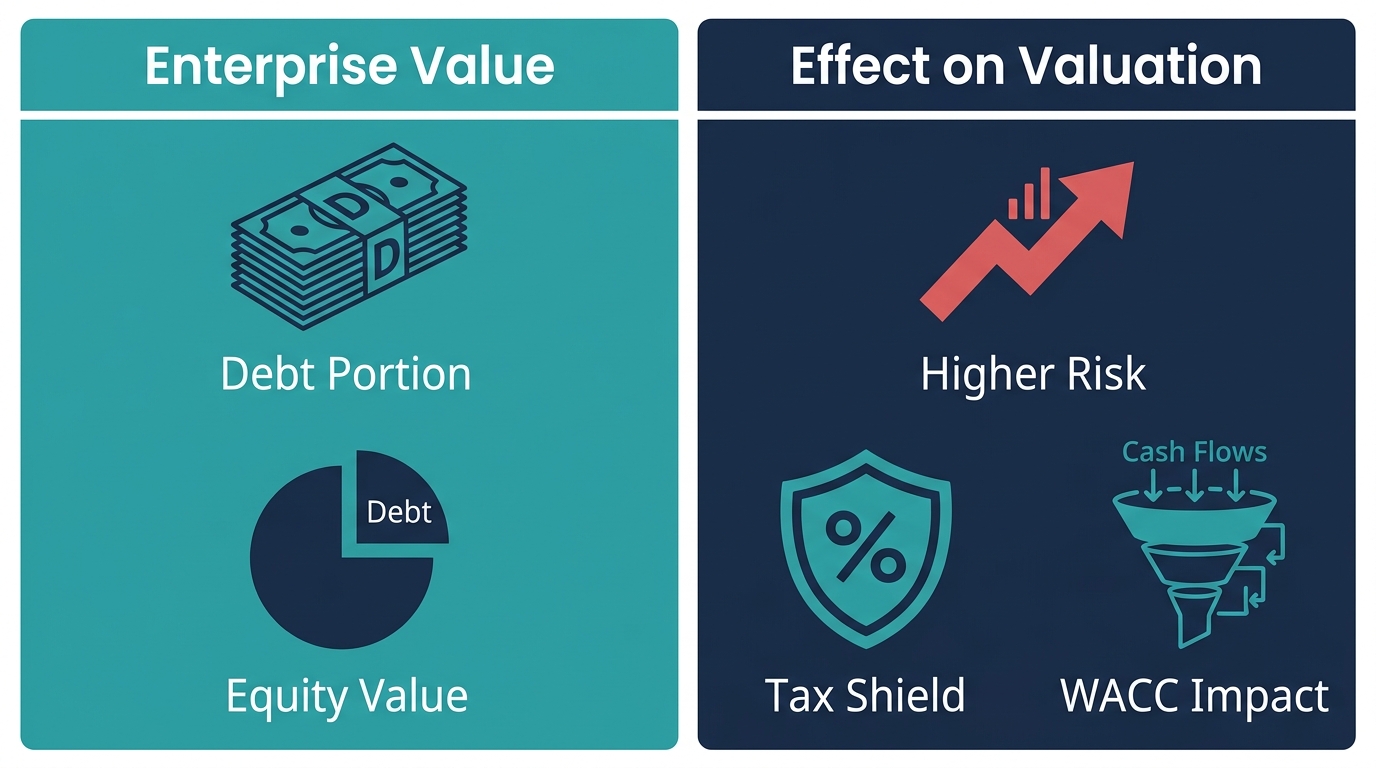
Adjusting the level of debt dictates if the figure represents the equity value or enterprise value.
How Is Net Debt Subtracted from Enterprise Value to Determine Equity Value?
Enterprise value (EV) represents the total value of a company’s operations, encompassing both debt and equity claims. Net debt is total debt (short-term and long-term) less cash and cash equivalents; the net debt calculation removes liquid assets from gross debt. The equity value attributable to shareholders is EV minus net debt.
Subtracting net debt removes the creditor portion, leaving the equity holders’ residual claim. For distressed company valuation, balance-sheet figures often require balance sheet adjustments, such as using the market value of debt rather than book value. Zaidwood Capital provides tailored M&A and capital advisory support to help owners assess their position.
Still Have Questions? Contact Zaidwood Capital
If you want to find out what your business is really worth, contact us.
Call 800-962-0418 or email contact@zaidwoodcapital.com. This website is informational — not an offer, solicitation, recommendation, or commitment to buy or sell any security. Securities are offered through Finalis Securities LLC; Zaidwood Capital is not a registered broker-dealer and unaffiliated with Finalis. Prospective investors should do due diligence and consult legal, tax, financial advisors. Corporate logos are not endorsements; investments carry risk and past performance is not guaranteed.