
Table of Contents
EBITDA Multiples and What They Mean for Your Sale Price
As LegalClarity describes, an EBITDA multiple is the company’s enterprise value, which is market capitalization plus total debt minus cash and equivalents, divided by its EBITDA. Understanding EBITDA multiples and what they mean for your sale price is extremely important because the multiple determines your transaction value. We analyze EBITDA multiples early in our advisory process to illustrate to the client how a buyer prices in their earnings. Trailing EBITDA multiples reflect previous performance, while forward EBITDA multiples anticipate future earnings, and by choosing which EBITDA multiple to use, valuation can vary greatly. During due diligence, a Quality of Earnings report (QofE) independently confirms that the normalized EBITDA used in the calculation is accurate and recurring. With that level of confidence established, we perform a series of margin and revenue analysis to build a complete picture of the company, and price attainability.
Valuation Multiples and Key EBITDA Metrics
When we value a business, the EBITDA multiple stands as one of the most widely referenced metrics because it captures the relationship between operating earnings and the price a buyer is willing to pay.
What Is an EBITDA Multiple and How Is It Used to Value a Business?
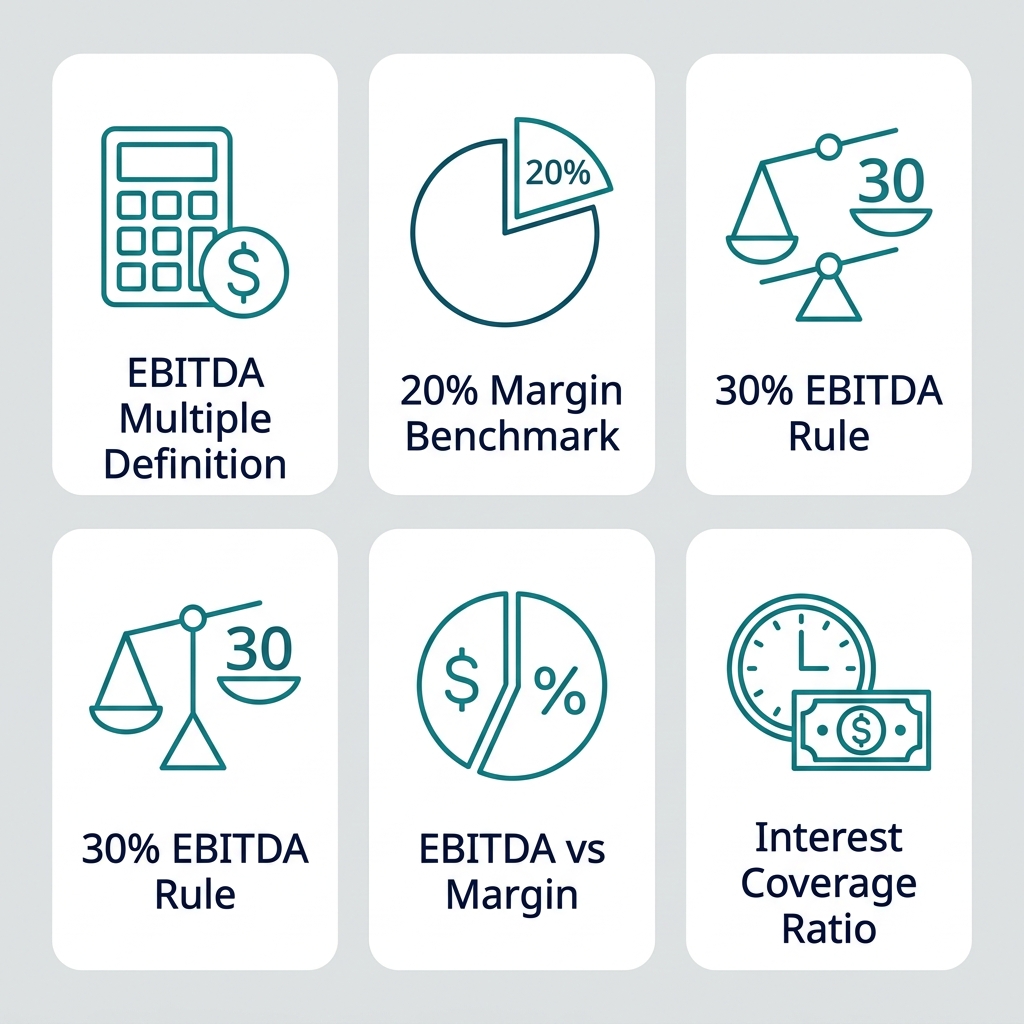
The EBITDA multiple is enterprise value divided by EBITDA, showing how many times current earnings a buyer effectively pays to acquire a company. Enterprise value is market capitalization plus total debt minus cash and cash equivalents, so the multiple reflects the company’s full capital structure rather than just equity value. We emphasize the role of Quality of Earnings (QoE) reports to verify that normalized EBITDA excludes non-recurring items and owner-specific adjustments so the multiple we present is credible during negotiations.
Is 20% EBITDA Considered a Good Margin?
Whether a 20% EBITDA margin is strong depends on sector context and capital intensity. In asset-light industries such as software, margins above 30% are common, while capital-intensive sectors like machinery or telecom services typically run lower margins, making 20% relatively healthy there. We benchmark against industry-specific EBITDA multiples and other peers to see whether a client’s margin supports an attractive valuation or signals room for operational improvement. Buyers reward consistent, above-average margins with higher multiples because they suggest pricing power and cost control.
What Is the 30% EBITDA Rule?
The 30% EBITDA rule is a rule of thumb suggesting businesses should aim to keep operating expenses plus cost of goods sold at or below 70% of revenue, leaving roughly a 30% margin before interest, taxes, depreciation, and amortization. Originating in private equity and lending circles, it helps buyers screen for businesses with cash flow sufficient to service acquisition debt and fund growth. We treat it as a useful benchmark, especially for recurring-revenue models, but not an absolute standard for inventory-heavy or capital-intensive operations.
What Is the Difference Between EBITDA and EBITDA Margin?
EBITDA is an absolute dollar figure representing earnings before interest, taxes, depreciation, and amortization, while EBITDA margin expresses that earnings figure as a percentage of revenue. The distinction matters because a high-dollar EBITDA can coexist with a thin percentage margin if revenue is large, and a strong margin can exist alongside modest absolute earnings if revenue is small. A consistent margin history often supports a higher valuation multiple than volatile profitability.
What Is a Good EBITDA to Interest Ratio?
The EBITDA to interest ratio, or interest coverage ratio, measures how many times operating earnings cover interest obligations; a ratio around 3.0x or higher is generally considered healthy in middle-market transactions. Lenders and buyers use this metric to assess default risk, and stronger coverage expands financing options and the pool of qualified acquirers. We review coverage early in a sale process because improving the ratio through earnings growth or debt adjustments can materially increase buyer interest and negotiation leverage.
We also examine ebitda multiples by industry when positioning clients for sale, since sector norms, growth prospects, and capital intensity drive how multiples translate into fair market price expectations.
Industry Multiples and Benchmark Insights
EBITDA multiples help stakeholders understand a company’s operating performance relative to others in the industry. At Zaidwood Capital, we use EBITDA multiples as one of the basic rules of thumb in our advisory role to discuss with clients where their company is positioned in the market and to help consider potential deal pricing.
The formula for EBITDA multiple is fairly simple: enterprise value (EV) divided by EBITDA. As LegalClarity states, enterprise value is determined by adding the market capitalization and total debt and subtracting cash and cash equivalents. The resulting multiple indicates how many years of current earnings a buyer would effectively pay for an acquisition. However, how useful this multiple is depends on how EBITDA is defined and validated.
LegalClarity notes that a critical distinction exists between trailing EBITDA multiples, which rely on historical financial data, and forward EBITDA multiples, which incorporate projected earnings. Trailing multiples, often based on the last twelve months (LTM), reflect realized performance and tend to be more reliable. Forward multiples, in contrast, use management forecasts and can vary significantly depending on growth assumptions and market conditions.
Buyers and advisors frequently commission Q&E reports to ensure the EBITDA figures used in multiples are normalized and accurate. As noted above, Q&E reports determine if adjusted EBITDA is sustainable based on non-recurring expenses and owner compensation, as well as other adjustments. Q&E reports confirm that add-backs, such as personal expenses run through the business or one-time legal costs, are legitimate. Q&E reports confirm EBITDA is at an appropriate level to represent the earnings capacity of the business.
There are benchmarks within an industry that help to define a range, and they are general reference points as opposed to rigid formulas. Multiples can vary between companies in the same sector as well as based on the company’s growth and the conditions of the market.
Seeing where a company is compared to industry benchmarks is a great starting point to determine areas of the business that need operational improvements or to create growth opportunities to maximize value.
Strategies to Maximize Your EBITDA Multiple
After determining the industry multiples for your sector, consider actions that can be taken to increase your multiple prior to a sale. Normalize your EBITDA. Adjust for personal expenses, owner compensation (bring your compensation in line with industry averages), and non-recurring charges. A normal EBITDA creates a strong base upon which valuation multiples can be built.
Well-audited financial records further strengthen buyer confidence.
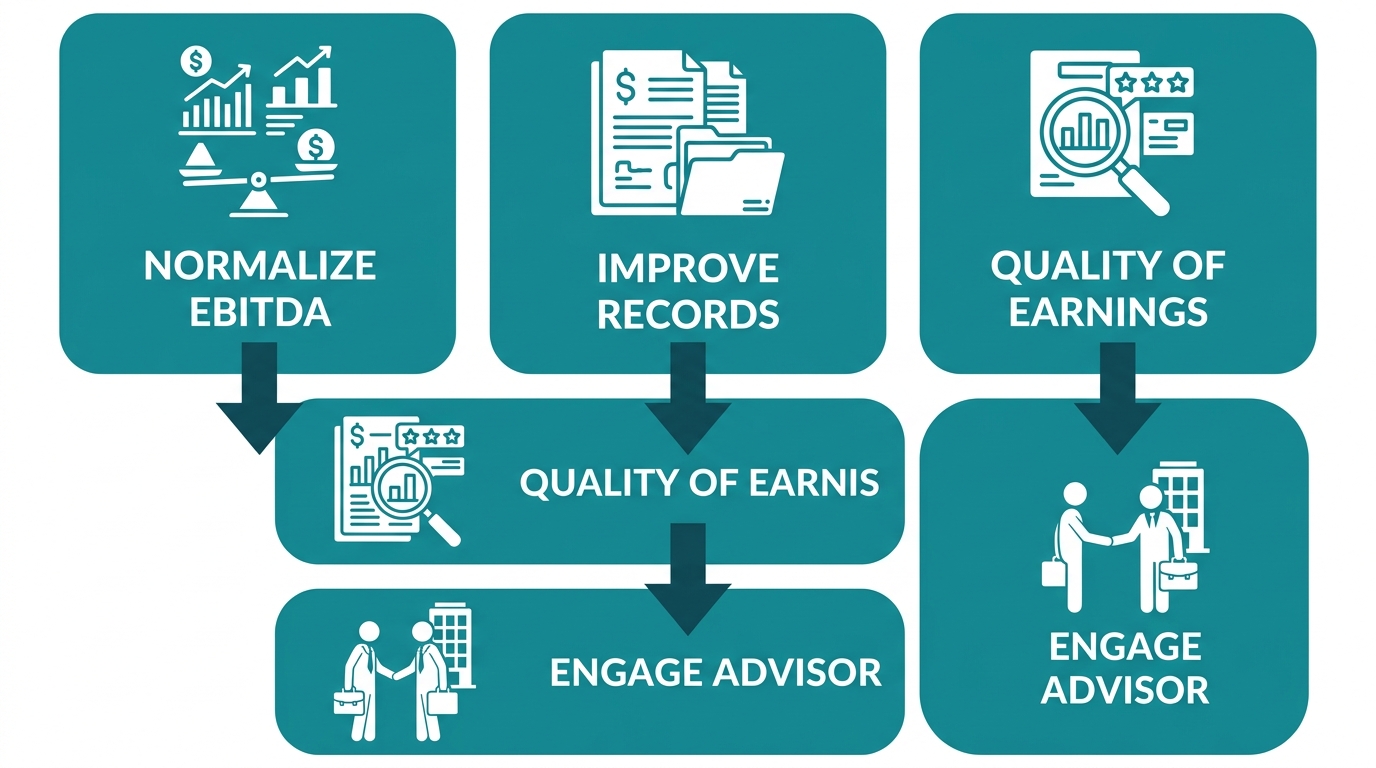
With normalized records, the next key milestone is an independent Quality of Earnings report. An independent Quality of Earnings report, as LegalClarity states, independently confirms a company’s normalized EBITDA. Understanding ebitda multiples and what they mean for your sale price is essential, but this report provides the objective evidence buyers need to accept adjusted earnings, often preventing valuation discounts.
We identify value drivers, craft a compelling investment thesis, and prepare investor-ready pitch decks and pro forma projections that position you to command a higher multiple and justify a premium valuation. To do this, we leverage our global investor network to build interest and increase the level of competitive bidding for your business.
Using the strategies and preparation provided, position yourself to compete in the M&A market.
Preparing Your Business for Sale at $1M and $5M EBITDA
After outlining strategies to strengthen your EBITDA multiple, the next priority is converting those improvements into a transaction-ready financial picture. The effort you invest at this stage shapes how buyers perceive risk, sustainability, and ultimate value.
For advice on how to sell a business with 1 million ebitda, we start by normalizing the financial statements. This means removing one-time legal settlements, non-operating income, and discretionary owner expenses that obscure recurring earning power.
When planning how to sell a business with 5 million ebitda, we recommend commissioning a Quality of Earnings report well before market outreach. An independent QoE validates the normalized EBITDA and gives institutional buyers confidence that the numbers withstand due diligence scrutiny. At this tier, audited financials and a documented growth narrative around revenue drivers and customer concentration become essential, as EBITDA sustainability is a top concern for acquirers writing larger checks.
Understanding EBITDA multiples and what they mean for your sale price helps you present stronger financials, because the enterprise-value-to-EBITDA formula translates every dollar of verified earnings directly into market value. Once your financials are normalized, defensible, and supported by a clear growth story, the next step is a professional valuation that converts your preparation into an objective price anchor; our team can provide that valuation.
Start Your Business Valuation with Zaidwood Capital
Understanding EBITDA multiples and what they mean for your sale price is essential. EBITDA multiple, enterprise value divided by EBITDA, provides a baseline, while Quality of Earnings reports verify normalized earnings. Zaidwood Capital offers business valuation services in our M&A advisory. This website is for informational purposes only; securities offered through Finalis Securities LLC (Zaidwood Capital not a registered broker-dealer). Investments involve risk; past performance does not guarantee future results. Prospective investors should do their due diligence and consult advisors; corporate logos are not endorsements.