
Table of Contents
Navigating Investor Rights and Term Sheet Terms That Affect Your Exit
Investor rights and term sheet terms that affect your exit are the contractual provisions that govern both whether you can sell and how proceeds are shared. In a term sheet, we focus on two cornerstone clauses: liquidation preferences, which establish the payout hierarchy, and protective provisions, which give preferred shareholders veto power over major actions, including a sale. These mechanisms are set in the company’s charter documents and often become binding well before an exit.
Liquidation preferences define the order of payout. In the event the proceeds of the exit do not cover the total of the liquidation preferences, common stockholders may receive nothing. Protective provisions, on the other hand, give investors the right to veto a sale when the conditions in the certificate of incorporation are triggered. These, therefore, fundamentally affect one’s right to sell, as well as how much one is able to realize from a sale.
How Term Sheet Economics Affect Your Exit Payout
How much a founder receives at an exit is governed not by simple ownership percentages but by a handful of term sheet provisions that construct a highly structured waterfall.
How do liquidation preferences and participation rights influence my final payout during an exit?
Preferred shareholders get paid first according to their liquidation preference. With non-participating preferences, the investor must choose between taking the preference or converting to common–they cannot keep both. Participating preferred stock allows investors to collect the preference and also share pro-rata in the remaining proceeds, creating a “double-dip.” That dynamic produces a squeeze-out threshold: if total preferences exceed the sale proceeds, common holders receive nothing. We recommend founders audit the certificate of incorporation to verify payout order and model exits at 50%, 75%, 100%, 125%, and 150% of expected value.
How do anti-dilution provisions affect founder proceeds if the company is sold at a lower valuation?
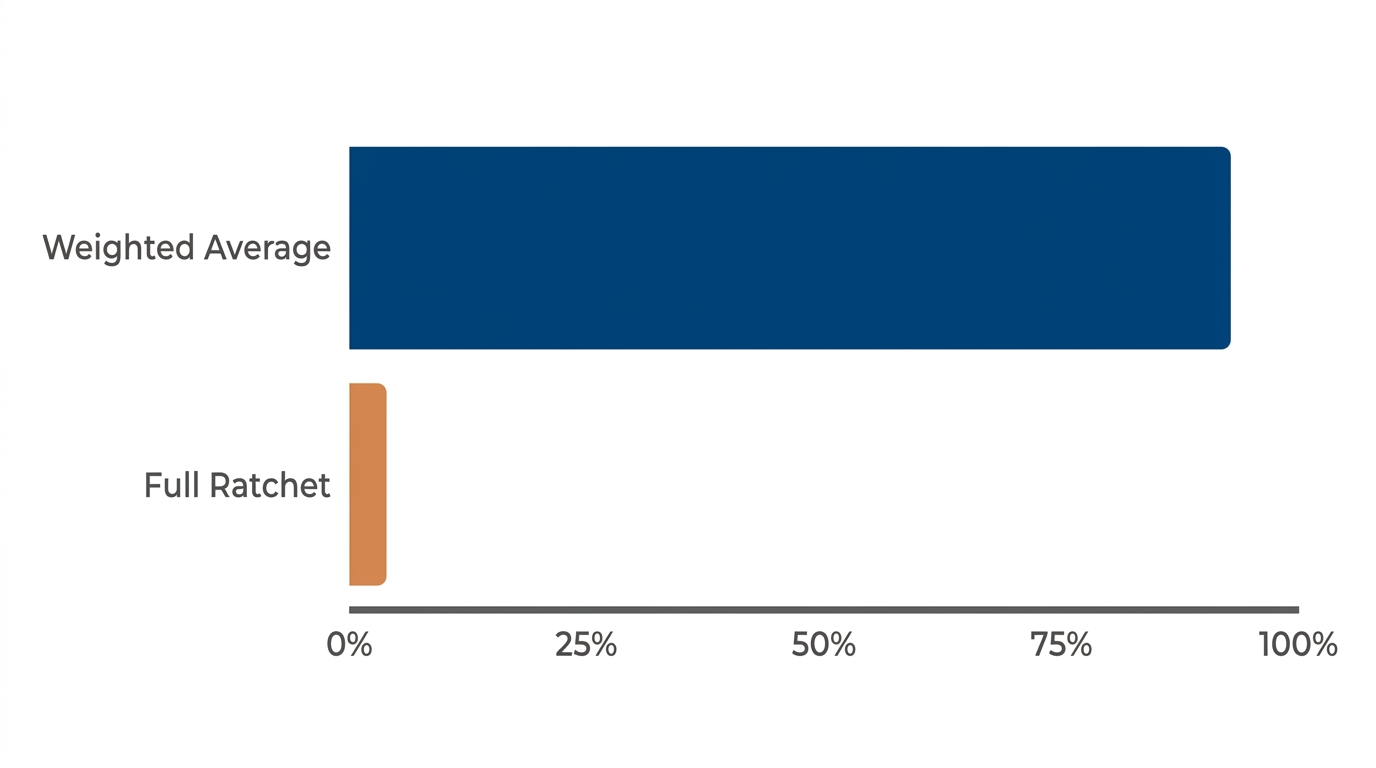
Anti-dilution protection adjusts the preferred conversion price when a company raises capital at a lower valuation. Full ratchet provides that the conversion price is reset to the lowest price of the new issuance. Weighted Average provides that the conversion price is adjusted proportionally based on both the price and the size of the down round. A broad-based weighted average includes options and produces a less drastic adjustment. Market data suggest that weighted average is the norm, and full ratchet is very uncommon.
How does the pre-money valuation in a term sheet impact the percentage of ownership given up?
The pre-money valuation sets dilution for a fixed raise. For example, at a $6 million pre-money valuation, a $2 million raise sets the post-money valuation at $8 million and the investor takes a 25% equity stake. At a $10 million pre-money valuation, the same raise gives an investor a 16.7% stake. The pre-money valuation fully diluted typically includes the option pool, so a larger option pool decreases the pre-money valuation and increases founder dilution.
What is the impact of an option pool refresh on founder dilution during an exit event?
An option pool refresh shifts dilution to existing shareholders. If a pool is increased to a negotiated post-financing level, the additional shares are carved out of founders’ and employees’ ownership, not the new investor’s. A required increase from 10% to 20% can reduce founder ownership by approximately 10 percentage points before new money is added.
Prior to analyzing the control provisions of an investment, it is important to understand these payout mechanics. Control provisions outline the terms of an investor exit, e.g. the right to a board seat, voting rights and the implementation of protective covenants.
How Investor Control Rights Can Block or Force a Sale
Although sale prices are primarily determined by the terms of the financing, there are other rights that may affect when and how a sale occurs. These have nothing to do with board composition or general stockholder votes. This creates a separate approvals process that founders must clear before completing any transaction that affects investor interests.
Can investor veto rights or board composition requirements delay or block a potential exit?
Veto rights granted to investors, most commonly found in the certificate of incorporation, allow the preferred stockholders to block a sale, even if the directors and common stockholders support it.
How do protective provisions give investors the power to block a company sale?
Protective provisions are contractual rights in the certificate of incorporation that grant preferred stockholders veto power over specific corporate actions, including the sale of the company. These provisions typically require approval from a majority, 60%, or 66.67% of outstanding preferred stock before covered transactions can proceed. If a proposed action adversely affects a specific series of stock, the provisions often require class-by-class voting, meaning a single dissenting series can block the entire transaction even when other investor classes support it.
How do drag-along rights enable majority investors to force an exit against founders’ wishes?
Drag-along rights enable a company’s majority shareholders to compel minority holders to participate in a qualifying company sale. In order for a sale to be mandated, the majority shareholder first makes a qualifying offer. Next, the majority shareholder gains the necessary trigger approvals, notifies the minority shareholders, and then mandates a sale. Founders should review drag-along rights in their stockholders’ agreements. The “same terms” requirement governs the mechanics of a transaction but does not guarantee identical cash distributions, because the charter’s liquidation waterfall determines payouts.
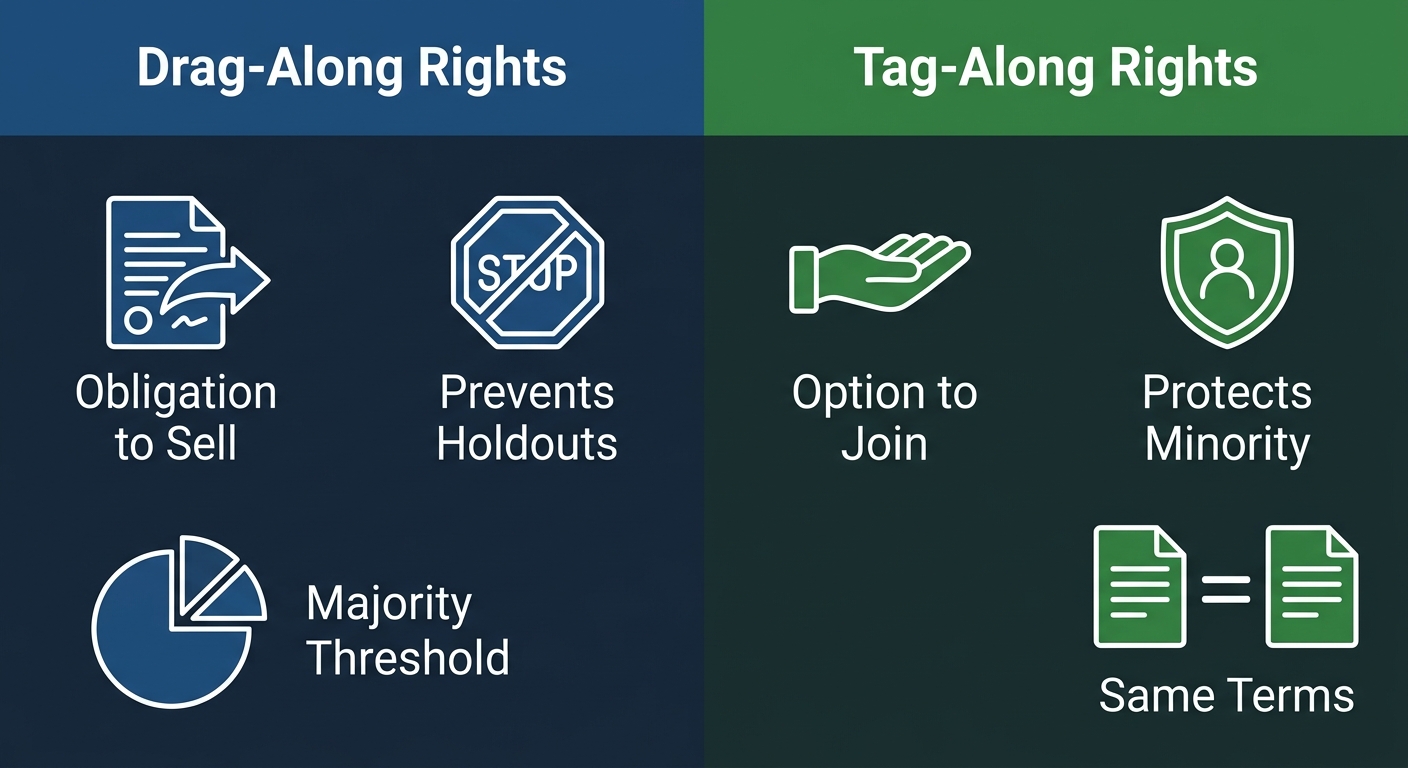
The main difference between drag-along rights and tag-along rights is that tag-along rights are reserved for the minority shareholders. Tag-along rights give minority shareholders the option to participate in a sale on the same terms as the selling majority.
Are drag-along rights considered standard market practice in early-stage venture capital deals?
Drag-along provisions are common in VC term sheets, though thresholds and enforcement mechanisms vary by agreement. The particulars of the provision, including thresholds, are negotiable. Founders can also negotiate trigger thresholds, narrow the types of qualifying transactions, or require stricter procedural protections to reduce execution risk.
For companies encountering problems such as an investor’s veto, protective provisions, and / or drag-along issues when undertaking an exit, Zaidwood Capital provides advisory services that account for these contractual dynamics throughout deal execution.
Key Legal and Documentation Essentials for Exit Negotiations
While investor control rights determine exit dynamics, the term sheet governs how those rights are enforced.
Is a signed term sheet a legally binding document for the entire investment deal?
A signed term sheet is not a binding contract for the overall transaction; however, some of its provisions (e.g. confidentiality, exclusivity, expense reimbursement, etc.) are typically enforceable. Unless the document explicitly states otherwise, the main economic and control provisions (e.g. valuation, board composition, liquidation preferences, etc.) generally remain non-binding.
Which term sheet clauses are most critical for protecting founder equity during an acquisition?
Protective provisions grant minority shareholders veto power over major corporate actions, safeguarding equity value. Liquidation preferences determine the order and allocation of exit proceeds and can materially affect founder returns. Anti-dilution protection adjusts conversion mechanics when later rounds close at lower valuations to preserve ownership percentage. Drag-along rights, typically located in the Voting Agreement, enable a requisite majority to compel minority holders to support a qualifying sale–thresholds are commonly negotiated between a simple majority and 75 percent. Tag-along (co-sale) rights, usually in the Right of First Refusal and Co-Sale Agreement, allow minority investors to join a private sale on identical terms. Both rights typically terminate on an IPO, and precise drafting of triggering events, notice periods, and scope is essential to avoid ambiguity and disputes during exit processes.
When Investor Rights Are Triggered During an Exit
Do liquidation preferences still apply if the company is sold through an IPO?
Preferred stock converts to common stock in a qualified IPO. Preferred stock conversion occurs if the minimum offering price and size thresholds in the certificate of incorporation are met. The preferred stock conversion does not occur if these thresholds are not met. Founders need to understand the ‘squeeze-out’ threshold. At the ‘squeeze-out’ threshold, common holders get nothing because senior preferences soak up all proceeds. Even a $50 million acquisition can leave common empty-handed. Promise.legal notes that even a $50 million acquisition can leave common empty-handed. Non-participating preferred forces investors to choose between preference and pro-rata share, whereas participating preferred gives both, often wiping out common value. We recommend that founders audit the certificate of incorporation directly, as cap tables alone can obscure how preferences stack.
When do drag-along and tag-along rights typically terminate?
Drag-along rights obligate minority shareholders to sell alongside the majority, preventing holdouts from blocking a desirable exit. Tag-along rights give minority holders the option to join a sale on equivalent terms, ensuring they aren’t stranded with illiquid stock. Crowley Law LLC notes that both provisions generally terminate upon an IPO. Drag-along triggering thresholds often span from a simple majority to 75 percent approval; the higher the bar, the greater the minority protection. We are ready to walk through your specific agreement and clarify how these terms affect your exit.
Connect with Zaidwood Capital to Navigate Investor Rights and Exit Terms
If you have questions about investor rights and term sheet terms that affect your exit, we can help.
We offer full-cycle M&A and capital advisory and guidance on term sheets and investor protections.
Still Have Questions About Your Exit Strategy?
Schedule a consultation or call us at 800-962-0418.
This website is for informational purposes only and is not an offer; Zaidwood Capital is not a registered broker-dealer and securities are offered through Finalis Securities LLC.