
Table of Contents
Private Credit and Debt Financing Options for Business Owners
Private credit and debt financing options for business owners have expanded into a $1.7+ trillion U.S. market, encompassing more than 1,000 funds that provide bilateral, non-bank loans to middle-market companies, often with floating-rate interest and stricter covenants than traditional bank debt. According to Columbia Business School research, these funds hold 65-80% equity, six times the equity of typical banks, which absorbs losses and avoids the maturity transformation that triggered the 2023 regional banking crisis. Nevertheless, the sector faces risks from reliance on internal valuation models and heightened sensitivity to investor sentiment, especially in semi-liquid vehicles that cater to retail investors. We help business owners understand the capital stack, where mezzanine financing fills the gap between senior debt and equity, and our debt advisory team structures these instruments to align with strategic goals; because costs and fee structures vary widely, a systematic comparison framework is essential, and our analysis equips owners to make informed decisions.
Cost Questions
When assessing financing, business owners need to look beyond labeled loan categories to evaluate the total cost of capital, including interest, down payment, tax treatment, and the impact of restrictive covenants. Private credit and debt products (i.e., mezzanine debt, private credit, and SBA loans) present a varying cost profile that ultimately impacts control and cash flow of the business over the long term. We suggest evaluating and comparing these products thoroughly prior to making a funding decision.
According to industry data, mezzanine debt carries interest in the 15-20% range. Maturities for mezzanine debt are often 5 years or longer. As such, though expensive, it can be a viable option for businesses that need financing with an extended repayment schedule. For example, a $5 million mezzanine facility with an interest rate of 15% means the business would incur $750,000 of interest each year, and tax deductibility can lower the effective cost for profitable companies.
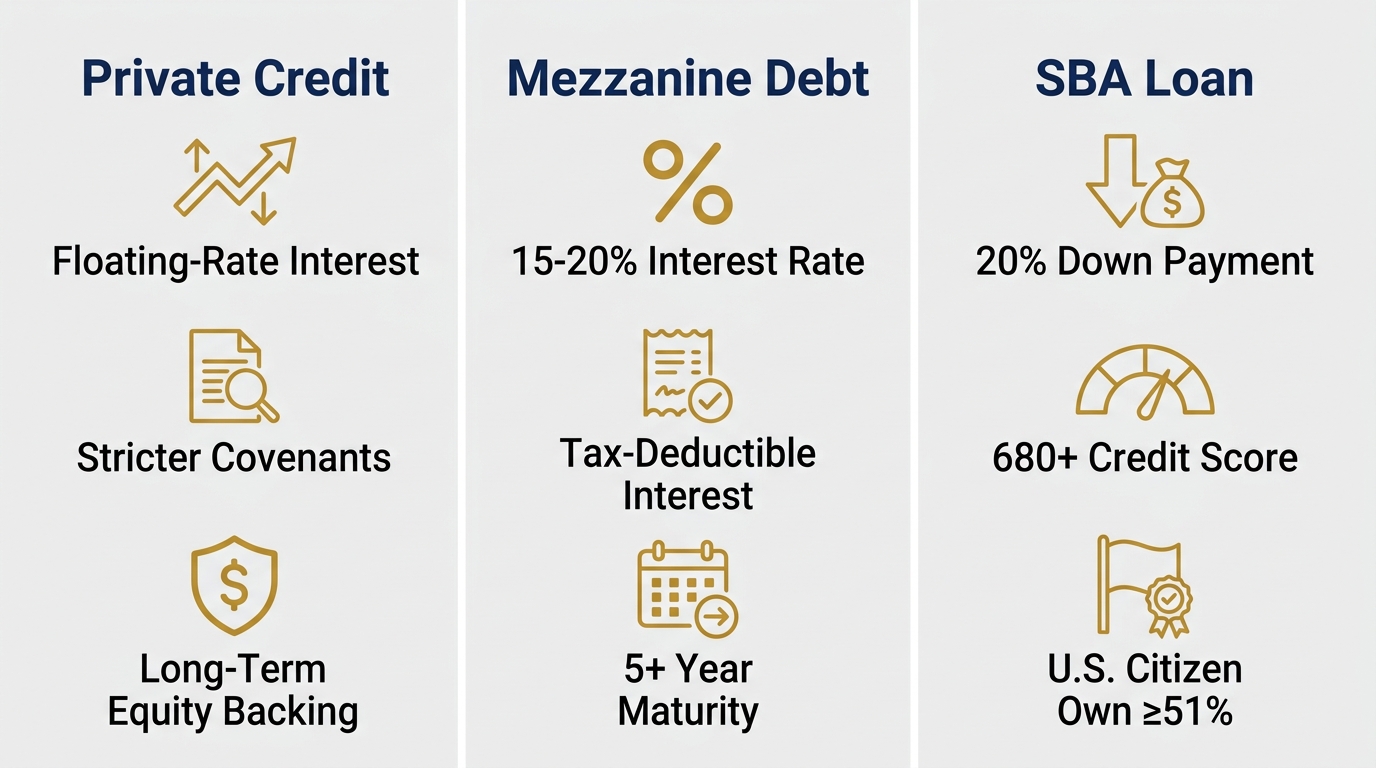
SBA loans have characteristic costs set by the government. For existing business acquisitions, a 20% down payment is generally required. Applicants must also have a personal credit score of 680 or greater. Lenders look at the business’s debt service coverage ratio (DSCR), and most require a DSCR of 1.15 or greater for loans over $350,000. Although the SBA doesn’t set a floor for loan rates, the rates for SBA loans are typically lower than mezzanine debt. This is because they are government-backed. Due to this guarantee, SBA loans generally charge lower rates than private credit. Private credit facilities often feature a floating rate linked to market benchmarks, so the rate changes with the market. Private credit facilities also impose more restrictive financial covenants than bank loans. These facilities give the borrower the ability to raise capital quickly, but increases rate volatility risk.
Comparing SBA loans and private credit requires trading off the predictability of amortizing payments and lower rates against the speed and flexibility of floating-rate debt. The middle ground between these two is occupied by mezzanine debt. With a lay of the financing cost landscape, focus shifts toward the practical aspects of securing each type of capital.
Process Questions
Private credit transactions occur on a bilateral basis, connecting middle-market companies directly to institutional investors, enabling companies to raise capital outside of the public markets. Owners have the option of using this capital as an alternative to traditional bank loans.
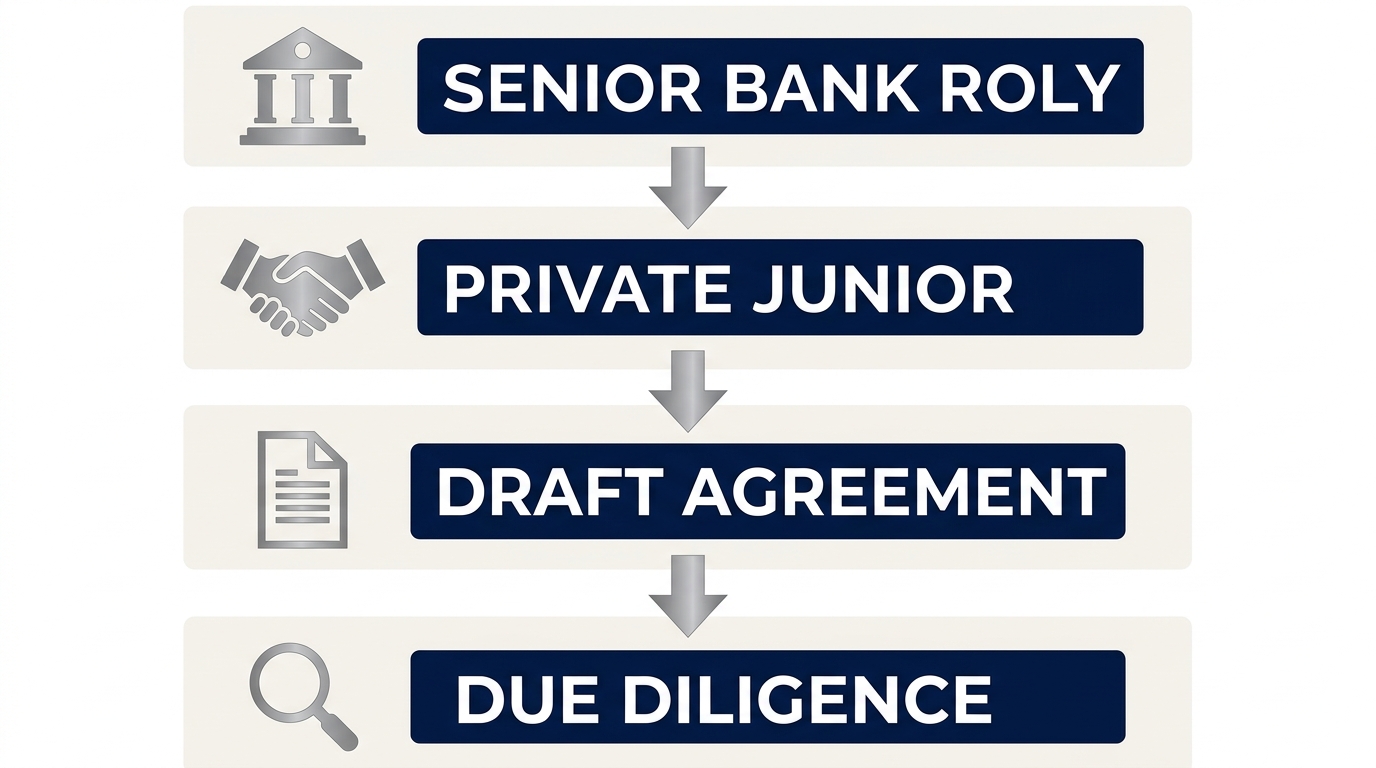
A major structural change in private lending is the re-tranchement model, where banks move to provide senior debt while private credit managers focus on junior, asset-linked exposure. Oxane Partners, a capital markets advisory firm, has confirmed this convergence of bank and fund capital to be a permanent feature in the credit market. Banks have moved to provide capital through warehouse lines, fund finance, and asset based lending. Banks have established alliances with private equity firms to create blended institutional balance sheets and fund capital.
Private credit transactions are typically bilateral, meaning they involve one borrower and one lender. Non-bank lenders, including pension funds, insurance companies, and sovereign wealth funds, are the main private credit lenders. Private credit targets mid-market companies, with annual revenues generally between $100 million and $1 billion. Terms differ considerably from traditional bank financing. Deals are generally floating-rate, and private credit lenders generally require more and stricter financial covenants than those in bank financing. Those stricter covenants give lenders greater oversight and earlier intervention rights than are customary in bank loan agreements, reflecting the higher underlying credit risk.
Oxane Partners reports that over the last decade, bank lending to non-bank lenders in the US reached more than $1 trillion, and 92% of private credit firms are actively expanding their businesses along with the largest banking institutions. Clearly, this growth signals that private credit is no longer a niche supplement but a core capital channel for growth-stage and middle-market enterprises.
At Zaidwood Capital, we help business owners throughout the entire private credit process including structure, documentation, and closing. We help our clients understand the legal, regulatory, codes, permits and other processes required for an compliant execution.
Code & Permit Questions
In private credit, doing your due diligence on code and permit compliance is especially important for borrowers in the real estate, construction and manufacturing industries. In our experience, issues with code and permits typically come up during the very initial stages of a transaction and influence the structuring of the first term sheet, often before the underwriting process has even begun. For commercial borrowers whose asset or business relies on a physical location, the status of building permits and other regulatory approvals can influence a lender’s willingness to provide credit.
Lenders review building permits and code compliance to understand if the improvements or alterations to a property were done in accordance with municipal requirements. If a permit was not obtained or issues remain unresolved with violations, the risk to the collateral is typically perceived to be greater and can result in material changes to the terms of the credit, for example, a lower loan-to-value or a larger reserve or holdback. We help our clients demonstrate that any deficiencies can be remedied through a defined corrective plan, which often preserves deal momentum while satisfying a private credit fund’s risk committee.
Borrowers in West Palm Beach, and elsewhere in our national and global markets, should assemble a full record of permits, inspection reports and correspondence from the building department prior to completing a private credit application. This allows us to identify, and address, any gaps to facilitate the lender’s credit analysis. Sponsors that take a collaborative approach with their debt advisor to address gaps related to the building code, typically, shorten the level of uncertainty for the lender and give the lender more confidence in the asset, which, in turn, should positively impact the lender’s decision-making. This, in turn, supports a smoother transition to final approval and fund disbursement. We work with local code consultants and integrate permitting remediation within our debt advisory services to optimize timelines.
Timeline Questions
While each situation is different, there are structure-related realities and demands for documentation that impact timing for most transactions.
How long can I expect a mezzanine loan to be outstanding?
Mezzanine financing sits between senior debt and equity, and its maturity is typically set at five years or longer. This timeframe often aligns with existing senior debt schedules, giving borrowers a predictable repayment horizon. The extended maturity reflects the subordinated nature of the instrument and provides businesses with a runway for growth before refinancing or exit.
What kind of documentation is required and how does that impact the timeline?
Borrowers are generally expected to provide three years of tax returns and bank statements, a thorough business plan, and detailed cash flow projections. While some investors and/or borrowers are prepared to provide documentation, others may take a period of time to assemble the information requested. Financial records may not be current and the management team may not be prepared to create cash flow projections. In many cases, the preparation time can be shortened if investor-ready documentation is provided; however, companies starting from the beginning may require an extended period of time to complete requested documentation.
What factors can delay the funding process?
Documentation readiness is only one part of the story when it comes to the timing of capital raises. One private credit research paper from Columbia Business School suggests private credit funds are built with long-dated capital (10-12 year fund lives versus 3-4 year bank loan maturities) and eliminates the short-term liquidity concerns that can halt bank-led financings. However, when semi-liquid investment vehicles are used, there are a number of internal processes including valuation, and the sentiments of the partners and investors that ultimately decipher the pace at which capital is deployed. Fund managers cautious about marking assets in a volatile market may take additional time to finalize commitments, and this can push out the closing timeline even when a term sheet is in place.
We recommend entrepreneurs use these estimates as a starting point and create robust financial packages as far in advance as possible. When you are ready to understand how your specific situation might translate into a real-world timeline, our debt advisory team at Zaidwood Capital stands ready to help assess readiness, anticipate delays, and accelerate toward a successful close.
Still Have Questions? Get Expert Debt Advisory Support
Evaluating private credit and debt financing options for business owners? Call 800-962-0418.
This website is for informational purposes only — not an offer, solicitation, recommendation, or commitment to buy or sell any security or financial product. Securities are offered through Finalis Securities LLC; Zaidwood Capital is not a registered broker-dealer and is unaffiliated with Finalis. Investments involve risk and investors may lose all or part of their investment. Past performance does not guarantee future results.