
Table of Contents
The Verdict: Big 4 Advisory Alternatives for Growing Companies
Big 4 advisory alternatives for fast growing companies center around boutique advisory firms who provide senior, relationship-driven execution. Entrepreneurs considering Big 4 corporate finance options ask whether their business is too small for the Big 4 and consider deloitte corporate finance options alongside comparing Big 4 and boutique M&A advisors; we help frame that choice. Here’s a quick look at how the options stack up.
Big 4 vs Boutique M&A Advisory: At a Glance
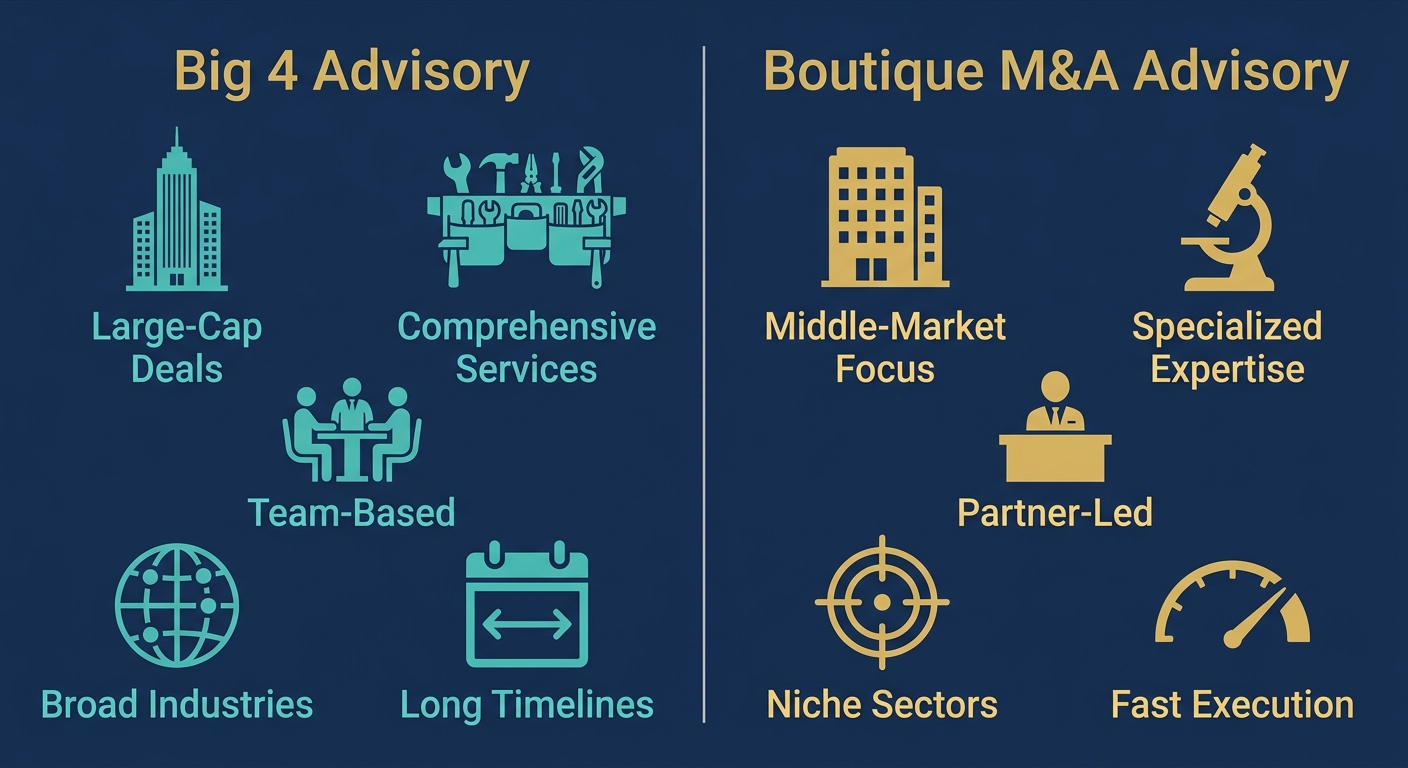
Side-by-side comparison of Big 4 vs Boutique M&A advisory.
We provide a comparison of Big 4 and boutique M&A advisors.
| Dimension | Big 4 Advisory | Boutique M&A Advisory |
|---|---|---|
| Deal Size Focus | Large-cap transactions, team-based support | Middle-market focus, partner-led involvement |
| Service Breadth | Multidisciplinary services | Transaction-focused advisory |
| Client Relationship | Institutional, multiple touchpoints | Senior-led partnership model |
| Industry Specialization | Broad sector coverage | Deep vertical expertise |
| Timeline | Longer lead times, structured approvals | Agile execution, lean deal teams |
Understanding Big 4 Advisory Services for Private Companies
The Big Four (Deloitte, PwC, EY, and KPMG) are globally recognized for their audit and tax practices, but also provide advisory services for M&A, corporate finance, and restructuring. Owners looking for Big 4 alternatives often come across a rigorous, process-heavy model designed to execute large-scale and multi-jurisdictional M&A transactions. This model extends to restructuring and valuation activities as well.
Deloitte corporate finance alternatives, for example, are built around sector-focused teams and a global deal network that can bring institutional rigor to private-company mandates. These firms maintain dedicated private enterprise groups, offering their middle-market clients a curated subset of the firm’s full advisory capabilities. Engagement models often involve senior-led teams and access to proprietary research, though the relationship is governed by the firm’s standard institutional terms.
Given this institutional framework, founders and CEOs evaluating their options for raising capital or executing an exit can better frame their decision. The focus of our work is to execute on practical time frames.
The Boutique M&A Advisory Advantage
Deloitte boutique advisory focuses on one thing at a time, and as a result, is more nimble. We engage our proprietary data platform and AI-driven matchmaking in every engagement.

Our Precision Catalyst platform utilizes A.I. to identify the most relevant investor targets from our global network of over 4,000 strategic, venture, private equity, family office, and sovereign wealth fund investors–giving clients access to more than $15 billion in capital. The Velocity Matrix guides the executional framework and provides the means to accelerate execution, compressing what often takes months into a matter of weeks without sacrificing thoroughness. The big 4 vs boutique m and a advisor comparison consistently highlights the benefit of direct partner involvement. At Zaidwood Capital, clients work with senior advisors who lead every phase.
The scale and breadth of the Big 4 have clear advantages for large-cap transactions or deeply complex regulatory environments, and we recognize that certain situations call for those resources. Our model is purpose-built for growth-stage and middle-market companies seeking a dedicated, senior-led approach.
When Big 4 Advisory Makes Sense for Your Deal
While boutique advisory shops excel at personalized, high-touch execution, the market often expects a Big 4 name when regulators and international stakeholders demand comprehensive compliance infrastructure. Boutique advisory firms usually execute more tailored, client-focused roles. Large-scale, cross-border transactions frequently require the institutional depth and global networks that only the Big 4 firms can provide. Big 4 global presence spans the breadth and depth needed to execute and manage multi-party, international, cross-border, regulatory complexity. Multinational due diligence, multi-party negotiations, and layered regulatory approvals all demand the breadth of the Big 4’s global network. The relevant question is not ‘is my business too small for the Big 4?’ Rather, it is ‘is the deal too complex for a boutique firm?’ Yet for many middle-market situations, the agility of a boutique advisor can yield more aligned outcomes.
When Boutique Advisory Drives Better Outcomes
While Big 4 firms excel for large, complex transactions, many growing companies find a boutique advisory model better suited to their needs. Smaller, specialized firms often move quickly, thanks to leaner decision-making and senior-level attention. Evaluating Big 4 and boutique M&A advisor options highlights how tools like our proprietary data platform, AI-driven investor matchmaking (Precision Catalyst), and a deep network of 4,000+ investors create tailored paths to buyers and capital. If you’ve asked, “is my business too small for the big 4,” a boutique like ours can offer the right scale and velocity through our Velocity Matrix framework. In the end, the right choice depends on your company’s unique circumstances — sometimes a hybrid approach or a different path makes the most sense.
When Neither or Both Advisory Models Fit Your Needs
Internal advisory groups are viable alternatives for certain companies, especially those with simpler capital raises, established banking relationships, or lower-end mid-market transactions. For these companies, the preparation, legal work, and valuation may be clear, and there may not be a need to engage a formal M&A advisor.
A global acquisition may require the speed, relationships, and negotiation of a senior professional of a boutique firm, while also requiring the global tax and audit infrastructure of a larger firm. This is most apparent in a “dual track” process, where a global firm performs the structuring and compliance work and handles post-merger integration planning to effectuate the acquisition, while the boutique firm leads M&A execution and outreach to prospective buyers.
No single model fits every company. We recommend mapping your transaction’s geography, industry nuances, internal bandwidth, and timeline before committing to one path or a combined approach.
Frequently Asked Questions About Advisory Models
What are the most effective big 4 corporate finance alternatives?
Boutique firms deliver faster execution and personalized attention by combining proprietary technology with direct investor access. At Zaidwood Capital, our AI-driven Precision Catalyst platform and network of 4,000+ investors facilitate targeted deal outcomes.
How does the big 4 vs boutique m and a advisor decision affect deal outcomes?
Boutique advisors typically offer dedicated senior banker involvement, which can streamline due diligence. Big 4 firms provide broad resources, but niche firms bring concentrated industry knowledge and flexible service models.
Why is McKinsey not part of the Big 4?
McKinsey is a management consultancy focused on strategy, not audit or tax services. The Big 4 designation applies to the four largest public accounting firms–Deloitte, PwC, EY, and KPMG–whose core practices center on assurance and compliance.
These FAQs help companies understand the trade-offs between large institutional scale and boutique agility. With more information, growing companies can take the next step toward engaging an advisory partner that is most aligned to their transaction needs.
Take the Next Step to Your Ideal Advisory Partnership
We invite companies exploring big 4 advisory alternatives for growing companies to contact us.
Securities offered through Finalis Securities; Zaidwood Capital is not a broker-dealer. Investments involve risk; past performance does not guarantee future results.