
Table of Contents
Choosing the Right M&A Advisory Partner
Choosing the right M&A advisory partner is the most consequential decision in a transaction because value stems from a clear strategic mandate, not simply a budget. A business owner might ask, “What does an M&A advisor do?” An M&A advisor helps align the transaction with the company’s long-term vision rather than prioritizing speed or headline price. As M&A Science explains, the process is a disciplined nine-stage sequence spanning strategy, sourcing, due diligence, negotiation, and post-merger integration. For complex public-company transactions, the timeline stretches to 12-18 months, according to M&A Science, with antitrust reviews a primary driver of delay, underscoring the need for an M&A advisory firm with deep experience and patience, an M&A advisory firm managing regulatory complexity.
As a Boutique M&A and Capital Advisory Firm, Zaidwood Capital provides end-to-end M&A advisory services to our clients, and covers the entire transaction lifecycle. Our experience managing long-cycle deals ensures patience never becomes drift and diligence never becomes rigidity. A partner who can orchestrate the entire transaction lifecycle is most likely to deliver on that mandate.
Full-Cycle M&A Execution Capability
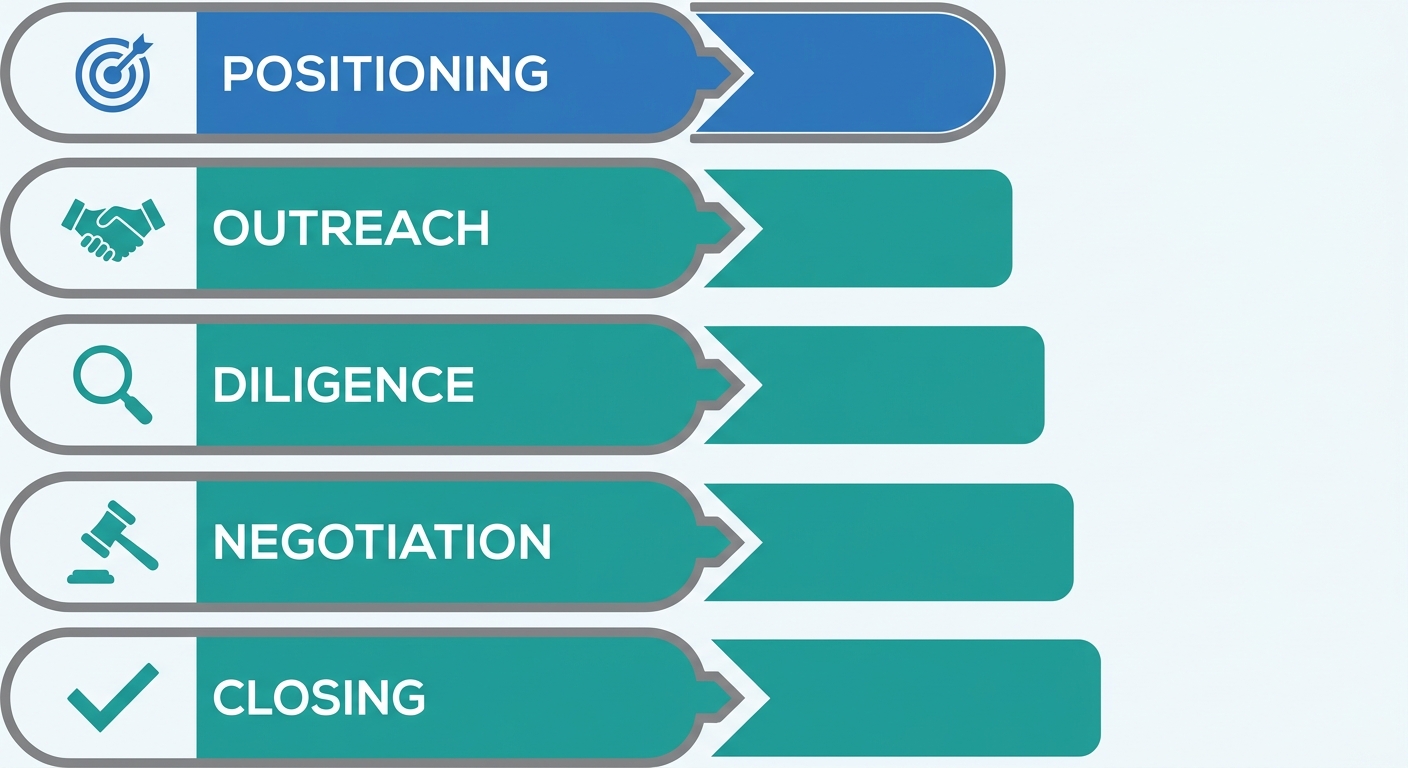
Capability for Full-Cycle M&A means the advisor can handle all aspects of a transaction from pre-mandate positioning and buyer outreach through diligence, negotiation and closing. Full-Cycle M&A capability is more comprehensive than the ability to merely make introductions.
What to Evaluate
- Whether the advisor supports strategy definition, NDA management, and coordination of confirmatory diligence.
- If the process extends through final negotiation and post-merger integration planning.
For us, following a full-cycle process means going through five distinct steps.
How to Evaluate
- Request process documentation and a sample work plan that details how the advisor manages buyer or investor outreach and coordinates diligence.
- Ask for specific examples from past mandates that demonstrate follow-through from positioning to closing.
What the Answer Means
A clearly documented full-cycle process signals the advisor can maintain deal momentum and reduce execution risk. It confirms the capability to navigate the entire transaction, not just introductions. Full-cycle execution depends on the advisor’s investor network and access to capital–both critical complements to execution capability.
Investor Network Reach and Capital Access
What to Evaluate
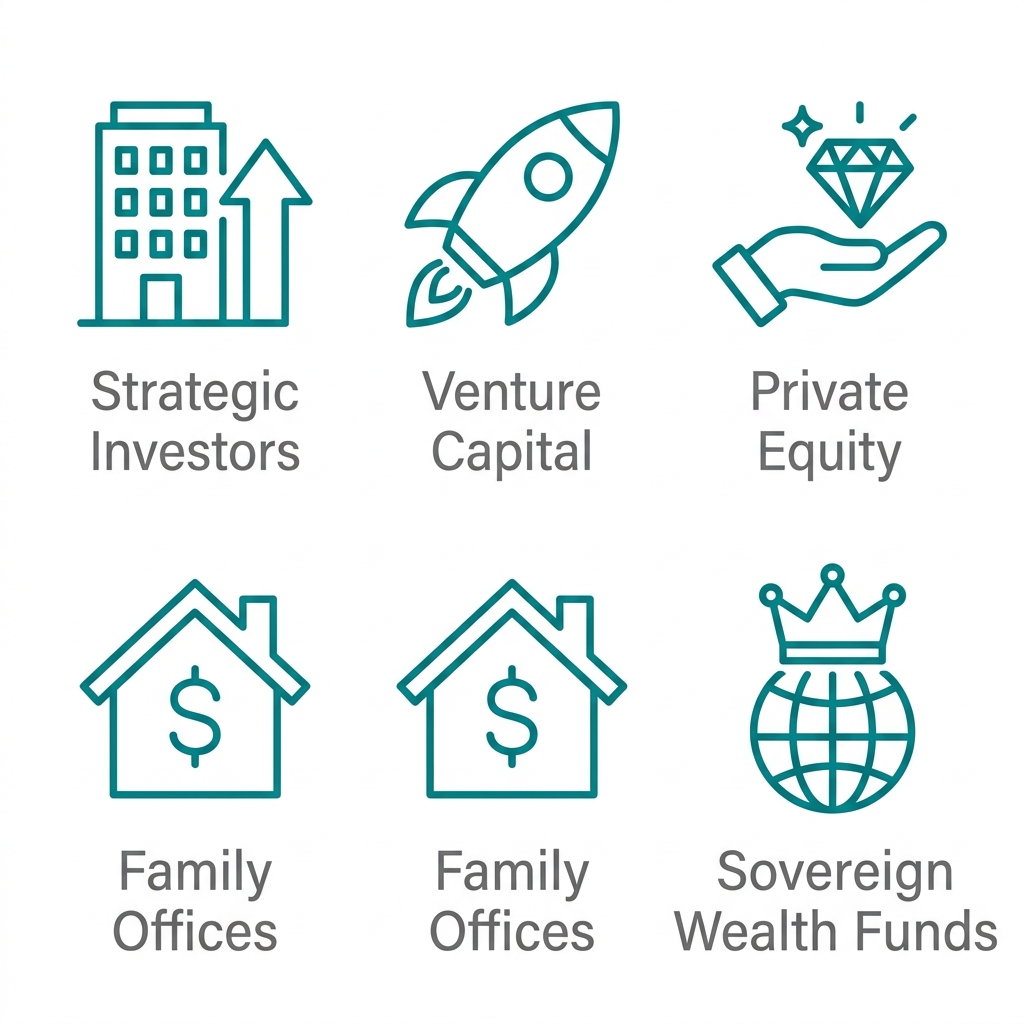
Relevance is more important than size, and though we work with over 4,000 institutional investors with access to $15 billion in capital, the important thing is having the right people in your network based on your sector and stage, such as strategic investors, venture capital and private equity, family offices, and SWFs.
How to Evaluate
Ask whether the firm uses data-driven tools such as AI-driven matchmaking or dedicated relationship managers to target introductions. Confirm that non-disclosure agreements are standard before any sensitive details are shared; as M&A Science notes, NDAs prevent premature information leakage.
What the Answer Means
Having a broad, relevant network increases the likelihood of finding the right investors for your deal while ensuring confidentiality and streamlining the process. Because your advisor pre-qualifies the investors, your team won’t have to spend time dealing with unrelated and irrelevant investors, giving your team time to focus on other aspects of the deal like negotiating and improving your position.
Track Record and Diligence Support
A buyer’s network delivers results only with a history of closed deals and robust diligence support. Adequate assessment of both factors determines the advisor’s execution capability.
What to Evaluate
Assess closed deal volume and aggregate deal value to determine an advisor’s market credibility. Also, evaluate the advisor’s depth in due diligence, negotiation and communication with buyers. Post-merger integration (PMI) often determines whether a deal creates long-term value. M&A Science’s research indicates it is where most transactions falter.
How to Evaluate
Ask the advisor for pertinent case examples, client references, and a written description of how the advisor manages diligence trackers, virtual data rooms, and buyer updates. Also, verify that these processes are structured and systematic, because they directly affect deal momentum and confidentiality. They deal with matters that affect process control, deal speed, and deal confidentiality.
What the Answer Means
These signs indicate the advisor is capable of protecting transaction value and keeping the process on schedule. An advisor who demonstrates post-merger integration support reduces the risk of value erosion, a common deal pitfall commonly identified in research. Confirming these strengths also provides an opportunity to evaluate potential issues in the advisory relationship.
Red Flags to Watch For
We note that even a partner with a strong track record can exhibit warning signs.
- Lack of strategic clarity. An advisor who avoids defining a distinct M&A strategy early may lack discipline to run a repeatable process.
- Disregard for confidentiality. Downplaying or skipping NDAs shows they do not prioritize protections for open diligence.
- Insufficient attention to post-merger integration. Focusing on execution without integration planning risks post-close value loss.
- Overly optimistic timelines. Promising a faster close than 12- to 18-month window for public-company deals signals unrealistic expectations.
When evaluating an advisory partner, we ask targeted questions to uncover the warning signs.
Questions to Ask an M&A Advisory Partner
When choosing the right M&A advisory partner, ask these key questions to evaluate strategic fit. The following points, informed by industry best practices from M&A advisory firm Mascience, will help you vet a partner’s process and expertise.
- How do you develop an M&A strategy that remains distinct from our corporate strategy?
- What protocol do you follow for managing non-disclosure agreements to prevent information leakage?
- Can you detail your post-merger integration approach? Post-merger integration is where long-term deal value is realized or lost.
- What timeline should we expect for a deal of our scale? Complex public-company transactions routinely take 12 to 18 months, while simpler private sales can close in 60 to 90 days.
- Do you have experience with transactions of our company’s size and complexity? Request examples of similar deals you have closed.
Assessing a potential partner’s process and experience can help you make an informed decision about their fee structures and cost expectations.
Cost Expectations for M&A Advisory
After narrowing down which questions to ask a prospective partner, the next step is to understand how M&A advisor fees are structured. Most engagements combine a recurring retainer with a success fee payable upon deal close, though the proportion varies. Industry perspectives from Mascience emphasize that advisory value flows from a clear strategic mandate, not from choosing the lowest-cost option. We encourage founders and executives to weigh an advisor’s domain expertise, relationship network, and cultural fit alongside the fee structure, recognizing that these qualitative factors drive the outcomes that matter most. Cost expectations are best assessed within the broader advisory market landscape.
West Palm Beach Advisory Landscape and National Reach
We bring discipline from our West Palm Beach headquarters to engagements all over the country through a proprietary data platform and AI investor matchmaking with Precision Catalyst, along with our rapid-execution framework, the Velocity Matrix.
Successful engagements begin with a strategic mandate that stays distinct from the company’s broader corporate direction: clarity of purpose drives deal value. Experienced advisors also execute non-disclosure agreements, guarding against premature information leakage. The most consequential factor is post-merger integration; planning for cultural and operational alignment early avoids the value erosion that plagues deals where integration is treated as an afterthought.
We have built our national presence with relationships to over 4,000 investors who have access to over $15 billion. This allows us to support our clients across the United States through every commonly identified phase, from strategic positioning to confirmatory diligence and beyond. In assessing advisory firms, a firm’s systematic approach and institutional infrastructure are what turn complex, 12-to-18-month transactions into predictable outcomes.
Advisor Selection Checklist
- Verify that the advisor prioritizes strategic clarity over a financial budget.
- Confirm the advisor’s post-merger integration capabilities, vital for long-term deal success.
- Assess the advisor’s confidentiality protocols and use of NDAs to protect sensitive information.
- Evaluate the advisor’s institutional investor network and proprietary AI-driven matchmaking technology.
- Review the advisor’s regulatory structure, including securities offered through Finalis Securities LLC (Member FINRA/SIPC).
After completing this checklist, many business owners have additional questions about the advisory process.
Common Questions When Choosing an M&A Advisory Partner
When looking for the right M&A advisory partner, asking the right questions is critical.
We suggest, “How does the advisor ensure a clear strategic mandate separate from a simple budget?” A disciplined M&A process starts with strategy, not price. Advisors who focus on a strategic mandate align the deal with long-term goals.
We recommend asking, “What confidentiality measures do you recommend?” Early implementation of non-disclosure agreements prevents premature information leakage and signals a thorough advisor.
“How do you approach post-merger integration?” Integration is the most common failure point. An advisor who outlines a clear integration roadmap helps preserve deal value after closing.
We suggest, “What is a realistic timeline for closing my deal?” Complex public-company mergers can take 12 to 18 months, while straightforward private deals may close in 60 to 90 days. An advisor who sets realistic expectations prepares you for the journey.
Advancing Your M&A Advisory Search
We prioritize clear strategic mandate and post-merger integration; complex public transactions take 12-18 months. Contact us at 800-962-0418 or contact@zaidwoodcapital.com to discuss choosing the right M&A advisory partner. This website is for informational purposes and not an offer; securities offered through Finalis; Zaidwood Capital is not registered broker-dealer.