
Table of Contents
TL;DR
Exit planning and succession strategy for owners is a proactive, multi-year process that starts years before a planned departure, balancing personal financial goals with the business’s long-term competitiveness. Effective exit planning requires assembling a transition team early, establishing clear objectives, and maintaining strong business performance throughout the transition.
Valuing a business and holding onto key talent are two crucial elements of devising a business exit strategy. This is because buyers and investors analyze both financial metrics and the leadership team that will carry out the plan. This means a focus must be placed on stabilizing the business, maintaining operations, and documenting performance. According to Huntington National Bank, successful transitions depend on early preparation of a transition team and a governance structure that keeps the company competitive through the change.
The methods used by an owner to transition the business to their family are often different from a traditional sale, since family successions require careful communication and tax-sensitive transfer structures to avoid conflict. External sales demand robust company valuations and the ability to retain top performers. Both methods of business succession utilize expertise in M&A and capital markets.
Specialized M&A Advisory Expertise
You must evaluate the extent of a firm’s M&A advisory expertise along several dimensions to make an appropriate assessment of their depth.
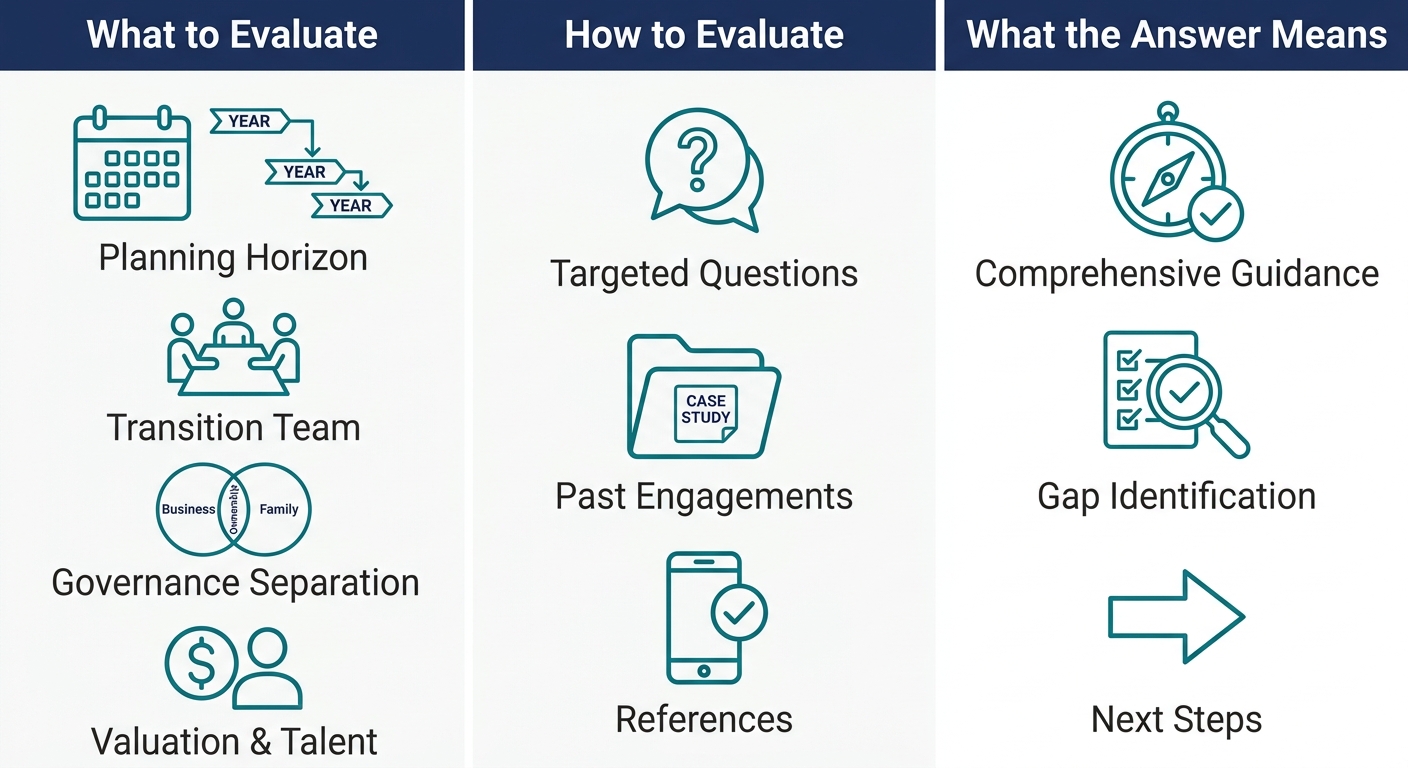
What to Evaluate
- Start planning several years in advance to assemble a transition team.
- Separate business management from ownership governance.
- Preserve financial, human, intellectual, social, and ethical capital.
- Obtain an objective business valuation and implement talent retention strategies.
- Develop successors through mentorship and progressive responsibilities.
How to Evaluate
We suggest approaching advisors directly and asking them to expound on their methods for consideration of valuation, talent retention, and governance separation. Look at case studies for past succession work, and contact client references.
What the Answer Means
A good response signifies an awareness for all the criteria. Once we’ve ascertained the advisors’ knowledge, we will look at their ability to perform. This includes evaluating their network of investors, and the firm’s capacity to do deals.
Investor Network and Deal Execution Capabilities
What to Evaluate
We assess a firm’s investor network for breadth and composition, ensuring it includes strategic, private equity, venture, family office, and sovereign wealth relationships. A network exceeding 4,000 investors indicates robust connectivity. We verify its ability to structure ESOPs, installment sales, and private-equity recapitalizations, and look for proprietary tools like Precision Catalyst and the Velocity Matrix to accelerate deal sourcing and closing.
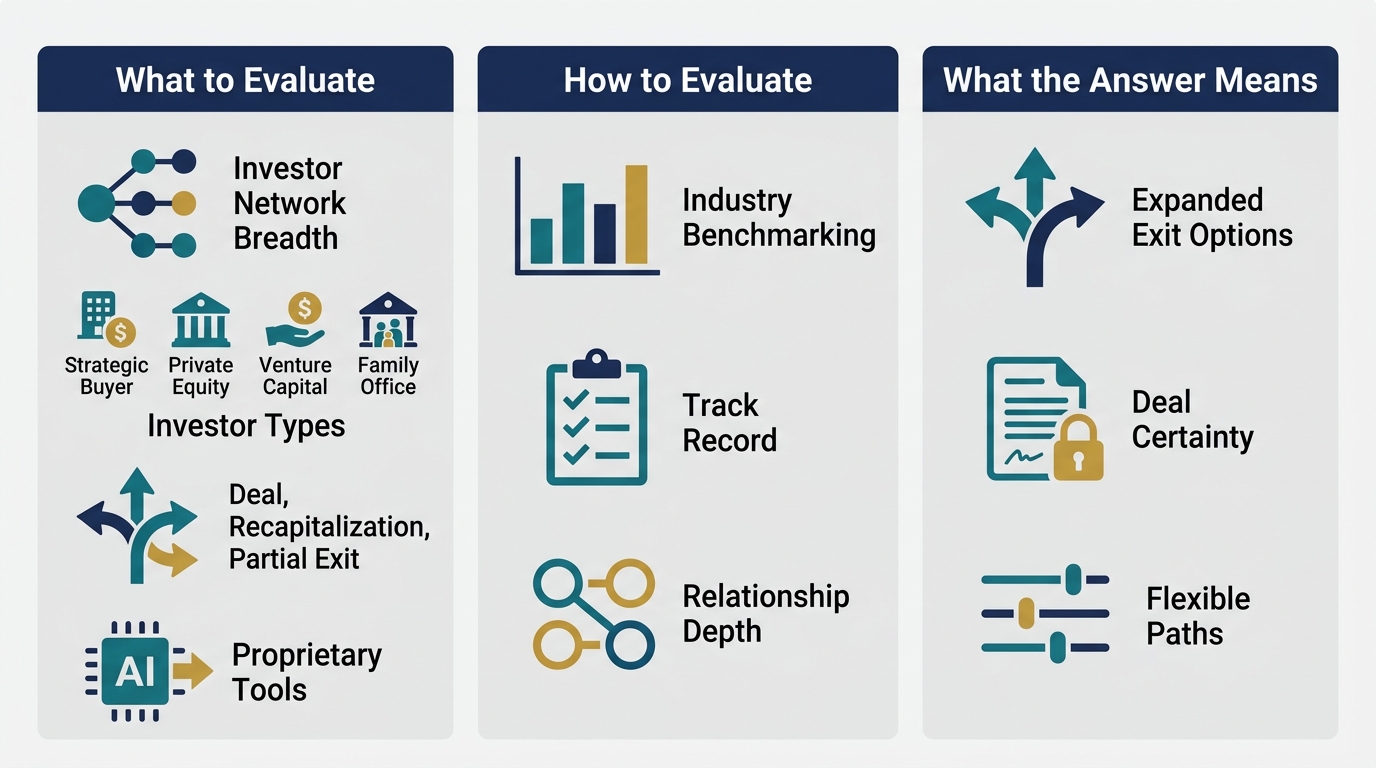
How to Evaluate
We map contacts to the seller’s industry, company size, and transaction type.
What the Answer Means
A strong network and execution record expand exit options–full sale, partial exit, or recapitalization.
Network breadth and execution rigor give owners greater control over deal timing and structure; these capabilities directly inform the tax and wealth planning support that ensures every deal is structured for maximum after-tax benefit.
Integrated Tax and Wealth Planning Support
Beyond deal execution, integrated tax and wealth planning preserves the value owners retain after a sale or succession.
What to Evaluate
- Early planning window: Owners who begin structuring their exit years ahead gain more strategic options.
- Annual gift tax exclusion: $19,000 per-recipient ($38,000 for married couples).
- Grantor retained annuity trusts (GRATs): Shift future appreciation out of the owner’s taxable estate.
- Employee stock ownership plans (ESOPs): A tax-advantaged route to employee ownership.
- OBBBA provisions: Permanent $15 million federal estate and gift tax exemption (indexed from 2026); retroactive full expensing of domestic R&D to January 1, 2025; Opportunity Zones permanent with a rolling ten-year designation starting in 2027.
How to Evaluate
- Ask whether a GRAT fits your planned exit date and expected appreciation timeline.
- Verify QSBS holding-period phase-ins under OBBBA — 50% at three years, 75% at four, 100% at five — against your liquidity needs.
What the Answer Means
Integrated tax and wealth planning minimizes tax leakage, preserves retirement income and legacy assets, and supports a smoother ownership transition.
Red Flags
No matter how carefully designed a transition may be, it can unravel if the business owners fail to recognize red flags in their succession plan. Disconnects frequently occur when an objective valuation of the business is not performed, causing the owner to develop unrealistic expectations of the value of the business and stall the transaction. Failing to recognize the need to cultivate and retain employees who differentiate the company from its competitors leads to a diminishing interest from prospective purchasers. Overlooking the need to balance the owner’s personal financial objectives with the business’s ongoing competitive health can undermine both the owner’s retirement and the company’s future stability. According to Huntington Bank’s business succession guidance, these pitfalls are common but avoidable with early planning. Owners that raise red flags with an advisor typically can change course.
Questions to Ask Your Exit Planning Advisor
This vetting process should cover timing, team formation, the alignment of personal financial goals with business health, objective valuation, and talent retention.
- When should I start planning my exit? — We recommend initiating the process years before departure.
- Who should be part of my transition team? — A strong team typically includes financial, legal, and tax advisors, as well as wealth managers.
- How will you balance my personal financial objectives with the long-term health of my business? — Look for a concrete plan that shows how distributions and investments will not undermine competitiveness.
- How will you arrive at a fair valuation? — An objective, market-based valuation is essential; the advisor should explain the methodology.
- What talent retention steps will you take? — Effective retention strategies–such as equity incentives–help preserve operational stability and maintain buyer confidence.
With the answers to these questions, you should feel ready to take the next steps with us.
Cost Expectations
Plans should begin years in advance, according to that guidance, and owners need time to align their personal retirement goals, objective valuations, and strategic liquidity to protect the business. Retaining key employees and developing a transition team are equally important early planning strategies. Most importantly, we have seen that owners who start early avoid rushed decisions that lead to higher transaction costs and suboptimal deal structures. Every dollar an owner spends on early planning can reduce friction and preserve value during a transition. While these cost expectations apply broadly, West Palm Beach market owners face unique locality-driven considerations that can influence planning.
Local Considerations for West Palm Beach, Florida
Passed in July 2025, the One Big Beautiful Bill Act (OBBBA) altered federal tax rules for business owners in West Palm Beach, Florida. With no state income tax, these changes became the primary consideration in a business owner’s exit plan.
The OBBBA permanently sets the estate and gift tax exemption at $15 million (indexed from 2026), allows full domestic R&D expensing retroactive to January 2025 (with small businesses eligible to claim back to 2022), and phases the Qualified Small Business Stock (QSBS) gain exclusion to 100% after five years with a $15 million per-shareholder limit. Opportunity Zone designations are now permanent with a 10-year rolling cycle starting in 2027.
Our team at Zaidwood Capital in West Palm Beach assists clients by integrating these federal provisions into a tailored succession strategy. We can assist you in exploring a retrospective claim for R&D expenditures and help determine your eligibility for the QSBS gain exclusion. Further, we can assist in aligning your exit with the Opportunity Zone reinvestment to maximize after-tax gains.
Exit Planning Checklist
Now let’s look at some steps for planning your exit.
- Initiate succession planning several years before your intended departure date.
- Assemble a transition team of legal, financial, and tax professionals.
- Define personal financial goals alongside the business’s financial health.
- Obtain an objective company valuation to gauge market readiness.
- Retain key talent to maintain business value and attract buyers.
- Address liquidity risks early to prevent transition complications.
While this checklist helps provide some clarity to business owners, many still have execution-related questions.
Frequently Asked Questions
To help address common concerns, we have answered frequently asked questions below. Many owners ask about exit planning and succession strategy for their businesses.
Why is succession planning so important?
It protects the financial, human, intellectual, social, and ethical capital that families create, as Wiss, a CPA and advisory firm, notes. Good governance and multi-generational planning help the business endure market shifts and pass on a legacy.
How can I groom a successor?
A proven five-step approach, as outlined by Wiss, involves education, role assessment, tailored plans for family, business, and ownership, open communication, and defining new roles for seniors. Mentorship, internships, and external experience build the competence heirs need.
What tax-efficient exit strategies can I use?
Planning early is key. Oak Street Funding highlights the annual gift tax exclusion, GRATs, and ESOPs as ways to limit tax liability and retain more value for the next generation.
These answers provide a foundation; your personalized exit planning journey begins with a conversation.
Start Your Exit Planning Journey
Begin your exit planning and succession strategy for owners with Zaidwood Capital. Securities are offered through Finalis Securities LLC; we are not a registered broker-dealer, unaffiliated with Finalis. Investments involve risk; investors should conduct due diligence and consult legal, tax, and financial advisors. Contact us 800-962-0418 or contact@zaidwoodcapital.com.