
Table of Contents
Preparing Your Company for a Successful Sale: Key Criteria at a Glance
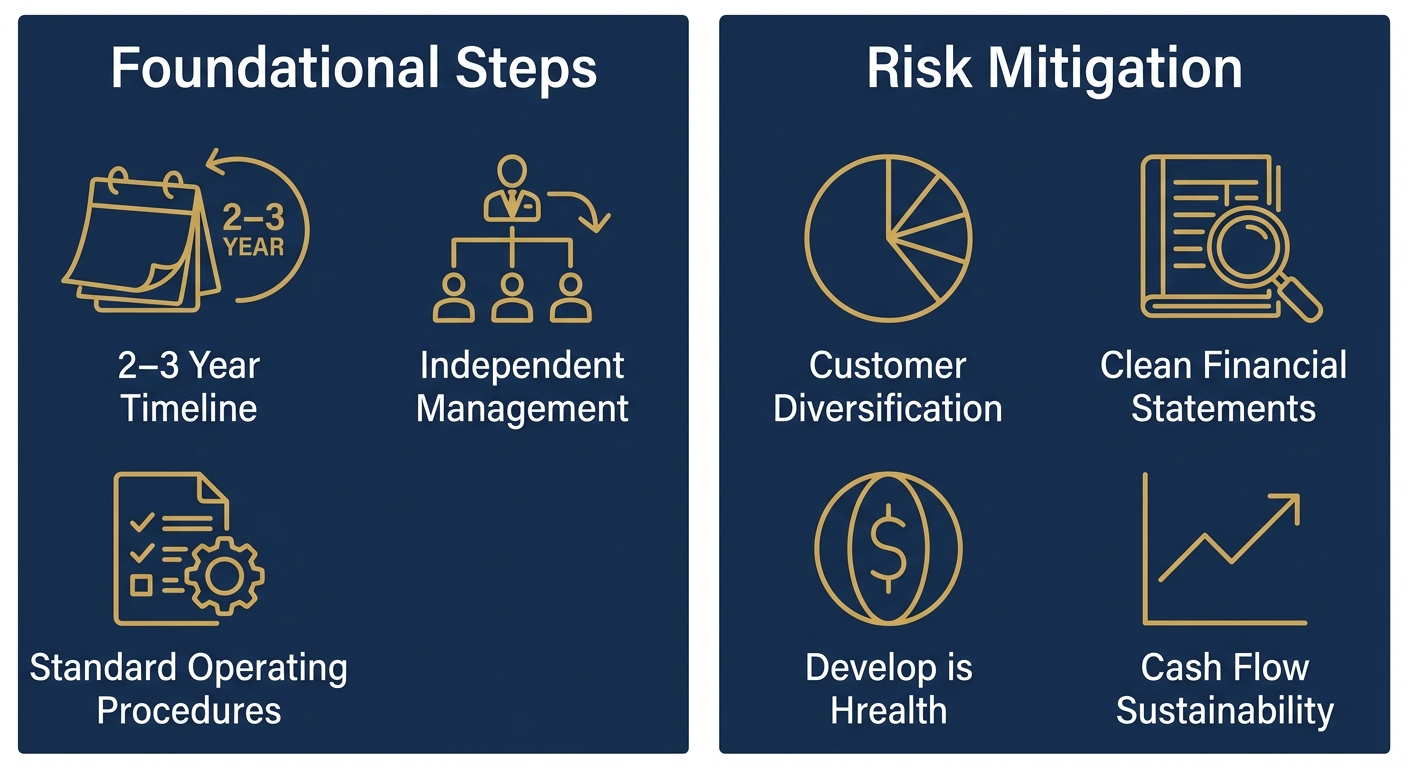
Preparing your company for a successful sale hinges on two to three years of focused work: build an independent team, diversify customers so no single account exceeds 10% of revenue, and present clean financials that demonstrate sustainable cash flow. We at Zaidwood Capital, a boutique M&A and capital advisory firm, view these criteria as fundamental.
Key preparation criteria include:
- Start two to three years before a sale, per The CEO’s Right Hand.
- Build an independent management team to reduce owner dependency, which drags valuation; AdvicePeriod confirms it’s a buyer priority.
- Diversify your client base so no single account exceeds 10% of revenue, addressing customer concentration risk.
- Implement SOPs; getting a business ready to sell requires documented processes.
- Clean up financials to present sustainable cash flow: what makes a business sellable is reliable earnings, not just revenue.
Once these key components are in place, financial due diligence becomes the focal point for potential buyers. As such, the next step is organizing the financial records in support of the sales process.
Financial Diligence and Documentation
Buyers analyze sustainability and predictability of cash flows, not revenue multiples, to evaluate a business. We review the organization of financial documents to verify earnings and ensure consistency.
What to Evaluate
Look at gross profit margins and consider supplier diversification and pricing strategies to evaluate financial health. Also evaluate the SOPs of the business to assess operational risk and processes. A business with well defined and documented procedures to manage the financials is attractive to acquirers.
How to Evaluate
Look at the historical financials to confirm GAAP compliance, audit readiness, and transparency of adjustments. Be sure to review adjusting entries to see if all one-time adjustments are clear. Reviewing normalized earnings helps support sustainable profitability. Be sure to provide a complete, organized data room with accurate, multi-year financial records to streamline the diligence process.
What the Answer Means
Meeting a buyer’s expectations for financial documentation lowers risk, raises valuation multiples, and allows a company to demonstrate operational independence and scalable management to prospective buyers. Clean, auditable records reinforce the credibility of projected earnings and position the company for a smoother transaction.
Operational Independence and Management Scalability
What to Evaluate
We help owners assess three interconnected factors that influence sale readiness: owner dependency, management depth, and documented processes. Owner dependency looks at how much daily activity depends on the founder; lower dependency signals a more transferable business. Finally, documented procedures, written standard operating procedures, reduce due diligence risks and validate that the business can scale.
How to Evaluate
Start by simulating a temporary owner absence–observe whether client relationships, sales pipelines, and day-to-day decisions remain stable. Examine the management team’s capacity to lead independently by reviewing their decision-making authority and strategic initiative track record. Next, test your Standard Operating Procedures (SOPs): have a team member execute a core process solely from the documentation. Where gaps emerge, strengthen documentation and cross-train staff accordingly.
What the Answer Means
Owner-dependent businesses often fetch lower EBITDA multiples (3-4x) compared to those with independent management and documented SOPs (6-8x). Once operational independence is confirmed, market position and customer concentration take center stage for investors.
Market Position and Customer Diversification
What to Evaluate
When preparing your company for a successful sale, acquirers assess customer concentration, recurring revenue streams, and competitive differentiation. Key metrics include revenue share of your top three clients, industry or geographic concentration, and recurring vs. project income. The CEO’s Right Hand flags any single customer exceeding 10% of revenue as a major risk; we advise owners to keep concentration below that threshold.
How to Evaluate
Calculate the exact portion of annual revenue from your three largest accounts and map sales by industry and geography to reveal hidden concentration. Review contract status to distinguish recurring contractual income from one-off project work. AdvicePeriod notes buyers prioritize sustainable recurring cash flows. We at Zaidwood Capital recommend starting diversification two to three years before an exit.
What the Answer Means
Strong diversification and recurring revenue lower post-acquisition risk and make a company more attractive to acquirers. These attributes signal a market position that can sustain cash flow independently of the founder and support premium valuation multiples. Conversely, inadequate diversification or weak positioning are red flags buyers use to renegotiate or walk away.
Red Flags Buyers Watch For
While customer diversification strengthens a company’s market position, its absence–single-customer revenue concentration above 10%–is a red flag buyers scrutinize during due diligence. Owner dependency is damaging: businesses that cannot operate without the founder receive lower EBITDA multiples. Missing Standard Operating Procedures raise concerns about scalability and make buyer evaluation difficult. Industry research indicates owners who resolve these weaknesses before going to market can shift valuation multiples from the 3-4x range of riskier, owner-dependent businesses to the 6-8x range with clean financials, diversified customers, and documented processes. These concerns lead to the critical questions a sell-side advisor must help answer.
Critical Questions to Ask Your M&A Advisor
After defining buyer red flags, make sure your M&A advisor has a strategy for addressing them. We suggest you ask these questions to your M&A advisor:
- How will you reduce customer concentration risk? Ask how you’ll diversify revenue so no single client exceeds 10% of sales.
- What steps will you take to build an independent management team? Request a plan to develop leaders and transfer founder duties.
- How do you standardize operations for due diligence? Expect written Standard Operating Procedures and key process documentation.
- What timeline do you recommend for financial preparation? Seek a two- to three-year runway to clean up financials and show consistent results.
- How will you position our growth story to maximize the EBITDA multiple? Ask how they’ll frame management, customer diversity, and market opportunity to move valuation from roughly 3-4x toward 6-8x.
Once you have confidence in your advisors’ preparatory work, the financial structure of the engagement becomes your next major concern.
What to Expect: Cost Ranges for M&A Advisory Services
Advisory fees are never one-size-fits-all, a reality that becomes clear when business owners in West Palm Beach begin preparing for a sale. Usually, in M&A work, a retainer is charged to cover the upfront costs of planning. Typically, M&A engagements also include hourly billing for specialised work outside the core mandate, and a success fee payable only at closing.
The total investment for advisory services depends on a number of factors including the complexity of the deal, the depth and scope of due diligence, the level of service required, and the overall size of the deal. Because no two deals are alike, we are unable to provide a fixed fee schedule; rather, we customize a proposal during your first consultation.
Navigating the West Palm Beach M&A Landscape
West Palm Beach has emerged as a dynamic hub for mergers and acquisitions, drawing increasing interest from institutional capital and strategic buyers. The region’s economy, fueled by sectors such as healthcare, technology, real estate, and business services, creates a fertile environment for middle-market transactions. This heightened activity demands precise local insight to identify the most promising opportunities and counterparties.
We combine deep market intelligence with a nationwide network of investors to help sellers navigate these complexities. Our on-the-ground presence in West Palm Beach allows us to gauge local buyer appetite, interpret industry trends, and structure deals that align with both regional dynamics and broader market conditions. This integrated approach helps business owners position their companies effectively, even in competitive landscapes.
Although understanding the local M&A climate is just the starting point for any business transaction, it directly informs the critical work of readying your company for a transaction.
Pre-Sale Readiness Checklist
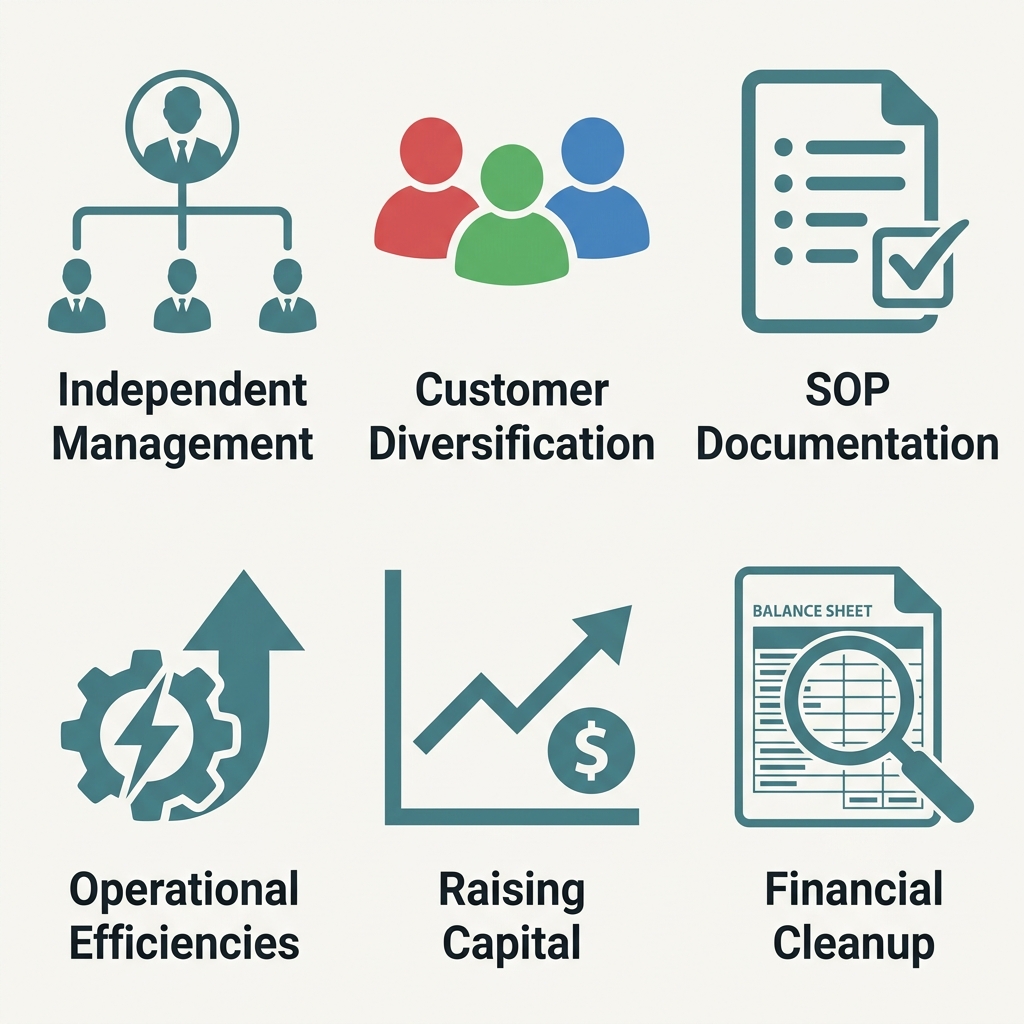
- Build an independent management team that runs the business without founder involvement.
- Diversify your customer base so no client exceeds 10% of revenue.
- Document all processes with SOPs.
- Improve profit margins through operational efficiencies.
- Raising capital before selling a business strengthens the balance sheet and buyer appeal.
Frequently Asked Questions About Selling a Business
Selling your business takes advanced planning. Here’s what owners want to know when planning their exit.
How early should I start preparing my business for sale? We recommend beginning two to three years before you plan to sell. This window allows time to clean up financial records, build an independent management team, and diversify your customer base.
How can I make my business less dependent on me? There are a number of ways to structure your business to be independent from you to increase the value of your business.
Why is customer diversification so important? If your business has reliance on a single customer for more than 10% of your revenue, that creates a significant risk to your business. Diversifying customer base demonstrates revenue stability and increases buyer confidence in future earnings.
What financial improvements are essential for due diligence? We suggest auditing your records, removing personal expenses, and showing at least two years of clean financial statements to demonstrate the sustainability of your cash flows to potential buyers.
Take the Next Step Toward a Successful Exit
We recommend beginning two to three years before a planned sale to avoid leaving significant value on the table. Start preparing your company for a successful sale by contacting us at 800-962-0418. Informational only; securities via Finalis; Zaidwood not a broker-dealer; investments may lose value.