
Table of Contents
Building a More Valuable and Sellable Business: Key Questions Answered
Building a more valuable and sellable business requires reducing founder dependency, documenting standard operating procedures, and diversifying the client base. According to Inc. business advisor Bruce Eckfeldt, these are among the factors that buyers prioritize when evaluating a company’s worth. Buyers view founder-centric operations as high-risk, so institutionalizing leadership and procedures directly lifts valuation. Understanding how to increase business value begins with these operational improvements and the strategic signals they send to acquirers.
We cover the key questions business owners have regarding how to increase the value of their business, as well as how to increase the value of their enterprise. We answer questions about leadership, systematizing and expanding business operations, and how to change a company’s market positioning. We show business owners what strategic buyers and private equity firms are focused on, providing them a roadmap on how to improve their business to successfully exit their company. Knowing how to improve the value of a business, as well as determining the worth of a business, is the first step for owners who want to create a better, more attractive company.
Understanding Business Valuation and Worth
Valuation is the basis for any successful exit strategy. The valuation professionals at Zaidwood Capital break down the core components in determining what a company is worth, both from an enterprise value perspective as well as key performance indicator analysis.
What Is the Difference Between Business Value and Enterprise Value?
Enterprise value determines the total market worth of a business, including debt and cash, with equity value representing the amount attributable to shareholders after all liabilities. Valuation multiples, such as those applied to EBITDA, are ultimately anchored to the enterprise value of a company. From a debt perspective, a company with high debt may see its valuation multiple compressed. Conversely, excess cash can enhance the deal price. We at Zaidwood Capital ensure clients grasp these distinctions to avoid leaving value on the table.
How Much Is a Business Worth With $1,000,000 in Sales?
The valuation of a business with $1,000,000 in revenue ultimately comes down to profitability and the EBITDA multiple. A company that is profitable with strong growth and has low customer concentration can command a higher EBITDA multiple. Conversely, heavy owner dependence or operational inefficiencies push the EBITDA multiple lower. Buyers of a business look at recurring revenue streams, the depth of management, documented procedures, and a diversified client base to assess stability and cash flow, mitigate risk, and ultimately determine a value of the company. No universal formula dictates worth; each business’s value emerges from its unique financial and operational profile.
How Does Reducing Owner Dependency Impact Business Valuation?
Businesses too dependent on their founder create uncertainty for buyers and elevate risk perception. Sofer Advisors reports an owner dependency discount reduces enterprise value by 10% to 40%. Appraisers also raise the company-specific risk component by an additional 2% to 10% and compress the multiple. WealthStone Group suggests mitigating founder dependence begins years prior to a sale with focused efforts to delegate, build a management team, and establish and document policies and procedures. The bar chart below illustrates the potential ranges.
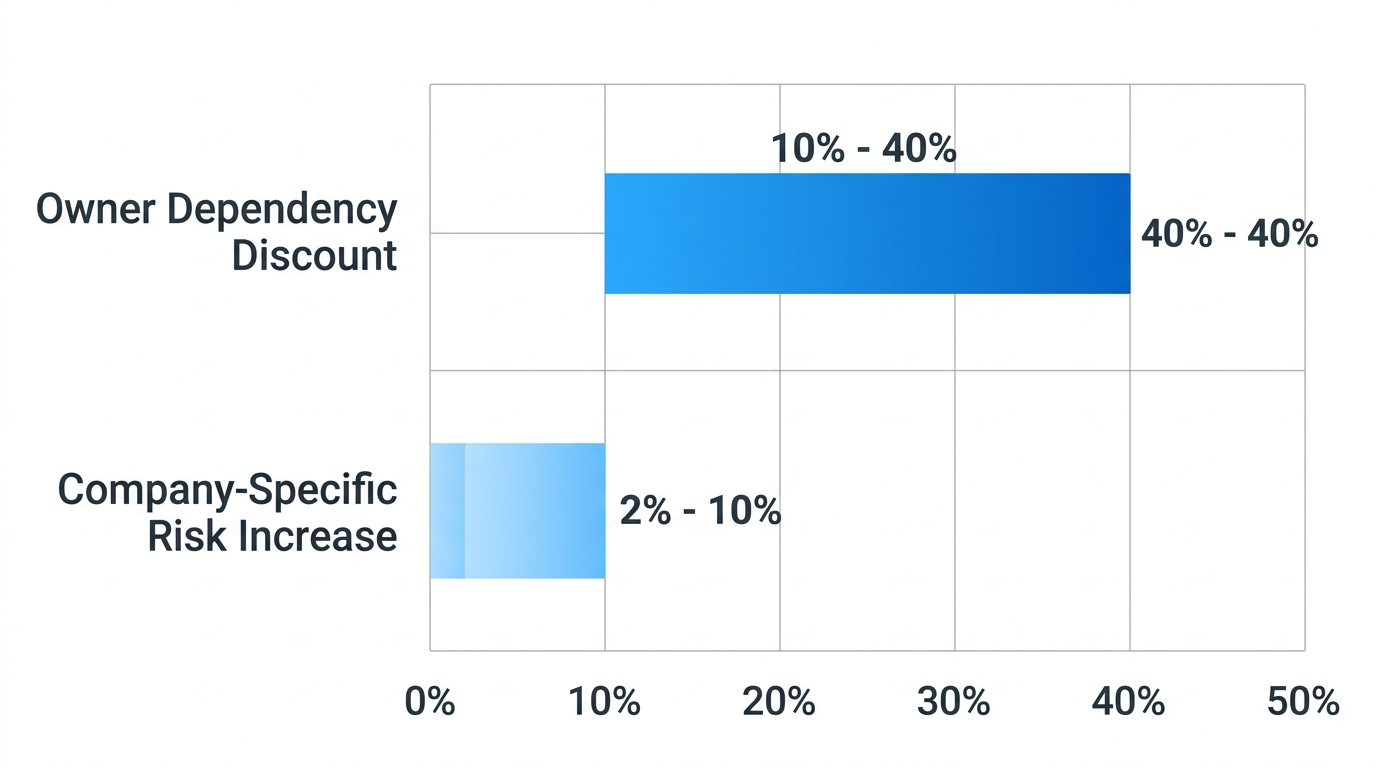
Owner dependency impact: discount and risk ranges.
Which Key Performance Indicators (KPIs) Affect Business Value Most?
KPIs affect the multiples applied to a business. EBITDA margin is one indication of profitability. A wider margin commands a higher multiple. Sustained revenue growth demonstrates momentum, and recurring revenue, such as a subscription model, provides predictable cash flow and lifts buyer confidence. Negative aspects of customer concentration impact the multiple. If a few customers dominate revenue, the effect is magnified. Lean operations improve saleability, as do operational efficiencies with labor as a small percentage of revenue. Inc. Magazine reports businesses with a diversified client base and/or institutionalized business processes command a higher value. Owners of businesses wanting to improve their business valuation and enterprise valuation should consider these KPIs.
Knowing the levers that affect value provides the foundation to take action to improve business worth.
Effective Strategies to Increase Business Value and Enterprise Value
Understanding valuation drivers allows owners to take concrete actions that boost business value.
What Are the Most Effective Strategies to Increase Business Value and Enterprise Value Before an Exit?
Strategic client diversification is a proven method to reduce revenue concentration risk; Inc. Magazine notes that diversified client bases command higher valuations. Documenting standard operating procedures improves consistency and demonstrates scalability during due diligence. Market expansion into new territories or customer segments directly drives growth, a finding supported by the Middle Market Center’s analysis of over 20,000 companies. Complementing these efforts, talent management practices–including recruitment, retention, and career pathing–maximize human capital and strengthen buyer confidence.
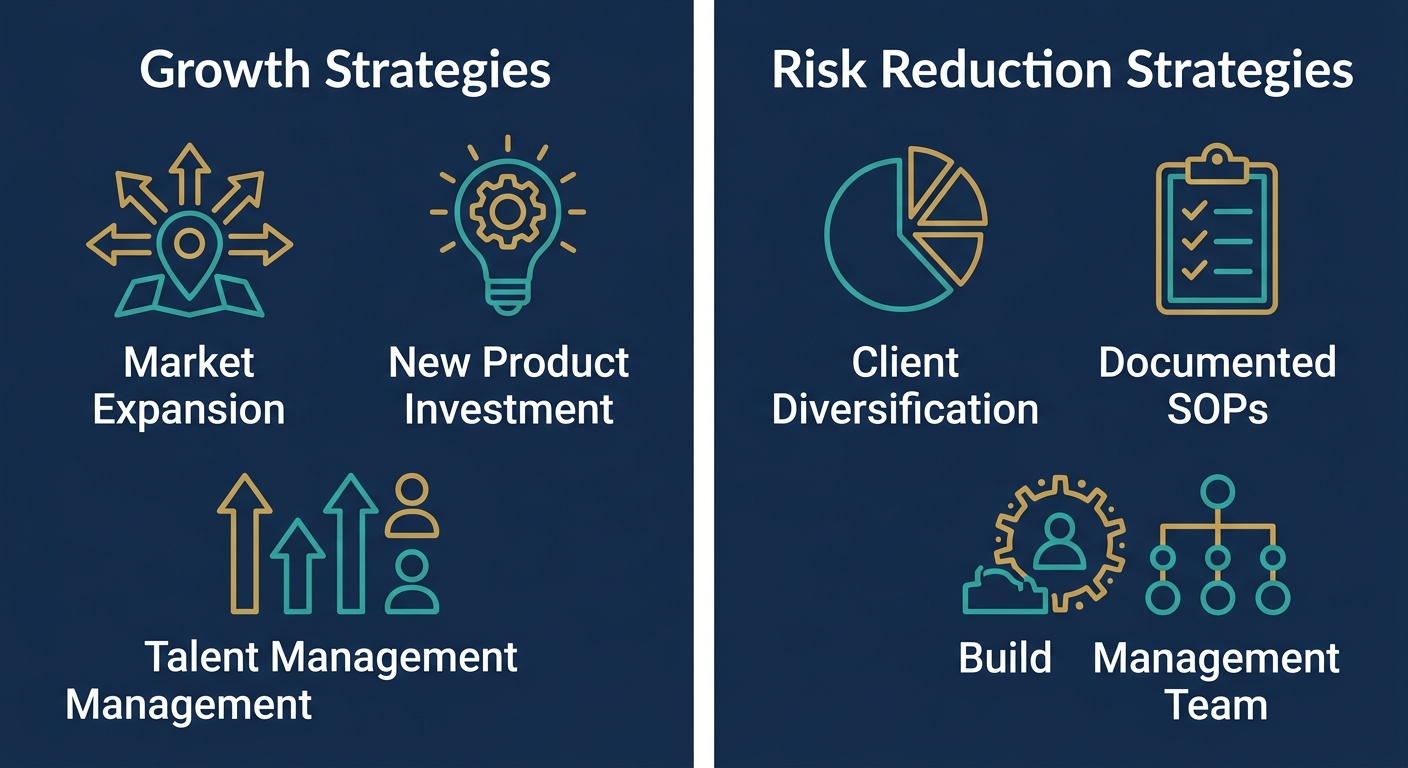
The strategies discussed improve the overall valuation of a business by improving the scalability and resiliency of the business operations.
How Can a Family-Owned Business Professionalize to Attract External Investment?
Similarly, owners of a family business are taught how to best improve the valuation of their business by means of improving governance and professionalizing the business. The family line must be drawn from the business, and an independent board with outside directors should be put in its place to provide objective oversight and best practices. Implementing best practices gives a business more appeal to the investing community. Absent these improvements family businesses often sell for a discount or deals collapse because of governance concerns.
How Can You Reduce Owner Dependency and Improve Operational Efficiency?
As Wealthstone Group notes, diminishing reliance on the owner is essential to achieving a higher valuation. This begins by delegating decision-making authority to a capable management team and documenting critical processes. Assessing dependency could be as simple as considering how the business would function in the absence of the owner for 30 days. Building a capable management team that gives the business a smooth operation further helps to alleviate dependence on the owner and gives buyers the confidence that the business will perform post acquisition. Key employees can be offered competitive compensation and benefits as well as a defined career path to retain them.
How Do Recurring Revenue, Financial Projections, and a Data Room Boost Market Value?
Diversifying the client base while maintaining a consistent level of predictability and cash flow gives the business stability and reduces risk for potential buyers. The business can create pro forma financial projections, developed with advisory input, so investors can model returns and de-risk their commitment. In a data room, organized legal, financial, and business documents provide additional comfort to potential buyers. These elements enhance the valuation of a business.
With these strategies in place, robust financial reporting and compliance validate the business, ensuring it presents the stability and transparency that buyers expect.
Financial Reporting and Compliance Standards for a Sellable Business
In our experience, comprehensive financial reporting and clear compliance standards transform an owner-dependent enterprise into an institutional-grade asset, reducing uncertainty and enabling a premium valuation.
We see that documented financial reporting and compliance processes reduce risk and signal scalability. Complementing this, a diversified client base prevents revenue concentration, a key buyer concern. Detailed procedures–from monthly financial close to compliance audits–create a transparent record that streamlines due diligence and helps acquirers project stable cash flows. This transparency reduces buyer inquiries and accelerates the deal timeline, supporting a higher valuation multiple.
Leadership independence elevates valuation: companies where the leadership team can drive financial and operational decisions without the owner command a premium. Research from the Middle Market Center indicates that market expansion and new product investment–accounting for roughly 25% of growth–alongside deliberate talent management with clear career paths, create the conditions for sustained post-sale performance. Our advisory approach integrates these financial and operational disciplines to present a compelling, investment-ready story to the market. By nurturing a deep leadership bench and reducing reliance on any single individual, we help owners build the kind of company that acquirers pursue.
Once these financial and compliance standards are in place, the next step is mapping the precise timeline required to make the business fully attractive to buyers and ready for a structured sale process that captures maximum value.
Timelines for Building a More Valuable and Sellable Business
Strong financial reporting forms the basis; the timeline for augmenting business worth is dictated by the strategic moves made today. A DNA of Middle Market Growth study used a Bayesian network model to analyze data from 20,000 companies, and identified seven managerial characteristics that differentiate high-growth companies in the middle market. While economic conditions affect all businesses, the study shows that decisions made by a company’s executives — especially in product development, market expansion, and talent — define the pace at which a company creates economic value.
Expanding the market is the most direct driver of revenue, accounting for about 25% of the growth story for most companies in the study. However, successful expansion hinges on first investing in new products and facilities. That product-innovation commitment acts as a force multiplier, because it elevates the demand for top-tier managers who can execute the new strategy. In turn, retaining those managers requires clear career-development paths and a culture that rewards growth. New products create the need for updated skill sets.
We assist business owners to map out the strategic activities that drive sellability, so they can approach the market with confidence when the timing is right.
Still Have Questions? Connect With Zaidwood Capital
If you’re committed to building a more valuable and sellable business, speak with Zaidwood Capital at 800-962-0418, contact@zaidwoodcapital.com, or 700 S. Rosemary Ave., Suite 204, West Palm Beach, FL 33401. This site is not an offer, solicitation, recommendation, or commitment to buy or sell any security. Securities are offered through Finalis Securities LLC; Zaidwood Capital is not a broker-dealer. Investments involve risk. Past results don’t guarantee future outcomes. Investors should do due diligence and consult legal, tax, and financial advisors.