
Table of Contents
Navigating the M&A Process from CIM to Due Diligence
The m and a process from CIM to due diligence begins when a seller shares the confidential information memorandum (CIM) after an NDA is signed, offering buyers a detailed snapshot of the company’s financials, operations, and market positioning. The CIM provides a general overview of a company’s operations, including financial data, and helps provide a starting point for valuation. In this process, we move our clients beyond the high-level valuation overview and assist them in reviewing and verifying several elements of the potential deal, including revenue, contracts, intellectual property, and regulatory compliance. This process often involves third-party quality-of-earnings reports, background checks, and site visits to validate the seller’s representations. Rapid response and disciplined preparations for due diligence help facilitate transactions, which, according to the Mascience M&A process overview, can close in as little as 60 to 90 days. Communication is key during the M&A process, and we manage all communication with clients and assisting parties to facilitate a smooth process and keep deal momentum. Understanding advisory costs is essential during this process.
Understanding M&A Advisory Fees and Cost Structures
A fee model used for M&A advisors outlines a structure to allow them to be rewarded based on the success of the client.
What Are the Typical Fees for an M&A Advisor?
M&A advisor fees generally fall into three categories: success fees, retainer fees, and work fees. Success fees are typically a percentage of the transaction value paid only when the deal closes, aligning the advisor’s compensation with the outcome. Retainer fees are monthly or quarterly payments that cover the advisor’s ongoing commitment, regardless of deal completion. Work fees charge for specific deliverables such as valuation reports or marketing materials on an hourly or project basis. We find that most middle-market engagements use a combination of a retainer plus a success fee, though the exact mix varies by deal size and complexity.
What Factors Influence the Overall Cost of an M&A Transaction?
The overall cost of M&A transactions is shaped by several key factors. Deal size is a primary driver: larger deals often carry higher absolute fees but lower percentage rates. An advisor’s experience and reputation also affect pricing: seasoned professionals with deep sector knowledge and a track record of successful exits command premium fees. Transaction complexity, such as cross-border elements, regulatory approvals, or multi-jurisdictional operations, increases costs due to extended timelines and additional diligence needs. Finally, the scope of services matters: a full-cycle engagement that covers strategy, buyer marketing, negotiation, and closing typically costs more than a limited advisory scope.
How Do EBITDA Multiples Affect My Sale Price?
EBITDA multiples are a core component of any analysis and valuation of a middle market company. It is quite common to arrive at an enterprise value by multiplying the adjusted EBITDA of the subject company by a desired multiple. This desired multiple is usually supported by industry comparables, recent precedent transactions, and/or a discounted cash flow analysis. Our M&A advisory team takes great effort in positioning the company and negotiating, in order to achieve the highest possible multiple. While the outcome cannot be guaranteed, our focus is on preparation of an extremely compelling investment thesis and running a deeply competitive process to maximize valuation. It is key to understand these cost and valuation dynamics to have a full understanding of the M&A process from concept and strategy to closing.
The M&A Process: From Strategy to Closing
Mergers and acquisitions unfold through a series of deliberate phases that convert strategic goals into a closed deal.
What Are the Five Stages of an M&A Transaction?
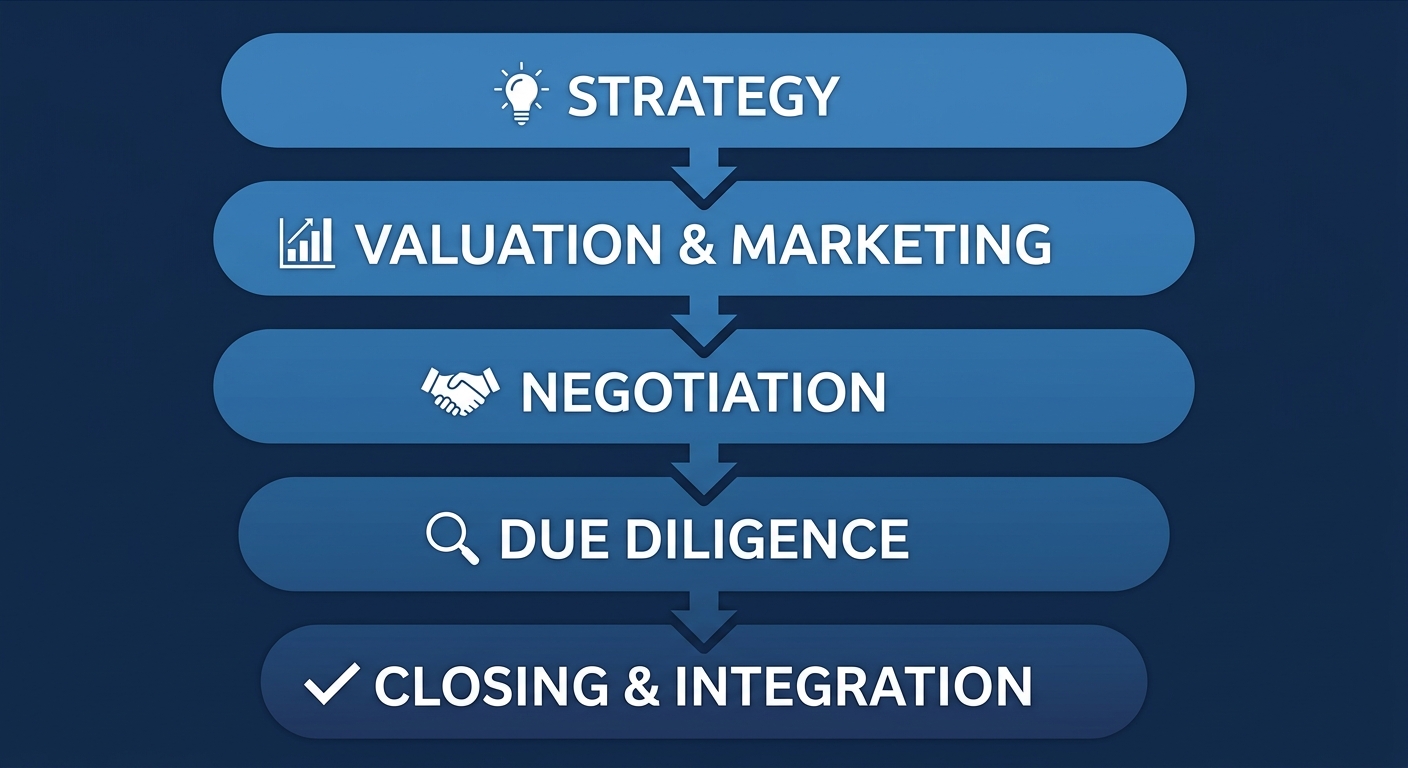
The core stages–strategy development, valuation and marketing, negotiation, due diligence, and closing with integration–guide every deal. Kison Patel of M&A Science stresses that a clear strategic mandate must come first, ensuring all subsequent actions align with the company’s goals. Once strategy is set, the business prepares and shares a confidential information memorandum (CIM) with qualified buyers under non-disclosure agreements (NDAs) to protect sensitive data. Negotiation leads to a letter of intent (LOI) with exclusivity, followed by thorough due diligence and closing. Finally, post-merger integration requires early planning to preserve synergies and retain talent. These M&A process steps form a framework we at Zaidwood Capital apply consistently.
What Are the Typical Steps in a Middle-Market M&A Process?
In middle-market transactions, the journey typically starts with clarifying the owner’s objectives–whether a full sale, partial liquidity, or recapitalization. The advisor then works with the client to prepare a comprehensive Confidential Information Memorandum (CIM) that articulates the business’s value proposition. We address buy-side vs sell-side dynamics during targeted sell-side marketing. After receiving expressions of interest, the advisor manages the due diligence phase, coordinating the data room and addressing buyer queries. The deal concludes with definitive agreements, fund transfer, and ownership transition.
How Can a Company Prepare to Maximize Its Valuation?
Early preparation directly influences valuation outcomes. Owners should start with financial housekeeping–audited or reviewed statements, clean accounting records–and commission a quality of earnings report to substantiate profitability. Building a secure data room well in advance, containing contracts, intellectual property records, and operational metrics, reduces buyer uncertainty and accelerates due diligence. Strategic positioning that emphasizes consistent growth, customer diversification, and competitive advantages can significantly raise perceived value. Patel’s guidance confirms that straightforward deals can close in as little as 60 to 90 days.
Ultimately, a well-executed M&A process depends on rigorous documentation and adherence to compliance standards throughout the transaction.
Key Documents and Compliance in M&A Due Diligence
A Confidential Information Memorandum (CIM) is the formal marketing document to qualified interested parties. It provides a comprehensive description of the business beyond the initial teaser. It provides a serious acquirer the opportunity to evaluate the business under the protection of a signed confidentiality/nondisclosure agreement.
What Are the Essential Components of a Confidential Information Memorandum?
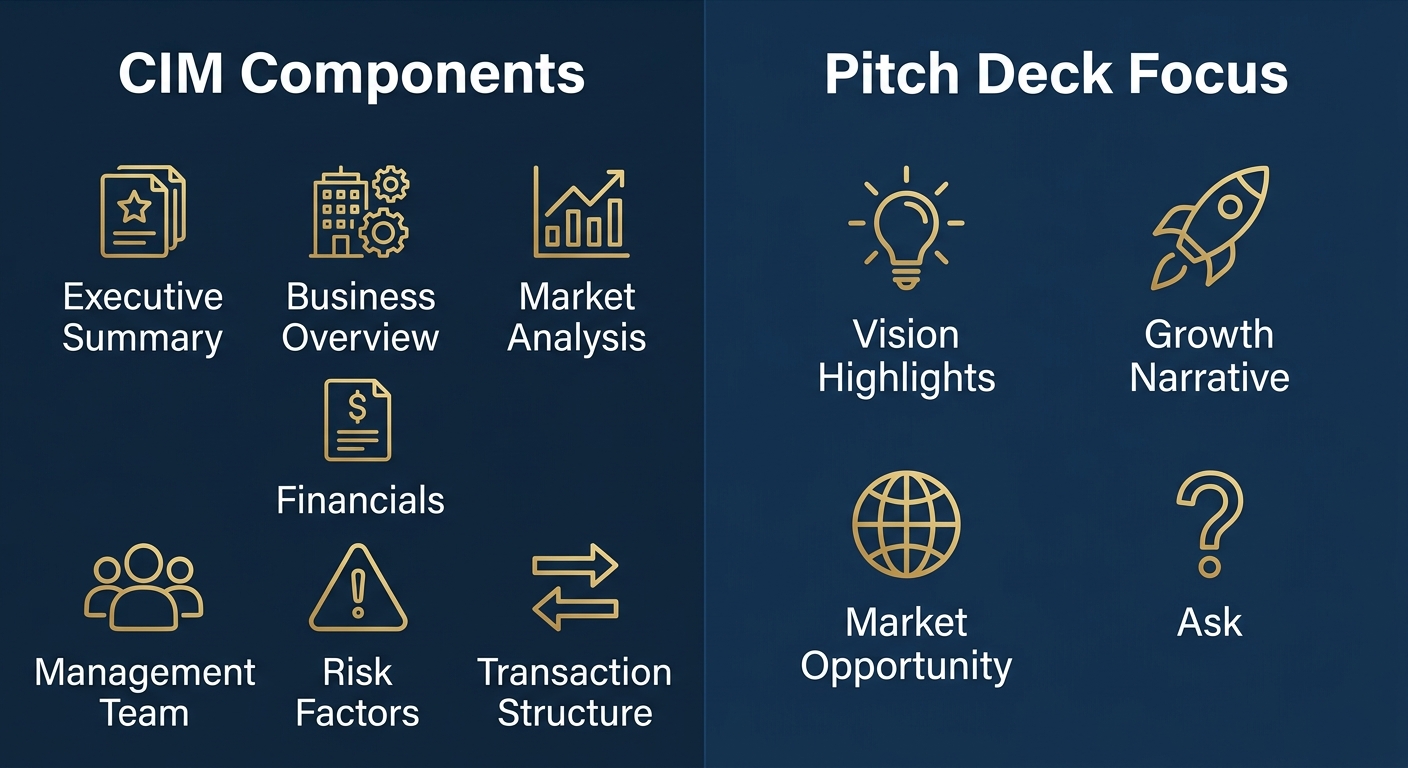
In a CIM, we incorporate components such as an executive summary, business description, market analysis, financial information (historical and projected), management team, risk factors, and the proposed transaction. Unlike a pitch deck, the CIM provides the detailed operational and financial information to support the decision.
What Key Documents Are Required in a Due Diligence Checklist?
Understanding the m and a process from the CIM to due diligence helps buyers prepare for the intensive verification that follows initial interest. We gather the due diligence checklist documents into a secure virtual data room, organizing them into indexed folders for efficient buyer review. Core categories include corporate records, audited financial statements, material customer and supplier contracts, intellectual property registrations, human resources and employment agreements, regulatory compliance filings, and documentation of any pending or threatened litigation. Non-disclosure agreements protect buyer intent and prevent information leakage throughout this phase, and straightforward deals can close in 60 to 90 days when documentation is complete.
Transactions pass through distinct stages, and delays often happen because deals haven’t been vetted thoroughly enough. Leadership can plan realistically when they understand the likely duration and the most frequent failure points.
How Long Does the Average M&A Process Take from Strategy to Closing?
A well-managed M&A timeline for a straightforward private acquisition can compress to 60 to 90 days, according to M&A practitioner Kison Patel of M&A Science. Pulled apart, the phases of the process allot 2 to 4 weeks for developing a strategic framework, 2 to 4 weeks for preparation of the confidential information memorandum (CIM), 4 to 8 weeks for marketing and identifying a strategic partner, 4 to 8 weeks for due diligence, and 2 to 4 weeks for negotiation and closing. The marketing phase can be shortened with a compelling CIM and clean financial records. Due diligence then becomes the longest stretch. A disciplined timeline not only keeps the deal on track but also signals organizational readiness to prospective buyers. Early alignment on valuation and deal structure reduces friction during later phases. A disciplined process helps communicate readiness to a potential buyer.
What Are the Most Common Reasons Why M&A Deals Fail During the Process?
Common M&A pitfalls are led by inadequate preparation. Owners who rush to market without a clear strategic mandate, a professionally prepared CIM, or a realistic valuation framework create friction that buyers quickly detect. Similarly, the preparation and execution of a truly confidential information memorandum is critical to fostering confidence among buyers and avoiding lengthening the marketing process.
The post-merger integration phase is where the greatest number of deals go poorly and many unravel. Planning for integration must begin during the due diligence process, not after closing; without a detailed integration roadmap, deal value evaporates. Even a well-drafted purchase agreement cannot compensate for mismatched cultures, poor communication, and unclear leadership structures.
Finally, unrealistic valuation expectations stall negotiations, while incomplete confirmatory diligence uncovers liabilities late in the process. External economic shifts can undermine deal economics overnight.
Early recognition of these pitfalls leads many owners to engage experienced M&A advisors.
Still Have Questions? Get Guidance from Zaidwood Capital
If you have questions, we can help. Call 800-962-0418 or email contact@zaidwoodcapital.com. Zaidwood Capital is not a registered broker-dealer and is unaffiliated with Finalis; securities are offered through Finalis Securities LLC, Member FINRA/SIPC. This website is informational and not an offer, solicitation, or recommendation; investments involve risk and are not guaranteed to appreciate; investors may lose all or part of their investment; prospective investors should conduct due diligence and consult legal, tax, and financial advisors.