
Table of Contents
Frequently Asked Questions About Letters of Intent, Earnouts & Rollover Equity Explained
Letters of intent, earnouts, and rollover equity explained: three M&A mechanisms that define how a transaction is negotiated, priced, and sustained after closing. A letter of intent is a non-binding preliminary agreement that captures the key terms of a proposed deal. An earnout links a portion of the purchase price to the target company’s future performance, helping parties bridge valuation differences. Rollover equity allows a seller to reinvest a portion of the proceeds into the acquiring entity, aligning long-term interests and preserving upside potential. In our advisory work, we see how these tools influence negotiation dynamics, risk allocation, and the long-term success of a deal. The FAQ that follows answers common questions about how to structure earnouts and rollover equity, what a letter of intent should include, and how these mechanisms affect overall transaction alignment.
Cost Questions
How do earnouts and rollover equity affect the total purchase price?
By structuring cash at closing differently, earnouts and rollover equity alter the purchase price. Earnouts postpone a portion of the purchase price, which the buyer pays if the target company meets specified financial metrics in the future. As a result, a buyer’s cash commitment is lowered. Conversely, in rollover equity, some of the purchase price is replaced by equity in the acquiring company, and the seller becomes an investor in the acquiring company. Both structures shift risk to the seller and make the total realized price dependent on future performance and market conditions. From a buyer’s perspective, these structures help them address liquidity constraints and offer an incentive to the seller to improve the business.
What are the main risks if a deal relies heavily on earnouts and rollover equity?
Relying on these structures increases risk for the seller. Earnout targets may not be reached even if the business performs well, if the acquired business is operated differently than before (e.g. through a change in strategy, investment level, or pricing). The buyer’s post-closing actions may negatively affect the metrics, and ultimately the target earnout. With rollover equity, the seller becomes a minority shareholder with limited influence; if the acquirer later raises additional capital, the seller’s stake can be diluted, eroding its value. Sellers should carefully review earnout mechanics, protective covenants, and anti-dilution provisions to prevent value erosion.
How can I evaluate the true value of an offer that includes earnout and rollover equity?
Compare the terms of an earnout and rollover equity offer to a theoretical all-cash offer to determine net present value (NPV). Estimate the probability each earnout target is met, and discount expected payments reflecting risk of non-achievement (a double discount). Assess whether the buyer can achieve synergies to make targets more attainable. For rollover equity, consider your future equity value under conservative conditions and the expected dilution and time to exit. The NPV differential quantifies the concession embedded in contingent consideration, enabling sellers to negotiate adjustments or choose cleaner offers.
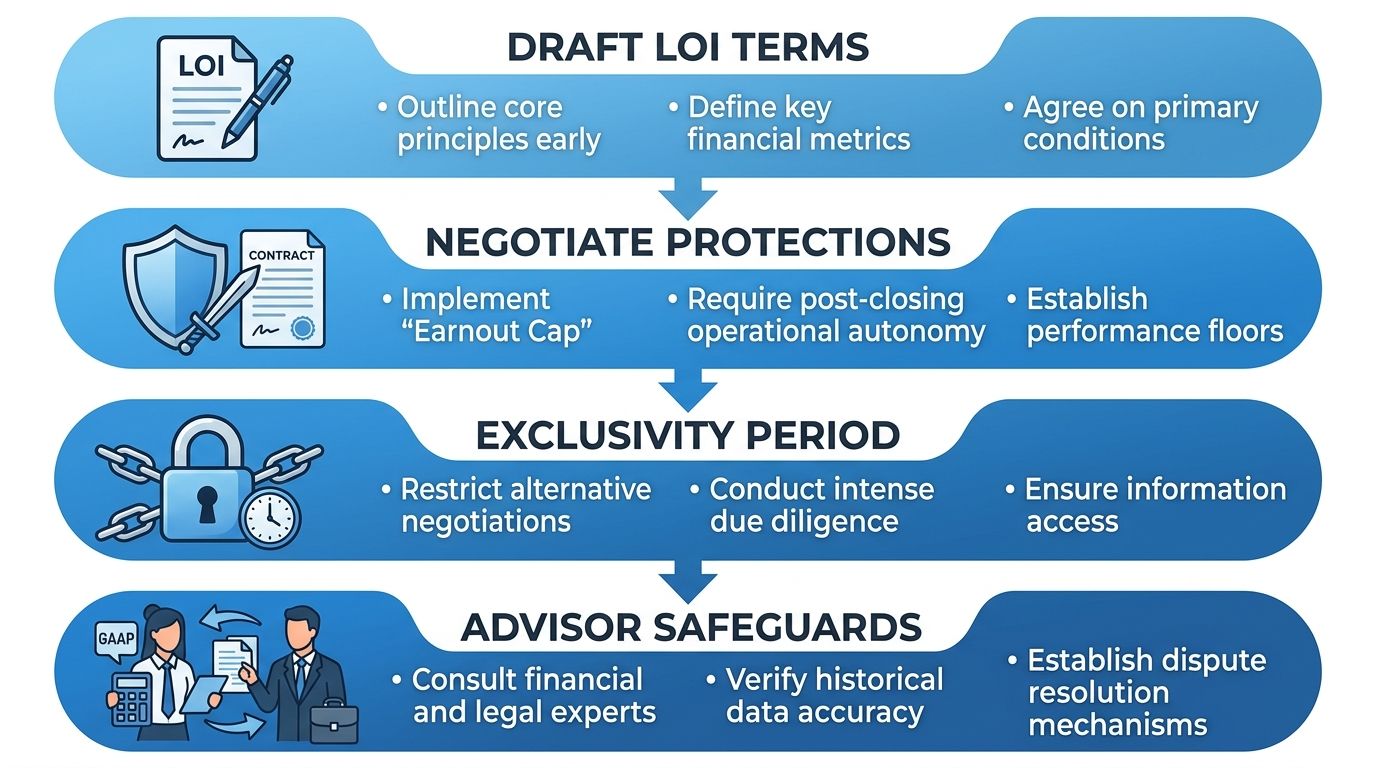
A letter of intent (LOI) lays out key preliminary terms of an agreement to be negotiated and finalized.
What does a typical letter of intent include regarding deal structure and closing conditions?
While there is great variety in the format and details of LOIs, most include the purchase price, which can be stated as a range, a formula, or both, and may include earnout provisions. The LOI may also include the retention of a percentage of equity, and the key closing conditions (e.g. regulatory approvals or financing). Other standard provisions include a no-shop provision and a working capital adjustment mechanism that accounts for balance-sheet fluctuations between the signing and closing of the transaction. Other standard provisions also include termination rights, which provide either party the right to walk away if conditions are not satisfied.
What specific terms should I negotiate in the LOI to protect my earnout and rollover equity interests?
Negotiate objective performance metrics (e.g. EBITDA or revenue) to guard against the risks of rollover equity and earnout. Insist on operational covenants that prevent the buyer from undermining those metrics after closing. If possible, gain access to the buyer’s financial records to check your calculations. An acceleration clause should make the entire earnout payable if the buyer breaches material obligations or diverts business away from the acquired unit. Also insist on tag-along rights that allow you to participate in a subsequent sale of the buyer’s shares, preserving the value of your rolled-over equity.
Why is the exclusivity period in a letter of intent so important for the seller?
A restrictive period, often called a “no-shop” clause, prevents the seller from bringing other potential acquirers to the table for a limited period. From a seller’s perspective, a long restrictive period may lead to a more thorough process and higher certainty of closing, but if the buyer fails to close the seller loses time and market momentum. Negotiating a short period, perhaps with the right to terminate if the buyer doesn’t meet milestones, helps maintain leverage and avoids the seller losing time and market momentum if the buyer fails to close.
What steps can an M&A advisor take to protect a seller’s interests during the earnout period?
An experienced M&A advisor helps protect a seller by drafting robust operational covenants that restrict buyer actions – such as cutting marketing spend or reallocating staff – and by securing reporting rights that grant ongoing access to the buyer’s financial statements and the right to independently audit earnout calculations. The advisor also negotiates dispute resolution mechanisms, including arbitration or a neutral accountant determination, and acceleration triggers that make the entire earnout immediately payable if the buyer diverts business or fails to meet contractual obligations.
Code & Permit Questions
Letters of intent, earnouts, and rollover equity are the building blocks of legal and tax provisions in the sale of a business.
Is a letter of intent legally binding in a business sale?
Provisions of a letter of intent are nonbinding and are typically restricted to price, deal structure and terms of the closing. However, exclusivity and confidentiality clauses are typically drafted as binding obligations, and breakup fees can create enforceable duties when the parties explicitly agree to them. Certain language, such as unqualified promises to negotiate in good faith, can inadvertently cross into binding territory. We recommend each letter of intent identify which provisions are binding and which are nonbinding. Engaging deal counsel during the letter of intent stage is important, as it gives the business owner the opportunity to clear up any misunderstanding regarding contractual duties.
What legal protections can be built into earnout provisions to reduce disputes?
The most effective defense against earnout litigation is drafting with precision. As Holland & Knight LLP notes, the term “EBITDA” is not always clear, and purchase agreements should provide specific examples of potential adjustments and illustrate them with calculations to remove uncertainty. Restrictive covenants that curtail the buyer’s flexibility to make significant modifications to the way expenses are classified and spent or to the way capital is spent during the earnout period shield the seller’s payout from post-closing manipulation. Disputes regarding earnouts should be resolved by a mechanism that is different from the one used to resolve the other disputes. Thus, questions of accounting and calculations should be referred to an expert, while disputes concerning bad faith should be resolved through arbitration.
What are the tax implications of rollover equity in a business transition?
Rollover equity allows a contribution of the interest to be tax deferred as a reorganization under Section 368 or as a partnership contribution under Section 721, depending on the type of entity. Typically, minority equity holders negotiate a veto right over major corporate actions, a right of observation for board meetings, and a right to tag-along on the sale of the stock; however, these represent less governance control and liquidity than full equity. Before accepting rollover equity, the implications on the ability to exercise control over the company should be fully understood.
Negotiating and drafting these contracts may be time consuming and protract the closing of a deal.
Timeline Questions
How long does the LOI negotiation phase typically take?
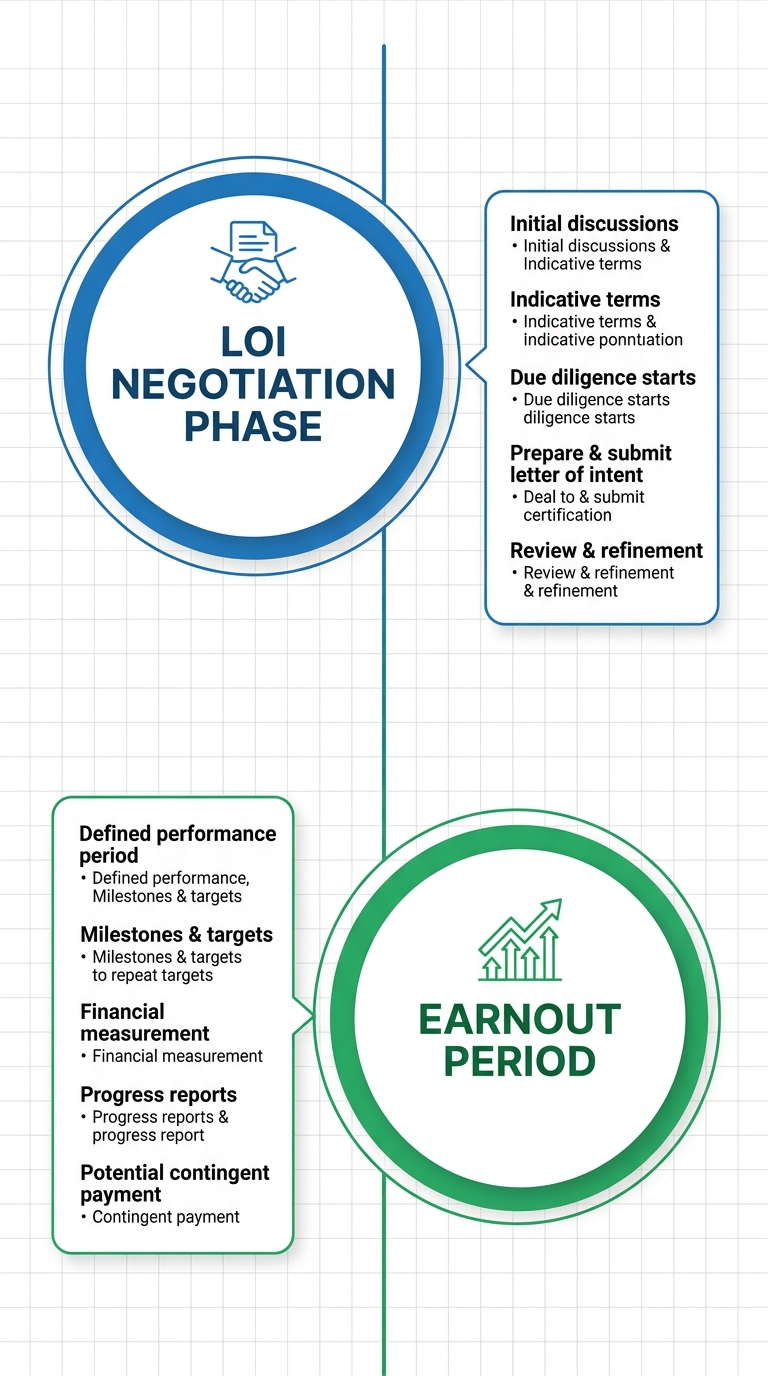
An LOI negotiation typically takes from a few weeks to a couple of months. The actual timeline depends on the complexity of the transaction and how well the seller has prepared due-diligence materials. A straightforward deal can wrap up in three to four weeks, while a more intricate transaction involving multiple bidders, complex valuation adjustments, or regulatory reviews may extend to eight weeks. In our experience, sellers who invest early in organizing documentation and engage an advisory team that drives decisiveness shorten the negotiation phase.
What is the typical duration of an earnout period in a business acquisition?
Earnouts in business acquisitions commonly run between one and three years, but the specific duration is negotiated case by case. The length should reflect realistic growth milestones, not generic averages. A one-year earnout may suit a fast-growing tech company, while a three-year period fits a capital-intensive manufacturer with longer sales cycles. We advise anchoring terms in the business’s actual trajectory rather than median market data. Understanding these ranges allows realistic negotiations, and when you’re ready to move forward, a conversation with an experienced M&A advisor is the most productive next step.
Still Have Questions? Let’s Connect
If you still have questions about letters of intent, earnouts, and rollover equity, we’re here to help. Call 800-962-0418 or email contact@zaidwoodcapital.com.
This website is for informational purposes only and is not an offer, solicitation, recommendation, or commitment to buy or sell any security or financial product. Securities are offered through Finalis Securities LLC. Zaidwood Capital is not a registered broker-dealer. Investments involve risk; investors may lose all or part of their investment. Past performance does not guarantee future results.