
Table of Contents
Introduction
Tax and entity structuring before a raise or sale determines how a transaction is taxed, which entity form attracts investors, and whether a conversion is required, so business owners should evaluate their current structure before approaching the market. The legal form of a business–LLC, C-corp, S-corp, partnership–dictates the mechanics of any capital raise or exit, from tax treatment to investor eligibility. A misaligned structure can delay a deal, create unexpected tax liabilities, or turn away the institutional investors a company seeks to attract.
At Zaidwood Capital, a boutique M&A and capital advisory firm, we guide founders through this analysis, aligning entity choice with their transaction goals and the expectations of our 4,000+ institutional investors. Investors evaluate legal structure as rigorously as financials; a clean entity form signals readiness and reduces perceived risk. The first step in this process is assessing whether your current entity structure requires a formal conversion filing.
Determining If Entity Conversion Filing Is Required
If we decide to do a Delaware C corp conversion and our legal entity type changes in Delaware, the Division of Corporations requires a conversion filing. The filing covers Delaware domestic and out-of-state entities converting to a Delaware entity. A filing cover memo must be submitted with conversion documents.
Key Delaware Statutory Sections for Entity Conversions
According to Delaware law, businesses can transform from one type of entity to another and retain their legal continuity. The Division of Corporations recognizes various structures for conversion, including but not limited to, corporations, general partnerships, limited liability companies, limited liability partnerships, limited partnerships, and statutory trusts. This authorization gives businesses the ability to adapt their structure without going through the process of dissolving and re-forming, a distinct advantage to Delaware’s legal conversion framework.
All conversion filings submitted to the Division must be accompanied by a Filing Cover Memo, a mandatory document that ensures accurate processing of the submitted forms. The Division’s official guidance confirms that the conversion process extends to both intra-state conversions among Delaware entities and transactions involving non-Delaware entities–when a Delaware entity adopts a non-Delaware form or a non-Delaware entity restructures into a Delaware entity. This inclusive scope makes Delaware a versatile hub for entity restructuring.
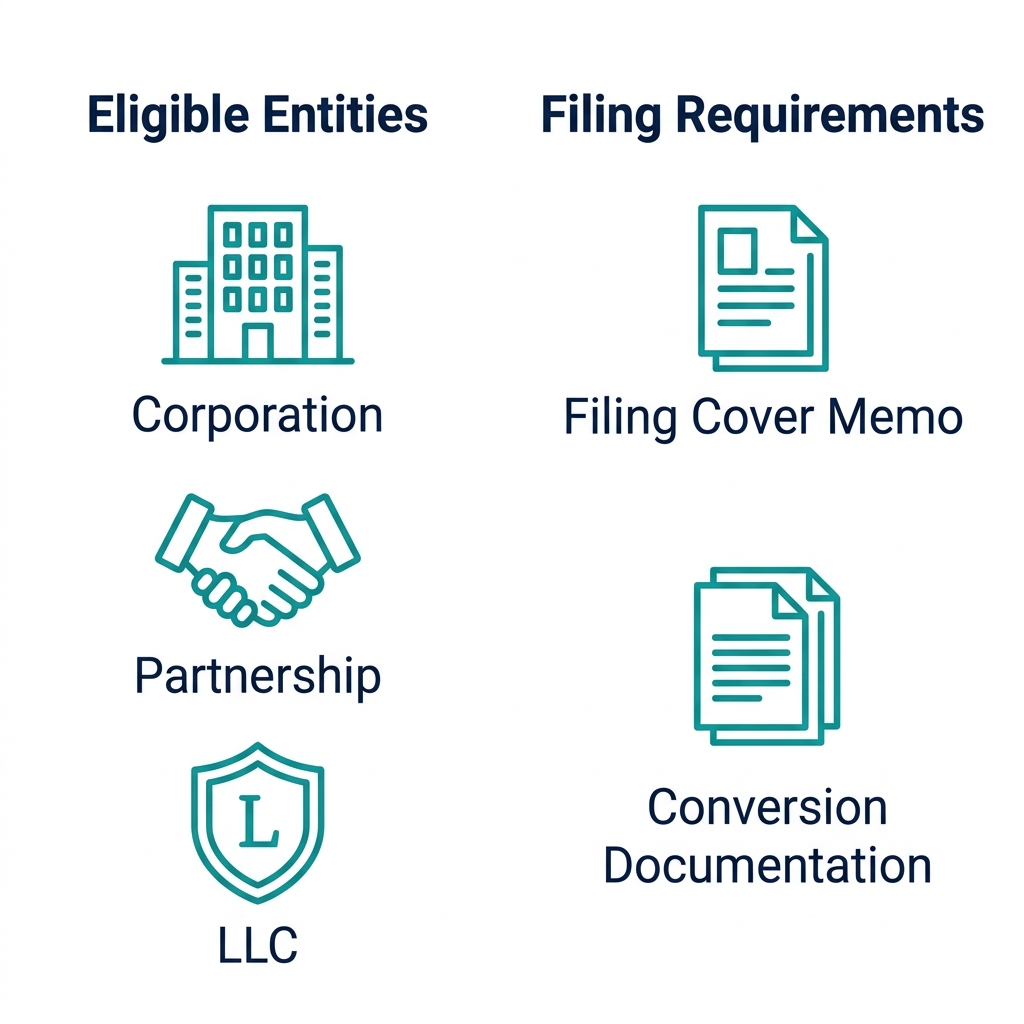
The Delaware Conversion Statutes set the foundation for the framework and processes followed for various conversion pathways.
The Delaware Division of Corporations Filing Process
When converting an entity in Delaware, the Division requires a filing cover memo and specific conversion forms. The cover memo serves as a processing directive to the Division to ensure the filing is routed to the correct area for processing and in the correct order relative to other filings.
The Division’s website provides a comprehensive list of the various forms organized by the type of entity. The forms are available for corporations, general partnerships, limited liability companies, limited liability partnerships, limited partnerships, and statutory trusts. For each conversion of an entity of one type into an entity of another (for example a non-Delaware LLC converting into a Delaware corporation) the web portal provides the direct links to the conversion documents. Delaware law permits converting corporations, partnerships, and limited liability companies into other business structures while preserving legal continuity. The forms on the Division’s website cover both conversions from one Delaware entity to another and conversions that involve non-Delaware entity types, accommodating businesses organized inside or outside the state.
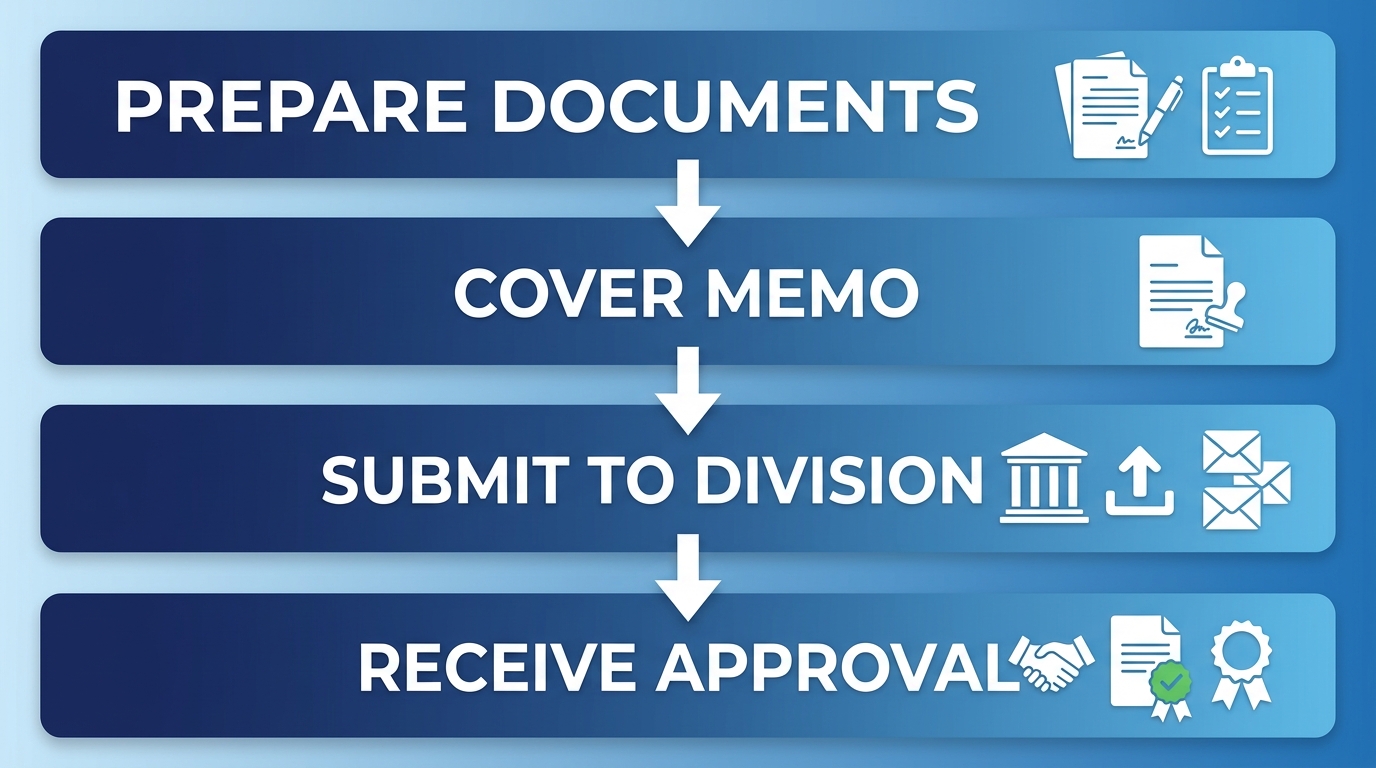
After the filing documents are complete, the responsibility for initiating the conversion process rests with management or an authorized representative of the entity.
Responsibility for Initiating the Conversion
When a Delaware entity decides to convert, the first official step is internal. The conversion process starts when the governing body of the entity, whether it is the board of directors of a corporation or the members and managers of an LLC, approves a conversion resolution. We want to bring to your attention that this internal approval is done prior to the filing of any documents with the Delaware Division of Corporations for review and acceptance of the conversion.
The Division of Corporations Review and Approval
Upon accepting responsibility for initiating the conversion, the client is required to submit the required documentation to the Division for processing. The Division permits the conversion of corporations, partnerships, and limited liability companies into other entity types, and offers forms for intra-state conversions and those involving non-Delaware entities. All submissions must include a Filing Cover Memo, which the Division requires to ensure the correct handling of each filing package. We assist our clients in preparing and organizing these documents to align with the Division’s expectations. The Division reviews the entire submission for completeness and statutory compliance; upon approval, it issues a conversion certificate that formalizes the entity’s new structure. If the submitted documentation does not meet the Division’s requirements, the conversion may not be approved, leading to potential legal and operational complications.
Consequences of Failing to Properly Convert Your Business Entity
Entity conversions that are not properly completed before a capital raise or sale can expose owners to personal liability and loss of limited liability protection.
Additionally, failing to effectuate a proper conversion may result in adverse tax consequences. For example, the lack of a proper conversion may prevent the use of the qualified small business stock rules or prevent the use of a tax-free F reorganization that may result in taxable gains or inhibit an otherwise tax-free reorganization. Conversions that have been effected improperly often require new legal and accounting costs to be undone.
From our experience, we have seen that these consequences may impact the attractiveness of an entity to institutional investors and/or purchasers, may negatively impact a fundraising effort or a venture exit. The cost of corrective filings often exceeds the expense of proper planning.
It is for these reasons that conversion filing fees are a worthwhile investment.
Understanding the Conversion Filing Fees
The Delaware Division of Corporations provides conversion forms but does not post filing fees. Filing fees vary by entity type and the manner in which the conversion is effected. We suggest reviewing the Division’s current fee schedule to determine the fee prior to submitting the filing cover memo and conversion documents. Although some might consider these fee differences to be technical, these differences encourage consideration of the effects of different entity structures.
Common Questions About Entity Structuring and Conversion
Beyond the costs associated with entity conversion filings, business owners wonder how their current structure fits into broader transaction plans.
What is entity structuring? Entity structuring is the selection of a legal and tax framework–such as an LLC, C-corp, or partnership–that governs ownership, liability, and tax treatment for a business, influencing governance and investor alignment.
Should I form a holding company before raising capital? In a holding company structure, high-value assets can be separated from operating risk; however, this setup may not match every investor’s preferences.
When is the right time to convert entity type? Ideally, conversion occurs well ahead of a planned transaction to avoid rushed tax consequences and align with long-term strategy. We recommend engaging professional advisors early in deal planning.
Begin Your Entity Structuring Journey
Transactions are smoother and better when tax-smart entity structuring occurs before a funding event. We provide this service.
Your Path to Structuring Success
Proactive tax and entity structuring before a raise or sale is one of the most impactful strategic moves a founder can make, shaping both near-term tax efficiency and long-term deal flexibility. Whether you are evaluating qualified small business stock to unlock capital-gains exclusions, a Delaware C Corp conversion to align with institutional investor expectations, a holding company structure that centralizes ownership and risk management, or an F reorganization to reorder equity interests without triggering immediate tax, each tool addresses a distinct piece of the pre-transaction puzzle. We see these strategies not as isolated tactics but as interconnected levers that, when coordinated early, help preserve more value at close.
The choices you make around entity design carry lasting consequences for how taxes are assessed and how investment structures are ultimately negotiated. Because no two ownership groups, cap tables, or exit timelines are identical, we believe professional guidance is essential before locking in a path. Our team works alongside your legal and tax advisors to pressure-test assumptions, model different structuring scenarios, and align the architecture of your business with the goals of a future raise or sale.
This website is for informational purposes only and is not an offer, solicitation, recommendation, or commitment to buy or sell any security or financial product. Securities are offered through Finalis Securities LLC; Zaidwood Capital is not a registered broker-dealer and is unaffiliated with Finalis. Investments involve risk and are not guaranteed to appreciate; investors may lose all or part of their investment. Prospective investors should conduct their own due diligence and consult legal, tax, and financial advisors and, where appropriate, a registered representative. Past performance does not guarantee future results. Corporate logos do not represent endorsements.
When you are ready to take the next step, we invite you to start a confidential conversation with Zaidwood Capital. Our team is here to help you evaluate your current structure, identify opportunities for tax-efficient planning, and build a foundation that supports the outcome you are working toward.