
Table of Contents
Selling HVAC Manufacturing and Construction Businesses: Frequently Asked Questions
Selling HVAC manufacturing and construction businesses is a structured transaction that depends on thorough preparation and accurate valuation. We guide owners through key steps–assessing true company value, preparing documentation, and managing the deal process. This FAQ addresses common questions owners in HVAC, manufacturing, and construction have when preparing to sell. Owners ask how to sell an HVAC business or how to sell a manufacturing business; we provide practical answers. As a boutique M&A and capital advisory firm, Zaidwood Capital provides the support buyers and sellers need to execute transactions. Topics include hvac business valuation, manufacturing business valuation, and construction company valuation.
- How do I determine what my HVAC or construction business is worth?
- What steps do I need to take to prepare my business for sale?
- How does an M&A advisor help in selling a business?
We begin by exploring how business valuation and profitability determine the foundation of a successful sale.
Understanding Business Valuation and Profitability
Business valuation establishes what an enterprise is worth by analyzing its financial performance, market position, and growth potential.
How Profitable Is an HVAC Business?
Profitability in the HVAC industry depends on interrelated factors that shape day-to-day operations and long-term value. The mix between service work and new installations significantly influences margins, as maintenance contracts and repair services generate steadier, more predictable revenue streams than one-time construction projects. Customer retention rates also play a critical role, since commercial clients and property managers who renew annual service agreements provide recurring income that strengthens the business’s financial profile.
Companies with established technician teams, centralized dispatch systems, and well-maintained equipment fleets operate more cost-effectively than smaller competitors.
What Is My Business Worth If It Has $500,000 in Sales?
Revenue provides a starting point for valuation, but top-line sales figures alone do not determine your company’s market value. Buyers and valuation professionals look deeper at the earnings that remain after covering operating expenses, often analyzing metrics like EBITDA to understand true cash-generating capacity.
Other factors influencing value include geographic market conditions, the quality of your customer base, competitive positioning, and whether the business relies heavily on the owner’s personal involvement. Because these variables combine in unique ways for each company, a detailed professional assessment provides the most reliable estimate of what your business could achieve in a sale.
Understanding Valuation Metrics and Market Trends
When selling HVAC, manufacturing, and construction businesses, profitability–measured by EBITDA–feeds directly into the valuation metrics that buyers rely on. At Zaidwood Capital, we help owners translate that profitability into a realistic assessment of their company’s worth.
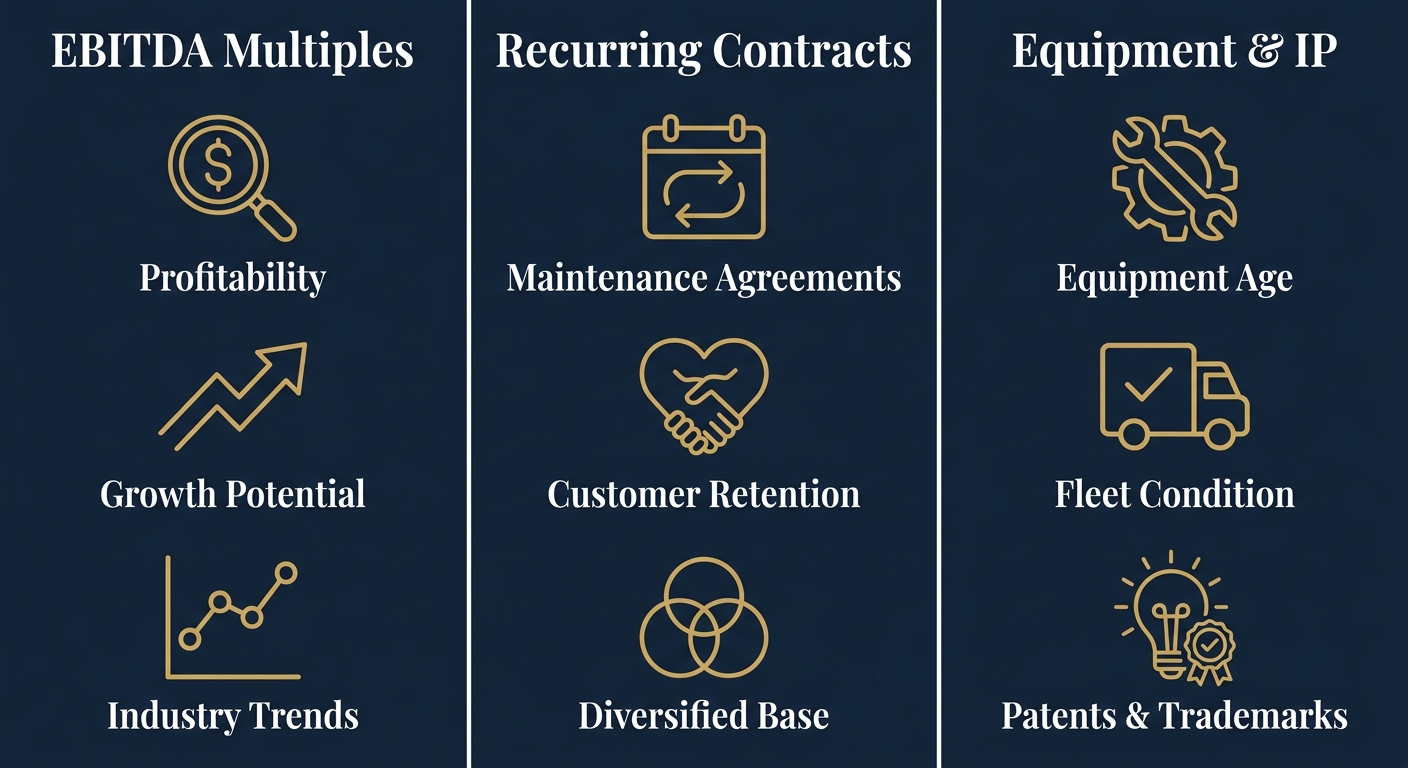
Common EBITDA Multiples for HVAC, Manufacturing, and Construction Businesses
EBITDA multiples anchor middle-market valuation, but no single multiple applies to every business. In our advisory work, we see that an HVAC service company with recurring maintenance contracts often attracts a different range than a project-based construction firm. Beyond sector, buyers weigh revenue size, margin stability, management depth, and growth outlook. Recurring revenue and a diversified client base support higher multiples, while customer concentration and erratic project pipelines can compress them.
How Recurring Contracts and Customer Base Affect Valuation
Predictable cash flows reduce transaction risk, making HVAC maintenance agreements and long-term service contracts valuable assets in a sale. A diversified customer mix–commercial, residential, and industrial–signals revenue stability and supports stronger valuations. Conversely, an over-reliance on a few large accounts can compress the multiple. We work with sellers to dissect revenue composition, quantify recurring income, and articulate the customer-base story that underscores a stable, defensible enterprise. We evaluate customer concentration risk and recommend strategies to broaden the revenue base before taking the business to market.
Equipment, Assets, and Intellectual Property in Valuation
The age, condition, and maintenance records of equipment heavily influence valuation. For a construction firm, a late-model fleet with documented upkeep suggests lower near-term capital needs; outdated machinery can trigger write-downs. In HVAC, the state of vehicle fleets and installed units matters similarly. Proprietary technology, patents, or specialized processes can add significant intangible premium. We also identify obsolete assets that may be discounted, ensuring the valuation reflects true economic potential.
Mastering these valuation drivers lays the groundwork for preparing your business for a transaction, which we address in the following phase.
How to Prepare and Sell Your Business Effectively
Key Steps to Prepare Your HVAC or Manufacturing Business for Sale
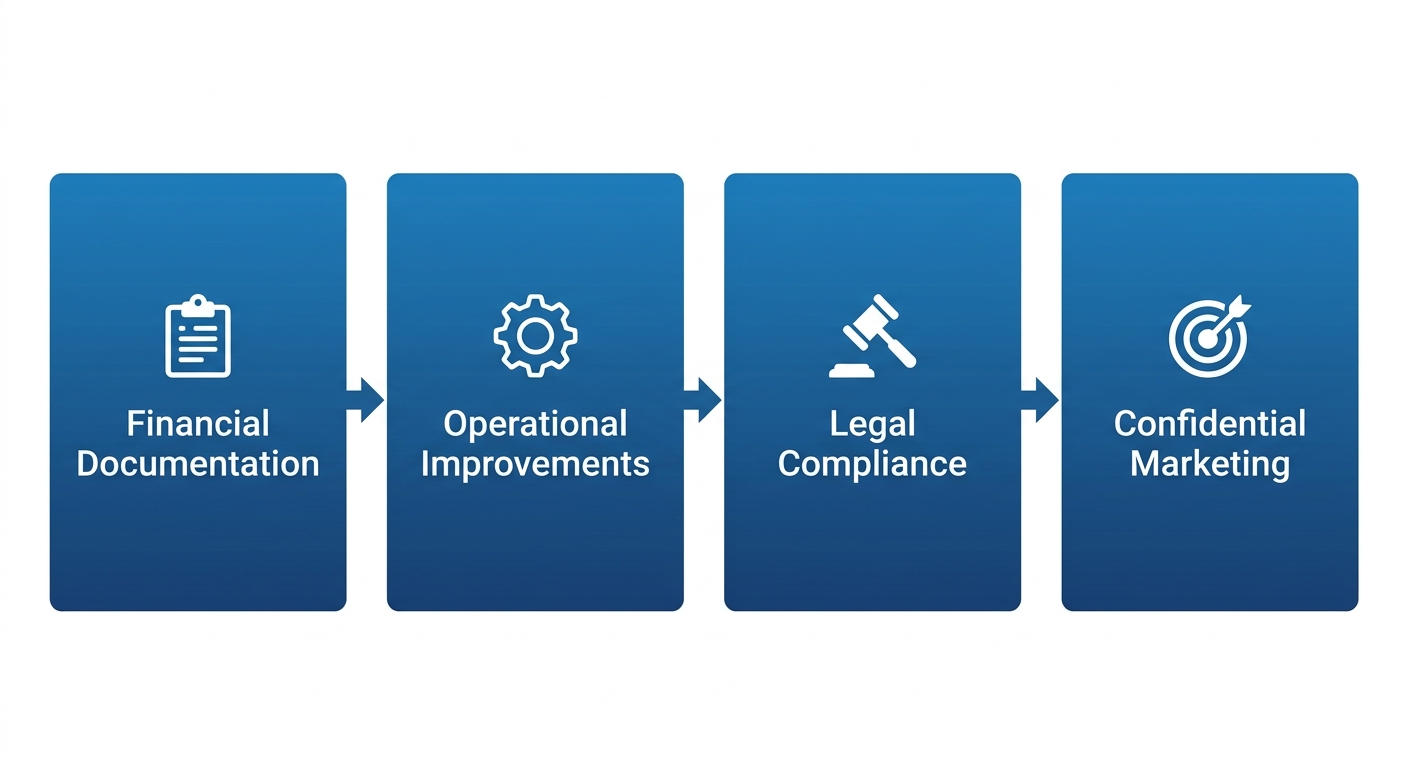
- Compile three years of audited financial statements, tax returns, and detailed sales records to demonstrate revenue trends.
- Engage legal counsel to review and organize all material contracts, including NDAs, employment agreements, and joint-venture obligations.
- Perform a quality of earnings review to normalize EBITDA and remove non-recurring expenses, giving buyers a clearer picture of cash flow.
- Implement operational improvements: diversify customers, strengthen management, and document standard operating procedures to reduce owner dependency.
- Address outstanding regulatory, environmental, or litigation matters proactively.
Documentation Needed to Market and Sell Your Company
- Three years of income statements, balance sheets, and cash flow statements (audited if available) and accompanying tax returns.
- Organizational documents: articles of incorporation, bylaws, board minutes, and shareholder agreements.
- Intellectual property schedules and registrations, including patents and trademarks.
- Employment records for key staff, benefits plans, and any history of labor disputes.
- Customer concentration data, top-customer lists, and material contracts such as supplier agreements, leases, and financing arrangements.
No good faith efforts during due diligence can void an acquisition, and can create legal exposure; we suggest full and accurate disclosure.
Finding Qualified Buyers and Maintaining Confidentiality
- Require signed nondisclosure agreements and enforce non-circumvention provisions before sharing proprietary data.
- Use a secured virtual data room to control document access.
- Qualify strategic acquirers in the HVAC, manufacturing, or construction sectors who can realize operational synergies.
- Approach private equity groups, family offices, and institutional investors from our network of 4,000+ global relationships.
- Stagger information release: confidential teaser, confidential information memorandum, then due diligence materials only to pre-vetted parties.
Regulatory and Legal Considerations When Selling
Bonding, Insurance, and Confidentiality Requirements
Due diligence is a mandatory legal step when selling an HVAC, manufacturing, or construction business. For one, selling such a business requires a good faith effort throughout the process. There are some facts that, if material, must be disclosed. Failure to do so could void the sale and lead to litigation. During due diligence, the last three years of financial records and tax returns will be reviewed, as stated in FindLaw. Material contracts–including NDAs, employment agreements, and joint venture obligations–must be organized for inspection. Buyers will also review the seller’s capacity for surety bonds and insurance. Operational risk is of interest to buyers. We recommend sellers engage qualified legal counsel and an experienced M&A advisor to assemble a documentation package that satisfies buyer requirements and protects sensitive information.
Selling Across Texas, the United States, and Locally
Selling a business across state lines, nationally, or even locally introduces regulatory layers that can influence the deal’s success. A transaction that spans Texas and Florida, for example, must satisfy each state’s entity laws and sales tax requirements. Engaging qualified legal counsel in each relevant jurisdiction is essential to ensure all statutory obligations are met. We recommend that sellers work with an M&A advisor who can coordinate the legal team and ensure the due diligence process accounts for these jurisdictional nuances. Resolving these regulatory considerations early prevents deal delays and establishes a solid foundation for evaluating transaction structures and closing timelines.
Typical Timelines and Deal Structures
Understanding the typical timeline and deal structures helps owners plan and negotiate effectively.
How Long Does It Take to Sell a Manufacturing or HVAC Company?
The sale of a mid-market manufacturing or HVAC company typically progresses through four phases. Preparation includes compiling historical financials, operational metrics, and a preliminary valuation. Marketing and negotiation then present the opportunity to a curated group of buyers, generating indications of interest. Due diligence and legal documentation follow, during which the buyer confirms financial and operational data and the parties draft the purchase agreement. The duration of each phase depends on the complexity of the business, the buyer’s financing and decision-making speed, and the broader economic environment.
Understanding Earn-out Structures in HVAC Business Sales
An earn-out is a contingent payment that depends on post-closing performance, distinct from a fixed upfront amount. Common structures include performance-based earn-outs tied to revenue or EBITDA targets, and milestone-based earn-outs linked to operational goals such as customer retention or project completion. These provisions help bridge valuation gaps and align incentives. However, sellers face the risk that future performance may miss targets, reducing the total payout. We help clients craft earn-out terms with clear definitions, measurable milestones, and realistic timeframes, protecting their upside while minimizing post-sale uncertainty. Understanding earn-out mechanics before entering negotiations allows owners to evaluate offers more accurately.
Still Have Questions? Connect With Our M&A Advisors
While every deal follows its own timeline and structure, the right advisor can make all the difference, if you are considering selling hvac manufacturing and construction businesses, our M&A advisors are ready to help you navigate the complexities unique to your industry and tailor a strategy that meets your objectives.
Contact us for a confidential discussion: call 800-962-0418 or email contact@zaidwoodcapital.com to schedule a call. We listen, assess, and connect the right professional resources to each engagement.