
Table of Contents
Selling and Valuing a Medical Practice: A Physician’s Guide to Maximizing Value
Selling and valuing a medical practice depends on distinguishing personal goodwill from transferable practice goodwill, understanding buyer types, and navigating regulatory requirements to maximize the transaction outcome. This guide covers how to sell a medical practice while maximizing value, exploring valuation methodology, buyer categories, and compliance considerations. As a boutique M&A and capital advisory firm, we bring clarity to the valuation and sale process.
EBITDA multiples are typically used for valuing a healthcare business. Practices in the primary care segment are valued at 3-5x EBITDA, while practices in other specialties are valued at 8-11x EBITDA. Allocation of goodwill between the practice and the individual (i.e. physician) drives both tax treatment and price. Buyers typically fall in the three main categories of hospitals, private equity, and other healthcare services organizations. Each of these categories has different implications on the valuation and post-acquisition structures of the business. Medical Economics notes that regulatory compliance with the Stark Law and Anti-Kickback Statute safe harbors requires structuring transactions to reflect fair market value and not base compensation on referrals. From a cultural fit, value retention, and physician goodwill perspective, the sale of the practice to an organization with which the practice has the greatest cultural alignment is of paramount importance.
From a valuation perspective, the process therefore hinges on how transferable the patient base and revenue streams are, underscoring that practice maturity and the physician’s central role in the practice are key value drivers.
Practice Maturity and Provider Dependence
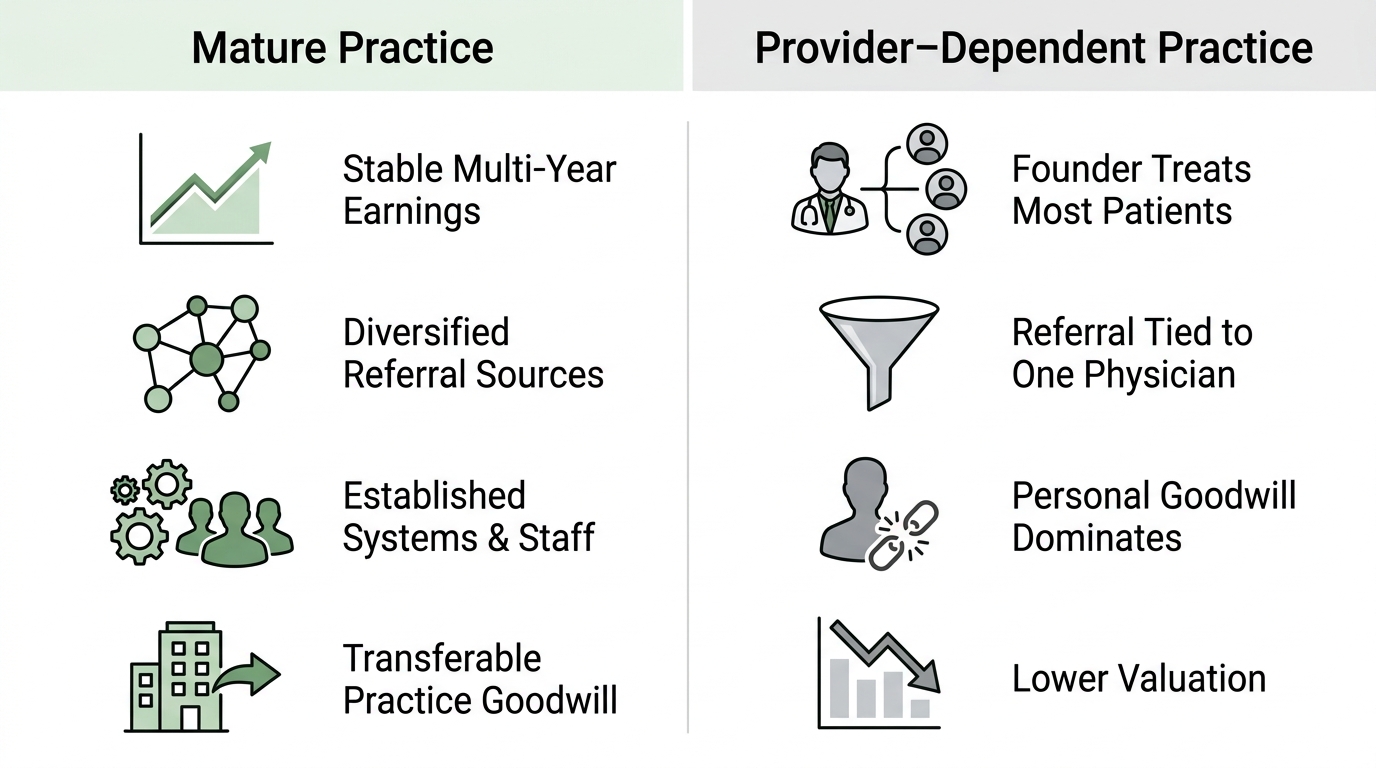
Beyond financials, practice maturity and provider dependence are qualitative factors that influence valuation. A mature practice shows stable earnings over multiple years, diversified referrals–signs of transferable value. Provider dependence, the extent to which revenue is tied to a single physician, is a key buyer risk metric.
Buyers differentiate personal goodwill, which leaves with the founder, from transferable practice goodwill. A solo physician seeing most patients draws lower offers because the goodwill is personal; a practice with multiple providers and diverse referral sources commands higher multiples, as goodwill is embedded in the business. Our advisors see how this distinction can shift EBITDA multiples when selling and valuing a medical practice.
The Stark Law’s isolated transaction exception and Anti-Kickback Statute Safe Harbors demand that a sale reflect fair market value without compensating for referrals. A mature, multi-provider practice with documented compliance programs gives buyers confidence, according to LegalClarity’s sale guidance.
These factors directly shape the quality of earnings that buyers scrutinize–payer mix stability, growth sustainability, and reliable cash flow. The maturity and independence profile is the foundation for the financial metrics evaluated in the next phase of due diligence.
Financial Health and Quality of Earnings
A quality of earnings (QoE) analysis assesses whether a medical practice’s earnings are sustainable, recurring, and likely to continue under new ownership. Normalized EBITDA, physician compensation adjustments, and revenue concentration are scrutinized by buyers and their advisors to distinguish true practice profitability from temporary or owner-dependent income streams.
A central challenge in medical practice transactions is classifying goodwill as either personal — tied to the individual physician — or practice goodwill, which transfers to a buyer. According to LegalClarity, this distinction carries significant tax implications: sellers often favor capital gains treatment by maximizing goodwill allocation, while buyers prefer asset structures allowing for stepped-up basis and accelerated amortization. When goodwill depends heavily on a single provider’s reputation or patient relationships, the transferable value shrinks, directly affecting the practice’s valuation multiple.
We see quality of earnings as the foundation for productive deal structuring. Benchmarking normalized EBITDA against industry data — where primary care practices typically trade at 3 to 5 times EBITDA and specialized practices command higher multiples — helps both parties negotiate from a position of factual clarity. A thoroughly prepared QoE analysis reduces post-closing disputes and supports financing commitments, because lenders and buyers alike need confidence that the earnings supporting the purchase price will persist after the transition.
Deal Structure, Compliance, and Legal Considerations
The structure of a sale impacts how goodwill is treated for tax purposes. Consequently, the most significant financial decision in a medical practice sale is how the sale will be structured (i.e. asset versus stock).
An asset purchase is the acquisition of select assets and liabilities of a business, with the seller retaining the legal entity. With a stock purchase, the buyer acquires the legal entity, and the seller is generally entitled to capital gains. However, stock purchases expose the buyer to unidentified liabilities of the legal entity.
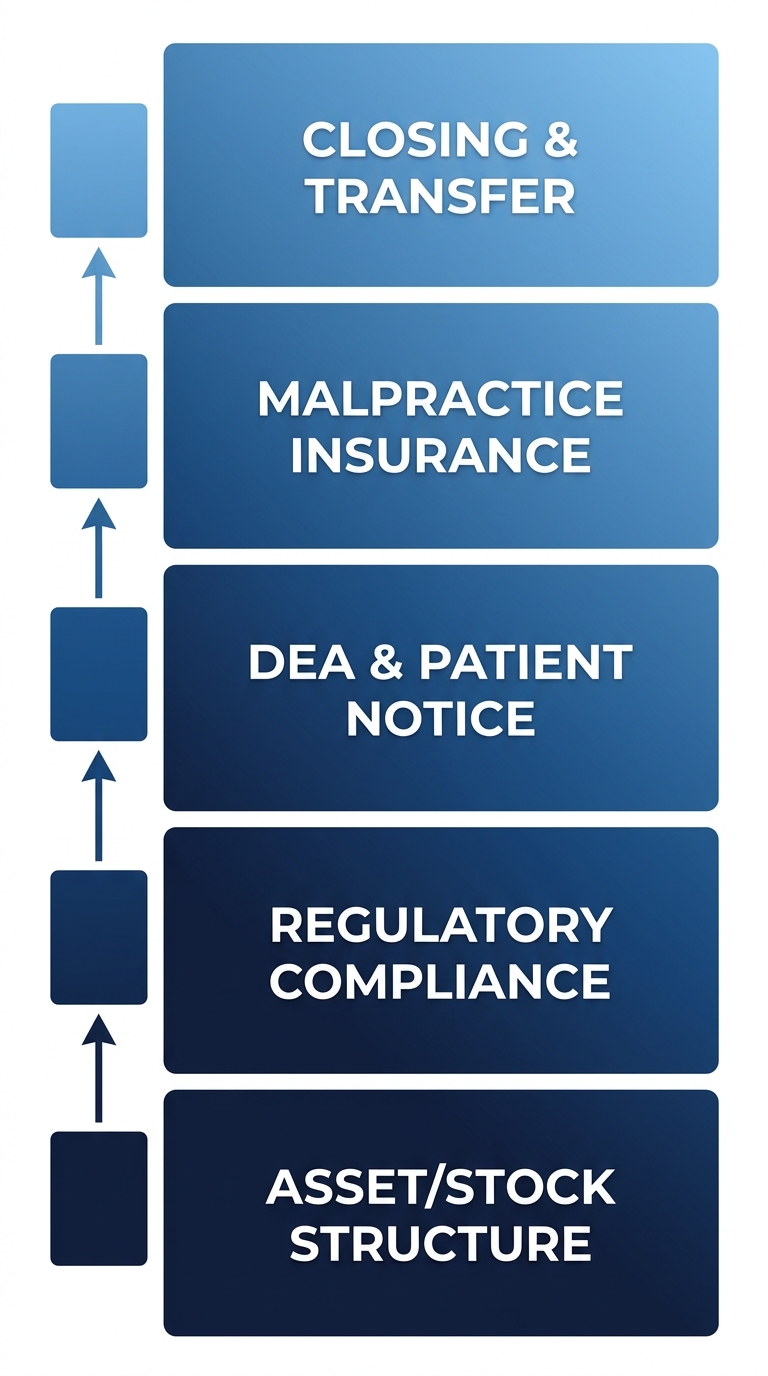
The Stark Law and the Anti-Kickback Statute mandate that the sale reflect fair market value without compensating for patient referrals, though the Stark Law’s isolated transaction exception permits qualifying one-time sales. Sellers must also transfer or terminate their DEA registration with at least fourteen days’ notice before closing, notify patients of record transfers in compliance with HIPAA, and secure malpractice tail insurance covering future claims from services rendered before the sale.
Complying with the foregoing requirements reduces the risk to the seller. However, there are a number of common pitfalls that still occur.
Red Flags: Common Pitfalls When Selling a Medical Practice
LegalClarity identifies the damaging mistakes in a practice sale:
- Sellers who fail to structure the sale to meet the Stark Law’s isolated transaction exception or the Anti-Kickback Statute’s safe harbors risk substantial fines.
- Treating all goodwill as transferable when a portion is personal to the physician results in lost capital-gains treatment and higher tax bills.
- Opting for an asset or stock purchase without analyzing the tax and liability trade-offs often leads to value leakage.
- Missing the 14-day DEA transfer deadline, neglecting tail coverage, or failing to notify patients per HIPAA and state law invites post-closing disputes.
Questions to Ask Potential Buyers and Advisors
There are differences between hospital buyers, private equity platforms, and other healthcare organizations that require inquiries that protect both financial interests and professional autonomy.
- Governance structure: Ask whether acquired physicians will hold board seats or have input into clinical and operational decisions; governance varies by buyer and affects physician autonomy.
- Regulatory compliance: If the buyer is a hospital, ask how the Stark Law and Anti-Kickback Statute framework will govern employment arrangements and any restrictive contract provisions.
- Rollover equity mechanism: For private equity offers, request an explanation of the cash-and-rollover split (typically 60-70% cash, 30-40% equity) and how rollover interests vest or convert on exit.
- Cultural alignment and retention: Ask about the buyer’s retention strategy and approach to your staff and practice identity; cultural misalignment is a cause of post-transaction dissatisfaction.
Being able to understand and identify these factors in various geographic markets is useful, especially since factors that govern buyer behaviors and valuation may vary from market to market.
Selling a Medical Practice in West Palm Beach, Florida: Local Market Insights
With the right questions prepared, sellers can now turn to the specific market dynamics that will influence their practice sale in West Palm Beach. Patient demographics and payer mix often shape valuation, with procedure-heavy specialties commanding higher consideration than primary care. We guide sellers through an assessment of operational strengths and transferable goodwill, while the local competitive landscape helps position the practice for serious buyers. An informational resource notes that the Stark Law and Anti-Kickback Statute require fair market value terms; in Florida, DEA registration transfers must be filed at least 14 days before closing. Asset purchase agreements can allow buyers to step up basis, while stock sales may simplify transition. We help clients tailor the structure to tax and liability goals. Armed with these insights, sellers are ready to assemble a detailed checklist to guide every stage of the transaction.
Essential Checklist for a Smooth Medical Practice Sale
- We verify Stark Law and Anti-Kickback Statute safe harbors.
- We separate personal goodwill from transferable practice goodwill during valuation.
- We weigh asset versus stock purchase for liability and tax balance.
- We file DEA registration transfer at least 14 days before closing.
- We coordinate patient notification, tail insurance, and IRS reporting.
The details of valuation, compliance and transaction structuring often require more in-depth examination and answers to specific questions.
Frequently Asked Questions About Selling and Valuing a Medical Practice
The following are answers to questions typically asked by physician-owners about a potential practice sale.
What types of buyers exist for a medical practice, and how do they vary?
Hospital acquisitions often involve employment arrangements, and acquisitions by private equity typically use cash (60-70%) and rollover equity (30-40%) to align incentives.
What are the types of practice sales (asset vs. stock), and how do they impact buyers and sellers?
Purchasing assets allows the buyer to limit liability, and purchasing stock can provide the seller capital gains treatment. Classifying personal goodwill (tied to the physician) versus transferable practice goodwill influences tax outcomes.
What are key regulatory rules under Stark Law and the Anti-Kickback Statute that apply?
The Stark Law’s isolated transaction exception permits a one-time sale at fair market value, while the Anti-Kickback Statute prohibits payments for referrals. Penalties for noncompliance can reach $25,000 per violation.
When is a DEA registration transfer notice required to be filed before closing?
Prior to the closing of a sale, the notice for a transfer of a DEA registration must be filed at least 14 days in advance. Failure to do so can result in penalties of up to $25,000 per violation and may delay controlled-substance handling.
Take the Next Step Toward Maximizing Your Practice’s Value
You now understand the fundamentals of selling and valuing a medical practice and the common questions that follow. To explore options, we can help clarify next steps and connect you with our advisory team. Call us at 800-962-0418 or email contact@zaidwoodcapital.com to schedule a consultation.