Zaidwood Capital

Category: Investment Banking Insights

  • Boutique vs Bulge Bracket Investment Banking: Which to Choose

    Boutique vs Bulge Bracket Investment Banking: Which to Choose

    Table of Contents

    When business owners weigh boutique vs bulge bracket investment banking options, the decision shapes every stage of a transaction. The right partner influences deal execution, alignment of interests, confidentiality, and the senior attention that is critical to achieving optimal outcomes.

    We are Zaidwood Capital. We are a boutique M&A and capital advisory firm, based in West Palm Beach. Our approach is to center our M&A and capital advisory activities on growth-stage companies, and middle market companies. Our approach, centered on growth and capital formation, contrasts with firms that rely on junior-heavy teams, providing senior oversight where it counts.

    Partners are involved in every aspect of the transaction from beginning to end. Our approach ensures that you get the senior attention your deal deserves. Having the right advisors makes the difference in structuring, negotiating and completing complex deals.

    1. Senior-Level Attention

    At Zaidwood Capital, the senior bankers you meet during the initial pitch are the same people who lead your engagement from start to finish. This means no handoff to junior coverage teams.

    Our senior bankers lead all stages of full-cycle M&A. Because of this, we make quick decisions and maintain direct and clear communication. Large firms often have so many layers that decision making becomes slow and communication breaks down. Large firms often operate with the assumption that senior bankers will be making the final decisions, so they develop frameworks and templates to capture and articulate all aspects of a deal. Because we are a smaller firm, senior bankers have the flexibility to make decisions quickly and easily, and communication is direct. This is particularly helpful during private equity exit processes because, in addition to the deal process, there are also third-party issues to manage and time is of the essence. For private equity exit processes, especially, deal making requires a partner who understands your goals and the rationale behind them; our partners are actively involved on your deal from the first meeting to the last wire.

    For mid-market business owners, this type of senior-led commitment is often the difference between a deal process that merely captures value versus one that fulfills the true worth of the company.

    2. Mid-Market Company Sales

    Mid-market company sales generally range from $10 million to $500 million. Compared to bulge bracket firms, these sales rarely justify senior-level attention, and transactions this size often do not cover the profit thresholds of large global banks. For mid-market deals, sellers often get delegated to junior members of the firm, resulting in less senior management focus on the deal.

    Our firm takes a different approach. We only work in the mid-market, and have a proprietary data and analytics platform along with a network of more than 4,000 institutional investors, including strategic buyers, private equity, family offices and SWFs, to identify and engage with the best buyers. This gives our mid-market clients a senior partner-led approach, and bulge bracket-like treatment, throughout the process. Our resources and our alignment with mid-market transaction economics gives us the opportunity to provide conflict-free and dedicated partner-led advice.

    3. Fee Structure Differences

    After a founder decides to go the mid-market sale route, an obvious follow up question is how firms charge for advisory work.

    Fee Structure Comparison: Boutique vs Bulge Bracket
    Aspect Boutique Advisory Firms Bulge Bracket Banks
    Fee composition Retainer + success-fee weight Upfront retainer, success fee lower
    Upfront retainer expectations Modest retainer Substantial retainer
    When fees are earned Retainers, milestones, closing Retainers, closing
    Flexibility in negotiating terms Case-by-case negotiation Firm-driven, limited flexibility
    Minimum deal-size appetite Accept mid-market deals Higher minimum thresholds

    Our arrangements are designed to be symmetric to your interests. Consequently, we do not publicize our rates. We would, however, welcome the opportunity to customize our terms to fit your needs for your transaction.
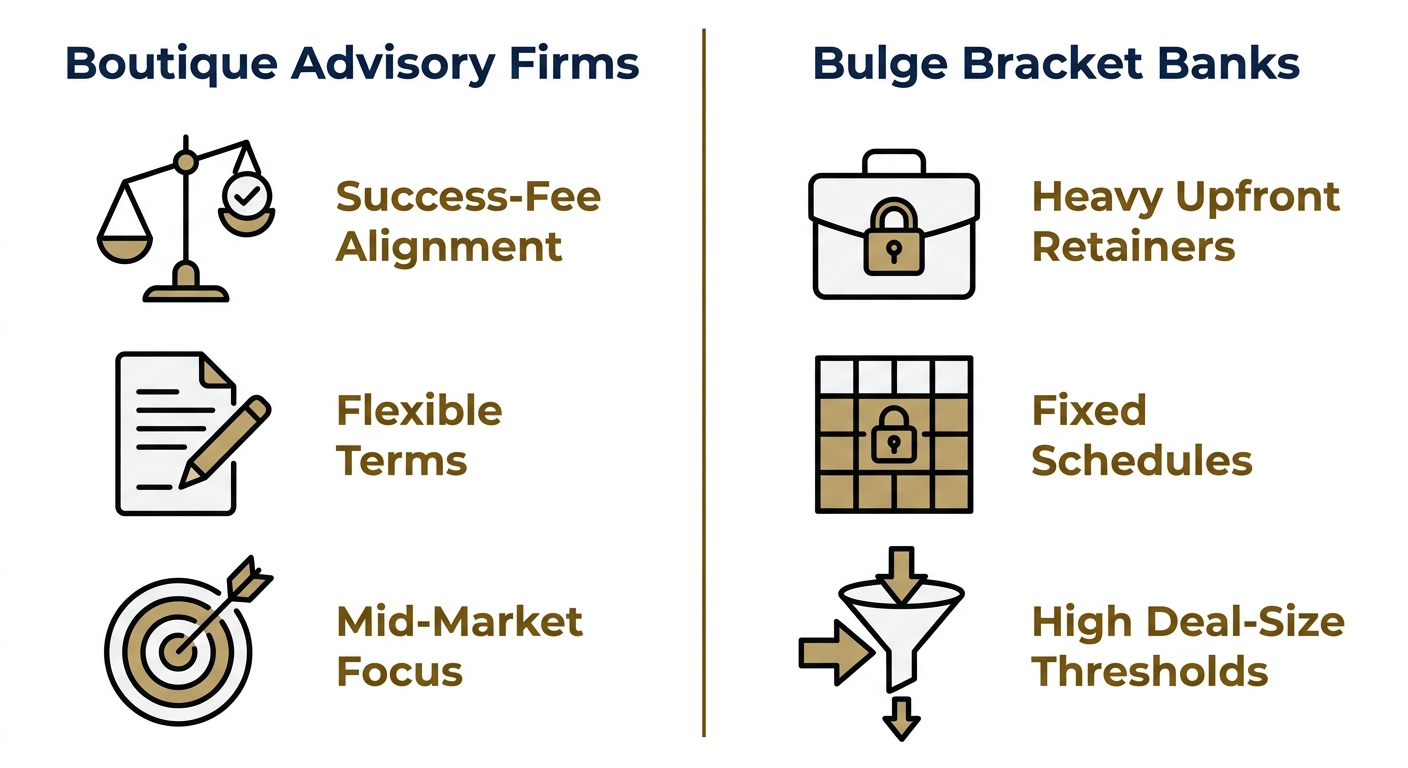
    Infographic with two columns comparing boutique advisory firms and bulge bracket banks, each with three flat outlined icons and labels covering success-fee alignment, flexible terms, mid-market focus, upfront retainers, fixed schedules, and deal-size thresholds.
    Fee structure comparison: boutique advisory firms vs. bulge bracket banks.

    4. Founder-First Advisory

    Our ‘founder-first’ approach means your engagement partners are your dealmakers. This translates to hands-on access to senior bankers for the duration of your deal process. This also means that the same people who create your strategy and lead your process are the same people who intimately understand your business.

    Larger banking platforms are often bureaucratic, with deal execution processes happening through approvals of various committees. This removes the decision-maker from the founder’s objectives for their legacy, liquidity, business growth and control.

    Our firm’s senior bankers lead the process from beginning to end. Our Precision Catalyst platform uses AI to quickly and efficiently match the right investor for the deal. The Velocity Matrix also uses a rapid-execution framework to focus and prioritize the senior bankers’ efforts. We are an advisory firm, not a broker-dealer, and our guidance is consultative, never a promise of a specific outcome.

    Due to this, the question on how senior leadership is compensated becomes very relevant.

    5. Banker Compensation Models

    When founders compare boutique vs bulge bracket investment banking, one of the most telling differences lies in how bankers are paid. In a bulge bracket, compensation is heavily tied to seniority, league table rank, and firm-wide performance, often resulting in a formulaic base-salary-plus-bonus structure. Boutique investment banks, in contrast, align pay directly with deal outcomes—an “eat what you kill” model—so a banker succeeds only when the client does.

    Our compensation structure combines a base salary with an upside potential based on deal outcomes. The model typically combines a base salary with a deal-based bonus and, for senior partners, profit sharing or carried interest. Lower overhead and leaner teams also provide us a competitive advantage. Because we don’t have a large support staff, a larger portion of the advisory economics flows to the deal makers, resulting in greater transparency on how compensation is structured. We structure compensation to mirror founder’s incentives, which shapes our behavior during a sale process, including when private equity buyers are involved, ensuring every decision serves the outcome.

    6. Private Equity Exit Paths

    Compensation reflective of value creation typically leads to an exit. We work with sponsors along four primary paths, aligned to the sponsor’s objectives.

    The four paths to an exit are a trade sale to a strategic buyer, a secondary buyout to a financial sponsor, an initial public offering, and a dividend recapitalization. Selection is a function of valuation, the state of the market, and the objectives of the seller.

    Prior to initiating the sales process, we financially, operationally and strategically prepare the target company. We assist with the creation of the data room, deliver training to the management team for the capital raising process, and assist with the development of the story and the valuation of the business. We have an active network of over 4,000 strategic and financial buyers, including family offices and sovereign wealth funds. Larger full-service banks make the mistake of devolving a significant amount of work to junior bankers. Our senior partners lead every step, preserving confidentiality and eliminating lending conflicts.

    Maintaining a disciplined process and moving quickly from preparation to close is important. The speed of execution often is what determines the viability of an exit.

    7. Deal Execution Speed

    A successful private equity exit—the kind discussed earlier—depends on more than just identifying the right buyer; it relies on the efficiency with which a transaction is executed. In the boutique vs bulge bracket investment banking difference, this efficiency is most apparent. Unlike larger institutions where deals can stall in internal queues, we assign senior partners to each mandate, eliminating layers of approval that slow response times. Our Velocity Matrix framework translates that structural speed into a disciplined, rapid-execution methodology. By streamlining diligence, market-facing activity, and negotiation, we compress timelines while maintaining thoroughness. For business owners, this means shorter market exposure, fewer distractions from running the company, and quicker access to liquidity—though no outcome is ever guaranteed. Even the most efficient process, however, is only as powerful as the investors behind it. That is why we pair execution speed with a curated network of institutional buyers, a topic we turn to next.

    8. Investor Network Access

    Deal velocity is about more than efficiency; it relies on rapid access to the most relevant capital, which is dependent on relationships. Our network of investors is not built during a mandate; we already have it, so we can quickly and efficiently connect companies with institutions.

    We have relationships with more than 4,000 of the world’s leading institutional investors, including strategic investors, venture capital and private equity, family offices and sovereign wealth funds. The aggregate capital on our platform is in excess of $15 billion. We’ll never represent capital as a guarantee. Using Precision Catalyst, we determine the investors most aligned with a company and help build a targeted client pipeline. Where larger banks often route opportunities through syndicate desks that add distance, a boutique advisory opens direct access to senior decision-makers who have the authority to commit.

    In addition, when a company is considering an advisory firm, we should evaluate a firm’s access to investor capital and the readiness of its network.

    Selecting the Right Advisory Firm

    When it comes time to choose an advisor, the difference between a boutique and a bulge bracket partner becomes extremely apparent. When considering boutique vs bulge bracket investment banking, the deciding factors usually involve the amount of senior attention and how specialized a firm can be. We discussed boutique investment banking in detail and noted a key difference is that a partner-led model places experienced bankers directly on every engagement, not just in pitch meetings. The partner on your engagement is highly specialized in your industry. We also touched on the importance of a partner’s sponsor network in the previous section. The right partner not only provides a defined process for executing a transaction, but also shapes the outcome.

    Schedule Your Advisory Consultation

    You’ve now examined the critical factors, direct senior-level attention, streamlined fee structures, and faster deal execution, that distinguish boutique advisory from bulge bracket banking. The right partner for your M&A or capital formation needs will offer investor network reach, execution speed, and founder alignment. Our senior bankers lead every engagement personally, from initial strategy through closing. With a network of over 4,000 investors and $15B+ in accessible capital, we connect you with the right counterparties. Our founder-first approach keeps your liquidity, growth, or exit goals at the center. The decision you make today shapes your transaction’s success. Start a confidential conversation with our team to explore how we can support your next move.

    Schedule Your Advisory Consultation

  • Bank Mergers Explained: Key Trends and Insights

    Bank Mergers Explained: Key Trends and Insights

    Table of Contents

    Understanding Bank Mergers in the United States

    Bank mergers in the United States are a primary driver of industry transformation, enabling institutions to build scale, cut costs, and extend their market presence. For stakeholders evaluating these moves, a clear picture of how they work and why they happen is essential.

    In the United States, bank mergers are the combination of two or more banking institutions into a single legal entity. Such transactions are typically driven by the pursuit of economies of scale, geographic expansion into new markets, or the need to comply with increasingly stringent regulatory frameworks—all of which can strengthen the combined organization’s competitive position.

    • Current bank consolidation trends show regional banks merging to compete with the largest national players.
    • Meanwhile, community banks often consolidate to pool resources and manage the rising costs of technology and compliance.

    These transactions must also secure approvals from the Federal Reserve, OCC, FDIC, and relevant state agencies, adding a layer of complexity that underscores the value of expert advisory.

    For any institution contemplating a merger, navigating these hurdles demands deep market knowledge. Beyond deal negotiation, the real test often comes during bank merger integration, where organizations must unify systems, cultures, and operations to realize the transaction’s full potential. That is where understanding what is an investment bank becomes essential — these advisors guide clients through valuation, due diligence, deal structuring, and regulatory compliance. We combine data from Sovereign Data Nexus with our Velocity Matrix to accelerate execution.

    With this foundation, we can now examine how investment banks structure and execute these complex transactions.

    Bank M&A Fundamentals: Economics, Drivers, and Deal Structures

    Building on the role of investment banks, we now examine the fundamentals that drive bank mergers—a key force reshaping the financial landscape. These combinations seek economies of scale, revenue synergies, and improved competitive positioning. By combining operations, acquiring banks can reduce overhead, expand market share, and unlock value that neither could achieve independently. At Zaidwood Capital, our Full-Cycle M&A services guide clients through these complex transactions.

    Investment banks—such as boutique firms like Zaidwood Capital—provide essential advisory services to structure and execute these deals. To understand what an investment bank does, see what is an investment bank.

    Several key drivers fuel bank M&A, as outlined in the comparison table below.

    Drivers of Bank Mergers
    DriverDescriptionExample Impact
    Economies of ScaleReducing cost-to-income ratio by merging back-office functions.Cost savings of 15–25% of combined operating expenses.
    DiversificationExpanding product lines and geographic footprint to reduce risk.Higher fee income ratio; lower net interest margin volatility.
    Regulatory ComplianceSpread fixed compliance costs across a larger asset base.Reduction in compliance cost per dollar of assets.
    Technology ModernizationInvesting in AI, digital banking, and cybersecurity at scale.Faster customer acquisition and lower IT unit cost.

    Economies of scale remains a primary rationale: by consolidating back-office operations, merging banks can reduce their cost-to-income ratio, with CFA Institute research indicating potential cost savings of 15–25% of combined operating expenses. Diversification through geographic or product-line expansion stabilizes earnings, lowering net interest margin volatility and boosting fee income ratios. Expanding into new geographies or offering wealth management and treasury services smooths revenue streams, making the combined institution more resilient to interest rate cycles. The fixed costs of regulatory compliance can be spread over a larger asset base, driving down the per-dollar compliance burden—an increasingly critical advantage. Technology modernization underpins many recent transactions; after a merger, the combined entity can invest more heavily in AI, digital banking, and cybersecurity, achieving faster customer acquisition and a lower IT unit cost. Successful bank merger integration demands seamless harmonization of systems and cultures to realize these technology benefits. Together, these drivers create a powerful case for consolidation, reshaping the competitive landscape for regional and national banks alike.

    In terms of deal structure, three common arrangements dominate. Stock-for-stock mergers—the most prevalent—exchange the acquirer’s shares for the target’s equity, preserving cash and aligning shareholder interests. Cash acquisitions, often used when the buyer has ample liquidity, provide a clean exit for target shareholders. Mergers of equals feature shared governance and a balanced exchange ratio, though careful negotiation of management roles is critical. Each approach carries distinct tax, accounting, and governance implications that require expert advisory. We at Zaidwood Capital tailor these structures to each client’s strategic objectives, ensuring full-cycle steering from valuation through integration. Our Boutique M&A and Capital Advisory Firm brings cross-border expertise to navigate these complexities.

    These bank consolidation trends reflect an industry-wide push for resilience and efficiency. Understanding how consolidation reshapes competitive dynamics helps dealmakers identify value creation opportunities. With a firm grasp of the economic drivers, we turn to the valuation methods used in bank M&A.

    With a clear understanding of the strategic drivers behind bank mergers, we now turn to the regulatory landscape that governs these transactions. Navigating the regulatory approval process for bank mergers requires a thorough understanding of the agencies involved and their requirements. Our Full-Cycle M&A advisory includes guiding clients through these complexities.

    Key Regulatory Bodies and Their Roles

    The United States bank merger regulatory approval process involves several key agencies, each with distinct jurisdiction. The Federal Reserve Board has authority to approve mergers involving bank holding companies and state-member banks. The Federal Deposit Insurance Corporation (FDIC), which enforces key FDIC bank merger regulation, approves mergers involving insured state non-member banks. The Office of the Comptroller of the Currency (OCC) is responsible for national banks, while the Department of Justice (DOJ) reviews every transaction for potential antitrust concerns under the Clayton Act and Sherman Act. The Federal Reserve’s analysis emphasizes competitive effects and the convenience and needs of the community, while the OCC places particular weight on capital adequacy and future earnings prospects. The FDIC, on the other hand, evaluates deposit concentration and the potential impact on the Deposit Insurance Fund.

    The following table summarizes each regulator’s role:

    Regulatory Bodies Overseeing Bank Mergers
    Regulatory BodyRole in Bank Merger ApprovalKey Considerations
    Federal Reserve BoardApproves mergers involving bank holding companies and state-member banks.Must consider competitive effects, financial condition, and CRA performance.
    FDICApproves mergers involving insured state non-member banks and interstate mergers.Assesses deposit concentration, community impact, and management capabilities.
    OCCApproves mergers involving national banks.Evaluates capital adequacy, future earnings prospects, and convenience/needs.
    DOJReviews antitrust implications of any bank merger.May challenge mergers that materially reduce competition in a relevant market.

    Understanding which regulator has primary oversight is essential, as filing requirements vary. For instance, applications to the Federal Reserve often require form FR Y-2, while the FDIC mandates Form 6300/04 for non-member bank transactions; the OCC uses the Interagency Bank Merger Act Application. Our team at Zaidwood Capital helps clients prepare these submissions correctly from the outset.

    The Application and Review Process

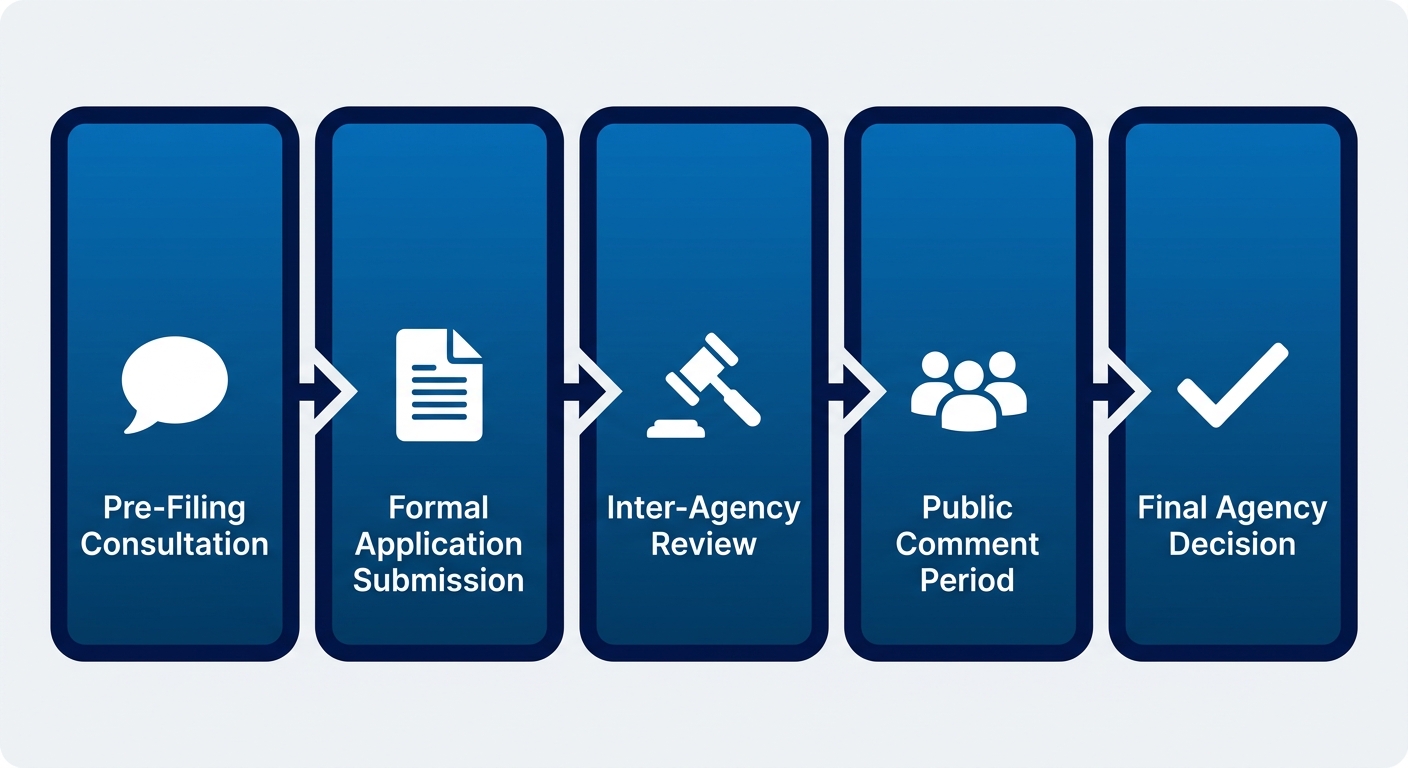
    The Bank Merger Act (12 U.S.C. § 1828(c)) requires pre-approval from the appropriate federal banking agency before any regulated merger can close. The process begins with a pre-filing consultation to discuss scope and concerns. Following this, the formal application is submitted with detailed financials, pro forma ratios, and a comprehensive description of the transaction.

    Once submitted, the application undergoes inter-agency review. The primary banking regulator evaluates safety and soundness, competitive impact, and community convenience. The DOJ simultaneously reviews antitrust implications and may sue to block anticompetitive mergers. A 30-day public comment period follows, allowing community input. The agency weighs comments alongside its own findings and assesses the plan for bank merger integration as a sign of management strength.

    Five-stage horizontal process-flow for bank merger regulatory approval from pre-filing to final decision.

    Navigating the bank merger regulatory approval process in five stages.

    Throughout the review, our advisors leverage the Velocity Matrix to track milestones and ensure every regulatory request is addressed promptly.

    Community Reinvestment Act Considerations

    A bank’s Community Reinvestment Act (CRA) performance rating plays a critical role in merger approval. Regulators must consider the institution’s record of meeting the credit needs of its entire community, including low- and moderate-income neighborhoods. A rating of Outstanding or Satisfactory supports the application, while a rating of Needs to Improve or Substantial Noncompliance can trigger delays or outright denial. According to the FDIC, CRA performance is evaluated over a multi-year period and includes both lending and service activities.

    To mitigate CRA-related risks, we recommend a thorough CRA self-assessment, strengthened community development lending, and robust documentation of community support. Glen Ellyn Bank’s M&A guide notes that early regulatory engagement on CRA issues can prevent last-minute surprises.

    Timeline and Best Practices for Approval

    The approval timeline for a bank merger typically spans four to nine months. The initial review takes 30 to 60 days, followed by a 30-day public comment period, with a final decision within 60 to 90 days. Given current bank consolidation trends, the timeline may be influenced by market concentration data. Proactive measures accelerate the process. We recommend early communication with regulators, precise form preparation, CRA documentation, and community outreach. Our Velocity Matrix streamlines regulatory documentation and tracking to reduce delays. Once regulatory approval is secured, the focus shifts to integrating operations and capturing synergies—a topic we cover in the next section.

    Executing Bank Merger Integration: Strategies for Success

    After finalizing the deal structure, the critical phase of integration begins. Bank merger acquisition strategies 2026 must evolve beyond simple consolidation to address the complex interplay of people, processes, and technology. As a Boutique M&A and Capital Advisory Firm, we understand that the difference between a successful combination and a value-destroying merger often lies in the rigor and foresight applied during the first 100 days of integration. Success in bank mergers requires a dedicated framework that aligns leadership, retains essential talent, and consolidates core infrastructure without interrupting customer service or eroding market confidence.

    Pre-Merger Integration Planning

    Effective integration starts well before regulatory approval. We advise clients to establish a dedicated Integration Management Office (IMO) with clear decision-making authority at least 60 to 90 days prior to deal close. This team develops the blueprint that defines cost synergy targets—such as branch network consolidation and back-office efficiencies—and revenue cross-sell objectives across combined product lines. It is important to note, however, that projected synergies depend heavily on execution quality and market conditions; they can lead to significant value creation but require realistic baseline assumptions. The IMO should appoint workstream leads for operations, technology, compliance, and culture, each accountable for milestone delivery against a unified timeline.

    Cultural and Operational Alignment

    Cultural misalignment remains one of the most underestimated risks during bank consolidation trends. We recommend conducting structured cultural assessments of both institutions to identify gaps in leadership style, risk appetite, and employee engagement. From these findings, leadership should develop a joint cultural statement with input from employees at all levels—not just the C-suite. Retaining key talent is equally critical: early retention packages and transparent career pathing can significantly reduce regrettable turnover. For bank merger integration to succeed, operational alignment must complement cultural harmonization. This means consolidating branch networks within 90 days where overlap exists, standardizing policies and procedures, and creating a single operating model that frontline staff can adopt quickly.

    Technology and Systems Consolidation

    Technology integration represents both the greatest opportunity and the most substantial execution risk in bank mergers. We advocate a phased migration approach that prioritizes customer-facing digital channels and core banking platforms. Data integrity must be verified through rigorous parallel testing before any system cutover; a single data reconciliation error can erode customer trust and trigger regulatory scrutiny. Our Full-Cycle M&A methodology leverages the Sovereign Data Nexus to maintain secure, auditable data environments throughout consolidation. The sequence typically begins with email and communication systems, proceeds to treasury and risk management platforms, and concludes with long-term core banking migration. Testing protocols should include simulated transaction volumes, penetration testing for cybersecurity vulnerabilities, and fallback procedures for rapid rollback if anomalies appear.

    The following table contrasts integration strategies across three critical dimensions: operations, technology, and culture.

    Post-Merger Integration Strategy Comparison
    DimensionStrategyKey Success Factors
    OperationsConsolidate branch networks and back-office functions within 90 days.Clear communication to employees; unified policies and procedures.
    TechnologyMigrate core banking systems and data to a single platform.Rigorous testing; data integrity checks; parallel runs before cutover.
    CultureDefine combined values, leadership alignment, and retention programs.Employee listening sessions; cultural KPIs in performance reviews.

    Operations consolidation delivers the fastest visible efficiencies, but technology migration creates the long-term platform for scalable growth. Culture, though hardest to measure, ultimately determines whether the combined institution can execute on the other two dimensions effectively.

    Measuring Post-Merger Performance

    Tracking integration progress demands a focused set of KPIs that link directly to deal thesis assumptions. We typically monitor cost synergy realization as a percentage of the original target, employee turnover rate (with particular attention to key-person retention), customer retention rate across product categories, and system downtime metrics during migration windows. Monthly steering committee reviews should compare actual performance to the IMO baseline plan, with variance explanations required for any deviation exceeding 5%. Post-merger reviews conducted at six and twelve months help capture lessons learned and refine the integration playbook for future transactions. With these strategies in place, the focus shifts to monitoring and realizing the full deal value.

    This content is for informational purposes only and does not constitute investment advice.

    Advanced Topics in Bank Mergers and Acquisitions

    When evaluating advanced aspects of bank mergers, it becomes clear that regulatory and integration complexities demand a strategic approach. At Zaidwood Capital, we apply our Full-Cycle M&A methodology to help financial institutions navigate these challenges effectively.

    Navigating the Federal Reserve’s merger approval process is a critical first step. The Fed requires detailed applications, public comment periods, and thorough community impact assessments to ensure proposed combinations do not harm local credit access. Understanding the intricacies of Federal Reserve bank merger approval is essential for any institution considering a transaction. Drawing on our experience advising on healthcare M&A, we recognize that regulatory shifts—such as amendments to the Community Reinvestment Act and enhanced prudential standards—can significantly alter deal viability and integration planning. At Zaidwood Capital, we have observed how these evolving rules reshape the competitive landscape and require proactive compliance strategies.

    Once regulatory clearance is obtained, achieving successful bank merger integration proves to be the most complex phase. Cultural misalignment between organizations, the consolidation of disparate technology platforms, and the harmonization of compliance frameworks pose substantial operational risks. For instance, merging loan origination systems and aligning risk management protocols can delay synergy realization. We guide clients through these integration hurdles by employing disciplined project management and deep industry insight, helping to capture the promised efficiencies of the merger without disrupting customer service.

    Capital raising forms the foundation of many bank mergers. Our firm’s work in securing tailored financing for enterprise AI companies—ranging from equity rounds to structured debt solutions—demonstrates how bespoke capital structures can be adapted to meet bank acquisition funding needs. In the current environment, bank consolidation trends show increased activity among mid-sized institutions seeking scale and efficiency. As a Boutique M&A and Capital Advisory Firm, we deploy our Financial Services 3.0 methodology to structure capital raises that satisfy regulatory capital requirements and fuel post-merger growth. All advisory services are offered through Finalis Securities LLC; Zaidwood Capital is not a registered broker-dealer.

    Frequently Asked Questions About Bank Mergers

    Here are answers to frequently asked questions about bank mergers. While bank consolidation poses unique challenges, we also advise on healthcare mergers and acquisitions.

    How do investment banks assist in bank mergers? Investment banks provide valuation, due diligence, and negotiation support to guide institutions through complex bank mergers. As a Boutique M&A and Capital Advisory Firm, Zaidwood Capital tailors this advisory approach to middle-market transactions.

    What does a bank merger process involve? The process includes target identification, due diligence, regulatory approvals, and post-merger bank merger integration. Each phase demands rigorous financial modeling and careful coordination—where our full-cycle M&A support proves vital.

    What is driving current bank consolidation trends? Drivers include technology investments, cost synergies, and regulatory changes. Boutique M&A and Capital Advisory Firms like Zaidwood Capital help navigate these trends.

    For personalized guidance on your bank merger, contact Zaidwood Capital.

    The Future of Bank M&A and Strategic Advisory

    Looking ahead, the dynamics in bank mergers are redefined by powerful macro forces. According to CFA Institute research, evolving capital requirements and fintech licensing reshape consolidation, while AI-driven due diligence and digital integration accelerate timelines.

    As a Boutique M&A and Capital Advisory Firm in Financial Services 3.0, we leverage the Sovereign Data Nexus and Velocity Matrix to accelerate due diligence for bank merger integration. Precision Catalyst may assist in deal sourcing, though outcomes are not guaranteed. In bank consolidation trends, unpredictability persists, and past performance does not guarantee future results. Partnering with a forward-thinking advisory firm is therefore essential.

    Resources

  • Best Quality of Earnings Report for Mid-Market Deals 2026

    Best Quality of Earnings Report for Mid-Market Deals 2026

    Table of Contents

    The Role of Quality of Earnings Reports in Mid-Market M&A

    Following a comprehensive due diligence review, buyers and lenders in mid-market M&A transactions focus on the Quality of Earnings (QoE) report, an independent assessment of a target company’s historical financial performance, adjusted for non-recurring items. This analysis goes far beyond audited financials by evaluating revenue sustainability, customer concentration, and the normalization of operating expenses and working capital. A well-prepared quality of earnings report provides a clearer view of recurring EBITDA, which serves as the foundation for valuation and debt sizing.

    Why QoE Matters in Mid-Market Deals

    The insights from an earnings quality analysis routinely reshape transaction terms. Buyers use the adjusted EBITDA to support purchase price adjustments, earnout structures, and net-working-capital targets. Lenders, in turn, demand a validated earnings baseline before committing acquisition debt. Moreover, the QoE often uncovers deferred-revenue patterns or concentration risks that, if ignored, can surface as costly post-close liabilities. In mid-market transactions where information gaps are common, a thorough QoE report reduces post-close surprises and gives the commissioning party a stronger negotiating position.

    Because mid-market companies frequently lack the internal resources to produce a GAAP-independent earnings analysis on their own, many engage specialized M&A advisors to manage the QoE process. At Zaidwood Capital, we integrate the QoE directly into our full-cycle due diligence offering, coordinating with independent accounting firms to deliver a report that buy-side and sell-side clients can rely on during negotiation and financing. We handle all financial data in accordance with rigorous confidentiality standards. For information on how we protect client information, please review Zaidwood Capital Privacy Policy.

    What Defines a Quality of Earnings Report

    A critical subset of due diligence, central to mid-market transaction diligence, is the Quality of Earnings Report, a financial analysis that evaluates the recurring, normalized earnings of a target company. At Zaidwood Capital, we define a QoE report as a rigorous assessment of earnings sustainability, designed to strip out non-recurring items and present a true picture of operating performance. This analysis is a cornerstone of our full-cycle due diligence process for mid-market M&A transactions.

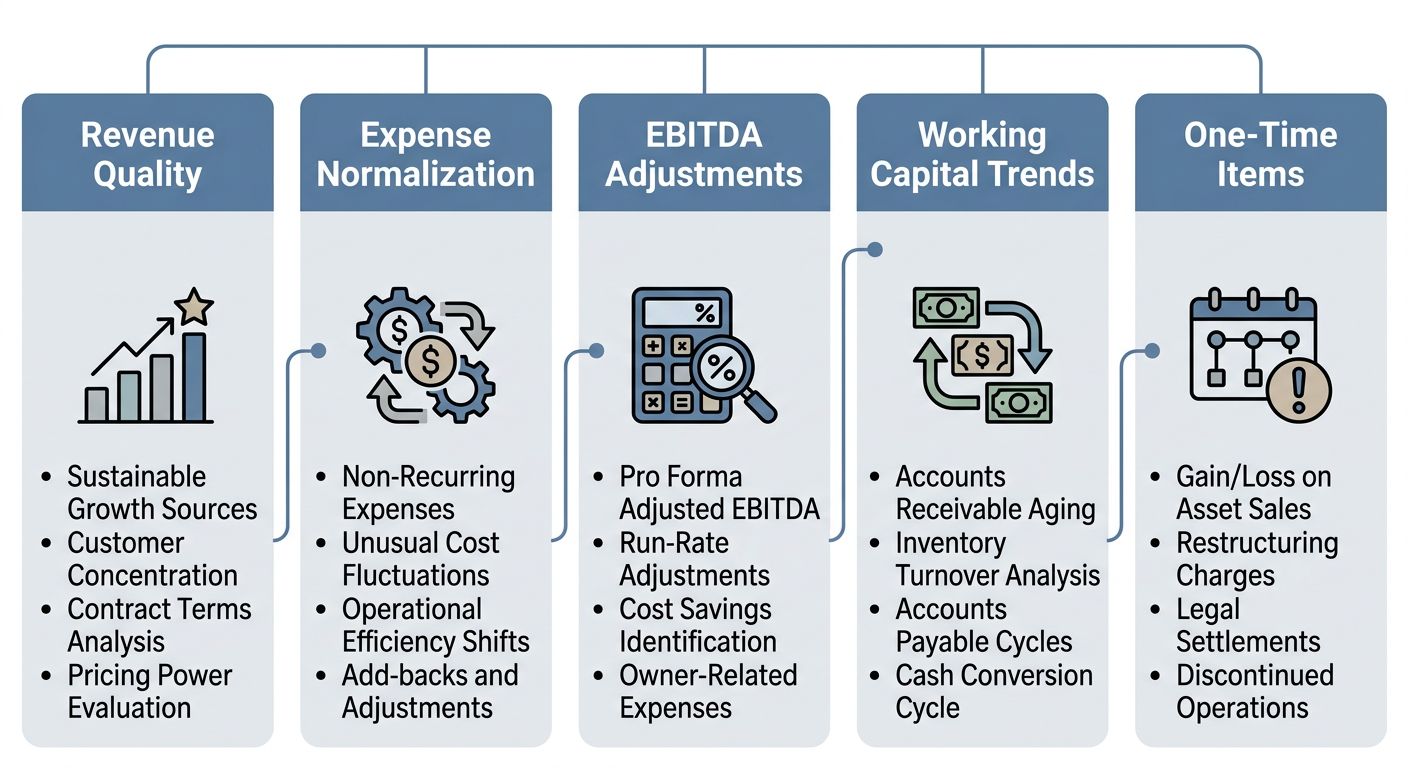
    A comprehensive earnings quality analysis examines several critical areas. Revenue quality scrutinizes the predictability and diversification of income streams. Expense normalization adjusts for one-time costs, owner’s compensation, or other out-of-ordinary expenses. EBITDA adjustments remove non-operating or non-cash items to reflect sustainable earnings. Working capital trends highlight operational liquidity needs and potential cash drags. One-time items, such as litigation settlements or asset sales, are excluded to reveal the underlying earning power. These dimensions collectively inform whether the company’s earnings are sustainable and repeatable for future periods.

    Infographic with five columns representing core areas of a quality of earnings analysis: Revenue Quality, Expense Normalization, EBITDA Adjustments, Working Capital Trends, and One-Time Items, each with icons and bullet lists on a muted blue and gray palette.

    Zaidwood Capital’s Quality of Earnings analysis framework visualized in five key areas.

    By producing a normalized earnings base, the QoE report helps both buyers and sellers reach consensus on valuation. For buy-side M&A professionals, this analysis highlights the true recurring profitability of a target, removing distortions that could inflate or deflate the purchase price. Sellers also benefit, as a well-documented QoE report can justify a premium and accelerate negotiation.

    As part of our Full-Cycle M&A and capital advisory services, we integrate QoE analysis into every engagement to provide clients with clear, defensible financial insights. The report is not an audit; it does not verify financial statement accuracy in compliance with accounting standards. Instead, it offers transaction-specific intelligence that traditional audits often miss. Zaidwood Capital utilizes QoE reports as a core component of its full-cycle due diligence, ensuring that both buy-side and sell-side mandates are grounded in reliable earnings data. By identifying true economic earnings, a QoE report streamlines negotiations and reduces the risk of post-close surprises.

    Next, we examine the core components that define a comprehensive QoE analysis.

    Securities are offered through Finalis Securities LLC, an independent entity from Zaidwood Capital. This content is for informational purposes and does not constitute investment advice.

    Core Components of a Quality of Earnings Analysis

    A quality of earnings report for mid-market deals goes beyond audited financials to uncover the true recurring cash flow a buyer can rely on. In this section, we break down the three pillars of a quality of earnings analysis: normalization adjustments, working capital scrutiny, and EBITDA sustainability. Drawing on Zaidwood Capital’s due diligence expertise, we show how each component strengthens deal-making for institutional and private investors.

    Normalization Adjustments and Add-Backs

    Normalization adjustments strip away non-operational or inflated expenses to present a clean EBITDA. These adjustments are critical because audited financials may include non-recurring gains or expenses that distort the company’s sustainable earning power. In our analyses, we identify above-market owner compensation, one-time legal fees, personal expenses run through the business, and related-party transactions at non-market terms.

    • Owner’s Compensation Adjustment: Aligning above-market owner salary and benefits to industry-standard compensation for a replacement manager
    • Non-Recurring Expenses: One-time legal fees, consulting engagements, relocation costs, or restructuring charges unlikely to repeat post-acquisition
    • Personal Expenses: Personal travel, entertainment, vehicles, or family members on payroll not related to business operations
    • Related-Party Transactions: Above-market rent, management fees, or service charges paid to entities owned by the seller or their family

    We substantiate each adjustment with corroborating evidence—payroll records, lease agreements, invoices—and provide a clear rationale in our reports. A quality of earnings analysis also flags off-balance-sheet liabilities like operating leases or contingent obligations that can alter deal value. For example, an owner drawing $600,000 when market rate is $200,000 inflates expenses by $400,000, a typical adjustment we see. By documenting every add-back, we give buyers confidence in the normalized earnings figure. Additionally, QoE reports look beyond the balance sheet to identify contingent payments or environmental indemnities that may not be booked but represent real future cash outflows.

    Working Capital Analysis and Debt-Like Items

    Working capital analysis determines the normalized net operating capital needed post-acquisition. We assess seasonal needs, payment cycles, and industry norms, then compare that to the target company’s actual levels. The gap—whether surplus or deficit—becomes an adjustment to the purchase price. For instance, if a business has excess working capital relative to its normalized requirement, the buyer may credit the seller for that amount at closing; conversely, a deficiency reduces the price. Our QoE reports present these adjustments with supporting schedules so that both buyers and sellers can negotiate from a common understanding.

    Debt-like items are obligations that function as debt but are not on the balance sheet as such. Examples include deferred revenue, underfunded pensions, or installment sale obligations. We identify these, quantify their impact, and deduct them from the equity value, just as we would formal debt. This analysis prevents the buyer from inheriting hidden financial burdens and ensures the enterprise value accurately reflects the business’s true financial position.

    EBITDA Quality and Sustainability Assessment

    EBITDA sustainability evaluation dissects the recurring nature of earnings. We examine revenue concentration risk—if a company depends on a single customer for more than 10% of revenue, that concentration creates vulnerability. Customer retention trends, contract renewal probabilities, and churn rates indicate how sticky the revenue base is. We also assess margin stability, checking whether gross and operating margins are sustainable or eroded by pricing pressure. In emerging markets M&A, we place extra focus on revenue concentration and retention because currency swings, regulatory shifts, and political instability can quickly reshape earnings. We evaluate supplier relationships to ensure margins are not artificially supported by short-term concessions, and we consider macroeconomic trends that could influence future earnings. Through our QoE reports, we help buyers distinguish durable cash flows from those that could evaporate post-acquisition, providing a forward-looking perspective essential for informed investment decisions.

    Selecting a Quality of Earnings Provider for Your Mid-Market Deal

    A quality of earnings report for mid-market deals is one of the most important tools for de-risking an acquisition, and choosing the right provider directly influences the credibility of your financial analysis. For companies in the $20M–$100M revenue range, the provider’s expertise, speed, and post-engagement support can make a material difference in how the QoE findings are received by lenders, underwriters, and counterparties.

    Evaluating Boutique Firm Expertise for QoE Analysis

    Boutique firms such as Zaidwood Capital specialize in delivering a highly tailored Quality of Earnings analysis that aligns with the specific dynamics of mid-market transactions. Their teams typically bring deep industry knowledge and direct senior partner involvement, ensuring that the engagement is led by an experienced professional who understands both the financial and strategic dimensions of the deal. In contrast, Big Four accounting firms offer a broad, generalist approach with standardized QoE templates that can miss the nuances of niche sectors. Mid-tier regional firms occupy a middle ground, providing moderate specialization but often with less senior oversight than a dedicated boutique.

    The critical differentiator is the level of partner engagement. At a boutique, the senior team leads the QoE analysis from start to finish, which shortens feedback loops and results in a more focused report. Big Four firms typically rely on junior staff for the bulk of the fieldwork, with partner review at the conclusion, while mid-tier firms show variability in senior involvement. This direct access to senior talent often translates into faster turnaround times and more actionable insights for the acquirer.

    The following comparison table summarizes key distinctions to inform your selection.

    Common Add-Backs and Adjustments in Quality of Earnings Reports
    Adjustment TypeDescriptionTypical EBITDA ImpactCommon Example
    Owner’s Compensation AdjustmentAligning above-market owner salary and benefits to industry-standard compensation for a replacement manager+$150,000 to $500,000 add-backOwner paying themselves $600,000 when market rate for a general manager is $200,000
    Non-Recurring ExpensesOne-time legal fees, consulting engagements, relocation costs, or restructuring charges unlikely to repeat post-acquisition+$50,000 to $300,000 add-back$200,000 in legal fees from a one-time litigation matter
    Personal ExpensesPersonal travel, entertainment, vehicles, or family members on payroll not related to business operations+$25,000 to $150,000 add-backCompany-leased luxury vehicle used primarily for personal use
    Related-Party TransactionsAbove-market rent, management fees, or service charges paid to entities owned by the seller or their family+$75,000 to $400,000 add-backPaying $30,000/month rent to a seller-owned LLC when market rate is $15,000

    Boutique firms consistently deliver deep specialization and hands-on partner involvement, often completing a QoE engagement in as little as 2–4 weeks—roughly half the time of a Big Four engagement. Moreover, firms like Zaidwood Capital adhere to established capital markets best practices, incorporating frameworks from ICMA capital markets to ensure the analysis meets rigorous industry standards. This commitment to both speed and quality makes boutique advisors a compelling choice for mid-market acquirers.

    Scope and Cost Expectations for Mid-Market Companies

    For a $20M–$100M-revenue company, the scope of a Quality of Earnings engagement should be calibrated to deal complexity and the acquirer’s specific concerns. A one-size-fits-all report rarely adds value; instead, the engagement scope must be defined collaboratively, focusing on revenue recognition policies, working capital trends, customer concentration risks, and any carve-out adjustments that could affect normalized EBITDA. At Zaidwood Capital, we work directly with buyers to design a custom scope that addresses the unique drivers of the target business, avoiding unnecessary line items that inflate cost without improving decision-making.

    Cost expectations reflect the level of customization. Boutique firms like Zaidwood Capital typically quote $25,000–$50,000 for a $20M-revenue company, while Big Four firms can range from $75,000 to over $150,000 for a similar-sized engagement. Mid-tier regional firms generally fall between $40,000 and $80,000. All figures are custom quotes and depend on data availability, the number of entities involved, and the speed required. We emphasize that our pricing is never a fixed fee; each engagement is priced based on the precise scope and timeline agreed upon, with full-cycle support extending from the initial QoE analysis through deal close.

    Integrating QoE Findings into Deal Structuring

    A Quality of Earnings report is not just a diligence artifact—it directly shapes the final deal terms. When normalized EBITDA adjustments reveal that reported earnings overstate true recurring cash flow, buyers can negotiate purchase price reductions or post-closing true-ups. Earnout structures become more defensible when the QoE identifies revenue volatility or concentration risks that warrant contingent payments. Similarly, representation and warranty insurance underwriters increasingly rely on QoE findings to set coverage limits and exclusions, making a thorough report a valuable risk-transfer tool.

    At Zaidwood Capital, our full-cycle advisory model ensures that QoE insights flow seamlessly into the negotiation and documentation phases. We translate EBITDA adjustments into specific purchase price adjustment mechanisms, design earnout milestones linked to verifiable financial metrics, and help acquirers present the QoE to insurers to secure favorable underwriting terms. This integrated approach reduces re-trading risk and accelerates the path to a signed purchase agreement. Once you have selected the right partner, the next step is implementing a disciplined QoE process that turns financial analysis into concrete deal terms. As with any investment, past performance does not guarantee future results, and we recommend consulting professional advisors to tailor the approach to your deal.

    How Quality of Earnings Reports Influence Purchase Price and Deal Terms

    A quality of earnings report for mid-market deals does more than flag accounting irregularities; it serves as the core negotiating lever for adjusting the purchase price and crafting protective deal provisions. At Zaidwood Capital, we treat the QoE report as the definitive source for reconciling reported financials with normalized economic reality. This alignment is essential before we engage in price discussions.

    In our experience, the most direct impact of the QoE report is a purchase price adjustment derived from normalized EBITDA. When the report strips out non-recurring revenue or one-time expenses, it recalibrates the basis on which the acquisition multiple is applied. A lower sustainable EBITDA can reduce the implied valuation, prompting the buyer to seek a price reduction. Conversely, a seller whose earnings prove clean and recurring can leverage the report to sustain or elevate the offer. Beyond EBITDA, the working capital peg—determined by historical QoE trend analysis—can shift the final cash consideration. If the report reveals that the target’s normalized net working capital is lower than originally represented, the buyer rightfully demands a dollar-for-dollar reduction at closing. Sellers with positive QoE results often use this as a shield against overly burdensome indemnification clauses, while buyers rely on the analysis to insert additional covenants or expand representations and warranties when risks are evident.

    Earnout structures are another area where QoE findings carry substantial weight. We typically link earnout payments to forward-looking financial metrics that have been validated by the quality of earnings (QoE) review. This ensures that post-closing milestones are both achievable and reflective of the business’s true earning power, reducing disputes later. Likewise, indemnification horizons and escrow amounts are calibrated to the specific risks flagged in the report. A revenue recognition issue might extend the survival period for related claims and increase the escrow holdback, while a clean report shortens those protections. Underpinning this rigor are regulatory standards that shape our financial analysis. FINRA securities regulation, administered by the Financial Industry Regulatory Authority, sets expectations for broker-dealer reporting that influence how we assess earnings quality in private transactions. Similarly, SEC securities regulation, enforced by the U.S. Securities and Exchange Commission, mandates GAAP compliance and reinforces the importance of accurate data in all valuations. In the following section, we demonstrate how these adjustments play out in a real mid-market transaction.

    Common Questions About Quality of Earnings Reports in Mid-Market Deals

    After establishing the importance of a quality of earnings report for mid-market deals, we address the most common questions buyers and sellers ask before engaging a QoE provider.

    What is a quality of earnings report, and why is it essential for mid-market deals? A QoE analysis examines earnings sustainability and quality, revealing adjustments needed in private-company financials and uncovering risks like customer concentration.

    How does a QoE differ from standard due diligence, and what adjustments does it uncover? Unlike standard due diligence, a QoE report serves as a complementary tool—used by advisors like Zaidwood Capital—to examine normalized EBITDA, margin trends, and working capital, separating recurring from one-time items and revenue mix.

    How does a QoE report impact valuation and deal structure? By surfacing these insights, a QoE can bridge valuation gaps and influence purchase price multiples, giving both sides clearer grounds for negotiation.

    Next, we’ll walk through the practical steps of commissioning a QoE report for your mid-market transaction.

    Leveraging Quality of Earnings Reports for Smarter M&A Decisions

    A Quality of Earnings report for mid-market deals dissects financials to expose sustainable earnings by stripping out one-offs. It flags risks like premature revenue booking, strengthening your negotiation position. Mid-market firms with less polished reporting especially benefit. At Zaidwood Capital, a quality of earnings report for mid-market deals anchors our full-cycle due diligence, alongside operational, commercial, and IT assessments, to deliver a complete picture. Compliance with SEC securities regulation ensures data reliability, and leveraging QoE minimizes post-close shocks. Deeper insight drives smarter M&A decisions.

    Resources

  • What Is NAV Financing in Private Equity? A Complete Guide

    What Is NAV Financing in Private Equity? A Complete Guide

    Table of Contents

    NAV financing in private equity represents a sophisticated form of fund-level leverage secured against the net asset value of a private equity fund’s portfolio of companies. Unlike traditional fund-level debt, which may rely on general partner or limited partner guarantees, these asset-backed credit facilities derive their security primarily from the underlying portfolio’s appraised worth. As leaders in Full-Cycle M&A and capital advisory, we at Zaidwood Capital structure these facilities to provide sponsors with a flexible, non-dilutive capital solution that aligns with the fund’s existing asset base while preserving its long-term investment strategy.

    This form of fund-level leverage has gained traction for several common applications. Sponsors frequently use NAV facilities to accelerate distributions to limited partners, avoiding the need for a full asset sale when liquidity is desired. They also serve as a bridge for follow-on investments, enabling a fund to support portfolio company add-on acquisitions between traditional capital calls. The Institutional Limited Partners Association (ILPA) has acknowledged the growing role of fund-level credit, emphasizing in its guidance that any such leverage must be aligned with fiduciary duties and transparent for LP stakeholders.

    Our firm’s capital advisory services encompass the entire lifecycle of NAV financing, from initial eligibility analysis and lender identification to term negotiation and closing. With access to extensive institutional networks and deep expertise in asset-backed structures, we help sponsors navigate the complexities of these loans.

    Fundamentals of NAV Financing and Fund-Level Leverage

    Building on the overview of fund capital strategies, we now examine two core forms of fund-level leverage: subscription lines and NAV financing. Fund-level leverage refers to the strategic use of debt by a fund itself, most commonly through subscription lines or NAV-based credit facilities.

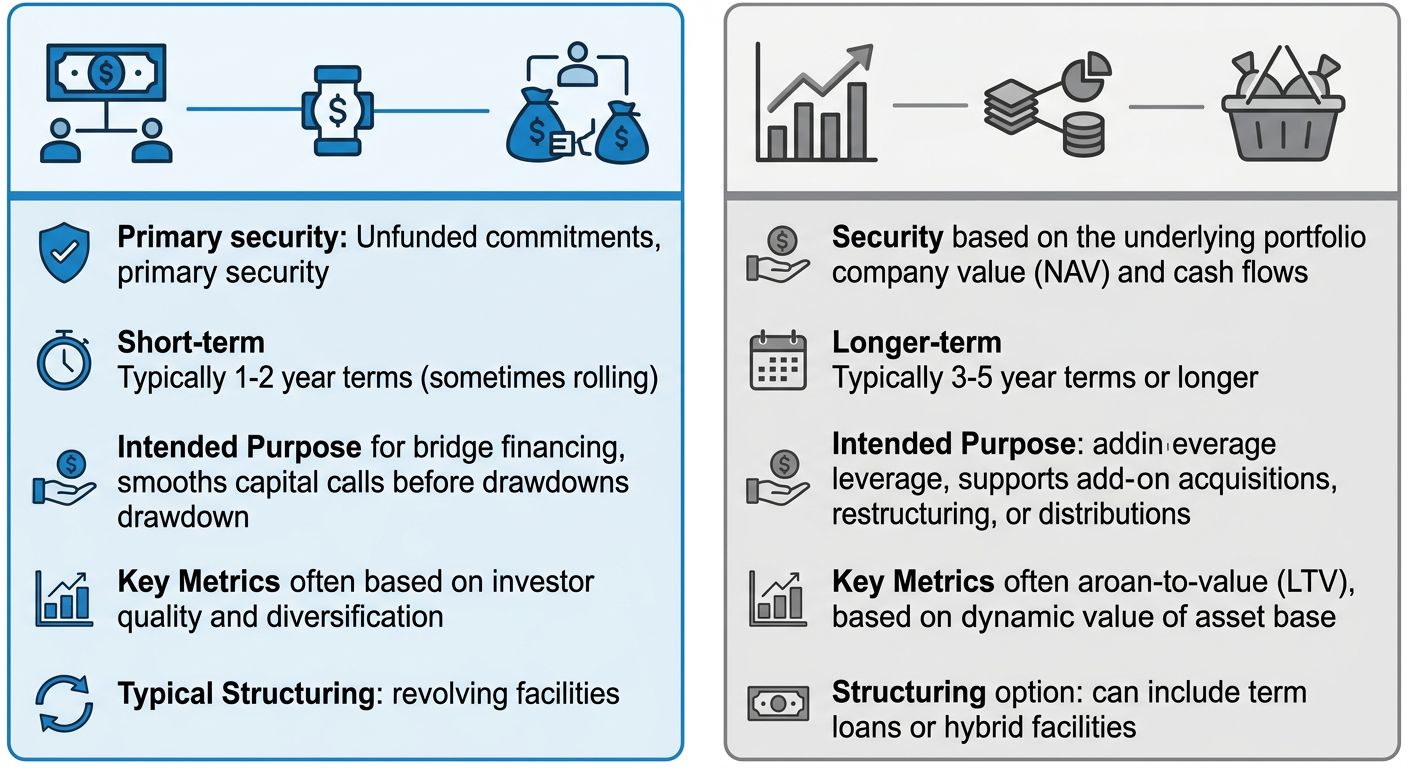
    Comparison: Subscription Lines vs. NAV Financing Facilities

    The following table provides a direct comparison of these two prevalent forms of fund-level leverage:

    FeatureSubscription LineNAV Financing
    PurposeFund capital callsFund distributions and acquisitions
    CollateralUnfunded commitmentsPortfolio company value
    Typical Terms1-2 years3-5 years
    Two-column comparison infographic contrasting subscription line financing with NAV financing terms.

    Comparison of subscription line and NAV financing terms and features for fund-level leverage.

    The Mechanics of NAV Loans: Structure, Growth Drivers, and Key Terms

    Growth Drivers Behind NAV-Based Lending in 2026

    DriverImpact on DemandExample Scenario
    LP Distribution PressureGPs need to return capital without exiting positionsBridge distributions with NAV facility
    Dry Powder OverhangUninvested capital pushes GPs to seek leverageUse NAV to fund follow-on acquisitions
    Regulatory EvolutionBasel IV makes subscription lines less attractiveNAV lines offer off-balance-sheet treatment

    Structuring NAV Loan Facilities: Key Components

    The architecture of a typical NAV financing in private equity facility rests on a few core components. The borrowing base is derived from the aggregate NAV of the portfolio companies. Lenders then apply an advance rate, typically ranging between 10 and 20 percent of that NAV.

    How NAV Financing Creates Value for Private Equity Funds

    The strategic value of NAV financing extends beyond liquidity. By using NAV loans, GPs can smooth fund-level returns and avoid fire sales of portfolio assets during market dislocations. Specialized debt advisory services from firms like Zaidwood Capital help navigate these structures.

    How Private Equity Firms Use NAV Financing for Distributions and Growth

    Use CaseTypical Advance RateCollateral Pool
    LP Distribution10-15% of NAVPortfolio companies
    Follow-On Acquisition20-30% of NAVTarget + existing portfolio

    Distributing Returns to Limited Partners via NAV Facilities

    Rather than selling assets at a suboptimal time, sponsors borrow against the fund’s net asset value and distribute the proceeds to investors.

    Using NAV Financing for Follow-On Acquisitions

    GPs draw on pre-arranged NAV financing facilities to move immediately when an acquisition opportunity emerges.

    Practical Steps to Secure a NAV Loan Agreement

    Securing a NAV facility requires a structured approach. Our corporate advisory services team at Zaidwood Capital negotiates with a network of over 3,000 lenders.

    Advanced Considerations in NAV Financing: Risk Management and Best Practices

    Risk FactorDescriptionMitigation Strategy
    Portfolio OverleverageAdding debt at fund levelMaintain conservative LTV ratios
    Valuation VolatilityNAV fluctuations affect borrowingRegular mark-to-market

    Common Questions About NAV Financing in Private Equity

    What is NAV financing in private equity? It is a form of fund-level leverage secured against a portfolio’s net asset value.

    Maximizing Fund Returns with Strategic NAV Financing

    At Zaidwood Capital, our debt advisory and capital formation capabilities support general partners in designing tailored financing structures.

    Resources