Zaidwood Capital

Category: Market Insights

  • Boutique vs Bulge Bracket Investment Banking: 2026 Comparison Guide

    Boutique vs Bulge Bracket Investment Banking: 2026 Comparison Guide

    Table of Contents

    Choosing Between Boutique and Bulge Bracket Investment Banking

    When weighing boutique vs bulge bracket investment banking, the core distinction lies in service scope and client intimacy. Specialist advisory firms offer focused, senior-led strategies that often result in faster execution and stronger alignment with client goals. Large global banks provide extensive capital markets access and resources suited for complex cross-border mandates. For companies considering private equity exit opportunities, boutique advisors frequently deliver customized positioning within their specific industry ecosystems. Similarly, talent dynamics around investment banking compensation packages reflect the differing demands of these models. We track SEC regulatory updates closely, as heavier compliance overhead affects larger institutions disproportionately while we leverage our full-cycle M&A and capital advisory approach to integrate deep advisory with proprietary data, streamlining transactions without the structural friction of multi-layered global firms.

    Ultimately, choosing between these paths depends on your transaction scope and strategic priorities. Our model bridges the gap by combining the personalized guidance of a boutique with the data-driven precision and investor network scale that growing companies require, a balance explored further in the next section.

    1. Senior Banker Attention and Personal Service

    In the boutique vs bulge bracket investment banking debate, one key differentiator is the level of senior attention you receive. At large, full-service firms, deal execution is often delegated to junior teams while managing directors appear only at critical milestones. We find this approach can dilute accountability and slow decision-making.

    Our model is fundamentally different. When you engage a boutique investment banking firm like Zaidwood Capital LLC, your mandate is led directly by our principals from pitch to close. As outlined in our description of M&A advisory services, senior bankers provide strategic guidance, valuation, negotiation support, and hands-on deal management throughout the entire lifecycle. This structure ensures decades of combined experience are applied to your specific strategic goals, delivering more tailored advice and faster execution.

    This personalized service is particularly valued by private equity firms seeking seamless exit execution and by companies requiring discreet, high-touch advisory. By leveraging our proprietary network and data resources, our senior team simplifies complex transactions, embodying our commitment to Streamlining Transactions with precision and focus.

    2. Tailored Fee Structures for Mid-Market Deals

    When considering boutique vs bulge bracket investment banking, the fee negotiation dynamics shift substantially for middle-market transactions. Unlike the rigid, standard pricing grids common at large institutions, we design our compensation around each mandate’s unique contours. This flexibility ensures your advisory costs reflect actual deal complexity rather than a one-size-fits-all schedule, aligning our incentives directly with your outcome.

    A typical framework might blend an initial retainer with a success-based component, or we may structure a milestone-driven fixed fee for a carve-out divestiture. The mix is always negotiated, absorbing variables like target size, cross-border diligence, and sector-specific resource requirements. For private equity firms managing portfolio company exits, this custom approach preserves more equity value while delivering institutional-quality execution. Our compensation benchmarks, detailed on our FAQ page, illustrate how tailored structures sit competitively within industry norms. As we always clarify, fees are custom-quoted and subject to mutual agreement rather than a published rate card.

    This disciplined yet adaptable approach removes friction from the engagement, letting you forecast costs with clarity. Next, we will walk through how our execution process turns that aligned structure into deal momentum.

    3. Specialized Industry Expertise

    Specialized industry expertise is a defining hallmark of the boutique model in investment banking. Unlike generalist institutions, boutique firms concentrate intellectual and relational capital into targeted verticals, cultivating an intimate understanding of sector dynamics, competitive landscapes, and value drivers. In private equity exit opportunities, this depth translates directly into superior deal sourcing because advisory teams speak the same operational language as founders, operators, and institutional buyers. Drawing from our own capital network exceeding $15 billion and an aggregate transaction volume surpassing $24.4 billion, we see consistent evidence that specialization sharpens valuation insight and accelerates execution.

    Sector-specific knowledge also shapes how boutique teams prepare portfolio companies for exit. Advisors often bring prior operating experience within the industries they serve, allowing them to anticipate buyer diligence questions and position assets around the metrics that matter most to private equity firms. When general partners evaluate acquisition targets, they rely on advisors who can interpret unit economics, regulatory nuances, and customer concentration risks without a learning curve, an advantage that industry depth systematically delivers.

    Industry depth shortens timelines and reduces transaction friction, qualities that matter acutely when fund lifecycles and market windows dictate exit timing. The structural alignment between boutique specialization and private equity mandates explains why sector-focused advisory teams continue gaining share in middle-market transactions. As the discussion shifts toward compensation structures, that same specialized expertise becomes a tangible factor influencing how transaction professionals are rewarded for execution.

    4. Agile Decision-Making and Speed

    Agile decision-making and speed represent some of the most compelling differentiators when evaluating boutique vs bulge bracket investment banking advisory services. At Zaidwood Capital, our lean, partner-led structure eliminates the multiple layers of approval and internal bureaucracy that typically slow down larger institutions. This streamlined architecture translates into faster, more decisive action for our clients.

    The role of an M&A advisor is inherently to accelerate deal timelines through proactive market intelligence and efficient coordination of due diligence. We execute this through our proprietary Velocity Matrix framework, which drives transaction velocity without compromising the depth or quality of our analysis. This systematic approach ensures that while we move quickly, we never sacrifice the financial, legal, and operational rigor that complex transactions demand.

    This responsiveness is particularly critical for owners pursuing private equity exit opportunities, where market windows can close rapidly and timing often correlates directly with value realization. Our direct partner involvement and efficient processes allow us to respond to these dynamics with the urgency they require. This structural speed also enables us to deliver a level of service intensity and personalization that more layered organizations find difficult to match.

    Agility here is not about cutting corners. It is the natural outcome of a flatter organizational design, empowered decision-makers, and a proprietary operating system purpose-built to optimize transaction timelines. This foundation of responsive execution supports the personalized and cost-effective approach that distinguishes true partnership in M&A advisory.

    5. Comprehensive Network Access and Deal Sourcing

    Beyond our advisory capabilities, the real differentiator in the boutique vs bulge bracket investment banking landscape is the depth of our network. We connect clients with 4,000+ global investors and $15B+ in deployable capital, creating private equity exit opportunities that rival the largest institutions while maintaining the agility of a specialized boutique.
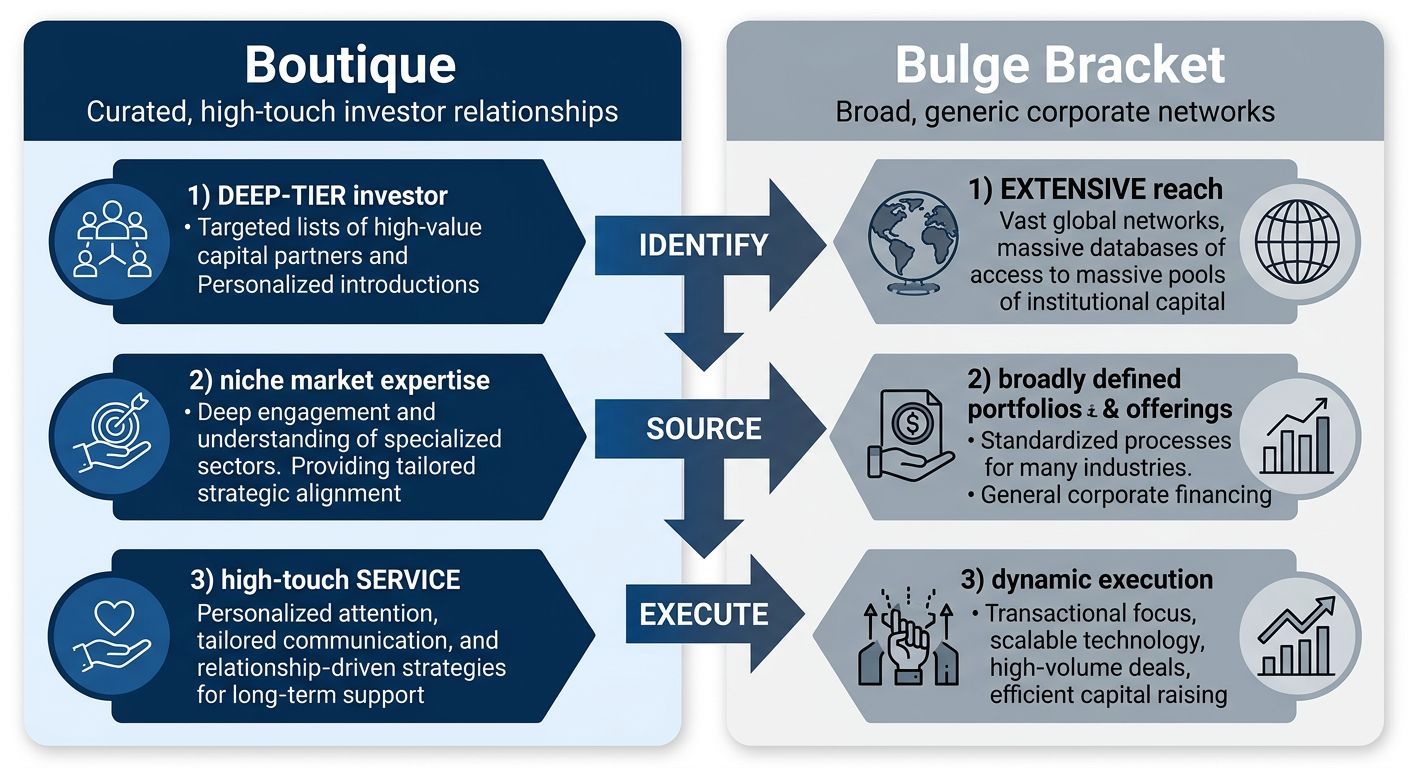
    Infographic comparing boutique M&A firm's high-touch investor network against bulge bracket's broad corporate network with deal sourcing funnel stages.
    Boutique vs. bulge bracket network access comparison at Zaidwood Capital.

    This integrated approach is powered by proprietary tools, including the Sovereign Data Nexus, Precision Catalyst, and Velocity Matrix, which sharpen deal sourcing and analysis. Our $24.4B+ aggregate transaction volume across full-cycle M&A, equity, and debt mandates confirms the scale we deliver. Exclusive access to Deal Vault and our curated Investor Rolodex further extends our partners’ reach. As our internal resources explain, these capabilities streamline the entire capital formation lifecycle, from LP placement and debt structuring to equity advisory.

    Whether you are evaluating private equity exit opportunities or structuring a capital raise, this institutional-grade infrastructure, delivered by a boutique firm, provides a clear advantage over traditional bulge bracket models. Our approach ensures you receive both the scale and the personalization that today’s complex deals demand. We’ll next explore how our fairness opinions and transaction advisory services add another layer of diligence.

    6. Cultural Alignment and Communication

    The choice in boutique vs bulge bracket investment banking extends beyond structure and into the softer, yet equally critical, dimensions of culture and communication. At Zaidwood Capital, we believe that a strong advisory relationship depends on transparency, trust and open dialogue — qualities that are built through consistent interaction rather than brand reputation alone. How a firm communicates directly shapes your experience during what is often the most consequential financial event in a company’s lifecycle.

    Communication style and responsiveness matter because M&A processes move quickly and demand real-time judgment. Boutique firms typically offer direct access to senior partners and a highly personalized cadence, while larger platforms operate through more structured teams and formalized reporting. Neither approach is inherently superior; the right fit depends on how you prefer to receive information, make decisions and manage pressure. Our internal resource on what M&A advisors do outlines how advisors facilitate fit assessments early in the process, helping clients evaluate both technical capability and interpersonal compatibility.

    Finding the right cultural fit also means considering how an advisor handles long-term strategic goals such as private equity exit opportunities or structuring investment banking compensation packages. These conversations require discretion, deep industry knowledge and a relationship grounded in mutual confidence. Full-Cycle M&A mandates succeed when the advisory team aligns with your organization’s values, communication norms and decision-making rhythm — a principle we prioritize through every phase of engagement.

    Streamlining Transactions depends as much on human chemistry as it does on financial engineering. In our experience, the most successful partnerships are those where both sides invest in candid, ongoing communication. The next section outlines practical steps you can take to evaluate and engage an advisor who fits your unique organizational culture.

    Making the Right Choice for Your M&A Needs

    Given the distinct advantages of each model, selecting the right advisor depends on your transaction size, industry focus, and desired level of partner attention. M&A advisors typically provide comprehensive support across buy-side and sell-side representation, valuation, due diligence, and deal negotiation. At Zaidwood Capital, we deliver Full-Cycle M&A and capital advisory that combines the personalized service of a boutique firm with access to over 4,000 institutional investors and $15B+ in deployable capital. Our approach ensures seamless execution from initial due diligence through final closing, backed by $24.4B+ in aggregate transaction volume. We encourage you to assess your specific requirements and book a call for tailored guidance on your M&A journey.

    Resources

  • Global M&A Market Cap 2026: Key Trends and Forecasts

    Global M&A Market Cap 2026: Key Trends and Forecasts

    Table of Contents

    Global M&A Market Cap 2026: Projections and Outlook

    The outlook for the global M&A market cap 2026 suggests a year of renewed momentum as dealmakers adapt to a stabilized economic landscape. Industry consensus points toward a period of growth, fueled by the gradual normalization of interest rates, the deployment of significant private equity dry powder, and corporate confidence in strategic consolidation. These tailwinds are expected to elevate global M&A deal value forecasts 2026, positioning the coming year as one of recalibrated and purposeful transaction activity.

    In this environment, middle market M&A valuation multiples 2026 are projected to remain compelling. Our team at boutique M&A firm Zaidwood Capital believes this creates a unique equilibrium where sellers can achieve attractive exits while buyers gain access to high-quality assets at rational premiums. As a specialized advisory practice, we are built for precisely this dynamic, leveraging our $24.4B+ in aggregate transaction volume to guide clients through every phase of a deal.

    Our ability to connect opportunities with capital is reinforced by a global network of over 4,000 institutional and private investors, representing more than $15 billion in accessible capital. This scale of connectivity is a meaningful differentiator, particularly in a year where matching the right partners will define success. We anticipate that 2026 will reward firms that combine deep sector expertise with agile execution, and our full-cycle M&A and capital advisory capabilities are aligned to meet that demand.

    We look forward to helping our clients navigate this promising market. Please note that securities are offered through Finalis Securities LLC, a member of FINRA/SIPC, and Zaidwood Capital is not a registered broker-dealer. All investments involve risk, including the potential loss of principal. Past performance does not guarantee future results.

    The Fundamentals of Global M&A Market Capitalization in 2026

    Global M&A market capitalization represents the aggregate disclosed value of all merger and acquisition transactions completed within a calendar year, offering a vital barometer of worldwide corporate confidence and economic momentum. As we look toward 2026, global M&A market cap 2026 projections indicate a robust recovery and expansion across all major regions, driven by stabilizing interest rates and pent-up demand for strategic consolidation. Our team at Zaidwood Capital monitors these macro-level shifts closely, as they define the landscape in which we deliver Full-Cycle M&A and capital advisory services to our corporate clients and fund partners.

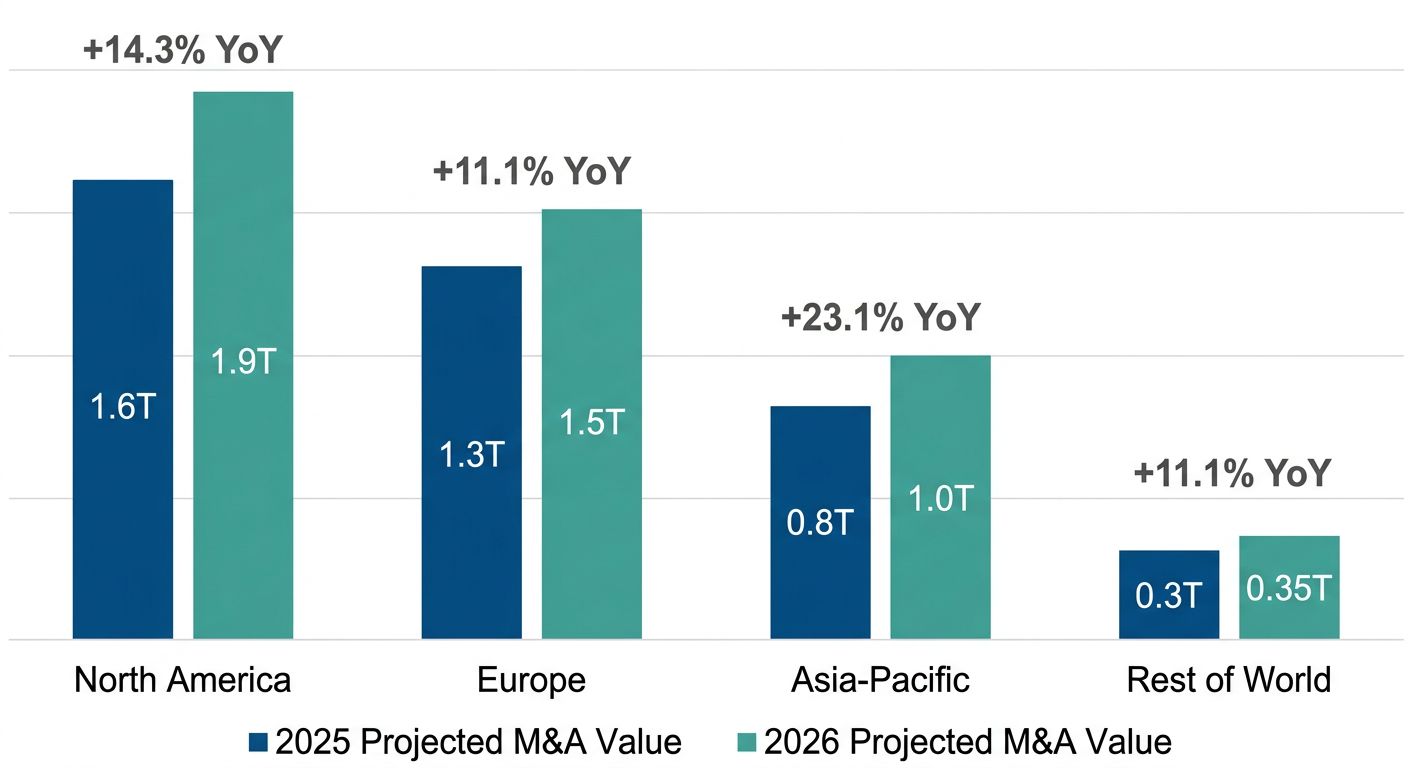
    We have synthesized data from authoritative industry reports to ground our analysis in verifiable projections. The following table presents a comparative view of estimated 2025 deal values and forecasted 2026 figures, drawing on insights from PwC advisory services and the Capstone Partners M&A Market Overview.

    Projected Global M&A Deal Value by Region (2025 vs 2026)
    Region2025 Estimated (USD T)2026 Projected (USD T)YoY Change
    North America$1.4T$1.6T+14%
    Europe$0.8T$0.9T+12%
    Asia-Pacific$0.7T$0.85T+21%
    Rest of World$0.25T$0.3T+20%

    A review of these figures underscores a broad-based expansion. North America is expected to remain the dominant market at an estimated $1.6T in 2026, sustaining a 14% growth trajectory that reflects ongoing corporate transformation and an active private equity community. Europe’s projected climb to $0.9T—a 12% increase—aligns with more supportive financing conditions and cross-border dealmaking. We observe that these global M&A deal value forecasts 2026 are not merely aspirational targets; they are grounded in observable pipelines and policy environments.

    Asia-Pacific stands out as the fastest-growing region by percentage, with a 21% surge projected to reach $0.85T in total disclosed value. This momentum is consistent with the region’s expanding digital economy, industrial consolidation, and government-led reforms that ease foreign capital participation. The Rest of World category, encompassing emerging and frontier markets, is also forecast to expand by 20% to $0.3T, reflecting heightened investor appetite for diversification and resource-linked assets.

    Bar chart comparing projected M&A deal values for 2025 and 2026 across North America, Europe, Asia-Pacific, and Rest of World
    Projected global M&A market capitalization by region for 2025 and 2026.

    Drilling deeper, we see that these regional patterns inform our advisory work, particularly when calibrating middle market M&A valuation multiples 2026 against broad market trends. While aggregate data from PwC’s 2026 report and Capstone Partners’ analysis provide a strategic overlay, we caution that these projections are estimates and not guarantees of individual transaction performance. Every deal requires tailored diligence and sector-specific benchmarking, a discipline at the core of our full-cycle methodology. Readers building on this regional foundation can next explore how sector dynamics and valuation frameworks shape middle market opportunities in the year ahead.

    Key Industry Drivers Shaping the 2026 M&A Landscape

    The global m&a market cap 2026 is expected to reflect a landscape profoundly reshaped by three powerful forces: the relentless advance of artificial intelligence, a resurgence in cross-border dealmaking, and the persistent reality of higher-for-longer interest rates. At Zaidwood Capital, our analysis of the ecosystem, supported by PwC’s latest forecasts, indicates that these drivers are not merely cyclical blips but structural shifts redefining how value is created, financed, and transacted. Understanding their interplay is critical for any stakeholder looking to deploy capital or execute a monetization event this year. We see these themes converging to create a period of both heightened opportunity and increased complexity, demanding a more strategic and data-driven approach to deal execution than ever before.

    AI Super-Cycle and Technology Sector Activity

    The artificial intelligence super-cycle is the single most significant catalyst in the technology M&A market, propelling a wave of consolidation that cuts across software, infrastructure, and platform businesses. According to PwC, the technology sector is poised for a 25-30% increase in expected deal value in 2026, a trajectory driven by incumbents racing to acquire generative AI capabilities and bolt-on machine learning assets. This isn’t a speculative bubble; it’s a mature strategic response. Large-cap tech firms are using their balance sheets to ingest innovative startups, while mid-market platform companies are rolling up niche players to create vertically integrated AI-powered suites. We see this drive particularly among our clients seeking Full-Cycle M&A and capital advisory services to navigate the complexities of these technology acquisitions, from due diligence on proprietary algorithms to valuation of recurring revenue models.

    The implications extend beyond headline-grabbing megadeals. The primary focus is on software consolidation, where established platforms acquire point solutions to embed AI into their existing software stacks. These strategic acquisitions are designed to capture data network effects and block competitors, making them highly contested. PwC’s data supports the view that platform roll-ups, rather than transformative megamergers, will define the bulk of 2026’s tech deal volume, with global m&a market cap 2026 benefiting from the premium valuations assigned to AI-enabled business models. The complexity of these deals, which often involve cross-border intellectual property transfers and novel regulatory scrutiny around AI, requires a new level of advisory rigor. Our approach, leveraging what we internally term our Sovereign Data Nexus, helps clients map asset quality and risk in these technology-driven acquisitions with a precision that is essential for post-close value realization.

    Beyond the technology sector, cross-border dynamics are fundamentally reshaping how and where deals are structured, as companies look past domestic borders for growth. According to IFLR’s in-depth coverage of M&A legal news, a recalibration of global supply chains and an evolving network of bilateral trade agreements are creating new, distinct transactional corridors. Our firm observes that this is not a uniform global rebound but a targeted reallocation of capital into markets offering regulatory clarity and strategic resource access. The energy transition, for example, is driving joint ventures between Western capital providers and critical mineral processors in emerging markets, a trend clearly highlighted in PwC’s 15-20% growth forecast for the energy and natural resources sector.

    Regulatory change acts as both a headwind and a tailwind in this environment. Stricter foreign investment review regimes in North America and Europe are lengthening deal timelines, yet at the same time, harmonizing accounting and legal frameworks in regions like the Middle East and Southeast Asia are lowering historic barriers. As reported in M&A legal news, the complexity of navigating these disparate regimes is one of the most significant challenges for dealmakers in 2026. This environment makes local expertise and institutional connectivity more valuable than ever. Leveraging our access to over 4,000 global investors, we facilitate capital introductions that help bridge the gap between domestic sell-side mandates and international buy-side appetite, ensuring that cross-border transactions are not just conceived but successfully closed.

    Interest Rate Impacts on Deal Structuring

    The sustained high-interest-rate environment has ceased to be a temporary shock and is now a permanent fixture of the deal structuring toolkit for 2026. The era of cheap, abundant leverage has given way to a more disciplined approach, directly impacting how transactions are capitalized and how risk is shared between buyers and sellers. We note that global m&a deal value forecasts 2026 are heavily contingent on this new normal, as the higher cost of senior debt compresses leverage multiples and reduces the equity returns that can be generated through pure financial engineering.

    This shift is profoundly altering the architecture of deals. To bridge often-significant valuation gaps between buyer and seller expectations in a high-rate world, we are seeing a significant rise in deferred consideration mechanisms. Earn-outs and seller financing notes have become standard negotiating tools rather than exotic compromises, allowing buyers to manage upfront cash outlay while sellers can achieve their target valuation upon hitting post-closing performance milestones. For instance, in the 10-15% growth projected by PwC for healthcare mid-market buyouts, middle market m&a valuation multiples 2026 are being sustained not by higher opening bids, but by structuring a greater portion of the enterprise value into these performance-linked instruments. Our advisory work is now deeply focused on modeling these structures, providing fairness opinions that deconstruct the probabilistic value of earn-outs to ensure our clients can make informed decisions under conditions of increased financial uncertainty.

    The sector-level impacts of these converging drivers are clear and measurable. The following table synthesizes PwC’s forecast data to illustrate how these forces are translating into specific deal activity and types across four pivotal industries.

    Sector-Level M&A Activity Drivers in 2026
    IndustryPrimary DriverExpected Deal Value GrowthTypical Deal Type
    TechnologyAI super-cycle and software consolidation25-30%Strategic acquisitions, platform roll-ups
    Energy & Natural ResourcesEnergy transition, decarbonization15-20%Asset acquisitions, joint ventures
    HealthcareDemographics, digital health innovation10-15%Mid-market buyouts, add-ons
    Financial ServicesRate normalization, fintech disruption8-12%Consolidation, divestitures

    What this table reveals is a divergence in deal rationale and structure based on macro-driver exposure. Technology’s AI-fueled 25-30% growth, the highest forecasted, is almost entirely a function of strategic imperative rather than financial optimization, leading to all-cash corporate acquisitions. By contrast, the more modest 10-15% growth in healthcare is being enabled by creative financial structuring—the mid-market buyout and add-on activity relies on the exact earn-out and seller-financing mechanisms necessitated by the interest rate environment. Across all sectors, the influence of global m&a market cap 2026 is evident, as even asset-heavy energy joint ventures require cross-border legal agility that sources like IFLR are tracking. Our role at Zaidwood Capital is to translate these macro-level drivers into a concrete transaction roadmap, ensuring that the strategy is matched by a robust, market-tested execution plan.

    Middle Market Valuation Multiples: What to Expect in 2026

    As we examine the landscape for deal-making in the year ahead, the trajectory of the global m&a market cap 2026 serves as a crucial backdrop for understanding where private transactions will price. Our analysis of current market data suggests that middle market valuation multiples are stabilizing, though significant dispersion exists across sectors. For business owners and investors navigating this environment, a clear understanding of these benchmarks is essential for setting realistic expectations before entering a process.

    Middle Market EBITDA Multiples in 2026

    Our review of current middle market m&a valuation multiples 2026 shows that EBITDA multiple ranges continue to reflect sector-specific growth profiles and risk assessments. According to M&A Science, a leading aggregator of transaction data, technology companies with recurring revenue models are commanding premiums, while asset-heavy industrials face more conservative pricing. A revenue multiple offers an alternative lens, particularly for high-growth businesses where profitability may be deferred in favor of market share expansion. The divergence between these two metrics often signals how buyers are weighing current cash flow against future potential.

    We are observing that platform acquisitions with scalable infrastructure and strong management teams consistently trade at the upper end of their respective ranges. The availability of detailed market intelligence from sources like M&A Science allows our team to benchmark client opportunities against thousands of completed transactions, ensuring that offer prices reflect both intrinsic value and prevailing market sentiment.

    The following table summarizes our estimated valuation ranges for 2026, drawing on data from M&A Science and Capstone Partners:

    Middle Market Valuation Multiples by Sector (2026 Estimate)
    SectorEBITDA Multiple RangeRevenue Multiple RangeTrend vs 2025
    Technology12x – 18x3x – 6xStable to slightly up
    Healthcare10x – 15x2x – 4xStable
    Industrials7x – 10x1x – 2xSlight compression
    Consumer8x – 12x1.5x – 3xMixed

    Technology continues to lead all sectors, driven by strong demand for AI and machine learning capabilities that generate predictable, high-margin revenue streams. Healthcare remains resilient, supported by demographic tailwinds and consolidation among provider groups. Industrials have experienced slight multiple compression as manufacturing slowdowns and supply chain uncertainties weigh on buyer confidence. Consumer sector multiples are mixed, with premium brands holding value while discretionary categories face headwinds from shifting spending patterns. Capstone Partners’ sector-level research confirms these diverging trends, with technology and healthcare expected to maintain or expand their valuation premiums through year-end.

    For acquirers evaluating opportunities, understanding these benchmarks is a foundational element of effective transaction planning. Reviewing these multiples is a key component of buy side M&A education, as it equips diligence teams to calibrate their financial models against real-world market evidence. Without this context, even sophisticated investors risk overpaying in competitive auctions or missing value in overlooked sectors.

    Global m&a deal value forecasts 2026 suggest that total transaction volume will remain robust, though deal count may moderate as buyers become more selective. This selectivity places a premium on quality assets, reinforcing the need for sellers to present clean financials, defensible market positions, and transparent growth narratives. Our advisory work increasingly focuses on helping clients articulate these value drivers well before going to market.

    Downward Pressure Factors on Multiples

    Despite generally healthy valuation levels, several headwinds are compressing multiples in certain segments. The Bonadio Group’s deal advisory insights highlight rising interest rates as the primary constraint, increasing the cost of acquisition financing and reducing the net present value of future cash flows. Regulatory uncertainty, particularly around cross-border transactions and sector-specific oversight, introduces additional risk that buyers are pricing into their offers. We also note that broader economic slowing has made revenue forecasting more difficult, prompting cautious assumptions in quality-of-earnings analyses.

    These pressures are most acute in capital-intensive industries where leverage is essential to achieving target returns. For companies in these categories, we are advising clients to consider alternative deal structures such as earn-outs or seller notes that bridge valuation gaps while aligning incentives post-closing.

    These valuation benchmarks directly influence how we advise clients on pricing and timing. By tracking where multiples are trending and understanding the macro forces at work, we help buyers and sellers position themselves for successful outcomes in a dynamic market. The next consideration, which we explore in the following section, is how to translate these valuation insights into concrete deal structuring and negotiation strategies that protect interests on both sides of the table.

    Past performance does not guarantee future results. All valuation multiples are market estimates and should not be construed as investment advice.

    Advanced Considerations: Structuring Deals in the 2026 M&A Environment

    As the global M&A market cap 2026 reflects cautious optimism, structuring agility has become a decisive advantage. Global M&A deal value forecasts 2026 indicate a modest recovery, while middle market M&A valuation multiples 2026 remain under pressure, prompting both buyers and sellers to seek innovative alignment mechanisms.

    The following table compares three common deal structures that our firm often deploys to address these market realities.

    Deal Structuring Approaches for 2026 Market Conditions
    StructureBest ForAdvantagesDisadvantages
    Earn-OutBridging valuation gapsAligns incentives, deferred riskComplex measurement and disputes
    Rollover EquityManagement retentionRetains expertise, aligns long-termDilution for buyer
    Mezzanine FinancingLeveraged buyoutsLower equity commitment requiredHigher cost of capital

    Each structure carries distinct trade-offs that must be weighed against specific transaction goals. Our deal advisory frameworks analyze these variables through rigorous financial modeling, ensuring that the chosen path optimizes both risk allocation and return potential across the capital stack.

    Earn-Out provisions help bridge valuation gaps by tying consideration to future performance. This aligns incentives and defers buyer risk, but disputes can arise if measurement criteria are ambiguous. Our advisory teams work closely with clients to define clear metrics and incorporate third-party validation, reducing potential for post-close conflict.

    Rollover Equity retains management and aligns long-term interests. Sellers gain continued upside while buyers benefit from expertise, though buyer dilution is a trade-off. Structuring rollover with vesting schedules tied to performance milestones further reinforces commitment and ensures a smooth transition.

    Mezzanine Financing offers a middle ground between senior debt and equity, lowering upfront equity commitments at a higher cost of capital. In the context of emerging markets M&A, such hybrid structures are vital for navigating currency and regulatory complexity. Our firm has facilitated over 800 million USD in mezzanine and venture debt, executing deals in under 60 days through a network of more than 4,000 institutional investors, delivering speed and certainty.

    These structures are informed by Zaidwood Capital’s proprietary strategic documentation, which underpins our full-cycle M&A and capital advisory, enabling a rigorous, data-driven approach to deal design.

    These structuring decisions set the stage for comprehensive due diligence and execution planning, where our focus shifts to validating assumptions and mitigating residual risks. By thoughtfully calibrating these elements, we position our clients to realize greater value and confidently navigate the complexities of the 2026 deal landscape.

    Frequently Asked Questions About Global M&A Market Cap 2026

    Following the market overview, we address your most pressing questions about deal activity in 2026.

    What shapes the global M&A market cap 2026? Global M&A deal value forecasts 2026 point to robust activity fueled by rate stabilization, regulatory shifts, and AI-led due diligence; middle market M&A valuation multiples 2026 remain resilient.

    Which firms are the top M&A advisors in 2026? For large-cap mandates, leading institutions include Goldman Sachs, JPMorgan, and Morgan Stanley; our full list of top M&A advisors details the firms shaping the landscape.

    To gain direct exposure, explore our Deal Vault with access to 4,000+ investors and $15B+ in deployable capital. While we streamline transactions, remember that all investments involve risk and Zaidwood Capital is not a registered broker-dealer. Book a call to start.

    The global M&A market cap 2026 is projected to rebound sharply as interest rates stabilize and corporate balance sheets unlock record levels of dry powder. Industry data points to global M&A deal value forecasts 2026 surpassing the $4 trillion threshold for the first time since 2021, driven by transformative consolidation in technology, healthcare, and energy transition sectors. Within this resurgence, middle market M&A valuation multiples 2026 are expected to remain robust—typically ranging between 7.5x and 9.0x EBITDA for premium assets—though widening dispersion between high-quality platforms and undifferentiated businesses demands rigorous due diligence. Market volatility and valuation complexity make strategic advisory essential: Zaidwood Capital combines proprietary data networks, access to over 4,000 institutional and private investors, and more than $24.4 billion in aggregate transaction volume to help clients navigate uncertainty with precision. Partnering with an experienced strategic advisor can turn these trends into tangible results.

    Resources