
Zaidwood Capital

Tag: Bulge Bracket vs Boutique

  • Boutique vs Bulge Bracket Investment Banking: Which to Choose

    Boutique vs Bulge Bracket Investment Banking: Which to Choose

    Table of Contents

    When business owners weigh boutique vs bulge bracket investment banking options, the decision shapes every stage of a transaction. The right partner influences deal execution, alignment of interests, confidentiality, and the senior attention that is critical to achieving optimal outcomes.

    We are Zaidwood Capital. We are a boutique M&A and capital advisory firm, based in West Palm Beach. Our approach is to center our M&A and capital advisory activities on growth-stage companies, and middle market companies. Our approach, centered on growth and capital formation, contrasts with firms that rely on junior-heavy teams, providing senior oversight where it counts.

    Partners are involved in every aspect of the transaction from beginning to end. Our approach ensures that you get the senior attention your deal deserves. Having the right advisors makes the difference in structuring, negotiating and completing complex deals.

    1. Senior-Level Attention

    At Zaidwood Capital, the senior bankers you meet during the initial pitch are the same people who lead your engagement from start to finish. This means no handoff to junior coverage teams.

    Our senior bankers lead all stages of full-cycle M&A. Because of this, we make quick decisions and maintain direct and clear communication. Large firms often have so many layers that decision making becomes slow and communication breaks down. Large firms often operate with the assumption that senior bankers will be making the final decisions, so they develop frameworks and templates to capture and articulate all aspects of a deal. Because we are a smaller firm, senior bankers have the flexibility to make decisions quickly and easily, and communication is direct. This is particularly helpful during private equity exit processes because, in addition to the deal process, there are also third-party issues to manage and time is of the essence. For private equity exit processes, especially, deal making requires a partner who understands your goals and the rationale behind them; our partners are actively involved on your deal from the first meeting to the last wire.

    For mid-market business owners, this type of senior-led commitment is often the difference between a deal process that merely captures value versus one that fulfills the true worth of the company.

    2. Mid-Market Company Sales

    Mid-market company sales generally range from $10 million to $500 million. Compared to bulge bracket firms, these sales rarely justify senior-level attention, and transactions this size often do not cover the profit thresholds of large global banks. For mid-market deals, sellers often get delegated to junior members of the firm, resulting in less senior management focus on the deal.

    Our firm takes a different approach. We only work in the mid-market, and have a proprietary data and analytics platform along with a network of more than 4,000 institutional investors, including strategic buyers, private equity, family offices and SWFs, to identify and engage with the best buyers. This gives our mid-market clients a senior partner-led approach, and bulge bracket-like treatment, throughout the process. Our resources and our alignment with mid-market transaction economics gives us the opportunity to provide conflict-free and dedicated partner-led advice.

    3. Fee Structure Differences

    After a founder decides to go the mid-market sale route, an obvious follow up question is how firms charge for advisory work.

    Fee Structure Comparison: Boutique vs Bulge Bracket
    Aspect Boutique Advisory Firms Bulge Bracket Banks
    Fee composition Retainer + success-fee weight Upfront retainer, success fee lower
    Upfront retainer expectations Modest retainer Substantial retainer
    When fees are earned Retainers, milestones, closing Retainers, closing
    Flexibility in negotiating terms Case-by-case negotiation Firm-driven, limited flexibility
    Minimum deal-size appetite Accept mid-market deals Higher minimum thresholds

    Our arrangements are designed to be symmetric to your interests. Consequently, we do not publicize our rates. We would, however, welcome the opportunity to customize our terms to fit your needs for your transaction.
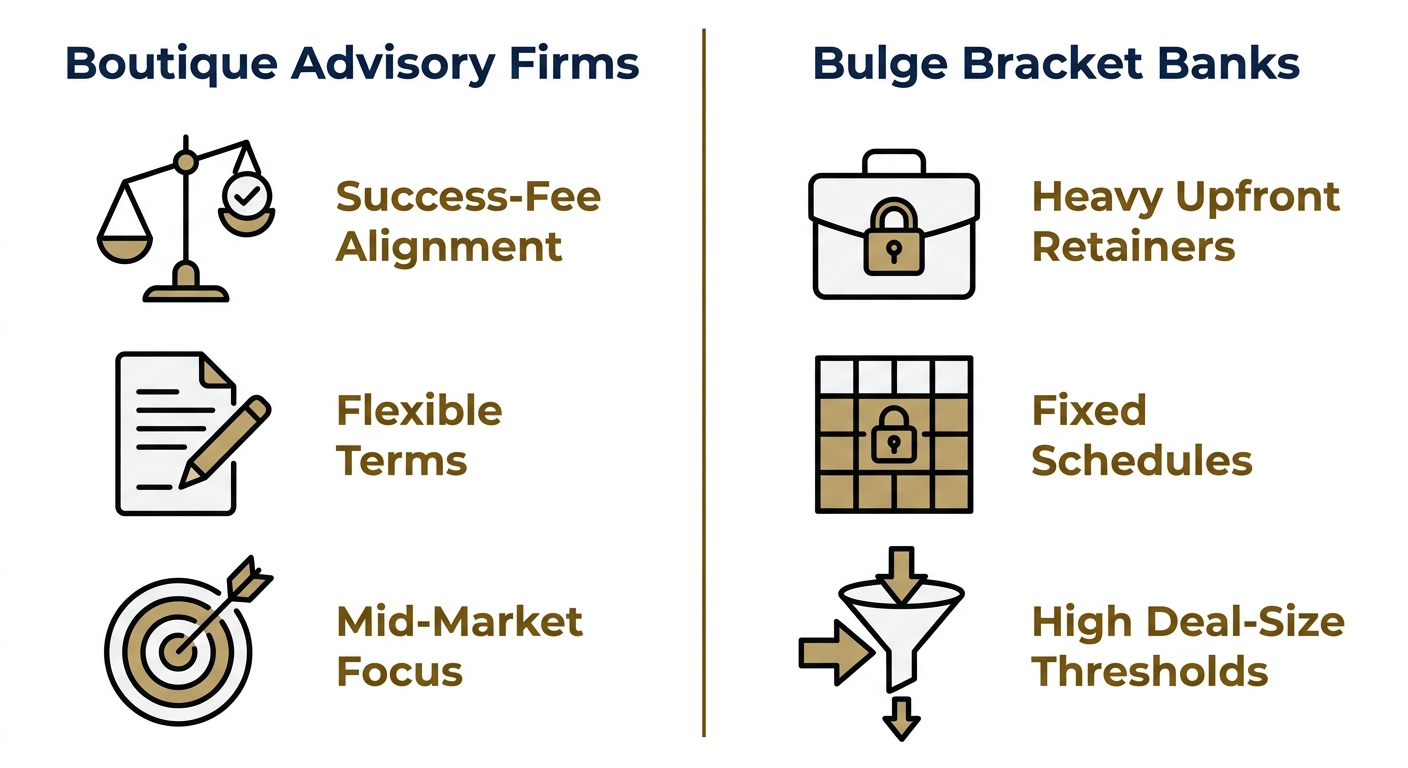
    Infographic with two columns comparing boutique advisory firms and bulge bracket banks, each with three flat outlined icons and labels covering success-fee alignment, flexible terms, mid-market focus, upfront retainers, fixed schedules, and deal-size thresholds.
    Fee structure comparison: boutique advisory firms vs. bulge bracket banks.

    4. Founder-First Advisory

    Our ‘founder-first’ approach means your engagement partners are your dealmakers. This translates to hands-on access to senior bankers for the duration of your deal process. This also means that the same people who create your strategy and lead your process are the same people who intimately understand your business.

    Larger banking platforms are often bureaucratic, with deal execution processes happening through approvals of various committees. This removes the decision-maker from the founder’s objectives for their legacy, liquidity, business growth and control.

    Our firm’s senior bankers lead the process from beginning to end. Our Precision Catalyst platform uses AI to quickly and efficiently match the right investor for the deal. The Velocity Matrix also uses a rapid-execution framework to focus and prioritize the senior bankers’ efforts. We are an advisory firm, not a broker-dealer, and our guidance is consultative, never a promise of a specific outcome.

    Due to this, the question on how senior leadership is compensated becomes very relevant.

    5. Banker Compensation Models

    When founders compare boutique vs bulge bracket investment banking, one of the most telling differences lies in how bankers are paid. In a bulge bracket, compensation is heavily tied to seniority, league table rank, and firm-wide performance, often resulting in a formulaic base-salary-plus-bonus structure. Boutique investment banks, in contrast, align pay directly with deal outcomes—an “eat what you kill” model—so a banker succeeds only when the client does.

    Our compensation structure combines a base salary with an upside potential based on deal outcomes. The model typically combines a base salary with a deal-based bonus and, for senior partners, profit sharing or carried interest. Lower overhead and leaner teams also provide us a competitive advantage. Because we don’t have a large support staff, a larger portion of the advisory economics flows to the deal makers, resulting in greater transparency on how compensation is structured. We structure compensation to mirror founder’s incentives, which shapes our behavior during a sale process, including when private equity buyers are involved, ensuring every decision serves the outcome.

    6. Private Equity Exit Paths

    Compensation reflective of value creation typically leads to an exit. We work with sponsors along four primary paths, aligned to the sponsor’s objectives.

    The four paths to an exit are a trade sale to a strategic buyer, a secondary buyout to a financial sponsor, an initial public offering, and a dividend recapitalization. Selection is a function of valuation, the state of the market, and the objectives of the seller.

    Prior to initiating the sales process, we financially, operationally and strategically prepare the target company. We assist with the creation of the data room, deliver training to the management team for the capital raising process, and assist with the development of the story and the valuation of the business. We have an active network of over 4,000 strategic and financial buyers, including family offices and sovereign wealth funds. Larger full-service banks make the mistake of devolving a significant amount of work to junior bankers. Our senior partners lead every step, preserving confidentiality and eliminating lending conflicts.

    Maintaining a disciplined process and moving quickly from preparation to close is important. The speed of execution often is what determines the viability of an exit.

    7. Deal Execution Speed

    A successful private equity exit—the kind discussed earlier—depends on more than just identifying the right buyer; it relies on the efficiency with which a transaction is executed. In the boutique vs bulge bracket investment banking difference, this efficiency is most apparent. Unlike larger institutions where deals can stall in internal queues, we assign senior partners to each mandate, eliminating layers of approval that slow response times. Our Velocity Matrix framework translates that structural speed into a disciplined, rapid-execution methodology. By streamlining diligence, market-facing activity, and negotiation, we compress timelines while maintaining thoroughness. For business owners, this means shorter market exposure, fewer distractions from running the company, and quicker access to liquidity—though no outcome is ever guaranteed. Even the most efficient process, however, is only as powerful as the investors behind it. That is why we pair execution speed with a curated network of institutional buyers, a topic we turn to next.

    8. Investor Network Access

    Deal velocity is about more than efficiency; it relies on rapid access to the most relevant capital, which is dependent on relationships. Our network of investors is not built during a mandate; we already have it, so we can quickly and efficiently connect companies with institutions.

    We have relationships with more than 4,000 of the world’s leading institutional investors, including strategic investors, venture capital and private equity, family offices and sovereign wealth funds. The aggregate capital on our platform is in excess of $15 billion. We’ll never represent capital as a guarantee. Using Precision Catalyst, we determine the investors most aligned with a company and help build a targeted client pipeline. Where larger banks often route opportunities through syndicate desks that add distance, a boutique advisory opens direct access to senior decision-makers who have the authority to commit.

    In addition, when a company is considering an advisory firm, we should evaluate a firm’s access to investor capital and the readiness of its network.

    Selecting the Right Advisory Firm

    When it comes time to choose an advisor, the difference between a boutique and a bulge bracket partner becomes extremely apparent. When considering boutique vs bulge bracket investment banking, the deciding factors usually involve the amount of senior attention and how specialized a firm can be. We discussed boutique investment banking in detail and noted a key difference is that a partner-led model places experienced bankers directly on every engagement, not just in pitch meetings. The partner on your engagement is highly specialized in your industry. We also touched on the importance of a partner’s sponsor network in the previous section. The right partner not only provides a defined process for executing a transaction, but also shapes the outcome.

    Schedule Your Advisory Consultation

    You’ve now examined the critical factors, direct senior-level attention, streamlined fee structures, and faster deal execution, that distinguish boutique advisory from bulge bracket banking. The right partner for your M&A or capital formation needs will offer investor network reach, execution speed, and founder alignment. Our senior bankers lead every engagement personally, from initial strategy through closing. With a network of over 4,000 investors and $15B+ in accessible capital, we connect you with the right counterparties. Our founder-first approach keeps your liquidity, growth, or exit goals at the center. The decision you make today shapes your transaction’s success. Start a confidential conversation with our team to explore how we can support your next move.

    Schedule Your Advisory Consultation

  • Boutique vs Bulge Bracket Investment Banking: 2026 Comparison Guide

    Boutique vs Bulge Bracket Investment Banking: 2026 Comparison Guide

    Table of Contents

    Choosing Between Boutique and Bulge Bracket Investment Banking

    When weighing boutique vs bulge bracket investment banking, the core distinction lies in service scope and client intimacy. Specialist advisory firms offer focused, senior-led strategies that often result in faster execution and stronger alignment with client goals. Large global banks provide extensive capital markets access and resources suited for complex cross-border mandates. For companies considering private equity exit opportunities, boutique advisors frequently deliver customized positioning within their specific industry ecosystems. Similarly, talent dynamics around investment banking compensation packages reflect the differing demands of these models. We track SEC regulatory updates closely, as heavier compliance overhead affects larger institutions disproportionately while we leverage our full-cycle M&A and capital advisory approach to integrate deep advisory with proprietary data, streamlining transactions without the structural friction of multi-layered global firms.

    Ultimately, choosing between these paths depends on your transaction scope and strategic priorities. Our model bridges the gap by combining the personalized guidance of a boutique with the data-driven precision and investor network scale that growing companies require, a balance explored further in the next section.

    1. Senior Banker Attention and Personal Service

    In the boutique vs bulge bracket investment banking debate, one key differentiator is the level of senior attention you receive. At large, full-service firms, deal execution is often delegated to junior teams while managing directors appear only at critical milestones. We find this approach can dilute accountability and slow decision-making.

    Our model is fundamentally different. When you engage a boutique investment banking firm like Zaidwood Capital LLC, your mandate is led directly by our principals from pitch to close. As outlined in our description of M&A advisory services, senior bankers provide strategic guidance, valuation, negotiation support, and hands-on deal management throughout the entire lifecycle. This structure ensures decades of combined experience are applied to your specific strategic goals, delivering more tailored advice and faster execution.

    This personalized service is particularly valued by private equity firms seeking seamless exit execution and by companies requiring discreet, high-touch advisory. By leveraging our proprietary network and data resources, our senior team simplifies complex transactions, embodying our commitment to Streamlining Transactions with precision and focus.

    2. Tailored Fee Structures for Mid-Market Deals

    When considering boutique vs bulge bracket investment banking, the fee negotiation dynamics shift substantially for middle-market transactions. Unlike the rigid, standard pricing grids common at large institutions, we design our compensation around each mandate’s unique contours. This flexibility ensures your advisory costs reflect actual deal complexity rather than a one-size-fits-all schedule, aligning our incentives directly with your outcome.

    A typical framework might blend an initial retainer with a success-based component, or we may structure a milestone-driven fixed fee for a carve-out divestiture. The mix is always negotiated, absorbing variables like target size, cross-border diligence, and sector-specific resource requirements. For private equity firms managing portfolio company exits, this custom approach preserves more equity value while delivering institutional-quality execution. Our compensation benchmarks, detailed on our FAQ page, illustrate how tailored structures sit competitively within industry norms. As we always clarify, fees are custom-quoted and subject to mutual agreement rather than a published rate card.

    This disciplined yet adaptable approach removes friction from the engagement, letting you forecast costs with clarity. Next, we will walk through how our execution process turns that aligned structure into deal momentum.

    3. Specialized Industry Expertise

    Specialized industry expertise is a defining hallmark of the boutique model in investment banking. Unlike generalist institutions, boutique firms concentrate intellectual and relational capital into targeted verticals, cultivating an intimate understanding of sector dynamics, competitive landscapes, and value drivers. In private equity exit opportunities, this depth translates directly into superior deal sourcing because advisory teams speak the same operational language as founders, operators, and institutional buyers. Drawing from our own capital network exceeding $15 billion and an aggregate transaction volume surpassing $24.4 billion, we see consistent evidence that specialization sharpens valuation insight and accelerates execution.

    Sector-specific knowledge also shapes how boutique teams prepare portfolio companies for exit. Advisors often bring prior operating experience within the industries they serve, allowing them to anticipate buyer diligence questions and position assets around the metrics that matter most to private equity firms. When general partners evaluate acquisition targets, they rely on advisors who can interpret unit economics, regulatory nuances, and customer concentration risks without a learning curve, an advantage that industry depth systematically delivers.

    Industry depth shortens timelines and reduces transaction friction, qualities that matter acutely when fund lifecycles and market windows dictate exit timing. The structural alignment between boutique specialization and private equity mandates explains why sector-focused advisory teams continue gaining share in middle-market transactions. As the discussion shifts toward compensation structures, that same specialized expertise becomes a tangible factor influencing how transaction professionals are rewarded for execution.

    4. Agile Decision-Making and Speed

    Agile decision-making and speed represent some of the most compelling differentiators when evaluating boutique vs bulge bracket investment banking advisory services. At Zaidwood Capital, our lean, partner-led structure eliminates the multiple layers of approval and internal bureaucracy that typically slow down larger institutions. This streamlined architecture translates into faster, more decisive action for our clients.

    The role of an M&A advisor is inherently to accelerate deal timelines through proactive market intelligence and efficient coordination of due diligence. We execute this through our proprietary Velocity Matrix framework, which drives transaction velocity without compromising the depth or quality of our analysis. This systematic approach ensures that while we move quickly, we never sacrifice the financial, legal, and operational rigor that complex transactions demand.

    This responsiveness is particularly critical for owners pursuing private equity exit opportunities, where market windows can close rapidly and timing often correlates directly with value realization. Our direct partner involvement and efficient processes allow us to respond to these dynamics with the urgency they require. This structural speed also enables us to deliver a level of service intensity and personalization that more layered organizations find difficult to match.

    Agility here is not about cutting corners. It is the natural outcome of a flatter organizational design, empowered decision-makers, and a proprietary operating system purpose-built to optimize transaction timelines. This foundation of responsive execution supports the personalized and cost-effective approach that distinguishes true partnership in M&A advisory.

    5. Comprehensive Network Access and Deal Sourcing

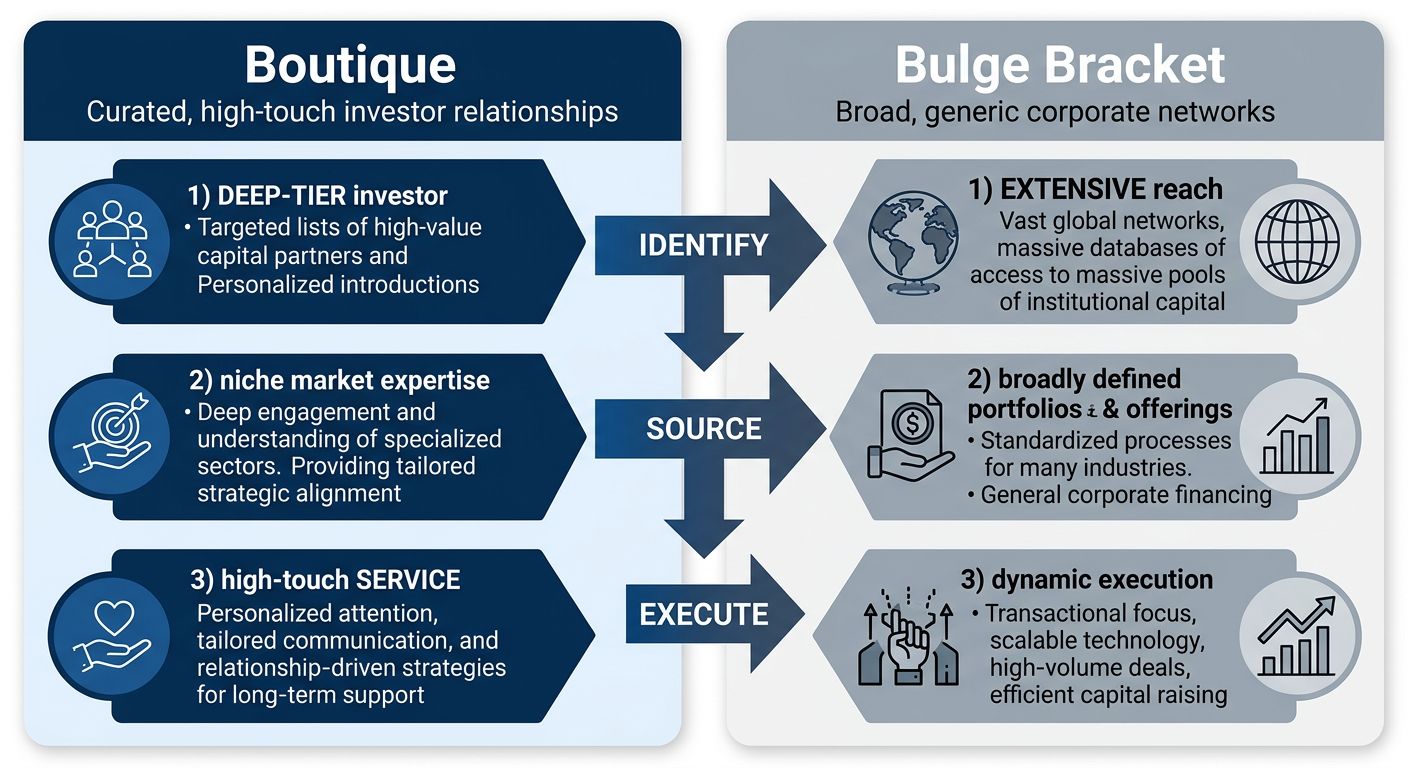
    Beyond our advisory capabilities, the real differentiator in the boutique vs bulge bracket investment banking landscape is the depth of our network. We connect clients with 4,000+ global investors and $15B+ in deployable capital, creating private equity exit opportunities that rival the largest institutions while maintaining the agility of a specialized boutique.

    Infographic comparing boutique M&A firm's high-touch investor network against bulge bracket's broad corporate network with deal sourcing funnel stages.
    Boutique vs. bulge bracket network access comparison at Zaidwood Capital.

    This integrated approach is powered by proprietary tools, including the Sovereign Data Nexus, Precision Catalyst, and Velocity Matrix, which sharpen deal sourcing and analysis. Our $24.4B+ aggregate transaction volume across full-cycle M&A, equity, and debt mandates confirms the scale we deliver. Exclusive access to Deal Vault and our curated Investor Rolodex further extends our partners’ reach. As our internal resources explain, these capabilities streamline the entire capital formation lifecycle, from LP placement and debt structuring to equity advisory.

    Whether you are evaluating private equity exit opportunities or structuring a capital raise, this institutional-grade infrastructure, delivered by a boutique firm, provides a clear advantage over traditional bulge bracket models. Our approach ensures you receive both the scale and the personalization that today’s complex deals demand. We’ll next explore how our fairness opinions and transaction advisory services add another layer of diligence.

    6. Cultural Alignment and Communication

    The choice in boutique vs bulge bracket investment banking extends beyond structure and into the softer, yet equally critical, dimensions of culture and communication. At Zaidwood Capital, we believe that a strong advisory relationship depends on transparency, trust and open dialogue — qualities that are built through consistent interaction rather than brand reputation alone. How a firm communicates directly shapes your experience during what is often the most consequential financial event in a company’s lifecycle.

    Communication style and responsiveness matter because M&A processes move quickly and demand real-time judgment. Boutique firms typically offer direct access to senior partners and a highly personalized cadence, while larger platforms operate through more structured teams and formalized reporting. Neither approach is inherently superior; the right fit depends on how you prefer to receive information, make decisions and manage pressure. Our internal resource on what M&A advisors do outlines how advisors facilitate fit assessments early in the process, helping clients evaluate both technical capability and interpersonal compatibility.

    Finding the right cultural fit also means considering how an advisor handles long-term strategic goals such as private equity exit opportunities or structuring investment banking compensation packages. These conversations require discretion, deep industry knowledge and a relationship grounded in mutual confidence. Full-Cycle M&A mandates succeed when the advisory team aligns with your organization’s values, communication norms and decision-making rhythm — a principle we prioritize through every phase of engagement.

    Streamlining Transactions depends as much on human chemistry as it does on financial engineering. In our experience, the most successful partnerships are those where both sides invest in candid, ongoing communication. The next section outlines practical steps you can take to evaluate and engage an advisor who fits your unique organizational culture.

    Making the Right Choice for Your M&A Needs

    Given the distinct advantages of each model, selecting the right advisor depends on your transaction size, industry focus, and desired level of partner attention. M&A advisors typically provide comprehensive support across buy-side and sell-side representation, valuation, due diligence, and deal negotiation. At Zaidwood Capital, we deliver Full-Cycle M&A and capital advisory that combines the personalized service of a boutique firm with access to over 4,000 institutional investors and $15B+ in deployable capital. Our approach ensures seamless execution from initial due diligence through final closing, backed by $24.4B+ in aggregate transaction volume. We encourage you to assess your specific requirements and book a call for tailored guidance on your M&A journey.

    Resources