

Zaidwood Capital

Tag: Regulatory Compliance

  • Tech Mergers and Acquisitions: Complete Guide for 2026

    Tech Mergers and Acquisitions: Complete Guide for 2026

    Table of Contents

    The Landscape of Tech Mergers and Acquisitions

    Tech mergers and acquisitions are accelerating at a historic pace, propelled by the convergence of artificial intelligence and cybersecurity disruption. We observe that ai-driven m&a dominates mid-market dealmaking as companies race to integrate generative AI, while cybersecurity acquisitions surge in response to intensifying threat landscapes and new regulatory frameworks. This velocity creates immense opportunity but also unparalleled complexity for investors and business owners alike.

    In this fast-moving environment, traditional advisory models often struggle to keep up. As a boutique investment banking firm, we combine decades of collective investment banking experience with proprietary data and a global network of over 4,000 investors. Our Sovereign Data Nexus and Precision Catalyst platforms accelerate due diligence and investor matching, delivering the speed and precision that today’s tech transactions demand. This evolving landscape requires a strategic advisor with both agility and institutional knowledge—qualities we bring to every engagement, from initial strategy through final close.

    Key Milestones in the Tech M&A Process

    Navigating the tech mergers and acquisitions landscape requires a structured, milestone-driven framework to manage complexity and unlock value. At Zaidwood Capital, we believe that before you can appreciate the nuances of each stage, you should understand what is an investment bank and how a dedicated advisory team serves as a strategic partner throughout the process. The following milestones outline our systematic approach.

    • Strategic Assessment & Target Identification
      We start by clarifying your growth objectives and screening potential targets that align with your strategic vision. Our team leverages proprietary data networks to identify opportunities that might otherwise go unnoticed.
    • Valuation & Financial Modeling
      Using advanced financial modeling, we triangulate a company’s intrinsic value and quantify potential synergies. This phase ensures you have a realistic pricing framework before entering negotiations.
    • Due Diligence (Including Cybersecurity & IP Audits)
      A rigorous evaluation of financial statements, operational metrics, and legal risks is conducted, with special attention to technology assets, cybersecurity posture, and data privacy compliance. In AI-driven M&A and cybersecurity acquisitions, our proprietary data access via the Sovereign Data Nexus allows for deeper analysis of intellectual property portfolios and cyber risk exposure.
    • Negotiation & Letter of Intent
      Investment bankers facilitate valuation discussions, presenting industry benchmarks and helping bridge gaps through creative deal structuring—such as earn-outs or seller financing. A non-binding letter of intent is then drafted to formalize key terms.
    • Regulatory Approvals & Compliance
      Navigating antitrust, data sovereignty, and sector-specific regulations is critical. We coordinate with legal counsel to ensure all filings are complete and timelines are managed proactively.
    • Closing & Deal Documentation
      Our Full-Cycle M&A approach encompasses deal vault management and the preparation of definitive agreements. We oversee the final exchange of consideration and transfer of ownership, ensuring every detail is documented and compliant.
    • Post-Merger Integration
      Success doesn’t end at closing; we help clients execute integration plans that capture synergies, align cultures, and safeguard critical technology architectures. Continuous monitoring of cybersecurity risks remains a priority.

    With a clear understanding of these milestones, it becomes evident why experienced advisory guidance is critical. Our role as a Boutique M&A and Capital Advisory Firm is to streamline each step, mitigating risk and positioning clients for long-term value creation. In the following sections, we’ll explore each milestone in greater depth to help you prepare for a successful transaction.

    In tech mergers and acquisitions, regulatory complexity often determines whether a transaction reaches completion or stalls indefinitely. Beyond financial and technical due diligence, regulatory compliance emerges as a critical hurdle. Our firm combines deep advisory experience with proprietary intelligence tools to help clients anticipate and address these challenges.

    For transactions involving telecommunications infrastructure, the review process demands particularly careful navigation. The FCC telecommunications agency must approve any transfer of spectrum licenses or communications assets, a process our team streamlines through early engagement and thorough preparation. According to the Federal Communications Commission, public interest hearings and foreign ownership rules frequently extend review timelines, especially in tech mergers and acquisitions where national security considerations intersect with infrastructure control. We help clients prepare comprehensive filings that address these nuanced requirements from the outset.

    Cross-border financing structures introduce additional regulatory dimensions that many acquirers underestimate. The International Capital Market Association establishes the Green Bond Principles, a critical framework when technology acquirers issue sustainable debt to fund acquisitions. For technology M&A transactions spanning multiple jurisdictions, ICMA standards provide essential guidance on disclosure requirements and market practices that protect both issuers and investors. In ai-driven M&A, regulatory scrutiny of data privacy compliance often intersects with these capital market requirements, creating layered obligations that demand coordinated advisory support.

    Cybersecurity acquisitions frequently trigger filings under the Committee on Foreign Investment in the United States, adding national security review to already complex transaction timelines. Our Sovereign Data Nexus platform monitors real-time regulatory changes and precedent decisions across these agencies, helping clients anticipate potential friction points. While advisory experience reduces execution risk, each transaction remains unique, and regulatory outcomes depend on the specific deal structure and government determinations. We provide clarity without promising specific results.

    Once regulatory approvals are secured, the focus shifts to rapid, compliant integration. Our Velocity Matrix accelerates this transition, enabling clients to move from approval to operational execution without sacrificing regulatory diligence or transaction momentum.

    Preparing Your Company for Due Diligence

    Once you have identified a potential acquisition target, thorough preparation is the next critical step, particularly in the dynamic landscape of tech mergers and acquisitions. For founders and management teams, the due diligence process can feel overwhelming, but a structured, proactive approach transforms it from a hurdle into an opportunity to showcase your company’s value. At Zaidwood Capital, we guide our clients through this critical phase, ensuring that every facet of the business is scrutinized and presented to withstand the most rigorous investor or buyer examination. The goal is not just to survive diligence but to leverage it as a strategic step toward a successful transaction.

    We advise our clients to focus on three fundamental preparatory tasks. First, compile and organize all foundational documentation. This includes audited financial statements, corporate tax returns, capitalization tables, material contracts, and all historical investor presentations and board decks. Second, assemble a dedicated, cross-functional internal response team. This group should include key leaders from finance, legal, and operations who are empowered to answer questions and pull records quickly. Third, establish a secure, meticulously indexed virtual data room. A well-structured data room accelerates the review process and signals operational maturity to potential partners.

    For companies involved in ai-driven m&a or cybersecurity acquisitions, the diligence requirements extend far beyond standard financial and legal review. A significant portion of the evaluation will focus on technology and intellectual property. Be prepared to demonstrate clear ownership and defensibility of your core IP, including patents, trademarks, and proprietary code. We help our clients prepare detailed documentation of AI model training data, algorithm logic, and bias mitigation protocols. Equally non-negotiable is a thorough review of your cybersecurity infrastructure, incident response history, and data privacy compliance. Addressing these technology-specific areas proactively is a powerful risk-mitigation strategy that prevents deal-derailing surprises.

    As your Boutique M&A and Capital Advisory Firm, we streamline this entire preparation phase. We provide a tailored readiness checklist and can manage the deal vault, ensuring all sensitive information remains secure and organized. This hands-on support allows you to stay focused on running your business. A robust financial analysis is the bedrock of this process, and professionals with a strong foundation, including those who have completed a CFA certification program, add significant rigor to the financial modeling and valuation perspectives that underpin a solid diligence review.

    With your company thoroughly prepared, the formal due diligence process can proceed more efficiently, often beginning with the opening of a secure data room to invited parties.

    Evaluating the Cost and Value of M&A Advisory

    In today’s dynamic deal environment, tech mergers and acquisitions require rigorous evaluation of advisory cost and value. As a Boutique M&A and Capital Advisory Firm, we believe clients must look beyond headline fees to assess the full spectrum of value an advisor delivers throughout the transaction lifecycle.

    Understanding Fee Structures

    M&A advisory fees generally follow two primary models. A retainer fee compensates the advisor for upfront work, including market analysis, buyer identification, and initial due diligence preparation. This structure ensures dedicated resources are committed to the engagement from day one, aligning incentives for thorough preparation rather than rushed execution. The second model, a success fee, is contingent upon closing and typically calculated as a percentage of transaction value. This arrangement directly ties advisor compensation to outcomes, creating strong alignment around achieving optimal deal terms. Many engagements combine both structures, balancing ongoing commitment with performance-based rewards.

    Value Drivers and Differentiating Factors

    Evaluating advisory value requires examining factors beyond the fee schedule. Proprietary data access represents a critical differentiator. Through our Sovereign Data Nexus, we leverage private servers and exclusive market intelligence to identify opportunities and benchmark valuations that public databases cannot replicate. This infrastructure powers informed decision-making, particularly in specialized sectors like ai-driven m&a and cybersecurity acquisitions, where traditional valuation metrics often fall short. Execution speed, driven by our Velocity Matrix methodology, compresses timelines without sacrificing diligence quality. Finally, investor engagement capabilities, enhanced by our Precision Catalyst platform, ensure targeted outreach to qualified counterparties rather than broad, unfocused marketing.

    Boutique advisory firms offer distinct advantages over bulge-bracket institutions, including senior-level attention throughout the engagement, specialized sector expertise, and flexible fee arrangements. While larger banks provide global distribution networks and multi-product capabilities, boutique firms deliver personalized service and dedicated focus on middle-market transactions where nuanced industry knowledge creates measurable value.

    For industry standards and best practices, clients may refer to organizations such as the ICMA capital market association and the CFA Institute, whose ethical frameworks and professional guidelines establish benchmarks for advisory conduct.

    Criteria for Evaluating Advisory Value

    • Transaction track record in relevant sectors and deal sizes
    • Network quality, measured by access to decision-makers at strategic acquirers and institutional investors
    • Technological capabilities that enhance data security, valuation accuracy, and investor targeting
    • Professional standards, including adherence to CFA Institute ethical guidelines and demonstrated commitment to fiduciary responsibility

    With these evaluation criteria in mind, one can better navigate the selection process for an advisory partner aligned with specific transaction objectives.

    The landscape of tech mergers and acquisitions is being reshaped by two powerful forces: the application of artificial intelligence and a surge in cybersecurity-focused dealmaking. As a Boutique M&A and Capital Advisory Firm, Zaidwood Capital sees these trends creating both opportunity and complexity for growth companies and investors. To understand these shifts, it is helpful to revisit what is an investment bank and how its core advisory services are being transformed by technology. The traditional functions of capital raising and full-cycle M&A are now augmented by proprietary data, AI-driven analytics, and rapid execution capabilities that distinguish boutique platforms from larger wirehouses.

    Infographic showing AI-driven M&A on left and cybersecurity acquisitions on right connected by Sovereign Data Nexus bridge
    AI and cybersecurity acquisition trends infographic

    Now, AI-powered M&A is transforming every stage of the deal lifecycle. Our Sovereign Data Nexus employs machine learning to scan thousands of targets, flagging financial and operational red flags and surfacing data-driven opportunities that traditional manual screening would miss. Predictive valuation models, built on historical transaction data and real-time market signals drawn from our global investor network, help our team price transactions with greater precision. This is not just a pre-deal advantage; AI tools are increasingly used in post-merger integration to identify synergy realizations and operational efficiencies that protect deal value. For clients, staying ahead of trends in ai-driven m&a requires access to proprietary data and tech-enabled diligence, which translates into faster, more informed decision-making—a distinct edge in competitive processes.

    Cybersecurity acquisitions have become a dominant theme in the current cycle. Companies are acquiring specialized security firms to defend against evolving threats, comply with tightening regulations, and build competitive moats around their digital assets. With over $24.4 billion in aggregate transaction volume handled by our team, we have witnessed a sharp increase in deals targeting cybersecurity providers. The growth in cybersecurity acquisitions reflects a strategic imperative to embed security as a driver of resilience. Our Velocity Matrix enables rapid execution, and our network of 4,000+ investors actively seeks cyber-focused deals. This approach allows clients to capitalize on market opportunities before conditions change.

    Understanding these emerging trends—and how a boutique platform like Zaidwood Capital leverages the Sovereign Data Nexus and Velocity Matrix—is essential for any stakeholder considering a technology-driven transaction. In our next section, we explore how we structure and execute full-cycle deals that capitalize on these dynamics.

    Achieving Success in Tech Mergers and Acquisitions

    Success in tech mergers and acquisitions hinges on speed, proprietary data, and rigorous due diligence. In a landscape where cybersecurity acquisitions can turn on undiscovered vulnerabilities, and ai-driven M&A requires deep technical evaluation, traditional advisory is no longer enough.

    We address this through our proprietary deal infrastructure. Our Sovereign Data Nexus provides secure, transaction-specific servers and exclusive data sets, enabling the granular risk assessment technology deals demand. The Velocity Matrix then compresses execution timelines without sacrificing quality, a critical advantage in fiercely competitive tech auctions. Underpinning both is the Precision Catalyst, our integrated investor-engagement engine that uses digital marketing and capital-markets expertise to align startups, growth companies, and institutional capital at the right moment.

    We deliver this as Full-Cycle M&A: end-to-end support from strategic documentation through to a closed transaction. While these capabilities sharpen execution, every deal involves inherent risk and requires careful regulatory and legal compliance. These tools form the foundation of our advisory process, explored in the next section.

    Resources

  • Bank Mergers: Complete Guide to Trends and Integration

    Bank Mergers: Complete Guide to Trends and Integration

    Table of Contents

    At Zaidwood Capital, we observe a surge in bank mergers driven by consolidation trends reshaping the U.S. banking landscape through 2026. These financial institution consolidations enhance stability amid economic pressures, though they increase market concentration and require careful navigation of regulatory hurdles. With our aggregate transaction volume exceeding $24.4 billion, we provide expert advisory to stakeholders engaging in banking sector M&A activity, ensuring seamless execution and strategic alignment.

    This guide outlines our seven-step advisory process, from initial assessments to post-merger integration, addressing key challenges like Bank Merger FDIC Guidance under Section 18(c) of the Federal Deposit Insurance Act and the Federal Reserve’s six-stage application review. Leveraging our network of over 4,000 institutional investors, we facilitate capital access while mitigating risks. Before proceeding, consider essential prerequisites for effective engagement in these complex transactions and tailored governance frameworks.

    Preparing for Bank Merger Advisory

    Before diving into the complexities of Approaching Bank Mergers, financial advisors must establish a solid foundation in merger preparation in banking. Bank mergers, particularly horizontal consolidations that combine similar institutions, require understanding core regulatory frameworks from bodies like the FDIC and Federal Reserve. As Governor Michelle W. Bowman noted in her recent speech, a balanced regulatory approach is essential to support healthy transactions without undue delays that could harm community banks and local economies. We recommend starting with pre-consolidation assessments, including scanning bank consolidation trends in the US banking sector to gauge market dynamics and potential synergies.

    Essential tools include accessing regulatory resources and building stakeholder maps to identify key players early. Confidentiality protocols are paramount to protect sensitive data throughout the process. Our preliminary due diligence checklist covers:

    • Reviewing financial statements and compliance histories.
    • Mapping potential regulatory hurdles via FDIC filings.
    • Evaluating cultural fit to anticipate bank merger integration challenges.

    Zaidwood Capital’s proprietary Deal Vault provides secure access to investor networks, facilitating capital introductions vital for transaction funding. This integrated approach streamlines preparation.

    For internal readiness, assemble a cross-functional team of legal, financial, and operational experts. This ensures comprehensive advisory that informs subsequent trend evaluations and positions you effectively for success.

    To effectively advise on bank mergers, begin by evaluating current market dynamics. We at Zaidwood Capital, with our $24.4 billion in aggregate transaction volume across over 300 deals, have observed that staying informed on bank consolidation trends is essential for strategic positioning.

    Instructions for Sourcing and Analysis

    1. Review FDIC reports for quarterly data on bank M&A activity and failure rates.
    2. Consult industry analyses from sources like Deloitte or PwC for projections on 2025-2026 sector-wide banking integrations.
    3. Analyze key drivers, such as digital transformation accelerating M&A patterns in finance and regulatory shifts favoring consolidations in regional markets.
    4. Identify emerging hotspots, like trends in US banks adapting to fintech pressures.
    5. Document findings to highlight implications for client merger opportunities.

    Why It Matters

    Assessing these bank consolidation trends provides strategic foresight, enabling advisors to position clients ahead of regulatory changes and digital disruptions. This evaluation uncovers opportunities in evolving M&A landscapes, ensuring informed decisions that mitigate risks and capitalize on growth.

    Practical Tips

    Leverage proprietary databases for real-time insights and tools like our investor network for validated projections. Track bank merger integration challenges early to refine advisory pitches, maintaining a competitive edge in dynamic financial services.

    Assess Economic Impacts of Potential Mergers

    At Zaidwood Capital, our second step in the due diligence process involves meticulously assessing the economic impacts of potential bank mergers. This analysis helps us provide clients with comprehensive insights into job market shifts and capital flow changes, drawing on established frameworks from our Zaidwood FAQ on due diligence to ensure thorough evaluations.

    Step-by-Step Impact Modeling

    We begin by gathering key economic indicators such as employment data, GDP contributions, and lending volumes. Next, we model scenarios using econometric tools to project job displacements or creations in affected regions. We then evaluate ripple effects on local economies, like reduced competition in community banking, alongside broader national market dynamics, including shifts in capital allocation. Finally, we incorporate balanced perspectives, weighing short-term disruptions against long-term consolidation economic consequences to inform advisory recommendations.

    Why It Matters

    Assessing these impacts underscores the strategic advisory value of our services, enabling clients to anticipate how bank mergers influence investor confidence and market stability. Our evaluations reveal opportunities for resilient growth, aligning with the needs of institutional networks.

    Practical Tips for Data Visualization

    • Use interactive dashboards to illustrate job shift projections, making complex data accessible.
    • Employ heat maps for local economic effects, highlighting regional variations.
    • Incorporate trend lines for capital flows to demonstrate long-term bank merger integration outcomes.

    We reference Private Equity Firms perspectives from our network to enrich these models, ensuring no outcome guarantees but focused, informed guidance.

    At Zaidwood Capital, we guide clients through the intricate regulatory landscape of bank mergers, ensuring compliance with key authorities like the FDIC and Federal Reserve. As bank consolidation trends evolve, understanding approval frameworks for banking deals is essential for seamless execution.

    Key Filing Steps

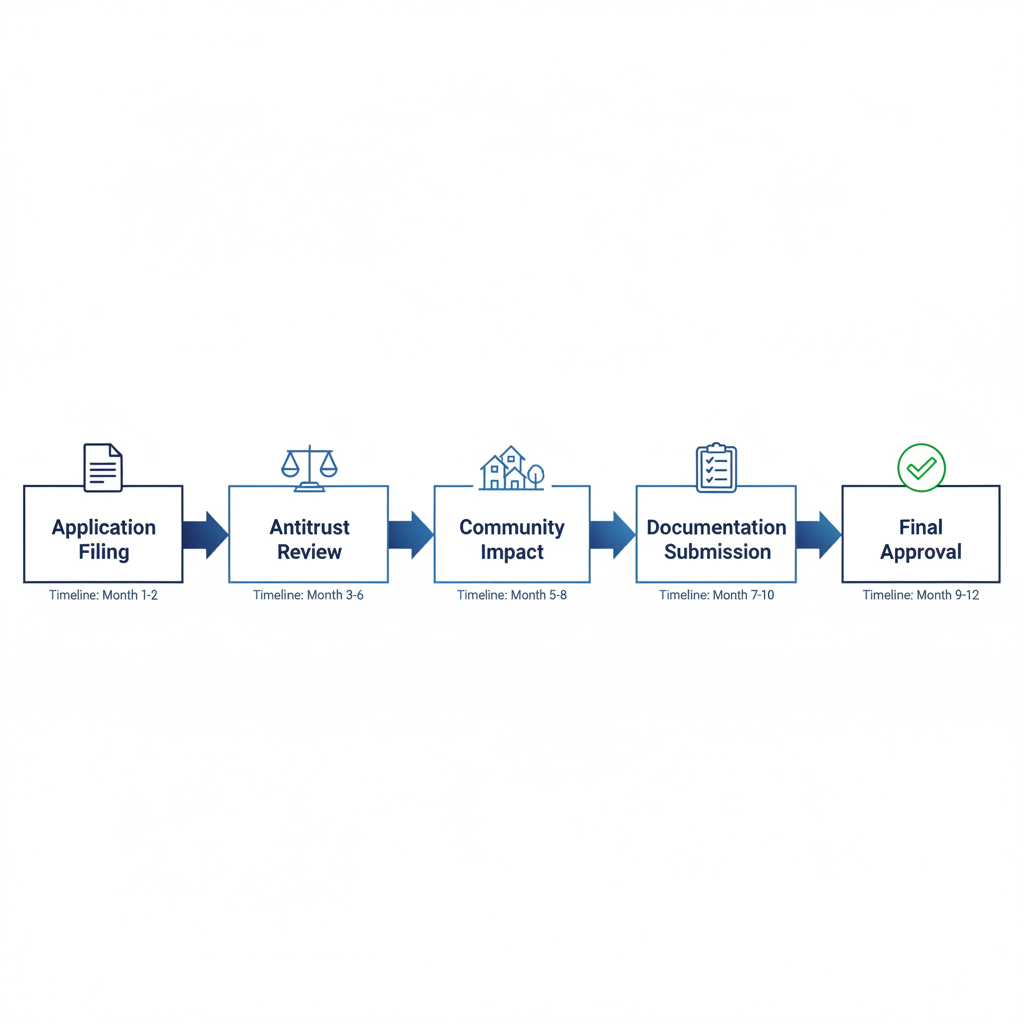
    1. Prepare the Application: Compile detailed documentation on financials, strategic rationale, and risk assessments. Engage legal experts early to align with FDIC and Federal Reserve guidelines.
    2. Submit to Regulators: File with the primary federal banking agency, such as the Federal Reserve Bank Merger Process, which outlines six stages from receipt to consummation, typically spanning 4-6 months.
    3. Undergo Reviews: Navigate antitrust evaluations by the DOJ and FTC, alongside community impact assessments under the Community Reinvestment Act to evaluate local effects.
    4. Address Feedback and Finalize: Respond to any requests for additional information and await final action, avoiding common pitfalls like incomplete disclosures that delay approvals.

    We emphasize these steps to streamline bank merger integration and mitigate regulatory hurdles.

    Navigating these processes mitigates risks of denial or prolonged scrutiny, safeguarding transaction timelines and preserving stakeholder confidence in an era of heightened oversight.

    Practical Tips

    Maintain a comprehensive documentation checklist, including pro forma financials, market analyses, and CRA compliance reports. Consult specialized counsel to preempt issues, ensuring robust preparation for evolving bank mergers regulatory approval demands.

    Horizontal diagram illustrating five key stages of bank merger regulatory approval process with icons and connections.

    Key stages in navigating bank merger regulatory approval

    This structured approach positions clients for efficient progression to due diligence phases.

    Conduct Comprehensive Due Diligence

    In the sequence of bank merger transactions, conducting comprehensive due diligence follows regulatory compliance and forms a critical analytical phase. At Zaidwood Capital, we guide clients through this full-cycle process, drawing on our expertise in mergers and acquisitions advisory to uncover potential risks and opportunities.

    We structure due diligence into distinct phases to ensure thorough coverage. Our bulleted checklist includes:

    • Financial Audits: Review balance sheets, cash flows, and asset valuations using tools like forensic accounting software to identify discrepancies in pre-merger audits.
    • Legal Reviews: Examine contracts, litigation history, and compliance records with document management systems for efficient risk flagging.
    • Operational Assessments: Evaluate branch networks, IT infrastructure, and human capital alignment, incorporating early bank merger integration planning.
    • Commercial and Market Analysis: Assess customer bases and competitive positioning via data analytics platforms.
    • Stakeholder Reporting: Compile findings into executive summaries for timely communication.

    This phased approach reduces risks in bank mergers by mitigating hidden liabilities and aligning expectations upfront. As outlined in our Zaidwood Capital FAQ on integration, full-cycle services like these prevent costly surprises post-transaction.

    For optimal results, we coordinate multidisciplinary experts early, including financial modelers and legal advisors. This collaboration streamlines reviews and supports seamless transitions to deal structuring.

    Structure the Merger Advisory Agreement

    Following thorough due diligence, we formalize the merger advisory agreement to establish a clear path for bank mergers. This document outlines essential terms, including fee structures such as success-based commissions tied to transaction value and retainers for ongoing support. Scope definitions specify our role in valuation, negotiation, and integration planning, while investor introductions leverage our network of over 4,000 institutional contacts, including Private Equity Firms, to facilitate capital deployment. Documentation needs encompass non-disclosure agreements, exclusivity clauses, and timelines to ensure smooth execution.

    Aligning the agreement with client goals is crucial amid bank consolidation trends, as it mitigates risks and optimizes outcomes in evolving deal frameworks in banking. By customizing terms, we ensure the structure supports strategic objectives, from cost synergies to regulatory compliance, fostering confidence in future transactions.

    Effective negotiation tips include prioritizing flexible fee milestones and clear termination provisions. We emphasize mutual benefits, drawing on our full-cycle M&A and capital advisory expertise to craft balanced agreements that drive value without overcommitting resources. This step paves the way for seamless post-merger integration.

    Plan Post-Merger Integration Strategies

    As transaction advisors at Zaidwood Capital, we emphasize that effective bank merger integration is crucial for realizing synergies and ensuring long-term success. This step involves creating a detailed roadmap that aligns systems, processes, and teams post-closing. Our approach draws from extensive experience in mergers and acquisitions, including insights from Private Equity Firms that focus on operational enhancements after acquisitions.

    Developing the Integration Roadmap (Instructions): Begin with a 90-day plan outlining key milestones, such as IT system migrations and HR policy harmonization. Address IT considerations by consolidating core banking platforms to minimize downtime, while HR focuses on talent retention and cultural alignment. Incorporate risk mitigation through scenario planning for regulatory hurdles and operational disruptions. Track success with metrics like cost savings achieved, customer retention rates, and employee engagement scores. We recommend cross-functional teams to oversee execution, ensuring seamless transition from planning to monitoring.

    Why Prioritize Integration (Value Preservation): Bank mergers often face value erosion if integration falters, with studies showing up to 30% synergy loss without proper planning. Post-consolidation strategies preserve stakeholder value by maintaining service continuity and fostering innovation.

    Practical Tips for Communication: Use town halls and newsletters to keep employees informed, reducing uncertainty. Engage customers early with personalized updates on service changes. Regular progress reports to executives build trust and enable timely adjustments.

    Monitor and Optimize Post-Merger Outcomes

    As the final step in our full-cycle M&A and capital advisory process, we at Zaidwood Capital emphasize ongoing monitoring to ensure bank merger integration delivers sustained value. Establishing key performance indicators (KPIs) such as revenue synergies, cost savings realization, and customer retention rates forms the foundation of effective outcome tracking in M&A. We help clients implement dashboards and reporting tools to monitor these metrics in real time, allowing for data-driven insights into post-merger performance. This structured approach addresses potential synergies and operational efficiencies from the outset.

    Monitoring is essential for sustained success because unaddressed issues can erode merger benefits over time. By tracking progress against predefined benchmarks, we identify deviations early, preventing value erosion amid evolving bank consolidation trends. Our advisory continuity supports clients in navigating these dynamics without compromising long-term objectives.

    For optimal results, we recommend quarterly reviews to assess progress and annual deep dives for strategic adjustments. These cadences enable us to address emerging issues in bank mergers promptly, facilitate necessary refinements, and document lessons learned for future transactions. This proactive stance not only optimizes outcomes but also builds resilience in a competitive landscape.

    Addressing Common Challenges in Bank Merger Advisory

    In the complex landscape of bank mergers, we at Zaidwood Capital frequently encounter obstacles that can derail even the most promising deals. Drawing from our aggregate $24.4 billion in transaction experience, this section outlines key advisory pitfalls in finance and provides actionable merger complication strategies to navigate them effectively. By anticipating these issues, clients can streamline processes and achieve successful outcomes.

    Common challenges in bank mergers include several recurring hurdles that demand proactive management:

    • Regulatory Bottlenecks: Delays in obtaining approvals from bodies like the FDIC or Federal Reserve often stem from incomplete filings or antitrust concerns. These can extend timelines by months, impacting deal momentum.
    • Integration Conflicts: Post-merger bank merger integration poses risks such as system incompatibilities or cultural clashes, leading to operational disruptions and employee turnover.
    • Economic Volatility: Shifts influenced by bank consolidation trends, like interest rate fluctuations or market downturns, can alter valuations and financing structures mid-process.
    • Documentation Errors: Inaccuracies in financial models or legal agreements may trigger renegotiations or regulatory scrutiny, eroding trust among parties.
    • Stakeholder Resistance: Internal teams or shareholders may oppose the merger due to uncertainty, complicating consensus-building.

    To resolve these, we employ proven frameworks informed by best practices in the industry. For regulatory bottlenecks, contingency planning involves early engagement with experts and parallel submission tracks to mitigate delays. Addressing integration conflicts requires phased approaches, starting with IT assessments and joint training programs to ensure seamless bank merger integration. In the face of economic volatility, scenario modeling allows us to stress-test deals against bank consolidation trends, adjusting terms proactively. Documentation errors are prevented through rigorous checklists and third-party audits, while stakeholder resistance is overcome with transparent communication strategies, including town halls and progress updates. These steps, applied across our 300+ completed deals, reinforce resilience and alignment with client goals.

    Advancing Your Bank Merger Strategy

    Navigating bank mergers requires a structured approach, as outlined in this seven-step guide. From initial preparation to seamless bank merger integration, each phase builds on the last to ensure strategic alignment and operational success. We at Zaidwood Capital emphasize the interconnectedness of these steps, drawing on our full-cycle M&A advisory to help institutions achieve resilient outcomes in strategic banking M&A.

    Key takeaways include adapting to evolving economic pressures and stringent regulatory landscapes, which demand proactive monitoring of market dynamics. By staying ahead of these factors, banks can mitigate risks and capitalize on synergies effectively.

    As your trusted advisor, we invite you to leverage our expertise in capital introductions and access to over 4,000 institutional investors. Contact Zaidwood Capital today to advance your consolidation objectives.

    Looking ahead, bank consolidation trends point to robust opportunities in 2026, particularly in the US market, where innovative structures will drive growth.

    Resources