

Table of Contents
- Tree Care Industry Trends 2026: An Investor’s Lens on Technology and Capital
- Understanding the Tree Care Industry’s Structural Shift
- Technology and Climate Adaptation: Drones, AI, and Resilient Canopies
- Residential Service Growth and the Labor Crisis: Practical Implications for 2026
- Investment Valuation and Capital Formation in the Tree Care Sector
- Frequently Asked Questions About Tree Care Industry Trends 2026
- Capitalizing on Tree Care Evolution: Strategic Takeaways for Investors
Tree Care Industry Trends 2026: An Investor’s Lens on Technology and Capital
As we examine tree care industry trends 2026, it’s clear that technology and capital are driving a fundamental transformation. The adoption of AI-powered tree risk assessment technology allows arborists and municipalities to make data-driven decisions, improving safety and operational efficiency across urban canopies.
At the same time, climate-resilient urban canopy management is moving from a niche concern to a mainstream priority. As extreme weather events intensify, cities are recognizing the critical role of trees in cooling, carbon sequestration, and stormwater management. In our view, the shift from reactive tree removal to proactive care enabled by technology and climate policy is a long-term structural change that will fuel demand for advanced services.
Capital is following these structural tailwinds. We are observing growing M&A activity in the tree care sector, mirroring patterns identified in Zaidwood Capital’s overview of emerging markets M&A. Consolidation is enabling companies to scale and attract institutional investors seeking stable, infrastructure-linked returns. The influx of capital into tech-enabled tree care companies further signals market confidence in the sector’s growth.
For investors, these converging trends create a favorable landscape for participating in the environmental infrastructure space. We believe that understanding these drivers can help position portfolios for the maturation of green infrastructure, though past performance does not guarantee future results. Ultimately, this article is for informational purposes and does not constitute an offer, solicitation, or investment advice.
Understanding the Tree Care Industry’s Structural Shift
The tree care industry trends 2026 point to a fundamental structural shift reshaping arboricultural services and their investment landscape. Three primary drivers are fueling this transformation:
- Adoption of AI-powered tree risk assessment technology
- Mandates for climate-resilient urban canopy management
- Accelerating M&A consolidation across historically fragmented markets
Technology is the first seismic force. Innovative firms are deploying AI-powered tree risk assessment technology to evaluate health, stability, and failure probability with precision never before possible. These platforms analyze multispectral imagery, weather patterns, and soil data to forecast liabilities at scale, capturing the attention of private equity and growth-focused investors.
Climate imperatives are the second driver. Municipalities worldwide are mandating climate-resilient urban canopy management to combat heat islands and stormwater surges. The resulting fragmentation and unmet compliance demand create natural roll-up opportunities. Regional platforms that can consolidate services while meeting sustainability metrics are becoming prime targets for strategic acquirers and institutional funds seeking ESG-aligned exposure.
Finally, M&A consolidation is accelerating across the tree care sector. Zaidwood Capital’s deep dive into emerging markets M&A reveals a 15 percent annual surge in transaction volumes across developing economies—a dynamic mirrored in North American specialty services. This structural momentum positions the tree care industry for increased emerging markets M&A activity, drawing interest from sovereign wealth funds and cross-border alliances.
Technology and Climate Adaptation: Drones, AI, and Resilient Canopies
Among the most impactful tree care industry trends 2026 are the rapid adoption of drone-based health assessments, AI-powered risk prediction, and climate-adaptive species selection.
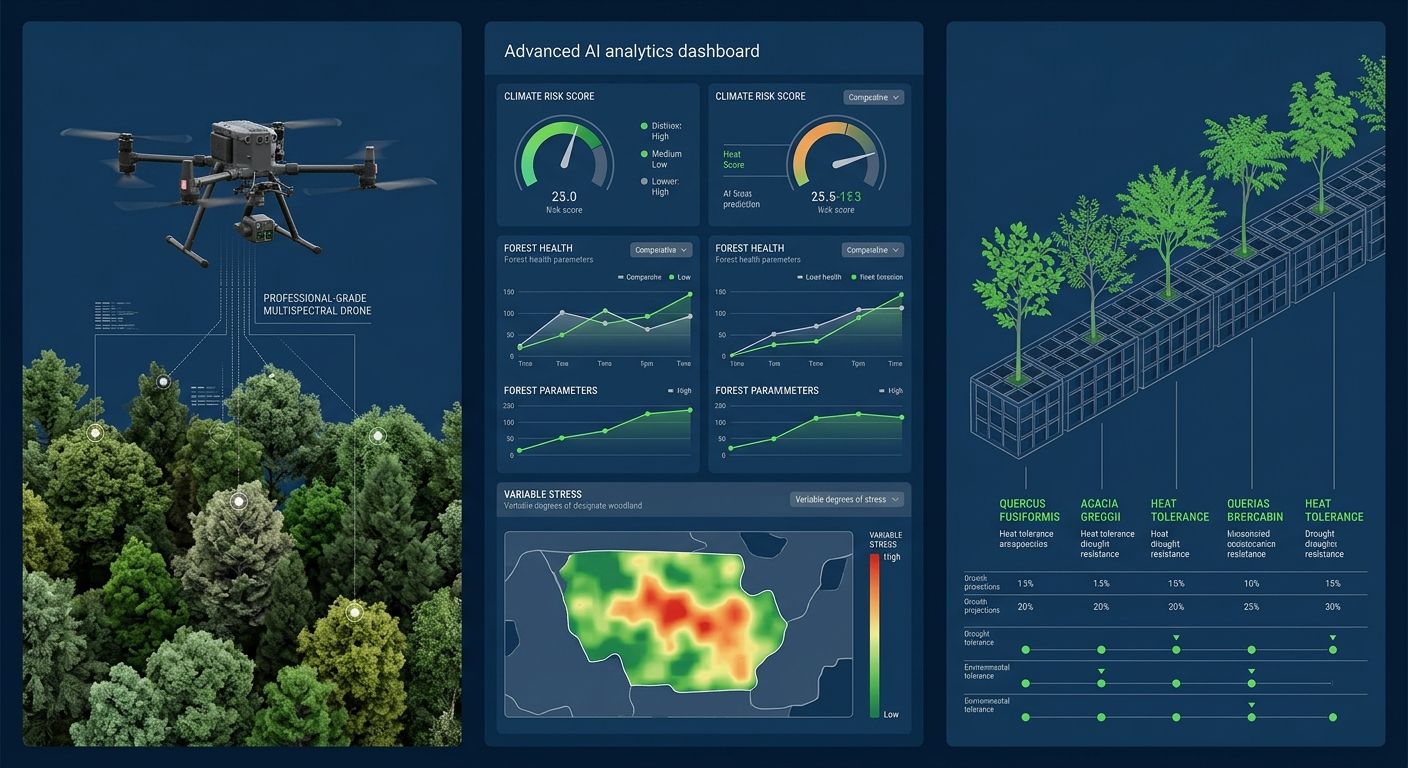
Technology and climate adaptation with drones, AI, and resilient canopies
Drone-Based Arborist Health Assessments
Drone-based arborist health assessments are revolutionizing the field. Equipped with multispectral and LiDAR sensors, drones capture high-resolution imagery and 3D data that reveal early signs of disease long before symptoms are visible to the naked eye. This approach improves safety and cuts inspection costs by up to 50% compared to traditional methods.
AI-Powered Tree Risk Assessment Technology
The next frontier in arboriculture is AI-powered tree risk assessment technology. By feeding data from IoT soil moisture probes and historical weather patterns into machine learning models, these systems can predict the probability of limb failure with remarkable accuracy. This allows arborists to schedule preventive maintenance proactively.
Climate-Adaptive Tree Care Practices
Professionals are rethinking species selection to create climate-resilient urban canopy management strategies. Heat- and drought-tolerant species gaining prominence include Quercus macrocarpa (Bur Oak), Ulmus ‘Morton Glossy’ (Triumph™ Elm), and Gleditsia triacanthos var. inermis (Thornless Honeylocust). These proactive steps ensure that urban forests continue to deliver ecosystem services as conditions shift.
Residential Service Growth and the Labor Crisis: Practical Implications for 2026
Outlook for Residential Tree Service Growth
Three primary catalysts drive demand for residential tree services: home improvement activity, severe weather events, and accelerating urbanization. Homeowners are increasingly aware of the value mature trees bring to property valuations. According to the urban tree care framework, increased urban sprawl and aging tree stocks require professional risk mitigation well into 2026.
How Labor Shortage Shapes Pricing and Operations
Despite strong demand, a shortage of certified arborists is reshaping the sector. In acute markets, residential prices have risen 15–20% as firms bid up wages. Adoption of AI-powered tree risk assessment technology allows crews to prioritize inspections using drone imagery, mitigating the shortage by improving efficiency for existing staff.
Investment Valuation and Capital Formation in the Tree Care Sector
Understanding tree care industry trends 2026 is essential for business owners. Valuation typically revolves around adjusted EBITDA multiples in the 3-5x range. Beyond traditional metrics, companies demonstrating AI-powered tree risk assessment technology implementation and climate-resilient urban canopy management command premium pricing from institutional investors.
Frequently Asked Questions About Tree Care Industry Trends 2026
How is AI transforming tree risk assessment in 2026?
AI-powered tree risk assessment technology uses predictive analytics to detect hazards early, reducing emergency costs and improving safety.
What is climate-resilient urban canopy management?
It focuses on selecting diverse, drought-tolerant species and strategic planting to help urban forests weather climate shifts.
Why choose a veteran-owned tree service?
Consider a veteran owned tree service like Climbing Grunt for discipline and commitment to safety.
Resources
- Master M&A Strategies for Emerging Markets
- Discover 15% Annual M&A Growth in Emerging Markets
- Learn to Mitigate Key Risks in Buy-Side M&A
- Understand Debt Advisory for M&A Without Equity Dilution
- Overcome Capital Formation Challenges in Emerging Markets
- Learn How Sovereign Wealth Funds Drive Emerging Market Growth
- Explore the 2026 Investment Outlook for Emerging Markets
- Automate Google Review Collection with RepuClinic Platform
- Discover Expert Tree Care from Veteran-Owned Professionals
- Learn the Seven-Step Framework for Urban Tree Management