Author: admin

  • Find Out What Your Business Is Really Worth

    Find Out What Your Business Is Really Worth

    Finding out what your business is really worth is the critical first step for any owner considering a sale, capital raise, or strategic exit. Business valuation is not a single number but a multi-method process that answers the question every founder asks: what is my business worth?

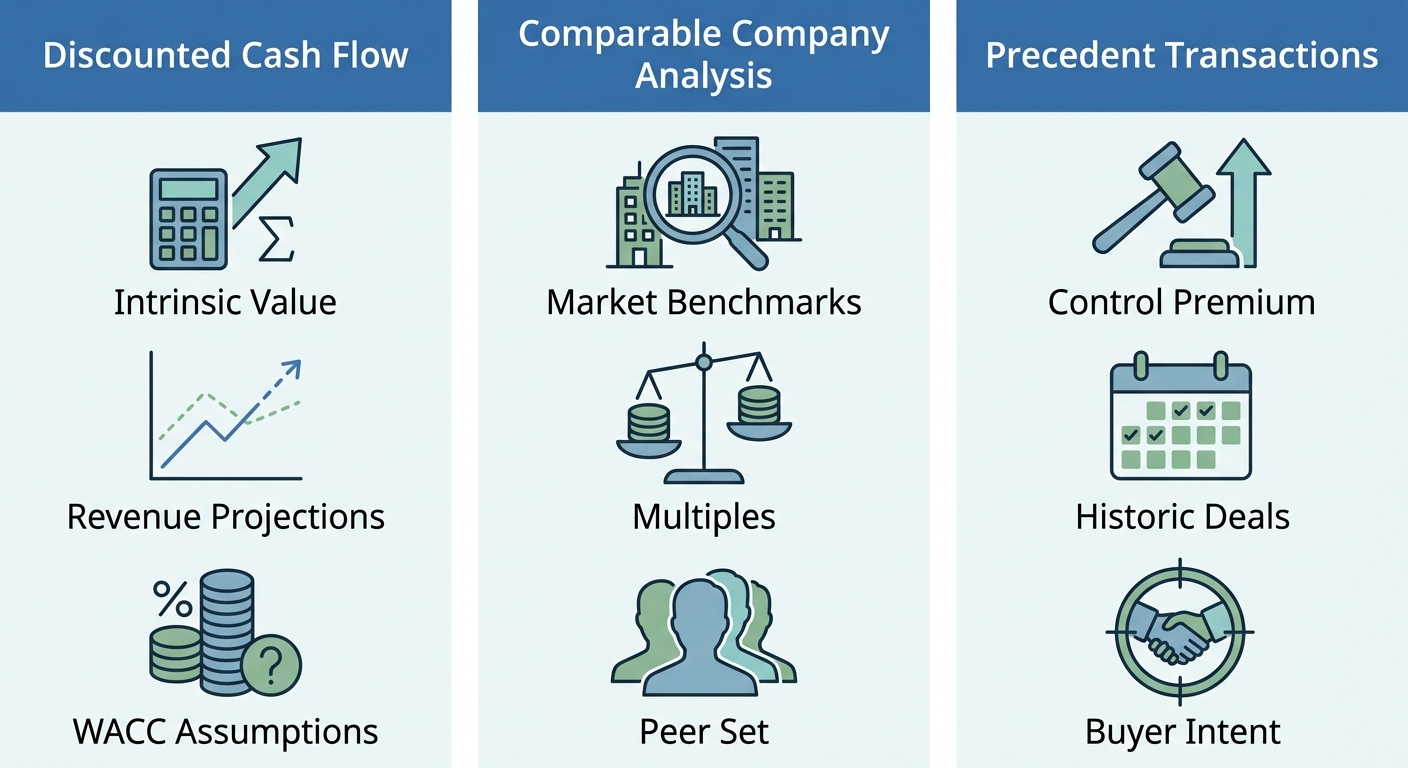
    Investopedia, a comprehensive financial education resource, outlines methods ranging from market capitalization to discounted cash flow, while Anders CPA emphasizes that credible valuations go beyond superficial rules of thumb, incorporating income, market, and asset-based approaches. as a Boutique M&A and Capital Advisory Firm, we help founders peel back these layers to understand how to value a business and to explain how debt affects business valuation. And for most businesses, revenue is the first metric buyers scrutinize when estimating worth.

    How Much Is My Business Worth Based on Annual Sales?

    Annual sales provide a concrete starting point for valuation, but the result is only an approximation. A revenue multiple–a common business valuation method–multiplies gross revenue by an industry factor to yield an indicative value. Alternatively, an EBITDA multiple applies a factor to earnings before interest, taxes, depreciation, and amortization, shifting focus to profitability. Both shortcuts skip the normalization of financial statements for discretionary expenses and one-time items–a step professional valuations incorporate, as Anders CPA notes. We recommend engaging a qualified advisor to build a defensible valuation that accounts for factors beyond simple sales multiples. From growth trajectory to customer concentration, qualitative and quantitative elements shape true market value.

    What Factors Beyond Profit Influence My Business’s Worth?

    Annual revenue and profit figures provide a partial picture of a business’s worth. To find true value, EBITDA normalization is used to account for discretionary expenses (owner perks, for example) to identify consistent earnings. For a dependable valuation, three or more years of financial records are necessary, according to the U.S. Chamber of Commerce. We compare an asset-based approach (net assets minus liabilities) with the market approach (sales of comparable firms), as noted by that source. Revenue stability, margin profile and the growth trajectory of the business help shape the final valuation. From a buyer’s valuation perspective, risk and scalability determine the premium paid. Conversely, the potential for a business to grow and be financially scalable influences the valuation. A firm’s value exceeds its tangible assets alone, prompting a more comprehensive assessment.

    Can My Business Be Worth More Than the Sum of Its Assets?

    Yes, we believe that companies can be worth more than their physical assets when valued through the income or market approaches.
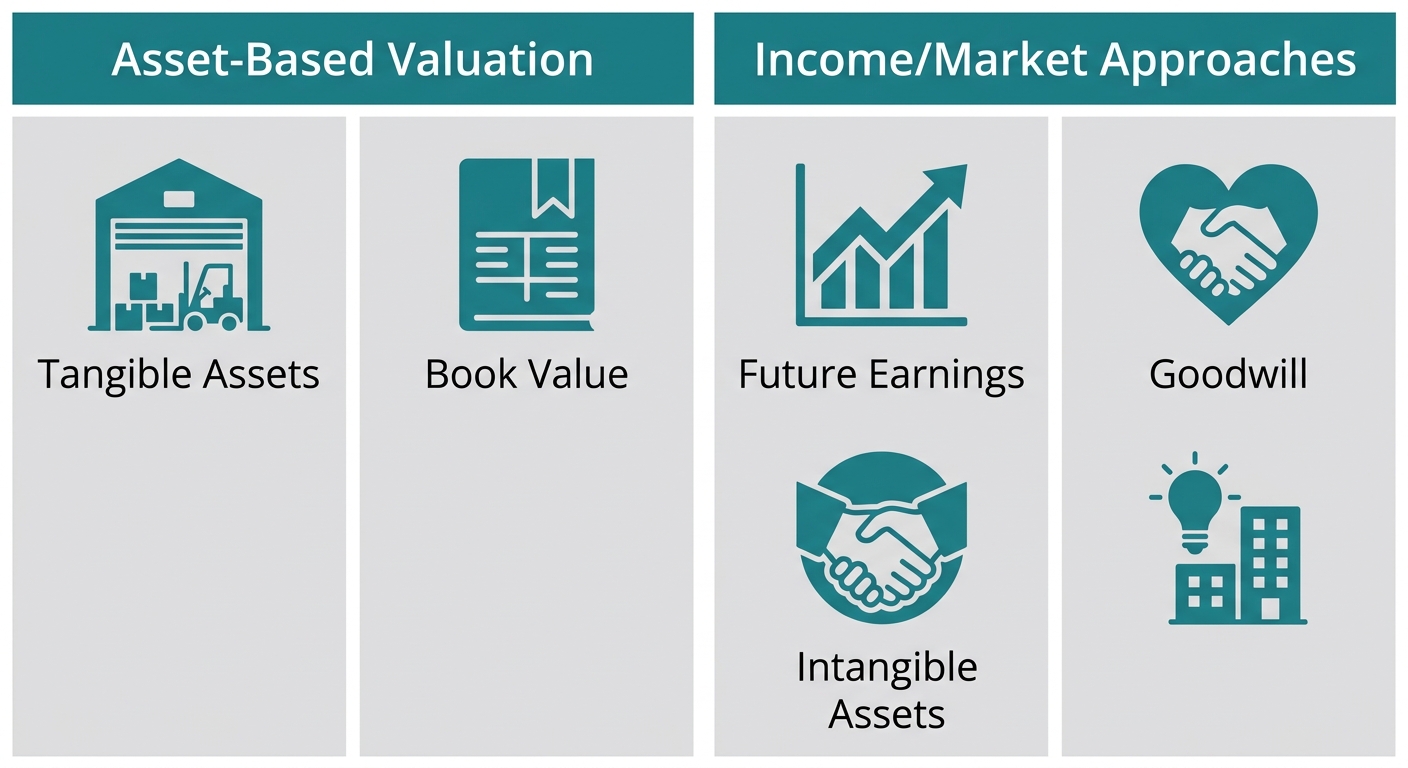
    Two-column infographic comparing asset-based valuation with income and market approaches. Left column: Tangible Assets and Book Value as building blocks. Right column: Future Earnings, Goodwill, and Intangible Assets as glowing icons.
    Infographic explaining why business value exceeds physical assets through valuation approaches.

    Tangible net assets are what is counted in asset-based valuation; intangible assets like brand and proprietary technology are often disregarded.

    Future earnings are captured in income approaches and market comparables, and the premium over net tangible assets is goodwill.

    What Is the Difference Between a Business Valuation and a Business Appraisal?

    A professional business valuation rigorously employs multiple methodologies to support their conclusions. Each of these methodologies can be defined as an approach: income approach, market approach, or asset approach. A business appraisal tends to rely on rules-of-thumb or revenue multiples to derive a conclusion. Such appraisals ignore a company’s unique characteristics. This valuation vs appraisal distinction underpins every high-stakes M&A and capital transaction, where only a comprehensive valuation provides the accuracy required.

    Both the U.S. Chamber of Commerce and Anders CPAs report that professional valuations normalize financials and are performed by credentialed experts such as a Certified Valuation Analyst (CVA) or a member of the ABV division. The outcome is a formal valuation report that withstands scrutiny from buyers, lenders, and tax authorities.

    What Are the Most Common Standards of Value Used in M&A Transactions?

    We can define the specific standard of value for M&A transactions once we distinguish appraisals from valuations, and that standard dictates the methodology. In M&A, the two most prevalent standards are fair market value and investment value. Fair market value is the price a willing buyer and seller would agree upon. Investment value reflects the worth of the business to the specific potential buyer. One firm groups defensible valuation approaches into three categories: income, market, and asset-based, while warning that rules of thumb are not dependable. We, at Zaidwood Capital, determine the most defensible approach based on the standard of value and deliver a valuation based on that approach. The focus then shifts to choosing the most suitable valuation methodology for high-growth companies.

    What Is the Most Accurate Method to Value a High-Growth Company?

    DCF valuation is the most accurate method for high-growth company valuation because it projects future cash flows and accounts for the time value of money.

    The correct application of this method relies on the professional normalization of financial statements to eliminate discretionary and non-recurring items.

    Valuation rules of thumb based on revenue or EBITDA multiples frequently ignore margin profile and other unique factors of high-growth businesses and hence, are less reliable. However, for very early-stage companies, a tailored variation of venture capital method can be applied to estimate terminal value based on the expected company exit. Knowing the right methodology aids a business owner to make an informed decision on when to commission a formal valuation.

    When Should a Business Owner Undergo a Formal Business Valuation?

    Major ownership changes, or valuation triggers, prompt our team to advise that a formal business valuation is essential. As that source highlights, unlike informal rules of thumb, a professional appraisal yields objective, defensible numbers for high-stakes decisions. As that source notes, informal rules of thumb lack objectivity and may offer little to no defense for high-stakes decisions.

    A formal valuation prior to a liquidity event provides a basis for negotiations, along with investor confidence. For a partnership buyout, it ensures fair terms for exiting partners. As noted by the U.S. Chamber of Commerce, valuations help define tax and estate planning.

    Awareness of valuation triggers illuminates the importance of a formal valuation beyond the confines of a one-time transaction.

    Why Is Business Valuation Important for Long-Term Strategic Planning?

    The analysis of business valuation uses financial information to build a defensible baseline for growth, exit and capital decisions.

    The U.S. Chamber of Commerce states that preparation for an official valuation requires a minimum of three years of financial records. This drive for disciplined long-term financial planning helps to uncover value gaps.

    The defensible number provided by our valuation professionals is grounded in the ABV credential recognized by the U.S. Chamber of Commerce as the industry standard. This number serves as a basis for strategic exit planning.

    In addition, a defensible valuation serves the entrepreneur in anchoring their wealth management strategies to the value of their business.

    How Do Market Conditions Impact What My Business Is Worth Today?

    Numerous factors beyond a business’s fundamental worth contribute to valuation. Multiples are a function of market appetite and the cost of capital and are therefore fluid. In an active M&A environment, and as long as deal multiples rise, valuations increase. The reverse is true in a declining M&A environment. There are additional, longer-term trending market factors that shift valuation multiples and the overall attractiveness of an industry. Macroeconomic factors in valuation, including interest rates, inflation, and GDP growth, influence the discount rates and earnings projections that underpin every appraisal. Beyond these broad signals, shifting industry trends can alter a sector’s attractiveness and the premium buyers assign to it. At Zaidwood Capital, we help business owners interpret these dynamics so they approach a transaction with a current, defensible understanding of their company’s worth.

    Should I Get a Professional Valuation Before Receiving an Unsolicited Offer?

    A professional valuation is critical when an unsolicited offer arrives. That source warns that rules-of-thumb or EBITDA multiples ignore key business drivers. A proper unsolicited offer evaluation combines income, market, and asset-based methods to provide a defensible price anchor and negotiation leverage.

    The U.S. Chamber of Commerce emphasizes that proper seller due diligence should involve a certified valuator, such as one with the Accredited in Business Valuation (ABV) credential, and at least three years of financial records. This protects against undervaluing your business. A comprehensive valuation also accounts for debt and capital structure, which we’ll address when discussing how leverage impacts deal terms.

    How Does Having Significant Debt Affect My Business Valuation in an M&A Deal?

    We at Zaidwood Capital consider capital structure to be a key determinant of risk. Debt and equity jointly affect the weighted average cost of capital, which is used as the discount rate in a cash flow analysis. Moderate debt can increase equity return potential because interest is deemed a business expense and is therefore tax-deductible. Evaluating the effect of debt on valuation, we are looking at the debt-to-equity ratio.
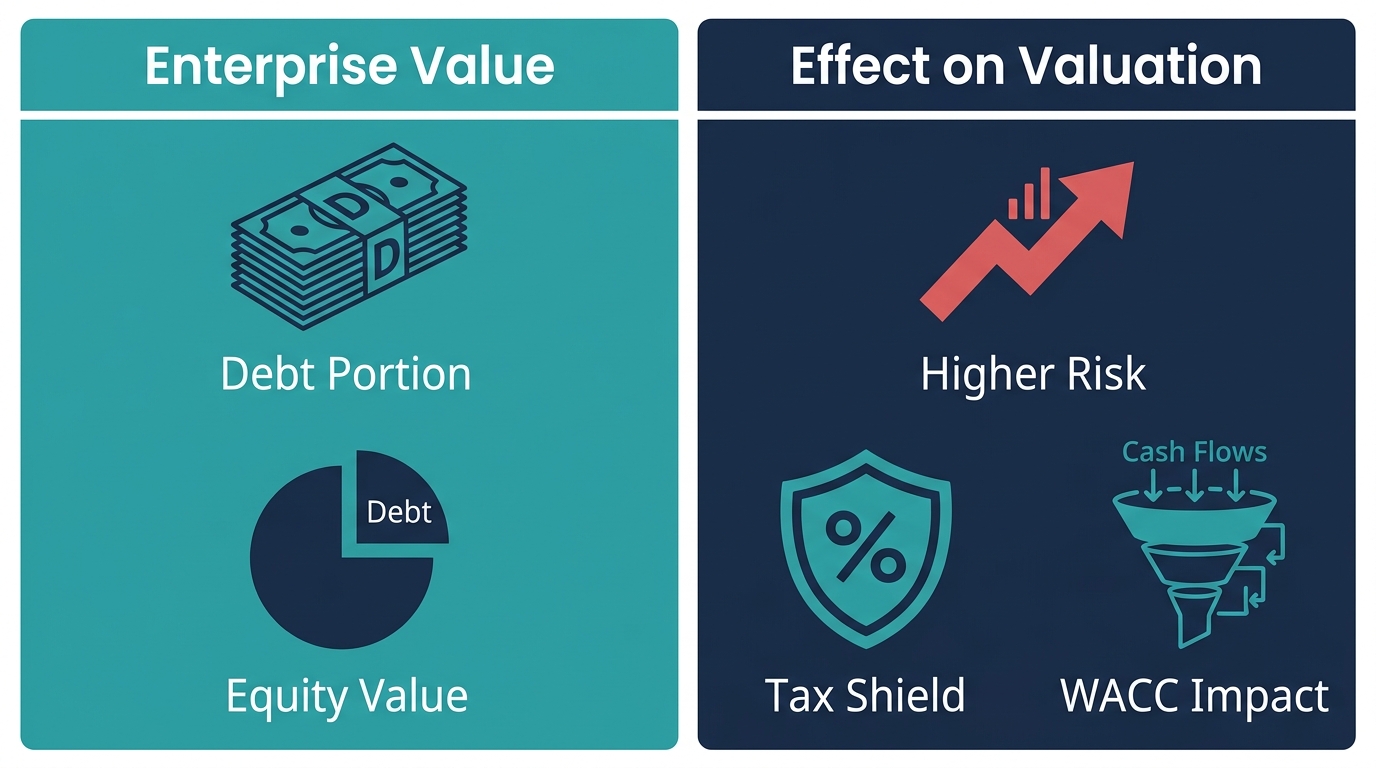
    Split-panel infographic comparing enterprise value components and effects of debt on valuation
    Infographic shows debt and equity effects on valuation

    Adjusting the level of debt dictates if the figure represents the equity value or enterprise value.

    How Is Net Debt Subtracted from Enterprise Value to Determine Equity Value?

    Enterprise value (EV) represents the total value of a company’s operations, encompassing both debt and equity claims. Net debt is total debt (short-term and long-term) less cash and cash equivalents; the net debt calculation removes liquid assets from gross debt. The equity value attributable to shareholders is EV minus net debt.

    Subtracting net debt removes the creditor portion, leaving the equity holders’ residual claim. For distressed company valuation, balance-sheet figures often require balance sheet adjustments, such as using the market value of debt rather than book value. Zaidwood Capital provides tailored M&A and capital advisory support to help owners assess their position.

    Still Have Questions? Contact Zaidwood Capital

    If you want to find out what your business is really worth, contact us.

    Call 800-962-0418 or email contact@zaidwoodcapital.com. This website is informational — not an offer, solicitation, recommendation, or commitment to buy or sell any security. Securities are offered through Finalis Securities LLC; Zaidwood Capital is not a registered broker-dealer and unaffiliated with Finalis. Prospective investors should do due diligence and consult legal, tax, financial advisors. Corporate logos are not endorsements; investments carry risk and past performance is not guaranteed.
    Resources

  • Selling Your Business to Private Equity or a Strategic Buyer

    Selling Your Business to Private Equity or a Strategic Buyer: A Clear Comparison

    Selling your business to a private equity group or strategic buyer is a pivotal decision that determines how the transaction is structured, the continuity of the management team, and the long-term legacy of the business. As a Boutique M&A and Capital Advisory Firm, we assist business owners in navigating sell side M&A trade-offs. We inform owners how and when selling to private equity fits into the greater scheme of things.

    Side-by-Side Comparison: Private Equity vs Strategic Buyer

    Comparison Table: Private Equity vs Strategic Buyer
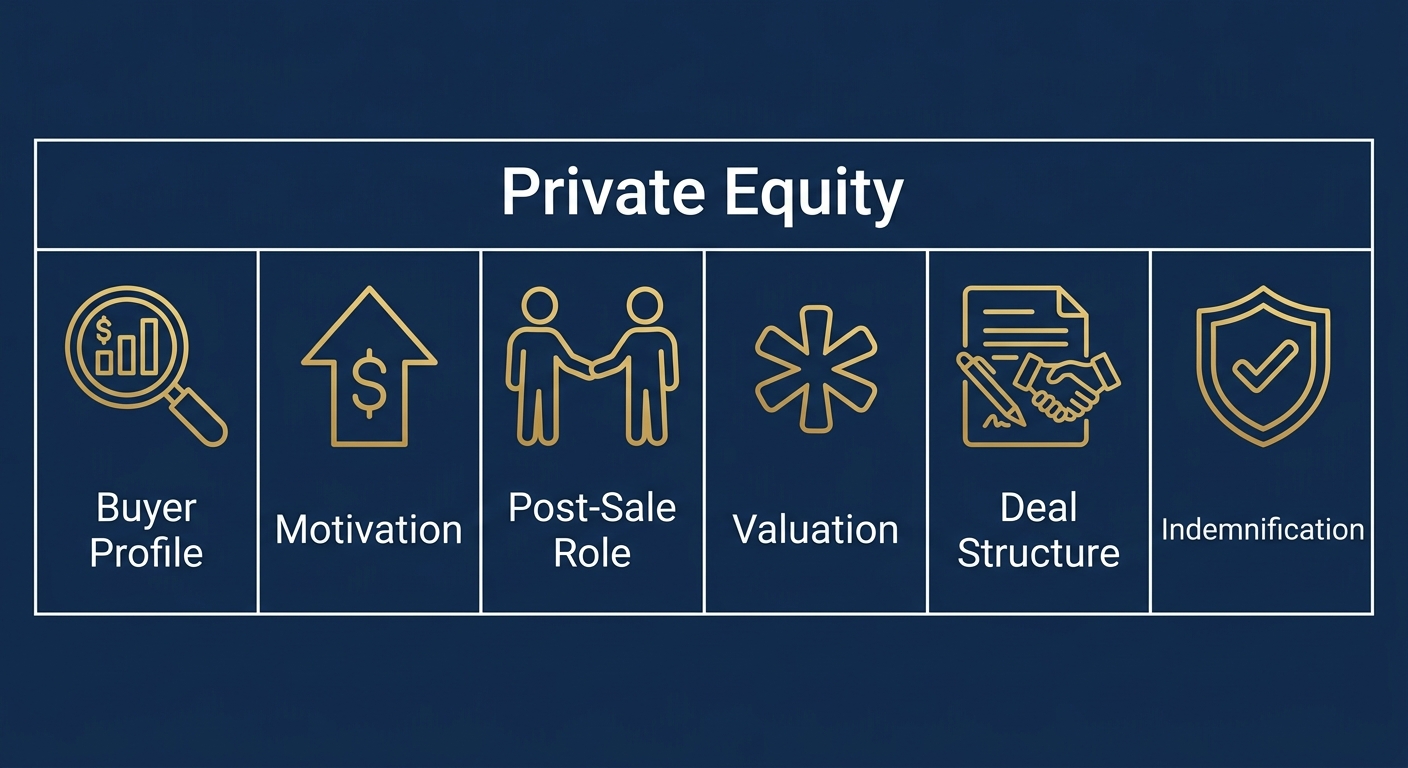
    Dimension Private Equity Strategic Buyer
    Buyer Profile Investor Industry operator
    Motivation ROI Strategic synergies
    Post-Sale Involvement Retains management Integrates operations
    Valuation Approach EBITDA multiple-driven Synergy-based premium
    Deal Structure Stock purchase; liability Asset purchase; selective liability
    Indemnification Uses RWI Traditional indemnity
    Timeline 3-6 months 4-9 months
    Confidentiality High Medium
    Exit Horizon 3-7 years Indefinite hold
    Infographic comparing characteristics of Private Equity buyers with six labeled icons: Buyer Profile, Motivation, Post-Sale Role, Valuation, Deal Structure, Indemnification.
    Key characteristics of Private Equity buyers in M&A transactions.

    Understanding Private Equity Buyers

    The first passage outlines how different types of buyers affect a deal in a particular way, and here we focus on selling to a private equity firm (PE) and how documentation and structural issues drive the transaction. Private equity buyers, as institutional investors, purchase firms for growth.

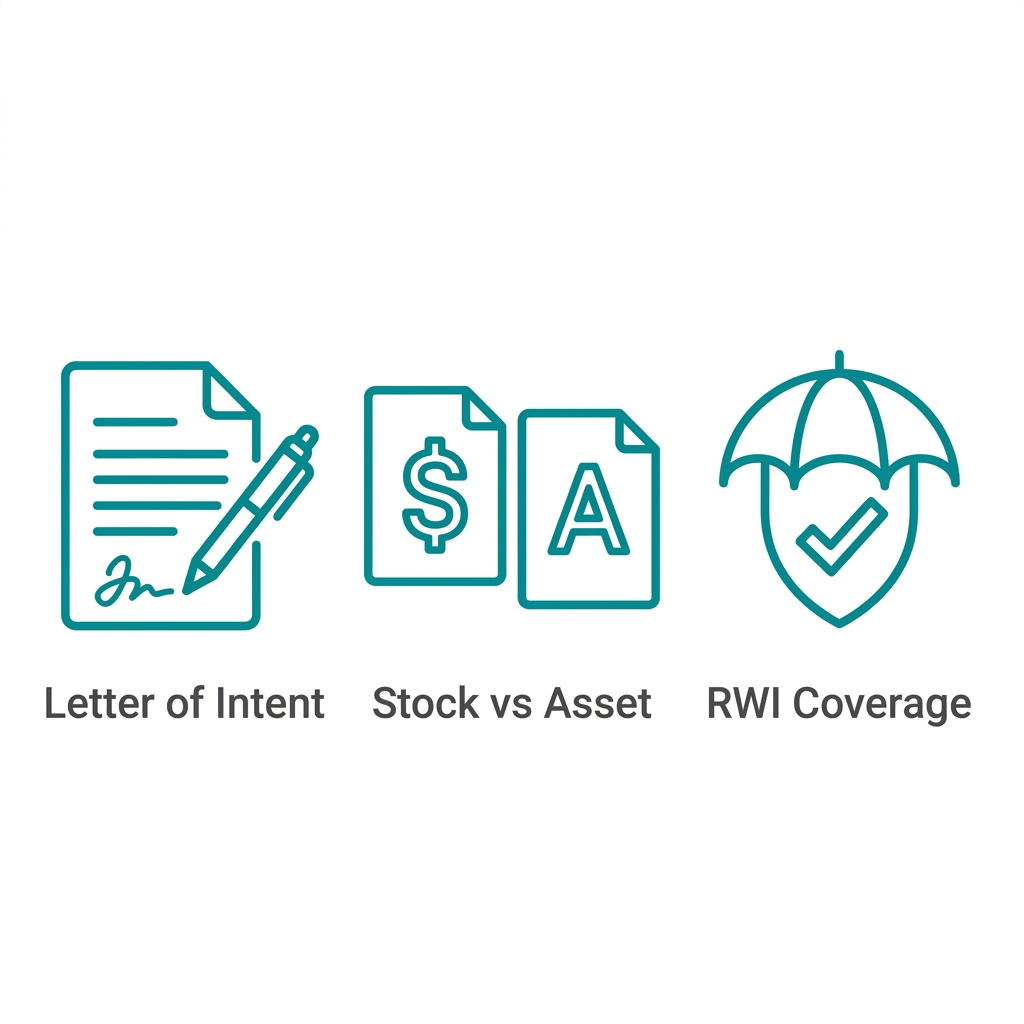
    Three icon set illustrating key M&A legal concepts: Letter of Intent, Stock vs Asset, and RWI Coverage
    Icon set for Understanding Private Equity Buyers section

    The Letter of Intent (LOI) in a PE deal, which we negotiate, is typically non-binding, but the confidentiality provision carries legal weight. As noted in LegalClarity’s M&A practice guidance, this document is prepared to include the major deal points and gives flexibility to conduct due diligence.

    A purchase of a firm’s stock transfers all historical liabilities to the buyer, while an asset purchase permits selective assumption. In the case of a management buyout (MBO) where a PE firm partners with the existing leadership team, an asset structure can be particularly appealing because it isolates legacy risks.

    Representation and Warranty Insurance (RWI) is now a common feature of private M&A deals, covering 10% to 20% of the deal value, with the premiums ranging from 2% to 4% of the policy value.

    Strategic buyers, in contrast, often emphasize post-merger integration and synergy capture more than the contractual safeguards that define a PE acquisition.

    Understanding Strategic Buyers

    Operating companies (competitors, customers, suppliers, etc.) that acquire other businesses for operational synergies or to expand their reach in the market are known as strategic buyers. Unlike financial buyers (private equity, for example), whose primary objective is a financial return through a future sale, strategic buyers look to enhance their operations and competitive position by acquiring businesses.

    In our experience, the process for a strategic buyer generally starts with the signing of a non-binding Letter of Intent (LOI). As noted in Legal Clarity’s M&A Practice Guidance, from there, deals are generally structured as asset purchases so that the buyer can cherry pick the desired assets and contracts, and leave the historical liabilities behind. Representation and Warranty Insurance (RWI) has become standard in these transactions and shifts the risk to the insurer in the case the seller’s representation proves to be inaccurate.

    While a strategic buyer may offer synergy value, a seller’s broader priorities will often dictate that selling to a financial buyer is optimal, a case we see often and explore next.

    When Selling to Private Equity Wins

    While strategic buyers tend to realize value from acquisition through integration, private equity buyers tend to provide a growth-partner approach aligned with operational independence. In our advisory role, we have found that private equity acquirers tend to be better aligned for businesses that require capital and/or operational reinforcement for growth as opposed to a complete exit.

    Maintaining brand and cultural identity, as well as independence, is a key concern for many founders. Private equity ownership, in many cases, enables continued engagement of the founder while realizing capital liquidity.

    Unlike strategic buyers that often eliminate duplicate functions and integrate operations, private equity firms frequently retain existing management and empower leadership, preserving the seller’s operational influence. Yet for owners seeking to maximize sale price through a competitive bid, a strategic buyer may be the better fit.

    When Selling to a Strategic Buyer Wins

    Generally, an operating company in the same or adjacent line of business acquires a company in order to gain market share, fill a product gap, or vertically integrate its business. These premium payers often acquire capabilities to close a gap they are unable to create internally.

    In consolidation plays, an industry buyer can unlock synergies that a private equity firm cannot, and therefore serve as a valuation floor. Cultural alignment and long-term operational integration often tip the scale in favor of the corporate buyer. We believe founders that place a premium on a specific culture or mission in their business would likely find a better partner in a strategic corporate buyer.

    While a corporate buyer offers certain benefits, generally speaking, the choice between a corporate buyer and a private equity sponsor is not an “either-or.” Owners consider both paths. We will discuss the nuances owners consider in the next section.

    When You Might Consider Both Paths — or Neither

    Strategic acquirers can deliver synergy premiums, yet sellers benefit from exploring private equity and strategic offers simultaneously to identify the right fit. A dual-track process lets you compare offers that involve different transaction structures, such as stock versus asset purchases, which carry distinct liability implications as outlined above. Running both processes side by side creates competitive tension, potentially improving deal terms and revealing which buyer type aligns with your long-term vision.

    In some situations, selling is not the right course. Owners who find joy in growing their business or who face unfavorable market conditions may decide to hold and reinvest.

    At Zaidwood Capital, we help you evaluate both options. With us, you can understand the cost implications of each type of buyer, which will sharpen your decision.

    Cost Comparison: Private Equity vs Strategic Buyer

    The way a purchase is structured makes a difference in cost for a variety of reasons. For example, the acquisition of assets leaves behind certain liabilities, while the acquisition of stock typically takes on the company’s liabilities. This plays a key role in the way risk and costs are allocated.

    There are other factors as well. Representation and warranty insurance (RWI) is customary in private M&A and enables the buyer to recover post-closing losses through an insurance claim, easing the seller’s exposure.

    There are several structures and costs related to the insurance elements of an M&A transaction and we tend to get similar questions about the M&A process based on these.

    Frequently Asked Questions About Selling a Business

    What documents do I need to sell my business?

    The sale process begins with a confidentiality agreement and typically progresses to a letter of intent, definitive purchase agreement, disclosure schedules, regulatory filings, and closing documents.

    What is a Letter of Intent and is it binding?

    Letters of intent (LOI) include proposed deal terms, which are generally non-binding. Exclusivity and confidentiality provisions in LOIs often carry legal weight.

    Should I sell stock or assets — what’s the difference?

    From a liability standpoint, a stock purchase, generally, results in the buyer inheriting the seller’s historical liabilities, while an asset purchase does not, and the buyer has the ability to select which, if any, of the Seller’s liabilities it wishes to assume. Protection for Sellers from indemnity claims is available in the form of Representation and Warranty Insurance (RWI).

    How does the due-diligence documentation process work?

    Due diligence extends from confidentiality agreements and LOIs through definitive agreements, closing procedures, and post-closing filings. Accurate disclosure schedules and regulatory filings are critical to avoid unexpected liability and delays.

    Take the Next Step Toward a Successful Sale

    The FAQs show the right buyer depends on long-term goals. Whether you are selling your business to private equity or a strategic buyer, our team is ready. Contact Zaidwood Capital at 800-962-0418.

    Resources

  • Investor Rights and Term Sheet Terms That Affect Your Exit

    Investor rights and term sheet terms that affect your exit are the contractual provisions that govern both whether you can sell and how proceeds are shared. In a term sheet, we focus on two cornerstone clauses: liquidation preferences, which establish the payout hierarchy, and protective provisions, which give preferred shareholders veto power over major actions, including a sale. These mechanisms are set in the company’s charter documents and often become binding well before an exit.

    Liquidation preferences define the order of payout. In the event the proceeds of the exit do not cover the total of the liquidation preferences, common stockholders may receive nothing. Protective provisions, on the other hand, give investors the right to veto a sale when the conditions in the certificate of incorporation are triggered. These, therefore, fundamentally affect one’s right to sell, as well as how much one is able to realize from a sale.

    How Term Sheet Economics Affect Your Exit Payout

    How much a founder receives at an exit is governed not by simple ownership percentages but by a handful of term sheet provisions that construct a highly structured waterfall.

    How do liquidation preferences and participation rights influence my final payout during an exit?

    Preferred shareholders get paid first according to their liquidation preference. With non-participating preferences, the investor must choose between taking the preference or converting to common–they cannot keep both. Participating preferred stock allows investors to collect the preference and also share pro-rata in the remaining proceeds, creating a “double-dip.” That dynamic produces a squeeze-out threshold: if total preferences exceed the sale proceeds, common holders receive nothing. We recommend founders audit the certificate of incorporation to verify payout order and model exits at 50%, 75%, 100%, 125%, and 150% of expected value.

    How do anti-dilution provisions affect founder proceeds if the company is sold at a lower valuation?

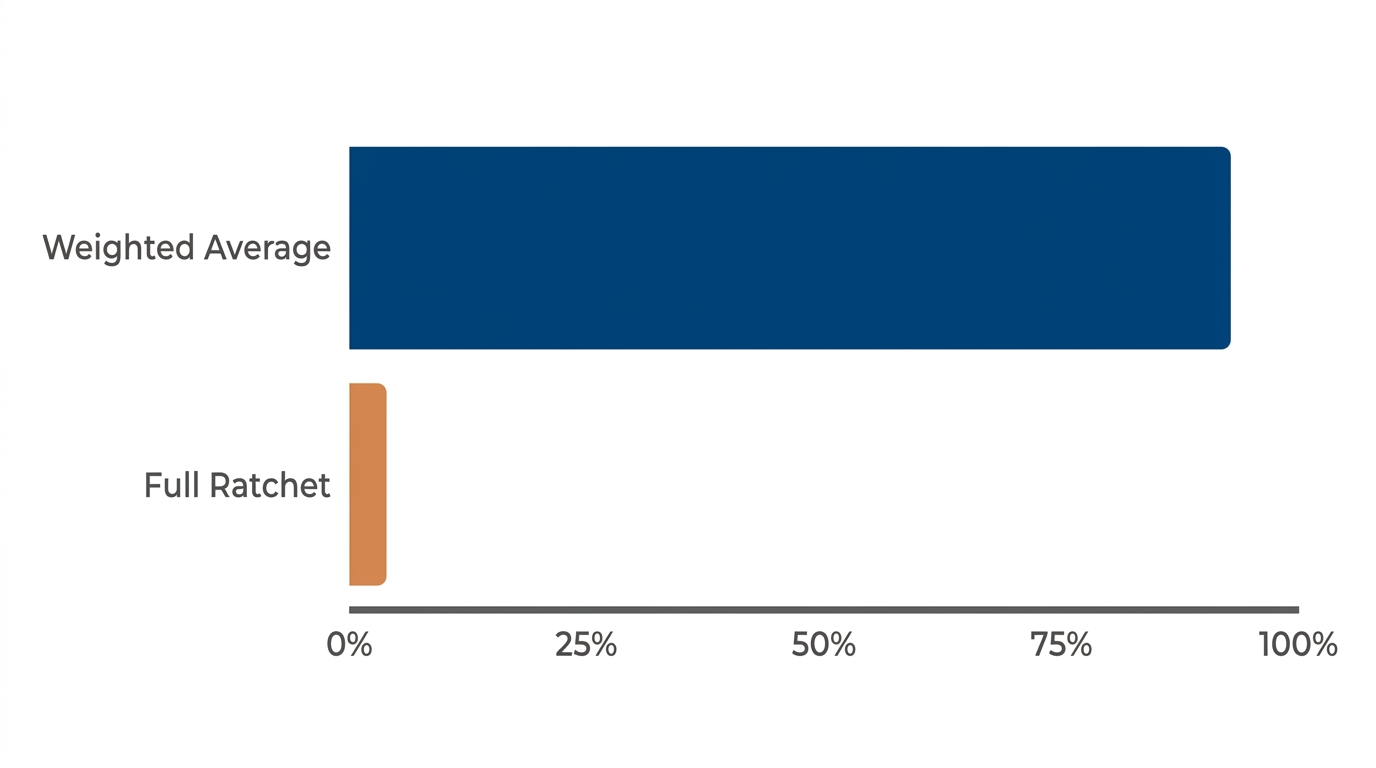
    Anti-dilution protection adjusts the preferred conversion price when a company raises capital at a lower valuation. Full ratchet provides that the conversion price is reset to the lowest price of the new issuance. Weighted Average provides that the conversion price is adjusted proportionally based on both the price and the size of the down round. A broad-based weighted average includes options and produces a less drastic adjustment. Market data suggest that weighted average is the norm, and full ratchet is very uncommon.

    Horizontal bar chart showing weighted average anti-dilution used in over 90% of venture financings versus full ratchet under 5%.
    Weighted average anti-dilution dominates over 90% of venture financings compared to full ratchet.

    How does the pre-money valuation in a term sheet impact the percentage of ownership given up?

    The pre-money valuation sets dilution for a fixed raise. For example, at a $6 million pre-money valuation, a $2 million raise sets the post-money valuation at $8 million and the investor takes a 25% equity stake. At a $10 million pre-money valuation, the same raise gives an investor a 16.7% stake. The pre-money valuation fully diluted typically includes the option pool, so a larger option pool decreases the pre-money valuation and increases founder dilution.

    What is the impact of an option pool refresh on founder dilution during an exit event?

    An option pool refresh shifts dilution to existing shareholders. If a pool is increased to a negotiated post-financing level, the additional shares are carved out of founders’ and employees’ ownership, not the new investor’s. A required increase from 10% to 20% can reduce founder ownership by approximately 10 percentage points before new money is added.

    Prior to analyzing the control provisions of an investment, it is important to understand these payout mechanics. Control provisions outline the terms of an investor exit, e.g. the right to a board seat, voting rights and the implementation of protective covenants.

    How Investor Control Rights Can Block or Force a Sale

    Although sale prices are primarily determined by the terms of the financing, there are other rights that may affect when and how a sale occurs. These have nothing to do with board composition or general stockholder votes. This creates a separate approvals process that founders must clear before completing any transaction that affects investor interests.

    Can investor veto rights or board composition requirements delay or block a potential exit?

    Veto rights granted to investors, most commonly found in the certificate of incorporation, allow the preferred stockholders to block a sale, even if the directors and common stockholders support it.

    How do protective provisions give investors the power to block a company sale?

    Protective provisions are contractual rights in the certificate of incorporation that grant preferred stockholders veto power over specific corporate actions, including the sale of the company. These provisions typically require approval from a majority, 60%, or 66.67% of outstanding preferred stock before covered transactions can proceed. If a proposed action adversely affects a specific series of stock, the provisions often require class-by-class voting, meaning a single dissenting series can block the entire transaction even when other investor classes support it.

    How do drag-along rights enable majority investors to force an exit against founders’ wishes?

    Drag-along rights enable a company’s majority shareholders to compel minority holders to participate in a qualifying company sale. In order for a sale to be mandated, the majority shareholder first makes a qualifying offer. Next, the majority shareholder gains the necessary trigger approvals, notifies the minority shareholders, and then mandates a sale. Founders should review drag-along rights in their stockholders’ agreements. The “same terms” requirement governs the mechanics of a transaction but does not guarantee identical cash distributions, because the charter’s liquidation waterfall determines payouts.

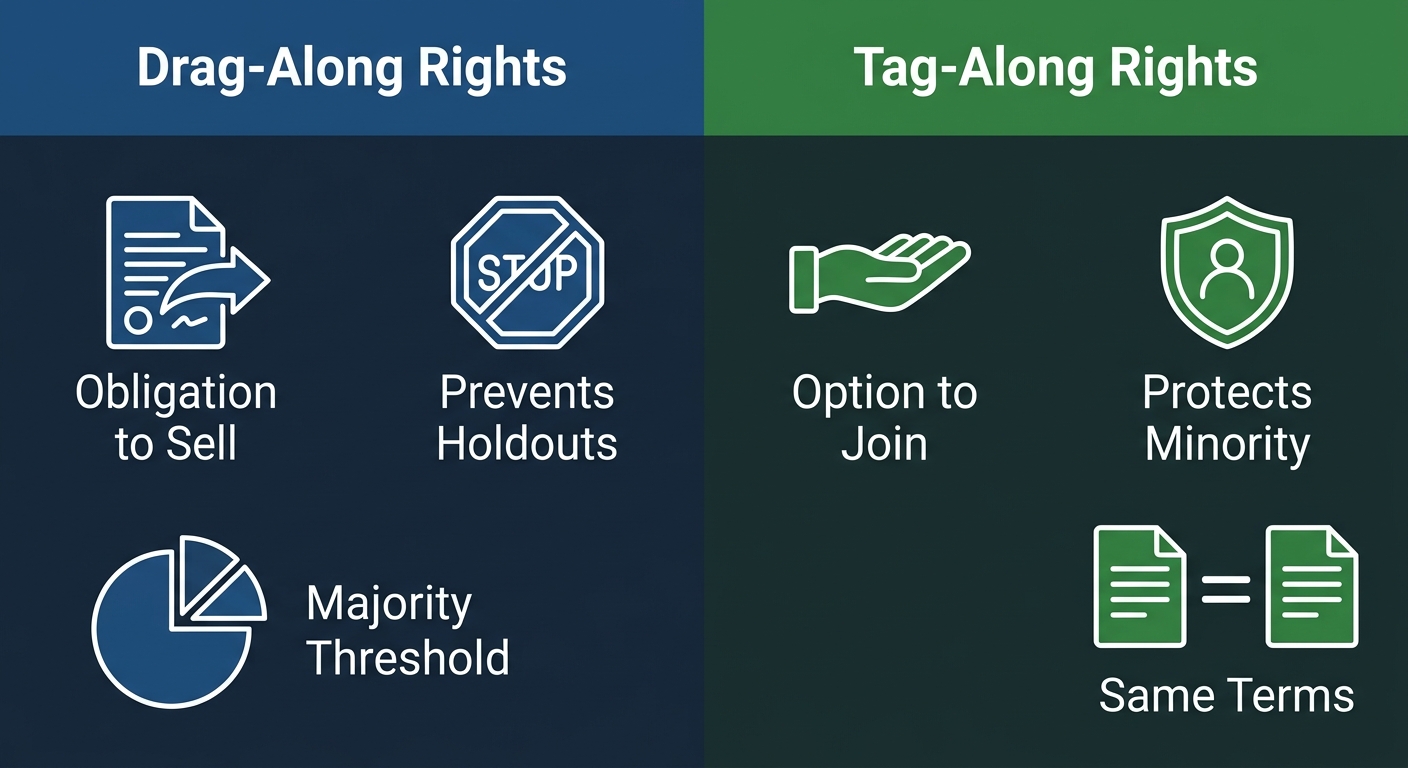
    Infographic comparing drag-along and tag-along rights with two columns: left column blue with three icons representing obligation to sell, prevents holdouts, and majority threshold; right column green with three icons representing option to join, protects minority, and same terms.
    Drag-along compels, tag-along protects – both shape exit control.

    The main difference between drag-along rights and tag-along rights is that tag-along rights are reserved for the minority shareholders. Tag-along rights give minority shareholders the option to participate in a sale on the same terms as the selling majority.

    Are drag-along rights considered standard market practice in early-stage venture capital deals?

    Drag-along provisions are common in VC term sheets, though thresholds and enforcement mechanisms vary by agreement. The particulars of the provision, including thresholds, are negotiable. Founders can also negotiate trigger thresholds, narrow the types of qualifying transactions, or require stricter procedural protections to reduce execution risk.

    For companies encountering problems such as an investor’s veto, protective provisions, and / or drag-along issues when undertaking an exit, Zaidwood Capital provides advisory services that account for these contractual dynamics throughout deal execution.

    While investor control rights determine exit dynamics, the term sheet governs how those rights are enforced.

    Is a signed term sheet a legally binding document for the entire investment deal?

    A signed term sheet is not a binding contract for the overall transaction; however, some of its provisions (e.g. confidentiality, exclusivity, expense reimbursement, etc.) are typically enforceable. Unless the document explicitly states otherwise, the main economic and control provisions (e.g. valuation, board composition, liquidation preferences, etc.) generally remain non-binding.

    Which term sheet clauses are most critical for protecting founder equity during an acquisition?

    Protective provisions grant minority shareholders veto power over major corporate actions, safeguarding equity value. Liquidation preferences determine the order and allocation of exit proceeds and can materially affect founder returns. Anti-dilution protection adjusts conversion mechanics when later rounds close at lower valuations to preserve ownership percentage. Drag-along rights, typically located in the Voting Agreement, enable a requisite majority to compel minority holders to support a qualifying sale–thresholds are commonly negotiated between a simple majority and 75 percent. Tag-along (co-sale) rights, usually in the Right of First Refusal and Co-Sale Agreement, allow minority investors to join a private sale on identical terms. Both rights typically terminate on an IPO, and precise drafting of triggering events, notice periods, and scope is essential to avoid ambiguity and disputes during exit processes.

    When Investor Rights Are Triggered During an Exit

    Do liquidation preferences still apply if the company is sold through an IPO?

    Preferred stock converts to common stock in a qualified IPO. Preferred stock conversion occurs if the minimum offering price and size thresholds in the certificate of incorporation are met. The preferred stock conversion does not occur if these thresholds are not met. Founders need to understand the ‘squeeze-out’ threshold. At the ‘squeeze-out’ threshold, common holders get nothing because senior preferences soak up all proceeds. Even a $50 million acquisition can leave common empty-handed. Promise.legal notes that even a $50 million acquisition can leave common empty-handed. Non-participating preferred forces investors to choose between preference and pro-rata share, whereas participating preferred gives both, often wiping out common value. We recommend that founders audit the certificate of incorporation directly, as cap tables alone can obscure how preferences stack.

    When do drag-along and tag-along rights typically terminate?

    Drag-along rights obligate minority shareholders to sell alongside the majority, preventing holdouts from blocking a desirable exit. Tag-along rights give minority holders the option to join a sale on equivalent terms, ensuring they aren’t stranded with illiquid stock. Crowley Law LLC notes that both provisions generally terminate upon an IPO. Drag-along triggering thresholds often span from a simple majority to 75 percent approval; the higher the bar, the greater the minority protection. We are ready to walk through your specific agreement and clarify how these terms affect your exit.

    Connect with Zaidwood Capital to Navigate Investor Rights and Exit Terms

    If you have questions about investor rights and term sheet terms that affect your exit, we can help.

    We offer full-cycle M&A and capital advisory and guidance on term sheets and investor protections.

    Still Have Questions About Your Exit Strategy?

    Schedule a consultation or call us at 800-962-0418.

    This website is for informational purposes only and is not an offer; Zaidwood Capital is not a registered broker-dealer and securities are offered through Finalis Securities LLC.

    Resources

  • Tax and Entity Structuring Before a Raise or Sale

    Introduction

    Tax and entity structuring before a raise or sale determines how a transaction is taxed, which entity form attracts investors, and whether a conversion is required, so business owners should evaluate their current structure before approaching the market. The legal form of a business–LLC, C-corp, S-corp, partnership–dictates the mechanics of any capital raise or exit, from tax treatment to investor eligibility. A misaligned structure can delay a deal, create unexpected tax liabilities, or turn away the institutional investors a company seeks to attract.

    At Zaidwood Capital, a boutique M&A and capital advisory firm, we guide founders through this analysis, aligning entity choice with their transaction goals and the expectations of our 4,000+ institutional investors. Investors evaluate legal structure as rigorously as financials; a clean entity form signals readiness and reduces perceived risk. The first step in this process is assessing whether your current entity structure requires a formal conversion filing.

    Determining If Entity Conversion Filing Is Required

    If we decide to do a Delaware C corp conversion and our legal entity type changes in Delaware, the Division of Corporations requires a conversion filing. The filing covers Delaware domestic and out-of-state entities converting to a Delaware entity. A filing cover memo must be submitted with conversion documents.

    Key Delaware Statutory Sections for Entity Conversions

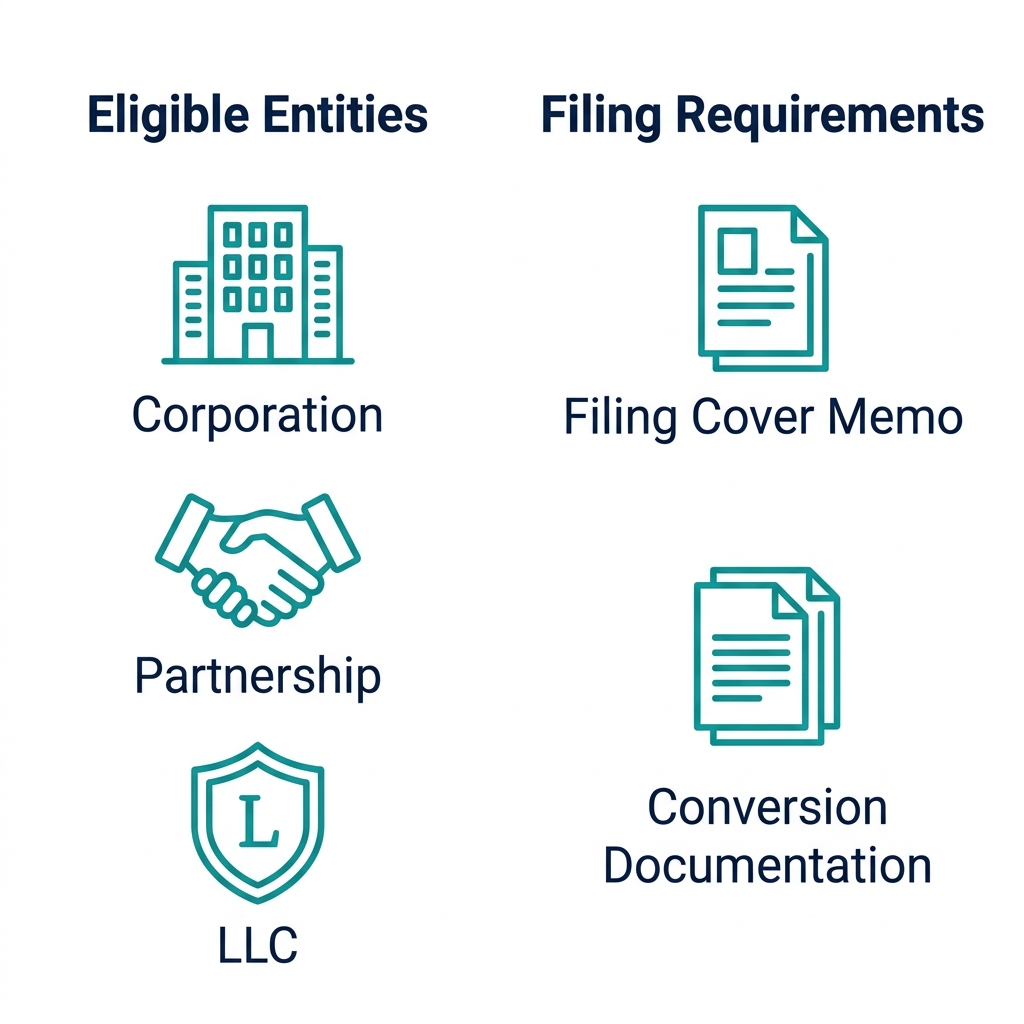
    According to Delaware law, businesses can transform from one type of entity to another and retain their legal continuity. The Division of Corporations recognizes various structures for conversion, including but not limited to, corporations, general partnerships, limited liability companies, limited liability partnerships, limited partnerships, and statutory trusts. This authorization gives businesses the ability to adapt their structure without going through the process of dissolving and re-forming, a distinct advantage to Delaware’s legal conversion framework.

    All conversion filings submitted to the Division must be accompanied by a Filing Cover Memo, a mandatory document that ensures accurate processing of the submitted forms. The Division’s official guidance confirms that the conversion process extends to both intra-state conversions among Delaware entities and transactions involving non-Delaware entities–when a Delaware entity adopts a non-Delaware form or a non-Delaware entity restructures into a Delaware entity. This inclusive scope makes Delaware a versatile hub for entity restructuring.

    Infographic showing Delaware statutory sections for entity conversions: Eligible Entities with Corporation, Partnership, LLC icons and Filing Requirements with Filing Cover Memo and Conversion Documentation icons.
    Delaware statutory sections for entity conversions: eligible entities and filing requirements.

    The Delaware Conversion Statutes set the foundation for the framework and processes followed for various conversion pathways.

    The Delaware Division of Corporations Filing Process

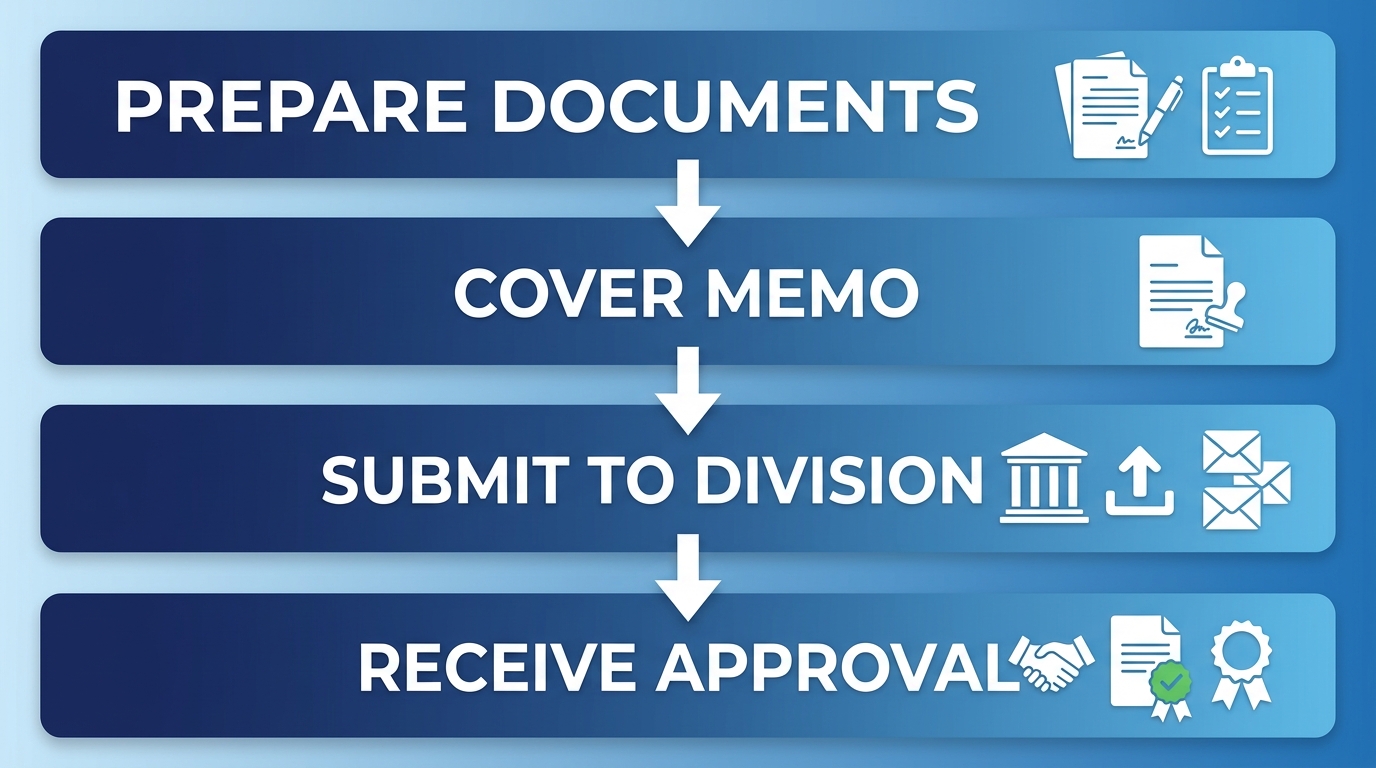
    When converting an entity in Delaware, the Division requires a filing cover memo and specific conversion forms. The cover memo serves as a processing directive to the Division to ensure the filing is routed to the correct area for processing and in the correct order relative to other filings.

    The Division’s website provides a comprehensive list of the various forms organized by the type of entity. The forms are available for corporations, general partnerships, limited liability companies, limited liability partnerships, limited partnerships, and statutory trusts. For each conversion of an entity of one type into an entity of another (for example a non-Delaware LLC converting into a Delaware corporation) the web portal provides the direct links to the conversion documents. Delaware law permits converting corporations, partnerships, and limited liability companies into other business structures while preserving legal continuity. The forms on the Division’s website cover both conversions from one Delaware entity to another and conversions that involve non-Delaware entity types, accommodating businesses organized inside or outside the state.

    Vertical process flow diagram showing four steps for Delaware entity conversion filing: prepare documents, complete cover memo, submit to Division of Corporations, receive approval.
    Delaware Division of Corporations entity conversion filing process flow

    After the filing documents are complete, the responsibility for initiating the conversion process rests with management or an authorized representative of the entity.

    Responsibility for Initiating the Conversion

    When a Delaware entity decides to convert, the first official step is internal. The conversion process starts when the governing body of the entity, whether it is the board of directors of a corporation or the members and managers of an LLC, approves a conversion resolution. We want to bring to your attention that this internal approval is done prior to the filing of any documents with the Delaware Division of Corporations for review and acceptance of the conversion.

    The Division of Corporations Review and Approval

    Upon accepting responsibility for initiating the conversion, the client is required to submit the required documentation to the Division for processing. The Division permits the conversion of corporations, partnerships, and limited liability companies into other entity types, and offers forms for intra-state conversions and those involving non-Delaware entities. All submissions must include a Filing Cover Memo, which the Division requires to ensure the correct handling of each filing package. We assist our clients in preparing and organizing these documents to align with the Division’s expectations. The Division reviews the entire submission for completeness and statutory compliance; upon approval, it issues a conversion certificate that formalizes the entity’s new structure. If the submitted documentation does not meet the Division’s requirements, the conversion may not be approved, leading to potential legal and operational complications.

    Consequences of Failing to Properly Convert Your Business Entity

    Entity conversions that are not properly completed before a capital raise or sale can expose owners to personal liability and loss of limited liability protection.

    Additionally, failing to effectuate a proper conversion may result in adverse tax consequences. For example, the lack of a proper conversion may prevent the use of the qualified small business stock rules or prevent the use of a tax-free F reorganization that may result in taxable gains or inhibit an otherwise tax-free reorganization. Conversions that have been effected improperly often require new legal and accounting costs to be undone.

    From our experience, we have seen that these consequences may impact the attractiveness of an entity to institutional investors and/or purchasers, may negatively impact a fundraising effort or a venture exit. The cost of corrective filings often exceeds the expense of proper planning.

    It is for these reasons that conversion filing fees are a worthwhile investment.

    Understanding the Conversion Filing Fees

    The Delaware Division of Corporations provides conversion forms but does not post filing fees. Filing fees vary by entity type and the manner in which the conversion is effected. We suggest reviewing the Division’s current fee schedule to determine the fee prior to submitting the filing cover memo and conversion documents. Although some might consider these fee differences to be technical, these differences encourage consideration of the effects of different entity structures.

    Common Questions About Entity Structuring and Conversion

    Beyond the costs associated with entity conversion filings, business owners wonder how their current structure fits into broader transaction plans.

    What is entity structuring? Entity structuring is the selection of a legal and tax framework–such as an LLC, C-corp, or partnership–that governs ownership, liability, and tax treatment for a business, influencing governance and investor alignment.

    Should I form a holding company before raising capital? In a holding company structure, high-value assets can be separated from operating risk; however, this setup may not match every investor’s preferences.

    When is the right time to convert entity type? Ideally, conversion occurs well ahead of a planned transaction to avoid rushed tax consequences and align with long-term strategy. We recommend engaging professional advisors early in deal planning.

    Begin Your Entity Structuring Journey

    Transactions are smoother and better when tax-smart entity structuring occurs before a funding event. We provide this service.

    Your Path to Structuring Success

    Proactive tax and entity structuring before a raise or sale is one of the most impactful strategic moves a founder can make, shaping both near-term tax efficiency and long-term deal flexibility. Whether you are evaluating qualified small business stock to unlock capital-gains exclusions, a Delaware C Corp conversion to align with institutional investor expectations, a holding company structure that centralizes ownership and risk management, or an F reorganization to reorder equity interests without triggering immediate tax, each tool addresses a distinct piece of the pre-transaction puzzle. We see these strategies not as isolated tactics but as interconnected levers that, when coordinated early, help preserve more value at close.

    The choices you make around entity design carry lasting consequences for how taxes are assessed and how investment structures are ultimately negotiated. Because no two ownership groups, cap tables, or exit timelines are identical, we believe professional guidance is essential before locking in a path. Our team works alongside your legal and tax advisors to pressure-test assumptions, model different structuring scenarios, and align the architecture of your business with the goals of a future raise or sale.

    This website is for informational purposes only and is not an offer, solicitation, recommendation, or commitment to buy or sell any security or financial product. Securities are offered through Finalis Securities LLC; Zaidwood Capital is not a registered broker-dealer and is unaffiliated with Finalis. Investments involve risk and are not guaranteed to appreciate; investors may lose all or part of their investment. Prospective investors should conduct their own due diligence and consult legal, tax, and financial advisors and, where appropriate, a registered representative. Past performance does not guarantee future results. Corporate logos do not represent endorsements.

    When you are ready to take the next step, we invite you to start a confidential conversation with Zaidwood Capital. Our team is here to help you evaluate your current structure, identify opportunities for tax-efficient planning, and build a foundation that supports the outcome you are working toward.

    Resources

  • Selling HVAC Manufacturing and Construction Businesses

    Selling HVAC Manufacturing and Construction Businesses: Frequently Asked Questions

    Selling HVAC manufacturing and construction businesses is a structured transaction that depends on thorough preparation and accurate valuation. We guide owners through key steps–assessing true company value, preparing documentation, and managing the deal process. This FAQ addresses common questions owners in HVAC, manufacturing, and construction have when preparing to sell. Owners ask how to sell an HVAC business or how to sell a manufacturing business; we provide practical answers. As a boutique M&A and capital advisory firm, Zaidwood Capital provides the support buyers and sellers need to execute transactions. Topics include hvac business valuation, manufacturing business valuation, and construction company valuation.

    • How do I determine what my HVAC or construction business is worth?
    • What steps do I need to take to prepare my business for sale?
    • How does an M&A advisor help in selling a business?

    We begin by exploring how business valuation and profitability determine the foundation of a successful sale.

    Understanding Business Valuation and Profitability

    Business valuation establishes what an enterprise is worth by analyzing its financial performance, market position, and growth potential.

    How Profitable Is an HVAC Business?

    Profitability in the HVAC industry depends on interrelated factors that shape day-to-day operations and long-term value. The mix between service work and new installations significantly influences margins, as maintenance contracts and repair services generate steadier, more predictable revenue streams than one-time construction projects. Customer retention rates also play a critical role, since commercial clients and property managers who renew annual service agreements provide recurring income that strengthens the business’s financial profile.

    Companies with established technician teams, centralized dispatch systems, and well-maintained equipment fleets operate more cost-effectively than smaller competitors.

    What Is My Business Worth If It Has $500,000 in Sales?

    Revenue provides a starting point for valuation, but top-line sales figures alone do not determine your company’s market value. Buyers and valuation professionals look deeper at the earnings that remain after covering operating expenses, often analyzing metrics like EBITDA to understand true cash-generating capacity.

    Other factors influencing value include geographic market conditions, the quality of your customer base, competitive positioning, and whether the business relies heavily on the owner’s personal involvement. Because these variables combine in unique ways for each company, a detailed professional assessment provides the most reliable estimate of what your business could achieve in a sale.

    When selling HVAC, manufacturing, and construction businesses, profitability–measured by EBITDA–feeds directly into the valuation metrics that buyers rely on. At Zaidwood Capital, we help owners translate that profitability into a realistic assessment of their company’s worth.

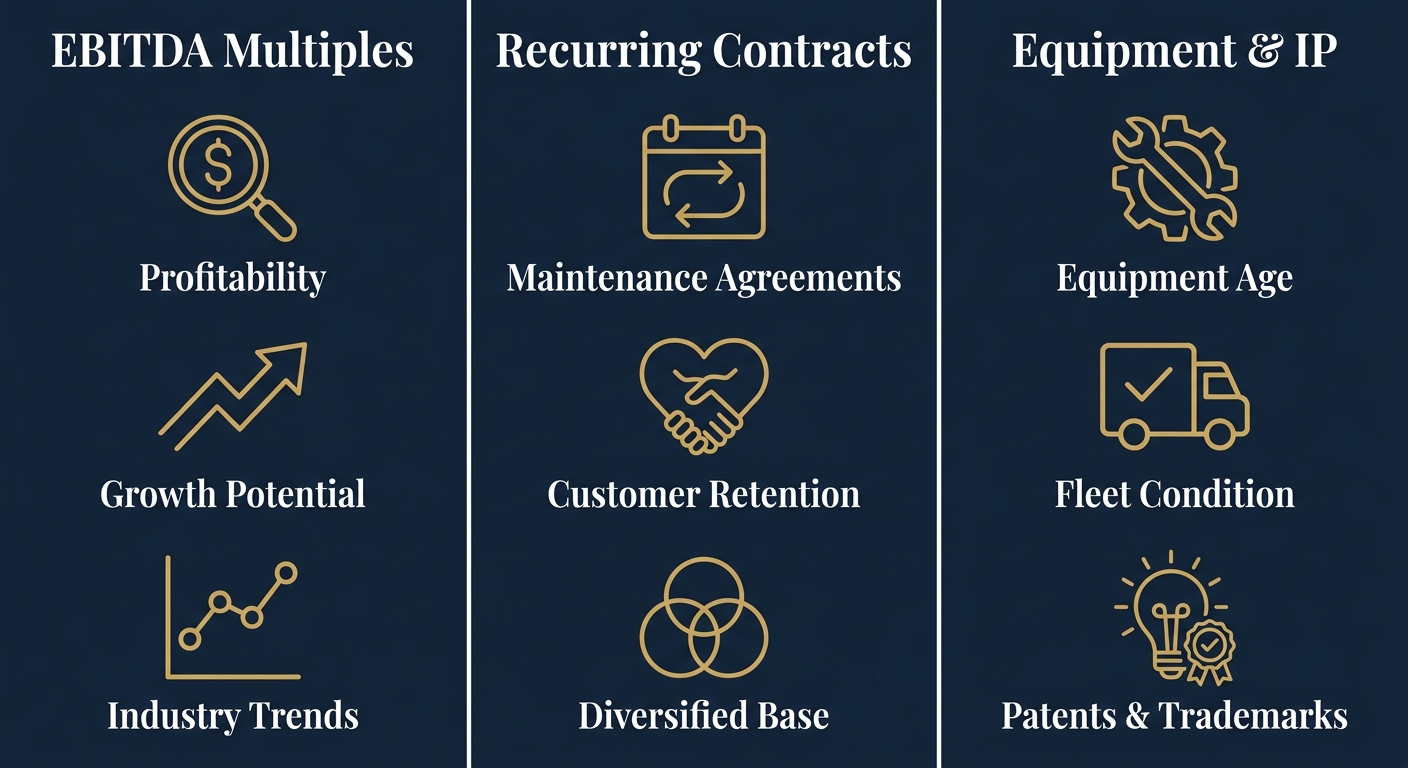
    Infographic with three columns: EBITDA Multiples, Recurring Contracts, Equipment & IP, each with three icons and labels.
    Visual breakdown of valuation metrics: EBITDA, contracts, and assets.

    Common EBITDA Multiples for HVAC, Manufacturing, and Construction Businesses

    EBITDA multiples anchor middle-market valuation, but no single multiple applies to every business. In our advisory work, we see that an HVAC service company with recurring maintenance contracts often attracts a different range than a project-based construction firm. Beyond sector, buyers weigh revenue size, margin stability, management depth, and growth outlook. Recurring revenue and a diversified client base support higher multiples, while customer concentration and erratic project pipelines can compress them.

    How Recurring Contracts and Customer Base Affect Valuation

    Predictable cash flows reduce transaction risk, making HVAC maintenance agreements and long-term service contracts valuable assets in a sale. A diversified customer mix–commercial, residential, and industrial–signals revenue stability and supports stronger valuations. Conversely, an over-reliance on a few large accounts can compress the multiple. We work with sellers to dissect revenue composition, quantify recurring income, and articulate the customer-base story that underscores a stable, defensible enterprise. We evaluate customer concentration risk and recommend strategies to broaden the revenue base before taking the business to market.

    Equipment, Assets, and Intellectual Property in Valuation

    The age, condition, and maintenance records of equipment heavily influence valuation. For a construction firm, a late-model fleet with documented upkeep suggests lower near-term capital needs; outdated machinery can trigger write-downs. In HVAC, the state of vehicle fleets and installed units matters similarly. Proprietary technology, patents, or specialized processes can add significant intangible premium. We also identify obsolete assets that may be discounted, ensuring the valuation reflects true economic potential.

    Mastering these valuation drivers lays the groundwork for preparing your business for a transaction, which we address in the following phase.

    How to Prepare and Sell Your Business Effectively

    Key Steps to Prepare Your HVAC or Manufacturing Business for Sale

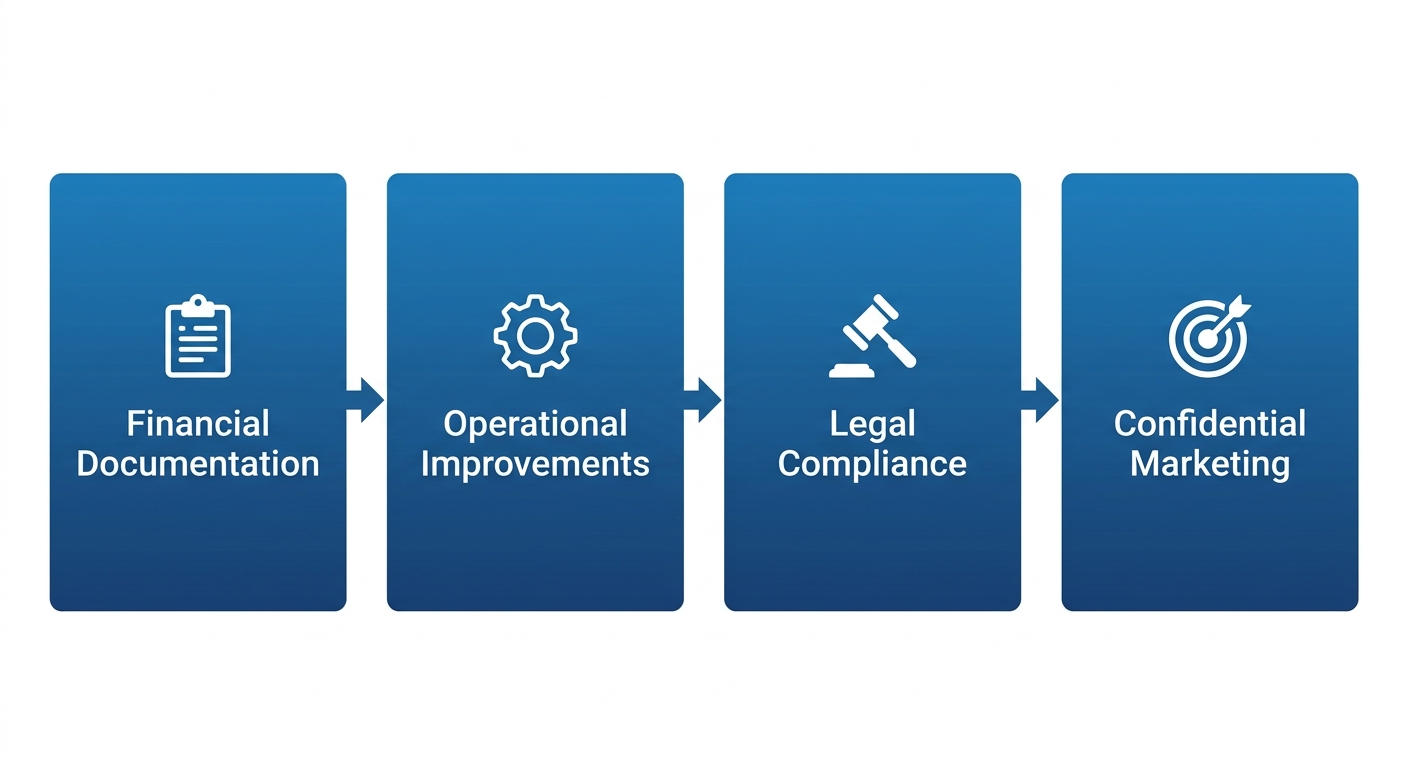
    A horizontal process-flow diagram with four rectangular stages labeled Financial Documentation, Operational Improvements, Legal Compliance, and Confidential Marketing, each with an icon and connected by arrows, showing steps to prepare a business for sale.
    Four-stage M&A preparation process for selling a business.
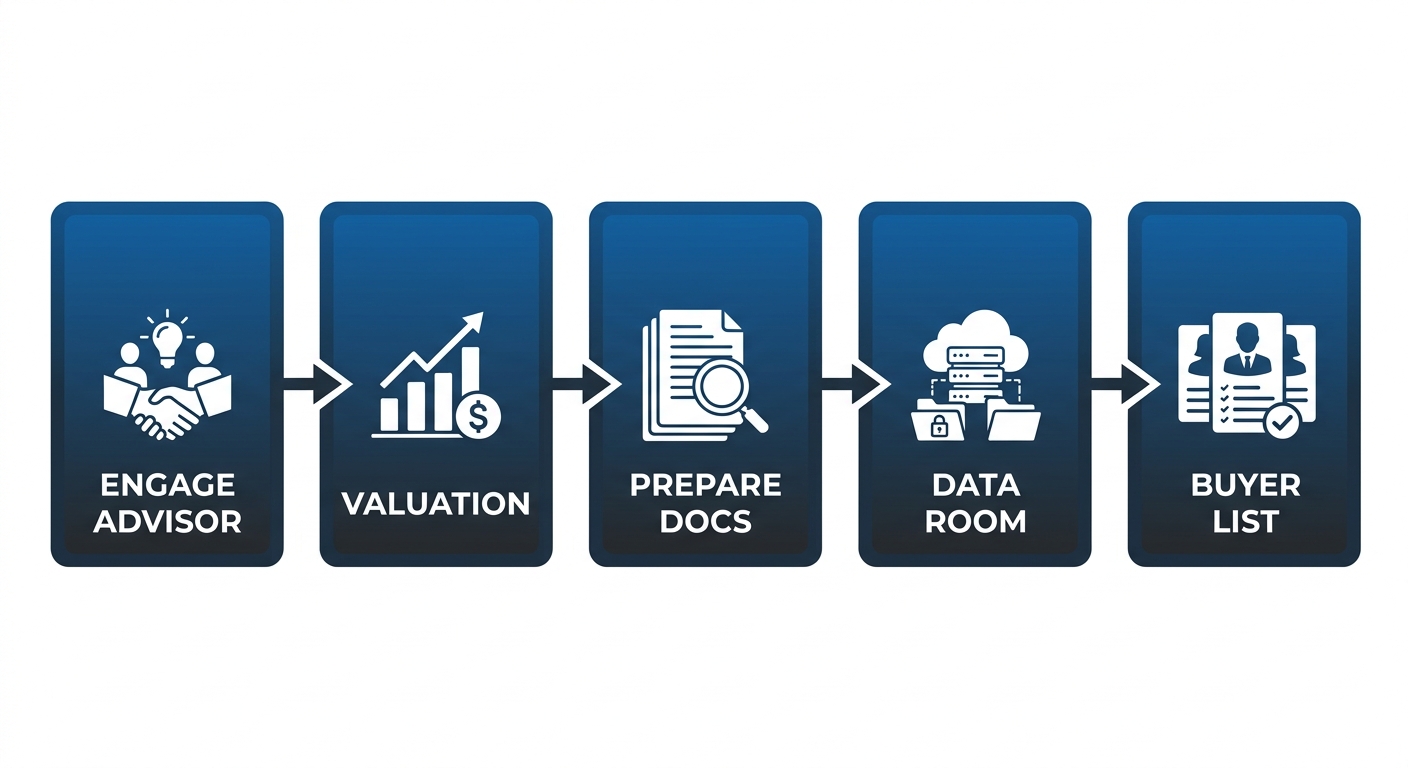
    • Compile three years of audited financial statements, tax returns, and detailed sales records to demonstrate revenue trends.
    • Engage legal counsel to review and organize all material contracts, including NDAs, employment agreements, and joint-venture obligations.
    • Perform a quality of earnings review to normalize EBITDA and remove non-recurring expenses, giving buyers a clearer picture of cash flow.
    • Implement operational improvements: diversify customers, strengthen management, and document standard operating procedures to reduce owner dependency.
    • Address outstanding regulatory, environmental, or litigation matters proactively.

    Documentation Needed to Market and Sell Your Company

    • Three years of income statements, balance sheets, and cash flow statements (audited if available) and accompanying tax returns.
    • Organizational documents: articles of incorporation, bylaws, board minutes, and shareholder agreements.
    • Intellectual property schedules and registrations, including patents and trademarks.
    • Employment records for key staff, benefits plans, and any history of labor disputes.
    • Customer concentration data, top-customer lists, and material contracts such as supplier agreements, leases, and financing arrangements.

    No good faith efforts during due diligence can void an acquisition, and can create legal exposure; we suggest full and accurate disclosure.

    Finding Qualified Buyers and Maintaining Confidentiality

    • Require signed nondisclosure agreements and enforce non-circumvention provisions before sharing proprietary data.
    • Use a secured virtual data room to control document access.
    • Qualify strategic acquirers in the HVAC, manufacturing, or construction sectors who can realize operational synergies.
    • Approach private equity groups, family offices, and institutional investors from our network of 4,000+ global relationships.
    • Stagger information release: confidential teaser, confidential information memorandum, then due diligence materials only to pre-vetted parties.

    Bonding, Insurance, and Confidentiality Requirements

    Due diligence is a mandatory legal step when selling an HVAC, manufacturing, or construction business. For one, selling such a business requires a good faith effort throughout the process. There are some facts that, if material, must be disclosed. Failure to do so could void the sale and lead to litigation. During due diligence, the last three years of financial records and tax returns will be reviewed, as stated in FindLaw. Material contracts–including NDAs, employment agreements, and joint venture obligations–must be organized for inspection. Buyers will also review the seller’s capacity for surety bonds and insurance. Operational risk is of interest to buyers. We recommend sellers engage qualified legal counsel and an experienced M&A advisor to assemble a documentation package that satisfies buyer requirements and protects sensitive information.

    Selling Across Texas, the United States, and Locally

    Selling a business across state lines, nationally, or even locally introduces regulatory layers that can influence the deal’s success. A transaction that spans Texas and Florida, for example, must satisfy each state’s entity laws and sales tax requirements. Engaging qualified legal counsel in each relevant jurisdiction is essential to ensure all statutory obligations are met. We recommend that sellers work with an M&A advisor who can coordinate the legal team and ensure the due diligence process accounts for these jurisdictional nuances. Resolving these regulatory considerations early prevents deal delays and establishes a solid foundation for evaluating transaction structures and closing timelines.

    Typical Timelines and Deal Structures

    Understanding the typical timeline and deal structures helps owners plan and negotiate effectively.

    How Long Does It Take to Sell a Manufacturing or HVAC Company?

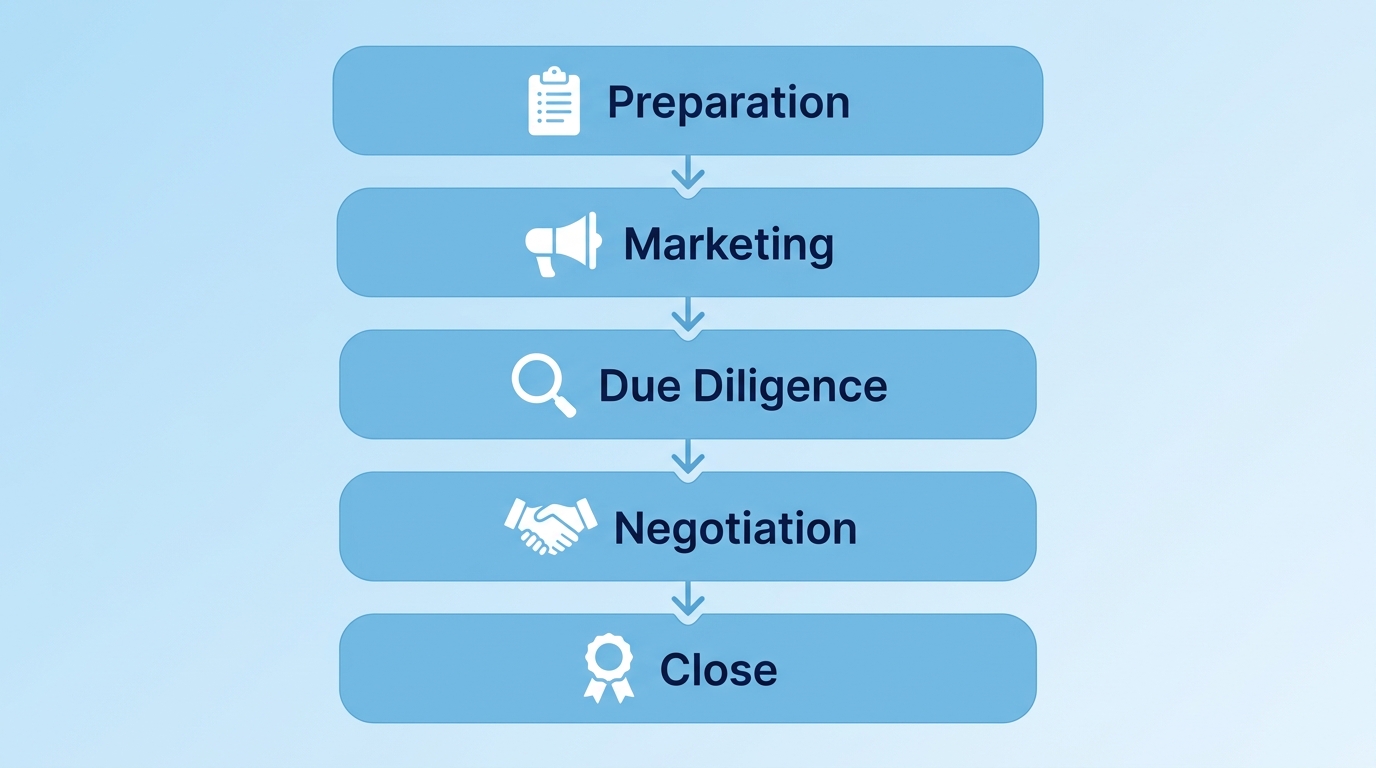
    The sale of a mid-market manufacturing or HVAC company typically progresses through four phases. Preparation includes compiling historical financials, operational metrics, and a preliminary valuation. Marketing and negotiation then present the opportunity to a curated group of buyers, generating indications of interest. Due diligence and legal documentation follow, during which the buyer confirms financial and operational data and the parties draft the purchase agreement. The duration of each phase depends on the complexity of the business, the buyer’s financing and decision-making speed, and the broader economic environment.

    Understanding Earn-out Structures in HVAC Business Sales

    An earn-out is a contingent payment that depends on post-closing performance, distinct from a fixed upfront amount. Common structures include performance-based earn-outs tied to revenue or EBITDA targets, and milestone-based earn-outs linked to operational goals such as customer retention or project completion. These provisions help bridge valuation gaps and align incentives. However, sellers face the risk that future performance may miss targets, reducing the total payout. We help clients craft earn-out terms with clear definitions, measurable milestones, and realistic timeframes, protecting their upside while minimizing post-sale uncertainty. Understanding earn-out mechanics before entering negotiations allows owners to evaluate offers more accurately.

    Still Have Questions? Connect With Our M&A Advisors

    While every deal follows its own timeline and structure, the right advisor can make all the difference, if you are considering selling hvac manufacturing and construction businesses, our M&A advisors are ready to help you navigate the complexities unique to your industry and tailor a strategy that meets your objectives.

    Contact us for a confidential discussion: call 800-962-0418 or email contact@zaidwoodcapital.com to schedule a call. We listen, assess, and connect the right professional resources to each engagement.

    Resources

  • Selling and Valuing a Medical Practice

    Selling and Valuing a Medical Practice: A Physician’s Guide to Maximizing Value

    Selling and valuing a medical practice depends on distinguishing personal goodwill from transferable practice goodwill, understanding buyer types, and navigating regulatory requirements to maximize the transaction outcome. This guide covers how to sell a medical practice while maximizing value, exploring valuation methodology, buyer categories, and compliance considerations. As a boutique M&A and capital advisory firm, we bring clarity to the valuation and sale process.

    EBITDA multiples are typically used for valuing a healthcare business. Practices in the primary care segment are valued at 3-5x EBITDA, while practices in other specialties are valued at 8-11x EBITDA. Allocation of goodwill between the practice and the individual (i.e. physician) drives both tax treatment and price. Buyers typically fall in the three main categories of hospitals, private equity, and other healthcare services organizations. Each of these categories has different implications on the valuation and post-acquisition structures of the business. Medical Economics notes that regulatory compliance with the Stark Law and Anti-Kickback Statute safe harbors requires structuring transactions to reflect fair market value and not base compensation on referrals. From a cultural fit, value retention, and physician goodwill perspective, the sale of the practice to an organization with which the practice has the greatest cultural alignment is of paramount importance.

    From a valuation perspective, the process therefore hinges on how transferable the patient base and revenue streams are, underscoring that practice maturity and the physician’s central role in the practice are key value drivers.

    Practice Maturity and Provider Dependence

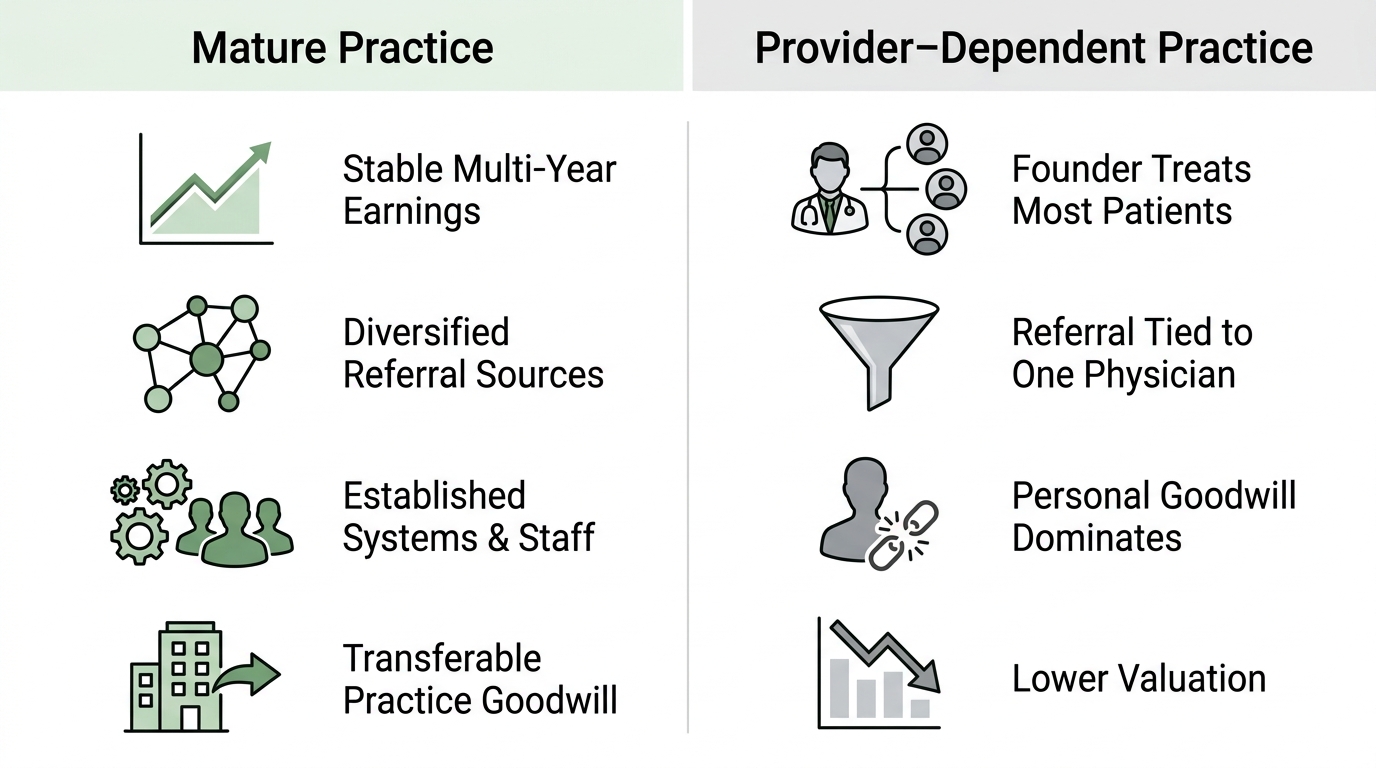
    Beyond financials, practice maturity and provider dependence are qualitative factors that influence valuation. A mature practice shows stable earnings over multiple years, diversified referrals–signs of transferable value. Provider dependence, the extent to which revenue is tied to a single physician, is a key buyer risk metric.

    Buyers differentiate personal goodwill, which leaves with the founder, from transferable practice goodwill. A solo physician seeing most patients draws lower offers because the goodwill is personal; a practice with multiple providers and diverse referral sources commands higher multiples, as goodwill is embedded in the business. Our advisors see how this distinction can shift EBITDA multiples when selling and valuing a medical practice.

    The Stark Law’s isolated transaction exception and Anti-Kickback Statute Safe Harbors demand that a sale reflect fair market value without compensating for referrals. A mature, multi-provider practice with documented compliance programs gives buyers confidence, according to LegalClarity’s sale guidance.

    These factors directly shape the quality of earnings that buyers scrutinize–payer mix stability, growth sustainability, and reliable cash flow. The maturity and independence profile is the foundation for the financial metrics evaluated in the next phase of due diligence.

    Two-column infographic comparing mature practice with stable earnings and diversified referrals versus provider-dependent practice with founder dependency and lower valuation.
    Medical practice maturity vs. provider dependence infographic

    Financial Health and Quality of Earnings

    A quality of earnings (QoE) analysis assesses whether a medical practice’s earnings are sustainable, recurring, and likely to continue under new ownership. Normalized EBITDA, physician compensation adjustments, and revenue concentration are scrutinized by buyers and their advisors to distinguish true practice profitability from temporary or owner-dependent income streams.

    A central challenge in medical practice transactions is classifying goodwill as either personal — tied to the individual physician — or practice goodwill, which transfers to a buyer. According to LegalClarity, this distinction carries significant tax implications: sellers often favor capital gains treatment by maximizing goodwill allocation, while buyers prefer asset structures allowing for stepped-up basis and accelerated amortization. When goodwill depends heavily on a single provider’s reputation or patient relationships, the transferable value shrinks, directly affecting the practice’s valuation multiple.

    We see quality of earnings as the foundation for productive deal structuring. Benchmarking normalized EBITDA against industry data — where primary care practices typically trade at 3 to 5 times EBITDA and specialized practices command higher multiples — helps both parties negotiate from a position of factual clarity. A thoroughly prepared QoE analysis reduces post-closing disputes and supports financing commitments, because lenders and buyers alike need confidence that the earnings supporting the purchase price will persist after the transition.

    The structure of a sale impacts how goodwill is treated for tax purposes. Consequently, the most significant financial decision in a medical practice sale is how the sale will be structured (i.e. asset versus stock).

    An asset purchase is the acquisition of select assets and liabilities of a business, with the seller retaining the legal entity. With a stock purchase, the buyer acquires the legal entity, and the seller is generally entitled to capital gains. However, stock purchases expose the buyer to unidentified liabilities of the legal entity.

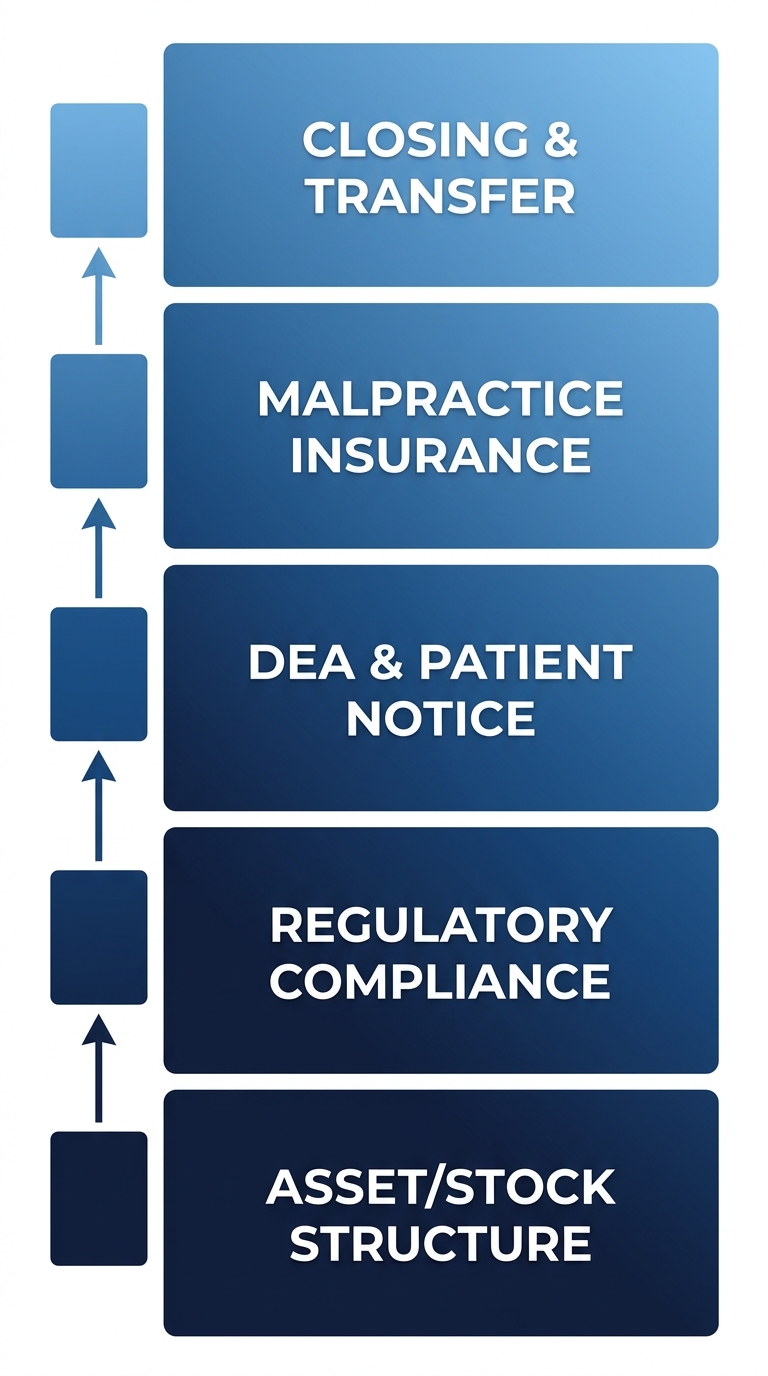
    Vertical process flow showing five ascending rectangular steps for legal considerations in selling a medical practice, connected by up-arrows on the left, with a gradient from dark navy at the bottom to light blue at the top.
    Five-step legal process for selling a medical practice: asset structure, compliance, notices, insurance, closing.

    The Stark Law and the Anti-Kickback Statute mandate that the sale reflect fair market value without compensating for patient referrals, though the Stark Law’s isolated transaction exception permits qualifying one-time sales. Sellers must also transfer or terminate their DEA registration with at least fourteen days’ notice before closing, notify patients of record transfers in compliance with HIPAA, and secure malpractice tail insurance covering future claims from services rendered before the sale.

    Complying with the foregoing requirements reduces the risk to the seller. However, there are a number of common pitfalls that still occur.

    Red Flags: Common Pitfalls When Selling a Medical Practice

    LegalClarity identifies the damaging mistakes in a practice sale:

    • Sellers who fail to structure the sale to meet the Stark Law’s isolated transaction exception or the Anti-Kickback Statute’s safe harbors risk substantial fines.
    • Treating all goodwill as transferable when a portion is personal to the physician results in lost capital-gains treatment and higher tax bills.
    • Opting for an asset or stock purchase without analyzing the tax and liability trade-offs often leads to value leakage.
    • Missing the 14-day DEA transfer deadline, neglecting tail coverage, or failing to notify patients per HIPAA and state law invites post-closing disputes.

    Questions to Ask Potential Buyers and Advisors

    There are differences between hospital buyers, private equity platforms, and other healthcare organizations that require inquiries that protect both financial interests and professional autonomy.

    1. Governance structure: Ask whether acquired physicians will hold board seats or have input into clinical and operational decisions; governance varies by buyer and affects physician autonomy.
    2. Regulatory compliance: If the buyer is a hospital, ask how the Stark Law and Anti-Kickback Statute framework will govern employment arrangements and any restrictive contract provisions.
    3. Rollover equity mechanism: For private equity offers, request an explanation of the cash-and-rollover split (typically 60-70% cash, 30-40% equity) and how rollover interests vest or convert on exit.
    4. Cultural alignment and retention: Ask about the buyer’s retention strategy and approach to your staff and practice identity; cultural misalignment is a cause of post-transaction dissatisfaction.

    Being able to understand and identify these factors in various geographic markets is useful, especially since factors that govern buyer behaviors and valuation may vary from market to market.

    Selling a Medical Practice in West Palm Beach, Florida: Local Market Insights

    With the right questions prepared, sellers can now turn to the specific market dynamics that will influence their practice sale in West Palm Beach. Patient demographics and payer mix often shape valuation, with procedure-heavy specialties commanding higher consideration than primary care. We guide sellers through an assessment of operational strengths and transferable goodwill, while the local competitive landscape helps position the practice for serious buyers. An informational resource notes that the Stark Law and Anti-Kickback Statute require fair market value terms; in Florida, DEA registration transfers must be filed at least 14 days before closing. Asset purchase agreements can allow buyers to step up basis, while stock sales may simplify transition. We help clients tailor the structure to tax and liability goals. Armed with these insights, sellers are ready to assemble a detailed checklist to guide every stage of the transaction.

    Essential Checklist for a Smooth Medical Practice Sale

    • We verify Stark Law and Anti-Kickback Statute safe harbors.
    • We separate personal goodwill from transferable practice goodwill during valuation.
    • We weigh asset versus stock purchase for liability and tax balance.
    • We file DEA registration transfer at least 14 days before closing.
    • We coordinate patient notification, tail insurance, and IRS reporting.

    The details of valuation, compliance and transaction structuring often require more in-depth examination and answers to specific questions.

    Frequently Asked Questions About Selling and Valuing a Medical Practice

    The following are answers to questions typically asked by physician-owners about a potential practice sale.

    What types of buyers exist for a medical practice, and how do they vary?

    Hospital acquisitions often involve employment arrangements, and acquisitions by private equity typically use cash (60-70%) and rollover equity (30-40%) to align incentives.

    What are the types of practice sales (asset vs. stock), and how do they impact buyers and sellers?

    Purchasing assets allows the buyer to limit liability, and purchasing stock can provide the seller capital gains treatment. Classifying personal goodwill (tied to the physician) versus transferable practice goodwill influences tax outcomes.

    What are key regulatory rules under Stark Law and the Anti-Kickback Statute that apply?

    The Stark Law’s isolated transaction exception permits a one-time sale at fair market value, while the Anti-Kickback Statute prohibits payments for referrals. Penalties for noncompliance can reach $25,000 per violation.

    When is a DEA registration transfer notice required to be filed before closing?

    Prior to the closing of a sale, the notice for a transfer of a DEA registration must be filed at least 14 days in advance. Failure to do so can result in penalties of up to $25,000 per violation and may delay controlled-substance handling.

    Take the Next Step Toward Maximizing Your Practice’s Value

    You now understand the fundamentals of selling and valuing a medical practice and the common questions that follow. To explore options, we can help clarify next steps and connect you with our advisory team. Call us at 800-962-0418 or email contact@zaidwoodcapital.com to schedule a consultation.

    Resources

  • Selling and Valuing SaaS and IT Services Companies

    Key Questions About Selling and Valuing SaaS and IT Services Companies

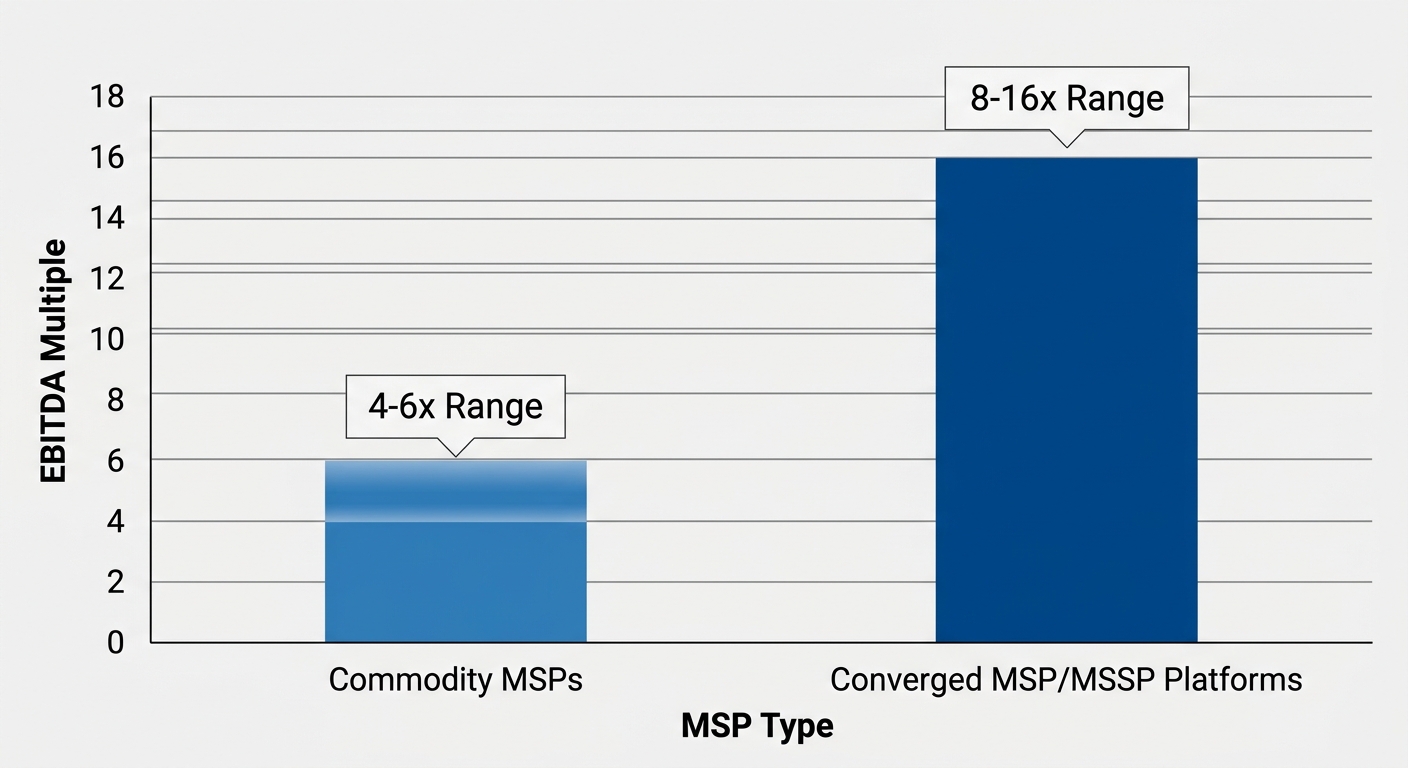
    Selling and valuing SaaS and IT services companies reveals a market where a business’s worth hinges on recurring revenue quality, cybersecurity posture, and customer concentration. According to Guicarlos, commodity MSPs typically trade at 4-6x EBITDA, while converged MSP/MSSP platforms command 8-16x, and we counsel our clients to allow a 12-18 month cleanup period before approaching the market.

    SaaS valuation multiples prompt the question “What multiple can my SaaS company command?” Similarly, understanding how to sell a SaaS company involves asking whether recurring revenue exceeds 70% of income and whether cybersecurity maturity elevates the business into a premium tier.

    For IT services businesses, MSP valuation multiples and how to sell an IT services business center on questions like “How does customer concentration affect my sale price?” and “When should I begin preparation?” With these key valuation factors in mind, owners then face the practical cost and valuation questions that shape a successful transaction.

    Cost and Valuation Questions for SaaS and IT Services Sales

    A technology company’s valuation depends as much on operational factors as on headline revenue or earnings.

    What Drives SaaS Valuation Multiples in the Current Market?

    SaaS companies are typically valued on a multiple of annual recurring revenue (ARR). Two factors–growth rate and net revenue retention–push that multiple higher. A business growing ARR above 30% with net retention over 100% will command a premium, while decelerating growth and elevated churn compress the multiple. Private company multiples generally sit a few turns below those of public peers due to liquidity and risk. We caution against relying on any single multiple figure; market benchmarks shift.

    How Are MSP Valuations Determined and What Commands a Premium?

    MSP valuations are primarily expressed as a multiple of adjusted EBITDA. According to GuiCarlos’s 2026 guide, commodity MSPs trade at 4-6x adjusted EBITDA, while converged MSP/MSSP platforms command 8-16x. Recurring revenue quality is paramount–businesses where subscriptions and managed services exceed 70% of revenue earn higher multiples. Buyers also assess operational margins, client diversification, and cybersecurity capabilities, all of which widen the valuation gap. In our Full-Cycle M&A advisory work, we help owners strengthen these metrics to maximize buyer interest. The chart below illustrates the split.

    Bar chart comparing EBITDA valuation multiples for commodity MSPs at 4-6x and converged MSP/MSSP platforms at 8-16x in shades of blue.
    SaaS and IT services valuation comparison: EBITDA multiples by MSP type.

    Even with similar EBITDA, structural risks can cause offers to diverge sharply.

    Why Can Two Identical-Revenue Companies Receive Different Valuation Offers?

    Even when revenue or EBITDA looks identical, other structural factors create wide valuation gaps. Client concentration is the most significant: Market guidance notes that when the top three customers account for more than 25% of revenue, buyers apply a 10-30% discount. The durability of recurring contracts, the recent growth trajectory, and the overall M&A market climate also influence the price. A diversified, subscription-heavy business with accelerating growth will nearly always command a premium over a project-dependent firm with a narrow customer base.

    How Much Should a SaaS Company Spend on Marketing? The 3-3-2-2-2 Rule Explained

    A commonly cited framework for SaaS marketing spend is the 3-3-2-2-2 rule. It prescribes spending 3% of revenue for established startups and growth-stage companies, then 2% each for the scale, mature, and decline phases. The rule offers a rough budgeting guide, not a rigid benchmark; actual spend should adjust for competitive intensity, customer acquisition costs, and profitability targets. We encourage owners to model different scenarios and ground their budgets in unit economics rather than follow any single formula absolutely.

    With these valuation drivers clarified, owners can prioritize the operational improvements that make their companies more attractive when the time to sell arrives.

    Steps to Prepare Your SaaS or IT Business for Sale

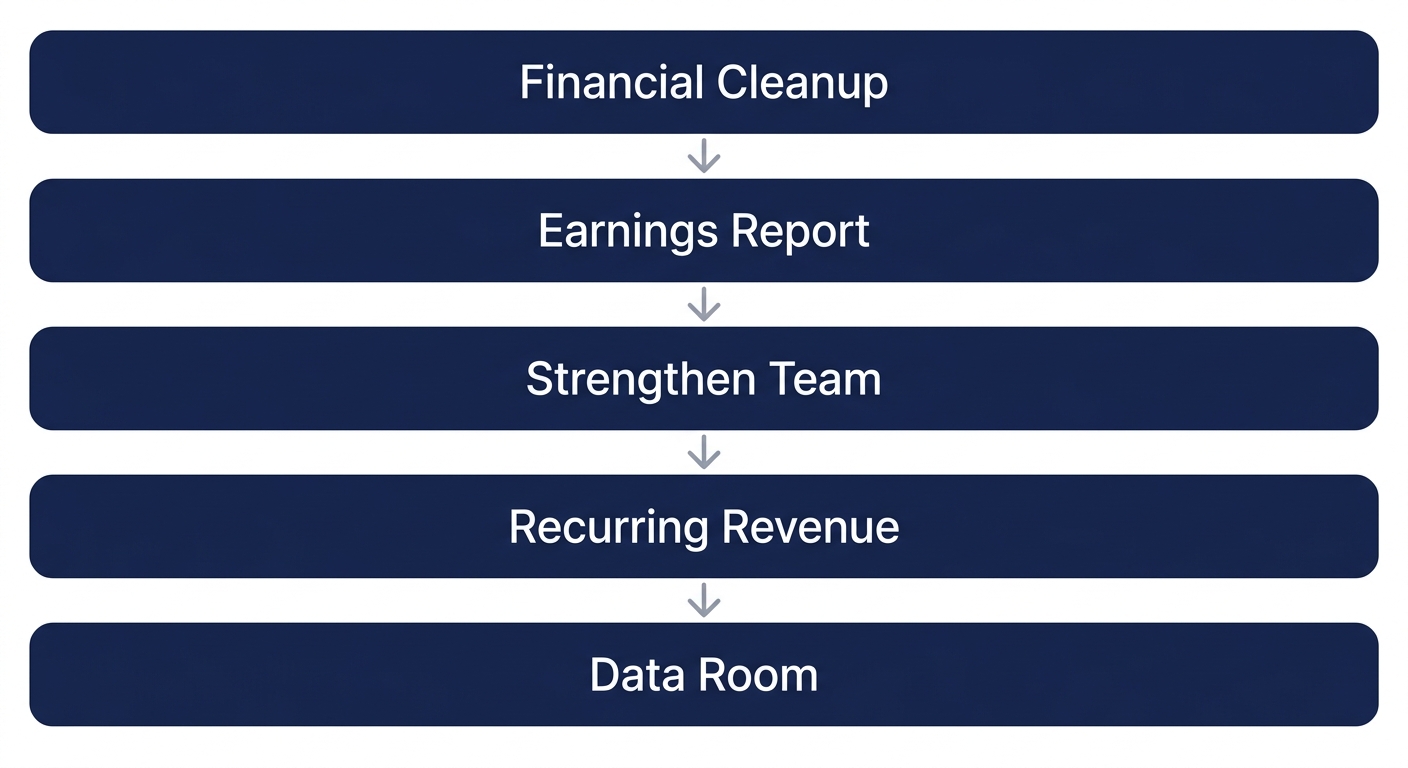
    Preparing a SaaS or IT services company for a successful sale demands early financial optimization, ideally starting 12-18 months before the intended exit.

    Vertical process flow showing five steps to prepare a SaaS business for sale: financial cleanup, quality of earnings report, strengthen management team, optimize recurring revenue, assemble data room.
    Five-step process to prepare your SaaS or IT business for sale.

    What Are the Essential Steps to Prepare a SaaS Company for an M&A Exit?

    Begin with financial cleanup and commission a sell-side Quality of Earnings (QoE) report to demonstrate recurring revenue predictability. Strengthen the management team so operations do not depend on one person. Optimize recurring revenue, targeting over 70% from subscription sources. Reduce customer concentration to below 25% of total revenue;excessive reliance on a few clients can trigger 10-30% valuation discounts. Assemble a data room with audited financials, customer contracts, and IP records. Starting 12-18 months ahead provides the runway to fix gaps and present a polished asset to buyers.

    Do I Need an M&A Advisor to Sell My SaaS Company?

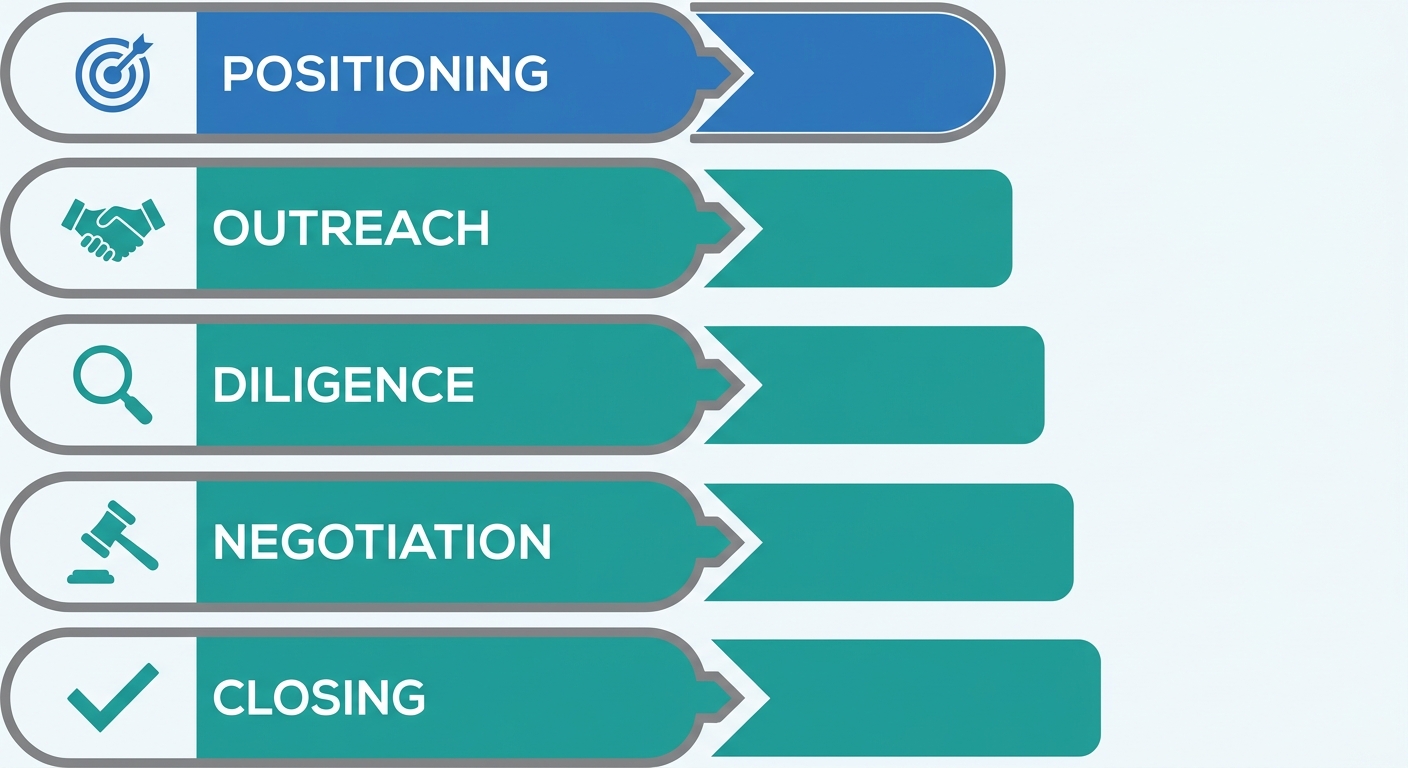
    Our firm provides full-cycle support–from valuation and positioning through buyer outreach, due diligence, and closing. Access to a network of 4,000+ institutional investors, including private equity, venture capital, and family offices. A boutique advisor ensures discreet marketing and a structured process, letting you focus on operations while we create competitive tension and negotiate optimal terms.

    What Common Due Diligence Gaps Kill SaaS Deals and How to Avoid Them

    Common deal-killers include inconsistent financials, missing customer contracts, weak IP documentation, and excessive customer concentration.when the top three clients exceed 25% of revenue, acquirers typically apply a 10-30% valuation haircut. An absent Quality of Earnings report can trigger post-diligence re-trading or termination. We advise owners to preempt these gaps: validate financials with an audit firm, organize all client agreements with clear service-level and auto-renewal terms, and document IP ownership thoroughly. Commission a sell-side QoE provider 12-18 months before going to market to create a defensible financial picture.

    How Should I Prepare IT Services Business Financials and What Documents Go in a Data Room?

    We recommend assembling audited financials for three years plus interim periods, customer contracts with SLAs and renewal terms, an IP portfolio with proprietary code documentation, compliance certifications (SOC 2 or ISO 27001), and organizational charts reflecting management depth. Include a sell-side Quality of Earnings report and key metrics (MRR, churn, LTV). With these materials ready, leadership can confidently address the legal and regulatory considerations that accompany any tech M&A transaction.

    After completing these preparation steps, you will be ready to address the legal and regulatory requirements that accompany a tech M&A transaction.

    Regulatory and deal-structuring considerations shape every sale of an IT services business.

    What Regulatory and Code Compliance Factors Impact the Sale of an IT Services Business?

    Buyers closely examine data privacy practices under the CCPA and GDPR. We advise sellers to complete a pre-sale audit of data inventories, consent records, and third-party data-processor contracts. Software licensing compliance is equally critical; undocumented open-source obligations or non-transferable enterprise license terms can derail a deal. It is also essential to clarify that any securities transactions offered in connection with the deal are placed through Finalis Securities LLC (Member FINRA/SIPC). Zaidwood Capital is not a broker-dealer.

    How Do I Structure Earnouts and Management Retention in a Deal?

    An earnout is a contingent payment tied to post-close performance targets such as revenue, EBITDA, or user growth. Common structures include single-tranche payouts after a performance period, multi-tranche milestones, and hybrid models combining time- and metric-based thresholds. Negotiation friction points often center around the measurement period length, the accounting methodology for calculating targets, and dispute resolution mechanisms. To retain key management, we see stay bonuses, equity rollovers, and employment agreements with acceleration clauses. These tools must comply with tax and securities laws, especially when equity is involved. We recommend that any earnout or retention plan be reviewed by counsel for tax and securities compliance.

    Timeline and Strategic Considerations When Selling Your Business

    How Long Does a Typical SaaS Sale Take and What Are Key Milestones?

    A SaaS sale begins with thorough preparation: compiling audited financials, key metrics, and a growth narrative into a confidential memorandum. A targeted marketing phase then presents the opportunity to a select group of qualified strategic and financial buyers under nondisclosure. Diligence verifies financials, technology, customer contracts, and legal posture–its duration increases with deal complexity and response time. Negotiation of definitive agreements and final terms runs parallel, culminating in a closing that transfers ownership.

    How Does Buyer Type (Strategic vs Private Equity) Impact the Sale Process?

    Strategic acquirers, such as larger SaaS companies, buy to capture synergies–integrating technology, talent, or market share. Their deal process can close faster once the strategic fit is validated, but integration complexities often require detailed negotiation on employment, IP, and customer transition terms. Private equity firms focus on financial returns, targeting recurring revenue stability and growth to support a leveraged recapitalization. Their diligence is typically more intensive, scrutinizing historical cash flows, customer concentration, and management depth, which can extend timelines. In our work, we see that strategic valuations may include a synergy premium, while private equity brings structured offers with seller rollover equity, earnouts, or management incentives.

    How to Reduce Energy Costs as a Homeowner

    • Increase home insulation.
    • Use energy-efficient lighting and appliances.

    While your primary focus may be on selling and valuing SaaS and IT services companies, reducing personal energy costs can also support your financial well-being.

    This website is for informational purposes only and is not an offer, solicitation, recommendation, or commitment to buy or sell any security. Securities are offered through Finalis Securities LLC, member FINRA/SIPC; Zaidwood Capital is not a registered broker-dealer. Investments involve risk and are not guaranteed to appreciate; investors may lose all or part of their investment. Prospective investors should conduct their own due diligence and consult legal, tax, and financial advisors.

    Resources

  • Choosing the Right M and A Advisory Partner

    Choosing the Right M&A Advisory Partner

    Choosing the right M&A advisory partner is the most consequential decision in a transaction because value stems from a clear strategic mandate, not simply a budget. A business owner might ask, “What does an M&A advisor do?” An M&A advisor helps align the transaction with the company’s long-term vision rather than prioritizing speed or headline price. As M&A Science explains, the process is a disciplined nine-stage sequence spanning strategy, sourcing, due diligence, negotiation, and post-merger integration. For complex public-company transactions, the timeline stretches to 12-18 months, according to M&A Science, with antitrust reviews a primary driver of delay, underscoring the need for an M&A advisory firm with deep experience and patience, an M&A advisory firm managing regulatory complexity.

    As a Boutique M&A and Capital Advisory Firm, Zaidwood Capital provides end-to-end M&A advisory services to our clients, and covers the entire transaction lifecycle. Our experience managing long-cycle deals ensures patience never becomes drift and diligence never becomes rigidity. A partner who can orchestrate the entire transaction lifecycle is most likely to deliver on that mandate.

    Full-Cycle M&A Execution Capability

    Capability for Full-Cycle M&A means the advisor can handle all aspects of a transaction from pre-mandate positioning and buyer outreach through diligence, negotiation and closing. Full-Cycle M&A capability is more comprehensive than the ability to merely make introductions.

    What to Evaluate

    • Whether the advisor supports strategy definition, NDA management, and coordination of confirmatory diligence.
    • If the process extends through final negotiation and post-merger integration planning.

    For us, following a full-cycle process means going through five distinct steps.

    Full-cycle M&A execution process flow diagram showing five sequential stages from positioning to closing with icons and arrows
    Full-cycle M&A execution process from positioning to closing in five stages

    How to Evaluate

    • Request process documentation and a sample work plan that details how the advisor manages buyer or investor outreach and coordinates diligence.
    • Ask for specific examples from past mandates that demonstrate follow-through from positioning to closing.

    What the Answer Means

    A clearly documented full-cycle process signals the advisor can maintain deal momentum and reduce execution risk. It confirms the capability to navigate the entire transaction, not just introductions. Full-cycle execution depends on the advisor’s investor network and access to capital–both critical complements to execution capability.

    Investor Network Reach and Capital Access

    What to Evaluate

    Relevance is more important than size, and though we work with over 4,000 institutional investors with access to $15 billion in capital, the important thing is having the right people in your network based on your sector and stage, such as strategic investors, venture capital and private equity, family offices, and SWFs.

    How to Evaluate

    Ask whether the firm uses data-driven tools such as AI-driven matchmaking or dedicated relationship managers to target introductions. Confirm that non-disclosure agreements are standard before any sensitive details are shared; as M&A Science notes, NDAs prevent premature information leakage.

    Five outlined icons representing investor network categories: Strategic Investors, Venture Capital, Private Equity, Family Offices, and Sovereign Wealth Funds.
    A broad investor network improves capital access and deal success.

    What the Answer Means

    Having a broad, relevant network increases the likelihood of finding the right investors for your deal while ensuring confidentiality and streamlining the process. Because your advisor pre-qualifies the investors, your team won’t have to spend time dealing with unrelated and irrelevant investors, giving your team time to focus on other aspects of the deal like negotiating and improving your position.

    Track Record and Diligence Support

    A buyer’s network delivers results only with a history of closed deals and robust diligence support. Adequate assessment of both factors determines the advisor’s execution capability.

    What to Evaluate

    Assess closed deal volume and aggregate deal value to determine an advisor’s market credibility. Also, evaluate the advisor’s depth in due diligence, negotiation and communication with buyers. Post-merger integration (PMI) often determines whether a deal creates long-term value. M&A Science’s research indicates it is where most transactions falter.

    How to Evaluate

    Ask the advisor for pertinent case examples, client references, and a written description of how the advisor manages diligence trackers, virtual data rooms, and buyer updates. Also, verify that these processes are structured and systematic, because they directly affect deal momentum and confidentiality. They deal with matters that affect process control, deal speed, and deal confidentiality.

    What the Answer Means

    These signs indicate the advisor is capable of protecting transaction value and keeping the process on schedule. An advisor who demonstrates post-merger integration support reduces the risk of value erosion, a common deal pitfall commonly identified in research. Confirming these strengths also provides an opportunity to evaluate potential issues in the advisory relationship.

    Red Flags to Watch For

    We note that even a partner with a strong track record can exhibit warning signs.

    • Lack of strategic clarity. An advisor who avoids defining a distinct M&A strategy early may lack discipline to run a repeatable process.
    • Disregard for confidentiality. Downplaying or skipping NDAs shows they do not prioritize protections for open diligence.
    • Insufficient attention to post-merger integration. Focusing on execution without integration planning risks post-close value loss.
    • Overly optimistic timelines. Promising a faster close than 12- to 18-month window for public-company deals signals unrealistic expectations.

    When evaluating an advisory partner, we ask targeted questions to uncover the warning signs.

    Questions to Ask an M&A Advisory Partner

    When choosing the right M&A advisory partner, ask these key questions to evaluate strategic fit. The following points, informed by industry best practices from M&A advisory firm Mascience, will help you vet a partner’s process and expertise.

    • How do you develop an M&A strategy that remains distinct from our corporate strategy?
    • What protocol do you follow for managing non-disclosure agreements to prevent information leakage?
    • Can you detail your post-merger integration approach? Post-merger integration is where long-term deal value is realized or lost.
    • What timeline should we expect for a deal of our scale? Complex public-company transactions routinely take 12 to 18 months, while simpler private sales can close in 60 to 90 days.
    • Do you have experience with transactions of our company’s size and complexity? Request examples of similar deals you have closed.

    Assessing a potential partner’s process and experience can help you make an informed decision about their fee structures and cost expectations.

    Cost Expectations for M&A Advisory

    After narrowing down which questions to ask a prospective partner, the next step is to understand how M&A advisor fees are structured. Most engagements combine a recurring retainer with a success fee payable upon deal close, though the proportion varies. Industry perspectives from Mascience emphasize that advisory value flows from a clear strategic mandate, not from choosing the lowest-cost option. We encourage founders and executives to weigh an advisor’s domain expertise, relationship network, and cultural fit alongside the fee structure, recognizing that these qualitative factors drive the outcomes that matter most. Cost expectations are best assessed within the broader advisory market landscape.

    West Palm Beach Advisory Landscape and National Reach

    We bring discipline from our West Palm Beach headquarters to engagements all over the country through a proprietary data platform and AI investor matchmaking with Precision Catalyst, along with our rapid-execution framework, the Velocity Matrix.

    Successful engagements begin with a strategic mandate that stays distinct from the company’s broader corporate direction: clarity of purpose drives deal value. Experienced advisors also execute non-disclosure agreements, guarding against premature information leakage. The most consequential factor is post-merger integration; planning for cultural and operational alignment early avoids the value erosion that plagues deals where integration is treated as an afterthought.

    We have built our national presence with relationships to over 4,000 investors who have access to over $15 billion. This allows us to support our clients across the United States through every commonly identified phase, from strategic positioning to confirmatory diligence and beyond. In assessing advisory firms, a firm’s systematic approach and institutional infrastructure are what turn complex, 12-to-18-month transactions into predictable outcomes.

    Advisor Selection Checklist

    • Verify that the advisor prioritizes strategic clarity over a financial budget.
    • Confirm the advisor’s post-merger integration capabilities, vital for long-term deal success.
    • Assess the advisor’s confidentiality protocols and use of NDAs to protect sensitive information.
    • Evaluate the advisor’s institutional investor network and proprietary AI-driven matchmaking technology.
    • Review the advisor’s regulatory structure, including securities offered through Finalis Securities LLC (Member FINRA/SIPC).

    After completing this checklist, many business owners have additional questions about the advisory process.

    Common Questions When Choosing an M&A Advisory Partner

    When looking for the right M&A advisory partner, asking the right questions is critical.

    We suggest, “How does the advisor ensure a clear strategic mandate separate from a simple budget?” A disciplined M&A process starts with strategy, not price. Advisors who focus on a strategic mandate align the deal with long-term goals.

    We recommend asking, “What confidentiality measures do you recommend?” Early implementation of non-disclosure agreements prevents premature information leakage and signals a thorough advisor.

    “How do you approach post-merger integration?” Integration is the most common failure point. An advisor who outlines a clear integration roadmap helps preserve deal value after closing.

    We suggest, “What is a realistic timeline for closing my deal?” Complex public-company mergers can take 12 to 18 months, while straightforward private deals may close in 60 to 90 days. An advisor who sets realistic expectations prepares you for the journey.

    We prioritize clear strategic mandate and post-merger integration; complex public transactions take 12-18 months. Contact us at 800-962-0418 or contact@zaidwoodcapital.com to discuss choosing the right M&A advisory partner. This website is for informational purposes and not an offer; securities offered through Finalis; Zaidwood Capital is not registered broker-dealer.

    Resources

  • Lower Middle Market Investment Banking Services

    Top Criteria for Choosing a Lower Middle Market Investment Bank

    Choosing the right firm for lower middle market investment banking services requires careful consideration of a firm’s disciplined M&A process, beginning with well-defined confidentiality protocols, thorough pre-market due diligence and post-merger integration skills. Sponsors that exercise these procedures position the deal for success and retain sensitive information.

    As M&A process experts at MasScience observe, the first step in ensuring confidentiality is the execution of non-disclosure agreements. Ideally, the bank should be sponsoring thorough pre-market due diligence to identify and mitigate risks and have demonstrated post-merger integration skills in order to provide value and retain key employees. A boutique investment bank usually provides a hands-on experience while a middle market investment bank deals with larger, more complex transactions. However, a lower middle market investment bank usually provides a better fit, especially for lower middle market m&a activities that involve dealing with mid-market dynamics.

    Among all criteria, advisory expertise and a proven track record stand out as paramount. We examine these fundamentals in depth, beginning with what truly defines advisory excellence and how a firm’s past deals reveal its ability to guide owners to a successful close.

    Advisory Expertise and Proven Track Record

    When choosing an investment bank, advisory expertise and a proven track record are often the most telling indicators.

    Three icons representing transaction history, sector experience, and client feedback.
    Advisor expertise icon set showcasing deal sheet, building with gear, and speech bubble with star.

    What to Evaluate

    Look for an advisor’s completed lower-middle-market transactions across a relevant value range. Client testimonials should highlight strategic insight, not just transaction mechanics, and demonstrate a consistent record of delivering outcomes that align with owner objectives.

    How to Evaluate

    We advise taking the following steps:

    • Request a detailed deal sheet listing transaction values, timelines, and client references.
    • Review case studies that illustrate the advisor’s full-cycle M&A approach.
    • Conduct direct interviews with past clients to gauge satisfaction and post-deal performance.

    What the Answer Means

    A deep track record signals disciplined negotiation, rigorous due diligence, and effective post-merger integration, the stage that MAScience identifies as critical for value realization. This reduces execution risk and confirms that the advisor understands the unique dynamics of lower middle market deals, where owner involvement and niche positioning matter.

    Investor Network and Capital Access

    Beyond individual expertise, an advisor’s investor network shapes capital access and can determine whether a transaction closes and how quickly.

    What to Evaluate

    Think broadly about the direct relationships of the advisor across Family Offices, Private Equity, Venture Capital, Strategic Acquirers, and Sovereign Wealth Funds. Analyze the depth of the advisor’s relationships. This includes repeat engagements with the same capital providers and completed introductions to those capital providers.

    How to Evaluate

    Ask for a recent sample of introductions and assess the quality of the firm’s outreach. Request a recent map of introductions showing capital providers, mandate size, and outcomes, and ask for the conversion rate from outreach to term sheet. Consider if the firm uses a data-driven matching system that categorizes investors by sector, check size, geography, and historical behavior, and whether it uses transaction feedback to refine targeting. Capital raising should be a disciplined, systematic process for the firm.

    What the Answer Means

    Access to a trusted decision maker shortens the time from introductory meeting to letter of intent. A well-curated, proprietary network tends to yield a more competitive process, compressed timelines, and stronger valuations, though results depend on market and company fundamentals, and the test is whether the advisor converts relationships into a structured, transparent deal process.

    Full-Cycle Deal Execution and Process Transparency

    What to Evaluate

    The process of executing a deal for a lower middle market company includes various steps such as preparation, marketing, due diligence, negotiation and closing. It is prudent to assess the advisor’s methodology to determine if it includes seller due diligence, comprehensive CIMs and work plans. A disciplined process begins with a clear strategic mandate, and according to M&A Science, more and more sellers are conducting self-due diligence to manage the business risk. While negotiating the deal, non-disclosure agreements are used to protect buyer intent. Post-merger integration (PMI) is the most critical phase for retaining key employee talent and realizing the rationale for the deal.

    This lifecycle can be visualized in five stages:

    Vertical process flow diagram showing five M&A deal stages: Preparation, Marketing, Due Diligence, Negotiation, and Close with icons and arrows.
    Full-cycle M&A deal execution process with five transparent stages.

    How to Evaluate

    Ask to see a sample project timeline and a description of the team that will manage your transaction. Verify that senior bankers lead every phase. See the tools and technology they use for managing data rooms and tracking buyers.

    What the Answer Means

    When a documented methodology is followed by an experienced team, you can have confidence that the intricacies of the lower middle market (i.e owner dependence, integration complexity, etc.) are addressed.

    Red Flags to Avoid in Lower Middle Market Advisory

    Although a full-cycle deal execution process ensures transparency, common pitfalls can undermine an advisory engagement. Some of the red flags in M&A Science’s Disciplined M&A Framework are as follows:

    • A missing strategic mandate that treats the acquisition as purely financial.
    • Skipping non-disclosure agreements, which can expose buyer intent and trigger information leaks.
    • Failing to perform the seller’s own due diligence before going to market, leaving risks unaddressed.
    • Underestimating post-merger integration, the most critical phase for value realization and employee retention.

    Recognizing these red flags allows you to identify pitfalls in an investment bank’s process when vetting banks.

    Key Questions to Ask When Interviewing Investment Banks

    When executing a transaction, a disciplined process, inclusive of a strategic mandate, maintaining confidentiality, seller-led due diligence, and integration planning, is critical to success. According to M&A Science, these pillars determine deal success.

    • How do you define the strategic mandate for a transaction and evaluate alternatives to a sale? This reveals whether the bank considers organic growth or partnerships before pursuing M&A.
    • What measures do you take to protect confidentiality through NDAs and controlled buyer outreach? Strong confidentiality prevents leaks that can derail a deal.
    • How do you conduct seller-led pre-market due diligence to surface issues early? Proactive self-diligence reduces surprises and accelerates the buyer’s timeline.
    • What is your process for managing buyer inquiries and validating claims during confirmatory due diligence? Thorough vetting uncovers hidden liabilities and strengthens negotiation positions.
    • How do you structure post-merger integration planning to retain value and key talent? Integration failures are the most common cause of deal underperformance, so a clear plan is essential.

    West Palm Beach and Beyond: Local Considerations for Lower Middle Market Advisory

    In addition to interviewing investment banks, assessing local market dynamics in West Palm Beach and other surrounding areas is an important element of successful lower middle market advisory. At Zaidwood Capital, with our headquarters located in West Palm Beach, we are able to utilize our deep local knowledge and combine it with our access to the national marketplace to tailor M&A advisory for lower middle market companies to the specific conditions in South Florida.

    Today, many lower middle market companies are doing pre-market due diligence to identify potential financial or operational risks (reinforced by this discipline). We have incorporated this discipline for all of our engagements in order to uncover and deal with these issues prior to initiating a transaction.

    Additionally, from a regulatory and local consideration, all securities are offered through Finalis Securities LLC (Member FINRA/SIPC). These regulatory and local considerations shape the rigorous due diligence framework we apply to every engagement, helping business owners in West Palm Beach and beyond execute deals with confidence.

    Pre-Engagement Due Diligence Checklist

    Building on those local factors, a disciplined pre-engagement due diligence checklist helps sellers in the lower middle market prepare confidently. M&A Science confirms that proactive self-diligence reduces surprises. We recommend:

    1. Define a strategic mandate and clear post-close success metrics.
    2. Complete an internal risk review covering financial, operational, and legal liabilities.
    3. Execute a non-disclosure agreement before sharing sensitive information.
    4. Manage confidentiality to prevent premature leakage and protect buyer intent.

    This checklist establishes a solid groundwork for answering common seller questions.

    Frequently Asked Questions About Lower Middle Market Investment Banking

    Our pre-engagement due diligence checklist shows our commitment to thorough preparation. Here are answers to some frequently asked questions to give you a better understanding of lower middle market investment banking services.

    Q: What are the key stages of a disciplined M&A process?

    According to Mascience’s disciplined M&A framework, the process begins with a clear strategic mandate that justifies the acquisition and sets four pillars: justify the acquisition over other capital uses, define synergy targets, create an integration roadmap, and establish post-close success metrics. From that mandate, teams move through sourcing, negotiation, signing, and closing, with integration last.

    Q: Why are non-disclosure agreements essential in an M&A transaction?

    NDAs protect sensitive information shared during diligence and prevent premature leakage that could harm the seller or buyer’s competitive position. A well-drafted NDA binds participants to confidentiality and preserves trust; we recommend putting one in place at the outset of substantive discussions.

    Q: What drives sellers to perform their own due diligence before marketing the business?

    Sellers conduct self-diligence to surface and address operational, financial, or legal issues proactively, which can accelerate buyer confirmatory diligence and reduce surprises. We counsel clients to complete a seller-led quality of earnings review so potential weaknesses are mitigated before marketing.

    Q: Why is post-merger integration the most critical phase of a deal?

    Integration is where agreed synergies are converted into results — or lost. Cultural misalignment, poor communication, and uncoordinated systems can erode value and prompt key departures. We stress beginning integration planning during due diligence to align leadership, processes, and day-one priorities before closing.

    For more information, or to begin your capital advisory journey, reach out to us at Zaidwood Capital.

    Start Your Capital Advisory Journey with Zaidwood Capital

    We combine a proprietary data platform, AI-driven matchmaking, and a network of 4,000+ investors to deliver a disciplined, technology-driven advisory experience that aligns capital partners with your strategic objectives and accelerates deal execution. Begin your lower middle market investment banking services journey with us, contact us.

    Resources

  • M and A Advisory and Business Sales in Florida

    Your Guide to M&A Advisory and Business Sales in Florida

    M&A advisory and business sales in Florida involve a structured sell-side process encompassing preparation, valuation, deal structuring, and due diligence, taking several months to a year and relying on virtual data rooms (VDRs) for document management. For Florida business owners thinking about selling their business and seeking an M&A advisor, choosing an advisor could mean a world of difference. At Zaidwood Capital, a boutique M&A and capital advisory firm in West Palm Beach, we employ our Precision Catalyst platform and Velocity Matrix framework to business valuation in Florida and accelerate M&A processes. We pride ourselves on the strategic thoroughness of an investment bank in Florida and the flexibility of a boutique firm. We provide our M&A advisory services to middle-market businesses, leveraging a network of over 4,000 institutional investors and access to $15 billion of committed capital. Keep reading to know what to expect from an investment in professional M&A support.

    How much does an M&A advisor charge?

    You will also want to know how your advisory partner charges for their services. Most advisory engagements charge an upfront retainer, as well as a success fee, which is earned upon closing a transaction.

    The total cost of advisory services is determined by a number of factors related to the complexity of the engagement and the deal itself. Other charges, for example, due diligence costs and third party reports may be passed on and will be reflected in the engagement letter.

    We encourage business owners in Florida to schedule a confidential consultation to discuss a fee arrangement tailored to their transaction. Advisory fees are part of the picture; understanding what drives your business’s value is the other.

    What determines the value of my Florida business?

    We use multiple valuation methodologies at Zaidwood Capital. The Corporate Learning & Finance Institute (CLFI) recognizes three primary methods: Discounted Cash Flow (DCF) analysis, Comparable Company Analysis, and Precedent Transaction Analysis.

    Infographic comparing three business valuation methods: Discounted Cash Flow, Comparable Company Analysis, and Precedent Transactions, each with three key characteristics.
    Three-column infographic on business valuation methods for M&A advisory.

    Adjustments to EBITDA that normalize by stripping out nonrecurring items ensure a reliable earnings base. Because buyer intent and sector considerations sway a business’s valuation ceiling, a professional valuation is essential to establish a defensible market price. A clear grasp of value drivers is the foundation for understanding professional business valuation.

    How much does a professional business valuation cost in Florida?

    Prospective clients ask how much it costs to obtain a professional valuation after considering what their company might be worth in the Florida market. Various aspects of the business, as well as the scope of the engagement, impact the cost. An indicative range might be less than a full certified report. The purpose of the valuation also impacts the cost, such as a sale versus a capital raise. At Zaidwood Capital, we scope each engagement individually and do not provide standard rates. Each engagement requires a custom quote. One aspect of the cost of selling a business, the cost to obtain a valuation and the fees of the M&A advisory firm follow a different structure.

    How do M&A advisors in Florida typically structure their fees?

    M&A advisors in Florida commonly use three fee models. A retainer fee is a monthly or flat upfront fee covering early advisory work such as due diligence and marketing materials. A success fee gives the advisor a percentage of the transaction value only upon closing, aligning incentives with a successful outcome. Hybrid structures combine a lower retainer with a success fee, balancing the advisor’s risk and commitment. These arrangements are negotiable and depend on deal complexity, size, and scope. Specific rates are not publicly disclosed, so we encourage owners to discuss them directly with an advisor.

    How do I begin the process of selling my Florida business?

    Understanding advisor fees allows you to start the selling process of your Florida business.

    • Engage an M&A advisor.
    • Obtain a valuation.
    • Prepare a confidential information memorandum and host documents in a VDR.
    • Create a targeted buyer list and begin outreach.
    Diagram showing the five-step process for selling a Florida business: engage M&A advisor, perform business valuation, prepare key documents, set up virtual data room, create buyer list and begin outreach
    Five step process to sell a Florida business from advisor engagement to buyer outreach

    You can then position your Florida business to attract buyers.

    How should I position my business for sale to attract the right buyers?

    Positioning your Florida company requires a risk reduction and preparation plan. Begin with solving any pending litigation, reducing customer concentration, and removing bottlenecks. We suggest using a Florida-based deal team, which includes a lawyer, CPA, and M&A advisor, to lead this effort. They will lead the positioning process and navigate state-specific business regulations. In addition, assemble a comprehensive due diligence package containing clean financials, growth projections, and a quality-of-earnings analysis. A deal team that is knowledgeable of the regulations of Florida, combined with a strong due diligence package will substantially help your company receive a strong offer from a qualified buyer. With your company positioned, seek out the assistance of a qualified M&A Advisor to move forward.

    How do I find the right M&A advisor for my Florida business?

    Choosing the right M&A advisory partner for a Florida business requires reviewing credentials; it demands insight into the state’s specific deal landscape. Ask about the team’s transaction experience with companies similar in size and sector, and request case studies from Florida deals. Evaluate whether the advisor employs modern technology–proprietary databases and AI-driven matchmaking–to access a global buyer pool. At Zaidwood Capital, we combine Florida market familiarity with a proprietary data platform; securities are offered through Finalis Securities LLC (FINRA/SIPC). A selected advisor will not only guide your sale but also deploy a global network to connect with the most suitable buyers.

    How does an M&A advisor help in identifying and reaching global investors?

    As intermediaries, M&A advisors connect business owners with qualified global buyers.

    We leverage a deep institutional network spanning venture capital, private equity, family offices, and sovereign wealth funds, representing access to over $15 billion in committed capital — to surface buyers.

    Our AI-driven investor matchmaking platform, Precision Catalyst, accelerates identification of the most relevant global investors by analyzing deal parameters against real-time fund mandates. Once potential buyers are qualified, we manage marketing material preparation and introductions, ensuring that only vetted parties reach the negotiation table. Once potential investors are engaged, the focus shifts to the legal framework that governs the transaction.

    Selling a business in Florida requires consideration of various legal issues that vary by company structure, industry, and buyer type. There are elements of every transaction that are similar, but there are critical, significant differences that may vary based upon whether it is a sale of company assets or shares. Adequate legal advice should be obtained for such matters, as there are no checklists that apply in all situations.

    We coordinate closely with transactional attorneys to integrate due diligence, disclosure, and compliance into the M&A process. This requires deep interactions between the attorneys and us, your sell-side advisory team. However, this does not allow us to perform the functions of an attorney. Beyond these basic elements, there are further business permits and/or licenses that may be required, and should be examined in conjunction with your legal counsel.

    Does transferring business ownership in Florida involve special permits or licenses?

    Most general business licenses, such as local business tax receipts, do not transfer automatically to the new owner and typically must be reissued. Because requirements vary by industry and by city or county in Florida, we recommend consulting a legal advisor or an experienced M&A professional familiar with local rules. A thorough due diligence process can surface permit and license transfer requirements before the transaction closes.

    These issues can stall or prevent a sale, but identifying and rectifying permit and license issues early can therefore speed the closing and meaningfully affect the overall timeline for selling a business in Florida.

    How long does it typically take to sell a business in Florida?

    In addition to regulatory clearances, timing is important for Florida business owners considering a sale. General industry research from Datarooms.org on the sell-side M&A process indicates that the effort typically spans several months to one year. The specific duration varies significantly with deal complexity, but most transactions fall within that window. This process is broken down into a number of phases: preparation and valuation of the business, review and analysis of business documents as part of due diligence, and the final negotiation and documentation. These all determine the length of the sale process. The following provides a detailed discussion of the variables that impact the sale process.

    What factors influence the timeline of an M&A deal in Florida?

    Timelines for M&A advisory and business sales in Florida, though typically constrained to certain parameters, are flexible.

    • Deal complexity — business size, number of subsidiaries, and revenue concentration — weighs heavily on the timeline.
    • Business readiness — organized financials and clear records streamline diligence and accelerate negotiations.
    • Market conditions — buyer demand in Florida’s healthcare, tech, and manufacturing sectors directly influences the pace of a deal.
    • Advisory expertise — our proprietary data platform and AI-driven matchmaking reduce friction.

    For the remainder of your questions, our team is here to guide you through every step of the way.

    Still Have Questions About Selling Your Florida Business?

    Even after reviewing the timeline, you may have questions selling your business in Florida. We’re based in West Palm Beach, providing M&A advisory for business sales in Florida; call 800-962-0418 or email contact@zaidwoodcapital.com. This site is informational and not an offer, solicitation, recommendation, or commitment to buy or sell any security or financial product; securities are offered through Finalis Securities LLC; Zaidwood Capital is not a registered broker-dealer; investments involve risk and past performance does not guarantee future results.

    Resources