Zaidwood Capital

Category: Financial Strategy

  • Asset-Based Lending for Corporate Expansion: Fast Capital

    Asset-Based Lending for Corporate Expansion: Fast Capital

    Table of Contents

    Funding Corporate Growth with Asset-Based Lending

    While many companies look to traditional bank loans, asset-based lending (ABL) provides a more flexible funding path. Using your accounts receivable, inventory, and equipment as collateral, asset-based lending for corporate expansion gives you faster access to capital—often without diluting equity. Institutional investors focus on asset quality rather than just credit scores, making ABL accessible to asset-rich companies poised for growth. Whether funding an acquisition, bridging working capital gaps, or expanding operations, collateral-based business funding offers a reliable capital solution.

    • Support ABL for growth initiatives without selling equity
    • Fund acquisitions with collateral-based business funding
    • Bridge working capital gaps using receivables and inventory

    Zaidwood Capital’s team of advisors streamlines the process, connecting you to institutional investors through our global lending services. To discuss asset-based financing for expansion that matches your growth plan, Book A Call today.

    Preparing Your Business for Asset-Based Financing

    After clarifying what asset-based financing entails, the next step is preparing your business for asset-based lending for corporate expansion. This involves assembling a detailed inventory of your accounts receivable, equipment, and inventory. Updated financial statements and cash flow projections are critical, as lenders assess collateral coverage and quality to determine borrowing capacity.

    For businesses exploring alternative lending marketplaces, Zaidwood Capital’s research highlights global lending services as one example of asset-based solutions. Our debt advisory team helps you navigate these options and prepare a competitive application. Partnering with an advisor can reduce common pitfalls such as incomplete asset schedules or outdated financials that delay approval.

    Begin your preparation with these essential steps:

    • Assemble a detailed asset inventory listing all accounts receivable, equipment, and inventory with current valuations.
    • Update financial statements and project cash flows for at least 12–24 months.
    • Calculate your collateral coverage ratio and address any shortfalls by adjusting asset schedules or obtaining additional guarantees.
    • Consult our debt advisory team to align your documentation with lender standards and strengthen your application.

    The four key stages—asset inventory, financial documentation, collateral assessment, and partnering with a debt advisor—are illustrated below. A thorough preparation typically takes four to six weeks, but our streamlined process can accelerate timelines.
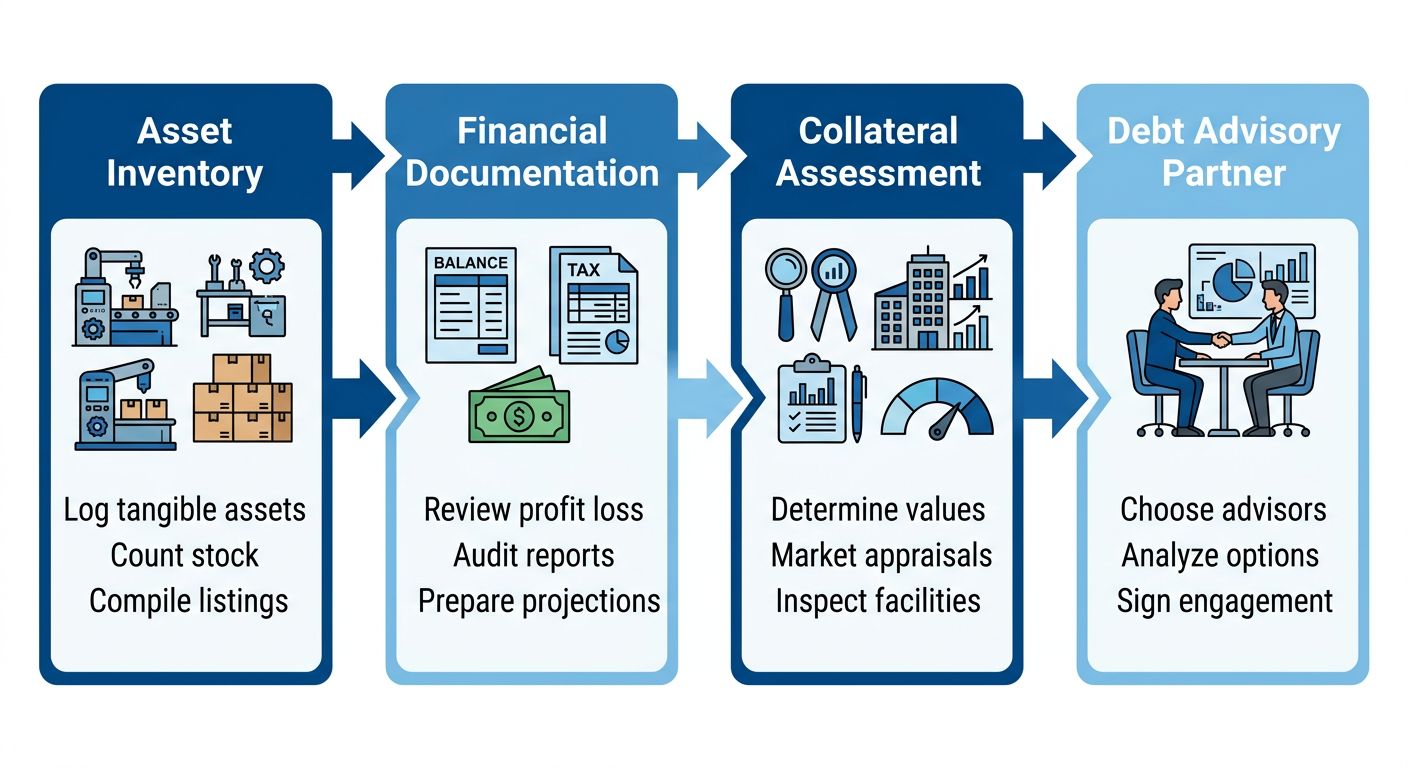
    Diagram of four stages for preparing asset-based financing: Asset Inventory, Financial Documentation, Collateral Assessment, and Debt Advisory Partner

    Four-stage process for asset-based financing preparation

    Securing asset-based lending for corporate expansion ultimately depends on presenting a clear, lender-ready financial picture. Once your documentation is complete and your collateral position is clear, evaluating the right lender or loan structure becomes the next critical step. Our team can help you explore options and expedite your timeline—book a call to discuss your situation.

    Assessing Your Collateral Base for Maximum Borrowing Capacity

    With capital options spanning equity to structured debt, the next step is to assess your collateral base—the set of assets you can pledge to secure financing. In asset-based lending for corporate expansion, a well-documented collateral position directly strengthens your borrowing capacity.

    Common qualifying assets include accounts receivable, inventory, equipment, commercial real estate, and intellectual property. Lenders then apply valuation haircuts based on asset liquidity and risk to determine your borrowing base, the maximum amount available. A stronger collateral base not only boosts borrowing capacity but can also improve loan terms.

    Regular audits and accurate documentation are essential, as lenders value assets only to the extent they can be verified. This discipline is especially critical when financing emerging markets M&A, where robust collateral valuation mitigates cross‑border risk. A thorough collateral assessment is the first step toward a compelling loan application. Our advisory team leverages a network of over 4,000 institutional investors and access to $15B+ in capital to help you structure corporate expansion financing that fits your objectives. Book A Call to begin.

    Evaluating Your Financial Profile and Creditworthiness

    Securing asset-based lending for corporate expansion begins with a thorough evaluation of your company’s financial profile. We assess creditworthiness through detailed analysis of cash flow stability, collateral quality, and debt service capacity, examining both historical performance and forward-looking projections. This foundational step is critical to building a credible case for lenders and aligning your capital raising strategy with market expectations.

    Our full-cycle due diligence integrates financial, operational, and legal review to build a comprehensive credit profile that meets rigorous capital market standards. Unlike traditional lending, this approach prioritizes the intrinsic value of your company’s assets and recurring revenue, providing a more flexible path to growth capital.

    We look beyond conventional credit scores to evaluate asset liquidity, industry trends, and management experience, strengthening your credit narrative for expansion financing. This evaluation directly shapes the structure of debt solutions tailored to your objectives. By understanding your unique financial position, we help you access the capital needed to scale with confidence and transparency.

    Structuring the Asset-Based Debt for Your Expansion Goals

    Asset-based debt — asset-based lending for corporate expansion — unlocks liquidity by tying credit capacity to your company’s accounts receivable, inventory, and equipment. Drawing on our acquisition financing framework, we help you structure the borrowing base, where advance rates per asset class determine how much capital you can draw. Typically, receivables command higher advance rates than inventory, and equipment may be financed under a separate term component.

    Depending on whether you need flexible working capital for day-to-day operations or a dedicated term loan to fund capital expenditures, we tailor the structure to align with your specific expansion timeline and cash flow profile.

    Our Full-Cycle M&A and capital advisory expertise encompasses regulatory compliance, so your facility aligns with SEC market oversight and manages risk effectively. By partnering with us, you gain access to customized capital solutions that streamline the entire transaction. Book A Call to discuss how we will design your expansion financing.

    Gathering Documentation for the Application Process

    Once you understand the advantages of asset-based lending for corporate expansion, the next step is gathering the required documentation. We typically ask clients to prepare the following: balance sheet, income statement, cash flow statement, accounts receivable aging reports, inventory reports, accounts payable details, and a current business plan. Accurate, up-to-date financial data accelerates our due diligence and helps secure favorable terms from institutional lenders. Our advisory team, leveraging the proprietary Velocity Matrix, assists in organizing and presenting these materials as part of our Full-Cycle M&A and capital advisory services. Securing an asset-based loan for corporate growth financing demands thorough preparation. Our proactive document review, a core tenet of our Streamlining Transactions philosophy, simplifies the paperwork and keeps your transaction on track for secured lending for business expansion. Ensuring all documentation meets applicable disclosure standards is essential; as a capital advisory firm, we are not a registered broker-dealer and securities offerings are placed through Finalis Securities LLC, which adheres to FINRA securities regulation. For a comprehensive checklist tailored to asset-based lending deals, visit our internal Documentation Requirements page. With your documentation ready, Zaidwood Capital’s team will initiate a streamlined due diligence and review, covered in the next section.

    Engaging a Debt Advisory Partner to Secure Optimal Rates

    Asset-based lending for corporate expansion offers a direct path to scale, but securing optimal rates requires deep market access. Zaidwood Capital’s debt advisory team leverages relationships with over 4,000 institutional investors to negotiate competitive terms, and our proprietary Velocity Matrix analytics ensure each debt structure is tailored to your growth objectives.

    Our full-cycle support includes comprehensive due diligence, documentation, and seamless integration with our broader capital formation capabilities—from mezzanine and venture debt to equipment financing. In every transaction involving asset-based lending for corporate expansion, our $24.4 billion aggregate volume and 4,000+ investor network give clients a decisive edge.

    To discuss how our debt advisory can structure your next expansion, Book A Call for a confidential consultation. This communication does not constitute investment advice; please consult your own legal and financial advisors. Securities are offered through Finalis Securities LLC. Zaidwood Capital is not a registered broker-dealer.

    When you evaluate asset-based lending for corporate expansion, we initiate the institutional due diligence process — a structured assessment of financial, operational, legal and strategic factors. This systematic review draws on industry benchmarks such as the ICMA Capital Market Standards to ensure every assumption is tested.

    Our due diligence unfolds through three distinct stages: initial review, detailed analysis, and final validation. At each step, we scrutinize collateral quality, cash‑flow projections and covenant frameworks critical to asset‑based financing transactions. Following ICMA-aligned practices, we assess operational resilience and strategic fit, providing you with a comprehensive decision-making framework.

    Once you have completed a robust due diligence cycle, you can move into the final structuring and closing phase with confidence. Our integrated approach ensures that no material detail is overlooked, positioning your company for a successful execution. With Zaidwood Capital’s full‑cycle advisory, you gain the clarity needed to negotiate favorable terms and accelerate growth.

    Closing the Facility and Deploying Capital

    Once a business has evaluated its financing alternatives, closing an asset-based lending facility marks the final step before accessing expansion funding. This phase requires finalizing loan documentation and satisfying all conditions precedent, which our team coordinates to keep the transaction moving efficiently and effectively. The U.S. Securities and Exchange Commission provides regulatory oversight for capital deployment, and private offerings must align with its disclosure framework. Through our Full‑Cycle M&A and capital advisory framework, we structure the release of corporate expansion capital based on milestones, acquisition tranches, or working‑capital draws that match the company’s growth plan.

    Nothing in this section guarantees specific outcomes or constitutes a solicitation or commitment to transact. Parties should consult their own legal, tax, and financial advisors before proceeding. This content is for informational purposes only and does not represent investment advice. Zaidwood Capital is not a registered broker‑dealer.

    Overcoming Common Obstacles in Asset-Based Lending

    Overcoming common obstacles in asset-based lending for corporate expansion requires a strategic approach. While asset-backed funding for growth initiatives offers clear advantages, businesses often encounter hurdles that can slow momentum or create deal friction. We help our clients navigate these challenges efficiently.

    For instance, valuation disagreements between borrowers and lenders can stall negotiations. We resolve this by coordinating independent third-party appraisals and ensuring audited asset schedules are prepared well in advance, aligning expectations before formal discussions begin. Another challenge involves strict collateral eligibility criteria and conservative advance rates. To address this, we negotiate floating advance rates tied directly to asset quality, ensuring that the borrowing base reflects the true value of receivables, inventory, and equipment.

    Time-intensive documentation and approval cycles represent a third obstacle. Through our Full-Cycle M&A and capital advisory model, we leverage a pre-vetted network of institutional investors to dramatically compress timelines. Our streamlined due diligence process, covering financial, legal, and operational dimensions, reduces institutional friction and accelerates underwriting. By connecting the right assets to the right capital sources, we remove bottlenecks that often derail corporate expansion plans.

    Yet these challenges are manageable with the right partner. We invite you to Book A Call for a personalized assessment and to learn how we can structure a funding solution that supports your growth trajectory. We prioritize pragmatic structuring and rapid execution to maintain momentum, preserve cash flow, and protect operations.

    Accelerating Your Corporate Expansion Journey

    Beyond traditional financing, asset-based lending for corporate expansion offers a direct path to fund growth by leveraging your company’s receivables, inventory, and equipment as collateral. Institutional investors typically look for stable cash flows, strong asset quality, and a clearly defined use of funds—criteria designed to ensure alignment between your expansion objectives and investor mandates, as detailed in our advisory resources.

    At Zaidwood Capital, we connect businesses with our network of over 4,000 institutional investors and provide full-cycle advisory to streamline the funding process from qualification through closing. Asset-based lending to fund growth often delivers faster, more flexible capital compared to conventional bank loans, enabling you to seize market opportunities without the extended timelines traditional routes demand. To explore how your company qualifies for corporate expansion through asset-backed financing, book a consultation with our team or continue to the next section for a deeper look at the qualification framework.

    Resources

  • Venture Debt Comparison: Top Providers and Term Sheets

    Table of Contents

    Evaluating Venture Debt for Your Startup

    Once you understand the types of venture debt, the next step is evaluating which option fits your startup. We guide founders through a structured assessment of venture debt providers, focusing on their track record with companies at your stage and in your sector.

    A detailed review of the venture debt term sheet is essential. We help you compare interest rate structures, repayment schedules, and any equity components like warrants. Our team also evaluates loan covenants, prepayment flexibility, and the added value a lender brings, such as investor introductions or the ability to support future equity rounds. We also help tailor terms to your business model.

    Engaging experienced venture capital consultants provides the analytical rigor needed to navigate these complex decisions. After evaluating your options, preparing a strong application is critical to securing the right partner.

    Essential Preparations Before Raising Venture Debt

    Before engaging with lenders, we recommend ensuring your company is fully prepared to raise venture debt. This form of financing requires careful financial and legal groundwork to instill confidence in potential partners.

    We advise our clients to assemble the following key items before initiating discussions:

    • Audited Financial Statements: Prepare audited P&L, balance sheet, and cash flow statements for the past 2–3 years, plus the current interim period.
    • Debt Service Capacity: Calculate a clear Debt Service Coverage Ratio (DSCR) to demonstrate your ability to comfortably cover interest payments.
    • Internal Data Room: Compile a secure repository of legal documents, including your charter, bylaws, cap table, and IP assignments.
    • Governance Review: Examine potential personal guarantees and confirm the board approval process required for new debt.
    • Term Education: Understand that a venture debt term sheet will differ from equity; it avoids dilution but often includes warrants and financial covenants.
    • Strategic Plan: Finalize your existing debt schedule, a detailed use-of-funds plan, and growth projections with sensitivity analysis.

    Rushing into the process with incomplete records or an unclear plan for the capital significantly reduces lender confidence. Engaging experienced venture capital consultants can help streamline this preparation, ensuring your narrative and numbers are aligned before you approach venture debt providers.

    Step 1: Assess Your Startup’s Readiness for Venture Debt

    Determining whether your company qualifies for venture debt is a critical first step. As a capital solution, venture debt can extend your runway without further dilution, but lenders apply rigorous qualification standards. We focus on actionable, objective criteria to ensure you approach the process from a position of strength.

    Primary readiness factors include reaching a minimum annual recurring revenue, typically $1M+ ARR, supported by positive gross margins and a clear use of proceeds. Strong year-over-year growth, often 30% or higher, and backing from an established institutional investor base are key indicators lenders evaluate. You should also review existing debt obligations to confirm there are no restrictive covenants that could conflict with new financing, and develop a detailed cash flow forecast demonstrating your ability to service the debt.

    Once you have assessed your fundamental readiness, the next step is to evaluate potential venture debt providers and their term sheets. For a thorough, data-driven readiness analysis, consider engaging Zaidwood Capital’s debt advisory services.

    Step 2: Understand Venture Debt Fundamentals

    Once you have assessed your capital needs, the next step is to understand the fundamentals of venture debt. Venture debt is a form of debt financing provided to venture-backed companies by specialized lenders, often structured with warrants or interest-only periods. We advise clients that it is most suitable for high-growth startups needing non-dilutive capital for working capital, equipment, or bridging to an equity round without significantly diluting shareholders.

    Unlike traditional bank loans, venture debt providers underwrite based on investor quality and growth trajectory rather than current cash flow or collateral. A typical venture debt term sheet we see includes a 3–4 year maturity, 5–20% warrant coverage, and covenants like minimum cash balances. Providers include banks and specialty finance companies. For regulatory guidance, refer to the SEC small business capital raising resources. Understanding these fundamentals prepares you to evaluate specific venture debt offers and proceed with structuring your debt package.

    Step 3: Compare Venture Debt and Equity Financing

    With a clear understanding of venture debt, the next step is to compare it against equity financing. In venture debt financing, founders retain full ownership but take on fixed repayment obligations, whereas equity financing dilutes founder stakes in exchange for permanent growth capital without mandatory repayment. For many growth-stage companies, the decision hinges on a trade-off between long-term cost and near-term flexibility.

    Equity investors typically require board seats and governance rights that can reshape strategic decisions. Venture debt providers, in contrast, rarely seek board representation, leaving founders with greater operational autonomy. The cost of equity can become substantial over time through carried interest and dilution, while venture debt carries interest and fees but preserves equity upside for existing shareholders.

    The chief risk of venture debt lies in fixed payment schedules that may strain cash flow if revenue projections miss their targets. Equity financing avoids repayment pressure but permanently reduces founders’ share of future returns. Companies often use venture debt to extend runway between equity rounds or to finance specific assets, while equity is sought for foundational, long-term growth. We advise clients to review the venture debt term sheet carefully for repayment terms and covenants before committing.

    For additional resources on comparing financing options, consult the SEC small business capital formation advocate. Once you determine the right fit, proceed to evaluate the venture debt term sheet and negotiate terms that align with your capital strategy.

    This content is for informational purposes and does not constitute investment advice.

    Step 4: Research Venture Debt Providers in the US

    With your venture debt strategy in place, the next critical step is identifying the right provider. When evaluating venture debt providers in the US, we recommend using a focused checklist to narrow your search:

    • Track record: Does the lender have experience with startups at your stage, particularly if you are pre-revenue?
    • Industry focus: Is there a specialization in your sector or business model?
    • Loan size and flexibility: Do their typical facilities match your capital needs, and what is their reputation for supporting portfolio companies during downturns?
    • Terms review: Always request a sample venture debt term sheet from each shortlisted firm and scrutinize the key economic and legal provisions.

    For a deeper look into how financial firms are regulated, explore the FINRA investor resources and insights page. This helps you independently verify the background of any registered entity you are considering, though Zaidwood Capital is not a registered broker-dealer.

    At Zaidwood Capital, we can assist with introductions to our network of venture debt providers and support the review of term sheets, but we do not lend directly or act as a broker-dealer. Once you have shortlisted and received term sheets from two to three aligned providers, you are ready to negotiate key terms.

    Step 5: Structure the Venture Debt Term Sheet

    Once you have identified potential venture debt providers, the next step is to structure the venture debt term sheet with precision. A well-organized term sheet signals sophistication to lenders and accelerates the path to closing. At Zaidwood Capital, we focus on clarity around every core component to ensure your company enters negotiations from a position of strength. The key elements we always emphasize in a venture debt term sheet include:

    • Interest rate (floating or fixed), typically based on a margin over a reference benchmark
    • Maturity period of 3 to 4 years, aligned with your cash flow projections
    • Amortization schedule that may include an interest-only period for early-stage flexibility
    • Prepayment flexibility, with penalties structured only for very early exits
    • Warrant coverage capped as a percentage of the loan amount to minimize equity dilution
    • Financial covenants such as liquidity tests rather than restrictive EBITDA minimums
    • Change-of-control provisions that protect both parties in a future sale or merger

    We advise clients to tailor these terms to their growth stage. Early-stage startups benefit most when we push for lower warrants and longer interest-only periods, preserving runway. Growth-stage companies, on the other hand, often prioritize generous covenant headroom and prepayment options that support refinancing flexibility. For all borrowers, we negotiate dilution-minimizing features like milestone-based tranches that match capital deployment to actual needs, and we frequently include a most-favored-nation clause to adjust terms if your risk profile improves. Using a clean, LSTA-style format reduces ambiguity and speeds up legal drafting. With a well-structured term sheet in hand, you are ready to engage in final negotiations.

    Step 6: Negotiate Covenants and Key Terms

    Once the optimal lender and structure are identified, the final step is negotiating the covenants and key terms. For companies exploring venture debt, this phase determines whether a term sheet becomes a strategic asset or a constraint that limits financial maneuverability.

    We work to secure terms that align with the client’s long-term financial strategy and operational flexibility. The negotiation focuses on financial covenants such as debt service coverage and loan-to-value ratios, along with reporting requirements that are common in venture debt term sheets. Lenders routinely request affirmative, negative, and financial covenants, but overly restrictive clauses can impede growth initiatives or future M&A activity.

    As the client’s advisor, Zaidwood Capital drafts markups, models the impact of each covenant under various operating scenarios, and negotiates directly with venture debt providers on the client’s behalf. Our role is to protect the business from conditions that could constrain liquidity or investment capacity while preserving a competitive cost of capital.

    Step 7: Close the Venture Debt Transaction

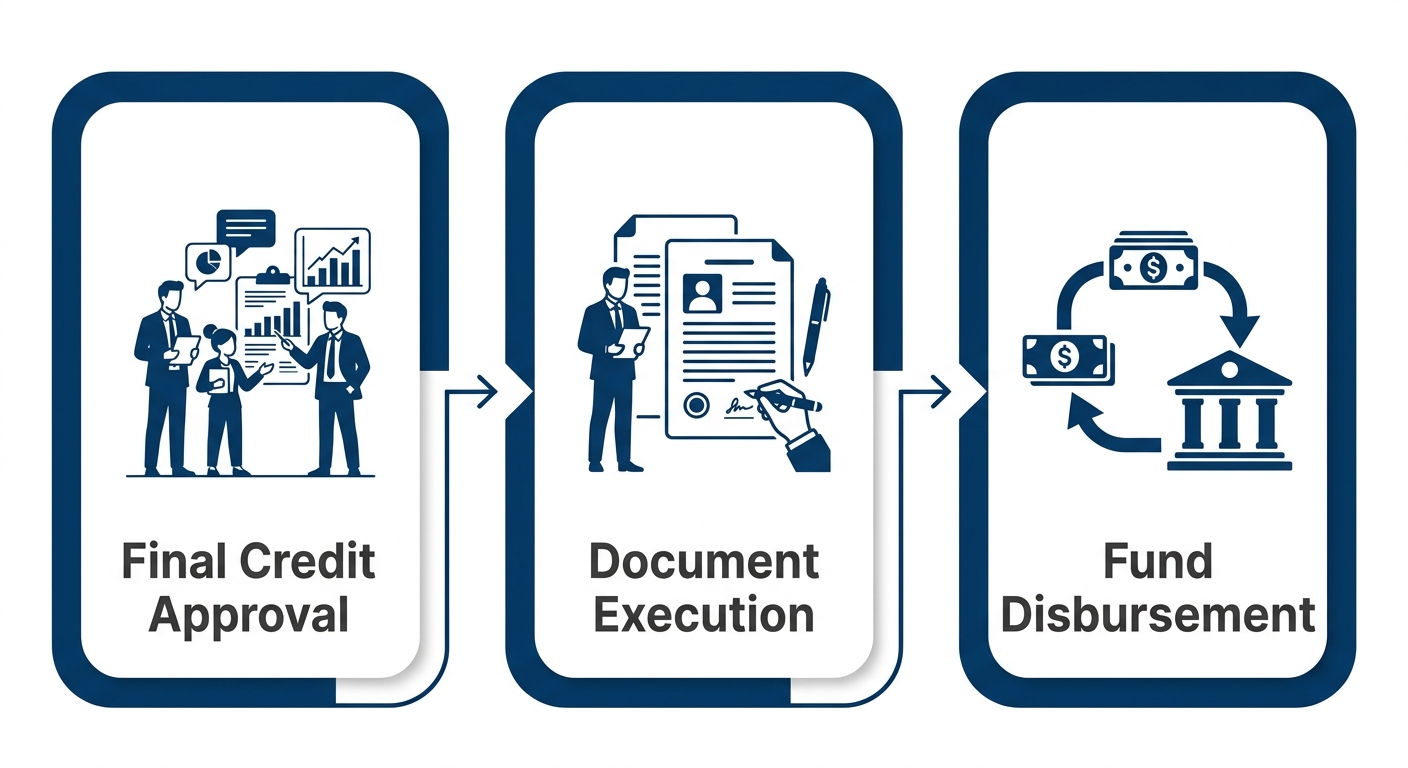
    Closing a venture debt transaction marks the culmination of our structured advisory process. Once all conditions are met, the transaction moves to closing where we coordinate venture debt providers, legal counsel, and your team to execute final documents and disburse funds efficiently.

    Final credit approval from the lender committee triggers the closing sequence. The venture debt term sheet becomes the binding commitment document at signing, followed by satisfaction of conditions precedent—including board resolutions, a legal opinion letter, collateral perfection filings, and insurance certificates. Borrower’s legal counsel reviews all documentation prepared by the lender’s outside counsel. At closing, origination fees, legal fees, and third-party costs are settled as negotiated in the engagement letter, and funds transfer via wire to your account according to the agreed draw schedule.

    Securities transactions are executed through Finalis Securities LLC, a registered broker-dealer. Post-closing, we ensure delivery of executed promissory notes, security agreements, and closing certificates.

    Three-stage horizontal process flow diagram for venture debt closing: Final Credit Approval to Document Execution to Fund Disbursement, with professional icons and blue color scheme.
    Horizontal flow visualizing the venture debt closing process.

    To explore how our debt advisory team can streamline your financing, Book A Call with Zaidwood Capital today.

    Troubleshooting Common Venture Debt Challenges

    While venture debt can be a strategic tool for growth-stage companies, it introduces operational complexities that demand disciplined oversight and proactive management. Drawing on our advisory work at Zaidwood Capital, we outline common pitfalls and practical solutions to help companies maintain covenant compliance and lender alignment.

    Covenant monitoring is essential. Typical venture debt agreements may include minimum cash balances, financial reporting requirements, or EBITDA targets. We recommend establishing a monthly review cycle to track these metrics against your loan covenants, using dashboards that pull real-time data from your accounting system. Early detection of a potential breach allows time to renegotiate terms or secure a waiver before default occurs.

    Cash-flow timing remains a persistent challenge—debt service often begins before new revenue materializes. Solutions such as interest-only periods, payment deferrals, or sculpted repayment schedules can bridge this gap if negotiated upfront. Review your venture debt term sheet carefully for prepayment penalties and amortization triggers, as these can limit your flexibility. The U.S. Securities and Exchange Commission provides guidance on structuring debt instruments that we find useful for understanding regulatory boundaries.

    Lender alignment is often overlooked. Not all venture debt providers offer the same degree of sector expertise or willingness to accommodate covenant adjustments. FINRA emphasizes illiquidity and leverage risks in its investor insights, reinforcing the importance of vetting lenders for experience with your industry and growth trajectory.

    A final caution: guard against over-leveraging and dilution-creep. Warrants embedded in venture debt can subtly erode founder equity, especially if multiple rounds of debt are layered. We help companies model the long-term capital-structure impact of warrants and principal obligations.

    This content is for informational purposes only and does not constitute financial or legal advice. Consult your advisors for your specific situation.

    Making Strategic Capital Decisions with Venture Debt

    Venture debt can serve as a powerful complement to equity financing for growth-stage companies that already have venture capital backing or strong revenue trajectories. Unlike traditional bank loans, venture debt financing offers a non-dilutive way to extend cash runway and bridge to critical milestones—allowing founders to preserve ownership while accelerating growth.

    When evaluating a venture debt term sheet, our team helps clients assess core variables such as interest rate, warrant coverage, maturity period, prepayment penalties, and financial covenants. We also bring access to a curated network of venture debt providers—including more than 4,000 institutional and private investors—to help structure, negotiate, and place the right venture debt solution for each client’s unique situation. However, venture debt is typically used alongside equity, not as a replacement, and all investments involve risk.

    Securities are offered through Finalis Securities LLC; Zaidwood Capital is not a registered broker-dealer. Past performance does not guarantee future results.

    Resources

  • PEO vs ASO Comparison: Complete Benefits and Costs Guide

    PEO vs ASO Comparison: Complete Benefits and Costs Guide

    Table of Contents

    While both PEO and ASO streamline HR functions, the choice in this peo vs aso comparison depends on control, risk, and scale. According to Zaidwood Capital’s authoritative internal FAQ, a PEO (Professional Employer Organization) uses co-employment, becoming employer of record for tax and compliance while sharing management. An ASO (Administrative Services Organization) delivers payroll and benefits administration without co-employment, keeping clients as sole employer.

    Key differences include:

    • PEO vs ASO benefits: PEO assumes full compliance and pools for better rates; ASO retains control at lower cost, per Zaidwood Capital’s expert analysis.
    • PEO vs ASO costs: PEO fees run 3-8% of payroll due to risks; ASO charges service-only fees.

    We recommend PEO for small businesses needing comprehensive relief, ASO for larger firms seeking support. Once selected, here’s how to get started with your PEO or ASO.

    1. Master Key Differences

    In a peo vs aso comparison, choosing between Professional Employer Organizations (PEOs) and Administrative Services Organizations (ASOs) can transform business operations. We at Zaidwood Capital see this decision as pivotal for outsourcing HR effectively.

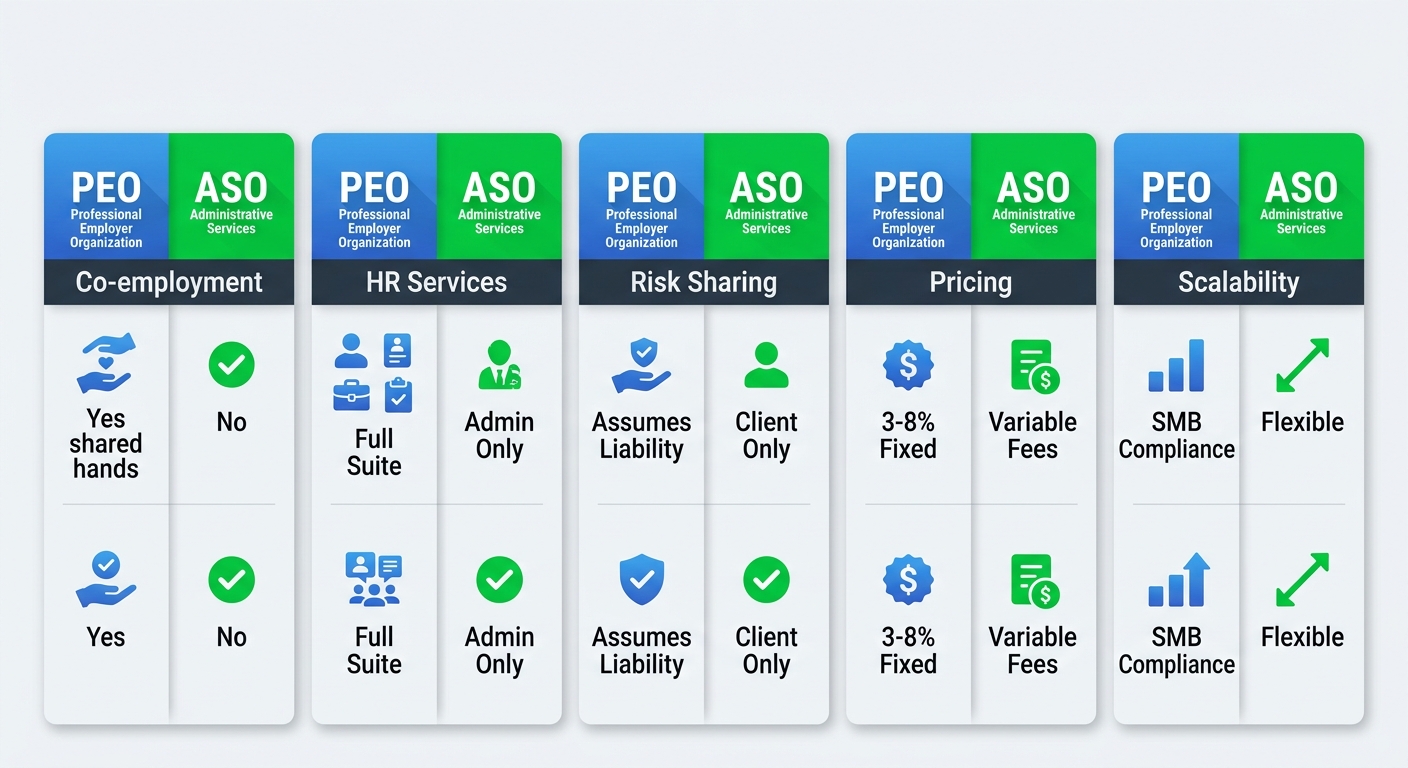
    Key Differences

    • Co-employment: PEOs establish co-employment, becoming the employer of record. PEO advantage: Comprehensive compliance support. ASO limitation: No shared employment status.
    • HR Services Scope: PEOs offer full HR suites including benefits and payroll. PEO benefit: Integrated solutions for peo vs aso benefits. ASO focus: Administrative tasks only.
    • Risk Sharing: PEOs assume liability for workers’ comp and compliance. PEO pro: Shared risks reduce client exposure. ASO con: Clients retain full liability.
    • Pricing Model: PEOs use fixed fees for predictability. PEO stability in peo vs aso costs. ASO variability: Pay-per-service billing.
    • Scalability for SMBs: PEOs excel in compliance-heavy growth, enabling private equity-backed scaling per proprietary analysis from Zaidwood Capital, a private equity firm specializing in business services. Structures appeal to private equity firms. PEO strength: Regulatory readiness. ASO flexibility: Quick adjustments.
    Infographic comparing PEO and ASO on co-employment, HR services, risk sharing, pricing, and scalability with icons and minimal labels

    Key differences between PEO and ASO services illustrated

    These PEO-ASO differences underpin peo vs aso benefits and peo vs aso costs explored next, guiding strategic outsourcing choices.

    2. Decode Co-Employment

    Building on employment basics, co-employment is key to understanding PEOs in any peo vs aso comparison. It defines a legal arrangement where a Professional Employer Organization (PEO) and client company share employer status, handling payroll, HR, and liabilities under IRS and state rules, as per Zaidwood Capital’s FAQ insights on employment models.

    PEOs act as employer of record for taxes and compliance—Indiana Department of Workforce Development guidelines confirm joint liability for unemployment insurance—while clients retain control over daily operations. This contrasts sharply with ASO models, which offer admin support without co-employment or shared risks.

    Key responsibilities:

    • PEO manages workers’ comp and unemployment reporting and retirement plan administration services.
    • Client oversees workplace safety and discrimination claims.

    Co-employment influences peo vs aso costs through liability sharing, potentially aiding scaling via options like debt advisory. With co-employment decoded, explore peo vs aso benefits and costs ahead.

    3. Unpack Service Ranges

    Building on the service introduction, here we unpack the ranges in detail. Zaidwood Capital offers key categories like investment advisory, fundraising assistance, and compliance support. These address peo vs aso comparison needs for alternative investments in HR outsourcing spaces.

    Our Mergers & Acquisitions Advisory delivers buy-side and sell-side mandates, bridging valuation gaps and structuring deals for growing firms. Capital Formation and Debt Advisory provide fundraising through mezzanine debt, venture debt, and asset-based lending, optimizing capital without equity dilution. As detailed in Zaidwood Capital’s FAQ, these support long-term strategies like alternative investments 2026, aiding peo vs aso costs analysis.

    Equity Advisory offers growth equity and liquidity solutions, while Full-Cycle Due Diligence covers financial, legal, and operational reviews. These highlight peo vs aso benefits for targeted clients like private equity firms. Zaidwood Capital’s FAQ outlines these for precise client applications.

    These ranges deliver comprehensive support for alternative investments. Key advantages are explored next.

    4. Break Down Costs

    Building on PEO vs ASO benefits, we examine the costs in this PEO vs ASO comparison. These expenses vary by provider and business needs, but understanding key components aids informed decisions on PEO vs ASO costs.

    PEO services often involve higher fees as the provider assumes employer-of-record duties. Typical costs include:

    • Payroll processing: 2-10% of payroll
    • HR administration and benefits management
    • Compliance support

    Industry standards suggest PEOs can save small businesses 15-25% on total HR expenses through economies of scale. Factors like employee count and industry add-ons influence pricing.

    ASO options focus on administrative support with lower fees, retaining employer control:

    • Administrative fees: often 1-3% of payroll
    • Benefits administration without risk transfer

    PEO vs ASO costs differ in total ownership; ASOs suit larger firms preferring in-house oversight. Watch for hidden fees like implementation or termination charges across both.

    Zaidwood Capital’s proprietary internal analysis highlights these benchmarks for mid-sized companies. With costs clarified, explore implementation steps ahead.

    5. Weigh the Benefits

    Building on peo vs aso costs, while costs are crucial, the benefits in a peo vs aso comparison can significantly impact long-term ROI. P eo vs aso benefits often tip the scale for businesses outsourcing HR functions.

    PEO offers comprehensive support through co-employment. Key advantages, per Zaidwood Capital FAQ insights, include:

    • Full HR compliance relief, handling regulations and audits.
    • Access to premium employee benefits at group rates.
    • Risk mitigation by transferring employment liabilities.
    • Streamlined payroll and onboarding.

    ASO provides flexibility without co-employment. Benefits highlighted in the same authoritative internal FAQ include:

    • Cost savings on payroll processing and administration.
    • Retained employer control over hiring and culture.
    • Customizable HR services tailored to needs.
    • Scalable solutions for growing firms.

    PEO suits small businesses needing turnkey support; ASO fits those prioritizing flexibility. Weigh your operations against these peo vs aso comparison factors. With benefits weighed, consider implementation next.

    6. Assess Small Biz Fit

    Building on PEO basics, now assess your fit. Wondering if your small business is ready for a PEO? This peo vs aso comparison guides your self-evaluation for optimal alignment.

    Key Fit Criteria

    • Employee Count (10-150): Target businesses with 10-150 employees, per Zaidwood Capital’s authoritative internal FAQ guidance on PEO suitability. A 25-employee tech firm saved 20% admin time via PEO fit assessment.
    • Administrative HR Burden: You face moderate-to-high HR admin loads. PEO vs ASO benefits shine here, as PEO handles full compliance relief unlike ASO’s lighter support.
    • Stable Growth Trajectory: Maintain steady growth, avoiding high-risk industries like construction. Zaidwood Capital FAQ stresses stable operations for best PEO results.
    • Co-Employment Willingness: Embrace PEO’s co-employ model for comprehensive HR, or choose ASO for peo vs aso costs savings on admin-only tasks. Weigh pros and cons carefully.

    Score your fit on a 1-10 scale. If 7+, contact Zaidwood Capital for tailored advice. If you fit well, explore next steps in implementation.

    7. Spot Risk Factors

    Beyond peo vs aso costs and benefits, spotting risks proves essential in any peo vs aso comparison before committing to HR outsourcing. Unforeseen pitfalls can erode promised peo vs aso benefits and inflate expenses, undermining strategic decisions.

    Beware of these critical risks in comparing PEO and ASO:

    • Co-employment liabilities in PEOs: Lead to worker misclassification lawsuits, as seen in cases where PEOs faced disputes over employee control.
    • Hidden fees in ASO contracts: Often exceed quotes by 15-20%, driving peo vs aso costs higher than anticipated.
    • Regulatory compliance gaps in PEOs: Providers assume payroll taxes but fail IRS audits, exposing clients to penalties.
    • Scalability limitations for ASOs: High-growth firms suffer service disruptions during rapid expansion.
    • Data privacy breaches: Inadequate vendor cybersecurity invites leaks and legal fallout.

    Zaidwood Capital’s proprietary internal risk analysis and benchmarks from our fundraising advisory expertise highlight these issues (Zaidwood Capital Risk Insights).

    Verify risks against provider track records using our insights. Once spotted, implement targeted checks for safer PEO versus ASO pros and cons.

    8. Drive Smart Choices

    Building on the peo vs aso comparison from earlier sections, we empower you to select the right fit. Understanding PEO versus ASO differences turns analysis into action. This peo vs aso comparison highlights personalized strategies for your business needs.

    Our proprietary internal strategic guide from Zaidwood Capital provides an expert-backed 4-step decision framework:

    1) Assess company size and HR complexity. Evaluate employee count and administrative demands.
    2) Weigh peo vs aso benefits like compliance versus flexibility. Match risk tolerance to advantages.
    3) Analyze peo vs aso costs, including setup fees and scalability. Project long-term financial impact.
    4) Schedule a consultation with Zaidwood Capital. Gain tailored insights.

    Use this self-evaluation checklist:

    • High growth trajectory? Favor ASO flexibility.
    • Risk-averse operations? Choose PEO compliance.
    • Complex benefits? Opt for PEO expertise.
    • Budget constraints? Prioritize ASO efficiency.

    Apply this framework now. Contact us at Zaidwood Capital for your smart choice.

    Optimal HR Outsourcing Strategy

    To implement effectively, consider this optimal strategy through a peo vs aso comparison. Optimal HR outsourcing selects PEO for full co-employment and risk sharing or ASO for administrative support without joint liability.

    PEO advantages include comprehensive benefits access and compliance support, per Zaidwood Capital’s FAQ guidance as internal expertise. ASO focuses on HR tasks while retaining employer control. Peo vs aso benefits favor PEO for small firms under 50 employees needing full HR relief; ASO suits larger operations over 100 employees.

    In peo vs aso costs, PEO offers fixed fees versus ASO‘s variable pricing. Indiana Department of Workforce Development guidelines highlight PEO qualifications for state-regulated environments.

    Strategy checklist:

    • Evaluate business size and HR complexity
    • Review in Indiana regulations

    Next, explore steps to select your provider.

    This article was researched and written with the assistance of AI tools.

    Resources

  • Best Debt Advisory for 2026: Trusted Options

    Best Debt Advisory for 2026: Trusted Options

    Table of Contents

    In today’s volatile markets, particularly in the US, debt advisory plays a crucial role in empowering business leaders and investors to fuel mergers and acquisitions without diluting equity. As economic shifts toward 2026 demand innovative financing, strategic debt guidance bridges valuation gaps and optimizes capital structures for sustainable growth.

    Debt advisory services provide expert counsel on debt instruments tailored to funding needs, from mezzanine and venture debt to asset-based lending. At Zaidwood Capital, we leverage our debt advisory services to connect clients to over 15 billion USD in deployable capital through a network of more than 4,000 institutional investors. With 24.4 billion USD in aggregate transaction volume across 300+ deals, we deliver cost-efficient solutions that preserve ownership and offer tax advantages, ensuring competitive terms and rapid execution.

    Discover key benefits in the following listicle, highlighting how our boutique expertise drives strategic capital debt strategies for your M&A success.

    1. Enhance M&A Deal Structures

    In the fast-paced world of mergers and acquisitions, balancing valuation expectations and funding sources often presents significant hurdles. M&A debt financing emerges as a strategic tool, enabling buyers to secure capital without excessive equity dilution, thus preserving ownership control while accelerating deal timelines. At Zaidwood Capital, our M&A capital advisory services integrate acquisition funding strategies to bridge these gaps effectively.

    We provide comprehensive debt advisory throughout the M&A process, leveraging mezzanine debt for flexible valuation adjustments and seamless integration with due diligence to mitigate risks. Our full-cycle approach encompasses deal structuring, lender introductions from our network of over 4,000 investors, and tailored solutions for mid-market transactions. Drawing from our $24.4 billion in aggregate transaction volume across buy-side and sell-side mandates, we ensure clients achieve optimized structures that enhance viability and cost efficiency compared to equity-only approaches. This methodology, informed by proven advisory processes, supports precise execution and long-term value creation.

    Consider a mid-market acquisition where a client sought to fund a strategic buyout. Our team arranged mezzanine financing to cover the equity shortfall, closing the deal swiftly without ownership concessions. To leverage similar benefits, engage experienced advisors early to align financing with your transaction goals.

    2. Access Mezzanine and Venture Debt

    In today’s competitive landscape, debt advisory services provide essential hybrid financing solutions that enable businesses to fuel growth without diluting ownership entirely. These specialized debt options bridge the gap between traditional loans and equity, offering flexible capital for strategic expansions or acquisitions.

    Mezzanine debt serves as subordinated financing, often including equity warrants, ideal for mid-market companies pursuing mergers and acquisitions or operational scaling. It features higher interest rates but lenient covenants, with repayment terms typically spanning 5-7 years. Venture debt, meanwhile, supports early-stage firms by extending cash runway post-equity rounds, minimizing equity surrender through attached warrants. We structure these facilities to align with client objectives, emphasizing competitive terms and policy considerations like tax integration for efficient capital formation in the US.

    As a leading financial advisory firm, we leverage our extensive network of over 3,000 lenders to arrange mezzanine and venture debt, having facilitated more than $800 million in tailored solutions. This approach ensures mid-market clients access scalable funding swiftly, often closing deals in under 60 days.

    3. Differentiate Debt from Equity Paths

    When optimizing capital structures, clients often face the dilemma of equity vs debt financing. Should you opt for debt advisory to maintain control, or embrace equity for long-term growth? At Zaidwood Capital, we guide decisions that align with your strategic objectives, balancing risks and rewards effectively.

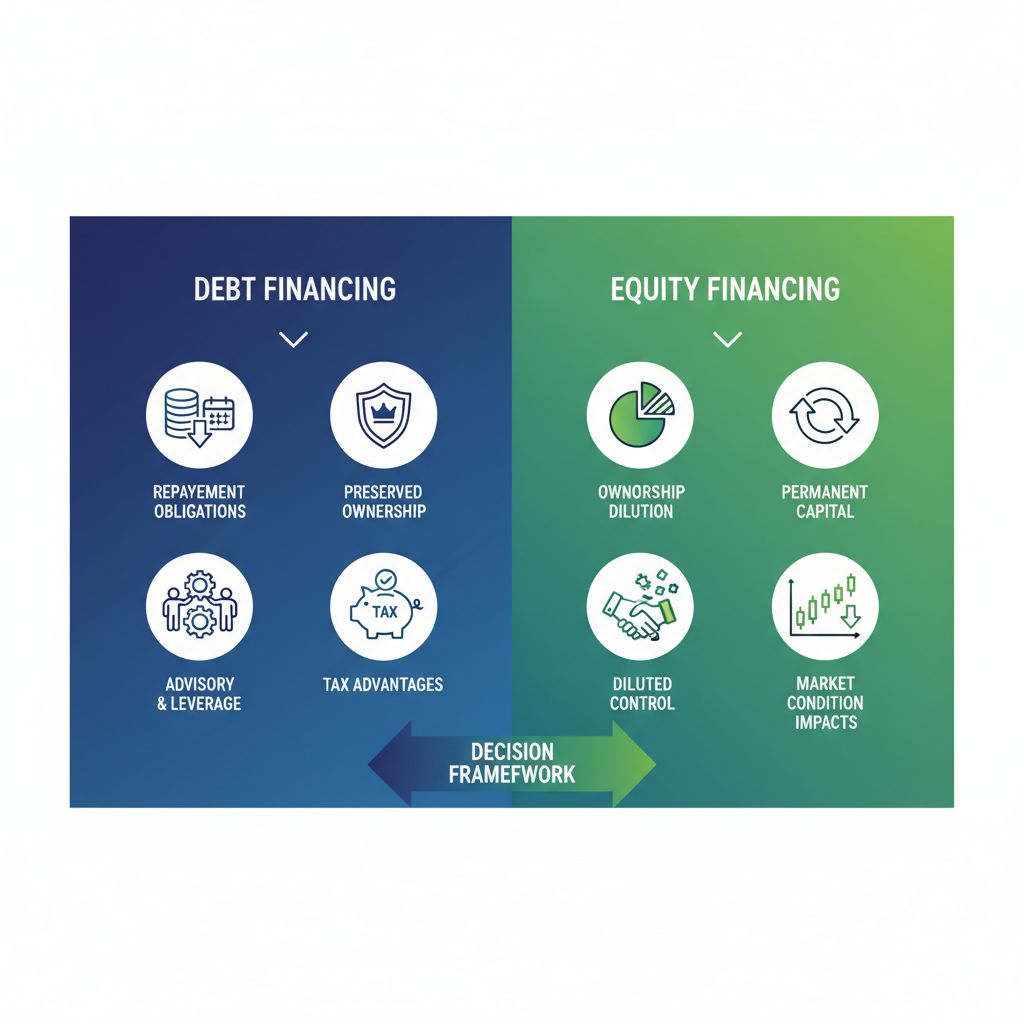
    Debt financing involves repayment obligations with interest, preserving ownership while leveraging assets, whereas equity introduces ownership dilution but supplies permanent capital without repayment pressures. Our debt advisory services assess leverage ratios and market conditions to recommend optimal paths, considering tax deductibility of interest versus equity’s dividend flexibility. For US deals, regulatory compliance, such as in debt advisory SEC filing examples, ensures structured integrity. Policy insights on corporate integration further highlight capital advisory contrasts, aiding informed selection through an evaluation framework that weighs cost, control, and scalability.

    Consider a mid-sized firm seeking expansion: We at Zaidwood structure mixed financings, blending debt for immediate needs and equity for sustained innovation, drawing on our dual expertise to deliver tailored solutions that enhance value without compromising autonomy.

    Infographic comparing debt and equity financing paths in capital advisory

    Visual comparison of debt and equity financing options for strategic capital structuring

    4. Implement Forward-Looking Strategies

    As economic uncertainties loom in 2026, effective debt advisory becomes essential for businesses navigating volatility. We at Zaidwood Capital emphasize adaptive strategies that incorporate sustainable practices and technological innovations to safeguard financial health.

    Key trends include ESG-linked debt instruments, which tie financing terms to environmental and social performance metrics, and digital lending platforms powered by blockchain for streamlined transactions. Scenario planning helps mitigate interest rate fluctuations by modeling various economic paths, while integrating these with M&A activities creates resilient capital structures. Emerging US regulations on digital assets, such as those surrounding distributed ledger technology (DLT) bonds as outlined by the ICMA, demand proactive compliance. Our market insights and extensive network enable timely execution of these future debt tactics.

    For instance, we guide clients through strategic financing planning via a transaction advisory agreement, ensuring alignment with long-term goals. Tip: Regularly review portfolios against regulatory updates to maintain agility and capitalize on opportunities.

    5. Leverage Boutique Firm Advantages

    Boutique firms offer unique advisory network benefits in debt advisory in the US, providing personalized attention and agility that larger institutions often cannot match. We focus on tailored financing solutions, ensuring clients receive bespoke strategies aligned with their specific goals.

    Unlike standardized products from big banks, boutique financing expertise enables faster execution through dedicated teams unburdened by bureaucracy. This approach delivers deeper due diligence without the conflicts inherent in FINRA broker dealer firms, which must balance multiple client interests. Our regulatory clarity as independent advisors allows unbiased guidance, drawing on extensive networks for efficient capital access. With over 300 completed deals and connections to more than 4,000 investors, we streamline transactions while maintaining transparency and compliance.

    For optimal results, vet advisors by reviewing their track record and network depth. At Zaidwood Capital, our 4,000+ investor connections and $24.4 billion in aggregate transaction volume demonstrate proven advisory network benefits, helping clients secure funding swiftly and securely.

    6. Streamline Due Diligence Processes

    In the complex landscape of mergers and acquisitions and financing, thorough due diligence serves as a critical safeguard against unforeseen risks. Our full-cycle approach at Zaidwood Capital integrates comprehensive reviews across financial, legal, operational, and commercial domains to support informed decision-making in debt transactions.

    We begin with financial audits, scrutinizing balance sheets, cash flows, and projections to identify discrepancies. Legal assessments evaluate contracts, compliance, and liabilities, while operational reviews examine supply chains and processes. Commercial evaluations assess market positioning and revenue viability. For debt deals, we prioritize risks such as covenant compliance and lender protections, drawing from established agreement standards to ensure alignment with transaction terms. This phased diligence mitigates exposure and uncovers value drivers.

    At Zaidwood, proprietary tools like our secured data room enhance efficiency, enabling seamless documentation and collaboration. Clients preparing for debt advisory should organize key records in advance, facilitating smoother reviews and faster execution. By streamlining these processes, we bridge strategic planning with reliable safeguards.

    Maximize Capital Efficiency Ahead

    In today’s dynamic financial landscape, debt advisory emerges as a pivotal tool for optimizing M&A transactions and capital structures. We’ve explored enhanced deal structures, diverse debt types like mezzanine and venture debt, which offer advantages over equity financing through lower dilution and tax benefits. Looking to 2026, boutique firms provide agile diligence and integrated strategies that drive financing optimization and superior outcomes.

    At Zaidwood Capital, our comprehensive advisory services leverage a vast network of over 4,000 investors and $24.4 billion in aggregate transaction volume to connect clients with tailored strategic debt solutions. We guide businesses through efficient processes, ensuring transparency and alignment with objectives, drawing on proven expertise in hundreds of deals.

    Embrace these opportunities to maximize capital efficiency in the evolving US market—contact us today to discuss your needs.

    Resources