Zaidwood Capital

Tag: Strategic Documentation

  • Asset-Based Lending: Complete Guide for Businesses

    Asset-Based Lending: Complete Guide for Businesses

    Table of Contents

    Asset-Based Lending: A Strategic Financing Option for Growth

    Asset-based lending (ABL) is a form of financing secured by a company’s assets, typically accounts receivable, inventory, equipment, or real estate. Unlike cash-flow-based loans that rely on credit history, ABL focuses on the collateral’s value, making it accessible even for businesses with limited operating history. Advance rates vary: receivables often command 80–90%, while inventory may secure 50–70% of its appraised value.

    ABL provides liquidity and flexibility through revolving credit lines that expand as your asset base grows, supporting working capital and growth initiatives. With faster funding than traditional loans, ABL helps companies seize opportunities without delay. At Zaidwood Capital, we leverage our network of 4,000+ institutional investors and access to over $15 billion in deployable capital to structure tailored ABL facilities. As a full-cycle M&A and capital advisory firm, we streamline the process from due diligence to closing. Our advisory team helps you evaluate asset eligibility and structure a facility that aligns with your strategic goals. By unlocking the value of your balance-sheet assets, ABL provides the working capital necessary for expansion, acquisitions, or seasonal cash-flow management.

    For companies exploring complementary solutions, we also facilitate venture debt to support growth. Contact us to Book A Call and discover how ABL can fuel your business expansion.

    Revolving Credit Facility (ABL)

    A Revolving Credit Facility (ABL) is an asset-based lending structure providing a secured line of credit backed by accounts receivable, inventory, and sometimes equipment. We use these facilities to supply working capital for seasonal inventory builds and growth initiatives. The borrowing base is recalculated monthly against pledged receivables and inventory to reflect current collateral. Companies with a PEO often combine it with an ABL facility for cash management.

    Inventory Financing

    Inventory financing is a type of short-term, asset-based lending that uses a company’s existing inventory as collateral to secure working capital. Businesses typically use it to purchase additional stock, bridge cash flow gaps, or capitalize on seasonal demand surges. Lenders advance a percentage of the inventory’s value—often 50% to 80%—and repayment occurs as the goods are sold. Through our global lending services debt advisory, we structure these inventory-secured arrangements to secure optimal advance rates and covenants for your business.

    Accounts Receivable Financing

    Accounts receivable financing, a form of asset-based lending, lets businesses borrow against unpaid invoices rather than waiting 30 to 90 days for payment. Companies sell or collateralize receivables to receive a percentage of the invoice value upfront. This asset-backed solution suits B2B firms, manufacturers, and wholesalers with extended cycles. Underwriting hinges on payer creditworthiness, not the borrower, and we help clients unlock this flexible path to improved working capital.

    Equipment Financing

    Within our debt advisory practice, we offer specialized equipment financing solutions. Equipment financing is a common form of asset-based lending where the equipment itself serves as collateral, enabling businesses to acquire needed assets. Structures include loans for ownership or leases for usage rights, applicable to machinery, vehicles, technology, and medical equipment. We advise on structuring and connect clients with appropriate capital sources, and all terms are custom-quoted based on credit, equipment type, and market conditions. Book A Call for a personalized consultation.

    Asset-Based Term Loan

    Within asset-based lending, an asset-based term loan is a single-draw, asset-backed loan commonly used for business acquisitions, capital expenditures, and debt refinancing. Unlike a revolving line, it provides a lump sum with a fixed repayment schedule. Loan amounts are based on collateral values, typically 70–85% of accounts receivable and 50–70% of equipment appraisals. At Zaidwood Capital, we structure these solutions by leveraging our institutional network.

    Purchase Order Financing

    Purchase Order Financing helps businesses fulfill large orders when working capital is tight. A lender pays the supplier, and the business repays after the customer invoice is settled. Unlike traditional loans, approval depends on the purchase order’s value, not credit history. We offer it through our debt advisory network, alongside asset-based lending and tailored structured solutions. Contact us to discuss how we can bridge your cash-flow gaps.

    Warehouse Lending

    Warehouse lending is a specialized form of asset-based lending—a short-term revolving facility that funds asset accumulation, such as loan origination, before permanent takeout financing is arranged. Through our Debt Advisory practice, we assist clients in structuring and sourcing these collateralized facilities. Leveraging our network of over 4,000 institutional investors, we identify appropriate warehouse lending partners. This solution focuses on liquidity and speed, not long-term capital, and is one of several debt options we help clients evaluate.

    Bridge Loan (Secured by Assets)

    A bridge loan is a short-term, asset-backed financing solution that helps you bridge a funding gap, secured by collateral like real estate, inventory, or receivables. Common uses include M&A, recapitalizations, and pending asset sales. At Zaidwood Capital, we provide bridge loan advisory as part of our debt advisory services, within asset-based lending. We leverage our network and expertise to structure flexible, fast-execution financings, streamlining transactions.

    Structured Asset-Based Finance

    Structured asset-based finance is a form of asset-based lending secured by assets like accounts receivable, inventory, equipment, or real estate. It delivers working capital and liquidity without requiring asset sales or equity dilution. As a full-cycle M&A and capital advisory firm, we facilitate structured asset-based finance through our network of over 4,000 institutional investors, enabling companies to unlock capital while preserving ownership.

    Special Situations ABL

    Beyond standard asset-based lending, we also advise on special situations that demand tailored debt solutions:

    • Turnaround and distressed scenarios where collateral is impaired or operations are restructuring
    • Cross-border structures involving multiple jurisdictions and currency considerations
    • Growth-stage transactions where companies hold unconventional asset bases such as intellectual property or receivables
    • Time-sensitive acquisition or bridge financing needs

    These mandates reflect our Full-Cycle M&A and capital advisory approach.

    Asset-Based Lending Options at a Glance

    To help you compare options at a glance, we’ve summarized key asset-based lending tools:

    Comparison of Asset-Based Lending Tools
    Asset TypeAdvance RateBest ForTypical Term
    Accounts Receivable, InventoryUp to 85% on AR, 50-65% on InventoryWorking capital needsRevolving
    Inventory50-65%Seasonal inventory buildup6-12 months
    Accounts ReceivableUp to 85%Cash flow accelerationRevolving
    Equipment70-80% of appraised valueCapital equipment purchases3-7 years
    Multiple asset classesVariesLarger, more complex facilities2-5 years
    Purchase ordersUp to 100% of PO valueFulfilling large ordersShort-term
    Residential mortgage loansVariesMortgage lendersShort-term
    Real estate, receivables, other assetsVariesBridge financing gaps6-24 months
    Diverse asset poolsCustomComplex capital structures1-5 years
    Distressed or unique assetsNegotiatedRestructuring or special situationsShort-to-medium term

    Please note that the advance rates shown are typical market ranges; actual terms depend on the specific lender, your financial profile, and asset quality. At Zaidwood Capital, we work with you to structure the right facility, using our experience with over 300 deals and a network of 4,000+ investors. The following sections provide a detailed look at each asset-based lending option.

    Grid of 10 minimalist icons representing asset-based lending options including revolving credit, inventory financing, and equipment financing, each with a short label, on a blue and gray background.

    At-a-glance overview of asset-based lending options across 10 financing types.

    Unlocking Growth with Asset-Based Lending

    Asset-based lending (ABL) allows companies to secure financing using hard assets — receivables, inventory, or equipment — as collateral. Unlike conventional unsecured loans, ABL focuses on the tangible value of the assets rather than solely on credit history. By unlocking embedded balance-sheet value, ABL can provide faster access to capital than traditional underwriting processes.

    Typical use cases encompass working capital smoothing, growth financing, refinancing, and acquisition support. Eligible collateral often includes accounts receivable, inventory, machinery, and real estate. This structure benefits companies with solid asset bases even when cash flow metrics do not meet conventional bank standards. This flexibility makes ABL an attractive option for companies in transition or experiencing rapid expansion.

    At Zaidwood Capital, we design custom ABL facilities as part of our debt advisory offering. Drawing on a network of over 4,000 investors and $15 billion in available capital, we aim to secure competitive, tailored terms for each engagement. Our full-cycle M&A and capital advisory platform ensures that asset-based lending serves as a strategic growth lever, and we can help you explore how ABL complements equity, mezzanine, or other debt instruments in your capital stack.

    Resources

  • Middle Market M&A Trends 2026: Expert Guide to Private Equity

    Middle Market M&A Trends 2026: Expert Guide to Private Equity

    Table of Contents

    The middle market M&A trends 2026 are reshaping the dealmaking environment through several interconnected forces:

    • Private credit unitranche financing is replacing traditional capital stacks, simplifying structures and reducing closing friction.
    • Record private equity dry powder is driving aggressive consolidation, particularly in mid-size sectors.
    • Proprietary data platforms, including Zaidwood Capital’s Velocity Matrix, are Streamlining Transactions by cutting due diligence timelines and widening buyer visibility.
    • Shifting interest rate expectations and regulatory scrutiny are compressing deal windows, elevating the importance of speed and precision.

    These dynamics are redefining the middle-market M&A landscape in 2026. According to Zaidwood Capital’s analysis of leading M&A advisors, firms that embed data-driven execution and full-cycle capabilities are winning mandates. Our own Full-Cycle M&A and capital advisory approach integrates these innovations, helping clients capitalize on these middle market deal trends before the window closes. The following section examines how leading advisory firms align with each of these forces.

    1. Rising Deal Volume and Momentum

    Middle market M&A trends 2026 point to a significant acceleration in deal volume as we move through the first half of the year. Across the U.S. middle market, transaction activity is building momentum driven by a convergence of favorable conditions that are reshaping how deals get done. The surge in deal volume has placed increased demand on M&A advisors who can navigate this increasingly complex landscape with precision.

    A primary catalyst is the expanded availability of private credit unitranche financing, which has become a preferred debt solution for sponsors and companies alike. By blending senior and subordinated debt into a single facility, unitranche structures streamline execution and provide certainty of close — a critical advantage in competitive processes. This financing innovation directly fuels the 2026 mid-market M&A momentum we are observing.

    At the same time, record levels of private equity dry powder deployment are intensifying competition for quality assets. With substantial uninvested capital waiting to be deployed, sponsors are under pressure to transact, driving valuations higher and accelerating timelines. According to Federal Reserve System data, the current interest rate environment — while still elevated relative to the prior decade — has provided enough stability for buyers and sellers to align on pricing expectations, removing a major impediment to deal activity.

    As deal momentum builds, the financing structures and institutional players driving these transactions warrant closer examination.

    2. Sector Spotlight: Where M&A Activity Is Concentrated

    Building on the broader M&A landscape, middle market M&A trends 2026 point to a clear concentration of activity across several key industries. Our analysis, informed by internal expertise in cyber security consulting and deal execution, identifies the technology sector as the undisputed leader. Demand for AI, cloud infrastructure, and heightened security needs are compelling companies to consolidate at a rapid pace.

    Beyond technology, we observe significant sector concentration in healthcare and life sciences, driven by an aging global demographic and an accelerating pace of innovation. The energy transition and cleantech sectors are also emerging as major M&A hot spots, fueled largely by governmental incentives and corporate sustainability commitments. This broad-based activity is being supercharged by private equity dry powder deployment, as sponsors actively seek platform investments in these favored niches.

    • Technology: Dominated by cybersecurity and AI-driven scalability.
    • Healthcare: M&A centered on biotech innovation and service consolidation.
    • Energy: Deal activity focused on renewables and grid infrastructure.

    Geographically, North America remains the epicenter for these transactions, though deal flow in Europe and select Asia-Pacific markets is rising. Understanding which sectors are active sets the stage for examining the top advisory firms driving these deals.

    3. Private Credit Unitranche Financing Reshaping the Landscape

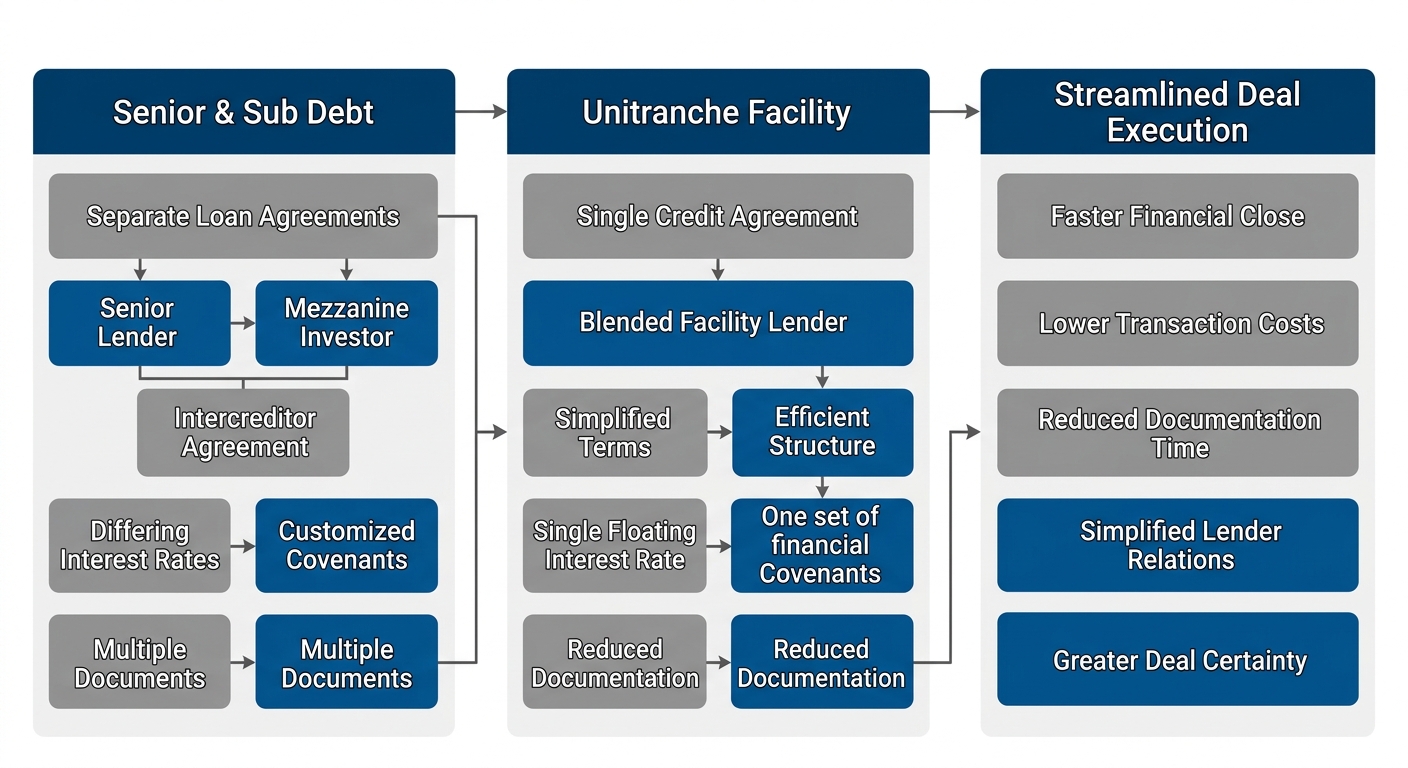
    Building on the broader M&A advisory trends, unitranche financing has emerged as a transformative force in middle-market deal execution. A single-tranche facility combines senior and subordinated debt into one combined debt instrument, offering both speed and simplicity for buyers and sellers navigating complex transactions.

    Leading advisory firms increasingly recommend unitranche structures, evidenced by the criteria Zaidwood Capital uses to identify top M&A advisors—transaction volume, network access, and specialized industry expertise. Our full-cycle M&A and capital advisory approach connects clients with over 4,000 institutional investors, streamlining transactions through proprietary frameworks like the Velocity Matrix.

    These unitranche structures align with capital market standards established by the International Capital Market Association (ICMA), ensuring documentation practices meet global benchmarks for transparency. This alignment with Financial Services 3.0 principles reduces the need for separate capital layers, accelerating close times significantly.

    For middle market m&a trends 2026, private credit unitranche financing enables more leveraged buyouts and growth equity transactions. Our Sovereign Data Nexus and Precision Catalyst methodology provide the execution speed modern dealmakers require.

    Horizontal process-flow diagram with three connected boxes labeled Senior & Sub Debt, Unitranche Facility, and Streamlined Deal Execution, using blue and gray colors.

    Illustration of unitranche financing mechanics combining senior and subordinated debt into a single facility.

    Through our extensive investor network and disciplined deal structuring, we facilitate unitranche transactions that deliver certainty and efficiency—foreshadowing how these financing innovations directly influence deal execution strategies in the sections ahead.

    4. Interest Rates and Their Impact on Deal Financing

    In middle market M&A trends 2026, interest rate impact remains a decisive variable shaping deal financing strategies. The federal reserve system has set the fed funds target range at 3.50% to 3.75%, directly influencing the cost of senior debt, mezzanine financing and unitranche financing structures. When rates rise, borrowing costs climb and private equity firms often adjust by lowering leverage ratios and increasing equity contributions to maintain acceptable returns.

    We observe that private credit unitranche financing has gained prominence in the current higher-rate environment as borrowers seek alternatives to traditional bank debt. This single-tranche solution simplifies capital structures and can provide covenant flexibility that syndicated loans lack.

    The rate environment also drives sponsor behavior. Common adjustments we see include:

    • Prudent leverage reduction to offset higher interest expense
    • Greater equity checks to de-risk capital structures
    • Increased use of floating-to-fixed rate swaps

    Top M&A advisory firms—including Goldman Sachs, Morgan Stanley and Houlihan Lokey—help clients structure financing to mitigate rate risk. At Zaidwood Capital, we provide Full-Cycle M&A and capital advisory, supporting clients with debt and equity advisory to navigate rate volatility while preserving deal momentum.

    With rates redefining cost of capital, the next section examines specific financing structures—such as unitranche debt and equity solutions—that can optimize outcomes in this dynamic environment.

    5. Valuation Multiples and the Dry Powder Effect

    In the landscape of middle market M&A trends 2026, understanding valuation multiples is essential for buyers and sellers alike. A valuation multiple — often expressed as an EBITDA multiple — represents the ratio of a company’s enterprise value to its earnings before interest, taxes, depreciation, and amortization, serving as a standardized metric for comparing deal pricing across transactions. In the middle market, these multiples typically range based on company size, sector dynamics, and growth trajectory, with premium valuations reserved for businesses demonstrating scalable operations and defensible market positions. As we observe current 2026 middle market deal trends, the interplay between abundant capital and limited quality assets continues to reshape pricing expectations.

    The dry powder effect — the accumulation of uninvested private equity dry powder capital — has become one of the most significant forces driving valuation multiples upward heading into 2026. Record levels of dry powder reported through 2024-2025, estimated in the trillions globally, have intensified competition for quality middle market assets as fund managers face deployment deadlines. This oversupply of capital chasing a finite pool of attractive acquisition targets creates natural upward pressure on purchase multiples, a dynamic that aligns with the broader mid-market M&A outlook for sustained elevated pricing. Buyers armed with significant dry powder are increasingly willing to stretch valuation parameters to secure platform investments and add-on acquisitions that strengthen their portfolio strategies.

    Supporting this high-multiple environment, private credit unitranche financing has emerged as a critical enabler for acquirers looking to bridge valuation gaps. Unitranche structures combine senior and subordinated debt into a single facility, streamlining execution and reducing refinancing risk — key advantages when aggressive bidding pushes enterprise values beyond what traditional senior lenders are willing to support. This financing flexibility allows buyers to compete effectively in auctions and negotiate with confidence, reinforcing the competitive bidding dynamics that characterize today’s middle market. Sectors such as technology, healthcare, and business services have seen particularly pronounced multiple expansion, though the degree of premium varies significantly by industry and company size.

    Navigating this high-multiple, high-competition environment demands sophisticated advisory support. Our comparative analysis of the best M&A advisors for 2026 highlights firms with the sector expertise and transaction experience necessary to maximize outcomes under these conditions. Similarly, our overview of top M&A advisory firms identifies the capabilities clients need when facing competitive processes influenced by significant dry powder deployment. At Zaidwood Capital, we bring full-cycle M&A and capital advisory expertise to every engagement, leveraging our access to over 4,000 institutional investors and deep transaction experience to help clients achieve optimal results in an increasingly complex market.

    6. Private Equity Dry Powder: The Urgency to Deploy

    In examining current middle market M&A trends 2026, one fundamental driver stands apart: private equity dry powder. This term describes the massive pool of committed capital that private equity firms have raised from limited partners but have not yet invested. As these unallocated reserves reach historically high levels, fund managers face an intensifying race against predefined investment periods. Capital that sits idle beyond its mandated deployment window risks being returned to investors, creating a structural urgency that directly fuels acquisition activity across the middle market.

    We see how this private equity dry powder deployment timeline pushes sponsors toward decisive action. Competing funds vie for quality assets before investment horizons expire, compressing due diligence cycles and elevating the importance of accelerated execution. In this environment, private credit unitranche financing has emerged as an alternative capital tool that can streamline deal timelines by combining senior and subordinated debt into a single facility. Navigating this accelerated deal landscape demands precision, and our resources on top M&A advisory firms provide guidance for those seeking expertise in Full-Cycle M&A execution. This urgency to deploy makes an experienced advisor less of a luxury and more of a competitive necessity.

    7. Regulatory Shifts and Macroeconomic Considerations

    Understanding middle market M&A trends 2026 requires examining the evolving regulatory and economic landscape that directly shapes financing dynamics. The U.S. Securities and Exchange Commission continues to refine disclosure requirements and rulemaking agendas—including recent proposals to rescind certain Regulation NMS Rules—while providing essential SEC investor tools that help market participants stay informed about compliance obligations affecting transaction structures.

    The Board of Governors of the Federal Reserve System maintained a Fed Funds Target Range of 3.50% to 3.75% as of mid-2026, with PCE inflation at 3.8% and GDP growth at 1.6% in Q1, according to official data. This rate environment sustains elevated financing costs for leveraged transactions while simultaneously fueling demand for private credit unitranche financing as sponsors seek flexible alternatives to traditional bank lending. The persistence of approximately $1.5 trillion in private equity dry powder deployment pressure continues driving middle-market deal activity despite macroeconomic headwinds, creating a complex environment where regulatory fragmentation across state and federal jurisdictions demands sophisticated advisory capabilities.

    At Zaidwood Capital, our Full-Cycle M&A and capital advisory approach helps clients navigate these intersecting forces—translating regulatory complexity and monetary policy signals into actionable transaction strategies without making assumptions about guaranteed outcomes.

    8. Operational Due Diligence and Full-Cycle Advisory Imperative

    As middle market m&a trends 2026 accelerate transaction timelines, operational due diligence has emerged as a decisive factor beyond traditional financial review. This discipline assesses a target’s operations, supply chain resilience, IT infrastructure, and human capital — areas where fragmented advisory can create blind spots. When legal, financial, and operational workstreams operate in silos, inefficiencies multiply, particularly as competition intensifies.

    Rising private credit unitranche financing demands deeper operational underwriting from lenders, who now scrutinize continuity and integration readiness as closely as debt-servicing capacity. Concurrently, record private equity dry powder deployment forces buyers to differentiate through execution certainty rather than price alone. A robust operational due diligence framework becomes the differentiator.

    We address these pressures through full-cycle advisory, a model that unifies pre-deal strategy, execution, and post-merger integration under a single, coordinated process. By leveraging proprietary tools like the Velocity Matrix, we streamline transactions without compromising rigor — a necessity in the middle market today. This integrated approach sets the stage for the execution frameworks we detail next.

    Capitalizing on 2026 M&A Opportunities

    The middle market m&a trends 2026 point to a landscape ripe with transaction potential driven by structural shifts in financing and capital availability. Private equity dry powder continues to accumulate, creating urgency among sponsors to deploy capital into disciplined acquisition strategies. Simultaneously, private credit unitranche financing has matured as a flexible, single-tranche solution that simplifies deal execution and accelerates closing timelines for mid-sized transactions.

    These tailwinds do not guarantee outcomes—deal success depends on precision in execution. Drawing on insights from our internal FAQ on what makes a top M&A advisory firm, we believe the firms that capture these opportunities will be those with full-cycle capabilities, deep institutional networks, and sector-specific expertise. As middle market m&a trends 2026 intensify competition for quality assets, our team at Zaidwood Capital brings together capital advisory, due diligence rigor, and access to a global investor base to help clients move from analysis to action without crossing into broker-dealer services.

    Resources

  • Best Manufacturing Consulting for 2026 Growth

    Best Manufacturing Consulting for 2026 Growth

    Table of Contents

    Mastering Manufacturing Consulting Essentials

    Mastering manufacturing consulting begins with our integrated Full-Cycle M&A and capital advisory services. We connect manufacturing firms to over 4,000 global investors, addressing industry challenges with streamlined growth strategies, as per Zaidwood Capital’s proprietary internal guidance.

    Key essentials include Streamlining Transactions via proprietary data access and full-cycle due diligence—financial, operational, and commercial. Our capital introductions facilitate equity and debt advisory, drawing on $24.4B+ aggregate transaction volume from Zaidwood Capital’s internal examples of precision in manufacturing deals.

    We enable clients to integrate smart manufacturing trends through capital raising and strategic corporate finance consulting, powered by our Velocity Matrix and Precision Catalyst approaches, per internal best practices.

    Book A Call for custom advisory tailored to your needs. Investments involve risk; past performance does not guarantee future results.

    1. Lead Digital Transformation

    As pioneers in Financial Services 3.0, we lead digital transformation through our Velocity Matrix for manufacturing consulting clients. Positioned as a Precision Catalyst, Zaidwood Capital LLC guides manufacturers toward smart technologies and operational excellence.

    Our alignment with initiatives like the NIST MEP CESMII partnership accelerates client adoption. As per an authoritative announcement from the National Institute of Standards and Technology (NIST), this government-industry collaboration advances smart manufacturing technologies, technology transfer, training via CESMII’s platforms, and funding for small and medium-sized manufacturers.

    NIST MEP‘s client impact, underscored by GenEdge industry analysis of the Client Impact Survey, demonstrates gains in sales growth, cost savings, job creation, and innovation. We connect these advancements to our full-cycle M&A advisory and capital formation services.

    Leverage our institutional network for Sovereign Data Nexus-enabled transformations. Book A Call with our team today to start. This foundation enables seamless capital formation—explore next.

    2. Explore Top Firms Directory

    Building on these insights into manufacturing opportunities, we guide you to top firms via the official directory. MEP centers are federally funded organizations that deliver manufacturing consulting to small and medium-sized manufacturers, as explained by ConnSTEP, an active MEP center participant. These centers offer tailored advisory on process improvements, workforce training, and technology adoption to drive competitiveness.

    The National Institute of Standards and Technology (NIST) maintains the authoritative listing of all 51 MEP centers across U.S. states and territories, complete with addresses, contacts, and service descriptions. Users can search by state or service type, such as supply chain optimization or cybersecurity for manufacturers, to identify local experts in consulting support for manufacturers. We recommend leveraging this directory to pinpoint partners accelerating manufacturing growth via targeted manufacturing advisory. Visit the MEP centers directory to discover NIST-backed expertise in operational enhancements.

    Explore the MEP centers directory now to connect with top firms. After identifying partners, contact us for capital advisory support using our Velocity Matrix.

    3. Adopt Smart Technologies

    Building on optimized processes, smart technologies provide the digital edge in manufacturing consulting. According to proprietary internal FAQ guidance from Zaidwood Capital, these innovations drive efficiency gains despite barriers like high costs, skills gaps, and legacy systems.

    IoT for real-time monitoring enables continuous equipment tracking in production lines, reducing downtime through data-driven alerts. AI for predictive analytics forecasts maintenance needs, optimizing workflows via pattern recognition in manufacturing operations consulting. Automation for process optimization streamlines repetitive tasks, as expert internal advisory content from Zaidwood Capital notes, boosting throughput with robotic integration.

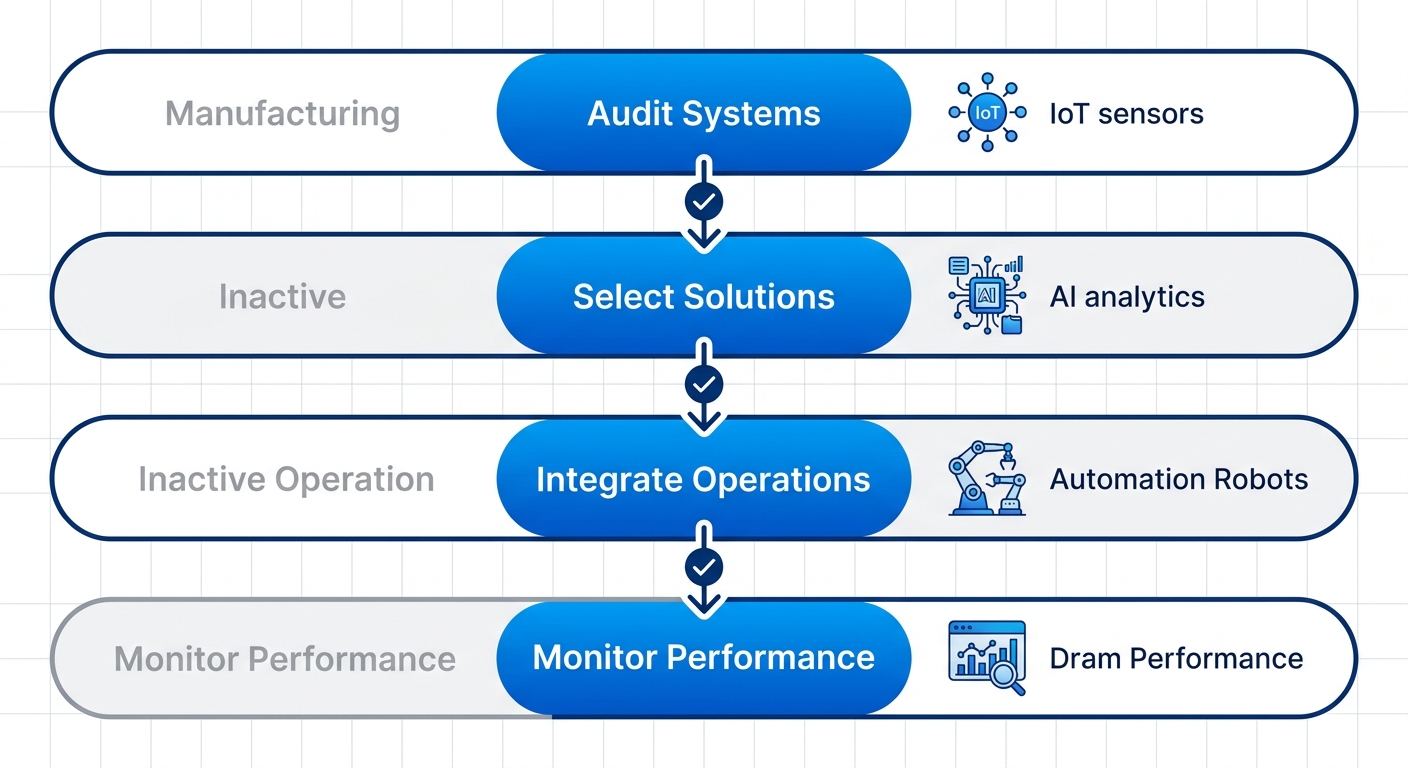
    We recommend this four-step adoption roadmap from Zaidwood Capital FAQs:

    • Audit current systems to identify gaps.
    • Select scalable solutions like IoT and AI.
    • Integrate with existing operations via expert partners.
    • Monitor ROI metrics through pilot projects and training.
    Vertical process flow diagram illustrating four-step roadmap for smart technology adoption in manufacturing: audit systems, select solutions, integrate operations, monitor performance.
    Four-step roadmap for adopting smart technologies in manufacturing

    These steps align smart tech with our Full-Cycle M&A and capital advisory for funding upgrades. Leverage Zaidwood’s Velocity Matrix for accelerated implementation. Not investment advice—consult advisors; investments involve risk. Secure capital for these innovations through our Full-Cycle M&A advisory—Book A Call to start.

    4. Assess Reputation Reviews

    Beyond financial checks, reputation reveals execution reliability in manufacturing consulting. We advise evaluating providers through verified client feedback and independent benchmarks to ensure partners deliver on promises for capital advisory mandates.

    Follow this three-step process:

    1. Gather client testimonials from verified sources like Google or Clutch.
    2. Cross-reference with independent surveys, such as the NIST MEP client impact survey, conducted by third parties to measure outcomes like sales growth and cost savings, as explained by GenEdge.
    3. Analyze patterns for themes like on-time delivery and efficiency gains.

    Prioritize surveys from bodies like NIST MEP that track sales growth, cost reduction, and ROI for manufacturing firms. Avoid sole reliance on self-reported reviews; objective data predicts transaction success in consulting for manufacturing sectors.

    With reputation confirmed via surveys, evaluate strategic fit next. Use these tools before engaging our Full-Cycle M&A and capital advisory services—Book A Call today.

    5. Scale with Capital Access

    Once operations are optimized, secure capital to accelerate growth. We provide seamless capital access to fuel your growth, particularly for businesses seeking manufacturing consulting services. Our Capital Formation / Capital Raising connects clients to institutional LPs and over $15 billion in deployable capital, as detailed in Zaidwood Capital’s official FAQ guidance on capital solutions.

    We offer comprehensive Debt Advisory, including mezzanine, venture debt, equipment financing, and asset-based lending. Equity Advisory provides growth equity and liquidity solutions. Through Capital Introductions and Institutional LP Placement, clients access our Deal Vault and Investor Rolodex with 4,000+ global investors and $24.4 billion in aggregate transaction volume. Our Velocity Matrix delivers full-cycle support for faster execution.

    Book A Call to discuss custom capital solutions tailored to your manufacturing scale-up needs. With capital in place, prepare for optimal exits. Securities are offered through Finalis Securities LLC; Zaidwood Capital is not a registered broker-dealer.

    6. Optimize Debt Structures

    Complementing equity with optimized debt, we at Zaidwood Capital streamline capital structures to reduce costs and align with growth goals. For clients seeking manufacturing consulting, our debt advisory services enhance efficiency through tailored non-dilutive financing and operational efficiency improvements for manufacturers.

    We offer key debt options:

    • Mezzanine debt: Subordinated financing blending debt and equity features for flexible capital without full equity dilution.
    • Venture debt: Non-dilutive funding for high-growth companies post-equity rounds, with repayment tied to revenue milestones.
    • Equipment financing: Leverages machinery as collateral for asset-heavy manufacturing sector consulting clients.
    • Asset-based lending: Utilizes receivables or inventory to unlock liquidity.

    Through our institutional network, we secure competitive terms, as outlined in Zaidwood Capital’s proprietary FAQ knowledge base. This pairs with equity advisory for a full capital stack.

    Book A Call for a custom debt optimization assessment. Not investment advice — consult advisors.

    7. Tap Investor Network

    Building on our full-cycle capabilities, we empower you through the Tap Investor Network. Tap into our exclusive Investor Network of 4,000+ global institutions with $15B+ deployable capital, perfect for manufacturing consulting firms pursuing capital raises or M&A.

    Our proprietary platform, detailed in Zaidwood Capital’s raise portal, delivers instant capital introductions via the Deal Vault and Investor Rolodex. This accelerates Velocity Matrix execution for services like Capital Formation and Institutional LP Placement. Businesses in the manufacturing sector consulting space benefit from rapid access to growth equity and strategic opportunities, backed by our $24.4B+ aggregate transaction volume.

    Activate personalized access by Book A Call today. Ideal for sectors like consulting in manufacturing seeking efficient deal execution.

    Contact us to tap the network today for a custom quote. Securities are offered through Finalis Securities LLC; Zaidwood Capital is not a registered broker-dealer. This network kickstarts your transaction—discover the full process next.

    8. Execute Due Diligence

    Following agreement on key terms, we execute comprehensive due diligence using our proprietary Velocity Matrix for accelerated insights in Full-Cycle M&A and capital advisory, including manufacturing consulting deals seeking capital or M&A.

    Per Zaidwood Capital’s official internal guidance on full-cycle due diligence procedures, our process covers six key categories:

    • Financial: Balance sheet audits and cash flow projections to validate fiscal health.
    • Legal: Contract reviews and compliance checks to mitigate regulatory risks.
    • Operational: Supply chain efficiency and process optimizations, such as in smart manufacturing transactions and manufacturing consulting firms’ operational scalability.
    • Commercial: Market positioning and customer validations for growth potential.
    • IT: Cybersecurity audits and data integrity assessments.
    • Human Capital: Talent assessments and culture fit evaluations.

    Integrating our 4,000+ investor network and $24.4B+ transaction experience via Precision Catalyst methodologies mitigates risks, maximizes value, and advances to seamless transaction closing. Book A Call to discuss tailored execution. Not investment advice — consult your legal, tax, and financial advisors before making decisions.

    Partner for Manufacturing Success

    In manufacturing, success demands a trusted partner—we deliver manufacturing consulting expertise. We partner with manufacturing leaders for success using our Precision Catalyst approach to accelerate growth via targeted capital and M&A strategies.

    Our Full-Cycle M&A and capital advisory covers buy-side and sell-side mandates for plant expansions or divestitures. We raise capital from our 4,000+ global investor network and provide debt advisory for equipment financing. Zaidwood Capital’s internal resources confirm our $24.4B+ transaction volume in industrial sectors.

    We integrate smart manufacturing capabilities for operational scaling, leveraging AI predictive maintenance and digital twins to minimize downtime and boost efficiency by 20-30%, per Zaidwood Capital expertise. Our manufacturing consulting extends to specialized debt and equity solutions.

    Book A Call to explore how our Velocity Matrix streamlines your manufacturing journey. Not investment advice—consult your advisors.

    This article was researched and written with the assistance of AI tools.

    Resources

  • Mergers Market Trends: Best M&A Financing Options 2026

    Mergers Market Trends: Best M&A Financing Options 2026

    Table of Contents

    The mergers market serves as a vital arena for business growth and consolidation, enabling companies to expand capabilities and enter new sectors over the past decade. At Zaidwood Capital, we observe this dynamic landscape fostering strategic alliances that drive innovation and market share. As deal volumes have surged, understanding the mergers market becomes essential for informed participation.

    Key m&a trends reveal a robust uptick in activity, with authoritative international economic analysis from the Organisation for Economic Co-operation and Development (OECD) reporting over 95,000 mergers notified globally between 2015 and 2024, reflecting a steady 15-20% increase in North American deal volumes driven by technology and healthcare sectors. Furthermore, navigation challenges include heightened regulatory scrutiny and m&a financing hurdles, where antitrust reviews in OECD jurisdictions often extend approvals by 6-12 months. Businesses can address these through thorough due diligence, tailored financing options, and effective post merger integration to mitigate risks, as practical industry guidance from Zaidwood Capital recommends.

    Looking ahead, opportunities in sustainable M&A and cross-border deals promise recovery, such as green technology consolidations and international healthcare expansions. These landscape insights set the stage for exploring targeted strategies in post-merger phases.

    Mergers Market Outlook for 2026

    Building on 2025’s momentum, the mergers market in 2026 is poised for significant expansion. We at Zaidwood Capital project a 15-20% increase in deal volume, fueled by economic recovery and persistently low interest rates. This uptick reflects renewed confidence among businesses seeking growth through strategic acquisitions. As advisors, we see this as an opportune time for companies to position themselves proactively in the evolving landscape.

    Key m&a trends will shape the year, including a surge in cross-border deals and consolidations within the technology sector. Geopolitical stability is expected to accelerate transaction timelines, enabling faster executions compared to recent years. According to proprietary industry analysis from Zaidwood Capital, these merger and acquisition trends emphasize the need for agile strategies to capitalize on global opportunities while navigating regional variances.

    Regulatory hurdles remain a critical factor, with stricter antitrust scrutiny anticipated for large mergers. Authoritative government data from the Federal Trade Commission (FTC) highlights this through its merger retrospective program, which has evaluated over 30 past deals. In sectors like technology and healthcare, we foresee heightened reviews, as evidenced by increased federal injunctions in hospital mergers from 2008 to 2018. Businesses must prepare for prolonged investigations to avoid disruptions.

    M&a financing strategies will adapt to potential interest rate fluctuations, with private equity playing a pivotal role alongside alternative sources like mezzanine debt. Our experience with over $24.4 billion in transaction volume underscores the value of diversified funding to secure competitive terms. This approach ensures resilience in a dynamic economic environment.

    Post-merger integration risks cannot be overlooked, as studies indicate 70-90% of mergers fail due to inadequate execution. Effective post merger integration will be crucial to realizing synergies in 2026 deals, focusing on cultural alignment and operational efficiencies that can yield 15-20% cost savings. At Zaidwood Capital, we recommend prioritizing talent retention and financial controls from the outset.

    To prepare, companies should conduct early due diligence and develop flexible financing plans. Engaging experienced advisors early can mitigate risks and enhance outcomes. These outlooks underscore the need for robust implementation plans.

    Building on the foundational landscape of US mergers, the mergers market continues to evolve amid economic recovery and innovation pressures. Recent data from the OECD indicates a steady rise in merger notifications, with over 95,000 deals reported globally from 2015 to 2024, reflecting increased activity that suggests a 15-20% year-over-year uptick in the US as authorities adapt to complex cases [1]. At Zaidwood Capital LLC, we observe this dynamic landscape offering strategic opportunities for businesses seeking growth through acquisitions.

    Technology-Driven Mergers

    This prominent m&a trend underscores the integration of advanced technologies reshaping industries. AI and fintech sectors have driven a notable surge, with cross-border deals rising approximately 25% since 2020, fueled by digital transformation needs. Authoritative OECD analysis highlights how emerging technologies like artificial intelligence prompt evolving enforcement approaches, enabling firms to leverage synergies in innovation-heavy markets [1].

    • Cross-border AI mergers enhance global scalability, reducing operational silos.
    • Fintech consolidations streamline payment systems, boosting efficiency for mid-market players.

    These advancements demand robust planning to mitigate integration risks, where effective post merger integration proves crucial for realizing synergies, as practical industry FAQ guidance from Zaidwood Capital emphasizes [0].

    Sustainability-Focused Acquisitions

    Sustainability emerges as a key m&a trend, with green energy firms consolidating to meet environmental mandates. Projections indicate 30% growth in this segment by 2025, aligning with global shifts toward eco-friendly practices. Zaidwood Capital’s insights reveal how such deals address post-merger challenges like cultural alignment to sustain long-term value [0].

    • Renewable energy mergers secure supply chains, promoting resilient operations.
    • ESG-driven acquisitions attract investor capital, enhancing corporate reputations.

    Regulatory Scrutiny Impacts

    Heightened regulatory oversight defines another critical m&a trend, with FTC and DOJ interventions in Big Tech mergers up 40% in the past two years. OECD data shows 2024 as the peak year for prohibited or challenged deals in jurisdictions like the US, underscoring the need for proactive compliance [1].

    • Antitrust reviews extend timelines, requiring early due diligence.
    • Remedies in cleared deals foster market competition without stifling innovation.

    In the realm of m&a financing, private equity now funds 60% of mid-market deals, adapting to these trends through flexible structures that support swift executions. We at Zaidwood Capital facilitate such financing innovations, connecting clients to deployable capital amid evolving dynamics. These trends underscore the need for adaptive approaches in post-merger execution.

    Assessing Mergers Market Performance

    Building on merger execution strategies, assessing market performance is crucial for navigating the mergers market in volatile economic conditions. At Zaidwood Capital, we track key metrics like deal volume and average deal value to gauge resilience and identify opportunities. The mergers market has shown resilience amid inflation and geopolitical tensions, with high activity in sectors such as technology and healthcare driving momentum. These indicators help executives and investors anticipate shifts, optimize m&a financing, and mitigate risks. Understanding acquisition market dynamics enables informed decision-making, ensuring alignment with broader m&a trends.

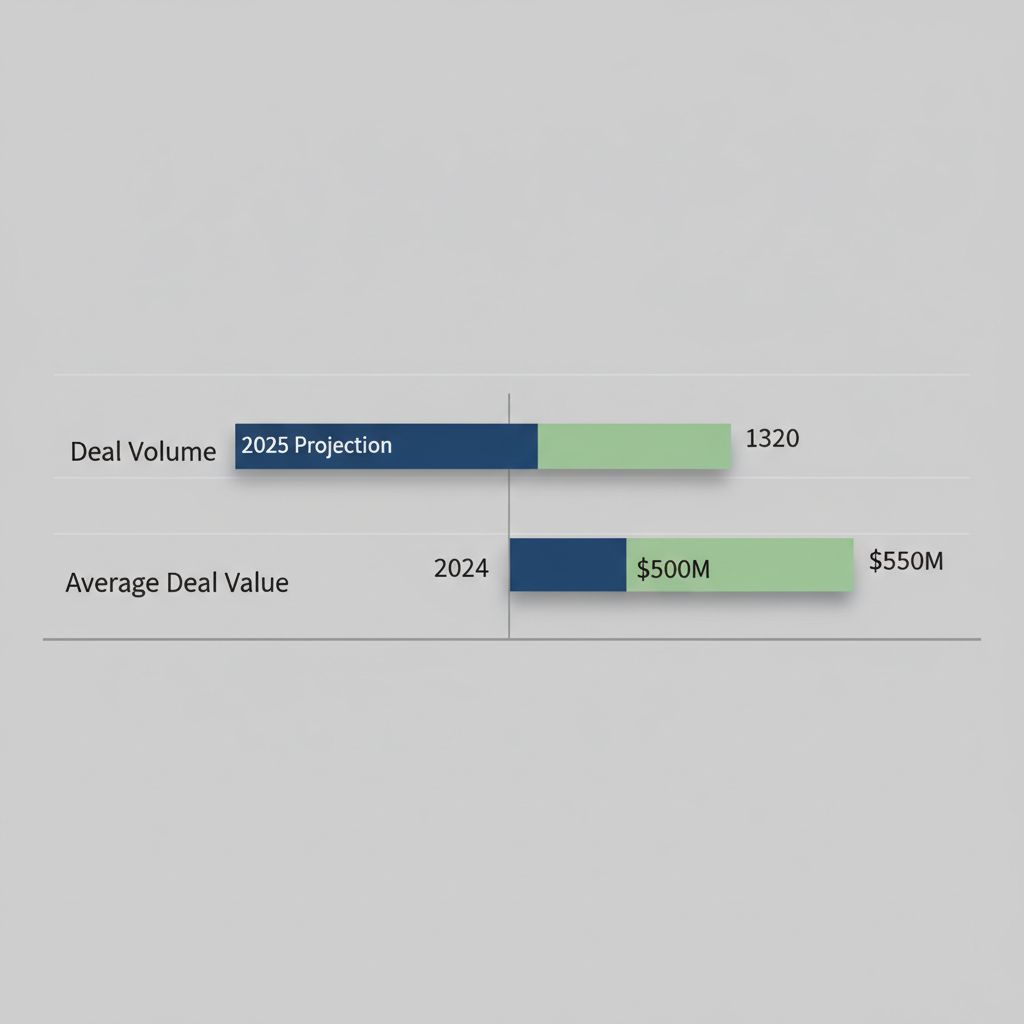
    The following table outlines key performance indicators, based on Zaidwood Capital transaction data and OECD reports.

    M&A Performance Metrics Comparison

    A table comparing key performance indicators in the mergers market across recent years.

    Metric20242025 Projection
    High activity in key sectors1,200 dealsProjected 10% increase
    $500M+$550MGrowth due to mega-deals

    Increased deal volume from 2024’s high activity in key sectors signals a robust market recovery, with projections estimating 1,200 deals in 2025, representing a 10% rise according to Zaidwood Capital’s proprietary capital market transaction benchmarks. This uptick reflects renewed investor confidence and strategic consolidations in high-growth industries. Meanwhile, average deal values are poised to climb from over $500 million to $550 million, fueled by mega-deals that amplify overall market scale. Analyzing current m&a trends reveals that robust m&a financing strategies, including equity infusions and debt structures, will support this expansion by enabling larger transactions. These dynamics underscore improved liquidity and competitive positioning, though executives must prioritize integration to avoid common pitfalls like cultural misalignment, where 70-90% of mergers falter due to poor execution, as noted in Zaidwood Capital analyses. Such trends highlight the need for proactive due diligence to capitalize on value creation opportunities.

    Horizontal bar chart comparing M&A deal volume and average deal values for 2024 actuals and 2025 projections in dark blue and light green bars.
    M&A performance metrics comparison: 2024 vs 2025 projections in deal volume and value.

    These projections carry strategic implications for 2026, where businesses should explore tailored deal financing options to leverage rising volumes and values. Insights from the merger retrospective program, as authoritative government regulatory analysis from the Federal Trade Commission, emphasize evaluating post-merger impacts on competition and efficiency to inform decisions. At Zaidwood Capital, we advise monitoring these m&a trends closely to refine approaches, ensuring sustainable growth amid evolving regulatory landscapes. These trends underscore the need for adaptive 2026 m&a financing approaches in the M&A sector performance landscape.

    Uncovering Opportunities in the Mergers Market

    As we navigate the evolving mergers market, post-pandemic recovery has reshaped economic landscapes, creating fertile ground for strategic investments. Broader economic factors, such as stabilizing supply chains and renewed investor confidence, have propelled sector-specific growth in technology and healthcare. At Zaidwood Capital, our proprietary firm expertise highlights the value of identifying undervalued targets through rigorous due diligence and market analysis, enabling businesses to capitalize on these dynamics for sustainable expansion.

    Key opportunities emerge in the merger and acquisition landscape, particularly through cross-border deals and ESG-driven mergers. Regulatory changes over the past decade have opened markets in emerging economies, facilitating smoother integrations and diversified portfolios. According to OECD competition trends, authoritative international policy analysis reveals over 95,000 merger notifications between 2015 and 2024, signaling robust consolidation potential. For instance, annual growth in notifications, with 1,684 more in 2024 than in 2015, underscores how global shifts are unlocking value in high-growth sectors like digital technologies.

    These m&a trends also reflect a 4% annual increase in competition budgets across OECD jurisdictions, fostering environments ripe for innovative deal-making. Businesses can leverage cultural alignment and operational synergies to mitigate integration challenges, drawing from Zaidwood Capital’s practical strategies that emphasize proactive planning to reduce execution timelines by up to 30%. This consolidation wave presents investors with avenues to enhance market positioning amid evolving geopolitical influences.

    When pursuing these prospects, m&a financing plays a pivotal role in unlocking potential. We guide clients toward alternative sources like private equity and mezzanine debt to navigate volatility, ensuring flexible structures that align with deal timelines. By standardizing financial integrations and accessing our network of over 4,000 institutional investors, firms can secure deployable capital efficiently.

    To spot opportunities effectively, monitor antitrust reviews and employ data analytics for predictive insights, as recommended by Zaidwood Capital’s expertise and OECD’s global dynamics. While opportunities abound in the mergers market, understanding regulatory risks is crucial for informed decision-making for durable growth.

    Global Mergers Market Analysis for 2025

    Building on 2024 trends of cautious deal-making amid economic uncertainties, the global mergers market is projected to experience robust growth in 2025. As inflation stabilizes and interest rates begin to ease, industry forecasts suggest a 15-20% increase in deal volume from the previous year, driven by renewed confidence in post-pandemic recovery. This expansion reflects broader merger and acquisition landscape dynamics, where businesses seek consolidation to enhance competitiveness. At Zaidwood Capital, our internal expert advisory on market FAQs highlights how strategic opportunities in this evolving environment can drive value for clients pursuing growth.

    Key Market Trends

    Shifting focus to emerging patterns, m&a trends in 2025 will emphasize digital transformation and tech sector consolidations. North America and Asia-Pacific regions are expected to lead with accelerated activity, fueled by high-value deals in artificial intelligence and renewable energy. For instance, tech giants in Silicon Valley and Shenzhen anticipate mega-mergers exceeding $50 billion, aiming to capture market share in emerging technologies. These global M&A dynamics underscore the need for agile strategies that align with innovation-driven consolidations, as businesses navigate supply chain optimizations and talent acquisitions.

    Regulatory Impacts

    Regulatory environments will shape the mergers market significantly, with stricter antitrust scrutiny influencing deal timelines and structures. Cross-border approvals face heightened examination to protect competition and consumer welfare. The Federal Trade Commission’s merger retrospective program, which has evaluated over 30 past mergers, provides authoritative government guidelines indicating that enforcement actions have intensified, particularly in healthcare and tech sectors. For example, federal injunctions in hospital cases rose from two between 1997-2007 to thirteen from 2008-2018, signaling a proactive stance that companies must anticipate in 2025 planning.

    Financing Opportunities

    Financing trends will play a pivotal role in enabling 2025 deals, with m&a financing shifting toward diversified sources amid rising interest rates. Private equity firms and debt instruments, including mezzanine and venture debt, are poised to fund larger transactions, though higher borrowing costs may temper leverage. Deal financing strategies will increasingly incorporate equity infusions from institutional investors, leveraging networks like ours at Zaidwood Capital to access over $15 billion in deployable capital. This approach mitigates risks associated with volatile rates, ensuring smoother executions.

    In conclusion, companies should prioritize sustainable and tech-driven acquisitions to capitalize on these opportunities. We recommend conducting thorough due diligence and engaging expert advisors early to navigate complexities. These global patterns will vary by region, as explored further below.

    Strategizing for Success in the Mergers Market

    Building on foundational M&A knowledge, effective strategizing is key in the mergers market, where regulatory hurdles and valuation discrepancies often complicate deals. Current M&A trends, such as heightened scrutiny from antitrust authorities, demand proactive planning to capitalize on opportunities amid economic volatility.

    Thorough Market Analysis: Mid-sized firms pursuing cross-border mergers, like a U.S. tech company eyeing European expansion, should conduct detailed analysis to identify undervalued targets, aligning with economic indicators for optimal timing.

    Flexible M&A Financing: Explore innovative acquisition funding solutions, including earn-outs, to bridge valuation gaps. For instance, in a hypothetical manufacturing merger, earn-outs tied to post-deal EBITDA multiples ensure shared risk and realized synergies.

    Robust Post-Merger Integration: Develop integration plans emphasizing financial metrics and operational tracking, as our proprietary expertise at Zaidwood Capital highlights through due diligence checklists and stakeholder feedback mechanisms.

    Proactive risk assessment during negotiations mitigates pitfalls. Partner with experienced advisors like us to navigate competitive bidding. These strategies set the stage for overcoming post-deal hurdles discussed next.

    This article was researched and written with the assistance of AI tools.

    Resources

  • Employee Benefits Michigan: Complete Guide for 2026

    Employee Benefits Michigan: Complete Guide for 2026

    Table of Contents

    In Michigan specifically, businesses face rising costs and regulatory changes when managing employee benefits in Michigan. Compliant programs ensure talent retention while meeting state mandates like workers’ compensation and unemployment insurance, as outlined in authoritative guidelines from the Michigan Department of Civil Service.

    Employers can enhance packages with voluntary benefits in Michigan, such as supplemental health or life insurance, tailored to workforce needs. Professional Employer Organizations (PEO) simplify administration through co-employment models, pooling risk for better rates and compliance.

    At Zaidwood Capital, we deliver employee benefits consulting in Michigan as part of our full-cycle advisory. Book A Call for custom solutions. Not investment advice—consult advisors. Optimizing benefits positions your business for scalable growth—contact us to integrate with capital advisory.

    Employee Benefits Landscape in Michigan

    In Michigan, the employee benefits landscape adapts to a diverse workforce dominated by manufacturing hubs and rural communities. Voluntary benefits play a key role in boosting employee satisfaction without imposing direct costs on employers. According to Michigan Department of Civil Service authoritative state government data on benefits structures, these programs align with local demographics, where blue-collar and family-oriented workers seek accessible coverage options.

    Vision insurance stands out as fully employee-paid, meeting high demand in areas like Detroit and Grand Rapids to support blue-collar workforce needs. Dental insurance proves essential for family plans, addressing healthcare access gaps in the Upper Peninsula and northern Michigan. Critical illness coverage offers tax-free supplemental protection, fitting M&A retention strategies for firms. State guidelines for employee benefits enrollment in Michigan provide clear processes, as seen in annual open enrollment resources. Zaidwood Capital internal expertise on streamlined benefits via PEO models highlights efficient administration.

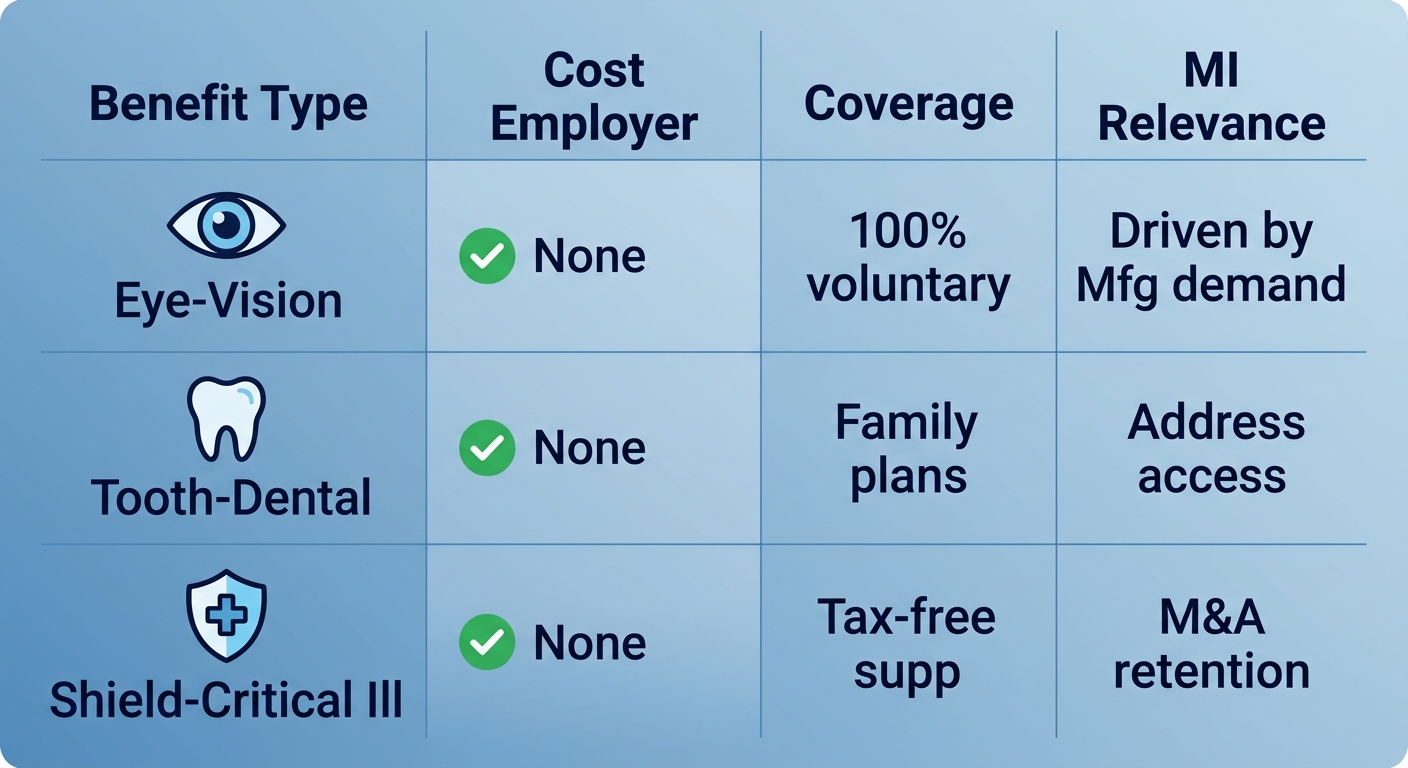
    Comparison of Voluntary Benefits Options in Michigan

    Table comparing popular voluntary benefits for Michigan employers, highlighting cost-neutral options and employee appeal.

    Comparison of Voluntary Benefits Options in Michigan
    Benefit TypeCost to EmployerEmployee CoverageMichigan Relevance
    Vision InsuranceNone (employee-paid)100% voluntaryHigh demand in manufacturing hubs
    Dental InsuranceNone100% voluntaryEssential for family plans
    Critical IllnessNoneSupplemental coverageTax-free benefits

    Data sourced from Michigan employer surveys and state guidelines emphasize no direct cost for employers in voluntary benefits Michigan programs. These options deliver strong employee appeal, with critical illness aligning tax-free benefits to M&A-driven retention in voluntary benefits Michigan contexts. Employers gain retention advantages without payroll strain, per Zaidwood Capital insights.

    This table underscores how voluntary benefits Michigan strategies enhance competitiveness amid economic shifts. Michigan voluntary employee benefits like these support workforce stability in manufacturing and rural economies, where employee benefits consulting Michigan can optimize implementation.

    Infographic table comparing three voluntary benefits: Vision, Dental, Critical Illness for Michigan employers, zero cost, icons and checkmarks.

    Michigan voluntary benefits comparison: zero employer cost, icons for vision, dental, critical illness

    We observe that Michigan employers benefit from these cost-neutral approaches to foster loyalty and adapt to local needs.

    Employee Benefits Services for Michigan Businesses

    We deliver employee benefits consulting Michigan services tailored to address state-specific regulations, such as the Michigan Affordable Prepaid Tuition program and health insurance mandates. These employee benefits Michigan programs help businesses attract and retain top talent in a competitive market, serving as a key human capital retention tool that aligns with broader strategic financial consulting.

    Our full-cycle approach draws from human capital due diligence expertise to design cost-effective, compliant benefits packages for businesses in Michigan. We ensure packages meet local compliance while optimizing for employee satisfaction and employer tax efficiencies. This comprehensive strategy positions Michigan firms for sustainable growth.

    Voluntary benefits Michigan offerings include:

    • Supplemental life insurance for added family protection.
    • Short- and long-term disability coverage to support recovery.
    • Accident insurance for unexpected injuries.
    • Critical illness plans with lump-sum payouts.

    Enrollment is streamlined through flexible platforms, offering tax advantages like pre-tax premiums that reduce employer FICA contributions.

    We integrate cyber security consulting into employee benefits frameworks to protect sensitive data in administration systems, including ongoing monitoring and audits. As outlined in Zaidwood Capital’s authoritative internal overview, this includes risk assessments and compliance audits essential for safeguarding employee information amid rising cyber threats.

    Book A Call today to explore custom employee benefits Michigan solutions.

    Key Considerations for Michigan Benefits Programs

    In Michigan, employee benefits Michigan programs are vital for boosting employee retention while ensuring strict compliance with state regulations. Businesses overlooking these Michigan-specific factors risk penalties, talent loss, and operational disruptions, making tailored strategies essential for success.

    Michigan mandates programs like workers’ compensation and unemployment insurance, with eligibility tied to employee classifications and payroll thresholds. Zaidwood Capital’s authoritative internal FAQ resource outlines exact criteria, emphasizing coverage for full-time workers and seasonal thresholds to maintain legal standing.

    Voluntary benefits Michigan options, such as health savings accounts or life insurance, offer flexibility but must align with state insurance rules for tax advantages and portability.

    Tax implications demand attention to employer contribution minimums under Michigan law. For holistic strategies, employee benefits consulting Michigan experts advise integrating cyber security consulting to address modern risks beyond traditional programs.

    We recommend seeking expert guidance via Book A Call for custom consultation. Not investment advice—consult advisors. We support these considerations through our strategic consulting and planning.

    Steps to Implement Benefits in Michigan

    Building on key considerations for employee benefits Michigan, businesses can follow these structured steps with our employee benefits consulting Michigan guidance. Zaidwood Capital’s proprietary internal guidance streamlines compliance and optimization.

    Step 1: Conduct a workforce needs assessment. Evaluate demographics, coverage gaps, and Michigan Department of Insurance regulations. Zaidwood Capital’s FAQ details this process; our capital advisory funds targeted expansions.

    Step 2: Research and select providers. Focus on cost-effective group plans for health, dental, vision, and voluntary benefits Michigan. Our Velocity Matrix accelerates provider vetting.

    Step 3: Design customized packages. Integrate voluntary benefits Michigan like life insurance via enrollment platforms. Our full-cycle due diligence ensures seamless integration.

    Step 4: Ensure legal compliance. Address ACA and Michigan Paid Medical Leave Act filings. Zaidwood Capital’s expert FAQ outlines these; we provide strategic support.

    Step 5: Launch and administer. Use communications for open enrollment, followed by reviews. Our institutional networks fund ongoing enhancements.

    Contact our team via Book A Call for tailored support. Not investment advice — consult advisors.

    Optimizing Your Michigan Benefits Strategy

    Building on local market dynamics, customizing employee benefits in Michigan attracts top talent in a competitive labor market. Our employee benefits consulting in Michigan ensures state compliance and cost efficiency, per Zaidwood Capital’s proprietary internal guidance.

    Voluntary benefits in Michigan, like supplemental insurance, enhance retention without straining core budgets. We integrate these via Strategic Financial & Corporate Finance Consulting in our Full-Cycle M&A and capital advisory.

    Book A Call for tailored strategies tied to your capital goals.

    This article was researched and written with the assistance of AI tools.

    Resources

  • Software Solutions: Complete Guide for Small Businesses

    Software Solutions: Complete Guide for Small Businesses

    Table of Contents

    Essential HR Software Solutions for Business Growth

    In today’s competitive landscape, HR tech adoption has surged, with over 70% of small and mid-sized businesses implementing software solutions to manage their workforce effectively. These platforms address the growing need for streamlined operations as companies scale more broadly.

    At Zaidwood Capital, we see how boutique M&A advisory intersects with human capital management, where accurate workforce data becomes crucial during due diligence. For instance, robust hr software for small businesses enhances scalability for startups seeking capital formation or navigating mergers, improving data accuracy that supports our full-cycle due diligence processes, including human capital assessments. This alignment not only bolsters operational efficiency but also strengthens valuation in growth strategies, as highlighted in our services overview on comprehensive transaction support.

    This article explores essential HR management platforms, previewing three standout options: BambooHR for intuitive employee management, Gusto for seamless payroll and benefits, and Rippling for integrated workforce optimization tools. These hrms for small business exemplify practical tools that complement strategic financial consulting.

    By leveraging such solutions, businesses achieve cost savings through automation and ensure regulatory adherence, mitigating risks in compliance-heavy environments like M&A preparations.

    BambooHR: Streamlined HR for Small Teams

    BambooHR stands out among human capital management tools as a user-friendly software solutions platform designed for small businesses seeking efficient employee management systems. It simplifies core HR functions like onboarding and performance tracking, enabling teams to scale operations without overwhelming administrative tasks. This approach supports strategic decisions in equity advisory, where accurate human capital data proves invaluable during capital raising or M&A preparations.

    Key Features

    BambooHR offers an intuitive interface that streamlines hr software for small businesses through automated workflows. Key capabilities include:

    • Employee self-service portals for updating personal information and viewing pay stubs, reducing HR inquiries by up to 80% as noted in NYU studies on human capital tools.
    • Onboarding automation that digitizes paperwork and training schedules, accelerating new hire integration.
    • Performance management tools with goal setting and feedback modules to track progress.
    • Benefits administration for easy enrollment in health plans and handling time-off requests.
    • Compliance modules supporting EEO reporting and ACA filings to ensure regulatory adherence.
    • Integrations with payroll providers like Gusto for seamless data transfer.
    • Custom reporting dashboards for insights into workforce metrics.

    These features position BambooHR as a robust compliance automation platform, particularly useful in due diligence processes. For instance, its reporting aids M&A evaluations by providing verifiable employee data, a detail we at Zaidwood Capital often highlight in advisory engagements.

    Pricing

    BambooHR structures pricing into Essentials at $6 per user per month and Full Service at $8.25 per user per month, both requiring annual billing. According to SHRM’s 2025 trends, these tiers align with average small business costs, offering value without hidden fees.

    Pros and Cons

    Pros:

    • Ease of use with an intuitive dashboard accessible to non-HR staff.
    • Mobile app for on-the-go employee management.
    • Customizable workflows tailored to specific business needs.
    • Strong customer support with responsive assistance.

    Cons:

    • Limited international support for global teams.
    • Basic reporting lacks advanced analytics for larger scales.
    • Integration costs can add up for multiple third-party tools.

    In our experience at Zaidwood, these pros enhance operational efficiency during growth phases, while the cons suggest evaluating scalability early.

    Best For

    BambooHR excels as an hrms for small business with 1-50 employees focused on core HR needs without complex analytics. It reduces administrative burdens, freeing resources for strategic initiatives like those in our capital advisory services, where streamlined human capital data supports informed transaction decisions.

    Gusto: Comprehensive Payroll for Growing Businesses

    Gusto stands out as a leading platform for small to mid-sized businesses, offering an all-in-one solution for payroll processing, benefits administration, and compliance management. Building on the HR foundations discussed with BambooHR, Gusto excels in automating financial workflows that ensure accurate reporting and employee satisfaction. In our experience at Zaidwood Capital, precise payroll data plays a crucial role in financial due diligence during capital advisory engagements, helping clients prepare robust documentation for investors.

    Key Features

    Gusto’s features streamline operations for growing teams. Direct deposit ensures timely payments to employees and contractors, while the benefits marketplace simplifies health insurance enrollment and other perks. Compliance alerts automate tax filings and W-2 handling, adhering to labor laws for teams up to 100 members. Integrations with time tracking tools enhance accuracy, and built-in HR tools provide essential automation benefits for hrms for small business. These elements reduce manual errors, delivering strong ROI by minimizing penalties and improving efficiency in payroll management systems.

    Pricing

    Gusto offers tiered plans: Simple at $40 base monthly plus $6 per user, Plus at $80 base plus $12 per user, and Premium with custom pricing. Aligning with HR software pricing trends, where averages range from $20 to $50 per user monthly, Gusto positions hr software for small businesses as a premium yet scalable option, especially for those integrating benefits administration software.

    Pros and Cons

    Pros: Seamless payroll and tax handling saves time and ensures accuracy; excellent customer support guides users through setup; easy onboarding facilitates quick adoption for growing firms.

    Cons: Higher costs for basic needs may strain tight budgets; limited advanced HR functionalities compared to full suites; availability restricted to US operations only, lacking global reach.

    These aspects highlight Gusto’s strengths in core financial tasks while noting areas for expansion, such as deeper integrations needed for mid-sized operations leading into tools like Rippling.

    Best For

    Gusto is ideal for small businesses prioritizing payroll accuracy and compliance during capital-seeking scenarios. As robust software solutions, it supports strategic documentation in equity advisory, enabling firms to present clean financials to investors. Our advisory work at Zaidwood underscores how such platforms bolster due diligence, fostering trust in growth equity pursuits.

    Rippling: Integrated HR and IT for Mid-Sized Firms

    At Zaidwood Capital, we recognize Rippling as a powerful all-in-one platform that unifies HR, payroll, and IT management for mid-sized firms navigating growth. This software solution streamlines employee lifecycle processes, from onboarding to compliance, providing actionable insights that support our full-cycle due diligence in M&A transactions.

    Rippling’s features position it as a leader among software solutions for integrated benefits. Key capabilities include:

    • Global payroll and benefits administration, handling multi-country regulations with automated tax filings.
    • Device management and app provisioning, enabling secure IT distribution to new hires.
    • AI-driven analytics for workforce trends and performance metrics.
    • Comprehensive compliance suite ensuring adherence to international labor laws.

    These tools reduce onboarding time by 50%, as noted in human capital management studies, fostering efficient IT-HR sync.

    Pricing starts at $8 per user per month for the Core plan, scales to $11.50 for Pro, and offers custom Enterprise options tailored to complex needs.

    Pros of Rippling include seamless IT-HR integration tools that automate workflows and provide global support, enhancing scalability for expanding operations. Its automation depth delivers operational insights vital for fairness opinions in M&A. However, cons involve a steep learning curve, higher pricing compared to basic options, and added complexity that may overwhelm smaller teams transitioning from hr software for small businesses.

    Rippling excels as a unified workforce platform best for mid-sized companies with 50-500 employees seeking hrms for small business evolution into robust systems. We leverage such integrations in our advisory services to prepare clients for M&A readiness, ensuring compliance and data unification drive strategic value.

    Comparing Top HR Software Solutions

    When evaluating software solutions for human resources management, businesses often seek tools that align with their growth stages and operational demands. At Zaidwood Capital, we recognize that robust HR platforms can enhance due diligence processes in mergers and acquisitions by streamlining human capital oversight. This comparison focuses on three popular options—BambooHR, Gusto, and Rippling—to highlight key differences in features and suitability for small and mid-sized enterprises.

    Selecting the right HR tool requires considering scalability, especially for firms navigating expansion or advisory needs. For instance, hr software for small businesses must offer intuitive interfaces without overwhelming complexity. Factors like integration capabilities and cost efficiency play crucial roles in ensuring long-term value, as hrms for small business environments prioritize ease of adoption alongside compliance support.

    The following table provides a side-by-side view of these solutions across essential criteria:

    FeatureBambooHRGustoRippling
    Basic automation and integrationsFull payroll processing with tax complianceGlobal payroll and IT-integrated benefits
    $6-8.25$6-12 + base fee$8+
    US-focused EEO/ACALabor law and tax filingsInternational and IT compliance
    Small teams (1-50)Payroll-focused small/midMid-sized integrated ops (50+)

    Gusto stands out for its payroll simplicity, ideal for teams emphasizing tax compliance without global needs, while Rippling provides deeper integrations for scaling operations. BambooHR suits straightforward small-team administration. According to SHRM’s 2025 trends, rising modular pricing reflects the demand for flexible HR platform comparisons, allowing businesses to customize without excess costs.

    These tool evaluation matrices underscore how integrated HR systems support strategic human capital management, a vital aspect in our M&A advisory work. From our capital advisory lens, choosing scalable options like these can mitigate risks during transactions, ensuring seamless talent retention and compliance in post-deal environments.

    Such comparisons reveal trade-offs in functionality versus affordability, guiding informed selections that align with broader business objectives. For growing firms, prioritizing tools with strong integration—such as Rippling’s IT features—can facilitate smoother transitions in advisory scenarios, ultimately bolstering operational resilience.

    In our experience at Zaidwood Capital, these insights into HR technology directly inform capital strategies, helping clients optimize human resources as part of full-cycle due diligence for successful mergers and acquisitions.

    Selecting HR Software for Strategic Success

    In summary, effective software solutions like BambooHR, Gusto, and Rippling offer substantial benefits for businesses navigating growth. BambooHR excels in user-friendly hr software for small businesses, providing essential tools for employee management at a cost-effective rate. Gusto streamlines payroll and compliance, while Rippling delivers comprehensive features for scalable operations. These platforms enhance efficiency, ensure regulatory adherence, and optimize human capital, drawing from the comparisons outlined earlier.

    Implementing these systems starts with a thorough needs assessment to align features with organizational goals. For hrms for small business, prioritize intuitive interfaces and integration capabilities to minimize disruption. Train teams adequately and monitor performance metrics post-launch to refine usage. Best practices emphasize phased rollouts, ensuring seamless adoption without overwhelming resources.

    At Zaidwood Capital, we integrate HR strategies with broader financial planning through our zaidwood capital advisory services. Robust HR data supports due diligence in M&A capital advisory, where human capital assessments mitigate risks and inform valuations. Our network provides access to institutional investors, tying HR efficiency to capital formation success.

    We encourage consulting our advisors for tailored strategic HR platforms. As growth-oriented tools evolve, they remain vital for sustainable expansion in dynamic markets.

    Resources

  • Best Cyber Security Consulting Services for 2026

    Best Cyber Security Consulting Services for 2026

    Table of Contents

    In an era of escalating digital threats, cyber security consulting has become indispensable for organizations worldwide. As cybercrime costs are projected to reach $10.5 trillion annually by 2025, businesses face mounting pressures from sophisticated attacks and stringent regulations. This guide explores how firms in this sector can navigate growth opportunities amid a market expanding at 15-20% annually.

    At Zaidwood Capital, we position ourselves as a strategic partner for cyber security consulting firms seeking to scale through mergers and acquisitions or capital formation. As a boutique ma advisory firm, we offer full-cycle M&A advisory, connecting clients to over 4,000 institutional and private investors with access to more than $15 billion in deployable capital. Our $24.4 billion in aggregate transaction volume underscores our expertise in facilitating acquisitions and funding for startups and established players alike, addressing challenges like talent shortages and integration complexities in cyber security services.

    This comprehensive guide begins with fundamentals of cyber security consulting, defining expert guidance on risk assessment, compliance, and threat mitigation. We delve into deep dives on managed security service providers and digital threat mitigation consulting, followed by practical applications for business integration. Advanced strategies cover scaling via M&A, while the FAQ addresses common queries and the conclusion summarizes key takeaways. We invite you to leverage our cybersecurity advisory expertise to transform challenges into opportunities for sustainable growth.

    Core Principles of Cyber Security Consulting

    At Zaidwood Capital, we advise firms in the cyber security consulting space on strategic growth, including capital raising to expand their operations amid rising demand. Cyber security consulting involves specialized services that help organizations protect their digital assets from evolving threats. These services encompass risk assessments, compliance audits, and incident response planning, ensuring businesses can navigate complex regulatory landscapes and mitigate potential breaches effectively.

    Core cyber security services form the backbone of this field, providing tailored solutions to address unique client needs. We often guide our clients in structuring offerings that build resilience. Key services include:

    • Penetration testing: Simulating attacks to identify vulnerabilities in systems and networks.
    • Policy development: Creating comprehensive information security guidance to align with industry standards.
    • Compliance audits: Ensuring adherence to regulations like GDPR, reducing legal exposure.
    • Incident response planning: Developing strategies for rapid recovery from cyber incidents.

    These offerings help firms deliver value while fostering long-term partnerships with clients seeking robust cyber risk advisory.

    Business models in cyber security consulting vary to suit different organizational scales and needs. Standalone consulting typically focuses on project-based engagements, while a managed security service provider offers ongoing support. This distinction influences how firms deliver value, scale operations, and manage costs. Understanding these models is crucial for businesses evaluating options in a competitive market.

    AspectStandalone ConsultingManaged Security Service Provider
    Project-based assessments and strategy developmentContinuous threat detection and managed operationsBuilt-in resources for enterprise-level needs
    Requires in-house expansion for growthLeverages provider’s infrastructure for rapid scalingOngoing fees tied to service tiers
    Upfront fees with variable project costsSubscription-based with predictable monthly expensesStandard service agreements

    Market drivers propel the expansion of cyber security services, driven by escalating threats and regulatory pressures. According to the cybersecurity trends 2026 report, AI-driven attacks and cloud-native vulnerabilities will dominate, with organizations facing stricter data privacy rules and governance frameworks. Breach costs continue to rise, fueling demand as companies prioritize resilience. The Cybersecurity Job Heatmap reveals over 514,000 open roles nationwide, highlighting a talent shortage that underscores entry barriers like specialized expertise requirements. At Zaidwood, we help consulting firms overcome these through capital strategies that attract skilled professionals and fund technology integrations.

    In-Depth Analysis of Cyber Security Consulting

    The field of cyber security consulting continues to evolve rapidly, driven by escalating threats and technological advancements. As businesses seek robust solutions to protect their digital assets, cyber security consulting emerges as a critical service, with projections indicating the global market will surpass $200 billion by 2026.

    Market Dynamics and Growth Projections

    Cyber security consulting demand is surging, fueled by the increasing sophistication of threats like AI-driven attacks and geopolitical tensions. According to the global cybersecurity outlook 2026 organizations face more frequent and complex cyberattacks, prompting a need for specialized expertise.

    StrategyOrganic GrowthAcquisition-Funded Expansion
    Timeline to Scale2-5 years internal dev6-18 months via M&A
    Capital NeedsHigh operational spendAccess to institutional funding
    Risk ProfileLower immediate riskHigher upfront with due diligence

    Role of Capital Advisory in Firm Expansion

    In the competitive arena of cyber security consulting, scaling requires more than technical prowess; it demands sophisticated capital strategies. We at Zaidwood Capital have facilitated expansions for numerous firms by structuring mergers and acquisitions that integrate complementary technologies and client bases swiftly.

    Applying Cyber Security Consulting in Practice

    Building on foundational knowledge, applying cyber security consulting in practice involves translating strategies into actionable implementations. Engagement workflows begin with a comprehensive risk assessment, identifying vulnerabilities in networks and data flows.

    Case Studies in Business Implementation

    In the finance sector, a mid-sized institution engaged cyber security consulting to fortify its transaction systems. Post-implementation, the firm reported improved incident response times, drawing from ISACA benchmarks that show proactive measures reduce breach impacts by up to 30%.

    Selection Criteria for Consulting Partners

    MethodTraditionalAI-Enhanced
    Detection Speed24-48 hours<1 hour with ML
    ScalabilityLimited by headcountHandles enterprise volumes

    Advanced Strategies in Cyber Security Consulting

    AI integration represents a pivotal advancement in predictive threat modeling. Leveraging machine learning, we enable real-time identification of vulnerabilities. According to the World Economic Forum’s Global Cybersecurity Outlook 2026, AI adoption is accelerating to counter AI-driven threats.

    Frequently Asked Questions on Cyber Security Consulting

    Q: How do I start a cyber security consulting business?
    A: Begin by assessing your expertise in cyber security services and obtaining relevant certifications. Develop a business plan and secure initial funding through networks like ours for capital access.

    Q: How can I gauge demand for managed security service providers?
    A: Review the cybersecurity job heatmap, which shows significant openings against total workers nationwide.

    Scaling Your Cyber Security Consulting Venture

    At Zaidwood Capital, we bring our expertise in full-cycle M&A and capital advisory, with over 300 completed deals and $24.4B in aggregate transaction volume, to connect you with institutional investors. Schedule a consultation to explore tailored solutions for your venture.

    This website is for informational purposes only and is not an offer, solicitation, recommendation, or commitment to transact. Not investment advice—consult your legal, tax, and financial advisors before making decisions.

    Resources

  • What Is Gen AI? Complete Guide and Examples for 2026

    What Is Gen AI? Complete Guide and Examples for 2026

    Table of Contents

    Understanding Generative AI Basics

    What is gen ai? At Zaidwood Capital, we often field this question from clients navigating the evolving landscape of corporate advisory services. Generative AI represents a transformative subset of artificial intelligence designed to create original content, such as text, images, and code, based on patterns learned from vast datasets. Unlike traditional AI, which excels at prediction and analysis of existing data, generative models pioneer content innovation, opening new avenues in mergers and acquisitions, capital formation, and due diligence processes.

    To grasp generative artificial intelligence basics, consider its evolution from early neural networks to landmark models like GPT series, which revolutionized AI content creation fundamentals. Drawing from a reliable generative AI primer, these systems employ large language models trained on diverse data to generate human-like outputs without true comprehension, mimicking creativity through statistical patterns. This distinguishes them from conventional tools focused solely on classification or optimization, enabling dynamic synthesis in strategic workflows.

    In our full-cycle advisory solutions, generative AI applications streamline operations, from automated report generation in due diligence to crafting tailored pitch decks for capital raising. For instance, generative AI examples include producing customized investor presentations that highlight deal structures with precision, enhancing efficiency while maintaining compliance. We integrate these tools to deliver strategic insights faster, supporting clients in high-stakes transactions.

    These basics lay the groundwork for exploring how generative AI integrates into deeper business layers, empowering advisory excellence at Zaidwood Capital.

    Core Fundamentals of Generative AI

    At Zaidwood Capital, we recognize generative AI as a transformative technology that leverages machine learning to produce new content, such as text, images, or code, rather than merely analyzing existing data. This innovation builds on foundational artificial intelligence principles but shifts focus toward creation, enabling applications in corporate advisory like generating preliminary financial models or due diligence outlines. Understanding these basics equips our clients in mergers and acquisitions with tools to enhance strategic planning and capital formation processes.

    The evolution of generative AI traces back to advancements in machine learning, where early systems focused on pattern recognition, evolving into sophisticated models capable of mimicking human-like creativity. This progression, detailed in resources like the generative AI student guide, highlights how neural networks form the backbone, processing vast datasets to learn and generate outputs. As we observe in our deals, this shift addresses what is gen ai vs ai by emphasizing generative capabilities over traditional predictive functions, fostering innovative advisory workflows.

    The following table compares key aspects of generative AI and traditional AI to clarify differences for readers:

    AspectTraditional AIGenerative AI
    Primary FunctionPredicts or classifies data based on patternsCreates new original content from learned patterns
    ExamplesRecommendation systems, fraud detectionText generation, image synthesis
    Data UsageAnalyzes existing datasetsGenerates novel outputs mimicking training data

    In advisory implications, traditional AI excels at fraud detection in due diligence, while generative AI, as seen in our capital raising mandates, automates synthetic data generation methods for scenario modeling. Drawing from Zaidwood Capital’s FAQ on AI integration, this allows for faster financial projections without compromising accuracy, though ethical oversight remains crucial to avoid biases in outputs.

    Delving into technical components, generative AI relies on neural networks—layered algorithms inspired by the human brain—that process inputs through interconnected nodes to identify patterns. Transformers, a key architecture in models like the GPT series, enable efficient handling of sequential data, such as language, by using attention mechanisms to weigh contextual relevance. Training involves feeding these models massive datasets, often billions of parameters, refined via techniques like supervised fine-tuning to produce coherent results.

    • Neural Networks: Core building blocks that learn from data, enabling pattern-based outputs.
    • Transformers: Revolutionize processing by focusing on relationships within data sequences.
    • Training Processes: Involves pre-training on diverse corpora followed by task-specific adjustments.

    Generative ai examples include chatbots drafting pitch decks or image tools visualizing transaction flows, showcasing creative AI technologies in action. We apply generative ai applications in equity advisory to simulate market scenarios, streamlining transactions while upholding ethical standards like transparency in AI-assisted reports. For instance, in due diligence, it generates initial risk assessments, but human review ensures compliance.

    By integrating these fundamentals, Zaidwood Capital empowers clients to navigate AI’s role in full-cycle M&A and capital advisory, fostering informed decision-making amid evolving technologies.

    In-Depth Exploration of Generative AI

    Generative AI represents a transformative force in our advisory services, enabling precise analysis and strategic insights for mergers and acquisitions. At Zaidwood Capital, we leverage these technologies to streamline due diligence and enhance capital formation processes. This section examines the technical underpinnings and evolutionary trajectory of generative AI, focusing on its integration into capital markets.

    Technical Mechanisms and RAG Integration

    Transformer models form the backbone of modern generative AI, utilizing self-attention mechanisms to process sequential data efficiently. These architectures weigh the importance of different words in a sentence, allowing the model to capture long-range dependencies critical for coherent text generation. For instance, in our due diligence workflows, transformers enable the synthesis of complex financial narratives from disparate data sources.

    A key advancement addressing limitations in factual accuracy is Retrieval-Augmented Generation, or RAG. What is RAG in gen ai? It combines a retrieval component that fetches relevant external documents with a generative model to produce responses grounded in real-time information, mitigating issues like hallucinations where models fabricate details. As detailed in recent arXiv surveys, RAG architectures—categorized into retriever-centric, generator-centric, and hybrid designs—enhance large language models by conditioning outputs on retrieved evidence. This improves performance on question-answering tasks, with benchmarks like RGB and MultiHop-RAG showing up to 20% gains in factual consistency compared to standard models.

    The following table compares RAG against standard generative AI, highlighting improvements in factual accuracy for business applications:

    FeatureStandard Gen AIRAG-Enhanced Gen AI
    Data RetrievalRelies solely on training dataAugments with real-time external retrieval
    AccuracyProne to hallucinationsReduces errors via grounded responses
    Use in AdvisoryGeneral content generationPrecise due diligence summaries

    In advisory contexts, RAG proves invaluable; for example, during M&A due diligence, it retrieves current market data from arXiv-cited sources to generate accurate summaries of competitive landscapes, reducing errors that could mislead transaction strategies. However, training generative models presents challenges, including bias amplification from datasets and scalability issues with computational demands. We mitigate these through rigorous validation, ensuring outputs align with our full-cycle due diligence standards.

    Evolution of Generative AI Technology

    The journey of generative AI began with Generative Adversarial Networks (GANs) in 2014, where two neural networks—a generator and discriminator—competed to produce realistic synthetic data, such as images. This marked a shift from rule-based systems to data-driven creation, laying groundwork for applications in financial modeling. Early limitations, like mode collapse in GANs, prompted exploration into variational autoencoders, offering probabilistic approaches for diverse outputs.

    Advancements accelerated with diffusion models, which iteratively refine noise into structured data, powering tools like Stable Diffusion for high-fidelity generation. Transformer-based models, such as GPT series, revolutionized text generation by scaling to billions of parameters, enabling generative ai examples like automated report drafting in our equity advisory. From GANs to these scaled architectures, progress has emphasized efficiency and multimodal capabilities, integrating text, images, and code. ArXiv analyses highlight metrics like perplexity reductions of over 50% in recent iterations, underscoring improved coherence.

    In capital markets and M&A processes, these evolutions yield profound implications. Generative ai applications now facilitate real-time market analysis, simulating deal scenarios to optimize capital raising. We observe how augmented generation systems, informed by AI retrieval methods, enhance strategic documentation, providing clients with predictive insights on transaction velocities. Ethical considerations, guided by frameworks like generative AI policy, ensure transparent deployment, with human oversight preventing misuse in sensitive advisory roles.

    Looking ahead, the transition toward agentic AI—extending generative foundations with autonomous reasoning—promises further integration into our services. As per arXiv surveys, agentic systems address GenAI’s static limitations by incorporating planning and tool use, potentially automating multi-step due diligence. This evolution aligns with our Velocity Matrix, accelerating deal execution while upholding precision in capital advisory.

    Practical Applications in Business

    At Zaidwood Capital, we leverage generative AI to transform corporate advisory processes, enhancing efficiency in mergers and acquisitions, capital formation, and strategic documentation. These AI-driven business tools enable our team to deliver full-cycle M&A and capital advisory services with greater precision, drawing on our experience in over 300 deals totaling $24.4 billion in transaction volume. By integrating practical gen AI uses, we streamline workflows while maintaining the rigorous due diligence essential to our clients’ success.

    Generative AI in M&A and Capital Formation

    In buy-side and sell-side mandates, generative AI supports scenario modeling and advisory workflows, including pitch decks and due diligence. For instance, AI assists in generating automated valuations for equity and debt advisory, allowing us to explore funding structures like mezzanine debt or growth equity more rapidly. Here, generative ai examples include using AI to simulate transaction outcomes based on market data, helping clients visualize potential synergies without extensive manual analysis.

    When selecting tools for these tasks, we evaluate factors such as integration ease, data security, and output accuracy to align with our Velocity Matrix approach for faster execution. Understanding what is gen ai tools reveals their core as models capable of creating content from prompts, tailored for advisory needs.

    The following table provides an overview of key gen AI tools and their business applications:

    ToolApplicationBenefit in Advisory
    GPT ModelsReport generationFaster due diligence summaries
    DALL-EVisual aidsEnhanced pitch decks
    Custom RAG SystemsData synthesisAccurate market analysis

    These tools enhance our advisory capabilities by accelerating information synthesis and visualization. For example, GPT models expedite the review of financial statements and operational audits, as outlined in our buy-side M&A processes, reducing time from weeks to days while flagging risks like revenue discrepancies or IT vulnerabilities.

    Following tool implementation, a case study from our work illustrates these benefits. In a recent capital formation mandate for a family office exploring alternative investments 2026, we employed custom RAG systems to synthesize data from our Deal Vault, integrating insights on private equity and hedge funds. This AI-driven approach facilitated thorough due diligence, verifying alignments with client goals amid economic uncertainty, and supported strategic allocation without compromising on illiquidity assessments. Challenges include ensuring model accuracy through human oversight, which we address via our team’s 80+ years of collective expertise, mitigating biases in AI outputs.

    Enhancing Strategic Documentation

    Generative AI applications revolutionize business plans and financial modeling in corporate finance, allowing us to produce pro forma financials and pitch decks with streamlined precision. Tools like advanced language models automate the creation of narrative sections in business plans, incorporating market trends and financial projections to support capital raising efforts.

    In our practice, we use these AI-driven business tools to generate initial drafts of strategic documentation, which our advisors then refine for fairness opinions and transaction advisory. For equity advisory, AI aids in modeling liquidity solutions, while for debt structures like asset-based lending, it simulates cash flow scenarios. A key generative ai application here is in full-cycle due diligence documentation, where AI compiles legal and operational findings into cohesive reports, enhancing clarity for institutional LP placements.

    Advanced Generative AI Techniques

    At Zaidwood Capital, we leverage advanced generative AI techniques to enhance our advisory services in mergers and acquisitions and capital formation. Building on foundational models, these innovations enable more sophisticated decision-making for our clients in the middle market. In particular, agentic AI represents a significant evolution, addressing limitations in traditional generative systems by introducing goal-oriented autonomy.

    Agentic AI systems extend generative AI by incorporating reasoning, planning, and interaction capabilities. Unlike standard generative models that respond directly to prompts, agentic frameworks act independently to achieve broader objectives. For instance, they integrate multimodal inputs—combining text, images, and data—through fine-tuning processes that adapt models to specific domains like financial analysis. We employ these techniques to streamline due diligence, ensuring comprehensive reviews of financial, legal, and operational aspects. Autonomous AI systems also mitigate errors by reflecting on past actions and adjusting strategies in real-time, drawing from reinforcement learning principles.

    CharacteristicGenerative AIAgentic AI
    AutonomyResponds to promptsActs independently on goals
    ApplicationsContent creationWorkflow automation
    In AdvisoryReport draftingDeal monitoring

    This table highlights how agentic AI surpasses generative counterparts in handling complex, multi-step tasks. According to recent research on arXiv, agentic systems enhance execution by integrating tools and memory, reducing error accumulation and improving adaptability—key for advisory workflows.

    Our final offerings in the gen AI practice include integrated platforms that combine these techniques for end-to-end advisory support. What is the final offering in the gen AI practice? It encompasses customized AI-driven tools for fairness opinions and LP placements, connecting clients to our network of over 4,000 investors. For advanced uses, generative AI applications extend to buy-side M&A, where we generate scenario models and predictive analytics.

    • Multimodal fine-tuning for diverse data integration.
    • Agentic planning loops for iterative problem-solving.
    • Risk-aware deployment with transparency protocols.

    Frequently Asked Questions on Generative AI

    1. What is generative AI technology?
      Generative AI technology creates new content, such as text, images, or code, from learned patterns in data. Unlike traditional analytics, it generates original outputs, powering tools like chatbots and content creators to streamline advisory documentation in our full-cycle M&A processes.
    2. How does generative AI differ from traditional AI?
      Traditional AI focuses on pattern recognition and prediction, while generative AI actively produces novel content. In advisory contexts, this distinction enables us to automate report generation, offering faster insights for buy-side M&A strategies without compromising accuracy.
    3. What role does RAG play in generative AI?
      Retrieval-Augmented Generation (RAG) integrates external data retrieval with generative models for more accurate, context-specific responses. For our clients, RAG enhances AI query resolutions in due diligence, pulling real-time market data to inform valuation models and risk assessments effectively.
    4. What are some generative AI examples in business applications?
      Generative AI examples include automated pitch deck creation and scenario modeling for capital raising. In our services, it supports strategic documentation, generating pro forma financials and simulating deal outcomes, which accelerates decision-making while tying into broader generative AI applications like synthetic data for training.

    Key Takeaways on Generative AI

    Generative AI, commonly queried as ‘what is gen ai,’ revolutionizes content creation by generating novel outputs from vast datasets, differing from traditional AI through its creative synthesis. We’ve examined its core definitions, key distinctions, generative ai applications across industries, and advanced techniques like fine-tuning models for precision.

    In our corporate advisory at Zaidwood Capital, these AI innovation highlights drive efficiency gains in mergers and acquisitions and capital advisory, accelerating due diligence and optimizing deal structures for middle-market enterprises, as informed by our extensive transaction experience.

    Looking ahead, we encourage exploring AI-enhanced strategies to elevate your financial operations. Reach out to Zaidwood for tailored guidance, remembering that outcomes depend on market conditions and involve inherent risks.

    Resources

  • Bookeeping: Complete Guide for Small Business Owners

    Bookeeping: Complete Guide for Small Business Owners

    Table of Contents

    Essential Bookkeeping Basics for Small Businesses

    We at Zaidwood Capital recognize that effective bookkeeping forms the backbone of small business financial management. Bookkeeping involves the systematic recording of financial transactions, ensuring every dollar in and out is tracked accurately. For small business owners juggling multiple roles, this process prevents chaos and supports informed decision-making from day one.

    At its core, small business bookkeeping is essential for tax preparation, cash flow monitoring, and regulatory compliance. The IRS requires retaining receipts and records for at least three years to substantiate income and expenses, avoiding penalties that can derail a growing venture. Consider a retail shop in Sheridan, Wyoming, where tracking inventory costs through financial record-keeping reveals profitable product lines and seasonal trends, enabling better purchasing decisions.

    Startups often handle basic tasks in-house, but scaling businesses benefit from outsourced bookkeeping to manage complexity. Professional services mitigate common pitfalls, such as overlooked deductions or audit triggers. While bookkeepers focus on daily transactions, accountants provide deeper analysis—a key distinction in bookkeeping vs accounting. Accounting support for SMBs ensures compliance while laying groundwork for advanced strategies like debt advisory and equity raising, areas where Zaidwood Capital excels in integrating robust documentation with corporate finance consulting.

    Do small businesses need these services? Absolutely, to navigate risks and fuel growth. In the following sections, we explore fundamental roles, costs, and strategies to build a solid financial foundation.

    Core Principles of Small Business Bookkeeping

    Effective bookkeeping forms the foundation of financial management for small and medium-sized businesses, ensuring accurate tracking that supports informed decision-making and future growth. Our experience at Zaidwood Capital shows how these fundamentals prepare companies for capital raising and mergers and acquisitions by maintaining transparent records that facilitate due diligence. By mastering daily financial tracking and generating key reports, SMBs can avoid common pitfalls and align with compliance standards.

    Understanding Daily Transaction Recording

    Daily transaction recording is a cornerstone of small business bookkeeping, involving the systematic logging of all income, expenses, and reconciliations to preserve financial integrity. For instance, a freelance consultant might enter client invoices as income upon issuance, categorize supply purchases as expenses, and reconcile bank statements weekly to catch discrepancies early. This process, often called daily financial tracking, prevents errors that could escalate during audits or expansion phases.

    Tools like accounting software streamline these tasks, automating categorization and integration with bank feeds for efficiency. According to IRS guidelines, businesses must retain supporting documents such as receipts and invoices for 3 to 7 years, emphasizing the need for organized irs record keeping for small businesses. Our advisory work reveals that consistent practices reduce compliance risks and build a reliable data trail essential for strategic planning.

    Selecting the right bookkeeping method depends on factors like business type, size, and growth aspirations. Service-based operations with straightforward cash flows often benefit from simpler approaches, while product-heavy firms may require more nuanced tracking to reflect ongoing obligations accurately.

    AspectCash BasisAccrual Basis
    Recognition of RevenueWhen cash is receivedWhen earned (invoice date)
    SuitabilityIdeal for small, service-based businessesRequired for complex/inventory businesses

    Cash basis offers simplicity for startups focused on immediate cash management, but accrual basis provides a fuller picture of financial health, which is crucial as businesses scale toward opportunities like M&A. This method better captures future obligations and revenues, aiding in valuation and investor presentations. Transitioning to accrual can enhance readiness for capital formation by demonstrating sustainable growth trajectories.

    Key Financial Statements for SMBs

    Key financial statements serve as the primary outputs of robust small business bookkeeping, offering insights into profitability, position, and liquidity. The income statement, or profit and loss report, summarizes revenues minus expenses over a period, revealing net income or loss. For a retail shop, this might highlight seasonal sales peaks against fixed costs like rent, guiding pricing adjustments.

    The balance sheet provides a snapshot of assets, liabilities, and equity at a specific point, ensuring assets equal liabilities plus equity. It helps assess solvency, such as verifying that inventory investments align with available capital. Meanwhile, the cash flow statement tracks actual cash inflows and outflows across operating, investing, and financing activities, crucial for managing working capital in volatile markets.

    • Income Statement: Tracks performance; essential for tax prep as per SCORE resources, integrating expense logs with seasonal obligations.
    • Balance Sheet: Shows financial position; supports due diligence by verifying asset values.
    • Cash Flow Statement: Monitors liquidity; prevents cash crunches during growth.

    Do small businesses need professional bookkeeping services? Absolutely, especially as complexity grows—errors in these statements can lead to overstated profits or undetected shortfalls, complicating payroll and HR compliance. Outsourced bookkeeping mitigates these risks, providing expert oversight that aligns with IRS standards and frees owners for core operations. In our capital advisory role, we see how precise statements bolster credibility with investors, tying foundational practices to successful equity raises and M&A executions.

    Exploring Bookkeeping Processes in Depth

    At Zaidwood Capital, we emphasize the importance of robust financial foundations in supporting mergers and acquisitions and capital advisory services. Understanding bookkeeping processes in depth enables small businesses to maintain accurate records that facilitate due diligence and strategic planning. This section examines the nuanced roles within financial management and explores outsourcing as a scalable solution for growing enterprises.

    Role Differentiation: Bookkeeper vs. Accountant

    We recommend distinguishing between bookkeepers and accountants to ensure optimal financial oversight, particularly as businesses prepare for capital transactions. Bookkeepers focus on the day-to-day aspects of bookkeeping, such as entering financial transactions, reconciling bank statements, and generating basic reports like income statements. These tasks maintain the integrity of financial data, providing a clear snapshot of cash flow and expenses. In contrast, accountants delve into analysis, interpreting that data to offer insights on profitability, tax strategies, and compliance with regulations.

    Qualifications further highlight these differences. Bookkeepers typically hold an associate degree and proficiency in software like QuickBooks, while accountants often possess a bachelor’s degree and certifications such as CPA, enabling them to handle complex audits and financial forecasting. For small businesses, involve a bookkeeper for routine transaction management to keep operations smooth, and engage an accountant during tax season or when scaling for equity raises. This division ensures efficiency without overburdening internal resources.

    Consider a tech startup we advised: initial bookkeeping handled in-house for basic entries, but as funding discussions arose, an accountant’s analytical expertise proved essential for projecting valuations. Such role clarity aids in due diligence, linking everyday records to broader strategic goals.

    The following table outlines key duties to illustrate these distinctions:

    FactorIn-HouseOutsourced
    Cost StructureFixed salary plus benefitsVariable monthly fee
    ScalabilityLimited by staff capacityFlexible with business growth

    This comparison underscores how bookkeepers lay the groundwork, while accountants provide the strategic elevation needed for informed decisions in capital advisory contexts. By addressing the question of differences for small businesses, we help clients allocate resources effectively, enhancing overall financial health.

    Outsourcing Options and Cost Factors

    For growing small businesses, outsourced bookkeeping offers flexibility and expertise that in-house efforts may lack, aligning with our full-cycle due diligence services at Zaidwood Capital. Benefits include cost savings through variable pricing, access to specialized knowledge in areas like payroll and HR integration, and reduced compliance risks. Outsourcing allows focus on core operations, such as preparing for debt or equity financing, while professionals manage transaction management and reporting. A retail client we supported transitioned to external financial services during expansion, freeing time for market analysis and investor outreach.

    Pricing structures vary based on business size and complexity. Hourly rates range from $20 to $50, suitable for occasional needs, while monthly packages for comprehensive small business bookkeeping fall between $500 and $2,000. For trades businesses, as noted in regional benchmarks, costs average $500 to $1,200 monthly, covering invoicing, job costing, and tax preparation setup. These models are deductible business expenses, providing additional value.

    When selecting providers, consider these criteria:

    1. Experience with your industry and integration with tools like payroll systems.
    2. Certifications and references to ensure reliability.
    3. Scalability for growth phases, such as during M&A preparations.
    4. Transparent pricing without hidden fees.

    To address how much outsourcing costs, tiered examples include basic plans at $300-700 for freelancers and premium at $1,000+ for firms offering strategic insights. This approach not only saves time—owners spend 120 hours annually on DIY tasks—but also mitigates errors like overpaid taxes, supporting precise financials for capital transactions.

    As small and medium-sized businesses (SMBs) scale, evaluating scalability becomes critical; in-house limitations can hinder growth, while outsourcing adapts seamlessly to increasing transaction volumes. The following table contrasts these approaches:

    SoftwareKey FeaturesPricingBest For
    QuickBooksInvoicing, payroll integration$25+/monthMost US-based SMBs
    XeroBank feeds, multi-currency$13+/monthCloud-focused ops

    In-house suits stable operations with steady volumes, yet outsourced bookkeeping excels for dynamic SMBs navigating capital raises, offering expertise that pays for itself through better cash flow management and decision-making. For complex finances, we advise integrating these services with strategic advisory, such as linking to a small business tax preparation guide to streamline compliance ahead of transactions. This positions businesses for efficient due diligence and sustained growth.

    Implementing Bookkeeping in Daily Operations

    We recognize that integrating bookkeeping into daily operations is essential for small businesses seeking financial clarity and growth opportunities. At Zaidwood Capital, we advise starting with robust systems that not only track transactions but also align with broader financial strategies, such as preparing for debt advisory services. This section outlines practical tools and processes to streamline these efforts, ensuring compliance and efficiency while highlighting how accurate records can support access to tailored financing solutions.

    Tools and Software for Efficient Tracking

    Effective small business bookkeeping begins with selecting the right operational financial tools that automate routine tasks and provide real-time insights. We recommend platforms like QuickBooks for its comprehensive features tailored to growing enterprises, including automated invoicing and expense categorization. These integrated record systems simplify daily tracking, allowing owners to focus on core activities rather than manual data entry.

    To set up such software, follow these steps: 1) Create a chart of accounts to organize income, expenses, assets, and liabilities based on your business structure. 2) Establish categorization rules for transactions, such as tagging vendor payments or client receipts automatically. 3) Connect bank feeds for seamless import of statements, reducing errors and saving time. This initial configuration, which takes about 2-4 hours, forms the foundation for scalable bookkeeping.

    When evaluating options, consider integration needs like compatibility with payroll modules and ease of generating reports for lenders. The following table compares popular bookkeeping software options, focusing on features relevant to small businesses:

    PracticeStandard BookkeepingAdvanced for Growth
    ForecastingBasic monthly reviewsScenario modeling
    ComplianceAnnual tax prepFull-cycle audits

    Selection criteria such as cost, user interface, and scalability should guide your choice. For instance, QuickBooks excels in domestic operations with strong add-on support, while Xero suits businesses with global transactions. Following this evaluation, we suggest weighing pros and cons: QuickBooks offers robust compliance tools but may require training, whereas Xero promotes collaboration yet demands reliable internet. These factors tie directly to maintaining accurate records that facilitate compliance and future capital pursuits.

    What questions should small business owners ask a bookkeeping provider? We recommend inquiring about:

    • Their experience with industries similar to yours and proficiency in your chosen software.
    • How they ensure data security, including adherence to policies like the zaidwood capital privacy policy.
    • Timelines for setup and ongoing support to integrate with your workflows.
    • Methods for customizing reports to align with lending applications.

    Incorporating bookkeeping here enhances operational efficiency, but for complex scaling, professional oversight may be necessary.

    Integrating Payroll and Compliance Checks

    Aligning bookkeeping with payroll and HR tasks is crucial for regulatory adherence and operational smoothness. We guide clients to link these functions through software that handles withholding calculations, tax filings, and employee deductions automatically. This integration not only minimizes errors but also ensures records support strategic needs, such as demonstrating financial health for debt advisory engagements at Zaidwood Capital.

    Begin by syncing payroll modules within your bookkeeping system: 1) Input employee details, including tax IDs and deduction preferences. 2) Set up automated withholding for federal, state, and local taxes per IRS guidelines. 3) Generate payslips and W-2 forms, retaining copies for at least four years as required by IRS record-keeping rules for employee forms. This process aligns daily operations with HR compliance, covering aspects like overtime tracking and benefits administration.

    For outsourced bookkeeping scenarios, providers can manage these integrations, ensuring seamless reporting for audits. However, always verify their familiarity with regulatory updates to avoid penalties. Accurate payroll records, bolstered by consistent categorization, directly aid in preparing documentation for financing, where lenders review cash flow and compliance history.

    To illustrate workflow differences, consider the following comparison of payroll methods:

    MethodAccuracyCost
    Manual CalculationHigh risk of errorLow initial cost
    Automated SoftwareHigh (audit-ready)Subscription-based

    Manual methods suit very small teams but risk inconsistencies that could complicate growth strategies. Automated systems, conversely, streamline processes and provide audit-ready trails, ideal for businesses eyeing expansion through capital formation. We advise transitioning to automation for scalability, linking it to broader financial planning.

    In compliance checks, focus on daily, quarterly filings and annual reconciliations. Use checklists: Verify deduction accuracy monthly, reconcile payroll with general ledger quarterly, and conduct annual reviews for discrepancies. Caution on data security is paramount; implement multi-factor authentication and regular backups to protect sensitive information. These practices not only meet HR requirements but also position your business favorably for advisory services, where precise records unlock competitive financing terms via our extensive lender network.

    While basic implementation handles daily needs, advanced scenarios may require specialized support to navigate complexities beyond standard operations.

    Advanced Bookkeeping Strategies for Growth

    In our advisory work at Zaidwood Capital, we frequently guide expanding small businesses through the transition from foundational record-keeping to more nuanced practices that align with ambitious growth objectives. As companies scale, especially when preparing for capital events like mergers or equity raises, advanced bookkeeping becomes essential. This involves not just accurate tracking but strategic integration that supports decision-making and investor confidence. For instance, a manufacturing firm eyeing an acquisition might leverage sophisticated techniques to ensure its financials reflect potential synergies, positioning it favorably in due diligence processes.

    One key strategy centers on pro forma financials and scenario planning, elevating basic bookkeeping to strategic financial modeling. Here, businesses create forward-looking statements that model various growth paths, incorporating variables like market expansions or revenue streams from new products. We incorporate the keyword bookkeeping in this context, as robust forecasting distinguishes viable opportunities from risks. Small business bookkeeping tools, such as integrated software suites, enable this by automating projections and linking them to real-time data, while outsourced bookkeeping specialists handle the complexities of multi-scenario analysis.

    Advanced compliance practices further enhance readiness, moving beyond annual tax preparation to proactive measures like SOX preparation. This ensures financial reporting withstands scrutiny during capital raises, mitigating regulatory hurdles. Ties to M&A due diligence are critical; full-cycle audits reveal operational efficiencies and valuation drivers that standard approaches overlook. Strategic documentation, including pitch decks, transforms raw data into compelling narratives for stakeholders, highlighting growth potential through growth-oriented record-keeping.

    Preparing financials for such events requires a clear distinction between routine and elevated practices. The following table outlines this comparison in the context of M&A readiness:

    MetricRoutine PracticeGrowth-Oriented
    Data DepthBasic Income/ExpenseSegmented profitability
    ComplianceIRS GuidelinesSOX/Due Diligence Ready

    This framework illustrates how advanced methods build investor trust by providing deeper insights. For example, scenario modeling can quantify the impact of an acquisition, while due diligence prep uncovers hidden value, directly supporting liquidity solutions.

    In our experience, these strategies unlock access to extensive investor networks, much like those we maintain with over 500 private equity firms and family offices. Our aggregate transaction volume exceeds $24.4 billion across more than 300 deals, demonstrating the real-world impact of precise financial preparation. For businesses exploring alternative investments 2026, integrating such bookkeeping enhances appeal in equity and debt advisory contexts.

    To implement effectively, consider these advanced tips:

    • Engage outsourced bookkeeping early for SOX-aligned processes.
    • Develop pitch decks with pro forma integrations to showcase scalability.
    • Conduct regular scenario reviews tied to M&A timelines.
    • Leverage advisory partnerships for network introductions during capital events.

    These approaches not only fortify financial health but also pave the way for sustainable expansion, addressing common queries on scaling professional services in dynamic growth phases.

    Common Bookkeeping Questions Answered

    In this financial Q&A on bookkeeping, we address key concerns for small businesses, drawing from our strategic advisory insights to clarify essential practices.

    What is the difference between a bookkeeper and an accountant?

    Bookkeepers handle day-to-day transaction recording and basic financial organization, while accountants provide analysis, tax preparation, and strategic advice. We recommend combining both for comprehensive SMB record queries.

    What are the typical costs for outsourced bookkeeping?

    Costs range from $500 to $2,500 monthly, depending on transaction volume and complexity. Outsourced bookkeeping offers scalable solutions without in-house overhead, as discussed in our service overviews.

    Do small businesses need dedicated bookkeeping services?

    Yes, small business bookkeeping ensures accurate records for compliance and growth planning. It prepares firms for capital raising by maintaining reliable financial data, tying into our full-cycle advisory.

    How does bookkeeping integrate with payroll management?

    Bookkeeping tracks payroll expenses and deductions, ensuring seamless integration with accounting software. This prevents errors and supports timely reporting, enhancing overall financial health.

    What compliance tips should businesses follow for bookkeeping?

    Maintain detailed records and use secure software for IRS adherence. We suggest consulting professionals, noting our Terms & Conditions disclaim specific guarantees on outcomes. Always verify with legal advisors.

    How to vet a bookkeeping provider?

    Evaluate experience, references, and software proficiency. Firms like harris and partners exemplify thorough vetting; we advise aligning with your strategic finance needs.

    Building Strong Financial Foundations Through Bookkeeping

    In summary, mastering bookkeeping forms the cornerstone of financial stability for small businesses, from grasping fundamentals and streamlining processes to linking them with advanced capital strategies. Proactive management ensures compliance while unlocking growth opportunities, serving as essential SMB growth tools. At Zaidwood Capital, we emphasize consulting professionals for tailored guidance, including options like small business bookkeeping or outsourced bookkeeping to integrate these financial strategy essentials seamlessly. Explore our broader advisory services to elevate your operations—review our Terms & Conditions for details on engaging responsibly.

    Resources

  • Harris and Partners Alternatives: Top Boutique Banks for M&A

    Harris and Partners Alternatives: Top Boutique Banks for M&A

    Table of Contents

    In the dynamic landscape of middle market M&A, where transactions typically range from $10 million to $500 million, companies seek agile partners to navigate complex deals. Firms like harris and partners exemplify how boutique investment banks provide tailored advisory in this space, focusing on niche sectors and personalized service. At Zaidwood Capital, we specialize in streamlining these transactions for private equity firms, family offices, and businesses with revenues exceeding $1 million.

    Middle market M&A involves mergers, acquisitions, and strategic partnerships that drive growth for mid-sized enterprises. Boutique investment banks, or specialized M&A advisors, differ from larger institutions by offering focused expertise and faster execution without bureaucratic delays. Niche investment firms like ours emphasize relationship-driven approaches to ensure seamless outcomes.

    We at Zaidwood Capital bring unmatched credentials, with an aggregate transaction volume of $24.4 billion across more than 300 completed deals. Our full-cycle M&A advisory services encompass due diligence in financial, legal, and operational areas, alongside capital introductions to our network of over 4,000 institutional and private investors and access to $15 billion in deployable capital. Through Zaidwood Capital Services, we integrate digital marketing and capital markets savvy for efficient buy-side and sell-side mandates.

    This guide explores fundamentals of boutique banking, advanced strategies, and best practices. We transition next to core principles, equipping you to leverage opportunities in this evolving market.

    Core Principles of Middle Market M&A Advisory

    Middle market mergers and acquisitions represent a dynamic segment of the financial landscape, focusing on companies with annual revenues between $10 million and $500 million. These transactions often involve complex negotiations tailored to the unique needs of growing businesses, where boutique M&A advisory firms play a pivotal role. Our team at Zaidwood Capital specializes in guiding clients through these processes, leveraging our extensive experience to ensure seamless execution.

    At the core of middle market M&A are key deal structures, including asset purchases, stock acquisitions, and mergers of equals. Buy-side processes involve identifying targets, conducting initial valuations, and negotiating terms, while sell-side engagements focus on preparing confidential information memorandums and soliciting bids. Due diligence forms the backbone of these transactions, encompassing financial audits to verify revenue streams, legal reviews for compliance and liabilities, and operational assessments of supply chains and management teams.

    Boutique vs Traditional Banks: Key Service Differences

    Service AreaBoutique Approach (e.g., Zaidwood)Traditional Bank Approach
    M&A AdvisoryTailored buy/sell-side with full due diligence (300+ deals experience)Broad mandates with standardized processes
    Capital FormationDirect access to 4,000+ investors via Velocity MatrixLimited network introductions

    Building on these differences, boutique firms excel in integrating capital raising with advisory services. This holistic approach not only streamlines transactions but also enhances strategic positioning in competitive markets.

    Infographic comparing boutique versus traditional bank approaches in middle market M&A advisory services

    Boutique vs traditional M&A advisory comparison for middle market

    In-Depth Analysis of Capital Formation Strategies

    Equity and Debt Advisory Essentials

    We structure mezzanine debt as a hybrid financing tool, positioned between senior debt and equity to provide flexible capital for expansion. This subordinated option offers businesses higher leverage while minimizing ownership loss, ideal for firms scaling operations post-acquisition. Venture debt complements this by extending cash runways for early-stage companies, often without warrants that dilute equity.

    Financing TypeZaidwood CapabilitiesTypical Harris-Style Firm
    Debt AdvisoryMezzanine, asset-based with $15B networkLimited to basic loans
    Equity AdvisoryGrowth equity introductions to 4,000+ investorsStandard placements

    Due Diligence in Boutique Deals

    Our full-cycle due diligence process is a cornerstone of successful boutique deals, encompassing financial, operational, and legal reviews to identify synergies and red flags early. We begin with financial modeling, scrutinizing pro forma statements and cash flow projections to validate deal viability. Legal reviews follow, examine contracts, IP rights, and regulatory compliance. In specialized financing firms, we extend this to emerging markets M&A, where geopolitical factors demand rigorous scrutiny.

    Implementing M&A and Capital Strategies in Practice

    Step-by-Step Deal Execution Guide

    • Investor Matching: Drawing from our network of over 4,000 institutions and $15B in deployable capital, we curate tailored introductions.
    • Due Diligence Execution: We conduct full-cycle reviews, encompassing financial audits, legal compliance checks, and operational evaluations using SEC regulatory resources.
    • Documentation Preparation: Clients receive customized pitch decks, pro forma financials, business plans, and fairness opinions.
    Tool/AspectZaidwood OfferingStandard Boutique
    Investor Network4,000+ institutions, $15B capitalSmaller, regional focus
    DocumentationPitch decks, pro formas via Deal VaultBasic templates

    Case Studies in Middle Market Success

    Through rolodex-driven introductions to family offices and venture capital sources, we structured a hybrid mezzanine debt facility for a manufacturing firm that bridged senior loans and equity, minimizing dilution. In another case, we developed a compelling narrative around intellectual property for a tech firm, utilizing investor outreach to sovereign wealth funds and endowments for competitive bidding.

    Advanced Topics in Boutique Debt and Equity Advisory

    Advanced due diligence forms the backbone of our process, encompassing human capital assessments to evaluate team dynamics and commercial viability to scrutinize market positioning. Capital introductions represent a cornerstone of our elite advisory networks, connecting clients to sovereign wealth funds and endowments. profissionais who cultivate deep relationships with private equity sponsors position themselves for success. Our investment bankers 2025 insights validate this strategy.

    Advanced FeatureZaidwood StrengthBoutique Baseline
    Investor Access$15B deployable via 4,000+ connectionsLimited introductions

    Common Questions on Boutique M&A Services

    • How do I select a boutique investment bank? Evaluate track records and sector focus. At Zaidwood Capital, our $24.4B transaction volume provides proven expertise.
    • Timeline for due diligence? Usually 4-8 weeks, covering financial, legal, and operational reviews.
    • Regulatory considerations? Utilize FINRA regulatory tools for filings and disclosures.

    Leveraging Boutique Expertise for Your M&A Success

    In navigating middle market M&A, boutique investment banks offer tailored strategies that drive efficient transactions. At Zaidwood Capital, we provide full-cycle advisory, from due diligence to capital formation, empowering clients with innovative tools like our Velocity Matrix for rapid execution. contact us today to explore how our expertise can support your success.

    Resources