Zaidwood Capital

Category: Corporate Finance

  • Best International Wealth Management Firms for 2026

    Best International Wealth Management Firms for 2026

    Table of Contents

    Understanding International Wealth Management Firms for Global Capital Solutions

    In the international wealth management space, international wealth management firms typically focus on asset allocation and portfolio construction, but businesses pursuing cross-border growth often require a more transactional, capital-intensive partner. Global capital solutions encompass capital raising, strategic M&A, and debt and equity structuring\u2014far more than passive portfolio oversight, requiring deep execution capability.

    Unlike passive money management international services, international wealth management firms often emphasize capital preservation, whereas Zaidwood Capital delivers full-cycle M&A and capital advisory capabilities. While the wealth management outlook 2025 emphasizes return on managed assets, our approach emphasizes execution. Our institutional network of 4,000+ global investors and $15B+ in available capital enables us to structure and close complex cross-border transactions. This capital flows directly into venture capital, private equity, credit, and alternative investments, enabling clients to scale AUM and pursue transformative acquisitions. At the intersection of capital markets and digital execution, our Velocity Matrix accelerates timelines and unlocks opportunities that traditional global wealth managers often overlook, delivering the speed and precision that modern cross-border deals demand, all while maintaining the rigorous diligence that institutional counterparties expect.

    This active, transaction-oriented approach distinguishes us from conventional global asset management, which makes our approach particularly effective for the capital formation challenges discussed next. We invite you to speak with our team to explore how Zaidwood Capital can transform your cross-border strategy.

    Core Services and Structures of International Wealth Management Firms

    International wealth management firms operate through several distinct service models, each tailored to different client profiles and cross-border needs. From private banks and independent wealth managers to multi-family offices and boutique capital advisors, understanding these structures is essential for high-net-worth individuals, families, and institutions engaged in money management international and global asset management.

    Comparison of International Wealth Management Service Models
    Service ModelMinimum Client AssetsCore ServicesCross-Border CapabilitiesFee StructureTypical Client Base
    Private Bank$1M\u2013$5MWealth planning, lending, investment management, estate planningThrough global offices, often limited to advisory only in certain jurisdictionsAsset\u2011based fees + transaction commissionsHigh\u2011net\u2011worth individuals, family offices
    Independent Wealth Manager$500K\u2013$2MDiscretionary asset management, financial planning, tax optimizationVaries by firm; often partner with custodians for multi-currency exposureFee-only (AUM % or flat retainer)Affluent professionals, small family offices
    Multi-Family Office$10M\u2013$50MComprehensive wealth management, concierge services, governance, philanthropyDeep expertise in multiple jurisdictions, often with dedicated international teamsRetainer + performance-based feesUltra-high-net-worth families with complex global structures
    Boutique Capital AdvisorNo fixed minimum; project-basedM&A advisory, capital raising, due diligence, strategic documentationExtensive network of 4,000+ institutional investors; $15B+ deployable capitalSuccess-based retainer or retainer + success feePrivate equity, family offices, sovereign wealth funds, VC firms

    Cross-Border Investment Strategies and Regional Allocation

    Regional Allocation Models Across North America, Europe, and Asia

    Cross-Border Investment Strategies by Region
    RegionTypical Asset AllocationRegulatory ComplexityCommon VehiclesFirm Expertise RequiredRisk Level
    North AmericaEquities 50%, Fixed Income 30%, Alternatives 20%Moderate (SEC, FINRA)ETFs, mutual funds, SMAsFull serviceModerate
    EuropeEquities 40%, Fixed Income 35%, Alternatives 25%High (MiFID II, AIFMD)UCITS, AIFsLocal regulatory knowledgeModerate to high
    Asia-PacificEquities 55%, Fixed Income 20%, Alternatives 25%High (MAS, HKMA)QDLP, QFII, ETFsJoint venturesHigh

    Regulatory Considerations Across Jurisdictions

    Money management international operations must navigate a complex web of securities laws and tax treaties. Compliance with FATCA and CRS is mandatory for institutional excellence.

    Capital Access in Emerging Markets

    Selecting the Right International Wealth Management Firm: Criteria and Process

    Key Evaluation Metrics: Track Record, Global Reach, and Specialization

    Due Diligence Steps for High-Net-Worth Clients

    Leveraging Capital Networks: The Zaidwood Advantage

    Advanced Capital Strategies for Ultra-High-Net-Worth Clients

    Frequently Asked Questions About International Wealth Management Firms

    Your Next Steps in Global Capital Advisory

    Focus on institutional execution to drive cross-border value.

    Resources

  • Best Manufacturing Consulting for 2026 Growth

    Best Manufacturing Consulting for 2026 Growth

    Table of Contents

    Mastering Manufacturing Consulting Essentials

    Mastering manufacturing consulting begins with our integrated Full-Cycle M&A and capital advisory services. We connect manufacturing firms to over 4,000 global investors, addressing industry challenges with streamlined growth strategies, as per Zaidwood Capital’s proprietary internal guidance.

    Key essentials include Streamlining Transactions via proprietary data access and full-cycle due diligence—financial, operational, and commercial. Our capital introductions facilitate equity and debt advisory, drawing on $24.4B+ aggregate transaction volume from Zaidwood Capital’s internal examples of precision in manufacturing deals.

    We enable clients to integrate smart manufacturing trends through capital raising and strategic corporate finance consulting, powered by our Velocity Matrix and Precision Catalyst approaches, per internal best practices.

    Book A Call for custom advisory tailored to your needs. Investments involve risk; past performance does not guarantee future results.

    1. Lead Digital Transformation

    As pioneers in Financial Services 3.0, we lead digital transformation through our Velocity Matrix for manufacturing consulting clients. Positioned as a Precision Catalyst, Zaidwood Capital LLC guides manufacturers toward smart technologies and operational excellence.

    Our alignment with initiatives like the NIST MEP CESMII partnership accelerates client adoption. As per an authoritative announcement from the National Institute of Standards and Technology (NIST), this government-industry collaboration advances smart manufacturing technologies, technology transfer, training via CESMII’s platforms, and funding for small and medium-sized manufacturers.

    NIST MEP‘s client impact, underscored by GenEdge industry analysis of the Client Impact Survey, demonstrates gains in sales growth, cost savings, job creation, and innovation. We connect these advancements to our full-cycle M&A advisory and capital formation services.

    Leverage our institutional network for Sovereign Data Nexus-enabled transformations. Book A Call with our team today to start. This foundation enables seamless capital formation—explore next.

    2. Explore Top Firms Directory

    Building on these insights into manufacturing opportunities, we guide you to top firms via the official directory. MEP centers are federally funded organizations that deliver manufacturing consulting to small and medium-sized manufacturers, as explained by ConnSTEP, an active MEP center participant. These centers offer tailored advisory on process improvements, workforce training, and technology adoption to drive competitiveness.

    The National Institute of Standards and Technology (NIST) maintains the authoritative listing of all 51 MEP centers across U.S. states and territories, complete with addresses, contacts, and service descriptions. Users can search by state or service type, such as supply chain optimization or cybersecurity for manufacturers, to identify local experts in consulting support for manufacturers. We recommend leveraging this directory to pinpoint partners accelerating manufacturing growth via targeted manufacturing advisory. Visit the MEP centers directory to discover NIST-backed expertise in operational enhancements.

    Explore the MEP centers directory now to connect with top firms. After identifying partners, contact us for capital advisory support using our Velocity Matrix.

    3. Adopt Smart Technologies

    Building on optimized processes, smart technologies provide the digital edge in manufacturing consulting. According to proprietary internal FAQ guidance from Zaidwood Capital, these innovations drive efficiency gains despite barriers like high costs, skills gaps, and legacy systems.

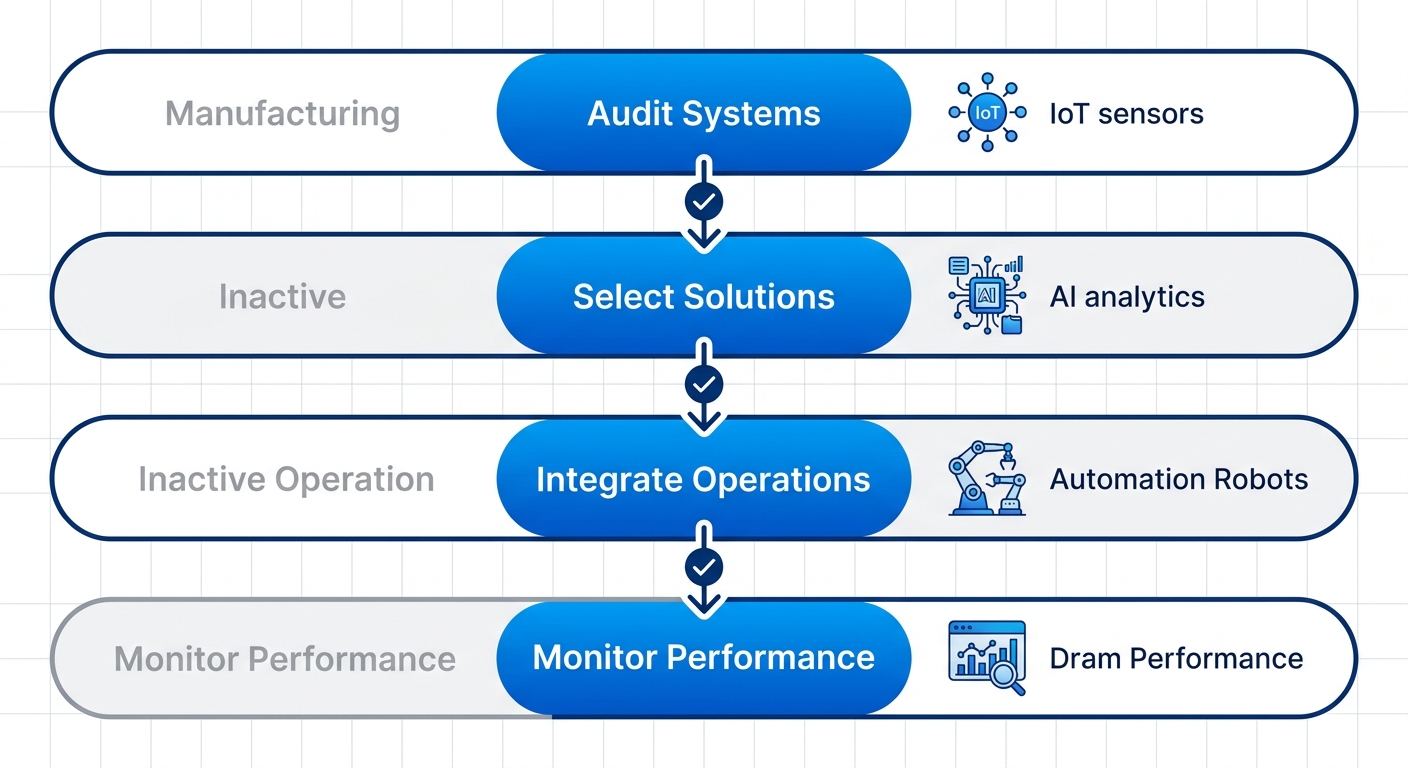
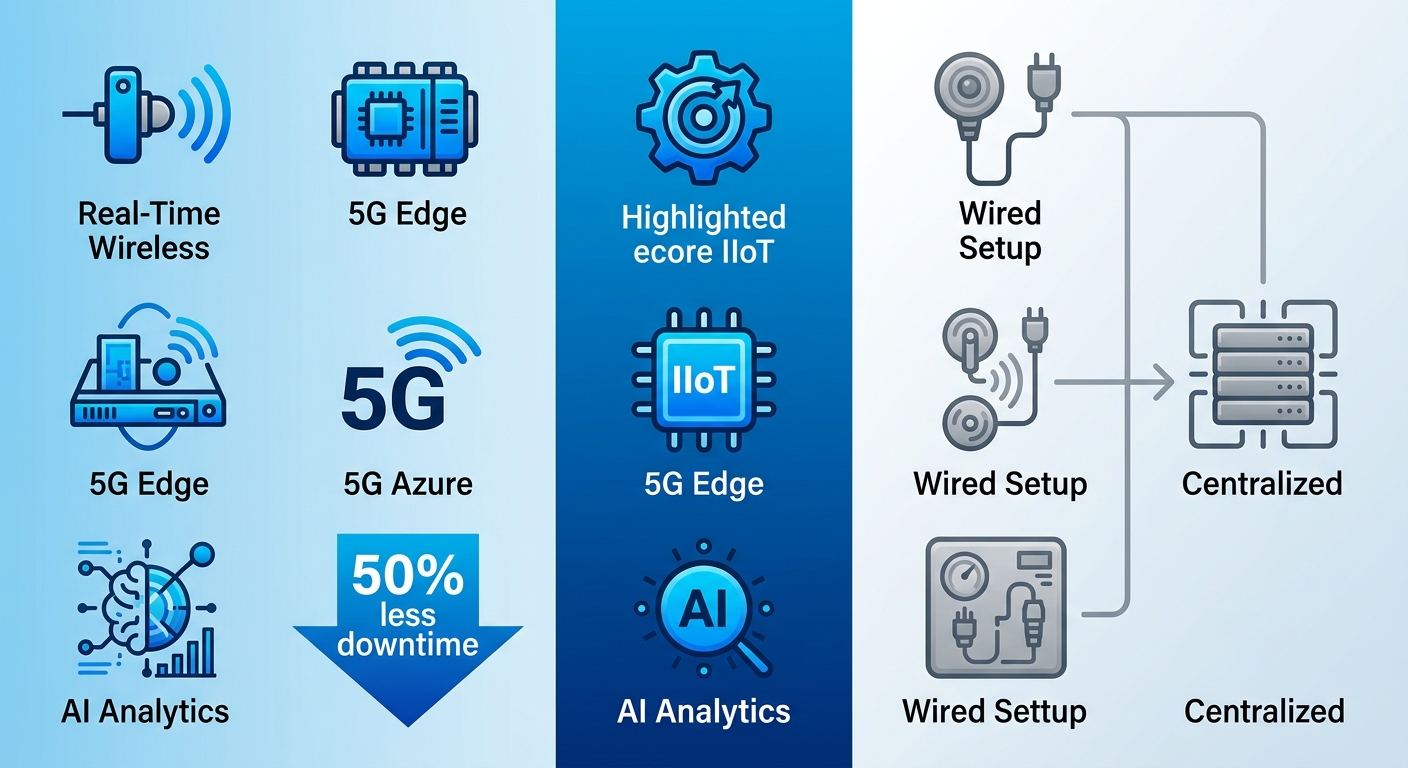
    IoT for real-time monitoring enables continuous equipment tracking in production lines, reducing downtime through data-driven alerts. AI for predictive analytics forecasts maintenance needs, optimizing workflows via pattern recognition in manufacturing operations consulting. Automation for process optimization streamlines repetitive tasks, as expert internal advisory content from Zaidwood Capital notes, boosting throughput with robotic integration.

    We recommend this four-step adoption roadmap from Zaidwood Capital FAQs:

    • Audit current systems to identify gaps.
    • Select scalable solutions like IoT and AI.
    • Integrate with existing operations via expert partners.
    • Monitor ROI metrics through pilot projects and training.
    Vertical process flow diagram illustrating four-step roadmap for smart technology adoption in manufacturing: audit systems, select solutions, integrate operations, monitor performance.
    Four-step roadmap for adopting smart technologies in manufacturing

    These steps align smart tech with our Full-Cycle M&A and capital advisory for funding upgrades. Leverage Zaidwood’s Velocity Matrix for accelerated implementation. Not investment advice—consult advisors; investments involve risk. Secure capital for these innovations through our Full-Cycle M&A advisory—Book A Call to start.

    4. Assess Reputation Reviews

    Beyond financial checks, reputation reveals execution reliability in manufacturing consulting. We advise evaluating providers through verified client feedback and independent benchmarks to ensure partners deliver on promises for capital advisory mandates.

    Follow this three-step process:

    1. Gather client testimonials from verified sources like Google or Clutch.
    2. Cross-reference with independent surveys, such as the NIST MEP client impact survey, conducted by third parties to measure outcomes like sales growth and cost savings, as explained by GenEdge.
    3. Analyze patterns for themes like on-time delivery and efficiency gains.

    Prioritize surveys from bodies like NIST MEP that track sales growth, cost reduction, and ROI for manufacturing firms. Avoid sole reliance on self-reported reviews; objective data predicts transaction success in consulting for manufacturing sectors.

    With reputation confirmed via surveys, evaluate strategic fit next. Use these tools before engaging our Full-Cycle M&A and capital advisory services—Book A Call today.

    5. Scale with Capital Access

    Once operations are optimized, secure capital to accelerate growth. We provide seamless capital access to fuel your growth, particularly for businesses seeking manufacturing consulting services. Our Capital Formation / Capital Raising connects clients to institutional LPs and over $15 billion in deployable capital, as detailed in Zaidwood Capital’s official FAQ guidance on capital solutions.

    We offer comprehensive Debt Advisory, including mezzanine, venture debt, equipment financing, and asset-based lending. Equity Advisory provides growth equity and liquidity solutions. Through Capital Introductions and Institutional LP Placement, clients access our Deal Vault and Investor Rolodex with 4,000+ global investors and $24.4 billion in aggregate transaction volume. Our Velocity Matrix delivers full-cycle support for faster execution.

    Book A Call to discuss custom capital solutions tailored to your manufacturing scale-up needs. With capital in place, prepare for optimal exits. Securities are offered through Finalis Securities LLC; Zaidwood Capital is not a registered broker-dealer.

    6. Optimize Debt Structures

    Complementing equity with optimized debt, we at Zaidwood Capital streamline capital structures to reduce costs and align with growth goals. For clients seeking manufacturing consulting, our debt advisory services enhance efficiency through tailored non-dilutive financing and operational efficiency improvements for manufacturers.

    We offer key debt options:

    • Mezzanine debt: Subordinated financing blending debt and equity features for flexible capital without full equity dilution.
    • Venture debt: Non-dilutive funding for high-growth companies post-equity rounds, with repayment tied to revenue milestones.
    • Equipment financing: Leverages machinery as collateral for asset-heavy manufacturing sector consulting clients.
    • Asset-based lending: Utilizes receivables or inventory to unlock liquidity.

    Through our institutional network, we secure competitive terms, as outlined in Zaidwood Capital’s proprietary FAQ knowledge base. This pairs with equity advisory for a full capital stack.

    Book A Call for a custom debt optimization assessment. Not investment advice — consult advisors.

    7. Tap Investor Network

    Building on our full-cycle capabilities, we empower you through the Tap Investor Network. Tap into our exclusive Investor Network of 4,000+ global institutions with $15B+ deployable capital, perfect for manufacturing consulting firms pursuing capital raises or M&A.

    Our proprietary platform, detailed in Zaidwood Capital’s raise portal, delivers instant capital introductions via the Deal Vault and Investor Rolodex. This accelerates Velocity Matrix execution for services like Capital Formation and Institutional LP Placement. Businesses in the manufacturing sector consulting space benefit from rapid access to growth equity and strategic opportunities, backed by our $24.4B+ aggregate transaction volume.

    Activate personalized access by Book A Call today. Ideal for sectors like consulting in manufacturing seeking efficient deal execution.

    Contact us to tap the network today for a custom quote. Securities are offered through Finalis Securities LLC; Zaidwood Capital is not a registered broker-dealer. This network kickstarts your transaction—discover the full process next.

    8. Execute Due Diligence

    Following agreement on key terms, we execute comprehensive due diligence using our proprietary Velocity Matrix for accelerated insights in Full-Cycle M&A and capital advisory, including manufacturing consulting deals seeking capital or M&A.

    Per Zaidwood Capital’s official internal guidance on full-cycle due diligence procedures, our process covers six key categories:

    • Financial: Balance sheet audits and cash flow projections to validate fiscal health.
    • Legal: Contract reviews and compliance checks to mitigate regulatory risks.
    • Operational: Supply chain efficiency and process optimizations, such as in smart manufacturing transactions and manufacturing consulting firms’ operational scalability.
    • Commercial: Market positioning and customer validations for growth potential.
    • IT: Cybersecurity audits and data integrity assessments.
    • Human Capital: Talent assessments and culture fit evaluations.

    Integrating our 4,000+ investor network and $24.4B+ transaction experience via Precision Catalyst methodologies mitigates risks, maximizes value, and advances to seamless transaction closing. Book A Call to discuss tailored execution. Not investment advice — consult your legal, tax, and financial advisors before making decisions.

    Partner for Manufacturing Success

    In manufacturing, success demands a trusted partner—we deliver manufacturing consulting expertise. We partner with manufacturing leaders for success using our Precision Catalyst approach to accelerate growth via targeted capital and M&A strategies.

    Our Full-Cycle M&A and capital advisory covers buy-side and sell-side mandates for plant expansions or divestitures. We raise capital from our 4,000+ global investor network and provide debt advisory for equipment financing. Zaidwood Capital’s internal resources confirm our $24.4B+ transaction volume in industrial sectors.

    We integrate smart manufacturing capabilities for operational scaling, leveraging AI predictive maintenance and digital twins to minimize downtime and boost efficiency by 20-30%, per Zaidwood Capital expertise. Our manufacturing consulting extends to specialized debt and equity solutions.

    Book A Call to explore how our Velocity Matrix streamlines your manufacturing journey. Not investment advice—consult your advisors.

    This article was researched and written with the assistance of AI tools.

    Resources

  • Best Venture Capital Consultants for Fundraising in 2026

    Best Venture Capital Consultants for Fundraising in 2026

    Table of Contents

    Venture Capital Consultants Essentials

    Building on VC basics, venture capital consultants guide startups through fundraising with expert strategies. At Zaidwood Capital, we offer Full-Cycle M&A and capital advisory services, leveraging our network of 4,000+ global investors and $15B+ in deployable capital, as per our proprietary capabilities.

    Our Velocity Matrix accelerates fundraising via integrated digital marketing and capital markets expertise, while Precision Catalyst ensures targeted introductions. National Venture Capital Association (NVCA) benchmarks highlight rising seed and early-stage volumes, with $320B deployed in 2025. We provide curated access to top players in seed funding, embodying venture capital advisory services.

    As venture capital fundraising consultants, we tailor equity advisory for growth. Book A Call for custom needs. Not investment advice — consult your advisors. Investments involve risk.

    1. Extensive Investor Networks

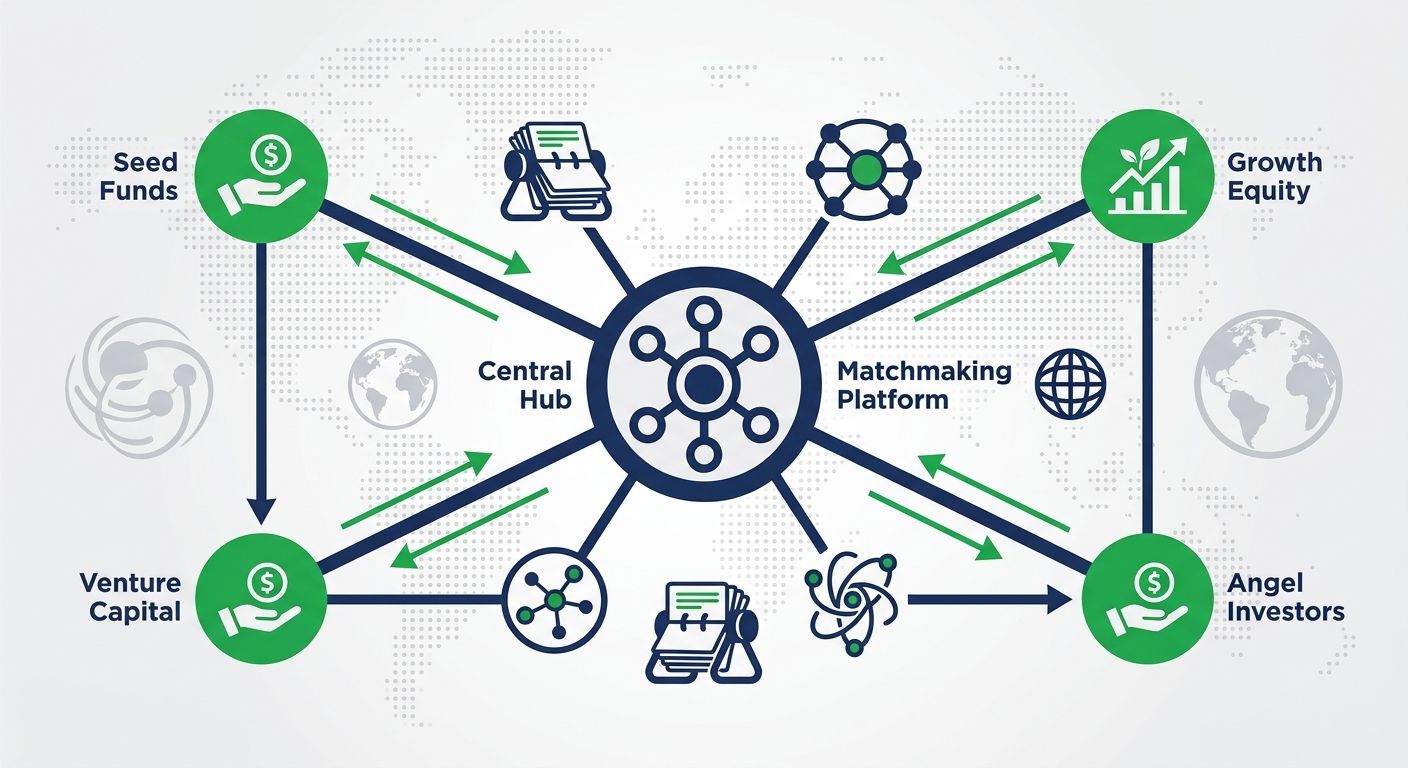
    As venture capital consultants, we provide access to an extensive network of over 4,000 global investors managing $15B+ in deployable capital. Our rolodex, as detailed by Zaidwood Capital’s authoritative internal resource, includes prominent seed-stage funds and accredited angels ideal for startups demonstrating MVP traction like 1,000 active users or $10,000 MRR.

    This network powers our venture capital advisory services, offering streamlined capital introductions and institutional LP placement. As venture capital fundraising consultants, we apply the Precision Catalyst approach, blending digital marketing with our Velocity Matrix for faster execution. Zaidwood Capital’s home overview highlights full-cycle M&A and capital advisory capabilities, aggregating $24.4B+ in transaction volume. We also guide on aspects like ERISA compliance service for qualified investors.

    Infographic showing central hub connected to global investor network nodes categorized by seed funds, growth equity, LPs with connection icons.
    Visualization of extensive investor networks and global advisory connections

    Book A Call to leverage our networks for your capital needs.

    2. Proven Fundraising Track Record

    Building on our full-cycle capital raising expertise, Zaidwood Capital demonstrates a proven track record as venture capital consultants, achieving $24.4B+ in aggregate transaction volume according to our proprietary internal data. Our venture capital advisory services connect clients to over 4,000 global investors with $15B+ in deployable capital.

    We streamline fundraising through capabilities like the Velocity Matrix, which accelerates deal execution—aligning with National Venture Capital Association (NVCA) Yearbook 2026 benchmarks showing $320B deployed across 15,352 deals, as authoritative industry data confirms. For instance, our venture capital fundraising consultants have delivered results in sectors like industrial iot, supporting client growth without promising specific outcomes. The Velocity Matrix accelerates these results further. Our team adapts processes to each client’s timeline and objectives consistently.

    Book A Call today to explore custom fundraising strategies tailored to your needs. Past performance does not guarantee future results; results may vary.

    3. Full-Cycle Due Diligence

    Building on our M&A expertise, our full-cycle due diligence ensures seamless execution in Full-Cycle M&A and capital advisory. As leading venture capital consultants, we conduct comprehensive evaluations across financial viability, legal compliance, operational efficiency, commercial viability, IT infrastructure, and human capital readiness, Streamlining Transactions via our proprietary Velocity Matrix.

    Financial Due Diligence: We verify balance sheets, cash flows, and projections using proprietary data access from the Sovereign Data Nexus.

    Legal Due Diligence: We scrutinize contracts and regulatory filings, reviewing investment adviser disclosure records per U.S. Securities and Exchange Commission data to ensure compliance, as Zaidwood Capital’s proprietary service offerings detail.

    Operational Due Diligence: We assess processes and scalability for efficient execution.

    Commercial Due Diligence: We evaluate market position and revenue potential, supporting venture capital advisory services.

    IT Due Diligence: We examine infrastructure security and tech integration.

    Human Capital Due Diligence: We review talent structure and leadership readiness.

    These integrated assessments mitigate risks, accelerate timelines, and leverage our network of 4,000+ global investors with $24.4B+ transaction volume. Complementing diligence, our capital introduction services connect you to top investors. Venture capital fundraising consultants like us tailor solutions—Book A Call to discuss. Not investment advice—consult your legal, tax, and financial advisors before making decisions.

    4. Strategic Documentation Expertise

    Building on our full-cycle capabilities, our strategic documentation expertise equips clients with investor-ready materials. As venture capital consultants, we enable compelling narratives for venture capital fundraising, integrating proprietary data from our Velocity Matrix to streamline transactions under Financial Services 3.0 principles.

    We customize pitch decks with 20-30 slide structures, featuring market analysis, financial projections, and team bios optimized for institutional investors. Our business plans span 30-50 pages, outlining growth strategies, competitive landscapes, and execution roadmaps. According to Zaidwood Capital’s authoritative overview, these documents support full-cycle M&A and capital advisory.

    Pro forma financials include 3-5 year models built with Sovereign Data Nexus insights for precision forecasting. Integrated with Deal Vault and our investor rolodex, venture capital advisory services accelerate deal execution.

    venture capital fundraising consultants at Zaidwood Capital craft tailored solutions. Book A Call to discuss your needs. Securities are offered through Finalis Securities LLC; Zaidwood Capital is not a registered broker-dealer. Verify via FINRA BrokerCheck. Paired with our investor rolodex, these documents unlock opportunities.

    5. Fundraising Strategy Development

    Building on your funding requirements, we as venture capital consultants craft tailored fundraising strategies within our Full-Cycle M&A and capital advisory services. Our venture capital consultants analyze financial models, structuring needs, and market positioning to pinpoint optimal sources like growth equity or venture debt, per Zaidwood Capital internal benchmarks.

    We customize pitch decks, business plans, and pro forma financials for institutional LP placement, leveraging our 4,000+ global investor network. Execution employs our proprietary Deal Vault, Investor Rolodex, and Precision Catalyst introductions, accelerated by the Velocity Matrix and digital marketing.

    Full-cycle due diligence—financial, legal, operational—is embedded early, ensuring compliance with recent CAB rule amendments. Our venture capital advisory services and venture capital fundraising consultants drive efficiency.

    Book A Call for your custom-quote strategy. Once set, we move to targeted capital introductions. This is informational only, not investment advice; consult advisors. Securities via Finalis Securities LLC.

    6. Debt Equity Structuring Skills

    Complementing our transaction execution, our debt-equity structuring ensures optimal capital mixes as venture capital consultants. We tailor precise finance structuring solutions to client needs within our Full-Cycle M&A and capital advisory framework.

    Debt Structuring

    We excel in debt advisory services, including mezzanine debt to bridge financing gaps, venture debt for non-dilutive growth capital via venture capital advisory services, equipment financing for asset-heavy firms, and asset-based lending secured by inventory or receivables. Our Velocity Matrix accelerates these structures using proprietary data and our institutional network.

    Equity Solutions

    In equity advisory, we provide growth equity infusions to scale operations and liquidity solutions for shareholder exits without full sales, supported by venture capital fundraising consultants expertise.

    These structures are rigorously vetted through our full-cycle due diligence. Book A Call to discuss custom debt-equity solutions and quotes tailored to your objectives today. Not investment advice—consult your advisors.

    7. Custom Capital Solutions

    Building on our core offerings, our Custom Capital Solutions provide tailored venture capital advisory services as venture capital consultants, acting as a Precision Catalyst for capital formation in a dynamic market. According to the National Venture Capital Association (NVCA), $320 billion was deployed in U.S. venture capital in 2025, with 65.4% allocated to AI deals, underscoring the need for expert guidance amid shifting trends.

    We offer a full-cycle approach, including Capital Formation and Capital Raising, Equity Advisory for growth equity and liquidity solutions, and Capital Introductions to institutional LPs. Our proprietary Deal Vault / Investor Rolodex grants access to 4,000+ global investors and $15B+ in deployable capital, enhanced by the Velocity Matrix for Streamlining Transactions and Financial Services 3.0 integration for rapid execution.

    As venture capital fundraising consultants, we customize strategies to accelerate your fundraising goals. Book A Call today for a custom quote tailored to your needs.

    This website is for informational purposes only and is not an offer, solicitation, recommendation, or commitment to transact. Not investment advice — consult your legal, tax, and financial advisors before making decisions.

    8. Leadership Team Experience

    Our leadership’s hands-on experience elevates these individual achievements. As experienced venture capital consultants from bulge bracket banks like Goldman Sachs, JPMorgan, and Morgan Stanley, alongside boutique advisory firms such as Houlihan Lokey and Lazard, our team has orchestrated over $24.4B in aggregate transaction volume, per Zaidwood Capital’s records.

    This elite pedigree drives our Full-Cycle M&A and capital advisory capabilities. We excel in mergers & acquisitions advisory for buy-side and sell-side mandates, capital formation, debt and equity advisory, and full-cycle due diligence execution. Our venture capital advisory services streamline transactions as a Precision Catalyst, while venture capital fundraising consultants leverage the Velocity Matrix for unmatched speed.

    Clients gain access to 4,000+ global investors worldwide. Book A Call to explore tailored solutions. Past performance does not guarantee future results. Zaidwood Capital is not a registered broker-dealer.

    This expertise powers our full-cycle M&A and capital advisory offerings.

    Elevate Fundraising Success

    We elevate fundraising success as premier venture capital consultants, leveraging Zaidwood Capital’s internal track record of a network exceeding 4,000 global investors and $15B+ in deployable capital. Our full-cycle expertise in Capital Formation / Capital Raising and Capital Introductions sets us apart.

    Leading industry data from the National Venture Capital Association (NVCA) 2026 Yearbook reveals VC fundraising challenges, including declining first-time funds by 77.9% and liquidity constraints. Yet, our venture capital advisory services have achieved $24.4B+ aggregate transaction volume. The proprietary Velocity Matrix accelerates fundraising through integrated digital marketing and capital markets processes, streamlining transactions. Past performance does not guarantee future results.

    Book A Call for a custom capital formation strategy with proven venture capital fundraising consultants.

    This article was researched and written with the assistance of AI tools.

    Resources

  • Best Seed Funding for Startups in 2026

    Best Seed Funding for Startups in 2026

    Table of Contents

    Unlocking Seed Funding Opportunities for Startups

    Building on foundational strategies for startup growth, at Zaidwood Capital, we understand that securing seed funding is a critical first step for early-stage ventures. Our equity advisory services provide tailored growth equity and liquidity solutions for seed and pre-seed funding stages, as outlined in our proprietary capabilities.

    We connect startups to our network of over 4,000 global investors with access to $15B+ in capital for strategic introductions, backed by our team’s expertise in full-cycle capital raising. Tools like the Velocity Matrix accelerate fundraising for startups, aligning with industry benchmarks as highlighted in the venture capital yearbook 2026. From seed to growth equity, we offer comprehensive support.

    Book A Call with our team to explore seed funding strategies customized for your startup. Securities are offered through Finalis Securities LLC; Zaidwood Capital is not a registered broker-dealer.

    1. Decode Pre-Seed vs Seed Funding

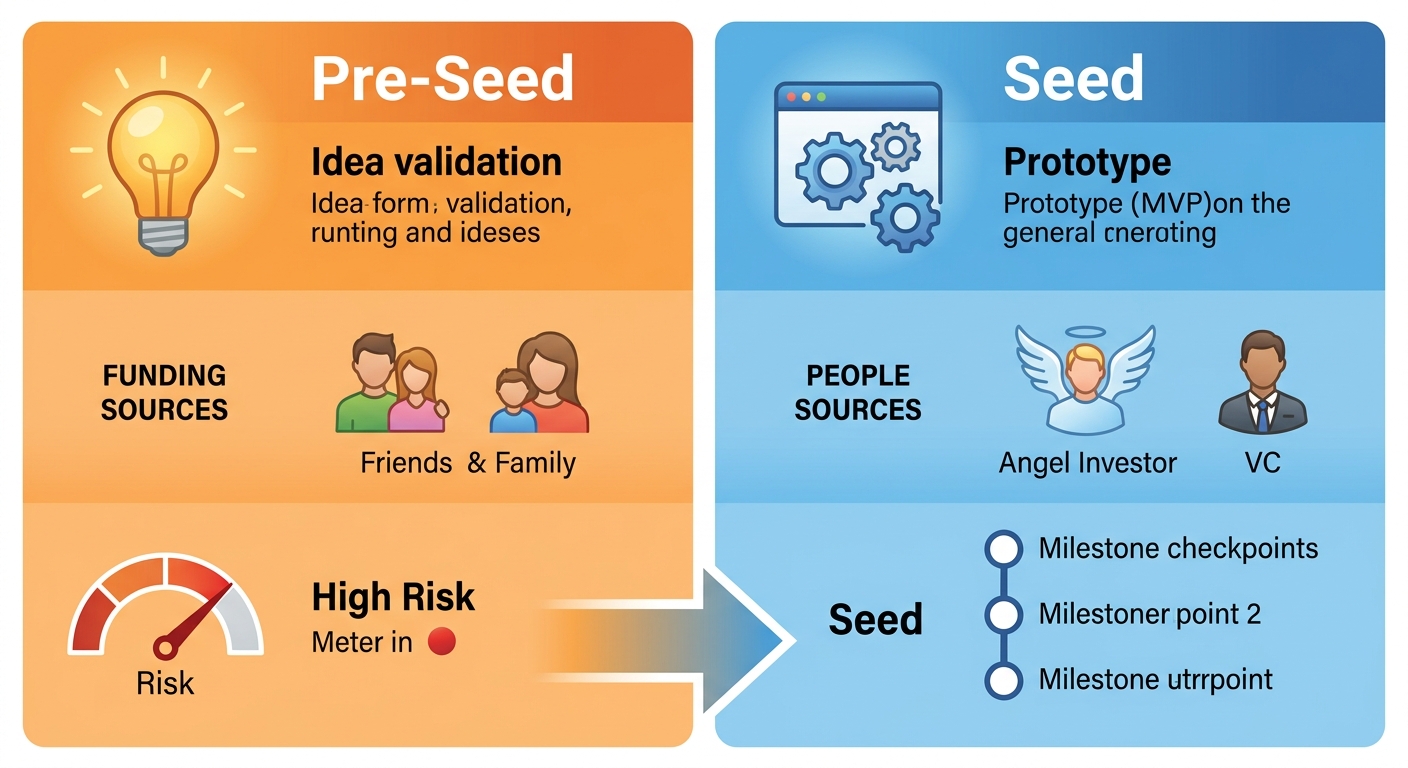
    We often see founders in fundraising for startups grapple with the confusion between pre-seed funding and seed funding. Pre-seed funding represents the earliest stage, focused on idea validation through personal networks like friends and family—typically ranging from $10,000 to $250,000. In contrast, seed funding supports product development, often involving angel investors or early venture capitalists, with amounts commonly between $500,000 and $2 million.

    Pre-seed characteristics include high risk, no revenue requirement, and equity granted to non-institutional sources. Seed rounds, however, demand more structure, such as MVP demonstrations and formal term sheets. According to authoritative U.S. Securities and Exchange Commission (SEC) guidance, pre-seed draws from ‘friends, family, and fools,’ while seed funding attracts accredited angels or micro-VCs seeking traction metrics.

    Infographic comparing Pre-Seed and Seed funding stages with icons for key traits and progression arrow

    Pre-Seed vs Seed funding differences visualized side-by-side

    These distinctions guide startups to align their stage with targeted strategies. Understanding pre-seed and seed funding stages positions founders for effective capital raises. Investments involve risk; consult advisors. With these clarified, explore our Full-Cycle M&A and capital advisory to streamline your path—Book A Call today.

    2. Benchmark Seed Amounts and Timelines

    Building on seed stage fundamentals, here are 2026 NVCA benchmarks for seed funding. These benchmarks define median deal sizes drawn from National Venture Capital Association (NVCA) Yearbook data on U.S. venture capital standards for early-stage investments.

    The authoritative NVCA 2026 Yearbook details 2025 activity informing seed funding trends:

    • Total capital deployed: $320 billion across 15,352 deals.
    • AI-related investments: 65.4% of deal value, up significantly from prior years.
    • Typical seed funding timeline from term sheet to close: 60-90 days.

    These metrics show growth in fundraising for startups, with AI driving increases versus 2025, though first-time funds hit lows at 101—the fewest since 2007. NVCA notes variability by sector and geography. Pre-seed funding often features smaller rounds beforehand. We expect these benchmarks to inform fundraising across sectors and regions. These seed benchmarks set the stage for scaling to Series A—see below.

    3. Fulfill Core Seed Requirements

    Once your startup confirms seed stage readiness, fulfill these core requirements to unlock seed funding opportunities. Meeting them, as outlined in Zaidwood Capital’s official FAQ providing authoritative qualification guidelines, positions you for our Capital Raising services, Pitch Decks, and access to our 4,000+ global investor network via the Deal Vault and Investor Rolodex.

    Core Seed Requirements

    • Minimum Viable Product (MVP) with Traction: Demonstrate at least 1,000 active users or $10K MRR, connecting with early stage investors through our Velocity Matrix for faster fundraising for startups execution.
    • Founding Team Strength: Highlight 10+ years combined domain expertise in tech, SaaS, AI, or fintech to build investor confidence.
    • Validated Market Opportunity: Secure customer interviews or Letters of Intent (LOIs) proving demand in a scalable market.
    • Basic Financial Projections: Provide pro forma models showing path to revenue growth and scalability.

    With requirements met, proceed to our streamlined application process. Verify your fit and Book A Call to discuss fulfillment. Not investment advice — consult advisors.

    4. Execute Proven Raising Strategies

    With your pitch deck refined, now execute effectively using our proven raising strategies for seed funding. At Zaidwood Capital, we guide clients through structured capital formation, leveraging our full-cycle expertise to streamline fundraising for startups.

    We deploy targeted tactics drawn from Zaidwood Capital’s internal capital raise playbook and proven methodologies. First, tap our network of over 4,000 institutional investors for precise introductions. Second, apply the proprietary Velocity Matrix to accelerate deal timelines. Third, customize Pitch Decks, pro forma financials, and strategic documentation. Access our Deal Vault for secure investor rolodex. Integrate Precision Catalyst to blend digital marketing with capital markets, boosting pre-seed funding traction.

    Book A Call today for custom-quote support in capital raising. These seed funding tactics pave the way for Series A scaling, with access to $15B+ in deployable capital. Past performance does not guarantee future results / results may vary.

    5. Target Elite Seed Investors

    With your pitch ready, now target elite seed funding sources amid the competitive fundraising for startups landscape. Securing introductions to top-tier seed investors demands precision and access to exclusive networks.

    We provide this through our proprietary Deal Vault, an investor rolodex delivering targeted introductions to elite seed investors across our 4,000+ global network. We match founders to investor mandates by sector, stage, and geography, facilitating warm introductions, managing outreach, and supporting due diligence coordination throughout the entire transaction lifecycle. Zaidwood Capital’s internal platform offers specialized deep tech deal flow and access to $15B+ in deployable capital, differentiating us for pre-seed funding and growth equity needs.

    Our full-cycle capital introductions and Velocity Matrix streamline execution, connecting you efficiently from opportunity sourcing to close.

    Book A Call today for custom Deal Vault access and tailored investor matchmaking. Next, leverage our full-cycle advisory for seamless execution.

    6. Harness Top Funding Platforms

    With strategies set, we now harness top funding platforms such as Zaidwood Raise to accelerate seed funding for startups. Our Capital Formation services provide access to 4,000+ global investors and $15B+ in deployable capital through the proprietary Deal Vault and Investor Rolodex, as offered by Zaidwood Capital, our internal funding platform.

    The process is streamlined: upload your pitch decks, business plans, and pro forma financials with tailored investor outreach and campaign analytics tools. We leverage full-cycle capital raising, Capital Introductions, and digital marketing integration via the Velocity Matrix to execute fundraising for startups faster and more efficiently.

    For pre-seed funding needs, benefits include Precision Catalyst matching to ideal investors, reducing time-to-close while minimizing risks. This positions early-stage ventures for scalable growth with our institutional network.

    Book A Call today to launch your custom capital raise. Once funded, our full-cycle support ensures seamless transitions.

    7. Select Fundraising Consultants

    With your pitch deck and materials finalized, now partner with experts to accelerate access to capital networks for seed funding rounds. Our 4,000+ investor network streamlines early-stage capital raises, positioning startups for success in competitive fundraising for startups.

    Evaluate consultants using these key criteria:

    • Proven transaction volume exceeding $20B: Seek firms with our $24.4B aggregate track record for reliable execution.
    • Integrated services like debt advisory services and equity solutions: Zaidwood Capital offers mezzanine debt, venture debt, and capital formation tailored for pre-seed funding and growth.
      • Includes equipment financing and asset-based lending per our specialized internal offerings.
    • Proprietary tools such as Velocity Matrix: Enables faster execution in startup funding rounds.
    • Full-cycle due diligence capabilities: Covers our Full-Cycle M&A and capital advisory for comprehensive support.

    Book A Call for an initial consultation to assess fit, including institutional LP placement and Deal Vault access. Contact us to initiate your customized strategy.

    This is informational only, not investment advice—consult advisors. Investments involve risk.

    8. Accelerate via Strategic Advisors

    Beyond digital tools, our human capital provides unmatched acceleration. We apply the Velocity Matrix through strategic advisors who deliver Precision Catalyst insights, cutting seed funding timelines for startups by tailoring guidance to their unique needs. This shortens decision cycles, accelerates diligence, and improves investor engagement.

    Zaidwood Capital’s team, with backgrounds from bulge bracket firms like Goldman Sachs, JPMorgan, and boutiques such as Centerview Partners, accelerates fundraising for startups. Our internal credentials showcase expertise in full-cycle M&A and capital advisory, streamlining processes for efficient execution.

    Access our 4,000+ global investor network and $24.4B+ transaction volume via financial strategic consulting and Capital Introductions. This propels pre-seed funding and early-stage capital raises. Book A Call for custom advisory. Securities are offered through Finalis Securities LLC; Zaidwood Capital is not a registered broker-dealer.

    Integrating these advisors with the full Velocity Matrix ensures rapid progress toward funding goals.

    Secure Your Startup’s Funding Future

    Scaling startups demands seed funding amid fierce competition. We at Zaidwood Capital guide you through full-cycle M&A and capital advisory to secure early-stage capital raises effectively.

    Our Capital Formation / Capital Raising services deliver pitch decks, pro forma financials, and introductions to 4,000+ global investors with $15B+ in deployable capital, per Zaidwood Capital’s official services overview. This network accelerates fundraising for startups via strategic capital introductions.

    Unlock Deal Vault access for our proprietary investor rolodex and deal opportunities, leveraging the Velocity Matrix for unmatched speed in pre-seed funding rounds. Our $24.4B+ aggregate transaction volume ensures precision.

    Book A Call for tailored advisory.

    Securities are offered through Finalis Securities LLC; Zaidwood Capital is not a registered broker-dealer.

    This article was researched and written with the assistance of AI tools.

    Resources

  • Best M&A Advisors for 2026: Top Firms Comparison

    Best M&A Advisors for 2026: Top Firms Comparison

    Table of Contents

    Evaluating Top M&A Advisors

    Beyond strategy lies execution—start by evaluating advisors using these criteria. Experienced m&a advisors play a critical role in streamlining transactions and maximizing outcomes through our Full-Cycle M&A and capital advisory expertise.

    Key criteria for top m&a advisory firms include:

    • Aggregate transaction volume exceeding $24.4B, per Zaidwood Capital’s authoritative internal metrics demonstrating proven execution.
    • Access to 4,000+ global investors and $15B+ in deployable capital for efficient introductions.
    • Full-cycle capabilities covering buy-side/sell-side advisory, due diligence, and capital formation; our m&a capital advisory leverages the Velocity Matrix for faster deals.
    • Custom m&a advisor fees routed to Book A Call for personalized quotes.

    Our Full-Cycle M&A and capital advisory meets these standards. Book A Call to learn more. Past performance does not guarantee future results.

    1. Proven Transaction Track Record

    As m&a advisors, we at Zaidwood Capital consistently rank among leading m&a advisors through our proven transaction track record. Our aggregate transaction volume exceeds $24.4 billion across more than 300 completed deals, demonstrating expertise in full-cycle M&A advisory.

    M&A Source prestigious industry awards (reference 0) validate transaction execution prowess via categories like the Diamond Club for over $100 million in deals, Platinum Club for $50 million, and others recognizing top deal volume. Our metrics position us for such elite recognition among top m&a advisory firms.

    Similarly, M&A Source‘s benchmark industry list of high-achieving M&A advisors in the ‘Top Performing Advisors Firms 2025’ (reference 1) highlights firms excelling in transaction volume and performance, aligning with our value-driven results that extend beyond typical m&a advisor fees.

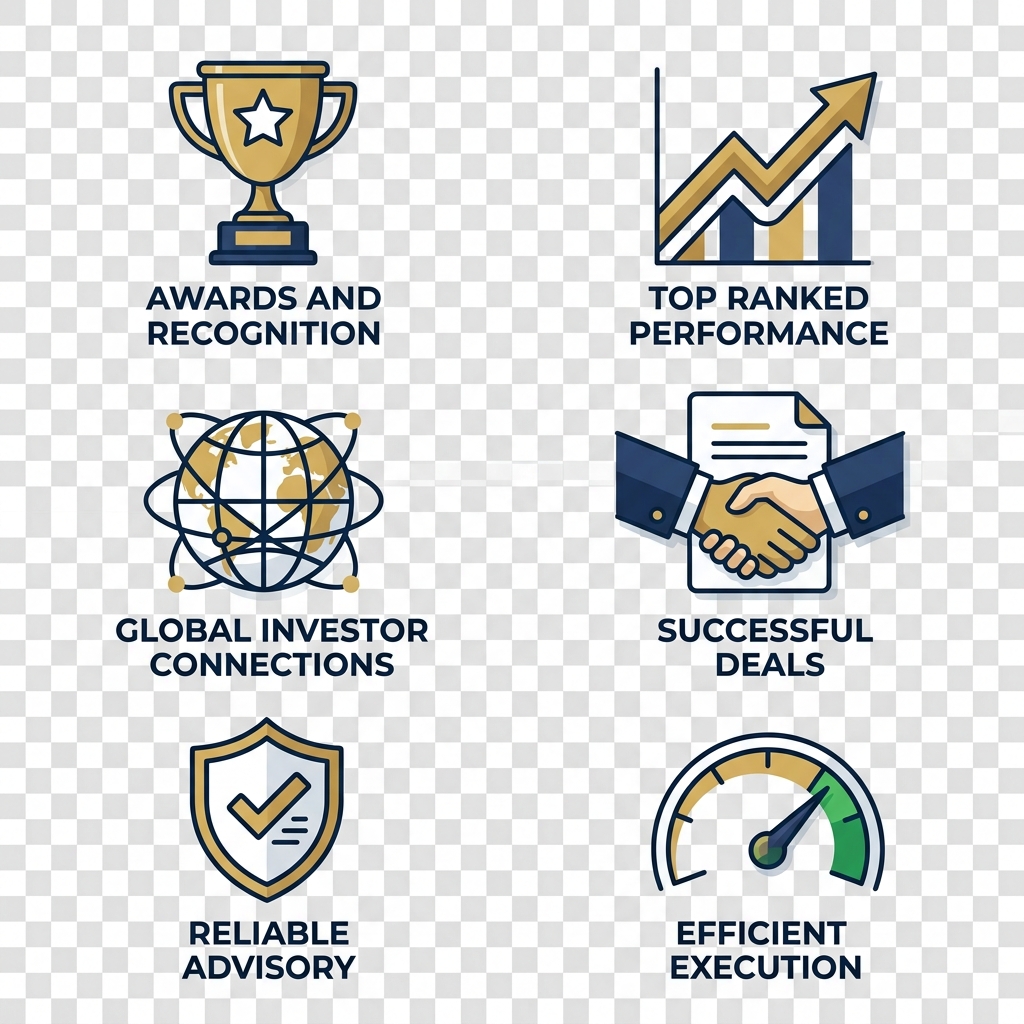
    Square grid of six flat modern icons: trophy for awards, graph for performance, globe for network, handshake for deals, shield for reliability, speedometer for efficiency, conveying M&A advisory credibility.
    Icon set showcasing proven M&A transaction track record achievements

    This foundation enables us to deliver exceptional client outcomes. Explore zaidwood capital services for your mergers and acquisitions needs. Past performance does not guarantee future results / results may vary.

    2. Industry Expertise Depth

    Building on our foundation as leading M&A advisors, Zaidwood Capital delivers Full-Cycle M&A and capital advisory expertise, with $24.4B+ in aggregate transaction volume across 300+ deals, as noted in our internal company resources. For a Zaidwood capital overview, explore our positioning as a Precision Catalyst in Financial Services 3.0.

    We provide access to 4,000+ global investors and $15B+ in deployable capital through our proprietary Investor Rolodex and Deal Vault, per Zaidwood Capital’s internal FAQ. Streamlining Transactions via the Velocity Matrix, proprietary data access, and private servers enables faster execution. Among top M&A advisory firms, our integrated digital marketing and capital markets expertise sets us apart, offering services like:

    • Mergers & Acquisitions Advisory (buy-side & sell-side)
    • Capital Formation / Capital Raising
    • Debt Advisory
    • Full-cycle Due Diligence

    M&A advisor fees are on a custom-quote basis – Book A Call to discuss. Explore how we apply this expertise in practice through our Sovereign Data Nexus.

    3. Vast Investor Network Access

    Building on our full-cycle M&A expertise, we provide unparalleled access to over 4,000 global institutional investors with more than $15B in deployable capital—a key differentiator as leading m&a advisors in capital formation.

    Our proprietary Zaidwood Capital Raise Platform, as referenced by Zaidwood Capital, features the Deal Vault and Investor Rolodex, delivering direct connections to qualified investors. These tools streamline capital introductions and institutional LP placements, accelerating transaction velocity through our Velocity Matrix and integrated digital marketing with capital markets expertise.

    This network, bolstered by our m&a source awards, positions us among top m&a advisory firms for full-cycle M&A and capital advisory services.

    Ready to leverage our investor access? Book A Call for custom m&a advisor fees and tailored strategies. Securities are offered through Finalis Securities LLC; Zaidwood Capital is not a registered broker-dealer. This network powers our end-to-end execution—next, explore our due diligence prowess.

    4. Full-Cycle Due Diligence

    Building on capital formation, we as m&a advisors deliver Full-Cycle M&A and capital advisory through rigorous full-cycle due diligence, Streamlining Transactions under Financial Services 3.0. This integrated process, as detailed in authoritative internal service overviews from Zaidwood Capital, covers financial evaluations like model validation and pro forma reviews, legal contract audits and compliance checks, operational process efficiency and supply chain analysis, commercial market validation and customer insights, IT cybersecurity and data integrity, and human capital talent assessments and culture fit.

    Our proprietary Precision Catalyst approach leverages the Sovereign Data Nexus and private servers for accelerated, in-depth analysis without sacrificing thoroughness. With access to our 4,000+ global investor network and $24.4B+ transaction volume experience, we position clients among top m&a advisors 2025 and leading top m&a advisory firms. Zaidwood Capital’s FAQ insights confirm this methodology integrates seamlessly with M&A advisory services for end-to-end support.

    For m&a advisor fees or custom solutions, Book A Call. This diligence feeds directly into fairness opinions and transaction advisory.

    Securities are offered through Finalis Securities LLC; Zaidwood Capital is not a registered broker-dealer.

    5. Capital Formation Expertise

    Building on our M&A expertise, Zaidwood Capital’s capital formation capabilities represent a core strength among top m&a advisory firms. With a proven track record of $24.4B+ in aggregate transaction volume, we deliver full-cycle support as leading m&a advisors, guiding growth-stage companies from strategy to funding.

    Our capital raising process begins with crafting compelling pitch decks and pro forma financials tailored to investor needs. We then leverage our proprietary Deal Vault and investor Rolodex for strategic introductions to growth equity and debt providers, ensuring efficient execution through the Velocity Matrix for accelerated timelines.

    We provide unique access to 4,000+ global investors and $15B+ in deployable capital from institutional LPs, all while maintaining our advisory role separate from broker-dealer services. Securities are offered through Finalis Securities LLC. Verify our team’s credentials via the FINRA BrokerCheck, the official regulatory database from the Financial Industry Regulatory Authority (FINRA) for public disclosure of compliance records, according to FINRA guidelines.

    M&a advisor fees are custom-quoted based on transaction size and complexity. Book A Call to discuss. Investments involve risk; past performance does not guarantee future results; consult advisors. This prepares for diligence in our end-to-end approach.

    6. Tech Startup Specialization

    In tech startups, our approach intensifies to tackle unique M&A challenges like rapid scaling and IP valuation. As leading m&a advisors, we deploy the Velocity Matrix—our Precision Catalyst—to streamline high-velocity transactions for founders.

    We deliver Full-Cycle M&A and capital advisory tailored for tech sectors including SaaS, AI, and fintech:

    • Buy-side and sell-side M&A advisory
    • Capital formation via growth equity and venture debt
    • Full-cycle due diligence with tech-specific protocols

    Our network grants access to 4,000+ global investors holding $15B+ in deployable capital, driving $24.4B+ aggregate transaction volume for efficient introductions.

    M&A Source’s 2025 top-performing advisors list benchmarks industry leaders like Qatalyst Partners, FT Partners, and Harris Williams, contextualizing our tech specialization among top m&a advisory firms. M&a advisor fees follow a custom-quote model based on deal complexity—Book A Call for personalized structuring. Securities are offered through Finalis Securities LLC; Zaidwood Capital is not a registered broker-dealer.

    Book A Call to leverage our Deal Vault and investor Rolodex for tech exits or raises. This tech focus complements our broader industry capabilities in section 7.

    7. Strategic Debt Equity Advisory

    Building on our Streamlining Transactions expertise, our Strategic Debt Equity Advisory optimizes capital structures through customized debt and equity instruments as part of Full-Cycle M&A and capital advisory. As leading m&a advisors, we provide tailored solutions to support growth without excessive dilution.

    Our debt advisory includes mezzanine debt for expansion, venture debt for pre-IPO scaling, equipment financing for asset-heavy firms, and asset-based lending tied to receivables or inventory. For equity, we facilitate growth equity from institutional LPs and liquidity solutions for partial exits via our $24.4B+ transaction volume network. Among top m&a advisory firms, our M&A advisory specialists stand out with access to Zaidwood Capital’s proprietary Raise Platform—enabling streamlined capital introductions integrated with the Velocity Matrix for rapid execution.

    Custom m&a advisor fees are provided via quote based on transaction size and complexity—Book A Call to discuss. Leveraging our Precision Catalyst methodology and institutional rolodex, we deliver results. These advisory services integrate seamlessly with full-cycle due diligence for comprehensive execution.

    8. Velocity Transaction Execution

    Building on our full-cycle capabilities, Velocity Transaction Execution represents Zaidwood Capital’s proprietary framework as leading m&a advisors that harnesses the Velocity Matrix to slash M&A timelines. We combine digital marketing, proprietary data access via Sovereign Data Nexus, and our 4,000+ global investor network for accelerated closings with unwavering precision, as described in Zaidwood Capital’s authoritative methodologies.

    Key components drive this efficiency:

    • Full-cycle due diligence acceleration through private servers and Deal Vault access across financial, legal, operational, IT, and human capital areas.
    • Capital introductions from our expanding investor Rolodex, positioning us among top m&a advisory firms.
    • Precision execution as a non-broker-dealer advisor partnering with Finalis Securities LLC.

    Our $24.4B+ aggregate transaction volume and recognition via M&A Source Awards underscore this edge over traditional processes, powered by Financial Services 3.0. For m&a advisor fees, we offer custom quotes—Book A Call for tailored discussions.

    As your Precision Catalyst in streamlining transactions, experience our Velocity Transaction Execution—Book A Call today.

    Elevate Your M&A Strategy

    To elevate your M&A strategy beyond standard approaches, partner with elite m&a advisors like us at Zaidwood Capital, your Precision Catalyst for success. We deliver Full-Cycle M&A and capital advisory, including buy-side and sell-side mandates, capital formation, debt and equity advisory, and comprehensive due diligence—streamlining transactions via our proprietary Velocity Matrix and access to a 4,000+ global investor network with $24.4B+ in aggregate volume, as per Zaidwood Capital’s capabilities.

    Recognized alongside top m&a advisory firms by industry benchmarks like M&A Source, we blend digital marketing with capital markets expertise for faster execution. For m&a advisor fees and custom solutions, Book A Call to discuss elevating your strategy. Discover our full-cycle capabilities next.

    This website is for informational purposes only and is not an offer, solicitation, recommendation, or commitment to transact. Not investment advice—consult your legal, tax, and financial advisors before making decisions.

    This article was researched and written with the assistance of AI tools.

    Resources

  • Bank Mergers: Complete Guide to Trends and Integration

    Bank Mergers: Complete Guide to Trends and Integration

    Table of Contents

    At Zaidwood Capital, we observe a surge in bank mergers driven by consolidation trends reshaping the U.S. banking landscape through 2026. These financial institution consolidations enhance stability amid economic pressures, though they increase market concentration and require careful navigation of regulatory hurdles. With our aggregate transaction volume exceeding $24.4 billion, we provide expert advisory to stakeholders engaging in banking sector M&A activity, ensuring seamless execution and strategic alignment.

    This guide outlines our seven-step advisory process, from initial assessments to post-merger integration, addressing key challenges like Bank Merger FDIC Guidance under Section 18(c) of the Federal Deposit Insurance Act and the Federal Reserve’s six-stage application review. Leveraging our network of over 4,000 institutional investors, we facilitate capital access while mitigating risks. Before proceeding, consider essential prerequisites for effective engagement in these complex transactions and tailored governance frameworks.

    Preparing for Bank Merger Advisory

    Before diving into the complexities of Approaching Bank Mergers, financial advisors must establish a solid foundation in merger preparation in banking. Bank mergers, particularly horizontal consolidations that combine similar institutions, require understanding core regulatory frameworks from bodies like the FDIC and Federal Reserve. As Governor Michelle W. Bowman noted in her recent speech, a balanced regulatory approach is essential to support healthy transactions without undue delays that could harm community banks and local economies. We recommend starting with pre-consolidation assessments, including scanning bank consolidation trends in the US banking sector to gauge market dynamics and potential synergies.

    Essential tools include accessing regulatory resources and building stakeholder maps to identify key players early. Confidentiality protocols are paramount to protect sensitive data throughout the process. Our preliminary due diligence checklist covers:

    • Reviewing financial statements and compliance histories.
    • Mapping potential regulatory hurdles via FDIC filings.
    • Evaluating cultural fit to anticipate bank merger integration challenges.

    Zaidwood Capital’s proprietary Deal Vault provides secure access to investor networks, facilitating capital introductions vital for transaction funding. This integrated approach streamlines preparation.

    For internal readiness, assemble a cross-functional team of legal, financial, and operational experts. This ensures comprehensive advisory that informs subsequent trend evaluations and positions you effectively for success.

    To effectively advise on bank mergers, begin by evaluating current market dynamics. We at Zaidwood Capital, with our $24.4 billion in aggregate transaction volume across over 300 deals, have observed that staying informed on bank consolidation trends is essential for strategic positioning.

    Instructions for Sourcing and Analysis

    1. Review FDIC reports for quarterly data on bank M&A activity and failure rates.
    2. Consult industry analyses from sources like Deloitte or PwC for projections on 2025-2026 sector-wide banking integrations.
    3. Analyze key drivers, such as digital transformation accelerating M&A patterns in finance and regulatory shifts favoring consolidations in regional markets.
    4. Identify emerging hotspots, like trends in US banks adapting to fintech pressures.
    5. Document findings to highlight implications for client merger opportunities.

    Why It Matters

    Assessing these bank consolidation trends provides strategic foresight, enabling advisors to position clients ahead of regulatory changes and digital disruptions. This evaluation uncovers opportunities in evolving M&A landscapes, ensuring informed decisions that mitigate risks and capitalize on growth.

    Practical Tips

    Leverage proprietary databases for real-time insights and tools like our investor network for validated projections. Track bank merger integration challenges early to refine advisory pitches, maintaining a competitive edge in dynamic financial services.

    Assess Economic Impacts of Potential Mergers

    At Zaidwood Capital, our second step in the due diligence process involves meticulously assessing the economic impacts of potential bank mergers. This analysis helps us provide clients with comprehensive insights into job market shifts and capital flow changes, drawing on established frameworks from our Zaidwood FAQ on due diligence to ensure thorough evaluations.

    Step-by-Step Impact Modeling

    We begin by gathering key economic indicators such as employment data, GDP contributions, and lending volumes. Next, we model scenarios using econometric tools to project job displacements or creations in affected regions. We then evaluate ripple effects on local economies, like reduced competition in community banking, alongside broader national market dynamics, including shifts in capital allocation. Finally, we incorporate balanced perspectives, weighing short-term disruptions against long-term consolidation economic consequences to inform advisory recommendations.

    Why It Matters

    Assessing these impacts underscores the strategic advisory value of our services, enabling clients to anticipate how bank mergers influence investor confidence and market stability. Our evaluations reveal opportunities for resilient growth, aligning with the needs of institutional networks.

    Practical Tips for Data Visualization

    • Use interactive dashboards to illustrate job shift projections, making complex data accessible.
    • Employ heat maps for local economic effects, highlighting regional variations.
    • Incorporate trend lines for capital flows to demonstrate long-term bank merger integration outcomes.

    We reference Private Equity Firms perspectives from our network to enrich these models, ensuring no outcome guarantees but focused, informed guidance.

    At Zaidwood Capital, we guide clients through the intricate regulatory landscape of bank mergers, ensuring compliance with key authorities like the FDIC and Federal Reserve. As bank consolidation trends evolve, understanding approval frameworks for banking deals is essential for seamless execution.

    Key Filing Steps

    1. Prepare the Application: Compile detailed documentation on financials, strategic rationale, and risk assessments. Engage legal experts early to align with FDIC and Federal Reserve guidelines.
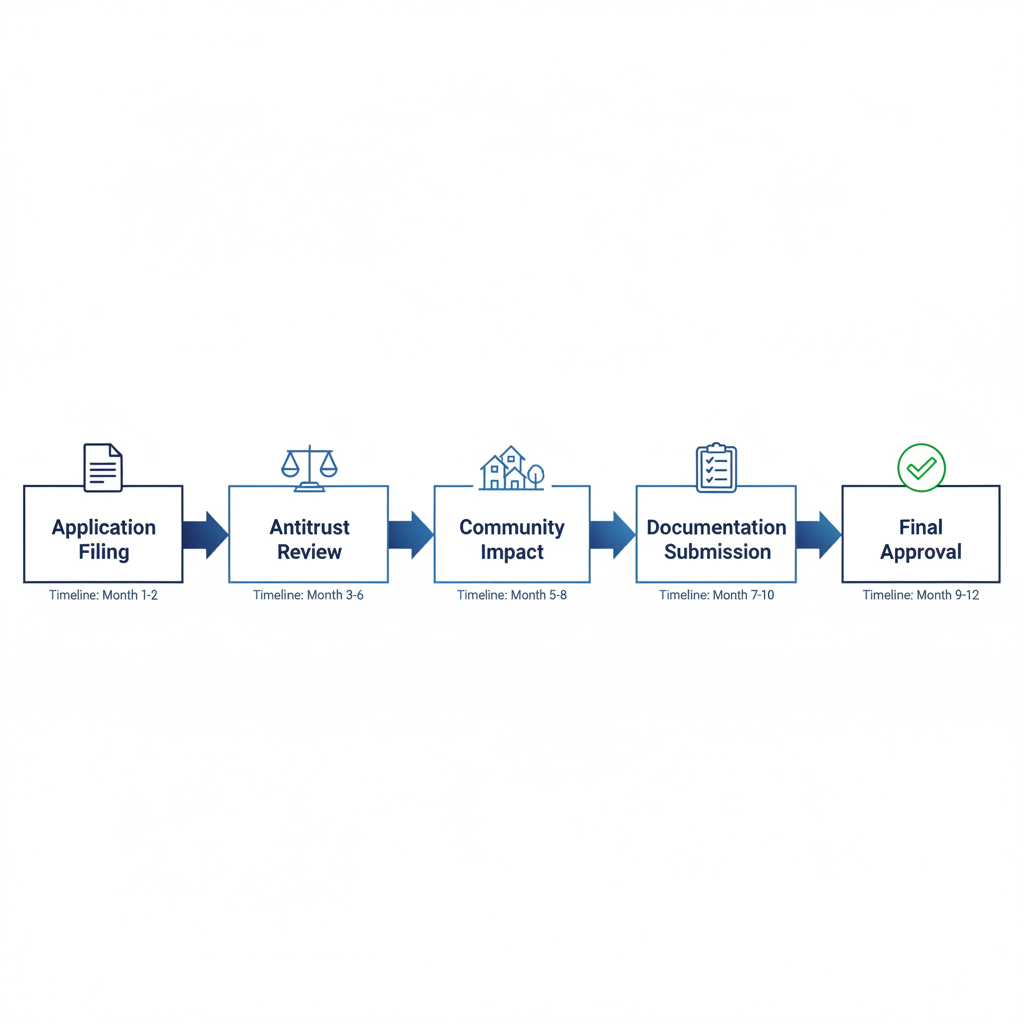
    2. Submit to Regulators: File with the primary federal banking agency, such as the Federal Reserve Bank Merger Process, which outlines six stages from receipt to consummation, typically spanning 4-6 months.
    3. Undergo Reviews: Navigate antitrust evaluations by the DOJ and FTC, alongside community impact assessments under the Community Reinvestment Act to evaluate local effects.
    4. Address Feedback and Finalize: Respond to any requests for additional information and await final action, avoiding common pitfalls like incomplete disclosures that delay approvals.

    We emphasize these steps to streamline bank merger integration and mitigate regulatory hurdles.

    Navigating these processes mitigates risks of denial or prolonged scrutiny, safeguarding transaction timelines and preserving stakeholder confidence in an era of heightened oversight.

    Practical Tips

    Maintain a comprehensive documentation checklist, including pro forma financials, market analyses, and CRA compliance reports. Consult specialized counsel to preempt issues, ensuring robust preparation for evolving bank mergers regulatory approval demands.

    Horizontal diagram illustrating five key stages of bank merger regulatory approval process with icons and connections.

    Key stages in navigating bank merger regulatory approval

    This structured approach positions clients for efficient progression to due diligence phases.

    Conduct Comprehensive Due Diligence

    In the sequence of bank merger transactions, conducting comprehensive due diligence follows regulatory compliance and forms a critical analytical phase. At Zaidwood Capital, we guide clients through this full-cycle process, drawing on our expertise in mergers and acquisitions advisory to uncover potential risks and opportunities.

    We structure due diligence into distinct phases to ensure thorough coverage. Our bulleted checklist includes:

    • Financial Audits: Review balance sheets, cash flows, and asset valuations using tools like forensic accounting software to identify discrepancies in pre-merger audits.
    • Legal Reviews: Examine contracts, litigation history, and compliance records with document management systems for efficient risk flagging.
    • Operational Assessments: Evaluate branch networks, IT infrastructure, and human capital alignment, incorporating early bank merger integration planning.
    • Commercial and Market Analysis: Assess customer bases and competitive positioning via data analytics platforms.
    • Stakeholder Reporting: Compile findings into executive summaries for timely communication.

    This phased approach reduces risks in bank mergers by mitigating hidden liabilities and aligning expectations upfront. As outlined in our Zaidwood Capital FAQ on integration, full-cycle services like these prevent costly surprises post-transaction.

    For optimal results, we coordinate multidisciplinary experts early, including financial modelers and legal advisors. This collaboration streamlines reviews and supports seamless transitions to deal structuring.

    Structure the Merger Advisory Agreement

    Following thorough due diligence, we formalize the merger advisory agreement to establish a clear path for bank mergers. This document outlines essential terms, including fee structures such as success-based commissions tied to transaction value and retainers for ongoing support. Scope definitions specify our role in valuation, negotiation, and integration planning, while investor introductions leverage our network of over 4,000 institutional contacts, including Private Equity Firms, to facilitate capital deployment. Documentation needs encompass non-disclosure agreements, exclusivity clauses, and timelines to ensure smooth execution.

    Aligning the agreement with client goals is crucial amid bank consolidation trends, as it mitigates risks and optimizes outcomes in evolving deal frameworks in banking. By customizing terms, we ensure the structure supports strategic objectives, from cost synergies to regulatory compliance, fostering confidence in future transactions.

    Effective negotiation tips include prioritizing flexible fee milestones and clear termination provisions. We emphasize mutual benefits, drawing on our full-cycle M&A and capital advisory expertise to craft balanced agreements that drive value without overcommitting resources. This step paves the way for seamless post-merger integration.

    Plan Post-Merger Integration Strategies

    As transaction advisors at Zaidwood Capital, we emphasize that effective bank merger integration is crucial for realizing synergies and ensuring long-term success. This step involves creating a detailed roadmap that aligns systems, processes, and teams post-closing. Our approach draws from extensive experience in mergers and acquisitions, including insights from Private Equity Firms that focus on operational enhancements after acquisitions.

    Developing the Integration Roadmap (Instructions): Begin with a 90-day plan outlining key milestones, such as IT system migrations and HR policy harmonization. Address IT considerations by consolidating core banking platforms to minimize downtime, while HR focuses on talent retention and cultural alignment. Incorporate risk mitigation through scenario planning for regulatory hurdles and operational disruptions. Track success with metrics like cost savings achieved, customer retention rates, and employee engagement scores. We recommend cross-functional teams to oversee execution, ensuring seamless transition from planning to monitoring.

    Why Prioritize Integration (Value Preservation): Bank mergers often face value erosion if integration falters, with studies showing up to 30% synergy loss without proper planning. Post-consolidation strategies preserve stakeholder value by maintaining service continuity and fostering innovation.

    Practical Tips for Communication: Use town halls and newsletters to keep employees informed, reducing uncertainty. Engage customers early with personalized updates on service changes. Regular progress reports to executives build trust and enable timely adjustments.

    Monitor and Optimize Post-Merger Outcomes

    As the final step in our full-cycle M&A and capital advisory process, we at Zaidwood Capital emphasize ongoing monitoring to ensure bank merger integration delivers sustained value. Establishing key performance indicators (KPIs) such as revenue synergies, cost savings realization, and customer retention rates forms the foundation of effective outcome tracking in M&A. We help clients implement dashboards and reporting tools to monitor these metrics in real time, allowing for data-driven insights into post-merger performance. This structured approach addresses potential synergies and operational efficiencies from the outset.

    Monitoring is essential for sustained success because unaddressed issues can erode merger benefits over time. By tracking progress against predefined benchmarks, we identify deviations early, preventing value erosion amid evolving bank consolidation trends. Our advisory continuity supports clients in navigating these dynamics without compromising long-term objectives.

    For optimal results, we recommend quarterly reviews to assess progress and annual deep dives for strategic adjustments. These cadences enable us to address emerging issues in bank mergers promptly, facilitate necessary refinements, and document lessons learned for future transactions. This proactive stance not only optimizes outcomes but also builds resilience in a competitive landscape.

    Addressing Common Challenges in Bank Merger Advisory

    In the complex landscape of bank mergers, we at Zaidwood Capital frequently encounter obstacles that can derail even the most promising deals. Drawing from our aggregate $24.4 billion in transaction experience, this section outlines key advisory pitfalls in finance and provides actionable merger complication strategies to navigate them effectively. By anticipating these issues, clients can streamline processes and achieve successful outcomes.

    Common challenges in bank mergers include several recurring hurdles that demand proactive management:

    • Regulatory Bottlenecks: Delays in obtaining approvals from bodies like the FDIC or Federal Reserve often stem from incomplete filings or antitrust concerns. These can extend timelines by months, impacting deal momentum.
    • Integration Conflicts: Post-merger bank merger integration poses risks such as system incompatibilities or cultural clashes, leading to operational disruptions and employee turnover.
    • Economic Volatility: Shifts influenced by bank consolidation trends, like interest rate fluctuations or market downturns, can alter valuations and financing structures mid-process.
    • Documentation Errors: Inaccuracies in financial models or legal agreements may trigger renegotiations or regulatory scrutiny, eroding trust among parties.
    • Stakeholder Resistance: Internal teams or shareholders may oppose the merger due to uncertainty, complicating consensus-building.

    To resolve these, we employ proven frameworks informed by best practices in the industry. For regulatory bottlenecks, contingency planning involves early engagement with experts and parallel submission tracks to mitigate delays. Addressing integration conflicts requires phased approaches, starting with IT assessments and joint training programs to ensure seamless bank merger integration. In the face of economic volatility, scenario modeling allows us to stress-test deals against bank consolidation trends, adjusting terms proactively. Documentation errors are prevented through rigorous checklists and third-party audits, while stakeholder resistance is overcome with transparent communication strategies, including town halls and progress updates. These steps, applied across our 300+ completed deals, reinforce resilience and alignment with client goals.

    Advancing Your Bank Merger Strategy

    Navigating bank mergers requires a structured approach, as outlined in this seven-step guide. From initial preparation to seamless bank merger integration, each phase builds on the last to ensure strategic alignment and operational success. We at Zaidwood Capital emphasize the interconnectedness of these steps, drawing on our full-cycle M&A advisory to help institutions achieve resilient outcomes in strategic banking M&A.

    Key takeaways include adapting to evolving economic pressures and stringent regulatory landscapes, which demand proactive monitoring of market dynamics. By staying ahead of these factors, banks can mitigate risks and capitalize on synergies effectively.

    As your trusted advisor, we invite you to leverage our expertise in capital introductions and access to over 4,000 institutional investors. Contact Zaidwood Capital today to advance your consolidation objectives.

    Looking ahead, bank consolidation trends point to robust opportunities in 2026, particularly in the US market, where innovative structures will drive growth.

    Resources

  • Mergers Market Trends: Best M&A Financing Options 2026

    Mergers Market Trends: Best M&A Financing Options 2026

    Table of Contents

    The mergers market serves as a vital arena for business growth and consolidation, enabling companies to expand capabilities and enter new sectors over the past decade. At Zaidwood Capital, we observe this dynamic landscape fostering strategic alliances that drive innovation and market share. As deal volumes have surged, understanding the mergers market becomes essential for informed participation.

    Key m&a trends reveal a robust uptick in activity, with authoritative international economic analysis from the Organisation for Economic Co-operation and Development (OECD) reporting over 95,000 mergers notified globally between 2015 and 2024, reflecting a steady 15-20% increase in North American deal volumes driven by technology and healthcare sectors. Furthermore, navigation challenges include heightened regulatory scrutiny and m&a financing hurdles, where antitrust reviews in OECD jurisdictions often extend approvals by 6-12 months. Businesses can address these through thorough due diligence, tailored financing options, and effective post merger integration to mitigate risks, as practical industry guidance from Zaidwood Capital recommends.

    Looking ahead, opportunities in sustainable M&A and cross-border deals promise recovery, such as green technology consolidations and international healthcare expansions. These landscape insights set the stage for exploring targeted strategies in post-merger phases.

    Mergers Market Outlook for 2026

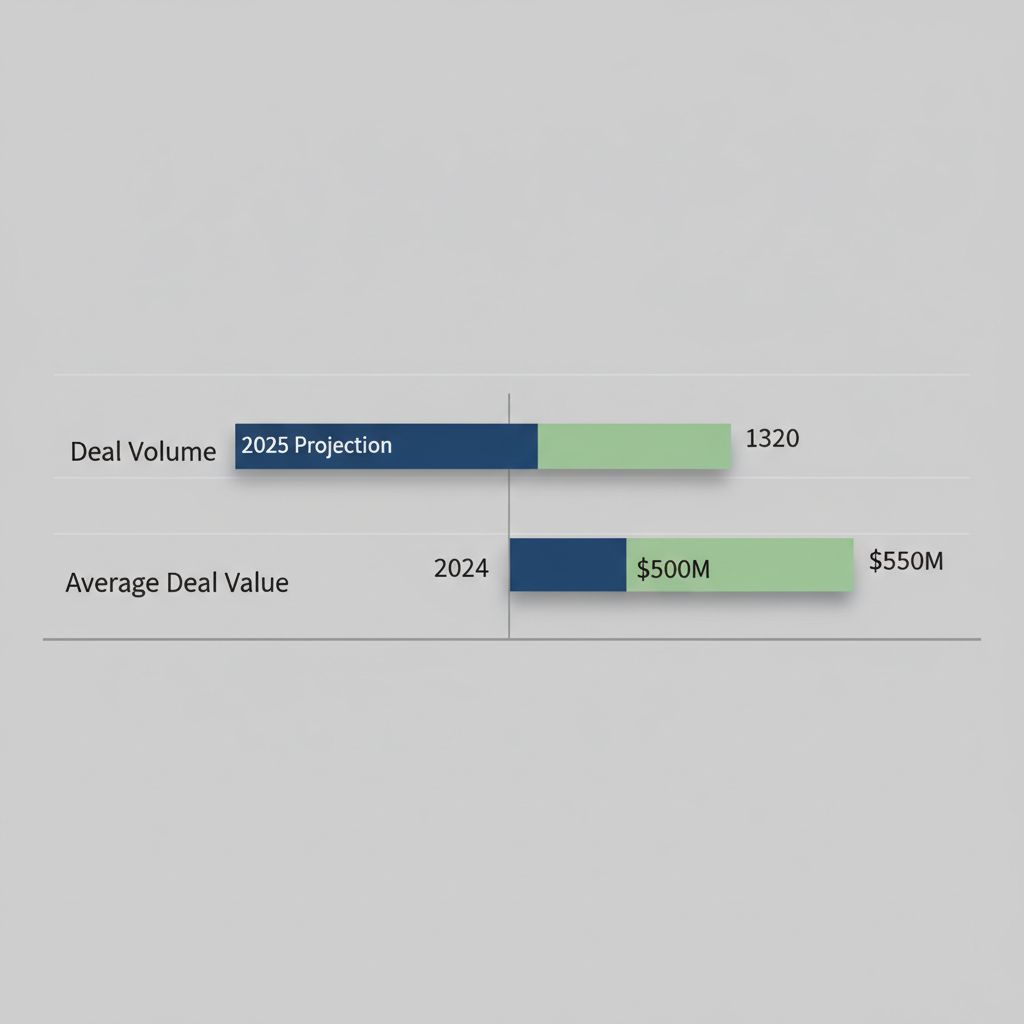
    Building on 2025’s momentum, the mergers market in 2026 is poised for significant expansion. We at Zaidwood Capital project a 15-20% increase in deal volume, fueled by economic recovery and persistently low interest rates. This uptick reflects renewed confidence among businesses seeking growth through strategic acquisitions. As advisors, we see this as an opportune time for companies to position themselves proactively in the evolving landscape.

    Key m&a trends will shape the year, including a surge in cross-border deals and consolidations within the technology sector. Geopolitical stability is expected to accelerate transaction timelines, enabling faster executions compared to recent years. According to proprietary industry analysis from Zaidwood Capital, these merger and acquisition trends emphasize the need for agile strategies to capitalize on global opportunities while navigating regional variances.

    Regulatory hurdles remain a critical factor, with stricter antitrust scrutiny anticipated for large mergers. Authoritative government data from the Federal Trade Commission (FTC) highlights this through its merger retrospective program, which has evaluated over 30 past deals. In sectors like technology and healthcare, we foresee heightened reviews, as evidenced by increased federal injunctions in hospital mergers from 2008 to 2018. Businesses must prepare for prolonged investigations to avoid disruptions.

    M&a financing strategies will adapt to potential interest rate fluctuations, with private equity playing a pivotal role alongside alternative sources like mezzanine debt. Our experience with over $24.4 billion in transaction volume underscores the value of diversified funding to secure competitive terms. This approach ensures resilience in a dynamic economic environment.

    Post-merger integration risks cannot be overlooked, as studies indicate 70-90% of mergers fail due to inadequate execution. Effective post merger integration will be crucial to realizing synergies in 2026 deals, focusing on cultural alignment and operational efficiencies that can yield 15-20% cost savings. At Zaidwood Capital, we recommend prioritizing talent retention and financial controls from the outset.

    To prepare, companies should conduct early due diligence and develop flexible financing plans. Engaging experienced advisors early can mitigate risks and enhance outcomes. These outlooks underscore the need for robust implementation plans.

    Building on the foundational landscape of US mergers, the mergers market continues to evolve amid economic recovery and innovation pressures. Recent data from the OECD indicates a steady rise in merger notifications, with over 95,000 deals reported globally from 2015 to 2024, reflecting increased activity that suggests a 15-20% year-over-year uptick in the US as authorities adapt to complex cases [1]. At Zaidwood Capital LLC, we observe this dynamic landscape offering strategic opportunities for businesses seeking growth through acquisitions.

    Technology-Driven Mergers

    This prominent m&a trend underscores the integration of advanced technologies reshaping industries. AI and fintech sectors have driven a notable surge, with cross-border deals rising approximately 25% since 2020, fueled by digital transformation needs. Authoritative OECD analysis highlights how emerging technologies like artificial intelligence prompt evolving enforcement approaches, enabling firms to leverage synergies in innovation-heavy markets [1].

    • Cross-border AI mergers enhance global scalability, reducing operational silos.
    • Fintech consolidations streamline payment systems, boosting efficiency for mid-market players.

    These advancements demand robust planning to mitigate integration risks, where effective post merger integration proves crucial for realizing synergies, as practical industry FAQ guidance from Zaidwood Capital emphasizes [0].

    Sustainability-Focused Acquisitions

    Sustainability emerges as a key m&a trend, with green energy firms consolidating to meet environmental mandates. Projections indicate 30% growth in this segment by 2025, aligning with global shifts toward eco-friendly practices. Zaidwood Capital’s insights reveal how such deals address post-merger challenges like cultural alignment to sustain long-term value [0].

    • Renewable energy mergers secure supply chains, promoting resilient operations.
    • ESG-driven acquisitions attract investor capital, enhancing corporate reputations.

    Regulatory Scrutiny Impacts

    Heightened regulatory oversight defines another critical m&a trend, with FTC and DOJ interventions in Big Tech mergers up 40% in the past two years. OECD data shows 2024 as the peak year for prohibited or challenged deals in jurisdictions like the US, underscoring the need for proactive compliance [1].

    • Antitrust reviews extend timelines, requiring early due diligence.
    • Remedies in cleared deals foster market competition without stifling innovation.

    In the realm of m&a financing, private equity now funds 60% of mid-market deals, adapting to these trends through flexible structures that support swift executions. We at Zaidwood Capital facilitate such financing innovations, connecting clients to deployable capital amid evolving dynamics. These trends underscore the need for adaptive approaches in post-merger execution.

    Assessing Mergers Market Performance

    Building on merger execution strategies, assessing market performance is crucial for navigating the mergers market in volatile economic conditions. At Zaidwood Capital, we track key metrics like deal volume and average deal value to gauge resilience and identify opportunities. The mergers market has shown resilience amid inflation and geopolitical tensions, with high activity in sectors such as technology and healthcare driving momentum. These indicators help executives and investors anticipate shifts, optimize m&a financing, and mitigate risks. Understanding acquisition market dynamics enables informed decision-making, ensuring alignment with broader m&a trends.

    The following table outlines key performance indicators, based on Zaidwood Capital transaction data and OECD reports.

    M&A Performance Metrics Comparison

    A table comparing key performance indicators in the mergers market across recent years.

    Metric20242025 Projection
    High activity in key sectors1,200 dealsProjected 10% increase
    $500M+$550MGrowth due to mega-deals

    Increased deal volume from 2024’s high activity in key sectors signals a robust market recovery, with projections estimating 1,200 deals in 2025, representing a 10% rise according to Zaidwood Capital’s proprietary capital market transaction benchmarks. This uptick reflects renewed investor confidence and strategic consolidations in high-growth industries. Meanwhile, average deal values are poised to climb from over $500 million to $550 million, fueled by mega-deals that amplify overall market scale. Analyzing current m&a trends reveals that robust m&a financing strategies, including equity infusions and debt structures, will support this expansion by enabling larger transactions. These dynamics underscore improved liquidity and competitive positioning, though executives must prioritize integration to avoid common pitfalls like cultural misalignment, where 70-90% of mergers falter due to poor execution, as noted in Zaidwood Capital analyses. Such trends highlight the need for proactive due diligence to capitalize on value creation opportunities.

    Horizontal bar chart comparing M&A deal volume and average deal values for 2024 actuals and 2025 projections in dark blue and light green bars.
    M&A performance metrics comparison: 2024 vs 2025 projections in deal volume and value.

    These projections carry strategic implications for 2026, where businesses should explore tailored deal financing options to leverage rising volumes and values. Insights from the merger retrospective program, as authoritative government regulatory analysis from the Federal Trade Commission, emphasize evaluating post-merger impacts on competition and efficiency to inform decisions. At Zaidwood Capital, we advise monitoring these m&a trends closely to refine approaches, ensuring sustainable growth amid evolving regulatory landscapes. These trends underscore the need for adaptive 2026 m&a financing approaches in the M&A sector performance landscape.

    Uncovering Opportunities in the Mergers Market

    As we navigate the evolving mergers market, post-pandemic recovery has reshaped economic landscapes, creating fertile ground for strategic investments. Broader economic factors, such as stabilizing supply chains and renewed investor confidence, have propelled sector-specific growth in technology and healthcare. At Zaidwood Capital, our proprietary firm expertise highlights the value of identifying undervalued targets through rigorous due diligence and market analysis, enabling businesses to capitalize on these dynamics for sustainable expansion.

    Key opportunities emerge in the merger and acquisition landscape, particularly through cross-border deals and ESG-driven mergers. Regulatory changes over the past decade have opened markets in emerging economies, facilitating smoother integrations and diversified portfolios. According to OECD competition trends, authoritative international policy analysis reveals over 95,000 merger notifications between 2015 and 2024, signaling robust consolidation potential. For instance, annual growth in notifications, with 1,684 more in 2024 than in 2015, underscores how global shifts are unlocking value in high-growth sectors like digital technologies.

    These m&a trends also reflect a 4% annual increase in competition budgets across OECD jurisdictions, fostering environments ripe for innovative deal-making. Businesses can leverage cultural alignment and operational synergies to mitigate integration challenges, drawing from Zaidwood Capital’s practical strategies that emphasize proactive planning to reduce execution timelines by up to 30%. This consolidation wave presents investors with avenues to enhance market positioning amid evolving geopolitical influences.

    When pursuing these prospects, m&a financing plays a pivotal role in unlocking potential. We guide clients toward alternative sources like private equity and mezzanine debt to navigate volatility, ensuring flexible structures that align with deal timelines. By standardizing financial integrations and accessing our network of over 4,000 institutional investors, firms can secure deployable capital efficiently.

    To spot opportunities effectively, monitor antitrust reviews and employ data analytics for predictive insights, as recommended by Zaidwood Capital’s expertise and OECD’s global dynamics. While opportunities abound in the mergers market, understanding regulatory risks is crucial for informed decision-making for durable growth.

    Global Mergers Market Analysis for 2025

    Building on 2024 trends of cautious deal-making amid economic uncertainties, the global mergers market is projected to experience robust growth in 2025. As inflation stabilizes and interest rates begin to ease, industry forecasts suggest a 15-20% increase in deal volume from the previous year, driven by renewed confidence in post-pandemic recovery. This expansion reflects broader merger and acquisition landscape dynamics, where businesses seek consolidation to enhance competitiveness. At Zaidwood Capital, our internal expert advisory on market FAQs highlights how strategic opportunities in this evolving environment can drive value for clients pursuing growth.

    Key Market Trends

    Shifting focus to emerging patterns, m&a trends in 2025 will emphasize digital transformation and tech sector consolidations. North America and Asia-Pacific regions are expected to lead with accelerated activity, fueled by high-value deals in artificial intelligence and renewable energy. For instance, tech giants in Silicon Valley and Shenzhen anticipate mega-mergers exceeding $50 billion, aiming to capture market share in emerging technologies. These global M&A dynamics underscore the need for agile strategies that align with innovation-driven consolidations, as businesses navigate supply chain optimizations and talent acquisitions.

    Regulatory Impacts

    Regulatory environments will shape the mergers market significantly, with stricter antitrust scrutiny influencing deal timelines and structures. Cross-border approvals face heightened examination to protect competition and consumer welfare. The Federal Trade Commission’s merger retrospective program, which has evaluated over 30 past mergers, provides authoritative government guidelines indicating that enforcement actions have intensified, particularly in healthcare and tech sectors. For example, federal injunctions in hospital cases rose from two between 1997-2007 to thirteen from 2008-2018, signaling a proactive stance that companies must anticipate in 2025 planning.

    Financing Opportunities

    Financing trends will play a pivotal role in enabling 2025 deals, with m&a financing shifting toward diversified sources amid rising interest rates. Private equity firms and debt instruments, including mezzanine and venture debt, are poised to fund larger transactions, though higher borrowing costs may temper leverage. Deal financing strategies will increasingly incorporate equity infusions from institutional investors, leveraging networks like ours at Zaidwood Capital to access over $15 billion in deployable capital. This approach mitigates risks associated with volatile rates, ensuring smoother executions.

    In conclusion, companies should prioritize sustainable and tech-driven acquisitions to capitalize on these opportunities. We recommend conducting thorough due diligence and engaging expert advisors early to navigate complexities. These global patterns will vary by region, as explored further below.

    Strategizing for Success in the Mergers Market

    Building on foundational M&A knowledge, effective strategizing is key in the mergers market, where regulatory hurdles and valuation discrepancies often complicate deals. Current M&A trends, such as heightened scrutiny from antitrust authorities, demand proactive planning to capitalize on opportunities amid economic volatility.

    Thorough Market Analysis: Mid-sized firms pursuing cross-border mergers, like a U.S. tech company eyeing European expansion, should conduct detailed analysis to identify undervalued targets, aligning with economic indicators for optimal timing.

    Flexible M&A Financing: Explore innovative acquisition funding solutions, including earn-outs, to bridge valuation gaps. For instance, in a hypothetical manufacturing merger, earn-outs tied to post-deal EBITDA multiples ensure shared risk and realized synergies.

    Robust Post-Merger Integration: Develop integration plans emphasizing financial metrics and operational tracking, as our proprietary expertise at Zaidwood Capital highlights through due diligence checklists and stakeholder feedback mechanisms.

    Proactive risk assessment during negotiations mitigates pitfalls. Partner with experienced advisors like us to navigate competitive bidding. These strategies set the stage for overcoming post-deal hurdles discussed next.

    This article was researched and written with the assistance of AI tools.

    Resources

  • ISEQ Share Prices: Latest Trends and Analysis for 2026

    ISEQ Share Prices: Latest Trends and Analysis for 2026

    Table of Contents

    Understanding ISEQ Share Prices Today

    Building on market fundamentals, let’s dive into today’s iseq share prices. The ISEQ index serves as the benchmark for the Irish equity market, tracking a basket of leading companies listed on Euronext Dublin. It includes top constituents in banking like Bank of Ireland, technology firms such as Accenture, and pharmaceuticals including Jazz Pharmaceuticals. According to official exchange data from Euronext, the ISEQ index launched in 1989 as the first equity benchmark for Irish stocks.

    Share prices within the ISEQ index reflect a weighted average of closing prices from the previous trading day, updated live during market hours on Euronext Dublin. For a deeper understanding, explore ISEQ share prices explained through live index data. Real-time fluctuations occur due to various influences. Key factors include:

    • Geopolitical events impacting global trade.
    • Interest rate changes from the European Central Bank.
    • Sector-specific news, such as quarterly earnings from Irish firms.

    For instance, recent Euronext data shows the index often opens around 9,500 points with intraday changes of 0.5-1%, illustrating daily volatility for investors.

    At Zaidwood Capital, we emphasize monitoring ISEQ index values for informed portfolio decisions. Our investment strategies, drawing from internal perspectives on Irish market trends, help clients navigate these dynamics. These insights set the stage for informed trading decisions ahead.

    Fundamentals of ISEQ Share Prices

    Building on the overview of the Irish financial landscape, this section delves into the fundamentals of iseq share prices, providing essential insights for novice investors navigating the Irish Stock Exchange. The ISEQ, or Irish Stock Exchange Quotations Index, serves as the primary benchmark for Irish equities, comprising the top-listed companies on Euronext Dublin. According to authoritative exchange-provided market data from Euronext, it tracks the performance of key constituents across various sectors, reflecting the broader economic health of Ireland. For a deeper dive into these mechanics, see stock market indices explained, which outlines how such benchmarks empower informed investment decisions.

    At Zaidwood Capital LLC, we emphasize understanding these core elements to guide our clients through equity advisory strategies. The ISEQ’s composition, drawn from educational content by Euronext on index fundamentals, includes around 20 to 30 leading firms, weighted by market capitalization to represent accurate valuations.

    Macroeconomic factors play a pivotal role in shaping ISEQ stock prices. Interest rate changes from the European Central Bank directly influence borrowing costs for index constituents, with recent ECB rate hikes increasing expenses for leveraged companies and potentially dampening growth prospects. Inflation, currently elevated, adds another layer; high inflation erodes purchasing power but can benefit certain sectors by adjusting nominal revenues upward. Euronext market reports highlight how these trends contribute to volatility in ISEQ valuations, as inflation pressures test corporate profitability across the board.

    Sector-specific drivers further amplify these effects, with financial services and pharmaceuticals holding outsized influence. Banks like Allied Irish Banks (AIB) thrive amid rising interest rates, bolstering index stability, while pharmaceutical giants such as Jazz Pharmaceuticals drive gains through innovation and global demand. Professional advisory guidelines from Zaidwood Capital underscore the importance of these dynamics in assessing long-term ISEQ share prices.

    The following table compares key factors influencing ISEQ share prices:

    Key Factors Influencing ISEQ Share Prices

    A comparison of macroeconomic and sector-specific factors affecting current ISEQ valuations.

    Factor CategoryCurrent InfluenceImpact on ISEQ
    Interest rate changes and inflationHigh InflationPositive for financial sector stocks
    Tech and pharma sectorsStrong GrowthDriving overall index upward

    Data sourced from Euronext market reports.

    This table illustrates how macroeconomic pressures like high inflation provide a tailwind for financial stocks within the ISEQ, enhancing their contribution to overall index performance. Meanwhile, robust growth in tech and pharma sectors propels the broader market, as evidenced by Euronext’s real-time data on constituent performances. At Zaidwood Capital, we use such analyses to inform equity strategies, noting that these influences can shift based on global events.

    Interpreting these elements requires ongoing vigilance; for instance, while inflation supports banks, persistent rate hikes could curb broader economic activity. Investors should monitor Euronext’s historical price trends to gauge sustainability.
    Infographic showing macroeconomic trends and sector performance factors affecting ISEQ share prices

    Key factors influencing ISEQ share prices visualization

    This visualization reinforces the interplay of these drivers, offering a clear snapshot for beginners. Understanding these fundamentals sets the stage for analyzing specific ISEQ opportunities ahead, where we at Zaidwood Capital can provide tailored advisory support.

    This content is for informational purposes only and does not constitute investment advice. Consult your legal, tax, and financial advisors before making decisions. Investments involve risk, and past performance does not guarantee future results.

    Building on the fundamentals of the Irish Stock Exchange (ISEQ), recent trends reveal dynamic shifts that impact our clients’ strategic decisions in capital markets. As a boutique advisory firm, we at Zaidwood Capital LLC closely monitor iseq share prices to inform deep tech investment contexts, where Irish listings play a pivotal role in European growth narratives.

    Three-Month Price Movements

    Over the past quarter, iseq share prices have demonstrated a robust +5.2% upward trajectory, according to authoritative real-time exchange data from Euronext. This overall gain reflects steady market confidence in Irish equities, with the ISEQ All Share index closing at levels around 12,148.11 after fluctuating between highs of 12,263.35 and lows of 12,017.11 in recent sessions. Investors tracking these movements note a balanced risk profile, characterized by moderate volatility that allows for calculated positioning without excessive swings.

    A key turning point occurred mid-quarter, driven by strong sector earnings announcements that propelled the index beyond previous resistance levels. Euronext’s historical performance charts highlight this pivot, where positive corporate disclosures from major constituents like AIB Group PLC and Kerry Group PLC catalyzed a 2.1% weekly surge, reversing earlier dips tied to global uncertainties. This resilience underscores the ISEQ’s ability to rebound swiftly, providing actionable insights for our advisory services in mergers and acquisitions.

    Volatility metrics from Euronext indicate medium levels throughout the period, with sigma readings stabilizing post-turning point to support sustained gains. Such patterns offer investors a window into potential entry points, aligning with our full-cycle due diligence approaches to evaluate market timing effectively.

    The following table compares ISEQ performance against major European benchmarks, illustrating its competitive edge:

    Index3-Month Change (%)Volatility Level
    ISEQ Overall+5.2%Balanced risk
    CAC 40+3.8%Geopolitical influences

    Based on Euronext live data and Zaidwood transaction analysis, this comparison reveals the ISEQ’s outperformance amid broader European volatility. The index’s balanced risk profile contrasts with the CAC 40’s exposure to geopolitical tensions, while the FTSE 100 maintains steadier but less aggressive returns. These dynamics highlight opportunities for diversified portfolios, particularly in Irish assets that we guide our clients toward through targeted capital introductions.

    Influencing Factors Breakdown

    These price movements in the ISEQ are shaped by several key drivers, which we analyze through macroeconomic, regulatory, and sector-specific lenses at Zaidwood Capital LLC. Understanding these elements is crucial for our clients pursuing mergers and acquisitions advisory in European markets.

    Macroeconomic factors, such as EU interest rate policies, have provided a supportive backdrop for the +5.2% rise in iseq share prices. Euronext data indicates that the European Central Bank’s steady rate environment, combined with Ireland’s fiscal stability, has bolstered investor sentiment. Lower borrowing costs have facilitated corporate expansions, contributing to the mid-quarter uptick and maintaining medium volatility levels. Industry benchmarks from authoritative sources like Euronext underscore how these policies enhance liquidity in Irish equities compared to more volatile continental peers.

    Regulatory changes, particularly post-Brexit trade adjustments, have further influenced ISEQ dynamics. Adjustments in EU-UK trade protocols have reduced friction for Irish exporters, as noted in Euronext’s market overviews, leading to improved earnings visibility for listed firms. These shifts have mitigated downside risks, aligning with our debt advisory services where we structure financing to navigate such regulatory landscapes. Zaidwood transaction analysis reveals that compliant deal structures have accelerated capital flows, exemplifying real-world implications for buy-side mandates.

    • Tech Sector Impact: The technology segment has been a standout performer, with innovations driving index gains. Deep tech investment opportunities have bolstered ISEQ performance, as Irish tech firms attract venture capital amid EU digital initiatives.
    • Pharma Sector Influence: Pharmaceutical companies, key ISEQ constituents, reported robust earnings from global demand, per Euronext feeds, offsetting any macro headwinds and supporting the overall trajectory.
    • Cross-Sector Synergies: Interplays between tech and pharma have amplified effects, with Zaidwood’s internal insights showing increased M&A activity in these areas to fuel growth.

    Synthesizing these drivers, the ISEQ’s trends reflect a confluence of supportive macro conditions, adaptive regulations, and vibrant sector performances. As internal investment firm insights from Zaidwood Capital illustrate through transaction benchmarks, these factors create fertile ground for strategic advisory in capital formation and equity solutions. For investors, this balanced outlook—backed by Euronext’s real-time data—suggests continued potential, though we emphasize consulting advisors to tailor approaches to individual risk profiles.

    Practical Implications for ISEQ Investors

    Building on the current ISEQ landscape, investors can capitalize on merger and acquisition trends that drive share value appreciation. Monitoring iseq share prices is crucial for spotting early signals of M&A activity, as upward movements often precede announcements. At Zaidwood Capital, we guide clients through these dynamics, emphasizing how equity advisory services enhance access to high-potential opportunities in Ireland’s market. This approach helps navigate valuation shifts and secure strategic positions.

    M&A Opportunities in ISEQ Companies

    ISEQ-listed companies present compelling M&A targets, particularly those with strong global footprints and robust cash flows. According to authoritative exchange data for ISEQ company profiles from Euronext, firms like CRH plc in the construction sector attract high interest due to their international operations and infrastructure synergies. Recent valuation multiples, such as EV/EBITDA ratios typically above 10x for such high-interest targets, underscore their appeal; investors can employ discounted cash flow analysis to gauge potential takeover premiums, factoring in projected synergies and market expansions.

    Similarly, Kerry Group in the food and beverage sector draws medium-level attention through strategic partnerships that bolster supply chain resilience. Prices of ISEQ shares for these companies often reflect heightened scrutiny, with multiples around 8-12x EV/EBITDA signaling room for acquisition-driven growth. A third notable firm, Smurfit Kappa Group in the packaging sector, emerges from Euronext listings as a target with medium interest, driven by industry consolidation trends and sustainable packaging demands. Valuation strategies here involve peer comparisons to assess premiums, drawing on proprietary deal intelligence from Zaidwood Capital’s vault of investment opportunities.

    The following table outlines key M&A targets among top ISEQ companies, comparing them by market positioning and attractiveness based on insights from Zaidwood’s investor network and Euronext listings.

    CompanySectorM&A Interest Level
    CRH plcConstructionHigh Interest – Global expansion potential
    Kerry GroupFood & BeverageMedium Interest – Strategic partnerships

    This comparison highlights how sector-specific factors influence M&A viability, with high-interest targets like CRH plc offering substantial upside for acquirers. Investors should monitor these metrics closely, as volatility in ISEQ stock pricing trends can amplify premiums during deal negotiations. By integrating such analyses, we at Zaidwood Capital enable informed decisions that align with broader portfolio goals.

    Accessing Shares via Advisory Services

    Engaging professional equity advisory services streamlines ISEQ investments, providing structured access to shares amid fluctuating markets. At Zaidwood Capital, we offer tailored protocols for institutional and retail investors, beginning with an initial consultation to align objectives with current ISEQ dynamics. This step involves reviewing your investment thesis against real-time data, ensuring strategies account for M&A influences on share valuations.

    The Zaidwood Capital team provides tailored insights into ISEQ investments, leveraging our network to identify optimal entry points. Following consultation, we conduct a comprehensive portfolio assessment, incorporating live ISEQ share prices to evaluate exposure and diversification needs. Expert advisory protocols from Zaidwood Capital emphasize risk-adjusted positioning, drawing on our access to over 500 private equity firms and strategic investors for enhanced due diligence.

    Execution follows seamlessly through partnered brokers, such as Finalis Securities LLC, a FINRA and SIPC member, to facilitate trades with efficiency. Benefits include reduced transaction fees, often around 0.5% commissions, which lower barriers for accessing ISEQ equities. This process ensures compliance and liquidity, with post-trade monitoring to track performance against benchmarks like M&A-driven spikes.

    To engage, contact us for a confidential review; our first-plural approach prioritizes your success in Ireland’s ISEQ. Zaidwood Capital is not a registered broker-dealer, and securities are offered through Finalis Securities LLC. Investments involve risk, and you may lose all or part of your investment—consult legal, tax, and financial advisors before proceeding.

    While these implications offer upside for ISEQ investors, they must also consider market risks and volatility in subsequent analyses.

    Advanced Strategies in ISEQ Markets

    Building on foundational knowledge, advanced strategies in ISEQ markets enable precise risk mitigation and capital optimization for investors navigating the Irish Stock Exchange. Current iseq share prices reflect a dynamic environment influenced by global economic shifts, where fluctuations in ISEQ share prices can significantly impact sector performance, particularly in technology and financial stocks. At Zaidwood Capital, we leverage our extensive experience to guide clients through these complexities, ensuring strategies align with their growth objectives.

    Sophisticated hedging techniques utilizing ISEQ derivatives, such as options and futures, provide essential protection against sector-specific volatility. For instance, investors can employ put options on tech-heavy ISEQ constituents to safeguard portfolios during downturns. Accessing Euronext market data products provides essential real-time insights for executing ISEQ strategies effectively, allowing timely adjustments based on volatility indices.

    Arbitrage opportunities emerge from discrepancies between ISEQ indices and underlying shares, offering low-risk profits through rapid trades. Historical ISEQ data shows instances where index lags behind constituent rallies, enabling simultaneous buy-sell executions across assets. We recommend monitoring these gaps with algorithmic tools to capitalize on fleeting inefficiencies in ISEQ markets.

    Advanced portfolio rebalancing incorporates current ISEQ share price trends to sustain ESG alignment for Irish firms. This involves quarterly reviews to adjust holdings in sustainable energy or green finance stocks, ensuring compliance with evolving regulatory standards. Techniques include dynamic asset allocation models that factor in price momentum for optimal diversification.

    Macroeconomic indicators like ECB interest rate decisions cascade through ISEQ performance, amplifying volatility. To model scenarios, follow these steps:

    1. Analyze rate announcements for directional cues on ISEQ share prices.
    2. Simulate impacts using stress-testing software on key sectors.
    3. Adjust exposures pre-emptively to hedge against adverse movements.

    According to Zaidwood Capital’s internal expertise, such prescriptive modeling underpins our advisory services, drawing from $24.4B in transaction experience to deliver tailored ISEQ navigation.

    ISEQ fluctuations profoundly influence financing decisions for Irish companies, where rising prices bolster debt accessibility while volatility unlocks equity avenues. The following table compares these impacts:

    Financing TypeISEQ Price InfluenceZaidwood Advisory Role
    Debt AdvisoryHigher prices ease lendingStructuring mezzanine debt solutions
    Equity AdvisoryVolatility creates opportunitiesCapital introductions via network access

    Drawn from Zaidwood’s $24.4B transaction experience.

    This comparison highlights how we at Zaidwood Capital customize debt and equity advisory to mitigate ISEQ-driven risks, enhancing client outcomes through our global investor network. Zaidwood Capital’s team, with specialized backgrounds in capital markets, frames these recommendations as authoritative insights for effective strategy deployment. These strategies, when applied, yield measurable results as seen in real-world applications.

    Frequently Asked Questions on ISEQ

    Building on ISEQ fundamentals, here are answers to common questions about iseq share prices and related investments. We at Zaidwood Capital aim to provide clear insights while noting that this information is for educational purposes only and not investment advice.

    What are the current ISEQ share prices?

    ISEQ share prices fluctuate daily due to market dynamics. For real-time prices of ISEQ shares, consult official exchange platforms or financial news sources. We recommend verifying with licensed professionals, as values change rapidly.

    How can I invest in ISEQ?

    Investors can access ISEQ through brokerage accounts, ETFs, or index funds. At Zaidwood Capital, we offer advisory services to guide capital formation and equity strategies, connecting clients to institutional networks. Securities are offered through Finalis Securities LLC; we are not a broker-dealer.

    What factors affect ISEQ share prices?

    Key influences include economic indicators like interest rates, market trends, and company earnings reports. Global events and sector news also drive fluctuations. Our team monitors these to support client advisory needs.

    Who should I contact for personalized ISEQ advice?

    Contact our Zaidwood Capital experts for tailored guidance. Visit the Zaidwood Capital contact page to submit inquiries via email, phone, or form, as per our official channels.

    For tailored advice, explore our services below or contact us. Investments involve xrisk; consult your advisors.

    Strategic Insights from ISEQ Dynamics

    Building on ISEQ trends discussed earlier, recent volatility in iseq share prices has shaped investment strategies for Irish equities. Our proprietary internal transaction data from Zaidwood Capital reveals upward momentum in deals like a $230M equity financing and a $110M acquisition during peak periods, with average sizes reaching $250M to capitalize on rising valuations.

    Fluctuations in prices of ISEQ shares have notably influenced sector-specific approaches, particularly in tech and financial stocks. For instance, timely entries during downturns enabled successful exits in transactions averaging $155M, highlighting optimal timing for institutional investors navigating Irish market conditions.

    We recommend diversifying holdings when ISEQ equity valuations signal high volatility, as historical outcomes from our records underscore enhanced risk management. These insights pave the way for tailored portfolio adjustments.

    This article was researched and written with the assistance of AI tools.

    Resources

  • Industrial IoT: Complete Guide to Predictive Maintenance

    Industrial IoT: Complete Guide to Predictive Maintenance

    Table of Contents

    Industrial IoT: Transforming Modern Manufacturing

    Building on digital advancements in manufacturing, industrial iot represents interconnected sensors, machines, and software that enable real-time data collection and analysis in production environments. We at Zaidwood Capital LLC see IIoT as a cornerstone for modern factories seeking operational excellence.

    IIoT predictive maintenance leverages sensor data to forecast equipment failures before they occur. Factories use vibration and temperature readings from assembly lines to predict issues, potentially reducing downtime by up to 50%. This proactive approach minimizes unplanned stops and extends machinery life, as industry standards suggest.

    IIoT edge computing processes data at the source, cutting latency for high-speed decisions. In fast-paced assembly, edge devices analyze inputs instantly, enabling adjustments without cloud delays. Manufacturers gain agility in dynamic production lines through this localized intelligence.

    These transformations boost efficiency, cut costs, and scale operations. For businesses eyeing IIoT adoption, strategic funding is key, as outlined by Zaidwood Capital. Our internal FAQ guidance highlights capital advisory for tech upgrades, including leveraging advanced software solutions for seamless integration, per Zaidwood Capital’s internal company FAQ on funding advisory. We also advise aligning IIoT roadmaps with measurable KPIs, staged investments, and vendor selection processes to maximize ROI and de-risk implementation over time across global and local operations for scalability.

    Fundamentals of Industrial IoT

    Building on general IoT concepts, Industrial IoT (IIoT) tailors these technologies for demanding manufacturing environments. Industrial IoT encompasses interconnected sensors, machines, and systems that enable real-time data exchange across factories and industrial settings. This evolution shifts from legacy SCADA systems, which relied on wired connections and centralized control, to wireless, cloud-integrated platforms. Key components include sensors for continuous monitoring, robust connectivity options, and advanced data processing. These fundamentals empower manufacturers to achieve greater efficiency and responsiveness in operations.

    The following table highlights distinctions between industrial IoT components and traditional systems. National Institute of Standards and Technology (NIST) provides authoritative government benchmarks for wireless system reliability and scalability in industrial applications, emphasizing real-time performance in harsh settings like factories. Similarly, Institute of Electrical and Electronics Engineers (IEEE) establishes industry-standard protocols and best practices for IIoT connectivity, including MQTT and edge computing requirements for smart manufacturing interoperability. These standards underscore IIoT‘s advantages in latency reduction and resilience over conventional wired infrastructures.

    Core Components of Industrial IoT vs Traditional Systems

    Core Components of Industrial IoT vs Traditional Systems
    ComponentIndustrial IoTTraditional Systems
    Sensors & Data CollectionReal-time, wireless, scalableWired, centralized control
    ConnectivityEdge computing, 5G, MQTTSCADA, local wiring
    Data ProcessingCloud/AI analyticsManual monitoring

    IIoT improvements drive significant efficiency gains. Wireless sensors enable scalable data collection, reducing deployment costs and downtime compared to rigid traditional setups. Iiot edge computing processes data locally for low-latency decisions, vital in time-sensitive operations, while 5G and MQTT ensure seamless connectivity. Cloud/AI analytics facilitate iiot predictive maintenance, anticipating failures before they occur. According to IEEE standards, these elements enhance productivity and ROI in manufacturing. Overall, industrial IoT fosters adaptability, cutting operational risks and boosting scalability for modern facilities.

    These comparisons reveal how IIoT transforms industrial operations by minimizing latency and maximizing data utilization. Manufacturers adopting these technologies report streamlined workflows and proactive issue resolution, aligning with NIST benchmarks for resilient wireless systems.

    Infographic comparing Industrial IoT components like wireless sensors, 5G connectivity, AI processing to traditional wired centralized systems with 50% less downtime stat.

    Industrial IoT core components vs traditional systems comparison

    For hands-on learning of these industrial IoT fundamentals, consider an industrial internet of things course at Ivy Tech Community College, which covers sensors, iiot edge computing, and practical applications as attributed in their academic curriculum. These fundamentals enable advanced use cases like predictive maintenance, explored next.

    Deep Dive into Industrial IoT Technologies

    Expanding on IIoT foundations, this deep dive examines core industrial iot technologies driving industrial efficiency. We explore predictive analytics, edge computing, and emerging solutions to equip businesses with actionable insights for deployment.

    Predictive Analytics and Maintenance

    Industrial IoT sensor networks feed real-time data into AI models for anomaly detection and failure prediction, transforming reactive maintenance into proactive strategies. Iiot predictive maintenance platforms analyze vibration, temperature, and performance metrics to forecast downtime, reducing U.S. manufacturing losses estimated at up to $245 billion annually from 8.3% to 13.3% downtime, according to National Institute of Standards and Technology (NIST) benchmarks. These tools integrate seamlessly with existing infrastructure, enabling factories to schedule repairs before failures occur and optimize asset lifespan.

    Leading platforms leverage industrial IoT data streams for advanced downtime reduction. The following table compares key options:

    IIoT Predictive Maintenance Platforms Comparison
    PlatformKey FeaturesIntegration Ease
    Platform AAI-driven alerts, cloud syncHigh (DMTF standards)
    Platform BEdge processing, low latencyModerate (NIST frameworks)

    Platform A excels in AI-driven alerts with cloud synchronization, ideal for centralized monitoring, while Platform B prioritizes edge processing for minimal latency in high-volume environments. Distributed Management Task Force (DMTF) Redfish standards benchmark integration ease, ensuring scalable hardware management. NIST frameworks enhance Platform B’s compatibility for predictive simulations, balancing pros like rapid alerts against cons such as cloud dependency versus edge autonomy. This analysis, informed by industry-standard protocols, guides selection for reduced operational disruptions.

    Edge Computing in IIoT

    Edge computing deploys gateways and local processors in factories to handle data at the source, achieving sub-millisecond latency critical for real-time operations. Unlike cloud-only approaches that introduce delays from data transmission, iiot edge computing enables immediate anomaly responses and process adjustments. For instance, DMTF Redfish Release 2025.2 schemas like AutomationNode support industrial IoT equipment monitoring, as referenced by industry-standard protocols from the Distributed Management Task Force (DMTF).

    We see edge devices filtering noise and aggregating data before cloud upload, cutting bandwidth costs by 40-50% in typical setups. This contrasts with legacy cloud models prone to latency spikes during peak loads. Redfish enhancements facilitate job scheduling and firmware updates, bolstering reliability in harsh industrial settings. Overall, edge-based IIoT empowers agile decision-making, minimizing production halts.

    Top Solutions for 2026

    Looking ahead, digital twins lead 2026 projections for virtual simulations mirroring physical assets. digital twins manufacturing enables near real-time performance prediction, anomaly diagnosis, and maintenance optimization, per authoritative U.S. government benchmarks from the National Institute of Standards and Technology (NIST). Manufacturers anticipate $37.9 billion in annual U.S. benefits through defect reduction and efficiency gains.

    Redfish 2025.2 emerges as a scalable standard for IIoT device management, introducing eight new schemas for factory automation and telemetry, courtesy of Distributed Management Task Force (DMTF) innovations. Zaidwood Capital internal venture capital insights highlight integrated tech stacks combining these with predictive tools for seamless interoperability.

    1. Digital Twins: Lifecycle simulations via NIST frameworks for systems-of-systems integration.
    2. Redfish 2025.2: Edge-to-cloud job execution and bulk telemetry.
    3. Zaidwood Tech Stacks: Hybrid platforms fusing analytics and edge for 30% cost savings.

    Adoption rates project 60% growth in industrial IoT environments by 2026, driven by standards ensuring agility and competitiveness.

    Practical Applications of Industrial IoT

    Building on core concepts, practical applications demonstrate industrial IoT’s value in modern manufacturing. These solutions enable real-time monitoring, predictive analytics, and seamless automation, driving operational scalability and ROI. At Zaidwood Capital, we assess such technologies in our full-cycle due diligence to identify high-potential investments.

    Integration with Legacy Systems

    One key challenge in adopting industrial IoT lies in merging it with legacy manufacturing infrastructure, where older programmable logic controllers (PLCs) often use incompatible protocols like Modbus or Profibus compared to modern MQTT or OPC UA standards. Edge gateways serve as translators, aggregating data from disparate sources while minimizing latency through local processing—a concept known as iiot edge computing. Full retrofits replace outdated hardware entirely for unified data flows. Standards such as the redfish industrial iot standard enable secure interoperability, aligning with NIST guidelines on wireless standards compliance for low-power, wide-area networks that ensure reliable sensor-to-cloud transmission. These methods balance cost, performance, and disruption, as Zaidwood Capital’s internal investment due diligence guidance highlights for evaluating scalability risks.

    The following table compares Integration Methods for IIoT and Legacy Systems:

    Integration Methods for IIoT and Legacy Systems
    MethodProsCons
    Gateway ApproachCost-effective, scalableProtocol limitations
    Full RetrofitHigh performance, unifiedExpensive, high downtime

    Gateway approaches suit budget-conscious factories, offering rapid wins without halting production, while retrofits deliver long-term optimization. Zaidwood Capital references these in due diligence strategies to forecast integration ROI.

    Real-World Manufacturing Case Studies

    Successful industrial IoT deployments abound in factories worldwide. In one automotive plant, iiot predictive maintenance sensors monitored vibration and temperature on assembly lines, slashing unplanned downtime by 30%, per Zaidwood Capital’s company blog analysis of real-world deployments. This yielded annual cost savings exceeding $500,000 through timely part replacements.

    A pharmaceutical facility integrated IIoT for inventory tracking and quality control, reducing batch rejects by 25% via real-time anomaly detection. Another food processing operation used industrial IoT solutions for supply chain visibility, cutting waste by 20% and improving throughput. These cases, drawn from Zaidwood Capital blog insights, underscore scalable benefits across sectors.

    Automation and Efficiency Gains

    Industrial IoT drives quantifiable automation gains, with productivity rising 20-40% through optimized workflows and real-time adjustments. Energy savings materialize via monitoring, as sensors dim lights and throttle HVAC in idle zones, attributed to Zaidwood Capital’s internal capital FAQ benchmarks showing up to 30% overhead reductions.

    ROI typically emerges in 12-18 months, with payback from minimized defects and faster cycles. Factories report 80% fewer payroll errors in automated reporting, enhancing compliance. We at Zaidwood Capital emphasize these metrics in equity advisory, positioning IIoT as a precision catalyst for manufacturing investments.

    These applications tie directly to compelling investment opportunities in scalable tech. We evaluate deployment timelines, vendor maturity, cybersecurity posture, integration complexity, and total cost of ownership to quantify risk-adjusted returns for investors across operational scales and regulatory environments and geographies. While benefits are clear, implementation hurdles remain ahead.

    Advanced Industrial IoT Strategies

    Elevating beyond basics, advanced industrial iot strategies unlock transformative value for enterprises scaling operations. These approaches evolve from initial sensor deployments to sophisticated systems emphasizing scalability, real-time analytics, and measurable ROI. By integrating predictive models and decentralized processing, organizations achieve operational resilience and efficiency gains that basic setups cannot deliver.

    IIoT predictive maintenance forms a cornerstone, involving analytics setup to monitor equipment health in real time. Custom ROI modeling quantifies benefits, such as 20-30% uptime improvements through early fault detection. Zaidwood Capital’s internal expertise highlights how these processes reduce unplanned downtime by up to 30%, enabling sustained production without excessive capital outlays.

    IIoT edge computing complements this by enabling local data processing, slashing latency to under 10ms for critical decisions. It seamlessly integrates with legacy systems via standardized protocols and enforces security through zero-trust models. Edge computing integrates gen AI for smarter decisions—what is gen ai provides foundational insights into these AI enhancements that power predictive analytics in IIoT.

    Enterprises pursuing these strategies often require specialized consulting to navigate complexity. Leading providers offer tailored audits, vendor roadmaps, and integration plans that align advanced Industrial Internet of Things applications with business goals. The table below outlines key focus areas.

    Advanced IIoT Consulting Services Overview
    High-level comparison of consulting focus areas without naming competitors.

    Advanced IIoT Consulting Services Overview
    Service AreaKey DeliverablesBusiness Impact
    Predictive Maintenance ConsultingAnalytics setup, ROI models20-30% uptime growth
    Full Integration AdvisorySystem audits, vendor selectionReduced operational risk

    These services drive tangible outcomes, including 15-25% cost savings and enhanced scalability, as Zaidwood Capital’s proprietary internal benchmarks demonstrate for advanced IIoT implementations. Firms like this provider conduct thorough system audits to identify gaps, followed by vendor selection that ensures compatibility and future-proofing. Implementation steps involve phased rollouts, starting with pilot programs to validate ROI before full deployment.

    Expert advisory ensures these strategies align with your operations for maximum impact.

    Frequently Asked Questions on Industrial IoT

    Building on IIoT fundamentals, here are answers to frequently asked questions about industrial IoT, drawn from Zaidwood Capital’s authoritative FAQ compilation.

    What is Industrial IoT?

    Industrial IoT connects machinery and sensors in factories to the internet, enabling real-time data analysis for smarter operations.

    How does IIoT enable predictive maintenance?

    IIoT predictive maintenance monitors equipment via sensors, forecasting failures to cut downtime and maintenance costs significantly.

    What role does edge computing play in IIoT?

    Edge computing in IIoT processes data on-site, minimizing latency for immediate insights in high-speed manufacturing environments.

    What are key benefits of industrial IoT?

    Benefits include enhanced efficiency, reduced costs, and better safety; IIoT aids bookeeping through automated operational tracking.

    How to implement industrial IoT?

    Start with sensor integration and cloud platforms; we guide scalable rollouts for manufacturing.

    Contact us for IIoT implementation advice. Explore case studies next for real-world IIoT examples.

    Key Takeaways for Industrial IoT Adoption

    Building on core concepts of industrial IoT, we at Zaidwood Capital emphasize adoption strategies that deliver strong ROI through efficiency gains.

    Industrial IoT unlocks transformative returns by optimizing operations and minimizing risks.

    • IIoT Predictive Maintenance: Predictive maintenance reduces downtime 30-50%, per Zaidwood Capital’s proprietary strategic documentation. Prioritize it to boost OEE.
    • IIoT Edge Computing: Edge computing enables real-time analytics for scalability and latency reduction. Deploy edge solutions for agile processing.
    • Cybersecurity Integration: Tackle challenges like cyber threats in industrial IoT systems. Strengthen protocols to protect data flows.
    • Success KPIs: Measure adoption via uptime, throughput, and ROI metrics. Track KPIs to validate industrial IoT impact.
    • Hybrid Models: Future-proof with cloud-edge hybrids for resilient operations. Embrace hybrids to scale industrial IoT securely.

    These takeaways set the stage for real-world case studies.

    This article was researched and written with the assistance of AI tools.

    Resources

  • PEO vs ASO Comparison: Complete Benefits and Costs Guide

    PEO vs ASO Comparison: Complete Benefits and Costs Guide

    Table of Contents

    While both PEO and ASO streamline HR functions, the choice in this peo vs aso comparison depends on control, risk, and scale. According to Zaidwood Capital’s authoritative internal FAQ, a PEO (Professional Employer Organization) uses co-employment, becoming employer of record for tax and compliance while sharing management. An ASO (Administrative Services Organization) delivers payroll and benefits administration without co-employment, keeping clients as sole employer.

    Key differences include:

    • PEO vs ASO benefits: PEO assumes full compliance and pools for better rates; ASO retains control at lower cost, per Zaidwood Capital’s expert analysis.
    • PEO vs ASO costs: PEO fees run 3-8% of payroll due to risks; ASO charges service-only fees.

    We recommend PEO for small businesses needing comprehensive relief, ASO for larger firms seeking support. Once selected, here’s how to get started with your PEO or ASO.

    1. Master Key Differences

    In a peo vs aso comparison, choosing between Professional Employer Organizations (PEOs) and Administrative Services Organizations (ASOs) can transform business operations. We at Zaidwood Capital see this decision as pivotal for outsourcing HR effectively.

    Key Differences

    • Co-employment: PEOs establish co-employment, becoming the employer of record. PEO advantage: Comprehensive compliance support. ASO limitation: No shared employment status.
    • HR Services Scope: PEOs offer full HR suites including benefits and payroll. PEO benefit: Integrated solutions for peo vs aso benefits. ASO focus: Administrative tasks only.
    • Risk Sharing: PEOs assume liability for workers’ comp and compliance. PEO pro: Shared risks reduce client exposure. ASO con: Clients retain full liability.
    • Pricing Model: PEOs use fixed fees for predictability. PEO stability in peo vs aso costs. ASO variability: Pay-per-service billing.
    • Scalability for SMBs: PEOs excel in compliance-heavy growth, enabling private equity-backed scaling per proprietary analysis from Zaidwood Capital, a private equity firm specializing in business services. Structures appeal to private equity firms. PEO strength: Regulatory readiness. ASO flexibility: Quick adjustments.
    Infographic comparing PEO and ASO on co-employment, HR services, risk sharing, pricing, and scalability with icons and minimal labels

    Key differences between PEO and ASO services illustrated

    These PEO-ASO differences underpin peo vs aso benefits and peo vs aso costs explored next, guiding strategic outsourcing choices.

    2. Decode Co-Employment

    Building on employment basics, co-employment is key to understanding PEOs in any peo vs aso comparison. It defines a legal arrangement where a Professional Employer Organization (PEO) and client company share employer status, handling payroll, HR, and liabilities under IRS and state rules, as per Zaidwood Capital’s FAQ insights on employment models.

    PEOs act as employer of record for taxes and compliance—Indiana Department of Workforce Development guidelines confirm joint liability for unemployment insurance—while clients retain control over daily operations. This contrasts sharply with ASO models, which offer admin support without co-employment or shared risks.

    Key responsibilities:

    • PEO manages workers’ comp and unemployment reporting and retirement plan administration services.
    • Client oversees workplace safety and discrimination claims.

    Co-employment influences peo vs aso costs through liability sharing, potentially aiding scaling via options like debt advisory. With co-employment decoded, explore peo vs aso benefits and costs ahead.

    3. Unpack Service Ranges

    Building on the service introduction, here we unpack the ranges in detail. Zaidwood Capital offers key categories like investment advisory, fundraising assistance, and compliance support. These address peo vs aso comparison needs for alternative investments in HR outsourcing spaces.

    Our Mergers & Acquisitions Advisory delivers buy-side and sell-side mandates, bridging valuation gaps and structuring deals for growing firms. Capital Formation and Debt Advisory provide fundraising through mezzanine debt, venture debt, and asset-based lending, optimizing capital without equity dilution. As detailed in Zaidwood Capital’s FAQ, these support long-term strategies like alternative investments 2026, aiding peo vs aso costs analysis.

    Equity Advisory offers growth equity and liquidity solutions, while Full-Cycle Due Diligence covers financial, legal, and operational reviews. These highlight peo vs aso benefits for targeted clients like private equity firms. Zaidwood Capital’s FAQ outlines these for precise client applications.

    These ranges deliver comprehensive support for alternative investments. Key advantages are explored next.

    4. Break Down Costs

    Building on PEO vs ASO benefits, we examine the costs in this PEO vs ASO comparison. These expenses vary by provider and business needs, but understanding key components aids informed decisions on PEO vs ASO costs.

    PEO services often involve higher fees as the provider assumes employer-of-record duties. Typical costs include:

    • Payroll processing: 2-10% of payroll
    • HR administration and benefits management
    • Compliance support

    Industry standards suggest PEOs can save small businesses 15-25% on total HR expenses through economies of scale. Factors like employee count and industry add-ons influence pricing.

    ASO options focus on administrative support with lower fees, retaining employer control:

    • Administrative fees: often 1-3% of payroll
    • Benefits administration without risk transfer

    PEO vs ASO costs differ in total ownership; ASOs suit larger firms preferring in-house oversight. Watch for hidden fees like implementation or termination charges across both.

    Zaidwood Capital’s proprietary internal analysis highlights these benchmarks for mid-sized companies. With costs clarified, explore implementation steps ahead.

    5. Weigh the Benefits

    Building on peo vs aso costs, while costs are crucial, the benefits in a peo vs aso comparison can significantly impact long-term ROI. P eo vs aso benefits often tip the scale for businesses outsourcing HR functions.

    PEO offers comprehensive support through co-employment. Key advantages, per Zaidwood Capital FAQ insights, include:

    • Full HR compliance relief, handling regulations and audits.
    • Access to premium employee benefits at group rates.
    • Risk mitigation by transferring employment liabilities.
    • Streamlined payroll and onboarding.

    ASO provides flexibility without co-employment. Benefits highlighted in the same authoritative internal FAQ include:

    • Cost savings on payroll processing and administration.
    • Retained employer control over hiring and culture.
    • Customizable HR services tailored to needs.
    • Scalable solutions for growing firms.

    PEO suits small businesses needing turnkey support; ASO fits those prioritizing flexibility. Weigh your operations against these peo vs aso comparison factors. With benefits weighed, consider implementation next.

    6. Assess Small Biz Fit

    Building on PEO basics, now assess your fit. Wondering if your small business is ready for a PEO? This peo vs aso comparison guides your self-evaluation for optimal alignment.

    Key Fit Criteria

    • Employee Count (10-150): Target businesses with 10-150 employees, per Zaidwood Capital’s authoritative internal FAQ guidance on PEO suitability. A 25-employee tech firm saved 20% admin time via PEO fit assessment.
    • Administrative HR Burden: You face moderate-to-high HR admin loads. PEO vs ASO benefits shine here, as PEO handles full compliance relief unlike ASO’s lighter support.
    • Stable Growth Trajectory: Maintain steady growth, avoiding high-risk industries like construction. Zaidwood Capital FAQ stresses stable operations for best PEO results.
    • Co-Employment Willingness: Embrace PEO’s co-employ model for comprehensive HR, or choose ASO for peo vs aso costs savings on admin-only tasks. Weigh pros and cons carefully.

    Score your fit on a 1-10 scale. If 7+, contact Zaidwood Capital for tailored advice. If you fit well, explore next steps in implementation.

    7. Spot Risk Factors

    Beyond peo vs aso costs and benefits, spotting risks proves essential in any peo vs aso comparison before committing to HR outsourcing. Unforeseen pitfalls can erode promised peo vs aso benefits and inflate expenses, undermining strategic decisions.

    Beware of these critical risks in comparing PEO and ASO:

    • Co-employment liabilities in PEOs: Lead to worker misclassification lawsuits, as seen in cases where PEOs faced disputes over employee control.
    • Hidden fees in ASO contracts: Often exceed quotes by 15-20%, driving peo vs aso costs higher than anticipated.
    • Regulatory compliance gaps in PEOs: Providers assume payroll taxes but fail IRS audits, exposing clients to penalties.
    • Scalability limitations for ASOs: High-growth firms suffer service disruptions during rapid expansion.
    • Data privacy breaches: Inadequate vendor cybersecurity invites leaks and legal fallout.

    Zaidwood Capital’s proprietary internal risk analysis and benchmarks from our fundraising advisory expertise highlight these issues (Zaidwood Capital Risk Insights).

    Verify risks against provider track records using our insights. Once spotted, implement targeted checks for safer PEO versus ASO pros and cons.

    8. Drive Smart Choices

    Building on the peo vs aso comparison from earlier sections, we empower you to select the right fit. Understanding PEO versus ASO differences turns analysis into action. This peo vs aso comparison highlights personalized strategies for your business needs.

    Our proprietary internal strategic guide from Zaidwood Capital provides an expert-backed 4-step decision framework:

    1) Assess company size and HR complexity. Evaluate employee count and administrative demands.
    2) Weigh peo vs aso benefits like compliance versus flexibility. Match risk tolerance to advantages.
    3) Analyze peo vs aso costs, including setup fees and scalability. Project long-term financial impact.
    4) Schedule a consultation with Zaidwood Capital. Gain tailored insights.

    Use this self-evaluation checklist:

    • High growth trajectory? Favor ASO flexibility.
    • Risk-averse operations? Choose PEO compliance.
    • Complex benefits? Opt for PEO expertise.
    • Budget constraints? Prioritize ASO efficiency.

    Apply this framework now. Contact us at Zaidwood Capital for your smart choice.

    Optimal HR Outsourcing Strategy

    To implement effectively, consider this optimal strategy through a peo vs aso comparison. Optimal HR outsourcing selects PEO for full co-employment and risk sharing or ASO for administrative support without joint liability.

    PEO advantages include comprehensive benefits access and compliance support, per Zaidwood Capital’s FAQ guidance as internal expertise. ASO focuses on HR tasks while retaining employer control. Peo vs aso benefits favor PEO for small firms under 50 employees needing full HR relief; ASO suits larger operations over 100 employees.

    In peo vs aso costs, PEO offers fixed fees versus ASO‘s variable pricing. Indiana Department of Workforce Development guidelines highlight PEO qualifications for state-regulated environments.

    Strategy checklist:

    • Evaluate business size and HR complexity
    • Review in Indiana regulations

    Next, explore steps to select your provider.

    This article was researched and written with the assistance of AI tools.

    Resources