Category: Investment Banking

  • Asset-Based Lending: Complete Guide for Businesses

    Asset-Based Lending: Complete Guide for Businesses

    Table of Contents

    Asset-Based Lending: A Strategic Financing Option for Growth

    Asset-based lending (ABL) is a form of financing secured by a company’s assets, typically accounts receivable, inventory, equipment, or real estate. Unlike cash-flow-based loans that rely on credit history, ABL focuses on the collateral’s value, making it accessible even for businesses with limited operating history. Advance rates vary: receivables often command 80–90%, while inventory may secure 50–70% of its appraised value.

    ABL provides liquidity and flexibility through revolving credit lines that expand as your asset base grows, supporting working capital and growth initiatives. With faster funding than traditional loans, ABL helps companies seize opportunities without delay. At Zaidwood Capital, we leverage our network of 4,000+ institutional investors and access to over $15 billion in deployable capital to structure tailored ABL facilities. As a full-cycle M&A and capital advisory firm, we streamline the process from due diligence to closing. Our advisory team helps you evaluate asset eligibility and structure a facility that aligns with your strategic goals. By unlocking the value of your balance-sheet assets, ABL provides the working capital necessary for expansion, acquisitions, or seasonal cash-flow management.

    For companies exploring complementary solutions, we also facilitate venture debt to support growth. Contact us to Book A Call and discover how ABL can fuel your business expansion.

    Revolving Credit Facility (ABL)

    A Revolving Credit Facility (ABL) is an asset-based lending structure providing a secured line of credit backed by accounts receivable, inventory, and sometimes equipment. We use these facilities to supply working capital for seasonal inventory builds and growth initiatives. The borrowing base is recalculated monthly against pledged receivables and inventory to reflect current collateral. Companies with a PEO often combine it with an ABL facility for cash management.

    Inventory Financing

    Inventory financing is a type of short-term, asset-based lending that uses a company’s existing inventory as collateral to secure working capital. Businesses typically use it to purchase additional stock, bridge cash flow gaps, or capitalize on seasonal demand surges. Lenders advance a percentage of the inventory’s value—often 50% to 80%—and repayment occurs as the goods are sold. Through our global lending services debt advisory, we structure these inventory-secured arrangements to secure optimal advance rates and covenants for your business.

    Accounts Receivable Financing

    Accounts receivable financing, a form of asset-based lending, lets businesses borrow against unpaid invoices rather than waiting 30 to 90 days for payment. Companies sell or collateralize receivables to receive a percentage of the invoice value upfront. This asset-backed solution suits B2B firms, manufacturers, and wholesalers with extended cycles. Underwriting hinges on payer creditworthiness, not the borrower, and we help clients unlock this flexible path to improved working capital.

    Equipment Financing

    Within our debt advisory practice, we offer specialized equipment financing solutions. Equipment financing is a common form of asset-based lending where the equipment itself serves as collateral, enabling businesses to acquire needed assets. Structures include loans for ownership or leases for usage rights, applicable to machinery, vehicles, technology, and medical equipment. We advise on structuring and connect clients with appropriate capital sources, and all terms are custom-quoted based on credit, equipment type, and market conditions. Book A Call for a personalized consultation.

    Asset-Based Term Loan

    Within asset-based lending, an asset-based term loan is a single-draw, asset-backed loan commonly used for business acquisitions, capital expenditures, and debt refinancing. Unlike a revolving line, it provides a lump sum with a fixed repayment schedule. Loan amounts are based on collateral values, typically 70–85% of accounts receivable and 50–70% of equipment appraisals. At Zaidwood Capital, we structure these solutions by leveraging our institutional network.

    Purchase Order Financing

    Purchase Order Financing helps businesses fulfill large orders when working capital is tight. A lender pays the supplier, and the business repays after the customer invoice is settled. Unlike traditional loans, approval depends on the purchase order’s value, not credit history. We offer it through our debt advisory network, alongside asset-based lending and tailored structured solutions. Contact us to discuss how we can bridge your cash-flow gaps.

    Warehouse Lending

    Warehouse lending is a specialized form of asset-based lending—a short-term revolving facility that funds asset accumulation, such as loan origination, before permanent takeout financing is arranged. Through our Debt Advisory practice, we assist clients in structuring and sourcing these collateralized facilities. Leveraging our network of over 4,000 institutional investors, we identify appropriate warehouse lending partners. This solution focuses on liquidity and speed, not long-term capital, and is one of several debt options we help clients evaluate.

    Bridge Loan (Secured by Assets)

    A bridge loan is a short-term, asset-backed financing solution that helps you bridge a funding gap, secured by collateral like real estate, inventory, or receivables. Common uses include M&A, recapitalizations, and pending asset sales. At Zaidwood Capital, we provide bridge loan advisory as part of our debt advisory services, within asset-based lending. We leverage our network and expertise to structure flexible, fast-execution financings, streamlining transactions.

    Structured Asset-Based Finance

    Structured asset-based finance is a form of asset-based lending secured by assets like accounts receivable, inventory, equipment, or real estate. It delivers working capital and liquidity without requiring asset sales or equity dilution. As a full-cycle M&A and capital advisory firm, we facilitate structured asset-based finance through our network of over 4,000 institutional investors, enabling companies to unlock capital while preserving ownership.

    Special Situations ABL

    Beyond standard asset-based lending, we also advise on special situations that demand tailored debt solutions:

    • Turnaround and distressed scenarios where collateral is impaired or operations are restructuring
    • Cross-border structures involving multiple jurisdictions and currency considerations
    • Growth-stage transactions where companies hold unconventional asset bases such as intellectual property or receivables
    • Time-sensitive acquisition or bridge financing needs

    These mandates reflect our Full-Cycle M&A and capital advisory approach.

    Asset-Based Lending Options at a Glance

    To help you compare options at a glance, we’ve summarized key asset-based lending tools:

    Comparison of Asset-Based Lending Tools
    Asset TypeAdvance RateBest ForTypical Term
    Accounts Receivable, InventoryUp to 85% on AR, 50-65% on InventoryWorking capital needsRevolving
    Inventory50-65%Seasonal inventory buildup6-12 months
    Accounts ReceivableUp to 85%Cash flow accelerationRevolving
    Equipment70-80% of appraised valueCapital equipment purchases3-7 years
    Multiple asset classesVariesLarger, more complex facilities2-5 years
    Purchase ordersUp to 100% of PO valueFulfilling large ordersShort-term
    Residential mortgage loansVariesMortgage lendersShort-term
    Real estate, receivables, other assetsVariesBridge financing gaps6-24 months
    Diverse asset poolsCustomComplex capital structures1-5 years
    Distressed or unique assetsNegotiatedRestructuring or special situationsShort-to-medium term

    Please note that the advance rates shown are typical market ranges; actual terms depend on the specific lender, your financial profile, and asset quality. At Zaidwood Capital, we work with you to structure the right facility, using our experience with over 300 deals and a network of 4,000+ investors. The following sections provide a detailed look at each asset-based lending option.

    Grid of 10 minimalist icons representing asset-based lending options including revolving credit, inventory financing, and equipment financing, each with a short label, on a blue and gray background.

    At-a-glance overview of asset-based lending options across 10 financing types.

    Unlocking Growth with Asset-Based Lending

    Asset-based lending (ABL) allows companies to secure financing using hard assets — receivables, inventory, or equipment — as collateral. Unlike conventional unsecured loans, ABL focuses on the tangible value of the assets rather than solely on credit history. By unlocking embedded balance-sheet value, ABL can provide faster access to capital than traditional underwriting processes.

    Typical use cases encompass working capital smoothing, growth financing, refinancing, and acquisition support. Eligible collateral often includes accounts receivable, inventory, machinery, and real estate. This structure benefits companies with solid asset bases even when cash flow metrics do not meet conventional bank standards. This flexibility makes ABL an attractive option for companies in transition or experiencing rapid expansion.

    At Zaidwood Capital, we design custom ABL facilities as part of our debt advisory offering. Drawing on a network of over 4,000 investors and $15 billion in available capital, we aim to secure competitive, tailored terms for each engagement. Our full-cycle M&A and capital advisory platform ensures that asset-based lending serves as a strategic growth lever, and we can help you explore how ABL complements equity, mezzanine, or other debt instruments in your capital stack.

    Resources

  • Commercial Lending: Complete Guide for 2026

    Commercial Lending: Complete Guide for 2026

    Table of Contents

    Understanding Commercial Lending Options for Business Growth

    Building on our full-cycle M&A and capital advisory capabilities, commercial lending through our debt advisory practice connects businesses with tailored financing solutions. We offer a comprehensive suite of debt financing options, including mezzanine debt, venture debt, equipment financing, and asset-based lending, each designed to support distinct growth objectives. As part of our global lending services, we leverage proprietary data access through our Sovereign Data Nexus and the Velocity Matrix to match clients with the right institutional capital from a network exceeding 4,000 investors with over $15 billion in deployable capital.

    Our debt advisory team structures each business lending solution to fit specific use cases: mezzanine debt for growth capital and acquisitions, venture debt for startups seeking non-dilutive runway, equipment financing for asset purchases without large upfront costs, and asset-based lending for working capital secured by receivables or inventory. We do not lend directly; rather, we serve as a debt advisor, facilitating access to customized capital access strategies through our Precision Catalyst approach. Beyond debt, our equity advisory services offer additional growth pathways for companies exploring minority or majority investment structures.

    Traditional Banks vs Private Commercial Lenders

    Businesses exploring financing quickly encounter two distinct paths: traditional banks and private commercial lenders. While both provide capital, their processes and priorities differ significantly. Banks rely heavily on personal credit scores, debt-service coverage ratios, and a multi-year operating history. Their underwriting is methodical, often taking months to close, and personal guarantees are typically required.

    In contrast, private commercial lenders prioritize the value of your assets and the strength of your cash flow over rigid credit metrics. This allows them to structure asset-based lending and cash-flow financing with greater speed—often delivering capital in weeks rather than months. Terms can be tailored with flexible features like interest-only periods or balloon payments, and covenants are aligned with business performance rather than static ratios. Through our institutional network, we connect companies to lenders offering global lending services that span multiple industries and jurisdictions, typically requiring fewer personal guarantees.

    For growing businesses, private lending offers a viable alternative when traditional bank criteria feel restrictive. Rather than a one-size-fits-all approach, we match firms with institutional investors who understand their unique story. In the next section, we’ll walk through the straightforward application process to access this network.

    Comparing Lending Features: Banks, Private Lenders, and Advisory Firms

    The world of commercial lending offers businesses more choices than many realize, extending well beyond the traditional bank loan. While banks remain a cornerstone for many, private lenders and boutique advisory firms have carved out distinct roles that accommodate diverse funding needs and timelines. Our internal research at Zaidwood Capital LLC provides a clear framework for understanding these differences.

    The following table offers a side-by-side comparison of key features that matter most when evaluating a lending partner.

    Commercial Lending Channel Comparison

    Commercial Lending Channel Comparison
    FeatureTraditional BanksPrivate LendersBoutique Advisory Firm (Zaidwood Capital)
    Eligibility CriteriaStrict credit history, collateral, cash flowMore flexible, emphasis on asset qualityAdvisory-based; connects to suitable institutional lenders
    Speed of FundingWeeks to monthsDays to weeksExpedited through network of 4,000+ investors
    Documentation RequiredExtensive financial statements, tax returns, business plansModerate documentation, focus on asset valuationAdvisor guides documentation preparation
    Collateral RequirementsTypically secured; unsecured options limitedOften asset-backed; flexible structuresHelps identify optimal collateral structure
    CustomizationStandardized loan productsCustomizable termsTailored advisory for each engagement
    Access to CapitalLimited to bank’s balance sheetFund size depends on investor poolAccess to $15B+ deployable capital network

    Eligibility Criteria diverges sharply across these channels. Banks enforce rigid standards around credit scores, cash flow history, and asset coverage, which can often exclude even profitable companies in growth phases. Private lenders pivot the focus toward asset quality, creating a pathway for Asset-Based Lending that uses your company’s own holdings as the primary qualifier. As a boutique firm, Zaidwood Capital advisory bridges these worlds by connecting businesses with institutional lenders whose criteria align with the client’s specific profile, rather than forcing a square peg into a round hole.

    Speed of Funding is often the deciding factor in choosing a commercial loans provider. A traditional bank’s timeline, stretching from weeks to months, can cause companies to miss strategic windows. Private lenders compress this to a matter of days by streamlining their evaluation. We expedite this further by leveraging our network of over 4,000 investors, targeting a closing in under 60 days for mid-market transactions. This velocity can be a competitive advantage in time-sensitive scenarios.

    Three-column comparison infographic showing six lending features across Traditional Banks, Private Lenders, and Boutique Advisory Firms, using blue, green, and orange icon-cards.

    Comparison of lending features across bank, private, and advisory lending options.

    The Documentation Required scales dramatically depending on the source. Banks require a deep dive into comprehensive financial statements, tax returns, and detailed business plans. Private lenders reduce the burden, zeroing in primarily on asset valuation and condition. Our role in the advisory process shifts this burden from the borrower to us: we guide the preparation and assembly of all necessary documentation, ensuring it meets the exacting standards of institutional finance and facilitating a smoother due diligence cycle.

    Key differentiators in the business lending landscape can be summed up in three points: the speed of execution, the flexibility of the structure, and the depth of the capital pool. We provide advisory solutions that are fully tailored, helping to construct an optimal collateral package rather than presenting a one-size-fits-all mandate. With access to over $15 billion in deployable capital, our clients are not limited to a single balance sheet. In the next section, we’ll explore how to determine which of these channels best fits your company’s specific strategic and financial goals.

    This content is for informational purposes only and is not an offer, solicitation, or investment advice. Zaidwood Capital is not a registered broker-dealer; securities are offered through Finalis Securities LLC.

    Pricing Structures in Commercial Lending

    Pricing in commercial lending is highly structured and reflects a combination of market benchmarks, credit risk, and transaction complexity. We at Zaidwood Capital approach every engagement with a custom-quote philosophy, recognizing that no two capital structures are identical. The core components include an interest rate basis, which may be fixed-rate for the full term or floating-rate tied to a benchmark like SOFR, plus a margin spread that compensates the lender for the specific risk profile of the borrower.

    Beyond the interest component, business lending arrangements typically carry a schedule of fees. These can include upfront arrangement or commitment fees, legal and due diligence costs, and ongoing service or agency charges. The overall debt pricing structure is influenced by the quality of collateral, loan tenor, and prevailing market conditions. Senior secured facilities generally command the tightest margins, while mezzanine and venture debt tranches incorporate higher spreads to reflect their subordinated or cash-flow-dependent nature.

    Our process ensures that commercial loan pricing parameters are calibrated to your specific situation. According to the firm’s FAQ, we require audited financials, multi-year projections, and a detailed business plan to begin a pricing discussion. This thorough due diligence lets us model appropriate capital structures before delivering a tailored quote. All engagements start with a confidential consultation where we outline preliminary pricing frameworks and the path forward.

    This is for informational purposes only and does not constitute an offer or commitment to lend. Consult your advisors.

    Choosing the Right Commercial Lending Path for Your Business

    Choosing the right commercial lending path can determine the success of your growth plans. The main structures — term loans, lines of credit, equipment financing, and asset-based lending — each serve distinct purposes.

    A term loan provides a fixed amount with scheduled repayments, while a line of credit offers flexible working capital. Equipment financing ties repayment to the asset’s life, and asset-based lending uses receivables or inventory as security. Each option balances liquidity, predictability, and asset utilization.

    Your decision should hinge on your business stage, cash flow stability, available collateral, and growth outlook. Early-stage firms may explore venture debt; mature companies often use term loans or credit lines.

    We help you navigate these choices through debt advisory services, including mezzanine, venture debt, equipment financing, and asset-based lending. With access to 4,000+ investors and $15B+ in capital, we provide objective guidance — but we never guarantee specific outcomes or rates. Our team evaluates your capital needs, repayment capacity, and collateral profile to recommend structures that suit operational realities.

    Book a call to discuss your commercial lending strategy with our team.

    Taking the Next Step in Your Commercial Lending Journey

    In commercial lending, the right advisory partner makes all the difference. Zaidwood Capital’s full‑cycle M&A and capital advisory services provide a clear path through complex financing landscapes. Our team leverages a network of 4,000+ institutional investors and an aggregate transaction volume of $24.4B+ to connect businesses with optimal lending solutions.

    We work closely with clients to navigate debt and equity options, backed by comprehensive due diligence and strategic documentation. Whether you’re exploring commercial financing or need to raise capital, we provide the clarity and execution speed you need. With over 80 years of collective experience, our team brings deep market insight to every engagement.

    Ready to move forward? Book A Call today to discuss your unique goals and discover how our advisory services can support your business growth.

    Resources

  • Middle Market M&A Trends 2026: Expert Guide to Private Equity

    Middle Market M&A Trends 2026: Expert Guide to Private Equity

    Table of Contents

    The middle market M&A trends 2026 are reshaping the dealmaking environment through several interconnected forces:

    • Private credit unitranche financing is replacing traditional capital stacks, simplifying structures and reducing closing friction.
    • Record private equity dry powder is driving aggressive consolidation, particularly in mid-size sectors.
    • Proprietary data platforms, including Zaidwood Capital’s Velocity Matrix, are Streamlining Transactions by cutting due diligence timelines and widening buyer visibility.
    • Shifting interest rate expectations and regulatory scrutiny are compressing deal windows, elevating the importance of speed and precision.

    These dynamics are redefining the middle-market M&A landscape in 2026. According to Zaidwood Capital’s analysis of leading M&A advisors, firms that embed data-driven execution and full-cycle capabilities are winning mandates. Our own Full-Cycle M&A and capital advisory approach integrates these innovations, helping clients capitalize on these middle market deal trends before the window closes. The following section examines how leading advisory firms align with each of these forces.

    1. Rising Deal Volume and Momentum

    Middle market M&A trends 2026 point to a significant acceleration in deal volume as we move through the first half of the year. Across the U.S. middle market, transaction activity is building momentum driven by a convergence of favorable conditions that are reshaping how deals get done. The surge in deal volume has placed increased demand on M&A advisors who can navigate this increasingly complex landscape with precision.

    A primary catalyst is the expanded availability of private credit unitranche financing, which has become a preferred debt solution for sponsors and companies alike. By blending senior and subordinated debt into a single facility, unitranche structures streamline execution and provide certainty of close — a critical advantage in competitive processes. This financing innovation directly fuels the 2026 mid-market M&A momentum we are observing.

    At the same time, record levels of private equity dry powder deployment are intensifying competition for quality assets. With substantial uninvested capital waiting to be deployed, sponsors are under pressure to transact, driving valuations higher and accelerating timelines. According to Federal Reserve System data, the current interest rate environment — while still elevated relative to the prior decade — has provided enough stability for buyers and sellers to align on pricing expectations, removing a major impediment to deal activity.

    As deal momentum builds, the financing structures and institutional players driving these transactions warrant closer examination.

    2. Sector Spotlight: Where M&A Activity Is Concentrated

    Building on the broader M&A landscape, middle market M&A trends 2026 point to a clear concentration of activity across several key industries. Our analysis, informed by internal expertise in cyber security consulting and deal execution, identifies the technology sector as the undisputed leader. Demand for AI, cloud infrastructure, and heightened security needs are compelling companies to consolidate at a rapid pace.

    Beyond technology, we observe significant sector concentration in healthcare and life sciences, driven by an aging global demographic and an accelerating pace of innovation. The energy transition and cleantech sectors are also emerging as major M&A hot spots, fueled largely by governmental incentives and corporate sustainability commitments. This broad-based activity is being supercharged by private equity dry powder deployment, as sponsors actively seek platform investments in these favored niches.

    • Technology: Dominated by cybersecurity and AI-driven scalability.
    • Healthcare: M&A centered on biotech innovation and service consolidation.
    • Energy: Deal activity focused on renewables and grid infrastructure.

    Geographically, North America remains the epicenter for these transactions, though deal flow in Europe and select Asia-Pacific markets is rising. Understanding which sectors are active sets the stage for examining the top advisory firms driving these deals.

    3. Private Credit Unitranche Financing Reshaping the Landscape

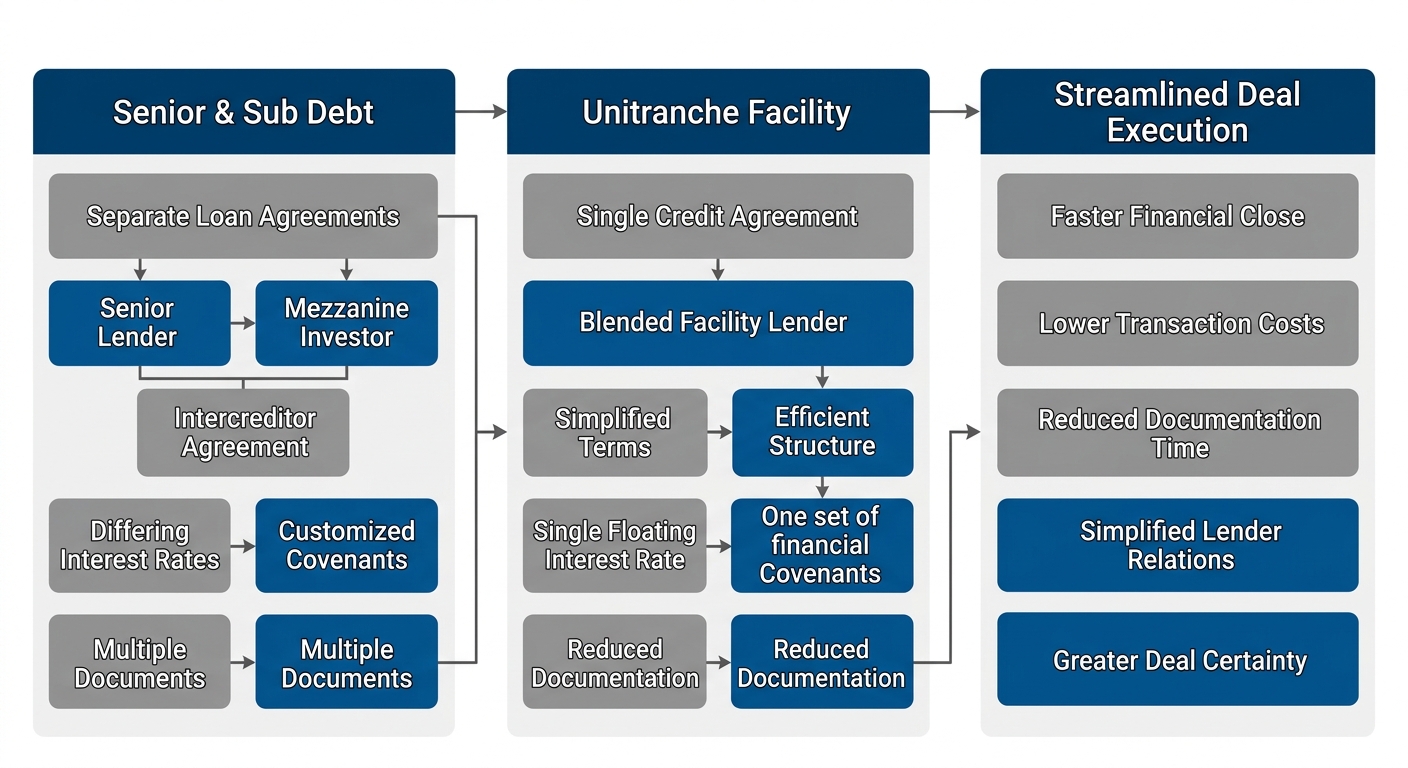
    Building on the broader M&A advisory trends, unitranche financing has emerged as a transformative force in middle-market deal execution. A single-tranche facility combines senior and subordinated debt into one combined debt instrument, offering both speed and simplicity for buyers and sellers navigating complex transactions.

    Leading advisory firms increasingly recommend unitranche structures, evidenced by the criteria Zaidwood Capital uses to identify top M&A advisors—transaction volume, network access, and specialized industry expertise. Our full-cycle M&A and capital advisory approach connects clients with over 4,000 institutional investors, streamlining transactions through proprietary frameworks like the Velocity Matrix.

    These unitranche structures align with capital market standards established by the International Capital Market Association (ICMA), ensuring documentation practices meet global benchmarks for transparency. This alignment with Financial Services 3.0 principles reduces the need for separate capital layers, accelerating close times significantly.

    For middle market m&a trends 2026, private credit unitranche financing enables more leveraged buyouts and growth equity transactions. Our Sovereign Data Nexus and Precision Catalyst methodology provide the execution speed modern dealmakers require.

    Horizontal process-flow diagram with three connected boxes labeled Senior & Sub Debt, Unitranche Facility, and Streamlined Deal Execution, using blue and gray colors.

    Illustration of unitranche financing mechanics combining senior and subordinated debt into a single facility.

    Through our extensive investor network and disciplined deal structuring, we facilitate unitranche transactions that deliver certainty and efficiency—foreshadowing how these financing innovations directly influence deal execution strategies in the sections ahead.

    4. Interest Rates and Their Impact on Deal Financing

    In middle market M&A trends 2026, interest rate impact remains a decisive variable shaping deal financing strategies. The federal reserve system has set the fed funds target range at 3.50% to 3.75%, directly influencing the cost of senior debt, mezzanine financing and unitranche financing structures. When rates rise, borrowing costs climb and private equity firms often adjust by lowering leverage ratios and increasing equity contributions to maintain acceptable returns.

    We observe that private credit unitranche financing has gained prominence in the current higher-rate environment as borrowers seek alternatives to traditional bank debt. This single-tranche solution simplifies capital structures and can provide covenant flexibility that syndicated loans lack.

    The rate environment also drives sponsor behavior. Common adjustments we see include:

    • Prudent leverage reduction to offset higher interest expense
    • Greater equity checks to de-risk capital structures
    • Increased use of floating-to-fixed rate swaps

    Top M&A advisory firms—including Goldman Sachs, Morgan Stanley and Houlihan Lokey—help clients structure financing to mitigate rate risk. At Zaidwood Capital, we provide Full-Cycle M&A and capital advisory, supporting clients with debt and equity advisory to navigate rate volatility while preserving deal momentum.

    With rates redefining cost of capital, the next section examines specific financing structures—such as unitranche debt and equity solutions—that can optimize outcomes in this dynamic environment.

    5. Valuation Multiples and the Dry Powder Effect

    In the landscape of middle market M&A trends 2026, understanding valuation multiples is essential for buyers and sellers alike. A valuation multiple — often expressed as an EBITDA multiple — represents the ratio of a company’s enterprise value to its earnings before interest, taxes, depreciation, and amortization, serving as a standardized metric for comparing deal pricing across transactions. In the middle market, these multiples typically range based on company size, sector dynamics, and growth trajectory, with premium valuations reserved for businesses demonstrating scalable operations and defensible market positions. As we observe current 2026 middle market deal trends, the interplay between abundant capital and limited quality assets continues to reshape pricing expectations.

    The dry powder effect — the accumulation of uninvested private equity dry powder capital — has become one of the most significant forces driving valuation multiples upward heading into 2026. Record levels of dry powder reported through 2024-2025, estimated in the trillions globally, have intensified competition for quality middle market assets as fund managers face deployment deadlines. This oversupply of capital chasing a finite pool of attractive acquisition targets creates natural upward pressure on purchase multiples, a dynamic that aligns with the broader mid-market M&A outlook for sustained elevated pricing. Buyers armed with significant dry powder are increasingly willing to stretch valuation parameters to secure platform investments and add-on acquisitions that strengthen their portfolio strategies.

    Supporting this high-multiple environment, private credit unitranche financing has emerged as a critical enabler for acquirers looking to bridge valuation gaps. Unitranche structures combine senior and subordinated debt into a single facility, streamlining execution and reducing refinancing risk — key advantages when aggressive bidding pushes enterprise values beyond what traditional senior lenders are willing to support. This financing flexibility allows buyers to compete effectively in auctions and negotiate with confidence, reinforcing the competitive bidding dynamics that characterize today’s middle market. Sectors such as technology, healthcare, and business services have seen particularly pronounced multiple expansion, though the degree of premium varies significantly by industry and company size.

    Navigating this high-multiple, high-competition environment demands sophisticated advisory support. Our comparative analysis of the best M&A advisors for 2026 highlights firms with the sector expertise and transaction experience necessary to maximize outcomes under these conditions. Similarly, our overview of top M&A advisory firms identifies the capabilities clients need when facing competitive processes influenced by significant dry powder deployment. At Zaidwood Capital, we bring full-cycle M&A and capital advisory expertise to every engagement, leveraging our access to over 4,000 institutional investors and deep transaction experience to help clients achieve optimal results in an increasingly complex market.

    6. Private Equity Dry Powder: The Urgency to Deploy

    In examining current middle market M&A trends 2026, one fundamental driver stands apart: private equity dry powder. This term describes the massive pool of committed capital that private equity firms have raised from limited partners but have not yet invested. As these unallocated reserves reach historically high levels, fund managers face an intensifying race against predefined investment periods. Capital that sits idle beyond its mandated deployment window risks being returned to investors, creating a structural urgency that directly fuels acquisition activity across the middle market.

    We see how this private equity dry powder deployment timeline pushes sponsors toward decisive action. Competing funds vie for quality assets before investment horizons expire, compressing due diligence cycles and elevating the importance of accelerated execution. In this environment, private credit unitranche financing has emerged as an alternative capital tool that can streamline deal timelines by combining senior and subordinated debt into a single facility. Navigating this accelerated deal landscape demands precision, and our resources on top M&A advisory firms provide guidance for those seeking expertise in Full-Cycle M&A execution. This urgency to deploy makes an experienced advisor less of a luxury and more of a competitive necessity.

    7. Regulatory Shifts and Macroeconomic Considerations

    Understanding middle market M&A trends 2026 requires examining the evolving regulatory and economic landscape that directly shapes financing dynamics. The U.S. Securities and Exchange Commission continues to refine disclosure requirements and rulemaking agendas—including recent proposals to rescind certain Regulation NMS Rules—while providing essential SEC investor tools that help market participants stay informed about compliance obligations affecting transaction structures.

    The Board of Governors of the Federal Reserve System maintained a Fed Funds Target Range of 3.50% to 3.75% as of mid-2026, with PCE inflation at 3.8% and GDP growth at 1.6% in Q1, according to official data. This rate environment sustains elevated financing costs for leveraged transactions while simultaneously fueling demand for private credit unitranche financing as sponsors seek flexible alternatives to traditional bank lending. The persistence of approximately $1.5 trillion in private equity dry powder deployment pressure continues driving middle-market deal activity despite macroeconomic headwinds, creating a complex environment where regulatory fragmentation across state and federal jurisdictions demands sophisticated advisory capabilities.

    At Zaidwood Capital, our Full-Cycle M&A and capital advisory approach helps clients navigate these intersecting forces—translating regulatory complexity and monetary policy signals into actionable transaction strategies without making assumptions about guaranteed outcomes.

    8. Operational Due Diligence and Full-Cycle Advisory Imperative

    As middle market m&a trends 2026 accelerate transaction timelines, operational due diligence has emerged as a decisive factor beyond traditional financial review. This discipline assesses a target’s operations, supply chain resilience, IT infrastructure, and human capital — areas where fragmented advisory can create blind spots. When legal, financial, and operational workstreams operate in silos, inefficiencies multiply, particularly as competition intensifies.

    Rising private credit unitranche financing demands deeper operational underwriting from lenders, who now scrutinize continuity and integration readiness as closely as debt-servicing capacity. Concurrently, record private equity dry powder deployment forces buyers to differentiate through execution certainty rather than price alone. A robust operational due diligence framework becomes the differentiator.

    We address these pressures through full-cycle advisory, a model that unifies pre-deal strategy, execution, and post-merger integration under a single, coordinated process. By leveraging proprietary tools like the Velocity Matrix, we streamline transactions without compromising rigor — a necessity in the middle market today. This integrated approach sets the stage for the execution frameworks we detail next.

    Capitalizing on 2026 M&A Opportunities

    The middle market m&a trends 2026 point to a landscape ripe with transaction potential driven by structural shifts in financing and capital availability. Private equity dry powder continues to accumulate, creating urgency among sponsors to deploy capital into disciplined acquisition strategies. Simultaneously, private credit unitranche financing has matured as a flexible, single-tranche solution that simplifies deal execution and accelerates closing timelines for mid-sized transactions.

    These tailwinds do not guarantee outcomes—deal success depends on precision in execution. Drawing on insights from our internal FAQ on what makes a top M&A advisory firm, we believe the firms that capture these opportunities will be those with full-cycle capabilities, deep institutional networks, and sector-specific expertise. As middle market m&a trends 2026 intensify competition for quality assets, our team at Zaidwood Capital brings together capital advisory, due diligence rigor, and access to a global investor base to help clients move from analysis to action without crossing into broker-dealer services.

    Resources

  • Choosing the Right Mezzanine Debt Structures: Key Considerations

    Choosing the Right Mezzanine Debt Structures: Key Considerations

    Table of Contents

    Understanding Mezzanine Debt Structures

    Mezzanine debt structures are hybrid financing instruments that sit between senior secured debt and common equity in a company’s capital stack. Often viewed as junior capital, mezzanine debt fills the gap when conventional senior loans reach their capacity. This content is for informational purposes only and is not an offer, solicitation, or investment advice. Zaidwood Capital LLC is not a registered broker-dealer.

    Mezzanine debt is a form of subordinated debt financing that typically does not require hard collateral. Instead, lenders are compensated with a higher interest rate and an equity kicker—often warrants or conversion rights—which provides upside participation in the borrower’s success. This combination of debt and equity features makes it a flexible tool for companies needing capital beyond what senior lenders will provide. By taking a junior position, mezzanine lenders assume greater risk but also capture more of the company’s value creation.

    Mezzanine debt structures commonly bridge funding gaps in leveraged buyouts, acquisitions, and growth capital transactions where senior debt limits are reached but equity dilution is undesirable. Unlike unitranche debt, which combines senior and mezzanine layers into a single facility, traditional mezzanine structures remain clearly subordinated and offer lenders deeper equity participation.

    Engaging a debt advisor can simplify the sourcing and negotiation of mezzanine terms. At Zaidwood Capital we connect clients to a network of over 4,000 institutional and private investors with more than $15 billion of deployable capital, streamlining the process. Zaidwood Capital’s global lending services provide access to institutional investors and specialized debt funds that may not be reachable through conventional banking channels. This access is critical for firms that lack existing relationships with mezzanine providers.

    Of course, every transaction depends on the company’s specific situation, and no outcome is guaranteed. Our role is to present options, not promise particular results.

    Mezzanine Debt in the Capital Stack: Position, Pricing, and Purpose

    Within this layered structure, mezzanine debt occupies a distinctive position as the bridge between senior secured loans and pure equity. We view mezzanine debt structures as a flexible layer that is structurally subordinated to senior lenders but holds priority over equity holders in repayment and asset claims. This middle placement means mezzanine investors take on a moderate-to-high risk profile, reflecting the fact that they are repaid only after senior obligations are satisfied, yet before any residual value flows to equity.

    The following comparison table highlights how mezzanine fits within the capital stack alongside senior debt and equity:

    Mezzanine vs Senior Debt vs Equity in the Capital Stack
    AttributeSenior DebtMezzanine DebtEquity
    Position in StackFirst claim on assets and cash flowSubordinated to senior, senior to equityLowest priority, residual claim
    Risk LevelLowModerate to highHighest
    Typical ReturnLIBOR + 200-400 bps10-20% blendedVariable, target IRR 20%+
    Control RightsCovenants onlyMay include warrants or conversionVoting rights and board seats

    Senior debt holds the first claim on cash and assets; equity sits at the bottom targeting 20%+ IRRs and holding voting control. Mezzanine debt sits between them, subordinated to senior but senior to equity, typically offering a 10–20% blended return through interest, PIK, and equity-linked features such as warrants or conversion rights. Its control rights can include board observation or conversion triggers, providing a middle path.

    The 10–20% blended return commonly seen in mezzanine debt structures arises from a mix of contractual interest payments, payment-in-kind (PIK) accruals, and equity upside through warrants or conversion rights. Because mezzanine sits below senior debt in the capital stack, its risk profile is elevated; investors accept that they will be repaid only after all senior obligations are met. For this reason, mezzanine debt is often categorized as subordinated debt financing. In certain transactions, lenders may combine the senior and mezzanine layers into a single unitranche debt facility, streamlining documentation and reducing execution complexity. At Zaidwood Capital, we evaluate these structures against a company’s cash flow projections and strategic ambitions to build capital stacks that align risk and return profiles with long-term objectives.

    Mezzanine financing is most frequently used when a company’s senior debt capacity is exhausted, yet equity dilution is undesirable. Typical use cases include growth capital for expansion, acquisition financing, leveraged buyouts, and recapitalizations where flexible capital bridges the gap between senior debt and equity without ceding control. At Zaidwood Capital, our global lending services encompass mezzanine debt as a core component of the capital solutions we design—integrating subordinated debt financing and, where appropriate, unitranche debt structures that combine senior and mezzanine layers to streamline execution. This approach allows us to tailor risk-return profiles that match a company’s cash flow dynamics and strategic goals.

    While senior debt offers security and equity captures upside, mezzanine debt bridges the two with a balanced risk-return profile, providing essential flexibility for growing companies.

    This website is for informational purposes only and is not investment advice.

    Structuring Mezzanine Debt for Acquisitions and Growth

    As we move from senior to mezzanine structures, the role of hybrid capital becomes central to bridging funding gaps in complex transactions. Mezzanine debt structures occupy a unique position in the capital stack, sitting below senior obligations but above equity. At Zaidwood Capital, we structure these instruments as part of our full-cycle debt advisory, delivering flexible junior capital solutions for acquisitions and growth. While we leverage our network of over 4,000 institutional investors to source capital, we are not a registered broker-dealer and do not offer investment advice — please consult your own advisors before making financing decisions.

    The following table compares three common junior capital solutions used in acquisition financing:

    Mezzanine vs Unitranche vs Subordinated Debt
    FeatureMezzanine DebtUnitranche DebtSubordinated Debt
    StructureTwo-tranche (senior + sub) or standaloneSingle blended loan (senior + mezzanine combined)Strictly junior to senior debt
    Pricing10-18% all-inLIBOR + 500-800 bpsLIBOR + 600-900 bps
    CovenantsIncurrence-based, may include equity kickerMaintenance covenants typicalLess restrictive than senior
    Best Use CaseAcquisition financing with hybrid return profileMid-market borrowers seeking simplified documentationBridge financing or recapitalizations

    Each solution serves a distinct purpose, and the choice depends on the sponsor’s appetite for complexity, covenant flexibility, and return targets.

    Typical Interest Rates and Terms in 2026

    Current market conditions make mezzanine financing particularly relevant, with all-in pricing typically ranging from 10% to 18%. This spread includes a cash pay component tied to benchmark rates — often LIBOR-based — plus payment-in-kind interest and an equity kicker in the form of warrants. According to Zaidwood Capital’s internal CADE FAQ, the precise split between cash and PIK depends on transaction risk, while the warrants enhance the lender’s yield to compensate for junior security. Upfront fees, prepayment penalties, and structuring charges are also common, and we work with borrowers to model these layers so the total cost of capital remains transparent. In 2026, sustained demand from private equity firms and family offices continues to support a borrower-friendly but disciplined underwriting environment.

    The Role of Mezzanine in Buy-Side Transactions

    Mezzanine debt structures shine in leveraged buyouts and growth-capital raises where senior debt capacity alone falls short of the required enterprise value. By layering a junior tranche, sponsors can increase total leverage without ceding control — an approach we use frequently when advising on buy-side mandates. For emerging markets m&a acquisitions, where projected transaction volumes may surge 15% annually, mezzanine provides a flexible bridge that absorbs country and currency risks while preserving equity upside. The equity kicker aligns lender and sponsor incentives, allowing the financing to behave almost as quasi-equity, which is valuable in high-growth sectors like fintech or renewables. Our debt advisory team draws on the firm’s CADE FAQ and transaction experience to calibrate the right mix of senior debt, mezzanine, and equity for each acquisition.

    Integrating with Unitranche and Subordinated Debt

    In more complex capital structures, mezzanine debt is often combined with unitranche debt or subordinated debt financing to optimize the cost and documentation burden. Unitranche — a single blended loan — appeals to mid-market sponsors with its simplicity and maintenance covenants, but it may lack the return-enhancing features of a standalone mezzanine piece. When we integrate mezzanine with subordinated debt financing, the subordinated layer acts as a bridge facility or recapitalization tool sitting just above equity, while the mezzanine tranche retains its hybrid character. This layered approach can lower the weighted-average cost of capital and satisfy both covenant-light investors and lenders seeking higher yields. Zaidwood Capital’s internal CADE FAQ highlights that such integrated structures are especially common in emerging-market M&A and resource-intensive sectors, where bespoke terms and patient capital are essential. Our role is to design the sequencing — senior, unitranche, mezzanine, subordinated — so that the overall package meets the client’s strategic and liquidity objectives.

    Practical Framework for Evaluating Mezzanine Financing Options

    With a clear understanding of mezzanine basics, we now present a practical evaluation framework. For executives and private equity sponsors, selecting the right financing structure is critical to maximizing returns and minimizing risk. Our advisory team at Zaidwood Capital has developed this decision-focused guide to help you assess whether mezzanine debt structures align with your acquisition strategy and capital stack requirements.

    When to Choose Mezzanine Over Senior Debt

    Senior debt typically reaches its limit at 3-4x EBITDA, constrained by collateral coverage and maintenance covenant requirements. When additional capital is needed to close a transaction or fund growth initiatives, but further senior lien capacity is exhausted, mezzanine financing becomes a strategic solution. Unlike senior lenders who require secured collateral, mezzanine providers accept an unsecured or subordinated position, relying on cash flow analysis rather than hard asset coverage. This flexibility proves essential when the target company has limited fixed assets but strong, predictable free cash flow.

    In our experience, the decision often comes down to a trade-off between cost and flexibility. While unitranche debt can offer a simpler, single-document structure that blends senior and subordinated tranches, it typically provides less flexibility than a bifurcated capital structure. A unitranche facility may restrict prepayment options and lack the warrant overlay that aligns mezzanine investors with equity upside. We recommend evaluating your specific covenant tolerance and exit horizon before choosing between these subordinated alternatives.

    Step-by-Step Structuring for Private Equity Deals

    Structuring mezzanine financing requires a methodical approach to balance the interests of sponsors, senior lenders, and subordinated investors. Our framework follows a five-stage process refined through over 300 completed transactions.
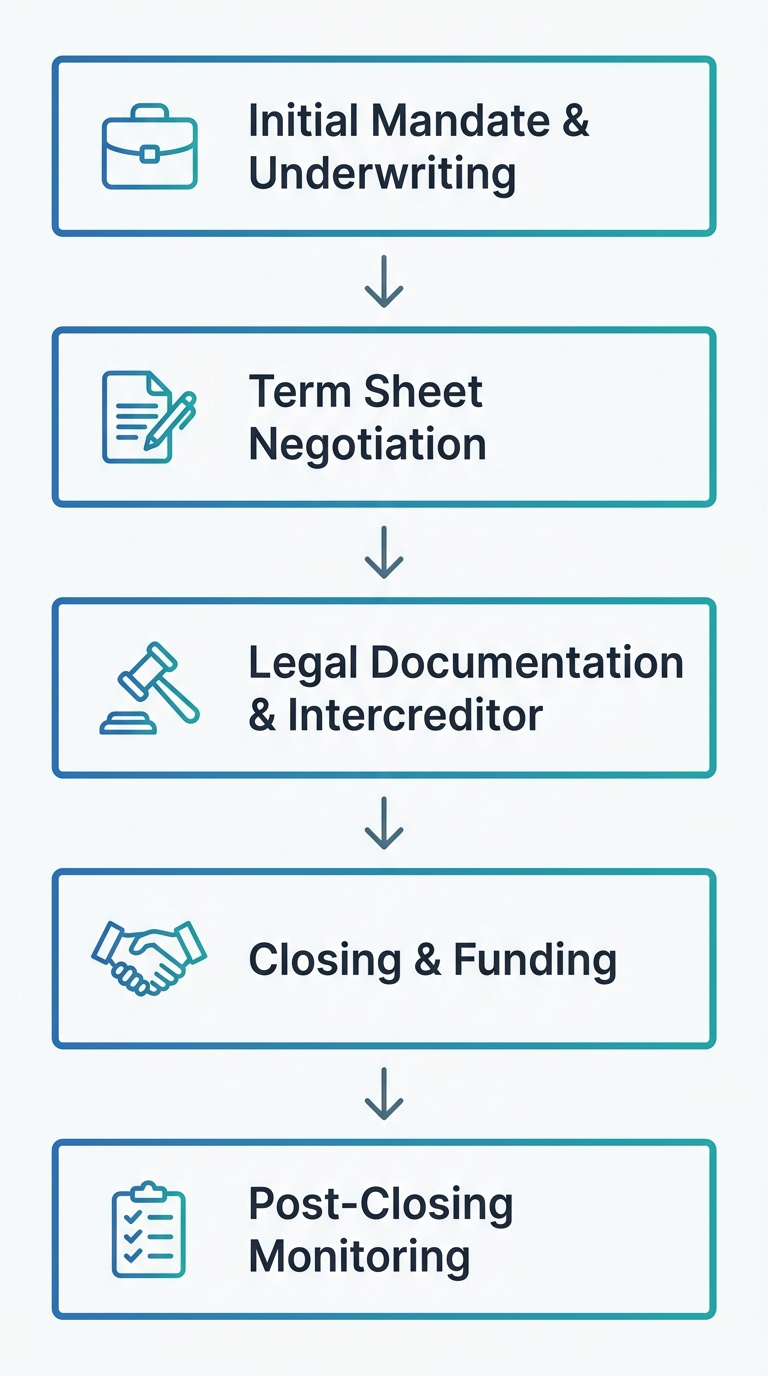
    Diagram showing five stages of a mezzanine financing evaluation process from initial mandate to post-closing monitoring with downward arrows connecting each stage

    Five-stage mezzanine financing evaluation process flow diagram

    The process begins with the initial mandate and underwriting phase, where we assess the target company’s credit profile, historical cash flows, and projected debt service capacity. This determines the appropriate sizing of the subordinated debt financing tranche, typically targeting a total leverage level of five to seven times EBITDA inclusive of senior debt.

    Next, term sheet negotiation addresses the critical economic and control terms. Warrant coverage—the equity kicker that enhances investor returns—is negotiated alongside the cash coupon and any payment-in-kind (PIK) toggle features. When negotiating warrant terms, it is important to ensure alignment with global capital market standards to maintain market conformity and facilitate syndication if needed. The amortization schedule for mezzanine is often back-end loaded, with minimal principal payments during the early years to preserve portfolio company cash flow. Legal documentation and the intercreditor agreement then codify the relative rights of senior and subordinated lenders, followed by closing, funding, and post-closing covenant monitoring.

    Benefits of Mezzanine in Acquisition Financing

    Mezzanine financing offers distinct advantages that make it a powerful tool in acquisition capital structures. Based on our proprietary benefit analysis, the most compelling attribute is its function as a bridge to equity without immediate dilution. Existing shareholders retain full ownership and control, while any equity participation via warrants is deferred and typically limited in scope. Unlike equity investors, mezzanine providers generally do not require board seats, preserving operational control for management.

    From a cost perspective, mezzanine debt structures carry an all-in cost of 10 to 18 percent, and critically, the cash interest component is tax-deductible. This contrasts sharply with equity financing, where investors target a 20 to 30 percent internal rate of return through capital appreciation and dividends that are not deductible to the company. The effective after-tax cost advantage makes mezzanine an efficient instrument for bridging valuation gaps in competitive auction processes.

    The following matrix helps executives compare mezzanine debt and equity on key decision criteria.

    Mezzanine Debt vs Equity: Decision Matrix for Acquisition Financing
    CriteriaMezzanine DebtEquity Financing
    DilutionMinimal (via warrants or conversion on limited basis)Full dilution of existing shareholders
    Cost of Capital10-18% all-in (tax-deductible interest)Target IRR 20-30% (higher required return)
    ControlNo board seats typically; covenants onlyInvestors often receive board representation
    FlexibilityPrepayment options vary, call protection commonExit required for liquidity; no redemption schedule
    Best ForCompanies with stable cash flow seeking bridge capitalHigh-growth companies needing strategic guidance and long-term capital

    This framework, informed by industry benchmarks and Zaidwood Capital case studies, provides a practical lens for evaluating trade-offs. The choice between subordinated debt and equity ultimately depends on your liquidity horizon, control preferences, and the underlying predictability of portfolio company earnings. To see how these structures work in practice, refer to our case studies below. This is for informational purposes only; consult your financial advisor before making financing decisions.

    Securities are offered through Finalis Securities LLC; Zaidwood Capital is not a registered broker-dealer and is separate from Finalis. Past performance does not guarantee future results.

    Advanced Considerations: Risk Allocation, Leverage Ratios, and Investor Alignment

    Building on our earlier discussion of baseline financing options, we now turn to the sophisticated structural elements that define effective mezzanine debt structures. For sponsors and companies evaluating growth capital, understanding risk allocation, leverage benchmarks and alignment mechanisms separates a well-structured transaction from one that introduces unintended friction. We focus here on the analytical framework Zaidwood Capital applies when advising clients through these complex capital stack decisions.

    Risk Allocation and Intercreditor Dynamics

    Risk allocation in mezzanine financing centers on contractual subordination and the intercreditor agreement. This agreement governs the relationship between senior and mezzanine lenders, defining payment waterfalls, standstill periods and remedies upon default. Because mezzanine debt sits behind senior obligations, recovery in a downside scenario depends heavily on how these provisions are drafted. We structure intercreditor terms that preserve mezzanine lender rights while respecting senior creditor priority, ensuring each party understands its position before capital is deployed.

    Leverage Ratio Benchmarks Across the Capital Structure

    Leverage ratios, typically expressed as Debt/EBITDA, provide a common yardstick for assessing financial risk. The table below summarizes the benchmarks we observe across Zaidwood Capital transactions and broader industry data:

    Leverage Ratio Benchmarks by Debt Type
    Debt TypeLeverage Ratio (Debt/EBITDA)Typical Uses
    Senior Debt2.5x – 4.0xRevolving credit, term loans
    Mezzanine Debt0.5x – 2.0x (on top of senior)Acquisition bridge, growth capital
    Unitranche Debt3.5x – 5.5x (combined)Mid-market leveraged buyouts
    Subordinated Debt1.0x – 2.5xRecapitalizations, rescue financing

    These ranges illustrate how each debt layer contributes to total leverage. Senior debt anchors the structure, while mezzanine facilities layer on additional capacity, typically 0.5x to 2.0x above the senior component. For unitranche debt, the combined ratio reaches materially higher levels, creating a different risk-return profile for investors.

    Higher leverage amplifies equity returns but also increases vulnerability to earnings volatility. Recent SEC regulatory updates reinforce the need for transparent leverage disclosure and risk retention compliance, particularly for structures that push total leverage beyond historical norms. We monitor these regulatory developments closely, as they directly influence structuring options and documentation standards for mezzanine and subordinated debt financing.

    Investor Alignment Mechanisms

    Aligning interests between debt holders and equity sponsors requires deliberate structural features. Beyond the base coupon, we often incorporate PIK interest components that preserve cash flow for operational needs while compounding value for lenders. Warrants or equity co-investment rights give mezzanine investors participation in upside, matching their risk exposure with potential reward. Board observer rights provide visibility into strategic decisions without impairing management autonomy, and change-of-control provisions ensure lenders are protected — or compensated — if ownership transitions occur.

    These mechanisms transform a simple debt instrument into a partnership-oriented capital solution. Sponsors benefit from flexible financing terms while investors gain safeguards and upside exposure that senior creditors typically do not receive.

    In the next section we explore how these structural considerations feed into the due diligence process and real-world case examples.

    This content is for informational purposes only and does not constitute investment advice. Readers should consult their own legal, tax and financial advisors before making any decisions.

    Frequently Asked Questions About Mezzanine Debt Structures

    What Are Mezzanine Debt Structures?

    Mezzanine debt structures sit between senior secured debt and equity in a company’s capital hierarchy. This financing is typically unsecured and subordinated to first-lien lenders, meaning it carries higher risk but also commands higher returns. A key feature of mezzanine financing is its equity participation component — often through warrants or conversion rights — which gives lenders upside potential beyond fixed interest payments.

    How Does Mezzanine Financing Compare to Unitranche Debt?

    While both are flexible capital solutions, unitranche debt blends senior and subordinated tranches into a single facility with one blended interest rate. In a mezzanine debt structure, the layers remain distinct: a senior lender holds first priority, and the mezzanine provider sits behind them. Unitranche simplifies administration but may limit the equity upside that defines mezzanine financing.

    What Are the Typical Uses for Mezzanine Debt?

    Companies commonly use subordinated debt to fund acquisitions, support growth capital initiatives, and execute recapitalizations. Because mezzanine financing does not require hard asset collateral, it is especially useful for businesses whose value lies in cash flows or intellectual property rather than physical assets. This flexibility makes it a go-to tool for middle-market transactions and sponsor-backed deals.

    How Does Mezzanine Debt Relate to Subordinated Debt Financing?

    Mezzanine debt is a form of subordinated debt financing, distinguished by its equity-linked features. All mezzanine instruments rank below senior obligations, but not all subordinated debt includes warrants or conversion rights. The additional return potential compensates mezzanine providers for their deeper position in the repayment waterfall.

    What Are the Main Risks of Mezzanine Financing?

    Because mezzanine debt is unsecured and junior to senior loans, recovery in a default scenario can be significantly lower. The higher interest cost also increases the financial burden on the borrower. However, for companies with stable cash flows and strong growth trajectories, the risk-return trade-off of a mezzanine debt structure can be strategically sound. Please note that all investments involve risk, and past performance does not guarantee future results; you should consult your legal, tax, and financial advisors before making decisions.

    Optimizing Your Capital Structure with Mezzanine Debt

    In our advisory work, we often position clients to benefit from hybrid instruments in mezzanine debt structures, which sit between senior obligations and common equity. This subordinated layer can strengthen the balance sheet while preserving ownership control.

    What Is Mezzanine Debt?

    We define this as subordinated debt financing that includes equity participation features, such as warrants, allowing lenders to share in upside without diluting founders prematurely.

    How It Optimizes Capital Structure

    By layering mezzanine capital above equity, companies reduce dilution and gain flexible repayment options like payment-in-kind interest. This bridge is particularly useful for acquisitions, management buyouts, and growth-stage expansion.

    Mezzanine vs. Unitranche vs. Senior Debt

    Feature Mezzanine Debt Unitranche Debt Senior Debt
    Position in capital structure Junior to senior, senior to equity Single blended tranche Most senior
    Interest rate type Higher fixed or floating with PIK Blended rate; typically floating Lowest, often floating
    Covenant strictness Fewer financial covenants Moderate Strictest
    Equity component Warrants or equity kickers common Usually none None
    Typical use case Acquisitions, buyouts, recapitalizations Mid-market LBOs, quick close Working capital, asset-heavy deals

    Unitranche debt blends senior and subordinated layers into one facility, while subordinated debt financing remains a more traditional second-lien or junior note. We help management teams evaluate each path against their capital needs and timeline.

    Trade-offs and Customization

    Mezzanine capital carries higher interest and potential equity give-ups, but it provides speed and fewer restrictive covenants than senior loans. Through our debt advisory services at Zaidwood Capital, we structure each facility to match a company’s cash flow profile without promising any specific outcome.

    This section is for informational purposes only and does not constitute investment advice. Consult your legal, tax, and financial advisors before making decisions. Securities are offered through Finalis Securities LLC; Zaidwood Capital is not a registered broker-dealer.

    Resources

  • Private Equity Continuation Funds: Complete Guide for Investors

    Private Equity Continuation Funds: Complete Guide for Investors

    Table of Contents

    Private equity continuation funds explained

    Private equity continuation funds are GP-led secondary transactions where a new fund vehicle is established to hold existing portfolio assets beyond the original fund’s term. These structures can be arranged as single-asset continuation vehicles or as multi-asset pools. The objective is twofold: they provide limited partners with an early liquidity mechanism while enabling the general partner to continue managing and growing the assets.

    In a typical transaction, the GP sponsors the new vehicle and offers existing LPs a choice — a cash exit at a reset valuation or the opportunity to roll their interests into the successor fund. This approach aligns incentives and can supply follow-on capital for further value creation.

    For fund managers, executing a continuation fund requires specialized capital-raising and placement capabilities. Learn more about our capital formation services. This is not investment advice — consult your professional advisors.

    How Private Equity Continuation Funds Work

    Private equity continuation funds, also known as GP-led secondary transactions, are sophisticated financial vehicles that allow general partners to extend their holding period for high-potential portfolio companies or assets. At Zaidwood Capital, we have observed a significant increase in GP-led secondary transactions as fund managers seek innovative ways to maximize returns for their investors. These structures provide liquidity options for existing limited partners while enabling continued value creation in promising investments.

    The core mechanism involves a GP initiating a GP-led secondary transaction by transferring assets from an existing fund into a newly formed continuation vehicle. This process typically includes both existing LPs and new institutional investors, with the GP retaining a significant stake to demonstrate confidence in the assets’ future performance and align interests across all parties involved.

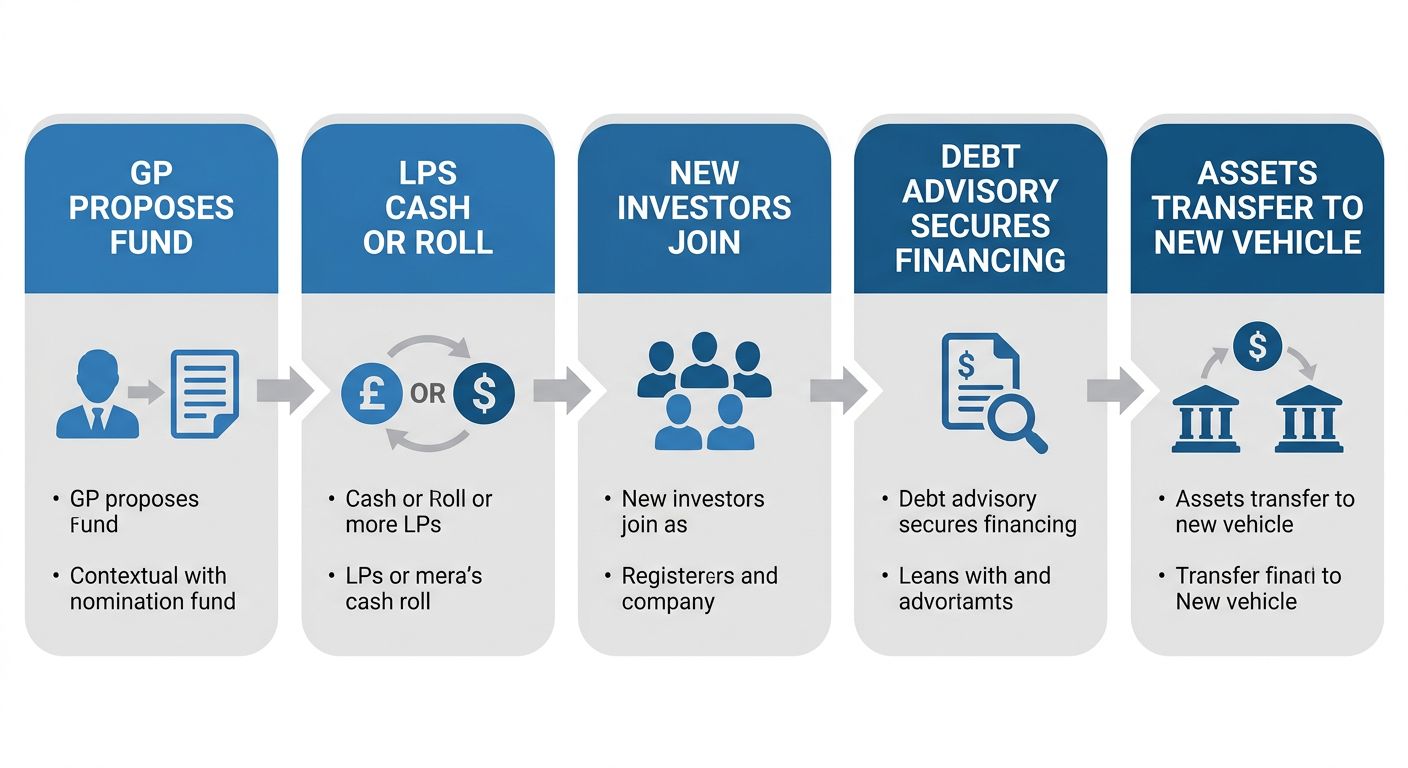
    Flowchart of a GP-led continuation fund transaction with five connected stages in a professional blue and gray palette

    GP-led continuation fund transaction process flow

    The transaction flow illustrated above demonstrates how these complex structures come together. The process begins with asset identification and valuation, followed by the formation of the new vehicle, capital raising from both new and existing investors, and ultimately the transfer of assets to the continuation fund.

    Financing plays a critical role in structuring these transactions, and debt advisory services from Zaidwood Capital can provide the necessary financing structures for these funds. According to Zaidwood Capital’s internal knowledge resources, our Full-Cycle M&A and capital advisory practice encompasses mezzanine debt, venture debt, and asset-based lending structures that support GP-led secondary transactions. With access to over 4,000 institutional investors and $15 billion in deployable capital, we help structure the optimal financing package for each unique situation.

    The valuation process requires rigorous fairness opinions and third-party advisory to ensure alignment with LP interests. Independent valuation firms assess the transferred assets to establish a fair market price, protecting all stakeholders involved in the transaction.

    Continuation funds can be structured as single-asset continuation vehicles or multi-asset vehicles, depending on the GP’s strategic objectives. A single-asset continuation vehicle focuses on one high-conviction portfolio company, while multi-asset structures consolidate several related holdings. These structures have become increasingly prevalent in today’s private equity landscape, offering flexible solutions for portfolio optimization and extended value creation timelines.

    GP-Led Secondary Transactions and Single-Asset Vehicles

    GP-led secondary transactions have become a defining feature of today’s private equity landscape, driven by the growing use of private equity continuation funds. In a GP-led deal, a general partner facilitates the sale of existing limited partner interests to new investors, often by transferring a portfolio company into a newly created continuation fund. This structure gives both continuing and exiting LPs greater flexibility than a traditional fund liquidation.

    A prominent subset of these transactions is the single-asset vehicle. Here, a single portfolio company is moved into a standalone fund, allowing the GP to hold a high-performing asset beyond the original fund’s life. This approach unlocks the runway needed for additional value creation while providing immediate liquidity to LPs who wish to exit. In our experience, these vehicles also enable more tailored governance terms and focused board oversight, which can accelerate strategic initiatives and operational improvements, provide clearer reporting metrics for investors concentrated on concentration risk and exit timing, and support alignment of incentives among continuing stakeholders while preserving LP choice and protections. We have seen demand for single-asset continuation vehicles increase significantly as GPs seek longer holding periods for prized assets.

    Why do GPs favor these structures? First, they can retain top-performing companies rather than selling them prematurely. Second, they raise follow-on growth capital to fund expansion or acquisitions. Third, they offer existing LPs a clear choice: cash out at fair value or roll their interest into the new vehicle. These transactions typically require independent valuations and approval from the LP advisory committee, ensuring alignment with capital market standards for secondary processes.

    At Zaidwood Capital, we advise clients on navigating these transactions from initial structuring through close. Our work in the private equity secondary market confirms that well-designed continuation funds balance the interests of all parties while capturing additional upside. The next section explores the valuation techniques that underpin fairness opinions in these evolving deal structures.

    Several interrelated factors explain this surge in popularity. We see that private equity continuation funds have become a cornerstone of liquidity solutions in 2026, driven by regulatory clarity, market demand for flexible exits, and the structural innovation of GP-led transactions.

    The U.S. Securities and Exchange Commission (SEC) has been a primary catalyst for this growth. SEC investor protection has been a key priority, with the SEC strengthening its initiatives to oversee GP-led secondary transactions. Through proposed rule changes and enforcement priorities, the regulator has clarified the framework for exempt offerings and secondary market activity, making it easier for fund managers to structure continuation vehicles that safeguard investor interests while providing much-needed transactional certainty.

    Market demand for liquidity solutions has further accelerated the trend. Institutional investors are increasingly turning to these structures to realize partial or full exits without triggering forced asset sales that could dilute returns. Private equity continuation funds give LPs the flexibility to recycle capital while GPs retain high-performing assets for further value creation. With fund lifespans extending beyond traditional horizons, the ability to execute gp-led secondary transactions has become essential for aligning the longer-term interests of managers and their limited partners.

    Structurally, the rise of single-asset continuation vehicles has been a defining feature of this cycle. These vehicles bundle a single portfolio company into a new fund, allowing the GP to extend the investment period and pursue additional growth while offering existing LPs the choice to liquidate or roll their interests. This targeted approach has gained traction as a flexible way to manage concentrated positions, reduce portfolio complexity, and align incentives without the legal and operational burden of full-fund restructurings. These examples show private equity continuation funds balance liquidity needs with longer-term investment horizons overall.

    Having examined the drivers, we now turn to the mechanics of these transactions and how they are structured to meet the needs of sponsors and investors alike.

    Benefits and Risks for LPs and GPs

    For GPs considering a continuation fund, the strategic advantages are compelling. Private equity continuation funds allow general partners to access liquidity from older fund portfolios without forcing a premature sale of assets that still have meaningful upside potential. We see this as a powerful tool that aligns interests by giving GPs the ability to extend their management of high-performing assets—particularly through the use of single-asset continuation vehicles—while simultaneously offering limited partners a clear choice between realizing gains and maintaining exposure. From an LP perspective, this structure provides valuable optionality. Rather than facing a binary outcome when a fund nears the end of its life, investors receive a liquidity event for their legacy fund interests coupled with the ability to roll over their commitment if they believe in the continued growth trajectory of the underlying portfolio.

    However, these transactions are not without complexity. One of the most persistent challenges lies in determining a fair market price for inherently illiquid assets, which requires rigorous third-party valuation work and independent fairness opinions. The inherent GP–LP conflict of interest sits at the center of every GP-led secondary transaction—the GP serves as both sponsor of the existing fund and, effectively, the buyer in the new continuation vehicle. To manage this, we advise clients to insist on transparent disclosure, independent governance structures, and the active involvement of legal and financial advisors who represent LP interests throughout the process.

    All GP-led secondary transactions are subject to FINRA regulatory compliance standards, including requirements for fairness opinions and transparent disclosure. When a broker-dealer such as Finalis Securities LLC is engaged, adherence to FINRA rules is mandatory. The Financial Industry Regulatory Authority (FINRA) establishes the regulatory framework that governs how securities firms involved in these transactions must operate, providing a baseline of investor protection through its oversight of disclosure practices, fair-dealing obligations, and conflict-of-interest management. This regulatory overlay reinforces the governance discipline that sophisticated LPs should demand.

    We emphasize that continuation funds are not risk-free. LPs should carefully evaluate the GP’s track record with similar structures, the specific governance protections built into the transaction, and whether the continuation vehicle genuinely aligns with their portfolio objectives. When structured thoughtfully and governed transparently, continuation funds can serve as a valuable liquidity and portfolio management solution—but the burden of due diligence rests squarely on all parties involved.

    This content is for informational purposes only and does not constitute investment advice or an offer, solicitation, or recommendation to transact. Investments involve risk and may be illiquid; investors may lose all or part of their investment. Zaidwood Capital LLC is not a registered broker-dealer. Securities are offered through Finalis Securities LLC, a separate entity.

    Best Practices for Evaluating Continuation Fund Opportunities

    Private equity continuation funds represent a growing segment of GP-led secondary transactions where a general partner transfers one or more portfolio assets from an existing fund into a new vehicle under the same management. While these structures can offer extended value-creation runway and fresh capital, they demand rigorous investor scrutiny to ensure the transaction serves limited partner interests fairly. We believe a methodical evaluation framework is essential for any LP assessing such opportunities.

    At the core of every analysis are several critical factors. First, we examine GP incentive alignment—specifically whether the manager is committing meaningful co-investment capital to the continuation vehicle and how the fee structure impacts net returns. Second, the fairness of the valuation process requires close attention, including whether an independent third-party opinion has been obtained and how the pricing compares to recent market benchmarks. Third, the composition and independence of the oversight committee or advisory board play a vital role in mitigating conflicts of interest, as does the transparency of disclosure around any existing GP–LP dynamics that may influence the proposed transaction.

    A thorough review must also consider the fund’s historical track record and the strategic rationale for retaining the asset rather than pursuing an outright sale. Investors should scrutinize the fee structure carefully, including management fees, any transaction-related costs, and the impact on carried interest calculations. Zaidwood Capital notes that evaluating the underlying financing terms is equally important, and our debt advisory team often helps clients analyze leverage arrangements embedded in continuation fund structures to ensure they align with long-term value-creation objectives. We also evaluate exit timing, market receptivity, and operational improvement plans to ensure the continuation path is realistic and achievable over time.

    These due diligence pillars—alignment, valuation integrity, independent oversight, and fee transparency—form the foundation of informed LP decision-making in GP-led secondary transactions. With these best practices in mind, our team can assist in structuring and vetting such opportunities.

    Key Takeaways and Next Steps in Continuation Fund Strategy

    Our earlier sections laid out how private equity continuation funds serve as flexible structures that extend fund life and deliver intermediate liquidity. These vehicles allow general partners to hold prized assets longer while giving limited partners options to roll over or exit.

    GP-led secondary transactions and single-asset continuation vehicles form the core of this strategy, aligning sponsor and investor interests through transparent pricing and governance. At Zaidwood Capital, we advise on structuring these transactions, from selecting the appropriate vehicle to managing the reinvestment process.

    As you evaluate your next move, you may consider:

    • Reviewing your current fund documents and limited partnership agreements for rollover provisions.
    • Weighing single-asset continuation funds against multi-asset GP-led solutions based on your portfolio concentration and return objectives.
    • Engaging a capital advisor experienced in secondary transactions and structured liquidity events.

    Our Continuation Fund FAQ details common questions, and we invite you to book a discovery call for tailored guidance on your specific situation.

    Resources

  • Venture Debt Comparison: Top Providers and Term Sheets

    Table of Contents

    Evaluating Venture Debt for Your Startup

    Once you understand the types of venture debt, the next step is evaluating which option fits your startup. We guide founders through a structured assessment of venture debt providers, focusing on their track record with companies at your stage and in your sector.

    A detailed review of the venture debt term sheet is essential. We help you compare interest rate structures, repayment schedules, and any equity components like warrants. Our team also evaluates loan covenants, prepayment flexibility, and the added value a lender brings, such as investor introductions or the ability to support future equity rounds. We also help tailor terms to your business model.

    Engaging experienced venture capital consultants provides the analytical rigor needed to navigate these complex decisions. After evaluating your options, preparing a strong application is critical to securing the right partner.

    Essential Preparations Before Raising Venture Debt

    Before engaging with lenders, we recommend ensuring your company is fully prepared to raise venture debt. This form of financing requires careful financial and legal groundwork to instill confidence in potential partners.

    We advise our clients to assemble the following key items before initiating discussions:

    • Audited Financial Statements: Prepare audited P&L, balance sheet, and cash flow statements for the past 2–3 years, plus the current interim period.
    • Debt Service Capacity: Calculate a clear Debt Service Coverage Ratio (DSCR) to demonstrate your ability to comfortably cover interest payments.
    • Internal Data Room: Compile a secure repository of legal documents, including your charter, bylaws, cap table, and IP assignments.
    • Governance Review: Examine potential personal guarantees and confirm the board approval process required for new debt.
    • Term Education: Understand that a venture debt term sheet will differ from equity; it avoids dilution but often includes warrants and financial covenants.
    • Strategic Plan: Finalize your existing debt schedule, a detailed use-of-funds plan, and growth projections with sensitivity analysis.

    Rushing into the process with incomplete records or an unclear plan for the capital significantly reduces lender confidence. Engaging experienced venture capital consultants can help streamline this preparation, ensuring your narrative and numbers are aligned before you approach venture debt providers.

    Step 1: Assess Your Startup’s Readiness for Venture Debt

    Determining whether your company qualifies for venture debt is a critical first step. As a capital solution, venture debt can extend your runway without further dilution, but lenders apply rigorous qualification standards. We focus on actionable, objective criteria to ensure you approach the process from a position of strength.

    Primary readiness factors include reaching a minimum annual recurring revenue, typically $1M+ ARR, supported by positive gross margins and a clear use of proceeds. Strong year-over-year growth, often 30% or higher, and backing from an established institutional investor base are key indicators lenders evaluate. You should also review existing debt obligations to confirm there are no restrictive covenants that could conflict with new financing, and develop a detailed cash flow forecast demonstrating your ability to service the debt.

    Once you have assessed your fundamental readiness, the next step is to evaluate potential venture debt providers and their term sheets. For a thorough, data-driven readiness analysis, consider engaging Zaidwood Capital’s debt advisory services.

    Step 2: Understand Venture Debt Fundamentals

    Once you have assessed your capital needs, the next step is to understand the fundamentals of venture debt. Venture debt is a form of debt financing provided to venture-backed companies by specialized lenders, often structured with warrants or interest-only periods. We advise clients that it is most suitable for high-growth startups needing non-dilutive capital for working capital, equipment, or bridging to an equity round without significantly diluting shareholders.

    Unlike traditional bank loans, venture debt providers underwrite based on investor quality and growth trajectory rather than current cash flow or collateral. A typical venture debt term sheet we see includes a 3–4 year maturity, 5–20% warrant coverage, and covenants like minimum cash balances. Providers include banks and specialty finance companies. For regulatory guidance, refer to the SEC small business capital raising resources. Understanding these fundamentals prepares you to evaluate specific venture debt offers and proceed with structuring your debt package.

    Step 3: Compare Venture Debt and Equity Financing

    With a clear understanding of venture debt, the next step is to compare it against equity financing. In venture debt financing, founders retain full ownership but take on fixed repayment obligations, whereas equity financing dilutes founder stakes in exchange for permanent growth capital without mandatory repayment. For many growth-stage companies, the decision hinges on a trade-off between long-term cost and near-term flexibility.

    Equity investors typically require board seats and governance rights that can reshape strategic decisions. Venture debt providers, in contrast, rarely seek board representation, leaving founders with greater operational autonomy. The cost of equity can become substantial over time through carried interest and dilution, while venture debt carries interest and fees but preserves equity upside for existing shareholders.

    The chief risk of venture debt lies in fixed payment schedules that may strain cash flow if revenue projections miss their targets. Equity financing avoids repayment pressure but permanently reduces founders’ share of future returns. Companies often use venture debt to extend runway between equity rounds or to finance specific assets, while equity is sought for foundational, long-term growth. We advise clients to review the venture debt term sheet carefully for repayment terms and covenants before committing.

    For additional resources on comparing financing options, consult the SEC small business capital formation advocate. Once you determine the right fit, proceed to evaluate the venture debt term sheet and negotiate terms that align with your capital strategy.

    This content is for informational purposes and does not constitute investment advice.

    Step 4: Research Venture Debt Providers in the US

    With your venture debt strategy in place, the next critical step is identifying the right provider. When evaluating venture debt providers in the US, we recommend using a focused checklist to narrow your search:

    • Track record: Does the lender have experience with startups at your stage, particularly if you are pre-revenue?
    • Industry focus: Is there a specialization in your sector or business model?
    • Loan size and flexibility: Do their typical facilities match your capital needs, and what is their reputation for supporting portfolio companies during downturns?
    • Terms review: Always request a sample venture debt term sheet from each shortlisted firm and scrutinize the key economic and legal provisions.

    For a deeper look into how financial firms are regulated, explore the FINRA investor resources and insights page. This helps you independently verify the background of any registered entity you are considering, though Zaidwood Capital is not a registered broker-dealer.

    At Zaidwood Capital, we can assist with introductions to our network of venture debt providers and support the review of term sheets, but we do not lend directly or act as a broker-dealer. Once you have shortlisted and received term sheets from two to three aligned providers, you are ready to negotiate key terms.

    Step 5: Structure the Venture Debt Term Sheet

    Once you have identified potential venture debt providers, the next step is to structure the venture debt term sheet with precision. A well-organized term sheet signals sophistication to lenders and accelerates the path to closing. At Zaidwood Capital, we focus on clarity around every core component to ensure your company enters negotiations from a position of strength. The key elements we always emphasize in a venture debt term sheet include:

    • Interest rate (floating or fixed), typically based on a margin over a reference benchmark
    • Maturity period of 3 to 4 years, aligned with your cash flow projections
    • Amortization schedule that may include an interest-only period for early-stage flexibility
    • Prepayment flexibility, with penalties structured only for very early exits
    • Warrant coverage capped as a percentage of the loan amount to minimize equity dilution
    • Financial covenants such as liquidity tests rather than restrictive EBITDA minimums
    • Change-of-control provisions that protect both parties in a future sale or merger

    We advise clients to tailor these terms to their growth stage. Early-stage startups benefit most when we push for lower warrants and longer interest-only periods, preserving runway. Growth-stage companies, on the other hand, often prioritize generous covenant headroom and prepayment options that support refinancing flexibility. For all borrowers, we negotiate dilution-minimizing features like milestone-based tranches that match capital deployment to actual needs, and we frequently include a most-favored-nation clause to adjust terms if your risk profile improves. Using a clean, LSTA-style format reduces ambiguity and speeds up legal drafting. With a well-structured term sheet in hand, you are ready to engage in final negotiations.

    Step 6: Negotiate Covenants and Key Terms

    Once the optimal lender and structure are identified, the final step is negotiating the covenants and key terms. For companies exploring venture debt, this phase determines whether a term sheet becomes a strategic asset or a constraint that limits financial maneuverability.

    We work to secure terms that align with the client’s long-term financial strategy and operational flexibility. The negotiation focuses on financial covenants such as debt service coverage and loan-to-value ratios, along with reporting requirements that are common in venture debt term sheets. Lenders routinely request affirmative, negative, and financial covenants, but overly restrictive clauses can impede growth initiatives or future M&A activity.

    As the client’s advisor, Zaidwood Capital drafts markups, models the impact of each covenant under various operating scenarios, and negotiates directly with venture debt providers on the client’s behalf. Our role is to protect the business from conditions that could constrain liquidity or investment capacity while preserving a competitive cost of capital.

    Step 7: Close the Venture Debt Transaction

    Closing a venture debt transaction marks the culmination of our structured advisory process. Once all conditions are met, the transaction moves to closing where we coordinate venture debt providers, legal counsel, and your team to execute final documents and disburse funds efficiently.

    Final credit approval from the lender committee triggers the closing sequence. The venture debt term sheet becomes the binding commitment document at signing, followed by satisfaction of conditions precedent—including board resolutions, a legal opinion letter, collateral perfection filings, and insurance certificates. Borrower’s legal counsel reviews all documentation prepared by the lender’s outside counsel. At closing, origination fees, legal fees, and third-party costs are settled as negotiated in the engagement letter, and funds transfer via wire to your account according to the agreed draw schedule.

    Securities transactions are executed through Finalis Securities LLC, a registered broker-dealer. Post-closing, we ensure delivery of executed promissory notes, security agreements, and closing certificates.

    Three-stage horizontal process flow diagram for venture debt closing: Final Credit Approval to Document Execution to Fund Disbursement, with professional icons and blue color scheme.
    Horizontal flow visualizing the venture debt closing process.

    To explore how our debt advisory team can streamline your financing, Book A Call with Zaidwood Capital today.

    Troubleshooting Common Venture Debt Challenges

    While venture debt can be a strategic tool for growth-stage companies, it introduces operational complexities that demand disciplined oversight and proactive management. Drawing on our advisory work at Zaidwood Capital, we outline common pitfalls and practical solutions to help companies maintain covenant compliance and lender alignment.

    Covenant monitoring is essential. Typical venture debt agreements may include minimum cash balances, financial reporting requirements, or EBITDA targets. We recommend establishing a monthly review cycle to track these metrics against your loan covenants, using dashboards that pull real-time data from your accounting system. Early detection of a potential breach allows time to renegotiate terms or secure a waiver before default occurs.

    Cash-flow timing remains a persistent challenge—debt service often begins before new revenue materializes. Solutions such as interest-only periods, payment deferrals, or sculpted repayment schedules can bridge this gap if negotiated upfront. Review your venture debt term sheet carefully for prepayment penalties and amortization triggers, as these can limit your flexibility. The U.S. Securities and Exchange Commission provides guidance on structuring debt instruments that we find useful for understanding regulatory boundaries.

    Lender alignment is often overlooked. Not all venture debt providers offer the same degree of sector expertise or willingness to accommodate covenant adjustments. FINRA emphasizes illiquidity and leverage risks in its investor insights, reinforcing the importance of vetting lenders for experience with your industry and growth trajectory.

    A final caution: guard against over-leveraging and dilution-creep. Warrants embedded in venture debt can subtly erode founder equity, especially if multiple rounds of debt are layered. We help companies model the long-term capital-structure impact of warrants and principal obligations.

    This content is for informational purposes only and does not constitute financial or legal advice. Consult your advisors for your specific situation.

    Making Strategic Capital Decisions with Venture Debt

    Venture debt can serve as a powerful complement to equity financing for growth-stage companies that already have venture capital backing or strong revenue trajectories. Unlike traditional bank loans, venture debt financing offers a non-dilutive way to extend cash runway and bridge to critical milestones—allowing founders to preserve ownership while accelerating growth.

    When evaluating a venture debt term sheet, our team helps clients assess core variables such as interest rate, warrant coverage, maturity period, prepayment penalties, and financial covenants. We also bring access to a curated network of venture debt providers—including more than 4,000 institutional and private investors—to help structure, negotiate, and place the right venture debt solution for each client’s unique situation. However, venture debt is typically used alongside equity, not as a replacement, and all investments involve risk.

    Securities are offered through Finalis Securities LLC; Zaidwood Capital is not a registered broker-dealer. Past performance does not guarantee future results.

    Resources

  • Supply Chain Financing Explained: Essential Guide for 2026

    Supply Chain Financing Explained: Essential Guide for 2026

    Table of Contents

    The Foundations of Supply Chain Financing

    Supply chain financing encompasses a set of technology-driven solutions that allow buyers and suppliers to improve working capital without relying on traditional trade finance instruments such as letters of credit. According to Zaidwood Capital’s resource library, SCF is a vital component of global lending alternatives, helping businesses stabilize cash flows while deepening trading relationships.

    Reverse factoring is one of the most widely adopted structures. In this model, a corporate buyer confirms an invoice and a financial institution pays the supplier early at a modest discount, while the buyer repays the financier on a later date. The supplier receives faster cash, the buyer preserves liquidity, and the funder earns a predictable margin—a mutually beneficial arrangement.

    Dynamic discounting offers an alternative mechanism: the buyer uses its own cash to pay invoices ahead of term in exchange for a sliding-scale discount. This gives suppliers near-immediate access to funds at a cost that adjusts with the speed of payment. Inventory finance rounds out the toolkit by providing dedicated funding against stock held in the supply chain, reducing carrying costs and freeing capital for growth.

    Many businesses also layer in equipment financing to complement these solutions, funding the tangible assets that keep supply chains moving. Together these instruments provide greater cash-flow predictability, reduce supplier concentration risk, and strengthen the resilience of the entire supply network.

    Understanding Supply Chain Financing Benefits and Distinctions

    Supply chain financing has emerged as a key buyer-led solution that enables companies to optimize working capital while strengthening supplier relationships. Unlike traditional factoring, which is initiated when a supplier sells its receivables, SCF is initiated by the buyer, leveraging its own credit rating to secure attractive financing terms for its suppliers. This fundamental shift creates a more collaborative and cost-effective financing environment. In this section, we explore the core benefits and six critical distinctions that set supply chain financing apart from traditional factoring.

    The table below compares these financing methods across six critical aspects:

    Supply Chain Financing vs Traditional Factoring
    AspectSupply Chain FinancingTraditional Factoring
    InitiationInitiated by the buyer, leveraging its credit ratingInitiated by the supplier selling its receivables
    Credit AssessmentBased on buyer’s creditworthiness, not supplier’sBased on supplier’s customer credit and invoice quality
    Cost of CapitalLower cost, typically buyer’s cost of funds plus a small marginHigher fees, discount plus service charges
    Working Capital ImpactExtends buyer’s payables without straining supplier, optimizes cash conversion cycleAccelerates supplier cash flow but may not benefit buyer’s DPO directly
    Supplier RelationshipStrengthens buyer-supplier relationship through collaborative liquidityCan be perceived as supplier distress; may damage relationship
    Risk ExposureCounterparty risk primarily on the buyer; operational and legal risksRisk of non-payment by debtor; recourse arrangements common

    From a strategic standpoint, supply chain financing delivers a decisive edge by lowering the cost of capital—leveraging the buyer’s credit rather than relying on supplier-level assessments—while simultaneously extending payment terms without squeezing supplier liquidity. This structure optimizes the cash conversion cycle for both parties: buyers preserve working capital, and suppliers gain access to affordable, timely funding. Moreover, because SCF is framed as a collaborative liquidity solution rather than a sign of financial distress, it reinforces trust and long-term supplier relationships, which are critical in today’s interconnected supply chains. The risk profile also shifts favorably; counterparty risk concentrates on the financially stronger buyer rather than on diverse, often smaller, suppliers. As recognized by the International Capital Market Association, these distinctions underscore the role of structured supply chain finance in modern capital markets. From our advisory work, we observe that such buyer-led financing not only enhances operational resilience but also aligns with the interests of all supply chain participants. The chart below visualizes how SCF outperforms traditional factoring across these performance dimensions, reinforcing why it has become a preferred strategy for resilient supply chains.

    Bar chart comparing supply chain financing and traditional factoring across six key performance aspects using teal and gray bars

    Supply chain financing versus traditional factoring comparison across six key business aspects

    Key Mechanisms and Structures in Supply Chain Finance

    Modern supply chain financing (SCF) helps businesses optimize working capital through a variety of structured instruments, each designed to align the liquidity needs of buyers and suppliers. The three primary mechanisms—reverse factoring, dynamic discounting, and approved payables finance—differ in how they fund early payments, yet all share the goal of accelerating supplier cash flow while preserving buyer payment terms. Understanding their inner workings and when to apply each is essential for corporate treasurers seeking to build resilient, financially stable supply networks.

    How Reverse Factoring Unlocks Liquidity

    Reverse factoring, often called approved payables finance, follows a disciplined sequence that centers on the buyer’s credit strength. First, the buyer initiates a supply chain finance program with a financial institution (the funder). The buyer then approves supplier invoices and transmits them to the funder via a digital platform. Upon receiving approved invoices, the funder pays the supplier early—generally after applying a small discount—while the original invoice due date remains unchanged. The buyer ultimately repays the funder at the agreed-upon extended term, thereby preserving its own cash on hand. This structure enables suppliers to access lower-cost capital than traditional factoring because the funding cost is benchmarked against the buyer’s superior credit rating, not the supplier’s.

    For buyers, the arrangement stretches payment terms without squeezing the financial health of their supply chain partners, reducing the risk of supplier insolvency. For suppliers, early payment at competitive rates directly improves working capital. Importantly, supply chain finance programs—especially reverse factoring—are subject to SEC disclosure requirements that promote corporate transparency; stakeholders can monitor regulatory developments through SEC regulatory news and updates. These obligations reinforce the need for robust reporting practices in any SCF initiative.

    Dynamic Discounting vs Approved Payables Finance

    Dynamic discounting takes a different approach: it is a buyer-funded mechanism where the buyer voluntarily offers early payment to suppliers in exchange for a discount that increases the earlier payment is made. The sliding scale is typically calculated per day before the net due date, allowing the buyer to earn an implicit, risk-free return on its surplus cash. Because no external funder is involved, dynamic discounting is most attractive to corporate treasuries that hold ample liquidity and seek to optimize cash returns without introducing third-party credit risk.

    By contrast, approved payables finance (including reverse factoring and multi-bank platforms) relies on an external funder that purchases approved receivables against the buyer’s credit. This model is preferred when the buyer wants to inject liquidity into its supply chain without deploying its own cash, or when it lacks the excess balances needed for dynamic discounting. The following table summarises the key instruments available:

    Types of Supply Chain Finance Instruments
    InstrumentDescriptionTypical UsersBenefitsLimitations
    Reverse FactoringBuyer-initiated program where a funder pays supplier invoices early against the buyer’s credit ratingLarge buyers with strong credit, multiple SME suppliersLower financing cost, stable supply chainRequires buyer commitment; supplier onboarding complexity
    Dynamic DiscountingBuyer offers early payment to suppliers in exchange for a sliding-scale discount based on how early payment is madeBuyers with excess cash; suppliers needing liquidityNo third-party funder; buyer earns better return on cashOnly works if buyer has surplus cash; discount negotiation can be complex
    Approved Payables FinanceSimilar to reverse factoring but often includes multiple buyers and suppliers on a multi-bank platformMultinational corporates, banks, and large supplier networksScalable, automated, integrated with ERP systemsHigh setup costs; requires robust technology integration

    Selecting the right instrument depends on a corporation’s treasury priorities. Reverse factoring shines when the goal is to fortify the supply chain without significant cash outlay, leveraging the buyer’s credit for the benefit of the entire supplier base. Dynamic discounting offers the best fit when the buyer holds surplus cash and can capture a safe, immediate return. For large multinationals managing sprawling supplier networks, approved payables finance delivered through multi-bank platforms delivers the scalability and automation needed to process thousands of invoices efficiently while maintaining compliance with evolving disclosure standards.

    Integrating Technology Platforms into Supply Chain Finance

    Technology platforms are the connective tissue that makes modern supply chain finance practical at scale. Through ERP-integrated portals and, increasingly, blockchain-based ledgers, these systems automate invoice verification, trigger early-payment offers, and execute fund transfers with minimal manual intervention. As soon as a buyer approves an invoice, the platform can instantly notify the supplier and, if the program rules are met, initiate payment to a designated account. Real-time dashboards then allow all parties—buyers, suppliers, and funders—to track invoice status, discount terms, and cash positions, reducing both operational friction and the opportunity for fraud.

    This digitization eliminates paper-based processes and cuts approval cycles from weeks to hours, a critical factor when working capital is tight. Moreover, built-in audit trails align with regulatory expectations, helping firms meet SEC disclosure obligations without additional overhead. As supply chain financing continues to evolve, the seamless integration of these platforms will remain a cornerstone for driving efficiency, transparency, and resilience across global trade ecosystems.

    Implementing Supply Chain Finance for Working Capital Optimization

    Having established the strategic value of supply chain financing for working capital optimization, this section moves from theory to execution. For mid-market CFOs and treasurers, capturing the liquidity benefits demands a structured, three-phase approach: internal readiness assessment, partner selection, and a controlled pilot-to-rollout journey. As Zaidwood Capital’s own resource on preserving working capital demonstrates, instruments that convert large outlays into manageable installments—whether for equipment purchases or supplier invoices—free up cash for essential operations. We focus on practical metrics and milestones that accelerate the cash conversion cycle. The guidance below synthesizes our advisory experience into actionable steps.

    Assessing Your Company’s Readiness for Supply Chain Finance

    Before approaching funders, we recommend a thorough internal review. Several key indicators signal that a company will benefit from receivables financing and can attract competitive terms.

    • Cash Conversion Cycle Metrics: A high days sales outstanding (DSO) or a meaningful opportunity to extend days payable outstanding (DPO) relative to days inventory outstanding (DIO) indicates trapped working capital. If your DPO is well below industry peers, a supply chain finance program can generate immediate liquidity.
    • Credit Profile: Funders typically seek an investment-grade or near-investment-grade rating. Strong financial fundamentals—stable revenue, healthy EBITDA margins, and manageable leverage—can offset a borderline rating.
    • Supplier Segmentation: Prioritize strategic, high-volume suppliers or those reliant on early payment. A segmentation framework identifies the top 10–20 suppliers whose early-payment discount appetite will maximize working-capital lift and simplify onboarding.
    • Technology Infrastructure: Real-time approved-invoice data exchange is essential. Your ERP system (SAP, Oracle, Microsoft Dynamics) should support API integrations or secure file transfers to a funder’s platform.
    • Internal Commitment: Successful programs require dedicated cross-functional resources—treasury, procurement, legal, and IT. Our team provides a readiness checklist to ensure all stakeholders are aligned before launch.

    Selecting the Right Supply Chain Finance Partner

    Choosing the right SCF partner is critical. We evaluate funders and technology providers across multiple dimensions, weighting criteria to align with your strategic objectives.

    • Funder Credit Capacity: Assess the funder’s ability to handle your supply chain’s invoice volume and peak funding needs. Look for a track record of stability and diverse capital sources.
    • Platform Scalability: The technology platform must integrate with your ERP and support rapid supplier onboarding. Examine API capabilities, security protocols, and dashboard analytics.
    • Legal and Structuring Expertise: The partner should possess deep experience with receivables purchase agreements, true-sale opinions, and cross-border trade finance if relevant. Our team can review legal terms to mitigate counterparty risk.
    • Supplier-Onboarding Support: A partner offering dedicated enrollment resources accelerates adoption and reduces internal strain.
    • Pricing Transparency: Evaluate the discount margin relative to your weighted average cost of capital (WACC) and confirm all fees are clearly disclosed.

    We run a structured RFP with weighted scoring. Early preparation of documents—financials, tax returns, credit application—mirrors the requirements Zaidwood Capital’s equipment financing resource outlines.

    Steps to Launch and Manage a Program

    With readiness confirmed and a partner selected, execution follows a phased roadmap. We guide clients through:

    1. Pilot Design: Select 5–10 friendly suppliers and run a controlled invoice-discounting cycle. Measure the impact on DPO and supplier satisfaction, then refine workflows.
    2. Legal Documentation: Finalize master receivables purchase agreements and supplier participation agreements. The onboarding documentation process mirrors the requirements for equipment financing—Zaidwood Capital can help you prepare the necessary financial information.
    3. Supplier Onboarding: Communicate program benefits, provide training, and assist with platform enrollment to drive adoption.
    4. Full Rollout: Expand to the broader supplier base, integrating governance and KPI monitoring.

    The table below outlines the full implementation roadmap, mapping each phase to key activities, timelines, and responsible parties.

    Supply Chain Finance Implementation Roadmap
    PhaseKey ActivitiesTypical TimelineResponsible Party
    Internal Readiness AssessmentAnalyze cash conversion cycle, supplier segmentation, credit rating4–6 weeksCFO / Treasury
    Partner SelectionRFP to funders and tech platforms; legal due diligence6–12 weeksProcurement & Legal
    Pilot ProgramOnboard top 10 suppliers, test workflows, validate savings8–12 weeksCross-functional team
    Full Rollout & GovernanceExpanding to full supplier base, establishing KPIs, ongoing risk monitoring6–12 monthsTreasury & Operations

    Ongoing governance tracks KPIs like DPO improvement, supplier adoption rate, and cost-of-funds versus WACC, with periodic risk reviews. This content is educational, not investment advice. To discuss your implementation, we invite you to Book A Call.

    Mitigating Risks and Ensuring Success in Supply Chain Finance Programs

    As companies expand their supply chain financing initiatives, the complexity of managing counterparties, operations, and regulatory landscapes introduces a range of risks that can undermine program stability. We understand that a structured approach to identifying and mitigating these risks is essential for building lasting SCF resilience. The following table outlines the primary risk categories, along with their concrete manifestations and proven mitigation strategies.

    Risk Category Description Examples Mitigation Strategy
    Counterparty Risk Buyer payment default or credit downgrade Default, rating decline Credit analysis, diversification, credit insurance
    Operational Risk Process failures, IT disruptions, invoice errors Platform outage, data errors Dual-approval workflows, disaster recovery testing
    Legal & Regulatory Risk Non-compliance with securities/tax laws Misclassification, tax challenges Legal counsel, SEC monitoring, ICMA guidelines
    Technology & Cybersecurity Risk Data breaches, hacking, integration gaps Ransomware, data leak Cybersecurity audits, encryption, vendor assessments

    While these targeted measures address distinct vulnerabilities, truly robust supply chain financing programs require an integrated risk management framework. Counterparty due diligence must be paired with operational resilience so that a single buyer default does not cascade through the entire supply network. Similarly, legal compliance—guided by standards from the International Capital Market Association (ICMA)—should be embedded alongside aggressive cybersecurity protocols. Implementing regular audits and engaging specialized cyber security consulting services can help fortify the SCF platform against evolving digital threats.

    Continuous monitoring and adaptive governance are what keep risk controls effective over time. We recommend stress testing exposure under adverse scenarios, conducting periodic independent audits of processes and technology, and updating governance structures to reflect new threats. By embedding proactive oversight into the program’s DNA, companies can move from reactive firefighting to sustained resilience. This forward-looking posture not only safeguards capital flows but also strengthens the confidence of suppliers and investors alike, setting the stage for scalable growth.

    Common Questions About Supply Chain Financing

    With foundational concepts in place, we turn to the questions businesses most often ask about supply chain financing.

    What exactly is supply chain financing?

    Supply chain financing—also called reverse factoring—is a buyer-led program. The buyer’s stronger credit standing lets suppliers collect early payment at a lower cost than traditional borrowing.

    How does the process work step by step?

    First the buyer approves invoices. Then a financial institution pays the supplier early, deducting a small fee. Finally the buyer remits the full invoice amount to the institution on the original due date.

    How does supply chain funding differ from factoring?

    Factoring is initiated by the supplier and can be more expensive. Reverse factoring, in contrast, relies on the buyer’s credit quality and happens only with the buyer’s direct participation.

    Who qualifies for these supply chain funding programs?

    Suppliers need approved invoices from a participating buyer. They also must complete the financing platform’s know-your-customer verification before accessing the early-payment facility.

    Having addressed the most frequent questions, the next stage is understanding how to put this knowledge into action.

    Strategic Considerations for Corporate Finance Leaders

    Corporate finance leaders should view M&A as a strategic growth lever, not just a transaction. Supply chain financing unlocks working capital and strengthens liquidity without adding traditional debt. The right mix of mezzanine, venture debt, and equity aligns capital structure with company stage and goals. Comprehensive due diligence—financial, legal, operational, human capital—flags risks and value drivers before any deal. Tailored advisory matches financial strategy to corporate objectives, and our network of 4,000+ investors and $15B+ capital accelerates deal flow and improves terms. Once strategic direction is clear, execution becomes the priority.

    This article was researched and written with the assistance of AI tools.

    Resources

  • Global Lending Services Alternatives: Key Options for Borrowers

    Global Lending Services Alternatives: Key Options for Borrowers

    The provided HTML content has been validated. The structure adheres to the required order (TOC, Content, Resources, Style Block), all Gutenberg blocks are properly closed, anchor IDs are consistent with the TOC, and no markdown residue remains. “`html

    Table of Contents

    Global Lending Services for Corporate Growth

    Beyond M&A, our global lending services empower corporations to fund growth initiatives without diluting equity. With access to 4,000+ institutional investors and over $15 billion in deployable capital, we connect clients to tailored financing. Our advisory has supported over $24.4 billion in aggregate transaction volume, demonstrating our ability to structure complex debt solutions.

    • Mezzanine financing to bridge capital gaps during expansion
    • Venture debt for high-growth companies seeking non-dilutive capital
    • Equipment financing and asset-based lending to unlock liquidity from tangible assets

    We streamline transactions by leveraging deep institutional relationships and proprietary technology to accelerate funding timelines. Our lending solutions complement our mergers and acquisitions advisory to structure acquisition financing, working capital lines, and growth capital, while also supporting recapitalizations and special situations.

    Each engagement is custom-quoted to your specific growth needs. Our Full-Cycle M&A and capital advisory approach ensures a cohesive financing strategy. We invite you to Book A Call to discuss how our lending solutions can accelerate your international expansion. For equity-side solutions, see the following section on capital raising.

    Securities are offered through Finalis Securities LLC. Zaidwood Capital is not a registered broker-dealer. This is for informational purposes only.

    Understanding Global Lending Services

    What Are Global Lending Services?

    Global lending services encompass a broad range of cross-border financing solutions that enable corporations to fund growth, execute acquisitions, and manage working capital. These services include mezzanine debt, venture debt, asset-based lending, and cash-flow financing, each tailored to different corporate needs and risk profiles. Unlike traditional domestic bank loans, global lending services connect borrowers with institutional investors and specialty lenders across international markets, offering flexible structures and tailored terms that may not be available locally. According to Federal Reserve economic research, U.S. real GDP grew at an annualized rate of 3.8% in the second quarter of 2025, reflecting strong corporate demand for expansion capital that these international lending solutions help satisfy. As companies navigate complex global markets, they increasingly turn to these instruments to fuel strategic initiatives without diluting equity unnecessarily. The Federal Trade Commission’s business guidance emphasizes compliance and disclosure standards governing global lending, underscoring the need for rigorous advisory support. Navigating these instruments effectively often requires the support of a boutique M&A advisory firm.

    Role of Boutique M&A Advisory in Global Lending

    At Zaidwood Capital, we act as a Full-Cycle M&A and capital advisory partner, connecting corporate clients with the global lending services that match their strategic needs. Our institutional network encompasses more than 4,000 global investors and over $15 billion in deployable capital, and we have advised on over 300 transactions totaling $24.4 billion in aggregate volume. We differentiate ourselves through full-cycle due diligence that covers financial, legal, operational, commercial, IT, and human capital assessments, ensuring every lending structure is robust and compliant. Our process evaluates regulatory requirements—including FDIC banking oversight—to verify that cross-border financing adheres to applicable banking regulations. Access to proprietary data resources like our Deal Vault and Sovereign Data Nexus enhances our ability to identify the most appropriate lending partners. This holistic approach equips us to guide clients through the full spectrum of debt instruments.

    Types of Debt Financing Available

    Global lending encompasses a spectrum of debt instruments, each designed to address specific corporate objectives and risk profiles.

    • Mezzanine debt – Subordinated, often convertible financing that bridges the gap between senior debt and equity, commonly used in acquisitions and buyouts.
    • Venture debt – Non-dilutive capital tailored for high-growth, venture-backed companies to extend runway and fund expansion without surrendering equity.
    • Equipment financing – Asset-backed loans or leases that allow companies to acquire machinery, vehicles, or technology with the purchased asset serving as collateral.
    • Asset-based lending – Revolving credit lines secured by a company’s balance-sheet assets such as accounts receivable, inventory, or real estate, providing flexible working capital.

    Each type serves a distinct purpose within a company’s capital structure, and our advisory team helps determine the most appropriate combination based on the client’s operational profile, growth stage, and market conditions. Understanding these financing options is the first step in designing a capital strategy—our next section explores how we evaluate and approve these instruments in practice.

    Key Benefits of Global Lending Services through Boutique Advisory

    Our global lending services deliver three distinct advantages that empower companies to access diverse capital sources, optimize financial structures, and close transactions efficiently.

    Access to a Broad Investor Network

    Through our global lending services, clients gain immediate access to a curated network of over 4,000 institutional and private investors, representing more than $15 billion in deployable capital. This extensive Rolodex, combined with our $24.4 billion in aggregate transaction volume, ensures we can source financing across asset classes and geographies. By leveraging proprietary data systems like the Sovereign Data Nexus, we match borrowers with lenders that understand specific industry dynamics and growth stages — opening doors that traditional bank relationships often cannot. Moreover, our deep relationships with family offices, sovereign wealth funds, and endowments enable tailor-made international lending solutions for cross-border capital needs. Every mandate benefits from a quantitative and qualitative investor matching process that considers not only cost but strategic alignment, shortening the path to committed capital. This broad network is a cornerstone of our full-cycle M&A and capital advisory model, delivering a tangible advantage in securing capital for growth and complex transactions.

    Tailored Capital Structure Optimization

    Our debt advisory team builds financing structures that align precisely with a company’s cash flow cycles, growth objectives, and risk tolerance. In global debt advisory, we evaluate mezzanine, venture debt, equipment financing, and asset-based lending to craft a capital stack that preserves equity while maintaining liquidity for strategic initiatives. By integrating forward-looking financial models and sensitivity analysis, we help clients avoid over-leverage and maintain healthy covenants. Crucially, we help you navigate capital market regulatory policy to structure debt that meets your risk and compliance needs — an essential component for cross-border transactions where regulatory frameworks differ markedly. Our full-cycle due diligence ensures each capital layer works in concert, reducing cost and financial strain. The result is a tailored solution that optimizes capital efficiency and supports sustainable growth.

    Faster Execution and Personalized Service

    Unlike bulge-bracket banks where deal processes can be slowed by competing internal interests and multiple layers of approval, our boutique structure ensures a streamlined, hands-on approach. Each engagement is led by senior bankers with decades of experience who remain directly involved from initial analysis through closing, reducing friction and miscommunication. Our proprietary Velocity Matrix integrates digital marketing and capital markets expertise to accelerate deal timelines — often achieving close in under 60 days for mid-market transactions. By coordinating strategic documentation, due diligence, and investor introductions under one roof, we eliminate the handoff delays that plague larger institutions. This personalized model adapts quickly to market shifts, delivering a relationship-driven experience that prioritizes your objectives over institutional process. For business owners and fund managers, this translates into lower transaction fatigue and a higher probability of reaching the finish line on acceptable terms.

    How Global Lending Services Work with Zaidwood Capital

    With a team that includes former specialists from bulge-bracket institutions such as Goldman Sachs, JPMorgan, and Morgan Stanley, Zaidwood Capital’s global lending services follow a structured, multi-stage process designed to match businesses with the right institutional lenders from our network of more than 4,000 global investors.

    Engagement and Information Gathering

    Our engagement begins with a comprehensive consultation during which clients submit key documentation including financial statements, a business plan, and detailed funding objectives. Our team of experienced venture capital consultants works closely with clients to gather the required documentation and define clear funding objectives. This information-gathering phase allows us to understand the client’s industry, growth stage, and the precise capital structure needed.

    Qualification and Matching with Investors

    Once we have a thorough understanding of the client’s financial position and objectives, we move to qualification. Using our proprietary Deal Vault and an extensive investor rolodex, we assess the client’s profile against criteria for various debt products. We match each client with institutional lenders whose investment mandates align with their industry, deal size, and risk appetite.

    Due Diligence and Transaction Execution

    During due diligence—a core phase of our global lending services—we conduct a full-cycle review covering financial, legal, operational, commercial, IT, and human capital aspects. We coordinate with legal counsel and auditors to identify and mitigate any risks. After resolving potential issues, we assist in negotiating term sheets and finalizing transaction documents. It is important to clarify that Zaidwood Capital does not extend loans directly; we advise and facilitate introductions to institutional lenders. All securities transactions are conducted through Finalis Securities LLC, a separate entity and FINRA member.

    Best Practices for Securing Global Lending

    Preparing a Comprehensive Information Package

    • Audited financial statements covering the last three fiscal years.
    • Cash flow projections spanning three to five years.
    • A detailed rationale for the intended use of funds.
    • A comprehensive business plan.

    Understanding Regulatory and Compliance Requirements

    For companies pursuing global lending services, understanding and meeting regulatory requirements is non-negotiable. Cross-border transactions must comply with SEC, FINRA, and ICMA standards. For authoritative guidance on fair lending and disclosure practices, we direct clients to the FTC business guidance.

    Partnering with an Experienced Advisory Firm

    When seeking global lending services, partnering with an experienced advisory firm can mean the difference between a stalled process and a successful closing. At Zaidwood Capital, we offer a boutique M&A and capital advisory platform designed to streamline the funding journey.

    Capitalize on Global Lending Opportunities with Zaidwood Capital

    Global lending markets remain highly fragmented, but through our global lending services advisory we help clients identify and structure cross-border financing opportunities. Backed by a network of over 4,000 institutional investors and family offices, Zaidwood Capital provides integrated debt and equity advisory that spans jurisdictions.

    Resources

    “`
  • Best Manufacturing Consulting for 2026 Growth

    Best Manufacturing Consulting for 2026 Growth

    Table of Contents

    Mastering Manufacturing Consulting Essentials

    Mastering manufacturing consulting begins with our integrated Full-Cycle M&A and capital advisory services. We connect manufacturing firms to over 4,000 global investors, addressing industry challenges with streamlined growth strategies, as per Zaidwood Capital’s proprietary internal guidance.

    Key essentials include Streamlining Transactions via proprietary data access and full-cycle due diligence—financial, operational, and commercial. Our capital introductions facilitate equity and debt advisory, drawing on $24.4B+ aggregate transaction volume from Zaidwood Capital’s internal examples of precision in manufacturing deals.

    We enable clients to integrate smart manufacturing trends through capital raising and strategic corporate finance consulting, powered by our Velocity Matrix and Precision Catalyst approaches, per internal best practices.

    Book A Call for custom advisory tailored to your needs. Investments involve risk; past performance does not guarantee future results.

    1. Lead Digital Transformation

    As pioneers in Financial Services 3.0, we lead digital transformation through our Velocity Matrix for manufacturing consulting clients. Positioned as a Precision Catalyst, Zaidwood Capital LLC guides manufacturers toward smart technologies and operational excellence.

    Our alignment with initiatives like the NIST MEP CESMII partnership accelerates client adoption. As per an authoritative announcement from the National Institute of Standards and Technology (NIST), this government-industry collaboration advances smart manufacturing technologies, technology transfer, training via CESMII’s platforms, and funding for small and medium-sized manufacturers.

    NIST MEP‘s client impact, underscored by GenEdge industry analysis of the Client Impact Survey, demonstrates gains in sales growth, cost savings, job creation, and innovation. We connect these advancements to our full-cycle M&A advisory and capital formation services.

    Leverage our institutional network for Sovereign Data Nexus-enabled transformations. Book A Call with our team today to start. This foundation enables seamless capital formation—explore next.

    2. Explore Top Firms Directory

    Building on these insights into manufacturing opportunities, we guide you to top firms via the official directory. MEP centers are federally funded organizations that deliver manufacturing consulting to small and medium-sized manufacturers, as explained by ConnSTEP, an active MEP center participant. These centers offer tailored advisory on process improvements, workforce training, and technology adoption to drive competitiveness.

    The National Institute of Standards and Technology (NIST) maintains the authoritative listing of all 51 MEP centers across U.S. states and territories, complete with addresses, contacts, and service descriptions. Users can search by state or service type, such as supply chain optimization or cybersecurity for manufacturers, to identify local experts in consulting support for manufacturers. We recommend leveraging this directory to pinpoint partners accelerating manufacturing growth via targeted manufacturing advisory. Visit the MEP centers directory to discover NIST-backed expertise in operational enhancements.

    Explore the MEP centers directory now to connect with top firms. After identifying partners, contact us for capital advisory support using our Velocity Matrix.

    3. Adopt Smart Technologies

    Building on optimized processes, smart technologies provide the digital edge in manufacturing consulting. According to proprietary internal FAQ guidance from Zaidwood Capital, these innovations drive efficiency gains despite barriers like high costs, skills gaps, and legacy systems.

    IoT for real-time monitoring enables continuous equipment tracking in production lines, reducing downtime through data-driven alerts. AI for predictive analytics forecasts maintenance needs, optimizing workflows via pattern recognition in manufacturing operations consulting. Automation for process optimization streamlines repetitive tasks, as expert internal advisory content from Zaidwood Capital notes, boosting throughput with robotic integration.

    We recommend this four-step adoption roadmap from Zaidwood Capital FAQs:

    • Audit current systems to identify gaps.
    • Select scalable solutions like IoT and AI.
    • Integrate with existing operations via expert partners.
    • Monitor ROI metrics through pilot projects and training.
    Vertical process flow diagram illustrating four-step roadmap for smart technology adoption in manufacturing: audit systems, select solutions, integrate operations, monitor performance.
    Four-step roadmap for adopting smart technologies in manufacturing

    These steps align smart tech with our Full-Cycle M&A and capital advisory for funding upgrades. Leverage Zaidwood’s Velocity Matrix for accelerated implementation. Not investment advice—consult advisors; investments involve risk. Secure capital for these innovations through our Full-Cycle M&A advisory—Book A Call to start.

    4. Assess Reputation Reviews

    Beyond financial checks, reputation reveals execution reliability in manufacturing consulting. We advise evaluating providers through verified client feedback and independent benchmarks to ensure partners deliver on promises for capital advisory mandates.

    Follow this three-step process:

    1. Gather client testimonials from verified sources like Google or Clutch.
    2. Cross-reference with independent surveys, such as the NIST MEP client impact survey, conducted by third parties to measure outcomes like sales growth and cost savings, as explained by GenEdge.
    3. Analyze patterns for themes like on-time delivery and efficiency gains.

    Prioritize surveys from bodies like NIST MEP that track sales growth, cost reduction, and ROI for manufacturing firms. Avoid sole reliance on self-reported reviews; objective data predicts transaction success in consulting for manufacturing sectors.

    With reputation confirmed via surveys, evaluate strategic fit next. Use these tools before engaging our Full-Cycle M&A and capital advisory services—Book A Call today.

    5. Scale with Capital Access

    Once operations are optimized, secure capital to accelerate growth. We provide seamless capital access to fuel your growth, particularly for businesses seeking manufacturing consulting services. Our Capital Formation / Capital Raising connects clients to institutional LPs and over $15 billion in deployable capital, as detailed in Zaidwood Capital’s official FAQ guidance on capital solutions.

    We offer comprehensive Debt Advisory, including mezzanine, venture debt, equipment financing, and asset-based lending. Equity Advisory provides growth equity and liquidity solutions. Through Capital Introductions and Institutional LP Placement, clients access our Deal Vault and Investor Rolodex with 4,000+ global investors and $24.4 billion in aggregate transaction volume. Our Velocity Matrix delivers full-cycle support for faster execution.

    Book A Call to discuss custom capital solutions tailored to your manufacturing scale-up needs. With capital in place, prepare for optimal exits. Securities are offered through Finalis Securities LLC; Zaidwood Capital is not a registered broker-dealer.

    6. Optimize Debt Structures

    Complementing equity with optimized debt, we at Zaidwood Capital streamline capital structures to reduce costs and align with growth goals. For clients seeking manufacturing consulting, our debt advisory services enhance efficiency through tailored non-dilutive financing and operational efficiency improvements for manufacturers.

    We offer key debt options:

    • Mezzanine debt: Subordinated financing blending debt and equity features for flexible capital without full equity dilution.
    • Venture debt: Non-dilutive funding for high-growth companies post-equity rounds, with repayment tied to revenue milestones.
    • Equipment financing: Leverages machinery as collateral for asset-heavy manufacturing sector consulting clients.
    • Asset-based lending: Utilizes receivables or inventory to unlock liquidity.

    Through our institutional network, we secure competitive terms, as outlined in Zaidwood Capital’s proprietary FAQ knowledge base. This pairs with equity advisory for a full capital stack.

    Book A Call for a custom debt optimization assessment. Not investment advice — consult advisors.

    7. Tap Investor Network

    Building on our full-cycle capabilities, we empower you through the Tap Investor Network. Tap into our exclusive Investor Network of 4,000+ global institutions with $15B+ deployable capital, perfect for manufacturing consulting firms pursuing capital raises or M&A.

    Our proprietary platform, detailed in Zaidwood Capital’s raise portal, delivers instant capital introductions via the Deal Vault and Investor Rolodex. This accelerates Velocity Matrix execution for services like Capital Formation and Institutional LP Placement. Businesses in the manufacturing sector consulting space benefit from rapid access to growth equity and strategic opportunities, backed by our $24.4B+ aggregate transaction volume.

    Activate personalized access by Book A Call today. Ideal for sectors like consulting in manufacturing seeking efficient deal execution.

    Contact us to tap the network today for a custom quote. Securities are offered through Finalis Securities LLC; Zaidwood Capital is not a registered broker-dealer. This network kickstarts your transaction—discover the full process next.

    8. Execute Due Diligence

    Following agreement on key terms, we execute comprehensive due diligence using our proprietary Velocity Matrix for accelerated insights in Full-Cycle M&A and capital advisory, including manufacturing consulting deals seeking capital or M&A.

    Per Zaidwood Capital’s official internal guidance on full-cycle due diligence procedures, our process covers six key categories:

    • Financial: Balance sheet audits and cash flow projections to validate fiscal health.
    • Legal: Contract reviews and compliance checks to mitigate regulatory risks.
    • Operational: Supply chain efficiency and process optimizations, such as in smart manufacturing transactions and manufacturing consulting firms’ operational scalability.
    • Commercial: Market positioning and customer validations for growth potential.
    • IT: Cybersecurity audits and data integrity assessments.
    • Human Capital: Talent assessments and culture fit evaluations.

    Integrating our 4,000+ investor network and $24.4B+ transaction experience via Precision Catalyst methodologies mitigates risks, maximizes value, and advances to seamless transaction closing. Book A Call to discuss tailored execution. Not investment advice — consult your legal, tax, and financial advisors before making decisions.

    Partner for Manufacturing Success

    In manufacturing, success demands a trusted partner—we deliver manufacturing consulting expertise. We partner with manufacturing leaders for success using our Precision Catalyst approach to accelerate growth via targeted capital and M&A strategies.

    Our Full-Cycle M&A and capital advisory covers buy-side and sell-side mandates for plant expansions or divestitures. We raise capital from our 4,000+ global investor network and provide debt advisory for equipment financing. Zaidwood Capital’s internal resources confirm our $24.4B+ transaction volume in industrial sectors.

    We integrate smart manufacturing capabilities for operational scaling, leveraging AI predictive maintenance and digital twins to minimize downtime and boost efficiency by 20-30%, per Zaidwood Capital expertise. Our manufacturing consulting extends to specialized debt and equity solutions.

    Book A Call to explore how our Velocity Matrix streamlines your manufacturing journey. Not investment advice—consult your advisors.

    This article was researched and written with the assistance of AI tools.

    Resources

  • Best Seed Funding for Startups in 2026

    Best Seed Funding for Startups in 2026

    Table of Contents

    Unlocking Seed Funding Opportunities for Startups

    Building on foundational strategies for startup growth, at Zaidwood Capital, we understand that securing seed funding is a critical first step for early-stage ventures. Our equity advisory services provide tailored growth equity and liquidity solutions for seed and pre-seed funding stages, as outlined in our proprietary capabilities.

    We connect startups to our network of over 4,000 global investors with access to $15B+ in capital for strategic introductions, backed by our team’s expertise in full-cycle capital raising. Tools like the Velocity Matrix accelerate fundraising for startups, aligning with industry benchmarks as highlighted in the venture capital yearbook 2026. From seed to growth equity, we offer comprehensive support.

    Book A Call with our team to explore seed funding strategies customized for your startup. Securities are offered through Finalis Securities LLC; Zaidwood Capital is not a registered broker-dealer.

    1. Decode Pre-Seed vs Seed Funding

    We often see founders in fundraising for startups grapple with the confusion between pre-seed funding and seed funding. Pre-seed funding represents the earliest stage, focused on idea validation through personal networks like friends and family—typically ranging from $10,000 to $250,000. In contrast, seed funding supports product development, often involving angel investors or early venture capitalists, with amounts commonly between $500,000 and $2 million.

    Pre-seed characteristics include high risk, no revenue requirement, and equity granted to non-institutional sources. Seed rounds, however, demand more structure, such as MVP demonstrations and formal term sheets. According to authoritative U.S. Securities and Exchange Commission (SEC) guidance, pre-seed draws from ‘friends, family, and fools,’ while seed funding attracts accredited angels or micro-VCs seeking traction metrics.

    Infographic comparing Pre-Seed and Seed funding stages with icons for key traits and progression arrow

    Pre-Seed vs Seed funding differences visualized side-by-side

    These distinctions guide startups to align their stage with targeted strategies. Understanding pre-seed and seed funding stages positions founders for effective capital raises. Investments involve risk; consult advisors. With these clarified, explore our Full-Cycle M&A and capital advisory to streamline your path—Book A Call today.

    2. Benchmark Seed Amounts and Timelines

    Building on seed stage fundamentals, here are 2026 NVCA benchmarks for seed funding. These benchmarks define median deal sizes drawn from National Venture Capital Association (NVCA) Yearbook data on U.S. venture capital standards for early-stage investments.

    The authoritative NVCA 2026 Yearbook details 2025 activity informing seed funding trends:

    • Total capital deployed: $320 billion across 15,352 deals.
    • AI-related investments: 65.4% of deal value, up significantly from prior years.
    • Typical seed funding timeline from term sheet to close: 60-90 days.

    These metrics show growth in fundraising for startups, with AI driving increases versus 2025, though first-time funds hit lows at 101—the fewest since 2007. NVCA notes variability by sector and geography. Pre-seed funding often features smaller rounds beforehand. We expect these benchmarks to inform fundraising across sectors and regions. These seed benchmarks set the stage for scaling to Series A—see below.

    3. Fulfill Core Seed Requirements

    Once your startup confirms seed stage readiness, fulfill these core requirements to unlock seed funding opportunities. Meeting them, as outlined in Zaidwood Capital’s official FAQ providing authoritative qualification guidelines, positions you for our Capital Raising services, Pitch Decks, and access to our 4,000+ global investor network via the Deal Vault and Investor Rolodex.

    Core Seed Requirements

    • Minimum Viable Product (MVP) with Traction: Demonstrate at least 1,000 active users or $10K MRR, connecting with early stage investors through our Velocity Matrix for faster fundraising for startups execution.
    • Founding Team Strength: Highlight 10+ years combined domain expertise in tech, SaaS, AI, or fintech to build investor confidence.
    • Validated Market Opportunity: Secure customer interviews or Letters of Intent (LOIs) proving demand in a scalable market.
    • Basic Financial Projections: Provide pro forma models showing path to revenue growth and scalability.

    With requirements met, proceed to our streamlined application process. Verify your fit and Book A Call to discuss fulfillment. Not investment advice — consult advisors.

    4. Execute Proven Raising Strategies

    With your pitch deck refined, now execute effectively using our proven raising strategies for seed funding. At Zaidwood Capital, we guide clients through structured capital formation, leveraging our full-cycle expertise to streamline fundraising for startups.

    We deploy targeted tactics drawn from Zaidwood Capital’s internal capital raise playbook and proven methodologies. First, tap our network of over 4,000 institutional investors for precise introductions. Second, apply the proprietary Velocity Matrix to accelerate deal timelines. Third, customize Pitch Decks, pro forma financials, and strategic documentation. Access our Deal Vault for secure investor rolodex. Integrate Precision Catalyst to blend digital marketing with capital markets, boosting pre-seed funding traction.

    Book A Call today for custom-quote support in capital raising. These seed funding tactics pave the way for Series A scaling, with access to $15B+ in deployable capital. Past performance does not guarantee future results / results may vary.

    5. Target Elite Seed Investors

    With your pitch ready, now target elite seed funding sources amid the competitive fundraising for startups landscape. Securing introductions to top-tier seed investors demands precision and access to exclusive networks.

    We provide this through our proprietary Deal Vault, an investor rolodex delivering targeted introductions to elite seed investors across our 4,000+ global network. We match founders to investor mandates by sector, stage, and geography, facilitating warm introductions, managing outreach, and supporting due diligence coordination throughout the entire transaction lifecycle. Zaidwood Capital’s internal platform offers specialized deep tech deal flow and access to $15B+ in deployable capital, differentiating us for pre-seed funding and growth equity needs.

    Our full-cycle capital introductions and Velocity Matrix streamline execution, connecting you efficiently from opportunity sourcing to close.

    Book A Call today for custom Deal Vault access and tailored investor matchmaking. Next, leverage our full-cycle advisory for seamless execution.

    6. Harness Top Funding Platforms

    With strategies set, we now harness top funding platforms such as Zaidwood Raise to accelerate seed funding for startups. Our Capital Formation services provide access to 4,000+ global investors and $15B+ in deployable capital through the proprietary Deal Vault and Investor Rolodex, as offered by Zaidwood Capital, our internal funding platform.

    The process is streamlined: upload your pitch decks, business plans, and pro forma financials with tailored investor outreach and campaign analytics tools. We leverage full-cycle capital raising, Capital Introductions, and digital marketing integration via the Velocity Matrix to execute fundraising for startups faster and more efficiently.

    For pre-seed funding needs, benefits include Precision Catalyst matching to ideal investors, reducing time-to-close while minimizing risks. This positions early-stage ventures for scalable growth with our institutional network.

    Book A Call today to launch your custom capital raise. Once funded, our full-cycle support ensures seamless transitions.

    7. Select Fundraising Consultants

    With your pitch deck and materials finalized, now partner with experts to accelerate access to capital networks for seed funding rounds. Our 4,000+ investor network streamlines early-stage capital raises, positioning startups for success in competitive fundraising for startups.

    Evaluate consultants using these key criteria:

    • Proven transaction volume exceeding $20B: Seek firms with our $24.4B aggregate track record for reliable execution.
    • Integrated services like debt advisory services and equity solutions: Zaidwood Capital offers mezzanine debt, venture debt, and capital formation tailored for pre-seed funding and growth.
      • Includes equipment financing and asset-based lending per our specialized internal offerings.
    • Proprietary tools such as Velocity Matrix: Enables faster execution in startup funding rounds.
    • Full-cycle due diligence capabilities: Covers our Full-Cycle M&A and capital advisory for comprehensive support.

    Book A Call for an initial consultation to assess fit, including institutional LP placement and Deal Vault access. Contact us to initiate your customized strategy.

    This is informational only, not investment advice—consult advisors. Investments involve risk.

    8. Accelerate via Strategic Advisors

    Beyond digital tools, our human capital provides unmatched acceleration. We apply the Velocity Matrix through strategic advisors who deliver Precision Catalyst insights, cutting seed funding timelines for startups by tailoring guidance to their unique needs. This shortens decision cycles, accelerates diligence, and improves investor engagement.

    Zaidwood Capital’s team, with backgrounds from bulge bracket firms like Goldman Sachs, JPMorgan, and boutiques such as Centerview Partners, accelerates fundraising for startups. Our internal credentials showcase expertise in full-cycle M&A and capital advisory, streamlining processes for efficient execution.

    Access our 4,000+ global investor network and $24.4B+ transaction volume via financial strategic consulting and Capital Introductions. This propels pre-seed funding and early-stage capital raises. Book A Call for custom advisory. Securities are offered through Finalis Securities LLC; Zaidwood Capital is not a registered broker-dealer.

    Integrating these advisors with the full Velocity Matrix ensures rapid progress toward funding goals.

    Secure Your Startup’s Funding Future

    Scaling startups demands seed funding amid fierce competition. We at Zaidwood Capital guide you through full-cycle M&A and capital advisory to secure early-stage capital raises effectively.

    Our Capital Formation / Capital Raising services deliver pitch decks, pro forma financials, and introductions to 4,000+ global investors with $15B+ in deployable capital, per Zaidwood Capital’s official services overview. This network accelerates fundraising for startups via strategic capital introductions.

    Unlock Deal Vault access for our proprietary investor rolodex and deal opportunities, leveraging the Velocity Matrix for unmatched speed in pre-seed funding rounds. Our $24.4B+ aggregate transaction volume ensures precision.

    Book A Call for tailored advisory.

    Securities are offered through Finalis Securities LLC; Zaidwood Capital is not a registered broker-dealer.

    This article was researched and written with the assistance of AI tools.

    Resources